Zirconium element (Zr): zirconium periodic table facts
Zirconium periodic table facts: zirconium (Zr) is element 40, a transition metal in group 4, period 5. If you have worn a sparkling imitation diamond or had a ceramic crown fitted, you have already met zirconium without knowing it. At the start of group 15, Bi, element 83 and its post-transition metal status are introduced in the bismuth atomic mass page for beginners.
This lustrous, greyish-white metal is hard to spot in daily life, yet it sits inside every water-cooled nuclear reactor, most foundry moulds and a growing share of dental work. You will find it locked up in the mineral zircon, always shadowed by its chemical twin hafnium, and it resembles titanium in being ductile, malleable and almost impossible to corrode.
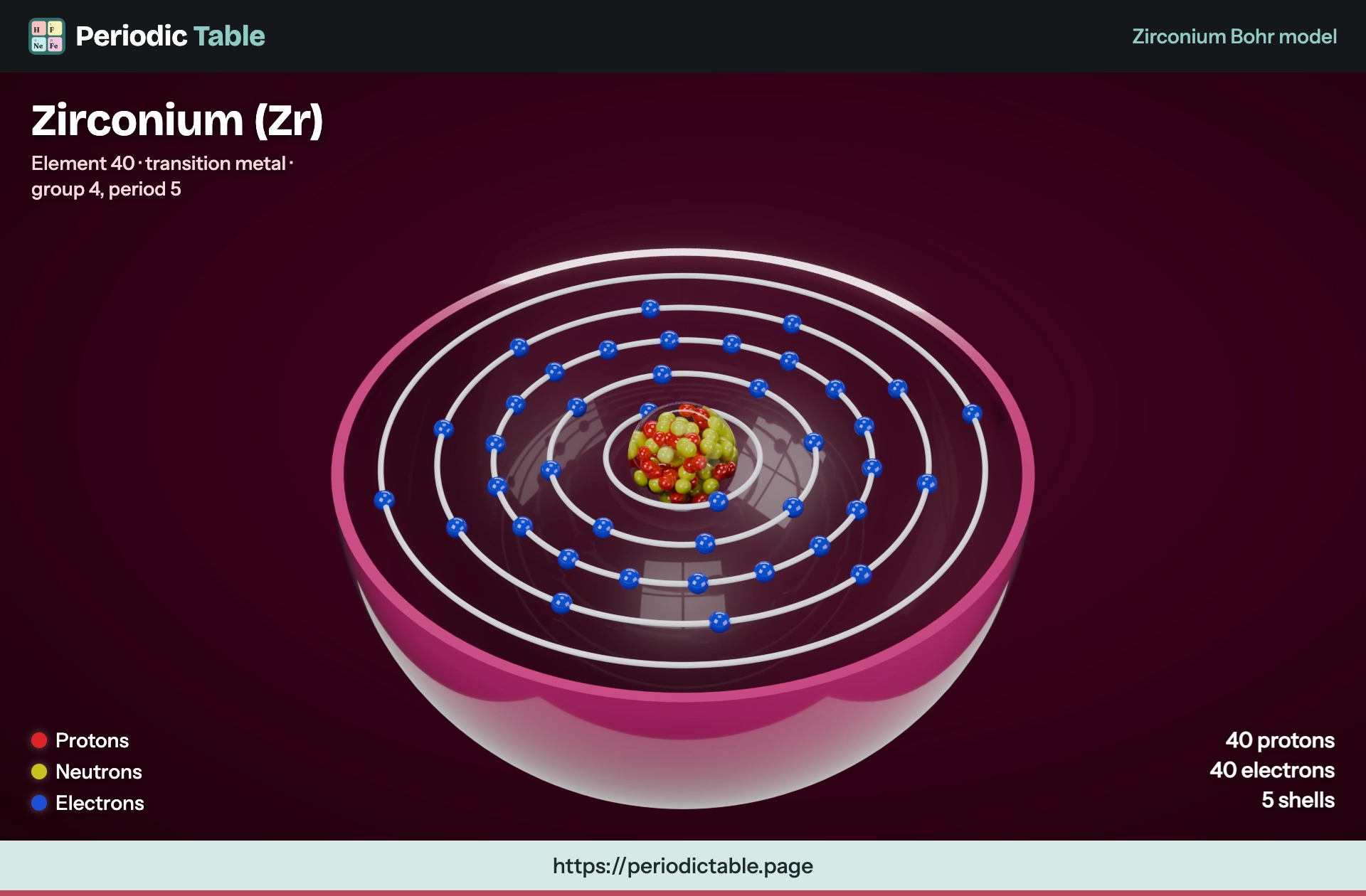
Rotate the 3D Bohr model of zirconium
Drag to orbit, scroll to zoom.
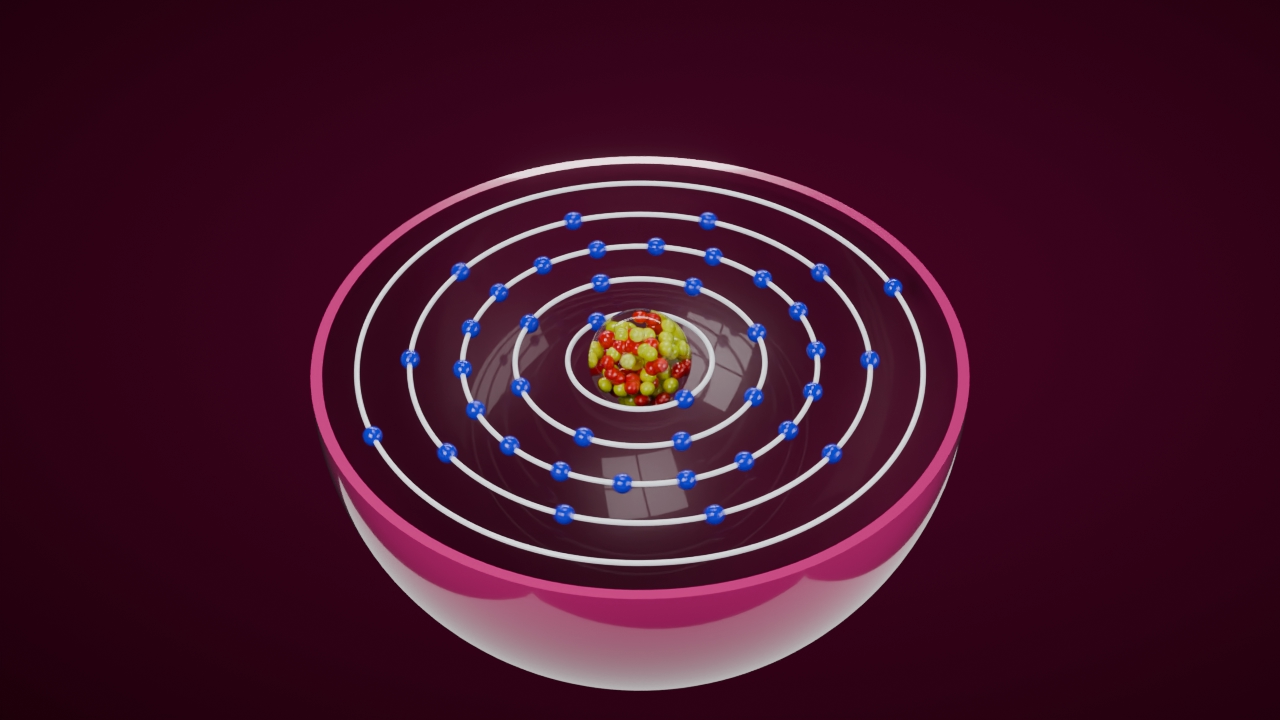
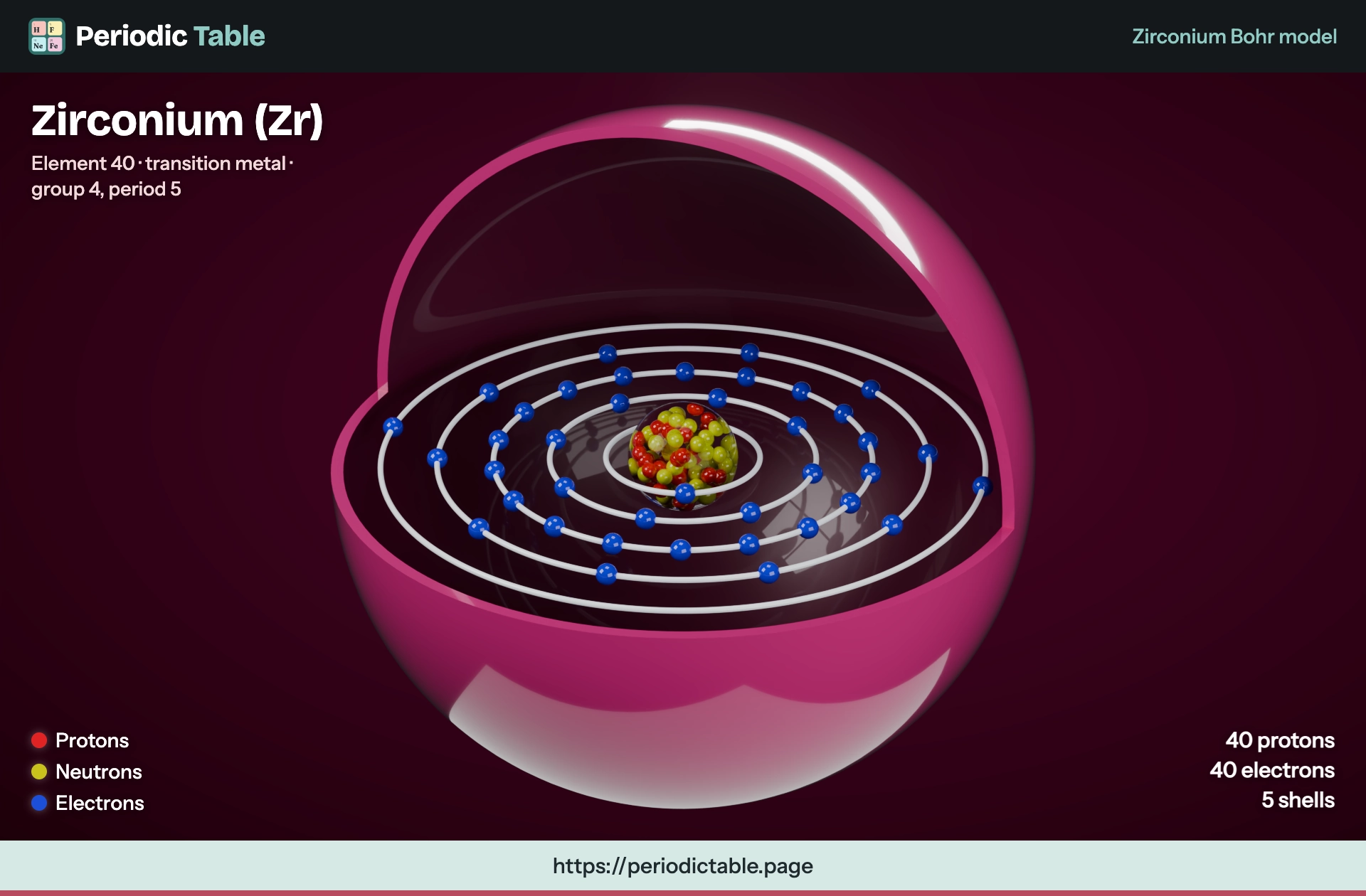
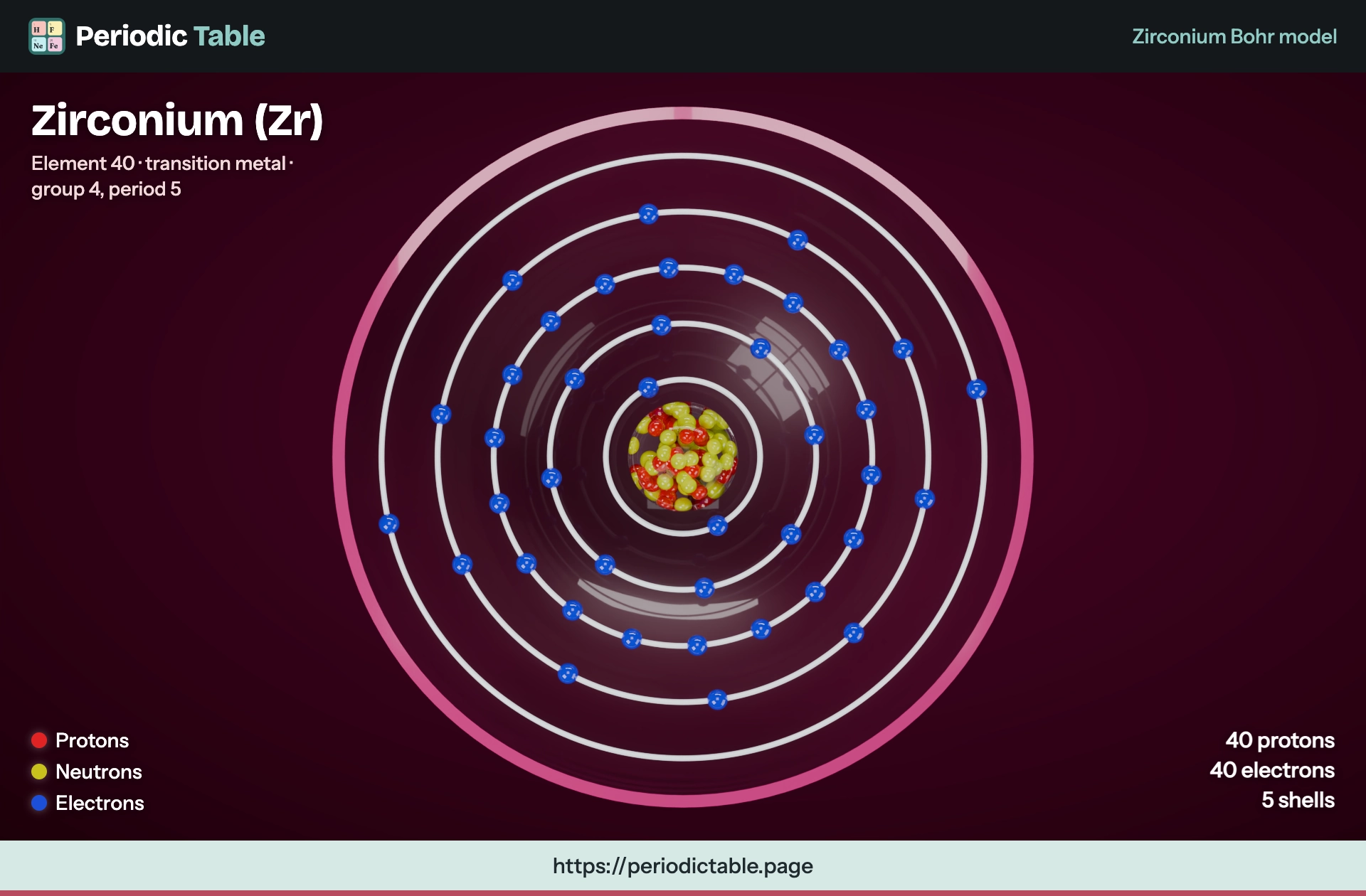
This is a Bohr model of zirconium (Zr), a simplified picture of a single zirconium atom. Its nucleus holds 40 protons, and a neutral zirconium atom has 40 electrons, arranged around it in 5 shells (2 in shell K, 8 in shell L, 18 in shell M, 10 in shell N and 2 in shell O).
Zirconium periodic table electron configuration
- Shorthand
- [Kr] 4d2 5s2
- Full
- 1s2 2s2 2p6 3s2 3p6 4s2 3d10 4p6 5s2 4d2
- Electrons per shell
- 2, 8, 18, 10, 2
Zirconium element properties and atomic data
- Atomic number
- 40
- Atomic mass
- 91.2242 u
- Phase at STP
- Solid
- Melting point
- 1854.85°C (2128 K)
- Boiling point
- 4376.85°C (4650 K)
- Density
- 6.52 g/cm³
- Electronegativity (Pauling)
- 1.33
- Period
- 5
- Group
- 4
- Block
- d-block
- Appearance
- Silvery white
- Discovery date
- 1789
- Discovered by
- Martin Heinrich Klaproth
- Named by
- —
Element zirconium at a glance: Zr and atomic number 40
Zirconium is a chemical element with the symbol Zr. On the periodic table it sits in group 4 and period 5 of the d-block, directly below titanium and above hafnium. The table below collects the core numbers you will need most often. Readers curious about hard, durable and inert behaviour will find it under rhodium (Rh), plus aqua regia notes.
| Property | Value |
|---|---|
| Symbol | Zr |
| Atomic number | 40 |
| Atomic weight | 91.224 |
| Group / period / block | Group 4, period 5, d-block |
| Melting point | 1855 °C (2128 K) |
| Boiling point | 4409 °C (4682 K) |
| Density | 6.52 g/cm³ at 20 °C |
| State at room temperature | Solid, silvery metal |
| CAS number | 7440-67-7 |
| Neighbours | Yttrium (39), niobium (41) |
Two things in that table are worth reading twice. Zirconium melts at a far higher temperature than iron or nickel, and at about 6.5 g/cm³ it is lighter than both.
Physical properties of zirconium metal
Freshly polished zirconium metal is bright and silvery, with a faint grey cast. It is soft and workable when very pure, but small amounts of oxygen, nitrogen or carbon make it hard and brittle. Recycling, electrolysis and mining of ore are summarised in the transition metal gold, with notes on toxicity of cyanide.
Crystal structure: hexagonal close-packed to body-centered cubic
At room temperature the atoms stack in a hexagonal close-packed arrangement called α-Zr. Heat it past 863 °C and the crystal structure rearranges into a body-centered cubic lattice, β-Zr, which then holds all the way to melting. That phase change matters to metallurgists, because rolling and forging behave very differently on either side of it.
Melting point, density and heat handling
Beyond the headline figures in the fact table, Zr has a specific heat capacity of about 278 J/(kg·K) and a thermal conductivity near 22.6 W/(m·K), about a tenth of aluminium's. Low conductivity plus extreme heat tolerance is exactly why zirconium ceramics shield parts at high temperatures. One quirk to remember: its thermal expansion is uneven, so a single crystal grows more along one axis than the other when warmed.
Transition metal chemistry: oxidation state and corrosion resistance
As a transition metal, zirconium has the electron configuration [Kr] 4d² 5s², and it gives up all four outer electrons readily. That is why +4 is by far its most common oxidation state; lower states (+3, +2, even 0 and −2) appear only in specialised compounds. Its electronegativity is 1.33 on the Pauling scale, among the lowest in its block.
- First three ionization energies: 640.1, 1270 and 2218 kJ/mol
- Electron affinity: about 41.8 kJ/mol
- Empirical atomic radius: 160 pm; covalent radius: 175 pm
The real story is corrosion resistance. The moment the surface meets air, it grows a thin, tightly bonded oxide film that seals the zirconium underneath and heals itself if scratched. That makes bulk zirconium corrosion-resistant to salt water, most acids and alkalis.
Hydrofluoric acid is the notable exception, and hot concentrated sulfuric or hydrochloric acid will attack it slowly. Few metals give chemistry plant designers this much confidence.
Isotopes of Zr: four stable and one nearly stable
Natural zirconium is a blend of five isotopes. Four never decay, and the fifth, 96Zr, decays by double beta emission so slowly that you can treat it as stable for any practical purpose.
| Isotope | Natural abundance | Half-life |
|---|---|---|
| 90Zr | 51.45% | Stable |
| 91Zr | 11.22% | Stable |
| 92Zr | 17.15% | Stable |
| 94Zr | 17.38% | Stable (double beta decay theoretically possible) |
| 96Zr | 2.80% | About 2.3 × 10¹⁹ years |
Among artificial isotopes, 93Zr is the one you will read about most. It is a long-lived fission product with a half-life of about 1.6 million years, created in reactors and in mid-century weapons tests, though its weak radiation keeps it a low-priority hazard.
Zirconium compounds and their chemistry
Almost every zirconium compound holds the element in the +4 state, and most are colourless, non-magnetic solids.
Zirconium dioxide and cubic zirconia
Zirconium dioxide, ZrO2, better known as zirconia, is the most important compound by far. It is unusually tough for a ceramic, which is why it shows up in ceramic knives, abrasives, lab crucibles and the thermal barrier coating on hot engine parts.
Stabilised in its cubic form, it becomes cubic zirconia, the classic diamond substitute: cut gemstones of it sparkle convincingly but weigh about 1.6 times as much as a diamond of the same size, which is how jewellers tell them apart. Zirconium carbide and zirconium nitride are refractory, wear-proof solids used on cutting tools and high-temperature coatings.
Halides, hydrides and organic derivatives
Zirconium tetrachloride, ZrCl4, is the workhorse intermediate: it feeds both metal refining and organic chemistry. From it chemists build zirconocene dichloride, the parent of the organozirconium compounds used in Ziegler–Natta catalysts that turn propylene into polypropylene. Two other compounds are scientific oddities:
- Zirconium tungstate contracts in every direction when heated, the opposite of nearly every other solid.
- Zirconium hydride forms when reactor tubing soaks up hydrogen over time and makes it brittle, a problem reactor engineers spent years designing out.
- Lead zirconate titanate (PZT) is the most widely used piezoelectric material, turning pressure into voltage in ultrasound probes, sensors and actuators.
Zirconium geology: zircon, baddeleyite and heavy mineral sands
Zirconium makes up about 130 parts per million of the earth's crust, more than copper or lead, yet it never occurs as a free metal. It crystallises from cooling magma, so it is found in igneous and metamorphic rocks, usually alongside hafnium and titanium. More than 140 minerals contain it, but three carry almost all the commercial interest:
| Mineral | Formula | Zr by mass (calculated) |
|---|---|---|
| Zircon | ZrSiO4 | 49.8% |
| Baddeleyite | ZrO2 | 74.0% |
| Eudialyte | Complex Na–Ca–Zr silicate | Under 10% |
Zircon grains shrug off weathering, so they erode out of their host rock and collect with ilmenite, rutile and other heavy minerals in beach and dune placer deposits. Because zircon traps uranium as it forms but rejects lead, it is also the favourite clock of geochronology: Australian grains about 4.4 billion years old are among the oldest pieces of Earth ever dated.
Zirconium beyond Earth
Beyond our planet, the element is plentiful in S-type stars, appears in meteorites, and turned up in surprisingly high amounts in Apollo moon rock.
History of Zr: from jargoon to the Kroll process
Zircon gems were known in ancient times under names like jargoon, hyacinth and jacinth. The name traces to the Persian word zargun, meaning gold-like, after the stone's golden tints. In 1789 the German chemist Martin Heinrich Klaproth analysed one of these stones from Ceylon (now Sri Lanka) and recognised an unknown earth in it, which he called zirconia.
- 1808 — Humphry Davy tries to isolate the metal by electrolysis and fails.
- 1824 — Jöns Jacob Berzelius heats potassium with potassium zirconium fluoride and gets impure zirconium.
- 1925 — Anton Eduard van Arkel and Jan Hendrik de Boer invent the crystal bar process, decomposing ZrI4 on a hot filament to produce pure zirconium.
- 1945 — William Kroll's cheaper method replaces it and makes tonnage production possible.
The Kroll process, still used today, reduces the tetrachloride with molten magnesium:
$$\mathrm{ZrCl_4} + 2\,\mathrm{Mg} \rightarrow \mathrm{Zr} + 2\,\mathrm{MgCl_2}$$
The magnesium chloride is drained off and recycled, leaving a porous zirconium "sponge" that is melted into ingots.
Zirconium production and hafnium separation
Almost all zirconium output starts as a by-product of mining titanium minerals from beach sands. Dredged sand is spun through spiral concentrators, ilmenite and rutile are pulled out magnetically, and the zircon left behind is sold as is or chlorinated for metal. Only a small fraction of mined zircon ever becomes metal, which explains why refined zirconium costs dozens of times more than the mineral.
The hard step is hafnium. Ordinary commercial zirconium carries 1–3% of its twin, harmless for chemical plants but unacceptable in a reactor, because hafnium captures neutrons about 600 times more readily.
Producers separate the two by solvent extraction (methyl isobutyl ketone or tributyl phosphate), by fractional crystallisation of fluoride salts, or by extractive distillation of the chlorides. The separated twin is not wasted: it goes into reactor control rods, doing the opposite job.
Uses of zirconium from reactors to implants
Most mined zircon is used directly as a mineral, and only a sliver is turned into metal, but that sliver does some of the most demanding work in engineering.
Nuclear reactors: fuel rods, cladding and zircaloys
Uranium oxide pellets in water-cooled reactors are sealed inside tubes of zircaloys, alloys of zirconium with small amounts of tin, iron, chromium or niobium. Two properties earn it the job: low neutron absorption (a tiny neutron-capture cross-section, so the chain reaction is not starved) and steady corrosion behaviour in hot water.
A single reactor can hold more than 100 km of this cladding. The weakness shows at extreme heat: above about 900 °C zirconium reacts with steam to release hydrogen, which is what exploded at Fukushima in 2011 after the fuel rods lost cooling.
Aerospace, jet engines and space vehicles
In flight hardware, a zirconium ceramic mixed with yttria forms thin ceramic shields on the blades, vanes and combustors of jet engines and gas turbines. The metal itself is used in hydrogen peroxide tanks, valves and thrusters on space vehicles, because it neither corrodes in peroxide nor triggers its decomposition.
Medical uses: dental implants and hip replacements
White zirconium ceramics combine strength, tooth-like colour and low tissue reactivity, which has made them a leading material for crowns, bridges and dental implants, and oxidised-surface Zr alloys are used in knee and hip replacements and some surgical instruments. Its compounds also bind small ions: zirconium phosphate sorbents regenerate fluid in some dialysis systems, sodium zirconium cyclosilicate treats hyperkalemia by trapping potassium in the gut, and aluminium zirconium salts are the active ingredient in many an antiperspirant or deodorant.
Ceramics, refractory linings and opacifier glazes
By tonnage, zircon's biggest market is ceramics: it is the standard opacifier that makes tiles and sanitaryware glazes white and opaque. Its refractory nature suits furnace bricks, ladle linings and casting moulds for molten metal. Smaller niches include sparks in fireworks, getters that scavenge stray gas in vacuum tubes, the burning foil in old photographic flashbulbs, and scratch-resistant black jewelry and watch cases.
Zirconium in industry: alloys, supply and critical mineral status
Outside reactors, zirconium alloys line heat exchangers, pumps, valves and pipework in acid plants, where they outlast stainless steel by years. Global mine output runs to well over a million tonnes of zircon concentrate a year, and production is concentrated: Australia and South Africa together supply around half, so a disruption in either moves prices worldwide. Recycling of zirconium is under 10%, which is why the United States lists the element as a critical mineral for its defence, energy and aerospace supply chains.
Zirconium powder hazards, biological role and exposure limits
Solid zirconium is safe to handle, but zirconium powder is highly flammable and can ignite spontaneously in air, so fine dust from machining is kept wet and never swept dry. The element has no known biological role, though your body holds around 250 mg of it, picked up from grains, eggs and water.
- OSHA permissible exposure limit: 5 mg/m³ averaged over an 8-hour shift
- NIOSH short-term limit: 10 mg/m³
- Immediately dangerous to life and health: 25 mg/m³
Dust can irritate eyes and lungs, but there is no evidence that it is a carcinogen, and most compounds show low toxicity, which is part of why zirconium ceramics are trusted inside the mouth and the body.