Gold element (Au): gold periodic table facts
Gold periodic table facts: gold (Au) is element 79, a transition metal in group 11, period 6. Few substances have shaped human civilization the way gold has. Where mining and minerals yield this metal as a by-product is described in element 83, bismuth, plus history and etymology.
Chemically, gold is a dense, soft, malleable transition metal with the symbol Au and 79 protons in every nucleus, sitting in the middle of the periodic table. Read on and you'll get every key property, isotope and use of gold as a chemical element, from its atomic data to why gold ends up in jewelry, phones and spacecraft.
Rotate the 3D Bohr model of gold
Drag to orbit, scroll to zoom.
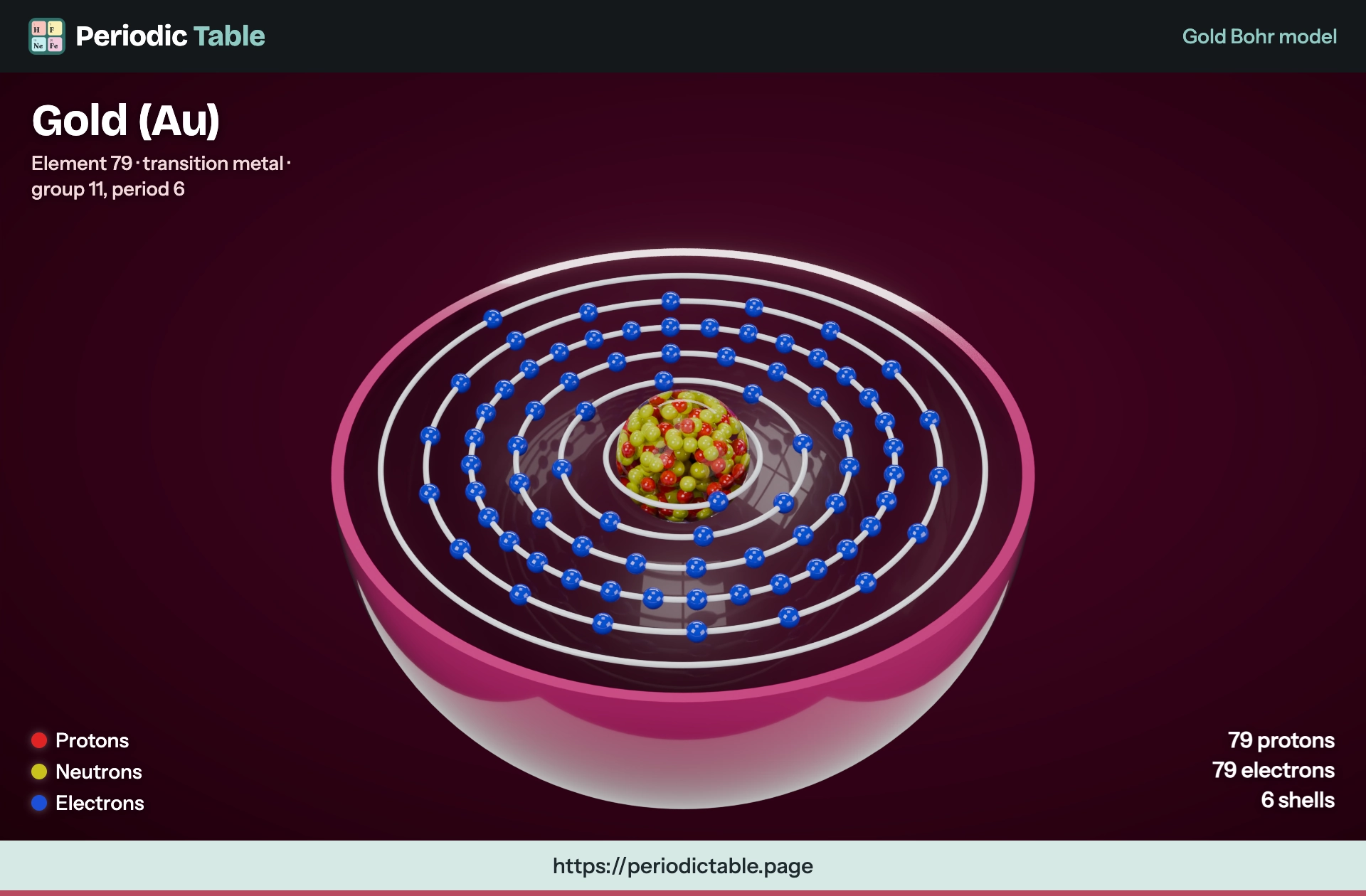
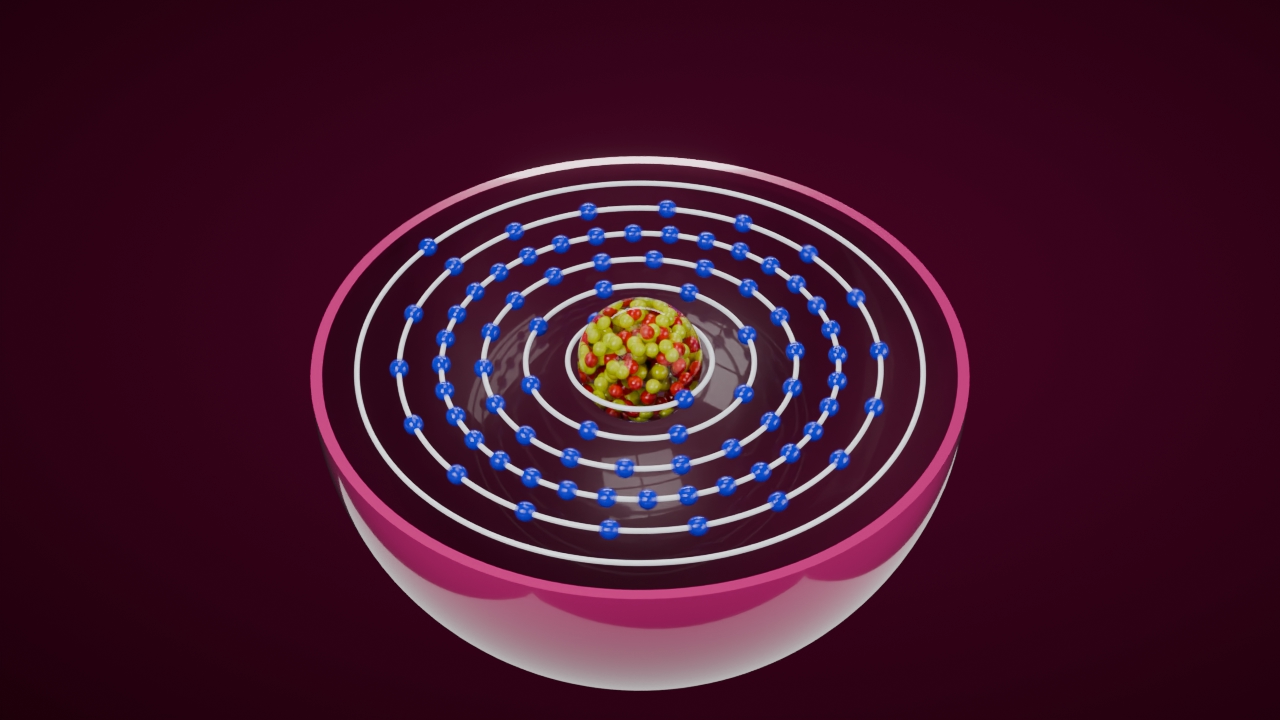
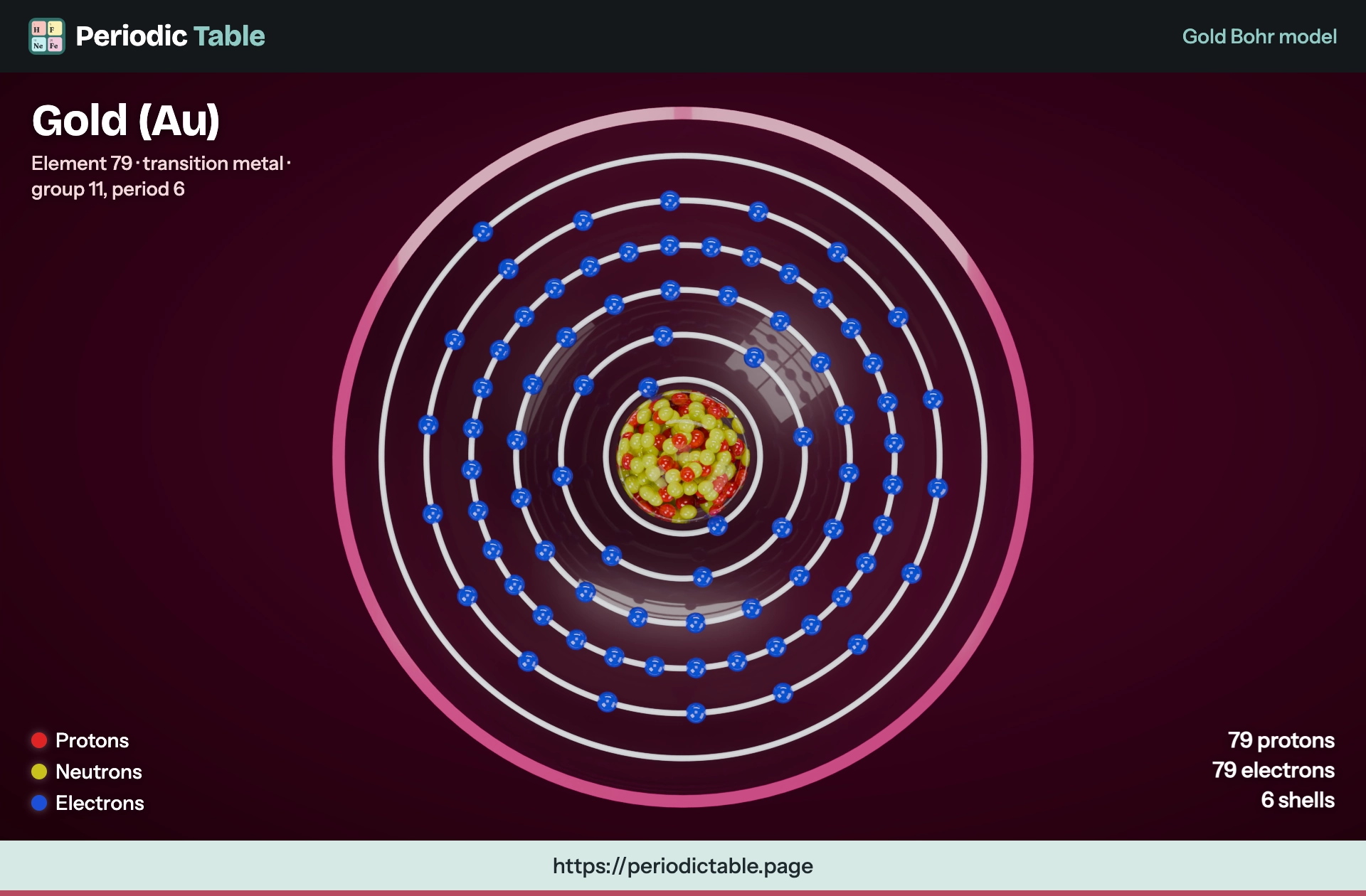
This is a Bohr model of gold (Au), a simplified picture of a single gold atom. Its nucleus holds 79 protons, and a neutral gold atom has 79 electrons, arranged around it in 6 shells (2 in shell K, 8 in shell L, 18 in shell M, 32 in shell N, 18 in shell O and 1 in shell P).
Gold periodic table electron configuration
- Shorthand
- [Xe] 4f14 5d10 6s1
- Full
- 1s2 2s2 2p6 3s2 3p6 4s2 3d10 4p6 5s2 4d10 5p6 6s1 4f14 5d10
- Electrons per shell
- 2, 8, 18, 32, 18, 1
Gold element properties and atomic data
- Atomic number
- 79
- Atomic mass
- 196.9666 u
- Phase at STP
- Solid
- Melting point
- 1064.18°C (1337.33 K)
- Boiling point
- 2969.85°C (3243 K)
- Density
- 19.3 g/cm³
- Electronegativity (Pauling)
- 2.54
- Period
- 6
- Group
- 11
- Block
- d-block
- Appearance
- Metallic yellow
- Discovery date
- Ancient
- Discovered by
- Middle East
- Named by
- —
Gold at a glance: atomic number, atomic mass and group 11
Before getting into behaviour, it helps to pin down the identity card. Every gold atom carries 79 protons, and gold's single naturally occurring nucleus sets the standard figure chemists quote for its mass. The values below are the reference numbers you'll see in data books and on any well-built element tile. In ceramics and jewelry, cubic zirconia, zirconium dioxide and refractory uses all sit on the zirconium geology page together with their properties.
| Property | Value |
|---|---|
| Symbol | Au |
| Atomic number | 79 |
| Atomic mass (standard atomic weight) | 196.966570 u |
| Group / period / block | Group 11, period 6, d-block |
| Electron configuration | [Xe] 4f14 5d10 6s1 |
| State at 20 °C | Solid |
| Melting point | 1,064.18 °C (1,337.33 K) |
| Boiling point | 2,970 °C (3,243 K) |
| Density | 19.3 g/cm3 at 20 °C |
| Key isotope | 197Au, 100% natural abundance |
| CAS number | 7440-57-5 |
Its atomic weight is known to six decimal places because there is only one stable nucleus to measure, so no isotope mixture blurs the figure. Data tables published by different bodies disagree slightly on the boiling figure (values from about 2,836 °C to 2,970 °C appear), which reflects older measurements rather than any real doubt about the value.
Period 6, the D-block and gold's electron configuration
Gold shares its column with copper and silver above it, the old "coinage metals" trio, with synthetic roentgenium below. Its neighbours across the row are platinum on the left and mercury on the right.
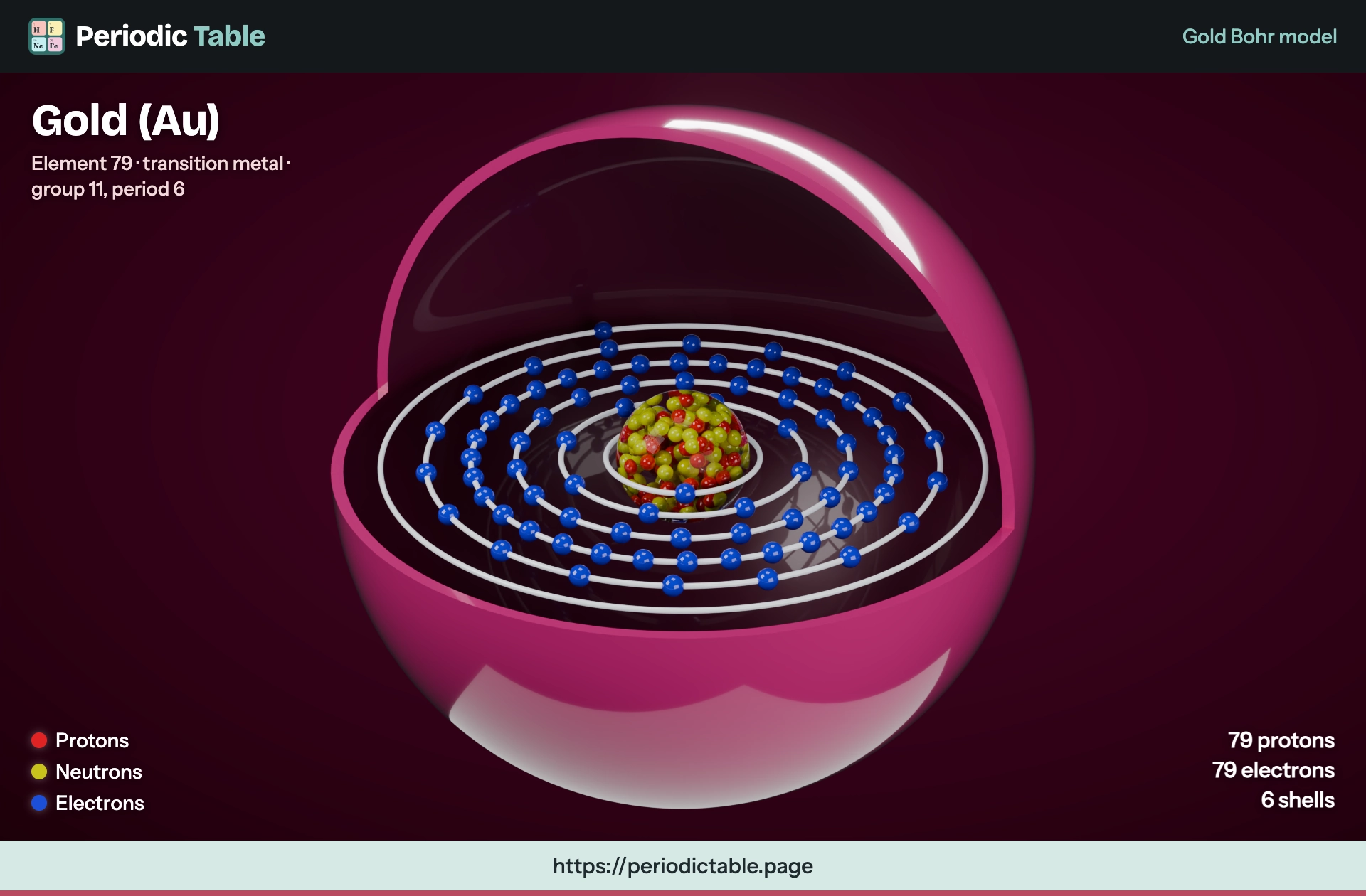
The outer arrangement ends in a full 5d shell plus one 6s electron, the same pattern its lighter group-mates show. That lone s-electron is held unusually tightly, which is the root of gold's stubborn chemistry and its colour, both covered below.
Electronegativity, electron affinity and ionization energies
The atomic-level numbers explain why gold behaves almost like a halogen in some compounds:
- Electronegativity
- 2.54 on the Pauling scale, the highest of any metal and close to carbon and selenium.
- Electron affinity
- About 222.8 kJ/mol, again the largest of any metal, which is why the Au− anion can exist.
- First and second ionization energies
- 890.1 kJ/mol and 1,980 kJ/mol.
- Radii
- Atomic radius 144 pm (empirical), covalent radius 136 pm, van der Waals radius 166 pm.
Physical properties of gold metal
The physical properties of bulk gold read like a wish list for engineers: soft enough to shape by hand, unchanged after centuries, and an excellent conductor of heat and current. Atoms pack in a face-centered cubic lattice, a crystal structure with many slip planes, which is why gold deforms instead of cracking. Readers interested in the 1944 discovery at the Metallurgical Laboratory and the Quiz Kids radio broadcast will find the americium element entry useful for background.
| Physical property | Value |
|---|---|
| Crystal structure | Face-centered cubic, a = 407.86 pm |
| Specific heat capacity | 129 J/(kg·K) |
| Thermal conductivity | 318 W/(m·K) |
| Electrical resistivity | 22.14 nΩ·m at 20 °C |
| Mohs hardness | 2.5 |
| Young's modulus | 79 GPa |
| Shear modulus | 27 GPa |
| Bulk modulus | 180 GPa |
| Magnetic ordering | Diamagnetic |
Why gold is so malleable and ductile
No element beats gold for malleability or ductility. Because its cubic lattice lets planes of atoms glide past each other without hardening, a craftsman can hammer gold into gold foil only a few hundred atoms thick, thin enough that light passing through looks greenish-blue. Gold can also be drawn into wire finer than a human hair and, at the nanoscale, stretched down to a chain one atom wide.
Put a number on it: a single troy ounce of gold, about 31.1 g, would form a cube just 1.17 cm along each edge, yet beaten out it covers a floor-sized sheet. Unalloyed gold is soft enough to dent with a fingernail, which is why everyday objects are almost always alloyed.
Density, melting point and boiling point
At 19.3 grams per cubic centimetre, gold is about 70% heavier than lead (11.34) and almost exactly as heavy as tungsten (19.25), while silver (10.49) is barely half as heavy and platinum (21.45) is heavier still. That near-match is why counterfeiters have gold-plated tungsten bars, and why assayers check more than weight alone. Panning works for the same reason: shake gravel in water and the yellow grains sink first.
Gold melts at a modest 1,064 °C, easy to reach in a simple furnace, but needs roughly 2,970 °C before it boils, so it survives casting with very little loss to vapour. Its vapour pressure stays below one pascal until well past 1,600 K.

The relativistic reason gold looks yellow
Most metals are grey or silvery white, so the warm colour needs explaining. Electrons near a nucleus of 79 protons move at a sizeable fraction of the speed of light, and that relativistic effect contracts the 6s orbital and narrows the gap between the 5d and 6s levels.
Gold then absorbs blue light and reflects red and yellow, giving its familiar hue. Alloying shifts the colour on purpose:
- Rose gold adds copper for a pink-red tone.
- White gold adds palladium or nickel to bleach the yellow.
- Green gold adds silver alone, giving a greenish-yellow.
- Colloidal gold, a suspension of tiny particles, looks ruby red when the particles are small and blue as they grow.
Chemical properties: how a noble metal resists corrosion
Gold is the most reluctant reactor among the noble metal family, second only to platinum at the bottom of the reactivity series. Gold does not tarnish in air, does not react with oxygen at any temperature, and shrugs off ozone below 100 °C.
That resistance to corrosion is why ancient artefacts come out of the ground still shining. Being inert doesn't mean gold has no chemistry, though; it simply takes aggressive reagents to start it.
Aqua regia and the few acids that dissolve gold
Single strong acids leave gold untouched, including hydrofluoric, sulfuric and nitric acid. That is the origin of the "acid test": the oxidising acid dissolves base metals and silver but not real gold.
Mix one part nitric acid with three parts hydrochloric acid, however, and you get aqua regia ("royal water"). The oxidising acid converts a trace of gold to Au(III) and chloride ions immediately capture it as tetrachloroaurate, pulling the equilibrium forward:
$$\text{Au} + 4\,\text{HCl} + \text{HNO}_3 \rightarrow \text{HAuCl}_4 + \text{NO} + 2\,\text{H}_2\text{O}$$
The product, chloroauric acid, is the starting point for gold chloride chemistry; heating powdered gold in chlorine near 180 °C gives gold(III) chloride, Au2Cl6. Two other routes also dissolve gold: alkaline cyanide solutions with oxygen present, and mercury, which forms an amalgam at room temperature without any true reaction.
Oxidation states of gold compounds
Oxidation numbers from −1 to +5 are known, but +1 and +3 dominate. In coordination chemistry the +1 state, Au(I), called aurous, prefers soft partners such as sulfur and phosphorus ligands and forms linear molecules, including the dicyanoaurate ion that carries gold in mining solutions. The +3 state, called auric, forms square-planar complexes.
Rarer cases include the −1 oxidation state in caesium auride (CsAu), +2 in gold(II) sulfate, and +5 in AuF5. In many cluster compounds each gold atom is drawn toward its neighbours by aurophilic bonding, an attraction roughly as strong as a hydrogen bond.
Isotopes of Au: one stable isotope and 36 radioisotopes
Natural gold contains just one nucleus, Au-197, which makes gold both mononuclidic and monoisotopic. Every other known isotope is man-made and radioactive, with masses running from 169 to 205, plus more than 30 nuclear isomers. Lighter isotopes tend to decay by positron emission or electron capture; heavier ones decay by beta-minus emission toward mercury.
| Isotope | Abundance | Half-life | Decay mode |
|---|---|---|---|
| Au-195 | Synthetic | 186.0 days | Electron capture to platinum-195 |
| Au-196 | Synthetic | 6.17 days | Mostly EC, some β− |
| Au-197 | 100% | Stable | None |
| Au-198 | Synthetic | 2.69 days | β− to Hg-198 |
| Au-199 | Synthetic | 3.14 days | β− to Hg-199 |
Half-life of gold-198 and making gold in a reactor
Gold-198, which loses half its activity every 2.7 days, is the workhorse radioisotope for nuclear medicine and some cancer treatment, since it decays fast enough to deliver its dose and then fade. Turning base material into gold, the dream of the alchemists and their philosopher's stone, finally happened in the twentieth century: Hantaro Nagaoka made gold from mercury by neutron bombardment in 1924, and Glenn Seaborg converted bismuth atoms in 1980. A nuclear reactor can make gold too, but the product is radioactive and costs far more than mined gold.
Where gold comes from: neutron stars and supernovae
Every atom of gold was forged far from Earth. Nuclei heavier than iron need the r-process, a rapid capture of neutrons that only the most violent events supply. For decades a supernova explosion was the favoured source.
In 2017 telescopes watching the merger event GW170817 saw the signature of fresh heavy elements, confirming neutron star collisions as a major factory; that single merger is estimated to have made several Earth masses of gold. Because such mergers are rare and arrived late in galactic history, researchers in 2025 added giant flares from magnetars, highly magnetic neutron star remnants, as a further source that helps explain gold in very old stars.
Gold was already present in the dust that formed the Solar System, but most of Earth's original gold sank into the molten core, so the reachable share in the crust was probably delivered later by asteroid impacts or carried up from the mantle. The universe, in other words, makes gold slowly and in violent bursts.
Native gold in the Earth's crust and seawater
Average concentration in the Earth's crust is only about 0.0013 to 0.004 parts per million, yet gold is easy to find because it usually occurs uncombined. Native gold turns up in three main settings:
- Lode deposits: veins of quartz where tiny grains sit beside sulfide minerals such as pyrite, the brassy "fool's gold" that fooled many prospectors.
- Alluvial deposits and placer deposits: flakes, grains and nuggets eroded from veins and concentrated by rivers, where their weight makes them settle out of moving water.
- Minerals and natural alloys: compounds with tellurium such as calaverite and sylvanite, and electrum, a natural alloy with more than 20% silver.
Truly pure elemental gold is rare in nature; most natural gold carries 8-10% silver. Seawater holds gold too, at roughly 10-30 parts per quadrillion, which adds up to an estimated 15,000 tonnes across the oceans. Many people have tried to recover that gold, from 1890s swindlers to Fritz Haber after World War I, and every attempt has failed because the concentration is far too low to pay.
Gold mining, refining and supply
Modern gold mining digs huge volumes of rock for small returns. A gold ore can be worth working at ore grades as low as 0.5 parts per million; typical open-pit mines run 1-5 ppm, and grains usually aren't visible until around 30 ppm.
South Africa's Witwatersrand basin has supplied about a fifth of all gold ever recovered and hosts mines nearly 4 km deep, while China now leads annual output, followed by Russia and Australia. Analysts rate gold's relative supply risk at 5.7 out of 10, and above-ground stocks pass 200,000 tonnes, enough for a cube a little over 21 metres on each side.
Refining methods: electrolysis, Wohlwill and miller
Raw doré from a gold mine still holds base metals that must come out. The Miller process bubbles chlorine through molten gold and yields about 99.5% purity quickly and cheaply.
The Wohlwill process uses electrolysis in a chloroauric acid bath to reach 99.99% or better, at higher cost and on a smaller scale. Older assay methods, cupellation and parting with acid, are still used to test small samples.
Cyanide, pollution and recycling
Most low-grade rock is ground and leached with sodium cyanide, which dissolves gold as a soluble complex. The method is efficient but dangerous: cyanide spills have killed aquatic life along long stretches of river, waste dumps can generate acid mine drainage, and small-scale gold miners who still use mercury add heavily to global pollution.
Recycling is the cleaner path. Around 30% of annual supply now comes from scrap, and recovering a kilogram of gold from old jewelry or circuit scrap emits a tiny fraction of the carbon dioxide that mining it does.
A history of gold from the Egyptians to the gold rush
Gold was probably the first metal people worked, because gold lies about in rivers already pure and bright. Small amounts appear in Palaeolithic caves, and the oldest finished gold artefacts, from the Varna necropolis in Bulgaria, date to the fifth millennium BCE. The Egyptians mastered smelting, alloying and, by about 1200 BCE, lost-wax casting; Tutankhamun's inner coffin alone holds over 100 kg of gold.
The first gold coins appeared in Lydia around 600 BCE. Later, reports of the gold ornaments worn by the Aztecs and Inca drove Spain's conquest of the Americas, and the search for alchemy's secret pushed early chemists to study metals systematically, laying groundwork for modern chemistry.
The nineteenth century brought the gold rush era, as finds in California, Australia, the Klondike and Witwatersrand drew hundreds of thousands of prospectors and founded cities such as Johannesburg. Through all of it goldsmiths kept improving their craft, and gold remained shorthand for wealth and power.
Aurum and the etymology of the symbol Au
The English word gold comes from Anglo-Saxon and older Germanic forms tied to a Proto-Indo-European root meaning "to shine" or "yellow." The symbol comes from the Latin aurum, whose root meant "glow" and is shared with aurora, the dawn, which is why many sources translate it, a little loosely, as "shining dawn."
The gold standard and gold as money
Scarce, durable and easy to divide, gold has served as money for some 2,600 years. Through the nineteenth century most industrial economies ran on the gold standard, backing paper notes with gold held in reserve. The system broke down in stages: wartime suspensions, the post-war Bretton Woods arrangement of fixed exchange rates, and finally the United States ending dollar convertibility in 1971, leaving fiat currency in its place.
Switzerland cut its last link in 1999. Even so, central banks still hold large gold reserves, and individuals buy gold bars and bullion coins as a store of value and a hedge against inflation, though research suggests that hedge holds over centuries more than over a few years.
Gold's ISO currency code is XAU. As a precious metal, gold is now one investment among many rather than the anchor of the monetary system, and some rarer precious metals regularly trade higher per ounce.
Measuring fine gold: karat, fineness and the troy ounce
Purity is quoted in two ways. The karat scale counts parts out of 24, so pure gold is 24 karat; millesimal fineness gives parts per thousand, so the same gold is 999 or 999.9.
Commercially, the purest grade is called fine gold, and gold prices are quoted per ounce of 31.1035 g on the troy scale. To see how the scales relate, take a 4.2 g 14k gold ring: 14 ÷ 24 of it, or 2.45 g, is gold and the other 1.75 g is alloy.
$$\text{fine weight (g)} = \text{item weight} \times \frac{k}{24} = 4.2 \times \frac{14}{24} = 2.45\ \text{g}$$
| Mark | Purity | Fineness | Gold in a 4.2 g ring |
|---|---|---|---|
| 24k | 100% | 999 | 4.20 g |
| 22k | 91.7% | 916 | 3.85 g |
| 18k | 75.0% | 750 | 3.15 g |
| 14k | 58.3% | 585 | 2.45 g |
| 10k | 41.7% | 417 | 1.75 g |
Here \(k\) is the number of parts out of 24. That 14k ring holds 0.079 troy ounces of gold, the figure a refiner pays on.

Uses of gold in jewelry, electronics and industry
New gold supply splits roughly 50% into jewelry, 40% into investment and 10% into industry. The industrial slice of gold demand is small by weight but hard to replace.

Gold alloys in jewelry
Unalloyed gold scratches and bends too easily for daily wear, so jewellers use gold alloys of 22k, 18k, 14k or 10k, adding copper, zinc or palladium for hardness and colour. Gold jewelry also has to match its hallmark, so craftspeople join gold parts with gold solders sold in easy, medium and hard grades, working from the highest melting solder down so earlier joints don't reopen.
Electrical conductivity in connectors and spacecraft
Only silver and copper conduct better, but both tarnish. Combining high electrical conductivity with zero corrosion makes gold the standard thin plating on electrical connectors, switch contacts and circuit boards, and fine wires join chips to their packages by wire bonding. Thin gold coatings are laid down by electroplating.
In electronics where failure is costly, from phones to jet engines, the tiny amount of gold used pays for itself many times over. A thin gold film reflects infrared radiation so well that it shields satellites, the visors of astronauts' helmets and the mirrors of the James Webb Space Telescope, and it de-ices some cockpit windows when electricity passes through it.
Medicine, dentistry and edible gold leaf
Two gold compounds are approved drugs, sodium aurothiomalate and auranofin, both used against rheumatoid arthritis for their anti-inflammatory effect. In dentistry, gold alloys make long-lasting crowns and bridges because they are tough, biocompatible and slightly soft. Gold nanoparticles label proteins in electron microscopy and are being studied for targeted drug delivery and imaging.
Gold in food: E175
Gold leaf, flake and dust are approved as a food additive under the code E175. A gold flake on a dessert adds no taste or nutrition and passes through the body unchanged.
Is metallic gold toxic?
In bulk form gold is non-toxic and non-irritating, which is why gold can be eaten as leaf and sit in a tooth for decades; stomach acid cannot touch it. The picture changes for its soluble salts. Gold chloride solutions damage the liver and kidneys, and potassium gold cyanide, used in plating, is dangerous on two counts at once.
Contact allergen reactions also occur: the American Contact Dermatitis Society named gold allergen of the year in 2001, though it sensitises far fewer people than nickel. As with other noble metals, the risk depends on chemical form; toxicity comes from dissolved gold ions, not from the shiny solid.