


Americium element (Am): americium periodic table facts
Americium periodic table facts: americium (Am) is element 95, an actinide in period 7 of the f-block. If you have an ionization smoke alarm on your ceiling, you already own a speck of americium, a transuranic element that never existed on Earth in useful amounts until a wartime laboratory made it in 1944. This guide walks you through what this radioactive metal is, where americium sits among the other actinides, how each isotope behaves, and why its radioactivity makes it useful in smoke detectors, industrial gauges and long-life power sources for missions beyond Mars. Students interested in electronics and industry will find element 83, bismuth lists electrical resistivity and sources of supply.
Rotate the 3D Bohr model of americium
Drag to orbit, scroll to zoom.
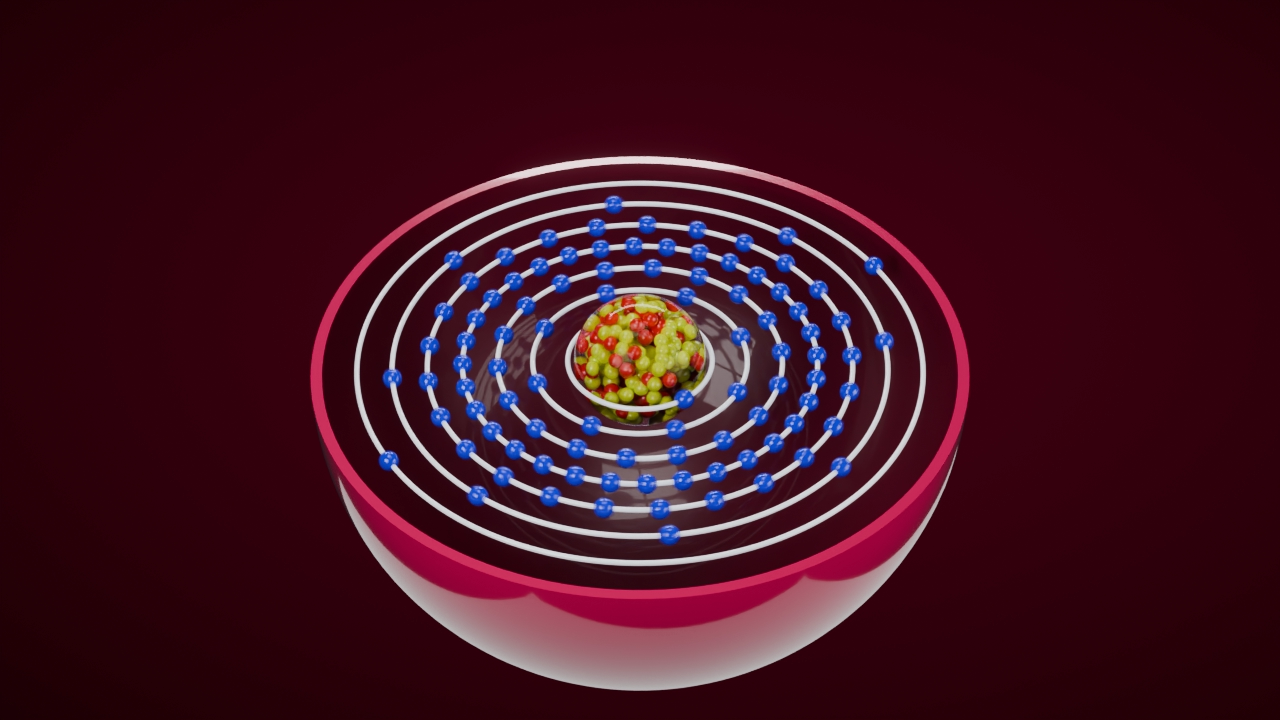
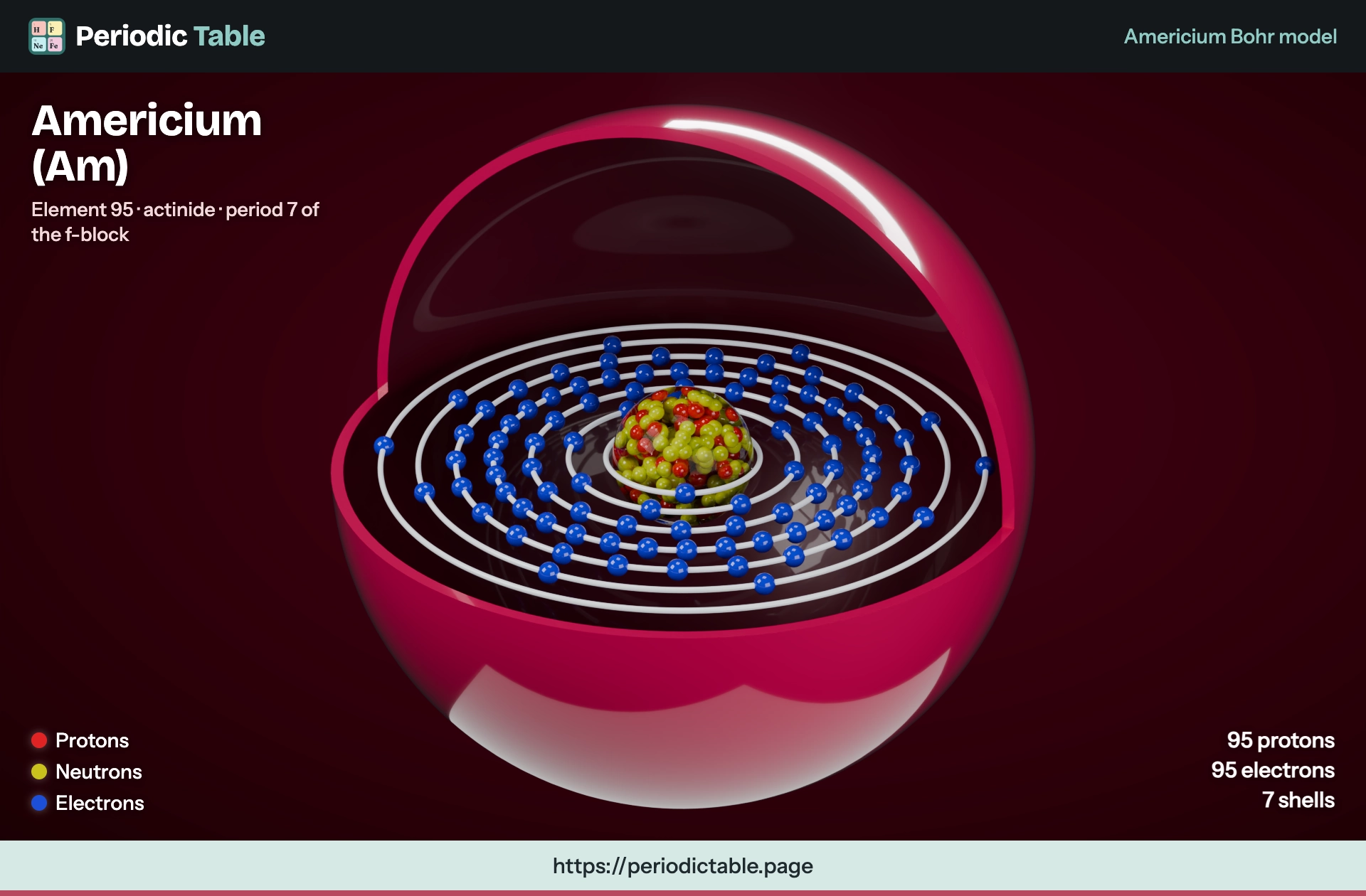
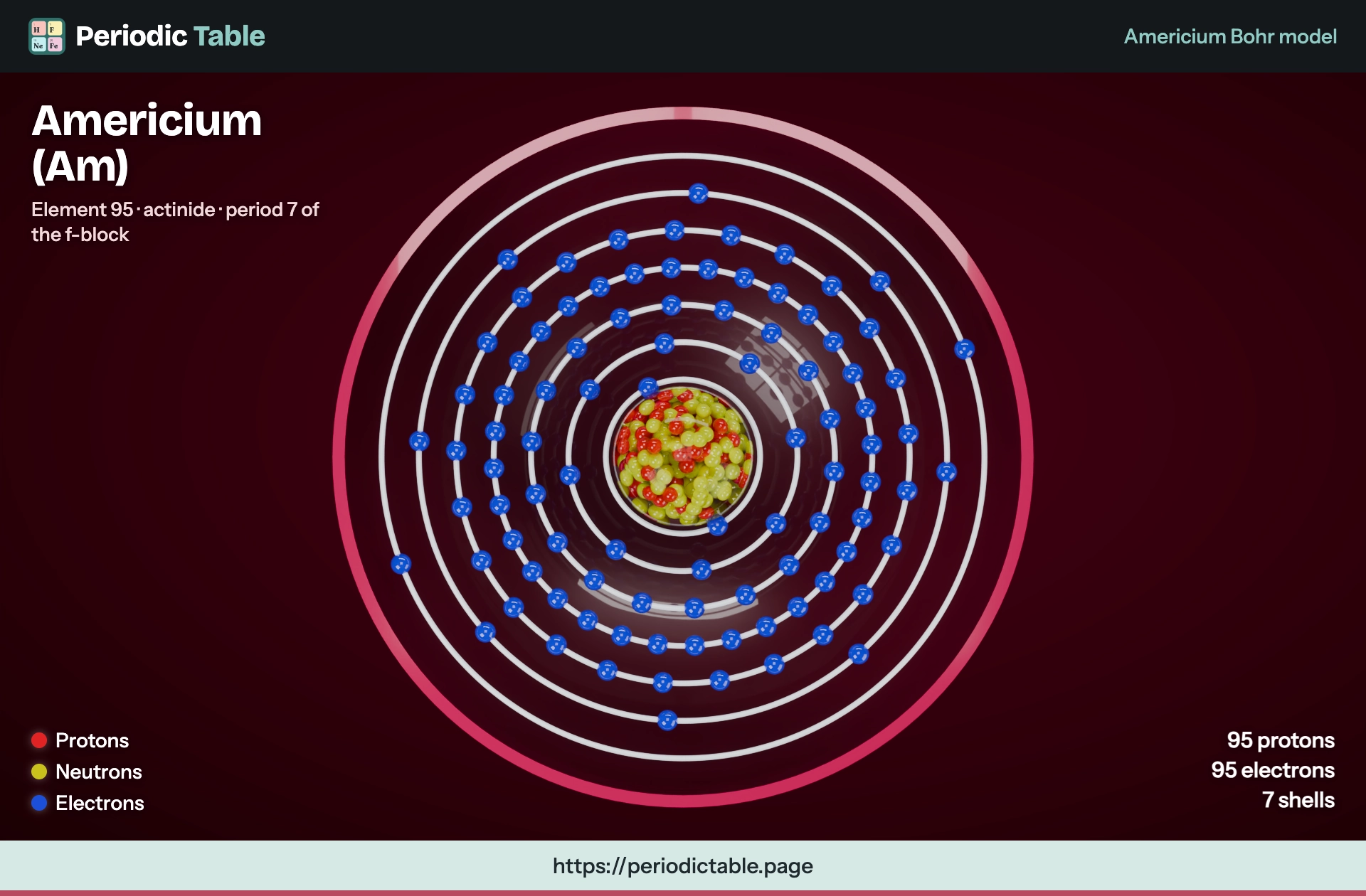
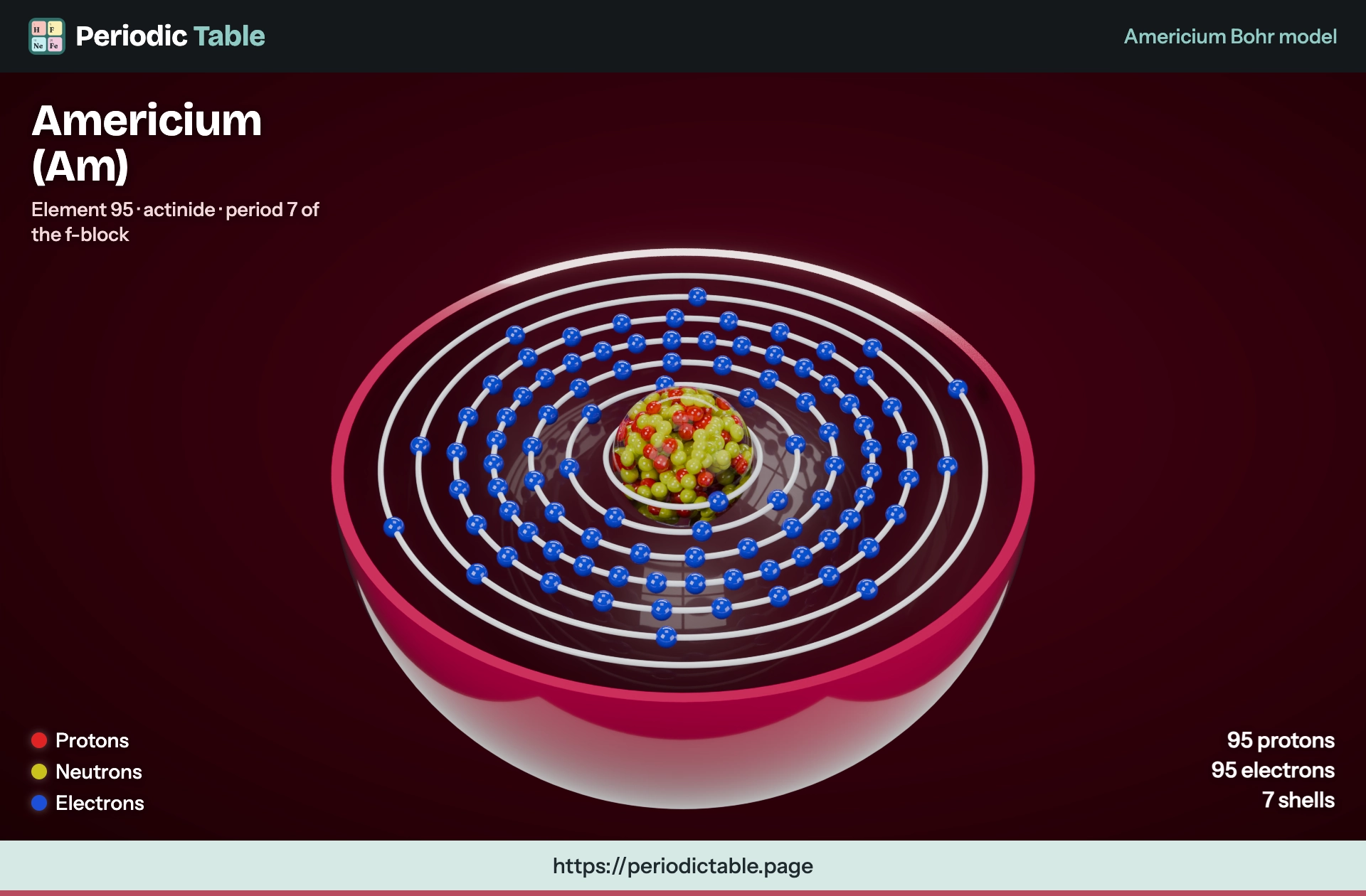
This is a Bohr model of americium (Am), a simplified picture of a single americium atom. Its nucleus holds 95 protons, and a neutral americium atom has 95 electrons, arranged around it in 7 shells (2 in shell K, 8 in shell L, 18 in shell M, 32 in shell N, 25 in shell O, 8 in shell P and 2 in shell Q).
Americium periodic table electron configuration
- Shorthand
- [Rn] 5f7 7s2
- Full
- 1s2 2s2 2p6 3s2 3p6 4s2 3d10 4p6 5s2 4d10 5p6 6s2 4f14 5d10 6p6 7s2 5f7
- Electrons per shell
- 2, 8, 18, 32, 25, 8, 2
Americium element properties and atomic data
- Atomic number
- 95
- Atomic mass
- [243] u
- Phase at STP
- Solid
- Melting point
- 1175.85°C (1449 K)
- Boiling point
- 2606.85°C (2880 K)
- Density
- 12 g/cm³
- Electronegativity (Pauling)
- 1.13
- Period
- 7
- Group
- —
- Block
- f-block
- Appearance
- Silvery white
- Discovery date
- 1944
- Discovered by
- Glenn T. Seaborg
- Named by
- —
What is americium? meet the element with atomic number 95
Americium is a chemical element with the symbol Am and atomic number 95, which means every one of its atoms holds 95 protons in the nucleus and, when neutral, 95 electrons around it. It is a member of the actinide family, the row of heavy, radioactive elements that runs from actinium to lawrencium, and it is classed as an inner transition metal because its outermost electrons fill the 5f subshell. Jewelry makers and dentistry labs consult the pure gold for why this yellow metal never tarnishes.
Unlike thorium, americium has no stable isotope and no primordial supply. It is an artificial element: every gram in existence was produced by neutron bombardment of element 94, either in a test reactor or as a by-product inside power reactors. That origin explains most of what follows about americium, from its high cost to the narrow list of jobs it does well.
- Symbol and number: Am, 95
- Category: actinide, inner transition metal
- Appearance: silvery americium metal that dulls slowly in air
- Origin: man-made, first produced in 1944
Where the element americium sits in the periodic table
In the modern periodic table, the element americium sits in the actinide series between plutonium (94) and curium (96), in the f-block of period 7. Directly above it in the lanthanide row is europium. That vertical pairing is not just a layout detail: the two elements share a similar electron arrangement, and their +3 chemistry runs in parallel, which is exactly why the discoverers gave americium a name that echoes its neighbour above.
Key facts about am at a glance
The values below summarise the core americium data you will find on reference pages. A few figures, such as the boiling temperature and electronegativity, vary between sources because they are calculated or measured on tiny, self-irradiating samples; where reputable references disagree, the commonly cited value is shown with a note. Readers interested in magnetism and the spectrum will find europium facts a handy summary.
| Property | Value |
|---|---|
| Atomic number | 95 |
| Symbol | Am |
| Relative atomic mass | [243] (mass number of the most stable isotope) |
| Group / block / period | Actinides, f-block, period 7 |
| Electron configuration | [Rn] 5f7 7s2 |
| State at 20 °C | Solid, silvery-white metal |
| Melting point | 1,176 °C (1,449 K) |
| Boiling point | about 2,011 °C measured; 2,607 °C calculated |
| Density | about 12 g/cm3 |
| Electronegativity (Pauling scale) | 1.3 |
| First ionization energy | about 578 kJ/mol |
| Atomic radius (empirical) | 173 pm |
| Covalent radius | 180 pm |
| Common oxidation state | +3 (range +2 to +7) |
| Main isotopes | Am-241, Am-243 |
| CAS number | 7440-35-9 |
The half-filled 5f7 shell is the key to reading this table: it gives americium a stable +3 ion, a magnetic signature, and a chemistry that looks far more like the lanthanides than like the lighter actinides that come before it.
Discovery and history of the actinide named after the Americas
The first deliberate synthesis took place in late 1944, when Glenn Seaborg, Ralph James, Leon Morgan and Albert Ghiorso irradiated Pu-239 targets in the 60-inch cyclotron at the University of California, Berkeley. Earlier experiments had almost certainly produced traces, but this team was the first to isolate and identify element 95.
Americium was the fourth element past number 92 to be found, after neptunium, plutonium and curium, even though it is the third in atomic order. Seaborg's group would go on to isolate ten new elements in all, reshaping nuclear science.
Separating americium from its neighbour proved so frustrating that the group nicknamed the pair pandemonium and delirium. Seaborg had recently rearranged the periodic table to place the actinides under the lanthanides, so the name followed by analogy: just as the lanthanide above was named after Europe, element 95 was named after the Americas. The first weighable piece of the metal, 40 to 200 micrograms, was not made until 1951.
A secret of the Manhattan project revealed on quiz kids
Because the work belonged to the Manhattan Project and the chemical identification was done at the Metallurgical Laboratory of the University of Chicago, the discovery stayed classified until the end of the war. It reached the public in an unusual way.
In November 1945, five days before the formal announcement to the American Chemical Society, Seaborg appeared on the children's radio show Quiz Kids. A young listener asked whether wartime nuclear weapons work had produced any new elements beyond the two already announced, and Seaborg let slip that elements 95 and 96 existed.
Americium properties of a soft radioactive metal
Freshly prepared, americium has a bright silvery lustre that tarnishes slowly in dry air. It is fairly soft and malleable, with a much lower bulk modulus than the actinides before it, so it deforms easily. It is less dense than its two actinide neighbours yet heavier than its lanthanide twin, mostly because of its greater atomic mass.
Two of its americium properties are unusual. First, it is paramagnetic from liquid-helium temperatures all the way to room temperature and above, whereas curium becomes antiferromagnetic at 52 K.
Second, it damages itself: alpha emission from its own nuclei knocks atoms out of place, so the crystal lattice slowly accumulates defects. That self-irradiation makes measured values such as electrical resistivity drift with sample age, especially in cold samples.
Crystal structure and phase changes
At room temperature the stable alpha form has a double hexagonal close-packed (dhcp) crystal structure, the same layer stacking found in alpha-lanthanum. Squeeze it to about 5 GPa and it switches to a face-centred cubic beta form; push to about 23 GPa and it becomes orthorhombic, resembling alpha-uranium. Heating at normal pressure gives a cubic phase near 770 °C and a body-centred cubic phase near 1,075 °C, so its phase diagram looks much like those of lanthanum, praseodymium and neodymium.
Melting point, boiling point and density
Americium melts at about 1,176 °C, well above element 94 (639 °C) and europium (826 °C) but below curium (1,340 °C). The boiling figure is less settled: some references give a measured value near 2,011 °C while others list a calculated 2,607 °C, so you should state the source whenever you quote it.
At roughly 12 g/cm3 it is about as heavy as lead, which surprises people who expect a reactor element to be heavier. Its thermal expansion is slightly anisotropic, a detail that matters for the solid-state physics of fuel pellets and targets.
Chemistry and oxidation states of am
Americium reacts readily with oxygen and dissolves in aqueous acids. In solution it almost always settles into the +3 state, and the chemistry of americium(III) resembles that of the trivalent lanthanides: it forms insoluble fluorides, oxalates, iodates, hydroxides and phosphates. What sets this element apart is its range of oxidation states, from +2 up to +7, the widest observed for any actinide.
- Am(III): yellow-reddish in solution, the most stable state
- Am(IV): unstable in solution, stable in solids such as the dioxide and tetrafluoride
- Am(V) and Am(VI): yellow and brown ions that behave like uranium in the same states
- Am(VII): dark green, very rare and strongly oxidizing
Each state has a sharp optical absorption fingerprint from f-f transitions, so analysts can identify them by spectrum. Higher states are made by oxidizing Am(III) in dilute nitric acid with persulfate or ozone, and they are strong oxidizers comparable to permanganate. This colour-coded chemistry is also what makes it possible to pull americium away from its heavier neighbour later in the fuel cycle.
Americium compounds: oxides, fluorides and beyond
Most americium compounds known today were made in milligram or microgram quantities, yet they cover a wide sweep of inorganic and nuclear chemistry, from simple oxides to sandwich-type organometallics.
Americium dioxide and the other oxides
Three oxides are known: AmO (+2), Am2O3 (+3) and AmO2 (+4). Americium dioxide is a black solid with a cubic fluorite lattice and is the working form of americium in nearly every application, including smoke alarm sources.
It is usually made by heating the oxalate, which loses water near 240 °C and converts fully to the dioxide by about 470 °C. Am(III) hydroxide is another common precipitate in laboratory separations.
Halides, silicides and organometallic compounds
The halides exist in the +2, +3 and +4 states. The pink americium(III) fluoride, AmF3, precipitates from weakly acidic solution and is the classic starting point for reduction to metal, while the pale pink tetravalent fluoride forms when that trifluoride meets fluorine gas.
The divalent chloride, bromide and iodide are black and react quickly with water. Beyond these salts, chemists have prepared sulfides, selenides and tellurides, pnictides with a rock-salt lattice, the silicides AmSi and AmSix, the borides AmB4 and AmB6, and a cyclopentadienyl complex close to AmCp3.
Americium isotopes and the nuclear isomer americium-242m
There are 19 known americium isotopes, with mass numbers from 229 to 247, plus 11 nuclear isomers. None is stable.
Two long-lived alpha emitters dominate every practical discussion, and one nuclear isomer, Am-242m, gets attention because it fissions so easily. A metastable isomer has the same nucleon count as its ground state but carries extra nuclear energy, which changes how it decays.
| Isotope | Half-life | Main decay mode | Product |
|---|---|---|---|
| Am-241 | 432.6 years | Alpha | Np-237 |
| Am-242 | 16.02 hours | Beta minus (82.7%), electron capture (17.3%) | Cm-242 / Pu-242 |
| Am-242m | 141 years | Isomeric transition (99.55%) | Am-242 |
| Am-243 | 7,350 years | Alpha | Np-239 |
Americium-243 is the most stable form, which is why reference tables list the relative mass as [243]. The rest of the family have half-lives measured in hours, minutes or less; the longest of the short-lived group, Am-240, lasts about 51 hours.
Half-life and decay of the two long-lived isotopes
Americium-241 emits alpha particles mostly at 5.486 MeV and 5.443 MeV and settles into neptunium-237. Because the daughter nucleus is left in excited states, it also gives off low-energy gamma rays, the strongest at 59.5 keV. That pairing of a strong alpha output with a low-energy, single dominant gamma line is what makes Am-241 so useful in instruments.
You can see how slowly a source fades with a quick calculation. Using the 432.6-year figure, the fraction left after t years is:
$$N(t) = N_0 \times 2^{-t/432.6}$$
After 10 years a source keeps 98.4% of its Am-241, after 25 years 96.1%, and after a century 85.2%. In practical terms, the source inside a household alarm loses well under 2% of its activity during a typical ten-year service life, so the sensor's electronics and dust wear out long before the radioactive part does.
How the artificial element is made in nuclear reactors
Americium is not made directly from uranium. Reactors first breed plutonium-239 from U-238, and each extra neutron that isotope captures makes it one mass unit heavier. The route to Am-241 is two steps of neutron capture followed by beta decay:
$$^{239}\text{Pu} \xrightarrow{(n,\gamma)} {}^{240}\text{Pu} \xrightarrow{(n,\gamma)} {}^{241}\text{Pu} \xrightarrow{\beta^-} {}^{241}\text{Am}$$
Half of any plutonium-241 turns into americium within about 14 years, so stored Pu keeps growing new Am-241 for decades. Further absorption inside nuclear reactors converts some of it to Am-242 and Am-242m, while Am-243 builds up when Pu-239 absorbs four neutrons under high flux. Kilogram quantities of americium now exist, yet the price of Am-241 has stayed near $1,500 per gram since it first went on sale in 1962, and the scarcer heavier form costs far more.
Separating americium from spent nuclear fuel
One tonne of spent nuclear fuel holds about 100 grams of americium, mostly americium-241 and americium-243. Getting it out is a multi-stage job. The fuel is dissolved in acid, and a PUREX process with tributyl phosphate pulls out most of the U and Pu.
Diamide-based solvent extraction then recovers a mixed stream of trivalent actinides and lanthanides, and chromatographic steps isolate americium from that mixture. The hardest separation, from curium, uses ozone to oxidize americium to a soluble higher state while curium stays put.
Recycling plants are now looking at this stream differently. At La Hague, Orano stores plutonium for MOX fuel manufacture, and Am-241 that grows in over time was historically sent to vitrified waste.
A 2024 pilot showed it can be recovered instead. Longer term, reactors could destroy long-lived americium by transmutation into shorter-lived nuclides, cutting the heat and radiotoxicity of high-level waste.
Where the transuranic element turns up in nature
Any americium present when Earth formed decayed away long ago, since even Am-243 halves every 7,350 years. Trace amounts may form naturally in uranium minerals through neutron capture, but that has never been confirmed. The element also has no stable isotopes to persist on its own.
What you can find in the environment comes from people. Atmospheric weapons tests between 1945 and 1980 spread it worldwide at about 0.01 picocuries in each gram of surface soil, and higher levels exist at Trinity, Enewetak, the 1968 Greenland bomber crash and Chernobyl. In soil, americium clings tightly to particles rather than dissolving in pore water, which limits how far it travels.
Americium uses from smoke detectors to spacecraft
Because it is costly and produced in small volumes, americium has a short list of jobs, and almost all of them exploit its radiation rather than its chemistry. Its main roles in industry, medical research and space science are:
- Ionization sources in household smoke detectors
- Am-Be neutron sources for soil, well and road testing
- Gamma sources for gauges, radiography and instrument calibration
- Candidate fuel for long-life space power systems
- Target material for making heavier elements in research
- Americium metal targets for nuclear physics experiments
How an ionization smoke detector uses americium-241
An ionization smoke detector holds about 1 microcurie (37 kBq) of americium-241 as the dioxide, roughly 0.29 microgram. Its alpha output ionizes the air in a small ionization chamber between two electrodes, allowing a tiny, steady current to flow.
When smoke drifts in, the smoke particles soak up the alpha radiation and slow the ions, the current drops, and the alarm sounds. Am-241 beat radium for this role because it gives about five times more alpha emission with relatively little penetrating gamma output.
Compared with an optical smoke detector, the ionization type is cheaper and senses particles too small to scatter much light, which makes it quick to react to fast, flaming fires. The trade-off is more false alarms from cooking or steam. The ionizing radiation stays inside the housing in normal use; the risk only appears if the source is pried out or the unit is burned.
Neutron source, gauges and gamma spectroscopy
Pressed together with beryllium, Am-241 oxide makes a compact neutron source: its alpha particles strike beryllium nuclei, which release a neutron. These AmBe sources power the neutron probe that measures soil moisture and compaction in highway construction, and they are standard tools in oil and gas well logging.
The 59.5 keV gamma line is also used for radiography, X-ray fluorescence spectroscopy and thickness gauges, for example to control glass thickness on flat glass lines. Because its spectrum is almost a single clean peak, it is ideal for calibrating gamma spectrometers.
Radioisotope thermoelectric generators for space
Deep-space missions that travel too far from the Sun for solar panels rely on radioisotope thermoelectric generators, which turn heat from a decaying radioisotope into electricity using the Seebeck effect. Plutonium-238 is the traditional fuel, but supply is tight. Am-241 yields about 114.7 mW per gram versus about 390 mW for plutonium-238, so you need roughly 3.4 times as much fuel mass for the same thermal output.
In return americium lasts far longer, and it can be recovered from existing civil plutonium stocks. The European Space Agency is studying it for its space probes and spacecraft, and in 2019 a UK team lit a small bulb with power from an americium pellet. Am-242m has also been proposed for nuclear batteries and nuclear propulsion, but those ideas remain on paper.
Fission and making heavier elements
Am-242m absorbs thermal neutrons extremely well and has a bare-sphere critical mass of only about 9 to 14 kg, compared with roughly 58 to 76 kg for Am-241 and about 209 kg for Am-243. That small figure invited proposals for compact reactors, but scarcity and the high price of the isomer keep it out of real use as reactor fuel. Its more practical research role is as a target: bombarding Am isotopes produced berkelium in 1949 and contributed to the synthesis of einsteinium, nobelium and lawrencium.
Health concerns and safe handling of am
The main health concerns with americium come from inhaling or swallowing it, not from standing near a sealed source. Its alpha particles are stopped by a sheet of paper or the outer layer of skin, but daughter products and some isotopes also emit gamma rays and neutrons that penetrate further, so bulk material is handled only in shielded laboratory facilities under strict safety rules.
If americium is swallowed, most passes out within days and only about 0.05% enters the blood. Of that absorbed share, about 45% settles in the liver and 45% in the bones, where its biological half-life is about 20 and 50 years respectively. Lodged in tissue, it raises the risk of cancer.
Notable cases of exposure include Harold McCluskey, a Hanford technician contaminated in a 1976 explosion who lived another 11 years, and David Hahn, a teenager who in 1994 extracted the sources from about 100 smoke alarms. Discarded alarms often end up in landfills, so check whether your area offers manufacturer take-back before throwing one away; that small step limits contamination from a device you would otherwise never think about.