


Bismuth element (Bi): bismuth periodic table facts
Bismuth periodic table facts: bismuth (Bi) is element 83, a post-transition metal in group 15, period 6. Pick up a piece of bismuth and two things surprise you at once: it is heavier than it looks, and its surface shimmers in bands of gold, blue and violet. Students of chemistry and physics use the full periodic table to look up how atoms group by reactivity.
Freshly cut elemental bismuth is a brittle, silvery-white metal with a faint pink tint, and its chemical properties make it one of the rare heavy elements you can handle, cast and even swallow in medicine. This guide walks you through what Bi is, how it behaves and why industry keeps finding new jobs for it.
Rotate the 3D Bohr model of bismuth
Drag to orbit, scroll to zoom.
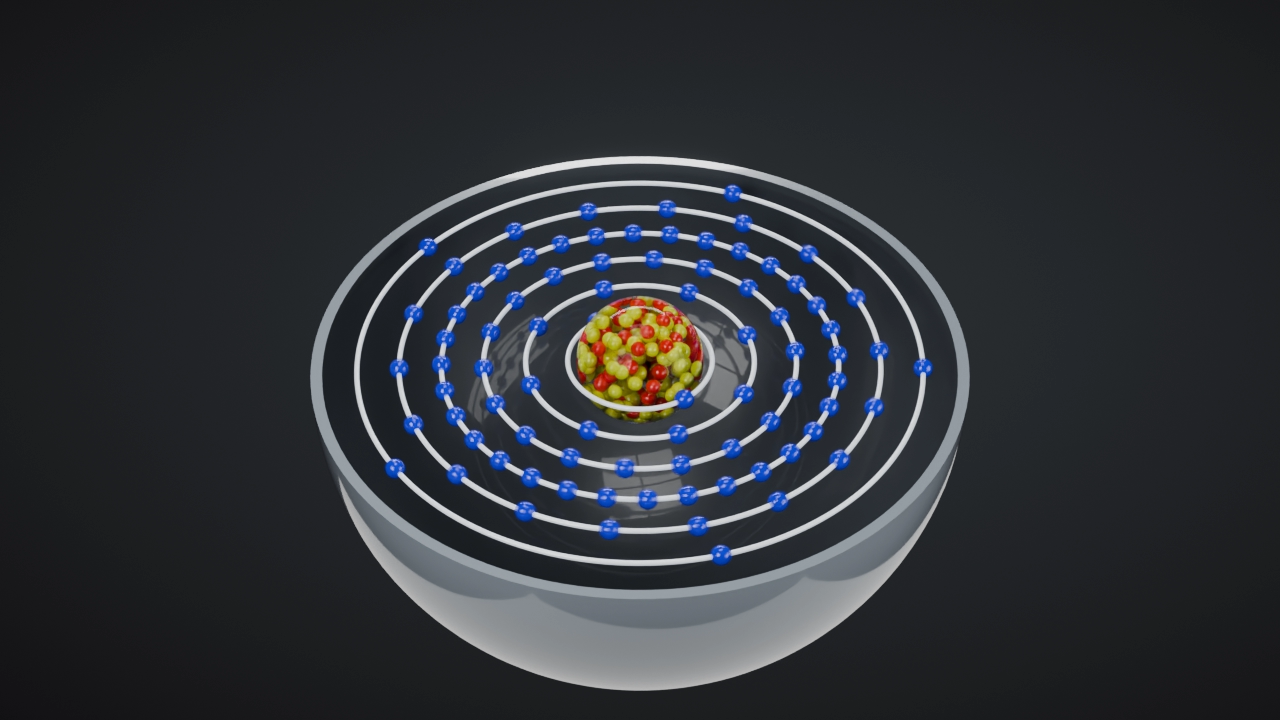
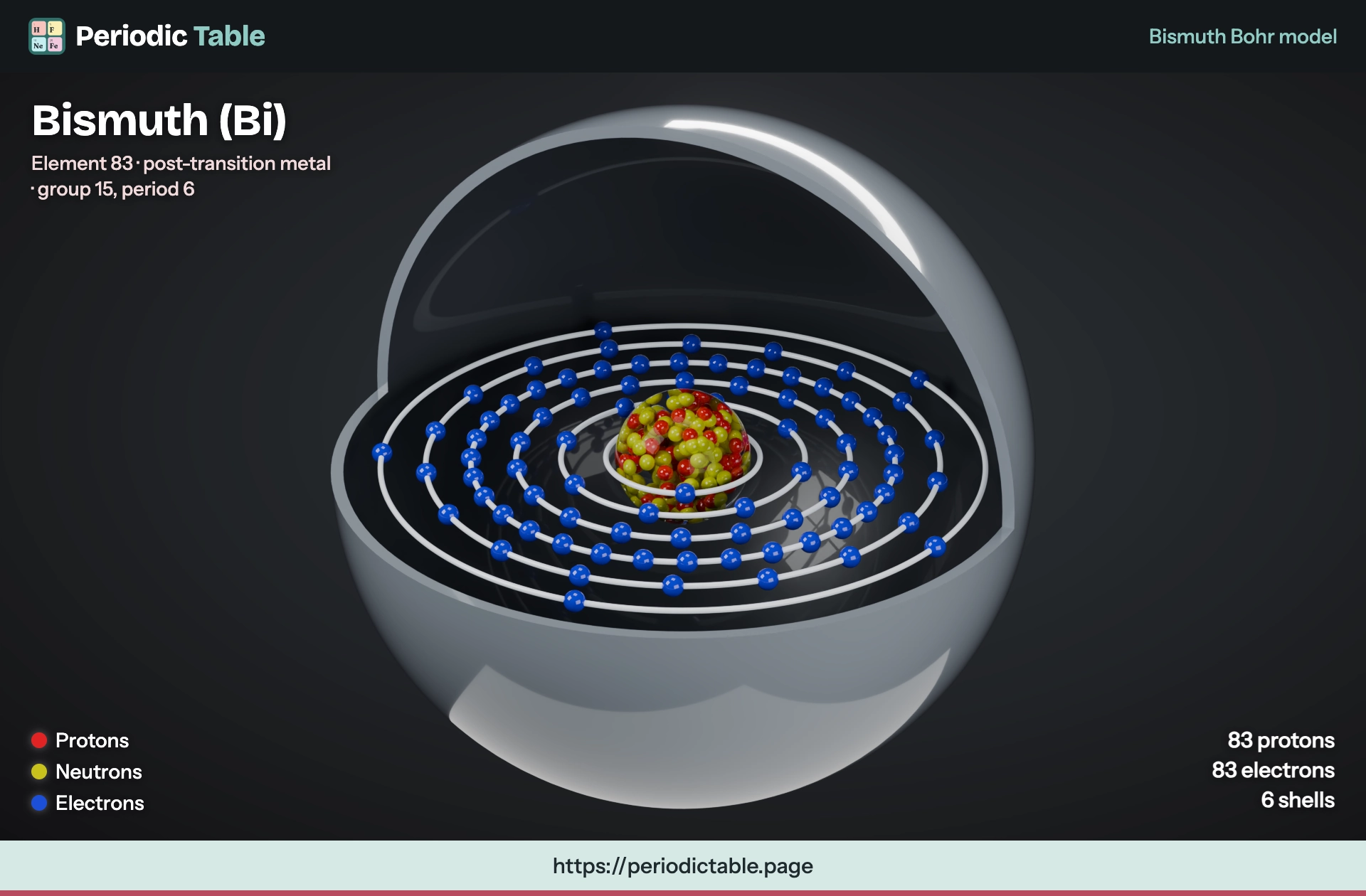
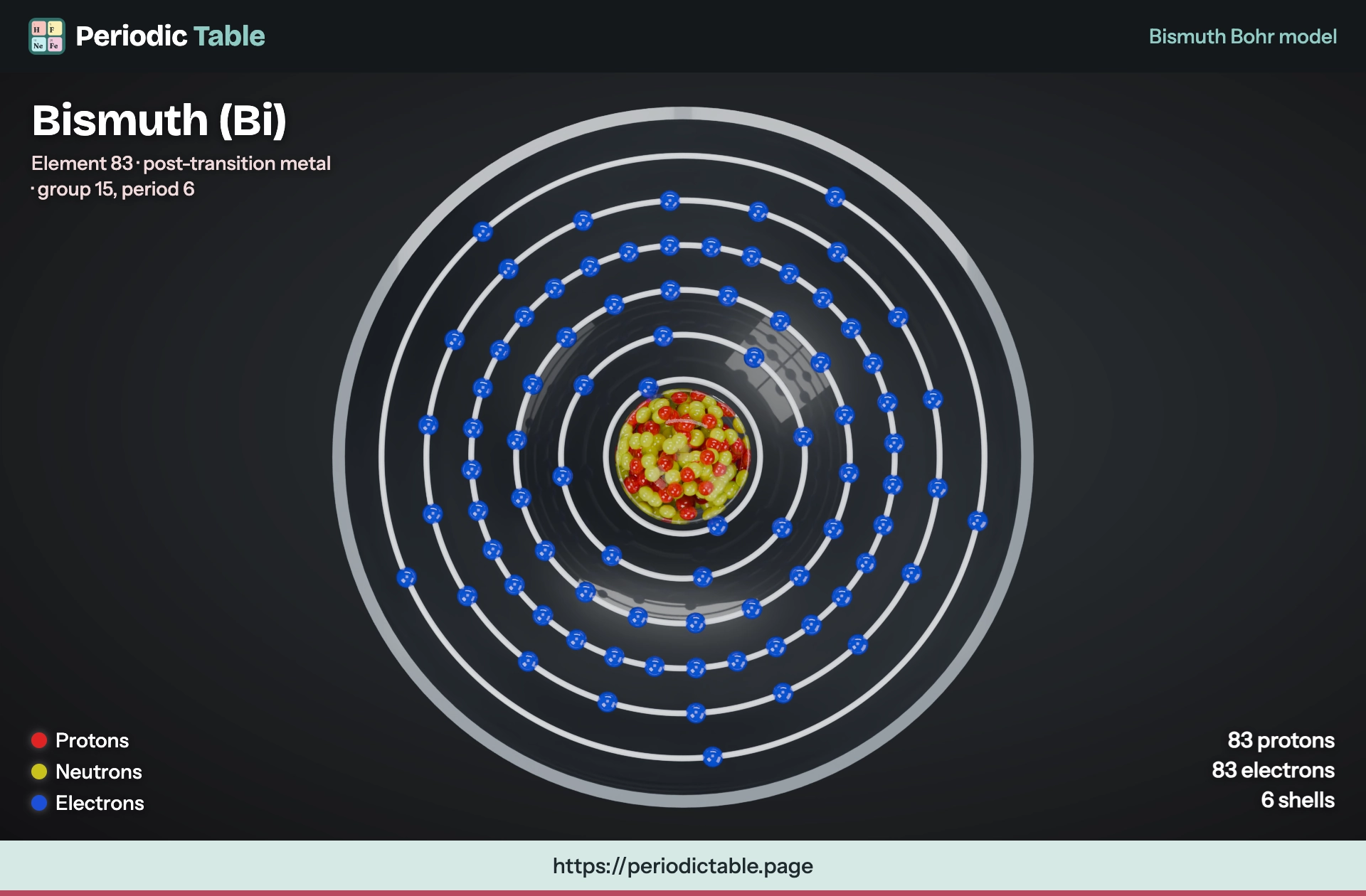
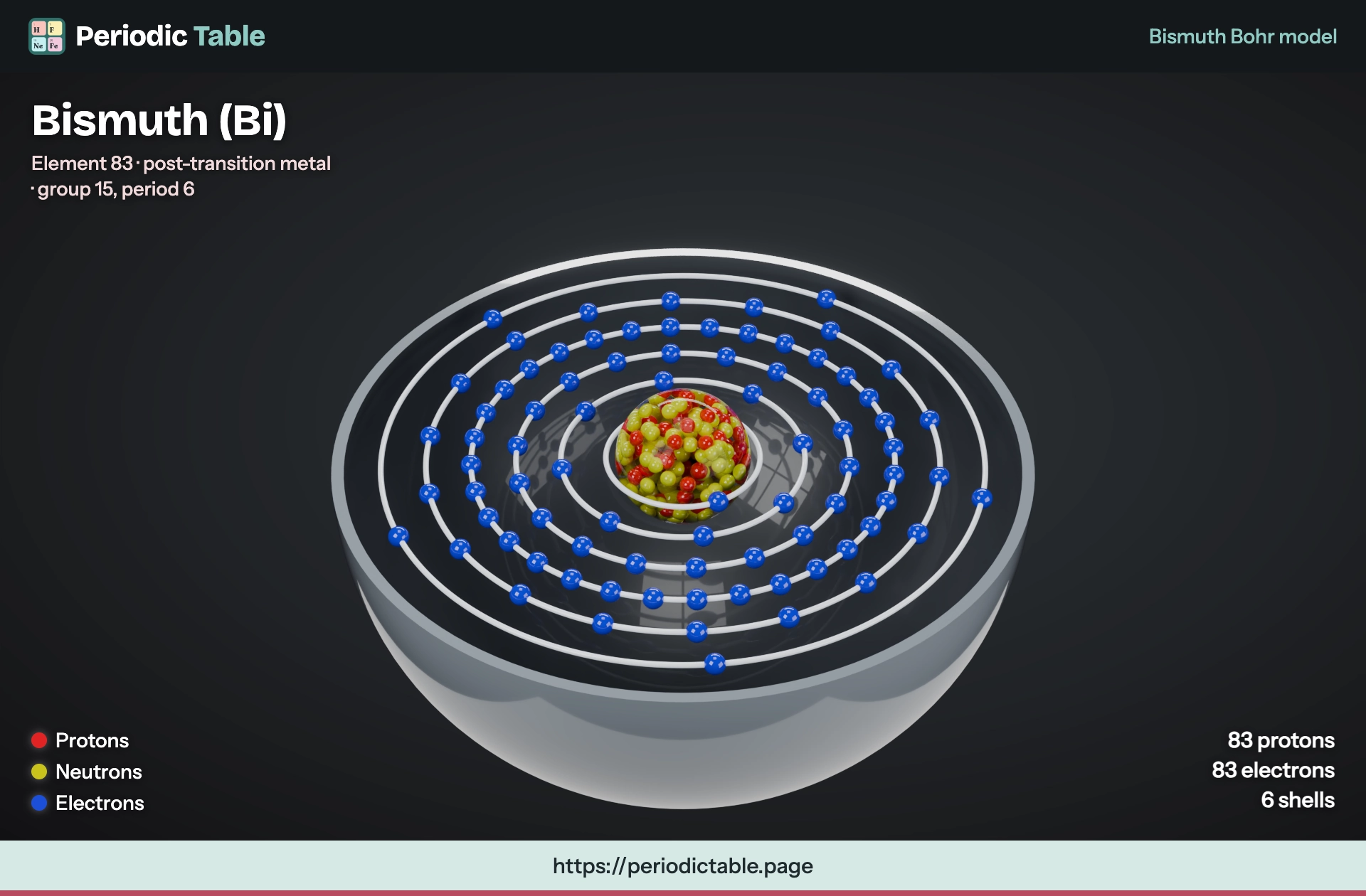
This is a Bohr model of bismuth (Bi), a simplified picture of a single bismuth atom. Its nucleus holds 83 protons, and a neutral bismuth atom has 83 electrons, arranged around it in 6 shells (2 in shell K, 8 in shell L, 18 in shell M, 32 in shell N, 18 in shell O and 5 in shell P).
Bismuth periodic table electron configuration
- Shorthand
- [Xe] 4f14 5d10 6s2 6p3
- Full
- 1s2 2s2 2p6 3s2 3p6 4s2 3d10 4p6 5s2 4d10 5p6 6s2 4f14 5d10 6p3
- Electrons per shell
- 2, 8, 18, 32, 18, 5
Bismuth element properties and atomic data
- Atomic number
- 83
- Atomic mass
- 208.9804 u
- Phase at STP
- Solid
- Melting point
- 271.55°C (544.7 K)
- Boiling point
- 1563.85°C (1837 K)
- Density
- 9.78 g/cm³
- Electronegativity (Pauling)
- 2.02
- Period
- 6
- Group
- 15
- Block
- p-block
- Appearance
- Lustrous silver
- Discovery date
- 1753
- Discovered by
- Claude François Geoffroy
- Named by
- —
Bismuth facts at a glance
Bismuth carries the chemical symbol Bi and sits at atomic number 83, which places 83 protons in every nucleus. It is the heaviest member of its family that occurs naturally in useful amounts, and for most of the twentieth century it was treated as the heaviest atom that never decays. The table below collects the reference values you will see quoted on most data sheets, rounded to the precision that matters in practice. Chemistry readers can use the argon boiling point to see why the atmosphere holds about 0.934% of it.
| Property | Bismuth metal value |
|---|---|
| Symbol | Bi |
| Atomic number | 83 |
| Atomic mass | 208.98 u |
| Group / period / block | Group 15, period 6, p-block |
| Electron configuration | [Xe] 4f14 5d10 6s2 6p3 |
| Melting point | 271.4 °C (544.6 K) |
| Boiling point | 1,564 °C (1,837 K) |
| Density at 20 °C | 9.78 g/cm3 |
| Crystal structure | Rhombohedral |
| Natural isotopes | One: Bi-209 (100%) |
| CAS number | 7440-69-9 |
Those numbers already hint at the bismuth facts that make it unusual: it melts on a kitchen stove, it is nearly as dense as lead, and it has a single natural isotope.
Where Bi sits in the periodic table
In the periodic table, Bi sits directly below antimony and above the synthetic moscovium, with lead to its left and polonium to its right. Chemists class it as a post-transition metal and a member of the pnictogen family that starts with nitrogen and phosphorus.
It shares the layered crystal habit of its lighter cousins arsenic and antimony, yet unlike them, and unlike its neighbors Pb and Po, it is only weakly toxic. That combination of a heavy nucleus and gentle chemistry is the thread running through almost every use you will read about below.
Physical properties of bismuth
The physical properties of bismuth read like a list of exceptions. It is soft for so heavy an atom, it resists magnetism more strongly than any other solid, and it conducts heat and electricity poorly. The mechanical and thermal values below explain why it shatters instead of bending. If you are curious where the halogen turns up on Earth, the halogen chlorine adds a note on seawater and chlorides.
| Mechanical or thermal property | Value |
|---|---|
| Mohs hardness | 2.25 |
| Young's modulus | 32 GPa |
| Shear modulus | 12 GPa |
| Bulk modulus | 31 GPa |
| Specific heat capacity | 122 J/(kg·K) |
| Electrical resistivity at 20 °C | 1.29 µΩ·m |
Color, iridescence and crystal structure
A clean, fresh fracture shows a white surface with a pinkish cast. Leave it in warm air and a thin oxide layer forms on top. That oxide film is only a few hundred nanometres thick, and light reflecting from its top and bottom surfaces interferes, so you see a rainbow that shifts as the thickness changes.
Physicists call this thin-film interference, the same effect behind soap bubbles and oil slicks, which is why a Bi sample looks iridescent without containing any pigment at all. Underneath, the atoms pack into a rhombohedral lattice of puckered layers. Squeeze the solid hard enough and it rearranges into new phases at sharply defined pressures, which is why laboratories use those jumps to calibrate high-pressure equipment.
Low melting point and expansion on solidification
Most metals shrink as they freeze. Bismuth does the opposite: it expands by about 3.32% on solidification, and the solid floats on its own melt, much like ice on water.
To picture the scale, a 350 g ingot occupies roughly 35.8 cm3 once solid; the same volume of lead would weigh about 406 g. That expansion pushes the molten mix into every corner of a mould, so Bi-bearing alloys produce crisp, sharp castings. Printers relied on it for centuries: the type used in typesetting needed to fill the fine serifs of each letter, and a dash of bismuth made printing faces sharper.
Diamagnetism and low thermal conductivity
Bismuth is the most strongly diamagnetic of all naturally occurring elements, meaning a magnetic field pushes it away rather than pulling it in. With a strong neodymium magnet you can levitate a thin graphite flake, or watch a Bi disc nudge away from the pole. Among metals it also has one of the lowest values of thermal conductivity, about 7.97 W/(m·K), and one of the highest electrical resistivities.
Its Hall coefficient is the largest among the metals, which made it a favourite in early magnetic-field sensors. In very thin films, it behaves as a semiconductor rather than a conductor, a quirk that keeps physicists studying it for quantum devices.
Chemical properties and oxidation states of bismuth
At room temperature Bi is stable in dry or moist air and in water. Heated strongly, it burns with a blue flame and gives off yellow fumes of bismuth(III) oxide: Reserves, supply risk and the Big Bang origin are covered in the lithium electron configuration, with a look at stars and the universe.
$$4\,\text{Bi} + 3\,\text{O}_2 \rightarrow 2\,\text{Bi}_2\text{O}_3$$Its preferred oxidation state is +3, because the two 6s electrons hold back from bonding (the inert pair effect). The +5 state exists but is strongly oxidizing; sodium bismuthate is a classic laboratory oxidizer. Bi dissolves in nitric acid to give bismuth nitrate and in hot concentrated sulfuric acid to give the sulfate, but it reacts with hydrochloric acid only when oxygen is present.
With the halogens it forms the trihalides, all of them Lewis acids that hydrolyse in moist air to oxyhalides. For chemistry students, it is a textbook example of how the heavier members of a group drift toward metallic behaviour.
Atomic data and electron configuration of Bi
The five outer electrons in 6s2 6p3 set the atomic size and how tightly the atom holds them. Values below follow the commonly cited reference sets; the Pauling scale value varies slightly between sources (1.9 to 2.02).
| Atomic property | Value for Bi |
|---|---|
| Electronegativity (Pauling scale) | 2.02 |
| First / second / third ionization energies | 703 / 1,610 / 2,466 kJ/mol |
| Atomic radius (empirical) | 156 pm |
| Covalent radius | 148 pm |
| Van der Waals radius | 207 pm |
| Electron affinity | 90.9 kJ/mol |
Isotopes of bismuth and its faint radioactivity
All natural bismuth is bismuth-209. For decades it was listed as the heaviest stable nuclide, although theory predicted it should be slightly radioactive. In 2003 French researchers finally detected its alpha decay to thallium-205, with a half-life of about 2.01 × 10¹⁹ years, roughly 1.5 billion times the age of the universe.
How weak is that? You can work it out from the decay law, where activity equals the decay constant times the number of atoms:
$$A = \frac{\ln 2}{t_{1/2}} \times N$$One kilogram of Bi holds about 2.88 × 1024 atoms. Dividing ln 2 by that span in seconds and multiplying gives an activity of about 0.0031 Bq per kilogram, roughly 272 decays a day or 99,000 a year.
A banana, with its natural potassium-40, emits around 15 decays every second, so the fruit is close to 5,000 times more radioactive than a kilogram of Bi. For every practical purpose it counts as stable; its radioactivity matters only to physicists and to builders of ultra-low-background detectors.
Bismuth-213 and its short half-life in targeted alpha therapy
Not every isotope is so lazy. Bismuth-213, produced from actinium-225, decays with a half-life of about 45.6 minutes and emits an alpha particle that travels only a few cell widths.
Attached to an antibody, it can deliver that energy straight to a tumour cell, which is the idea behind targeted alpha therapy. Because only about 6.5% of a dose remains after three hours, it must be prepared next to the patient, one reason this cancer treatment is still largely experimental.
Bismuth compounds and their chemistry
About half of all bismuth mined ends up in compounds rather than as metal. Almost all of them contain Bi in the +3 state:
- Bismuth oxide (Bi2O3): a yellow powder used in glass, ceramics, varistors and as the X-ray opaque filler in some dental cements.
- Bismuth sulfide (Bi2S3): the compound in the main ore mineral, and the harmless black deposit that stomach remedies containing it can leave on your tongue.
- Bismuth subnitrate and bismuth subcarbonate: white basic salts long used in stomach remedies and wound powders.
- Bismuth germanate: a dense crystal that turns gamma rays into flashes of light inside PET scanners.
- Sodium bismuthate: a strong oxidizer chemists use to test for manganese.
Each compound inherits the same advantage: a heavy, X-ray stopping atom with far less harm than comparable salts of its neighbours. Few of these salts are soluble enough to be absorbed in large amounts, which is a large part of their safety record.
History and etymology of bismuth
Bismuth was used long before anyone recognised it as a distinct substance. The Incas alloyed it into bronze for knives, apparently on purpose, and medieval alchemists and miners lumped it together with tin and lead. Miners in the German ore mountains called it tectum argenti, "silver being made", believing it was silver that had not yet finished forming in the ground.
The etymology is uncertain. The most widely repeated explanation is that the German Wismut (also spelled Wismuth) comes from weiße Masse, "white mass", which Georgius Agricola latinised as bisemutum in the 1540s. Agricola was also one of the first to describe it as a separate metal related to tin.
In 1738 Johann Heinrich Pott began separating it chemically from lead, and in 1753 Claude François Geoffroy showed conclusively that it was its own element. Because it was known in a practical sense for so long, no single person is credited with discovering it. For the history of chemistry, it marks the shift from describing metals by how they look to proving them distinct by how they react.
Applications of the bismuth element in everyday products
Most applications of Bi trade on three traits at once: a heavy atom, a gentle effect on the body and the way it melts at modest temperatures. You will find it in your bathroom cabinet, your makeup bag and inside fire safety systems.
Medicine: bismuth subsalicylate and Pepto-Bismol
Bismuth subsalicylate is the active ingredient in Pepto-Bismol and in current Kaopectate formulas, used for diarrhea, indigestion, nausea and heartburn. It coats the stomach lining, has a mild antibacterial effect, and combined with antibiotics it helps clear Helicobacter pylori, the bacterium behind most peptic ulcers. The pharmaceuticals industry also uses bismuth subcitrate and subgallate, and bismuth salts were a standard syphilis treatment until penicillin replaced them in the 1940s.
Cosmetics and pigments
Bismuth oxychloride (BiOCl) forms thin, flat crystals that reflect light like mother-of-pearl, which is why it appears in eyeshadows, nail polish, lipsticks and mineral powders. It gives a soft sheen that makeup brands once got from crushed fish scales. Bismuth vanadate is a bright, non-toxic lemon-yellow among artists' and industrial pigments, often chosen to replace yellows based on lead or cadmium.
Electronics and thermoelectric devices
Bismuth telluride (Bi2Te3) is the workhorse of thermoelectric devices. Run a current through it and one side cools while the other warms, which powers Peltier coolers in portable fridges, laser diodes and camera sensors; reverse the idea and a temperature difference produces electricity. In other electronics, Bi appears in tin-bismuth solder pastes, ceramic capacitors and research on topological insulators.
Low-melting bismuth alloys and solders
Mix bismuth with tin, cadmium or indium and the mixture can melt below the boiling point of water. These low-melting alloys, also called fusible alloys, include Wood's metal (about 70 °C) and the cadmium-free Field's metal (about 62 °C). In fire detection, a fusible alloy link in a sprinkler head softens in the heat of a fire and releases the water.
Lead-free tin-bismuth pastes flow at about 138 °C, gentle enough for heat-sensitive circuit boards. In metallurgy, small Bi additions make steel and aluminium alloys easier to machine. One bismuth alloy, Bismanol, was even developed as a permanent magnet.
Bismuth as a heavy metal with low toxicity
Bismuth is nearly as dense as the classic poisonous elements yet carries very little of their risk. The body absorbs only a small fraction of what you swallow and excretes most of it, which is why tablets containing it can be sold over the counter. It is not entirely harmless, though.
In the 1970s, people in France and Australia who took very large daily doses of bismuth salts for years developed a reversible brain disorder, bismuth encephalopathy, so long-term use should follow a doctor's advice. The subsalicylate form also releases salicylate, an aspirin relative, so it is not recommended for children or anyone told to avoid aspirin. For the environment, its low toxicity makes it one of the safest heavy elements to put into consumer goods.
Lead replacement in ammunition and plumbing
Bismuth's role as a lead replacement grew as the cost of lead pollution became clear, and around a third of global demand now fills roles that lead once did. Three uses account for most of that switch.
Bismuth shot for waterfowl hunting
Bismuth shot is one of the approved non-toxic options for waterfowl hunting, where the older pellets were banned because ducks swallowed them. It is far denser than steel, so it keeps more energy downrange.
Bismuth in fishing weights and range ammunition
Anglers use bismuth sinkers in waters where lead weights are restricted, and frangible bullets made with it break apart on steel targets instead of ricocheting, which suits indoor training ranges.
Bismuth brass for drinking water fittings
Brass taps and valves once relied on a few percent of lead to machine cleanly. Replacing it with bismuth keeps the brass easy to cut while meeting lead-free drinking water rules.
Bismuth ore, sources and production
Bismuth makes up only about 0.18 parts per million of Earth's crust, roughly as common as silver. It sometimes occurs as native metal, but its main minerals are bismuthinite (bismuth sulfide) and bismite (bismuth oxide).
Very few deposits are mined for bismuth ore alone. Instead, most bismuth production is a by-product of refining lead, copper, tin and tungsten concentrates, where it is recovered from smelter dusts and residues and then purified by electrorefining.
China dominates supply, producing most of the world's refined output, with smaller amounts from Peru, Mexico, Japan, Bolivia and Laos. Since mining companies dig for other metals first, supply cannot easily rise when demand does.
Price and recycling
That dependence on a few smelters makes the price jumpy. When Beijing added Bi to its export-control list in early 2025, prices elsewhere rose several-fold within months. Recycling helps only a little: most Bi ends up spread thinly through medicines, makeup and pigments, so it cannot be recovered, and only fusible alloys and some scrap are routinely reprocessed.
Growing bismuth crystals at home
The stepped, rainbow bismuth crystals sold in rock shops are lab-grown, because natural ones are almost never found. Their spiral, staircase shape forms because the edges of each face grow faster than the centre, leaving hollow hopper crystals. You can grow them yourself:
- Melt pure bismuth (not a fusible alloy containing lead or cadmium) in a stainless-steel pan you will not cook with again; it melts at about 271 °C.
- Skim off the grey oxide skin, then let the pan cool slowly and undisturbed.
- When a crust forms on top, tip out the remaining liquid and lift out the crystals underneath.
- Let them cool in air; the colours develop as the oxide film thickens.
Work outdoors or under good ventilation, wear heat-resistant gloves and eye protection, and remember the crystals are brittle and will shatter if dropped.