


Argon element (Ar): argon periodic table facts
Argon periodic table facts: argon (Ar) is element 18, a noble gas in group 18, period 3. Every breath you take carries a little argon, a chemical element with atomic number 18 that sits quietly in the air as the third most abundant gas, at 0.934% by volume. Chemists turn to the full periodic table for atomic weight, electron configuration and periodic trends in one view.
It is a noble gas: colorless, odorless and tasteless, and so reluctant to react that its name comes from the Greek word argos, meaning "inactive." Below you'll find its atomic and physical data, how it was found, where it comes from, and why that stubborn calm makes it so useful.
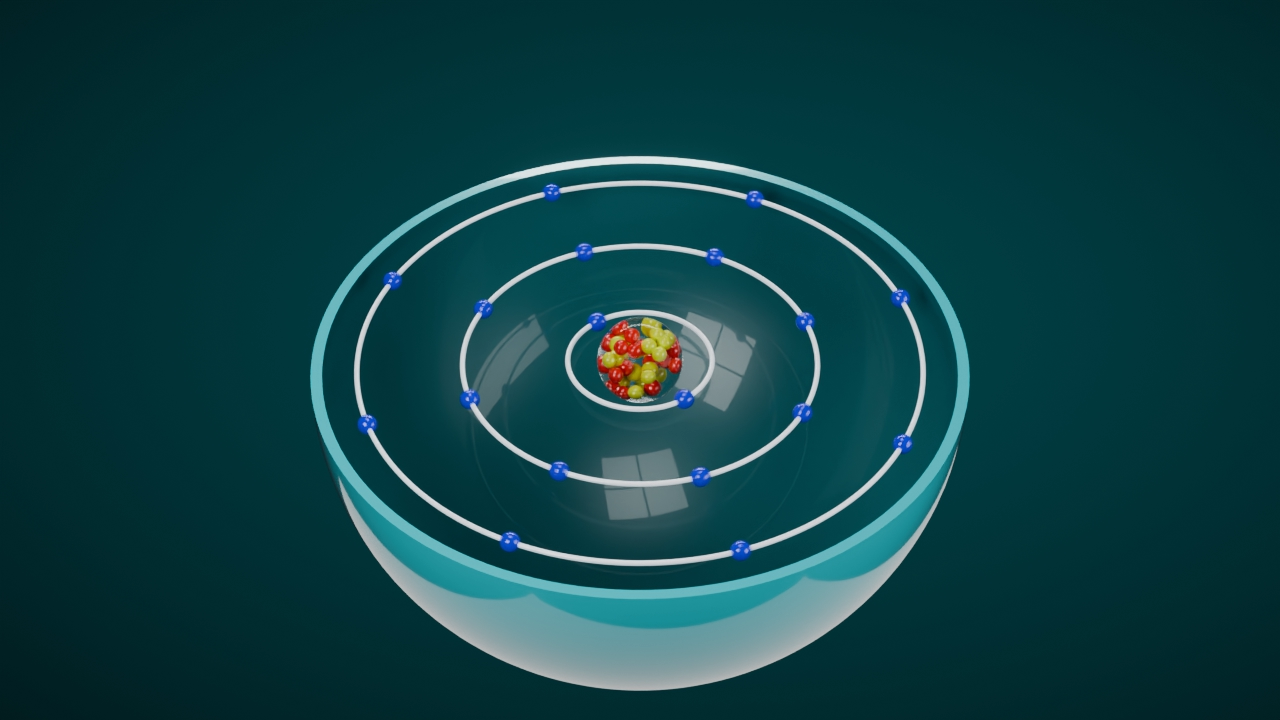
Rotate the 3D Bohr model of argon
Drag to orbit, scroll to zoom.
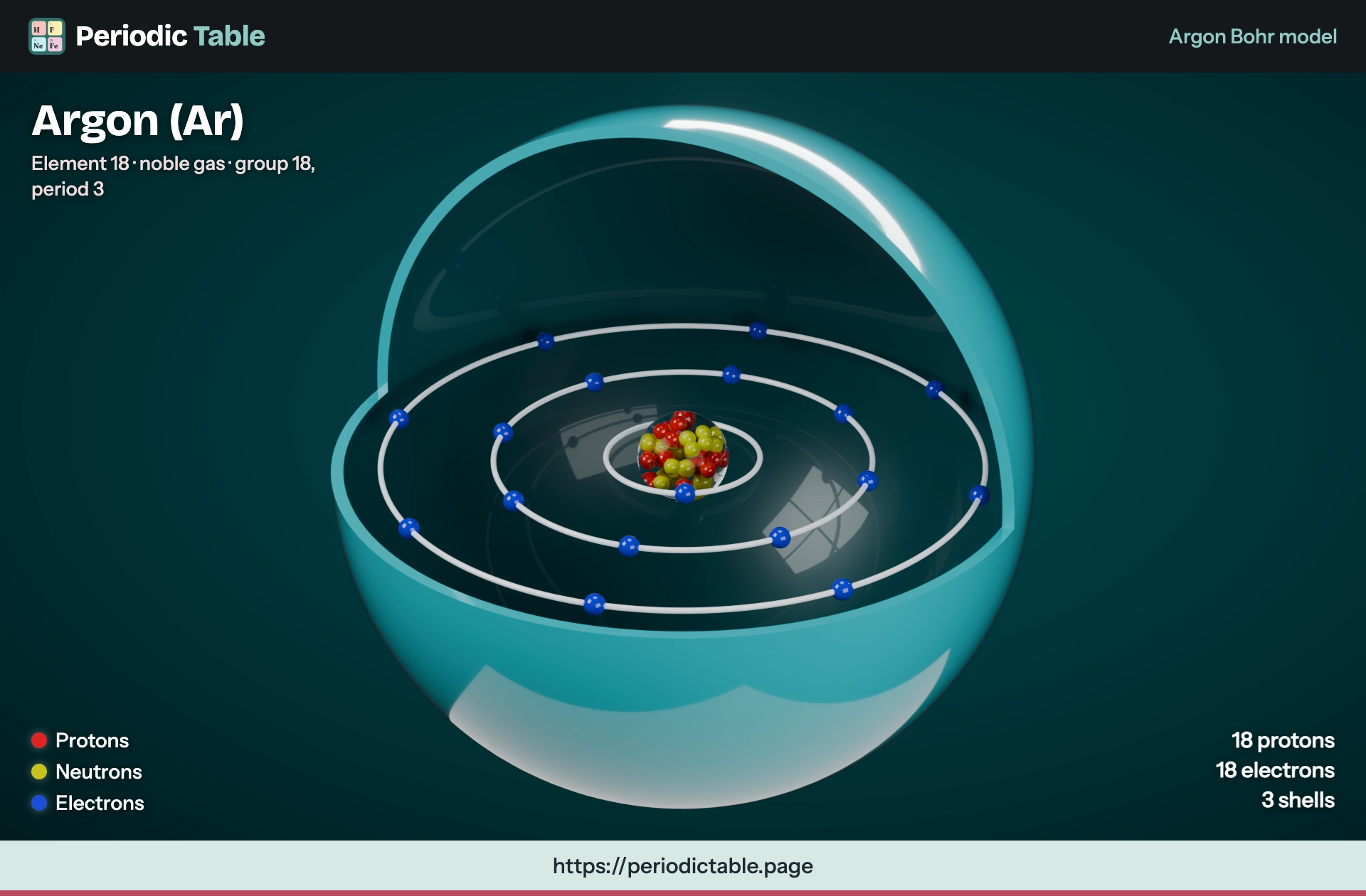
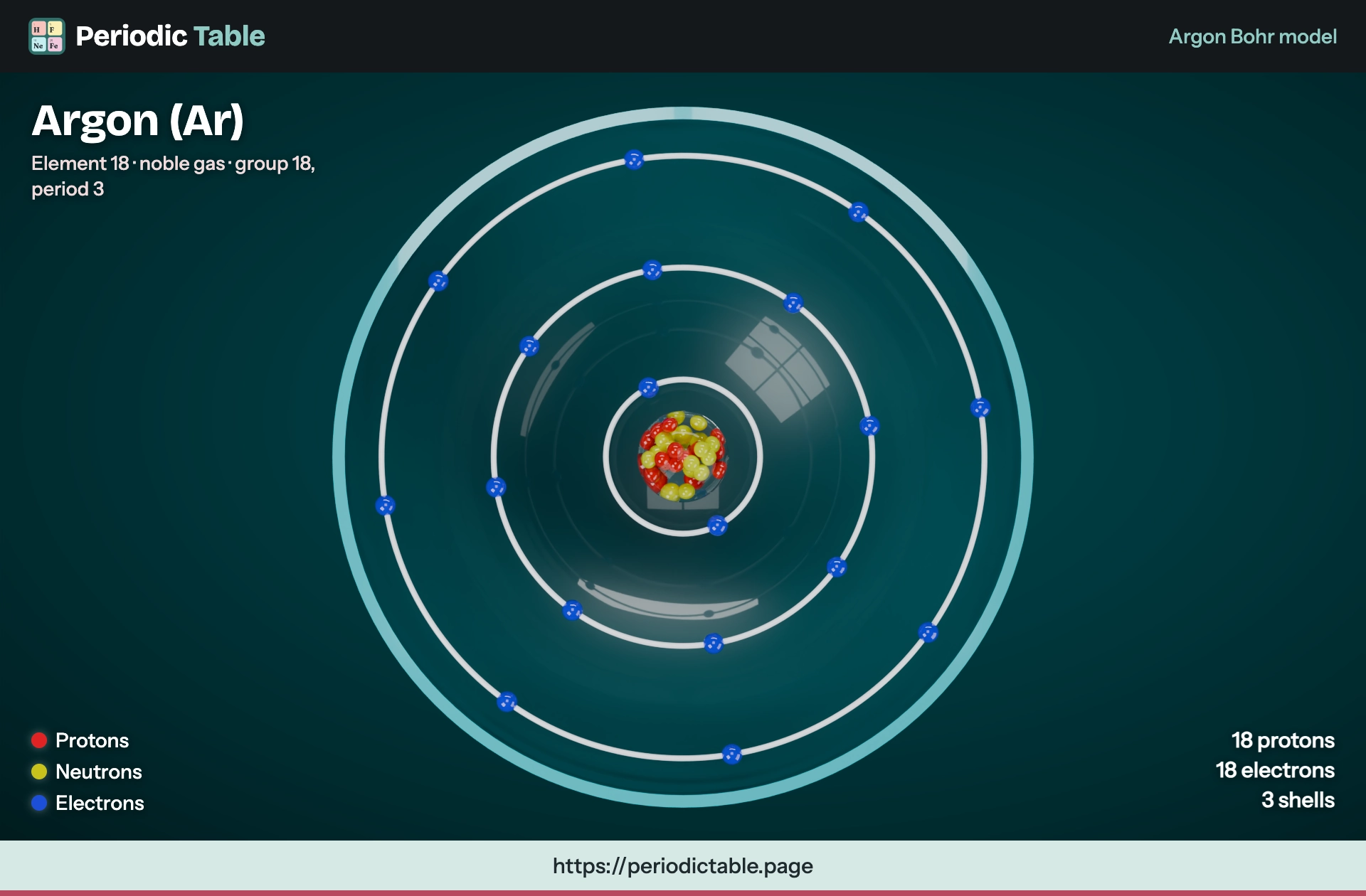
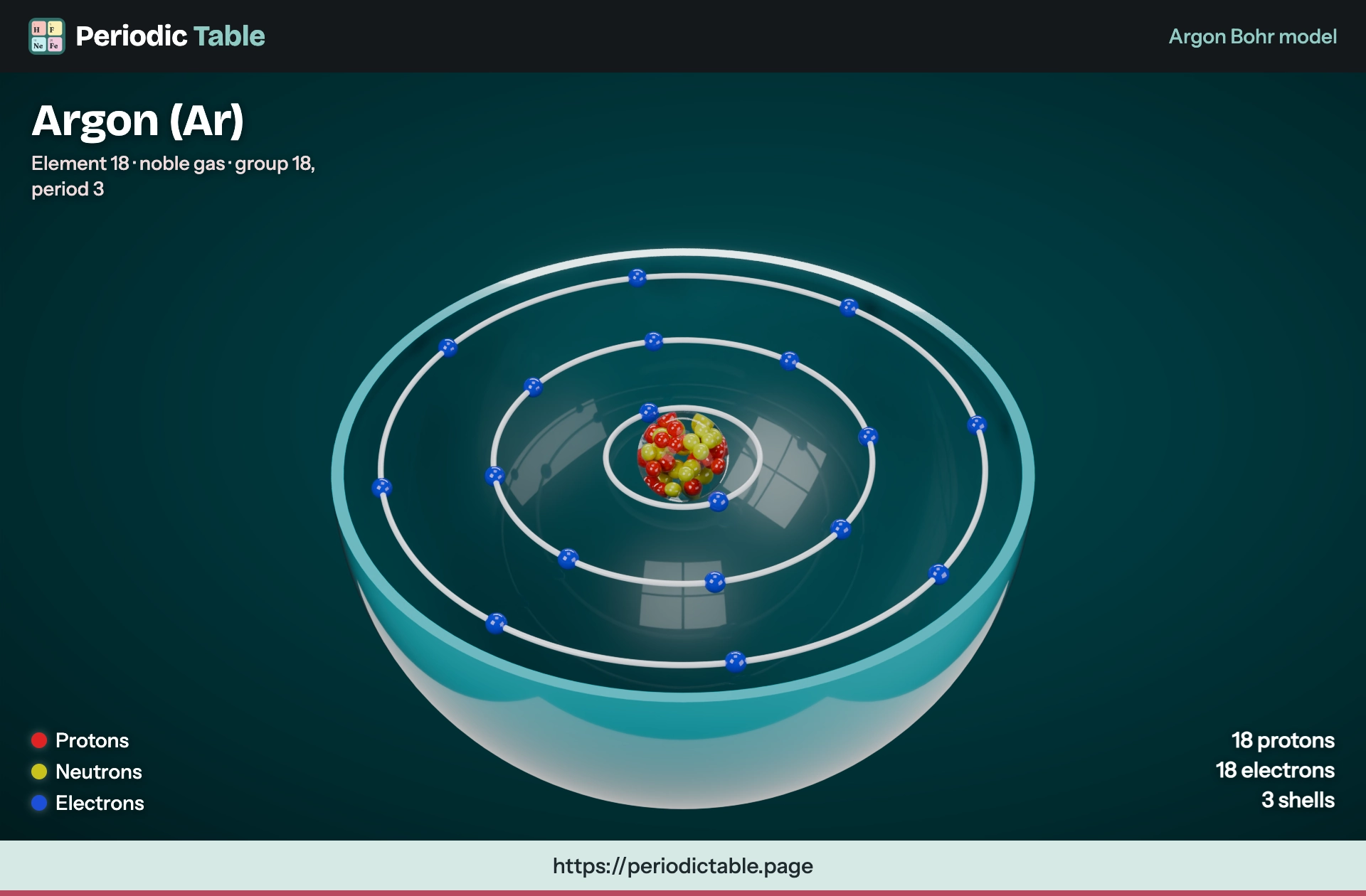
This is a Bohr model of argon (Ar), a simplified picture of a single argon atom. Its nucleus holds 18 protons, and a neutral argon atom has 18 electrons, arranged around it in 3 shells (2 in shell K, 8 in shell L and 8 in shell M).
Argon periodic table electron configuration
- Shorthand
- [Ne] 3s2 3p6
- Full
- 1s2 2s2 2p6 3s2 3p6
- Electrons per shell
- 2, 8, 8
Argon element properties and atomic data
- Atomic number
- 18
- Atomic mass
- 39.9481 u
- Phase at STP
- Gas
- Melting point
- -189.34°C (83.81 K)
- Boiling point
- -185.85°C (87.302 K)
- Density
- 0.001784 g/cm³
- Electronegativity (Pauling)
- Unknown
- Period
- 3
- Group
- 18
- Block
- p-block
- Appearance
- Colorless gas exhibiting a lilac/violet glow when placed in a high voltage electric field
- Discovery date
- 1894
- Discovered by
- Lord Rayleigh
- Named by
- —
Argon (Ar) at a glance: atomic data for element 18
On the periodic table, argon carries the symbol Ar and closes out period 3, coming right after chlorine and just before potassium, which opens period 4. Its nucleus holds 18 protons, and the most common form adds 22 neutrons. The table gathers the core identifiers you'll need for homework, lab work or a data sheet. Before studying oxidation states, half-lives and the odd metallurgy of a metal that shrinks on heating, look up element 94, plutonium for data on its radioactive isotopes and alloys.
| Property | Value |
|---|---|
| Symbol | Ar |
| Atomic number | 18 |
| Standard atomic weight | 39.95 |
| Group / period / block | Group 18 / Period 3 / p-block |
| Atomic radius | 71 pm (calculated) |
| Van der Waals radius | 188 pm |
| CAS number | 7440-37-1 |
The van der Waals radius is the figure that matters in practice, because Ar atoms never bond to their neighbours and only touch through weak attractions. The quoted atomic radius varies with the method used, so check which definition a source applies before you compare elements.
Electron configuration and the complete octet
Argon's electron configuration is [Ne] 3s2 3p6, or 2, 8, 8 per shell. That outer shell of eight is a complete octet: both subshells are full, so there is nothing to gain by sharing, taking or giving away electrons. This single fact explains almost everything about its chemistry.
Physical properties of argon gas
These physical properties are what engineers actually design around. It liquefies only at cryogenic cold, it sinks below lighter gases, and it conducts heat poorly, which is why it ends up between window panes and inside diving gear. Metallurgy and magnetism, especially strong diamagnetic behavior, are covered in the bismuth atomic number with a note on radioactivity.
| Physical property | Value |
|---|---|
| Melting point | 83.81 K (−189.34 °C) |
| Boiling point | 87.302 K (−185.848 °C) |
| Density at STP | 1.784 g/L |
| Triple point | 83.8058 K, 68.89 kPa |
| Specific heat capacity | 520 J/(kg·K) |
| Thermal conductivity (300 K) | 17.72 mW/(m·K) |
| Crystal structure (solid) | Face-centered cubic |
| Magnetic ordering | Diamagnetic |
Notice how narrow the liquid range is: only about 3.5 kelvin separates melting from boiling, so solid argon forms almost as soon as the liquid is cooled. The triple point is precise enough to serve as a defining fixed point on the International Temperature Scale of 1990, used to calibrate thermometers worldwide.
To see what the density figure means, take a bedroom of 4 m × 5 m × 2.5 m, or 50 m³ of air. At 0.934% by volume that room holds about 467 litres of argon, and at 1.784 g/L (0 °C and standard pressure) that is roughly 833 grams, close to a bag of sugar floating invisibly around you. Its molar mass of 39.95 g/mol is about 1.38 times the 28.97 g/mol average for dry air, so argon is denser than air by roughly 38%.
Why the noble gas barely reacts
With its octet full, argon is chemically inert under ordinary conditions. It is nonflammable, nontoxic and unreactive in any state, and it forms no stable compounds at everyday temperatures. That non-reactive nature is not a weakness: it is the whole reason industry buys argon. Readers worried about nerve agents, pesticides and organophosphates built on the same atom should consult the reactive nonmetal phosphorus for guides on toxic compounds and safety.
Where a hot metal would grab reactive species from the surroundings, element 18 simply sits there and keeps them away. It also dissolves in water a little, which is why traces turn up in seawater and groundwater.
Ionization energies, electronegativity and oxidation states
The numbers confirm the reluctance. Its first ionization energy is more than three times that of sodium, so pulling off even one electron costs a lot of energy.
- Ionization energies: 1,520.6 kJ/mol (1st), 2,665.8 kJ/mol (2nd), 3,931 kJ/mol (3rd)
- Electronegativity: no Pauling value, because there are no ordinary bonds to measure
- Oxidation states: 0 in practice, even in its rare fluorohydride
- Electron affinity: not stable, since an extra electron would have to start a new shell
The discovery of argon in 1894
The story starts a century before the discovery. In 1785, Henry Cavendish passed sparks through a trapped sample over alkali and was left with a small bubble, about 1%, that refused to react. He noted it and moved on.
In the early 1890s Lord Rayleigh noticed that atmospheric nitrogen was about 0.5% heavier than nitrogen made from ammonia. Working with William Ramsay at University College London, he stripped every known component from a sample. Ramsay passed the leftover repeatedly over hot magnesium, which soaks up nitrogen, and still had a dense residue that would not react.
The proof came from spectroscopy. The residue gave spectral lines in red and green that matched no known element, and in 1894 the pair announced argon. They chose a name meaning "the lazy one."
The emission spectrum of ordinary samples had already shown unexplained lines in 1882, but no one had isolated their source. Rayleigh won the 1904 Nobel Prize in Physics and Ramsay the Nobel Prize in Chemistry. Until 1957 the symbol was "A"; the IUPAC then changed it to the two-letter form used today.
Where argon occurs: Earth's atmosphere, crust and space
Almost all of Earth's supply sits in the atmosphere: nearly 1% by volume and about 1.29% by mass of Earth's atmosphere, more than twice as common as water vapour on average and about 23 times as common as carbon dioxide. The Earth's crust holds around 1.2 ppm and seawater about 0.45 ppm.
That supply has built up over roughly 4.5 billion years, as radioactive minerals break down and release argon. In space the picture is different.
Stars make the lighter isotope through stellar nucleosynthesis, especially in a supernova, and argonium ions found in the Crab Nebula were the first molecule containing a noble element detected beyond Earth. The thin skies of Mars and the thick haze of Saturn's moon Titan contain argon as well.
Argon isotopes: argon-40, argon-36 and argon-39
Three stable isotopes make up natural samples, and their mix tells you where a sample came from.
| Isotope | Abundance on Earth | Half-life | Origin |
|---|---|---|---|
| 40Ar | 99.6% | Stable | Decay of K-40 in the crust |
| 36Ar | 0.334% | Stable | Made in stars |
| 38Ar | 0.063% | Stable | Made in stars |
| 39Ar | Trace | 269 years | Cosmic rays high above Earth |
On Earth, argon-40 dominates because it comes from radioactive decay. Potassium-40 turns into it by electron capture:
$$^{40}_{19}\mathrm{K} + e^- \rightarrow {}^{40}_{18}\mathrm{Ar} + \nu_e$$
In the Sun and the outer planets, by contrast, argon-36 is the main argon isotope, made directly in stars. That radiogenic surplus is why terrestrial samples are heavier on average than the element after it in the table. Argon-39, with its short half-life, is used to date ice cores and groundwater.
Radiometric dating of rocks
Because K-40 decays to Ar-40 at a known rate, the ratio of the two locked inside a crystal works as a clock. Argon-argon dating, a refinement of the older K-Ar method, dates volcanic, metamorphic and sedimentary rocks from thousands to billions of years old.
Argon compounds and the HArF exception
For most of the 20th century chemists assumed element 18 formed no compounds at all. The first widely recognised exception came in 2000, when researchers in Helsinki shone ultraviolet light on frozen Ar containing hydrogen fluoride and made argon fluorohydride. It is the best-known argon compound, but it only survives below about 17 K; warm it slightly and it falls apart.
A few other oddities exist. Atoms can sit trapped inside water-ice cages called clathrates, a tungsten carbonyl complex was isolated in 1975, and the positive ion argonium (ArH+) appears in interstellar clouds. None of these change the everyday picture of an element that bonds with nothing.
Producing liquid argon by fractional distillation
All commercial supply comes from fractional distillation of liquid air in a cryogenic air separation unit:
- Intake is filtered, compressed and stripped of water and carbon dioxide.
- It is cooled until it liquefies, then fed into a tall column.
- Each fraction boils off in turn: liquid nitrogen at 77.3 K, Ar at 87.3 K and liquid oxygen at 90.2 K.
- Because it boils so close to oxygen, a side column draws off crude liquid argon for final purification.
Since it is a by-product of the same plants, this industrial gas stays cheap: around 700,000 tonnes are produced each year, and supply risk is low because the reserve is effectively unlimited.
Uses of argon as an inert gas
Most applications come down to two facts: it is an inert gas, and it is far cheaper than helium or xenon. When nitrogen is not unreactive enough for a job, manufacturers reach for argon next.
Shielding gas for metals and industrial processes
The biggest market is as a shielding gas. In gas tungsten arc welding (TIG) and gas metal arc welding (MIG), a steady flow blankets the electric arc and molten pool so oxygen and moisture cannot form oxides or porosity.
Steelmakers blow argon through molten metal to stir it, and it protects reactive metals such as titanium during processing. The same blanket also lets graphite furnaces run without burning, and lets manufacturers grow crystals of silicon and germanium for electronics.
Lighting and argon lasers
It fills incandescent light bulbs to stop the hot filament from degrading, and it helps start fluorescent tubes. When electricity passes through it in a gas-discharge lamp, the resulting plasma gives a lilac or violet glow; add a trace of mercury and you get a blue light. Argon-ion lasers emit blue-green beams, and argon lasers are still used in eye surgery to seal leaking retinal blood vessels.
Argon as a preservative
- Food: it pushes out oxygen and moisture to extend shelf life, under the additive code E938.
- Wine: in winemaking, a layer over the surface keeps wine in part-filled tanks from spoiling.
- Documents: since 2002 the US National Archives has kept the Declaration of Independence in sealed cases filled with it.
Laboratory, medical and research applications
Chemists fill gloveboxes and Schlenk lines with it to handle air-sensitive reagents, use it as a carrier in gas chromatography, and burn it as the plasma for ICP spectroscopy. Chipmakers rely on it for sputter deposition of thin films.
In medicine, cryosurgery and cryoablation use the cold liquid to destroy tumours, and laser surgery uses its beam to seal tissue. Physicists fill giant tanks to hunt for dark matter and to track neutrino collisions, reading the faint scintillation flashes it gives off.
Insulation, diving and other applications
Its low conductivity makes it good thermal insulation for energy-efficient windows, filling the gap between double-glazed panes. Technical divers use it to inflate a dry suit in scuba diving, keeping diving suits warmer than ordinary breathing mix would. Some high-end car tires are filled with it to slow rubber ageing and cut road noise.
Argon compared with the other noble gases in group 18
All six natural noble gases in the right-hand column of the periodic table share a full outer shell, but they differ hugely in how common they are. That abundance, more than any special property, makes argon the workhorse of the family.
| Element | Z | Atmospheric share | Main use |
|---|---|---|---|
| Helium (He) | 2 | 5.2 ppm | MRI cooling, leak detection |
| Neon (Ne) | 10 | 18.2 ppm | Signs and indicator lamps |
| Argon (Ar) | 18 | 9,340 ppm | Shielding, lamps, insulation |
| Krypton (Kr) | 36 | 1.1 ppm | Premium window fill |
| Xenon (Xe) | 54 | 0.09 ppm | Ion thrusters, anaesthesia |
| Radon (Rn) | 86 | Trace, radioactive | Research only |
It is roughly 500 times more abundant than neon, the next most common member, which is why it costs a fraction of the price.
Argon atmosphere safety and asphyxiation risk
The element is nontoxic, but an argon atmosphere can still kill. It is a simple asphyxiant: being heavier, it pools in low points and displaces oxygen without any warning smell or colour.
In confined spaces such as tanks, pits or pipe sections, a leak can push breathable levels down in minutes, and asphyxiation follows. Good safety practice means forced ventilation, an oxygen monitor before entry, and never trusting your senses to detect it.