


Phosphorus element (P): phosphorus periodic table facts
Phosphorus periodic table facts: phosphorus (P) is element 15, a reactive nonmetal in group 15, period 3. Strike a match, eat a slice of cheese or spread fertiliser on a vegetable bed and you are handling phosphorus, the highly reactive non-metallic element that sits at number 15 on the periodic table. If you wonder why a complete octet keeps this colorless, odorless gas unreactive, the argon element has the answer.
Its name means "bringer of light," a nod to the green glow that first amazed chemists, yet you never find elemental phosphorus lying free in nature. This guide walks you through what phosphorus is as a chemical element, why every form of life needs it, and how one element can be both a poison and a vital nutrient.
Rotate the 3D Bohr model of phosphorus
Drag to orbit, scroll to zoom.
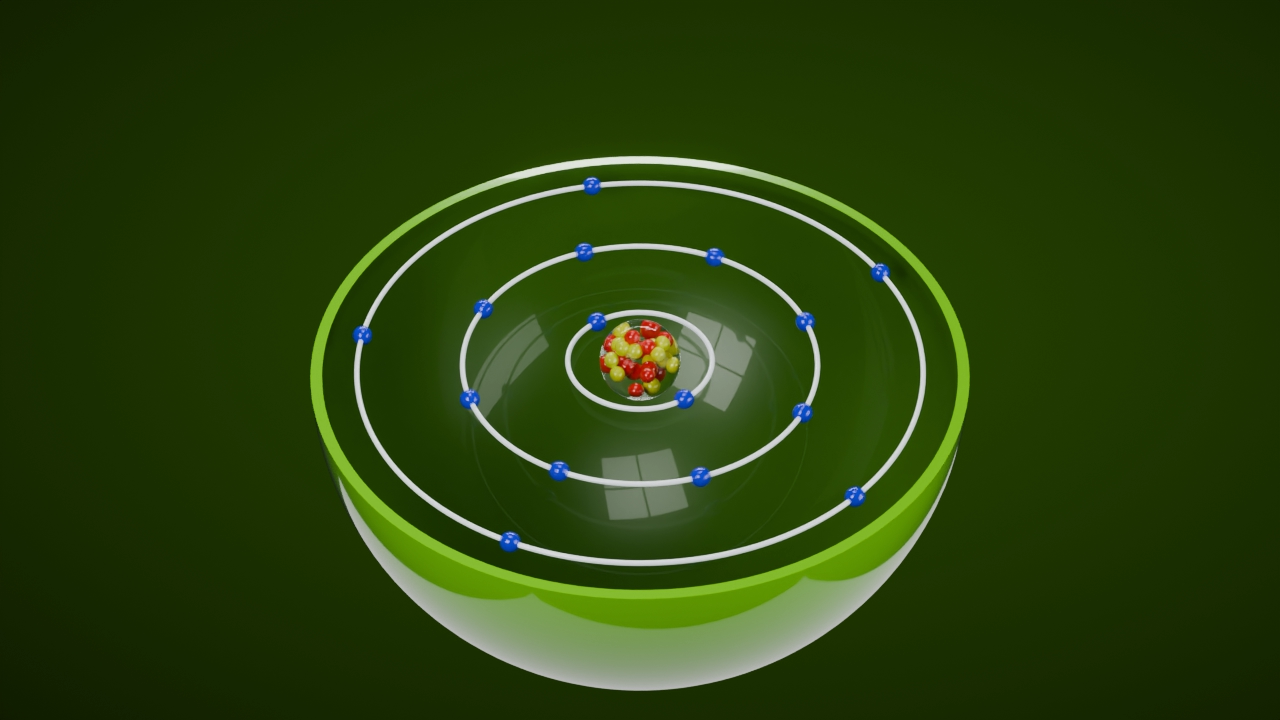
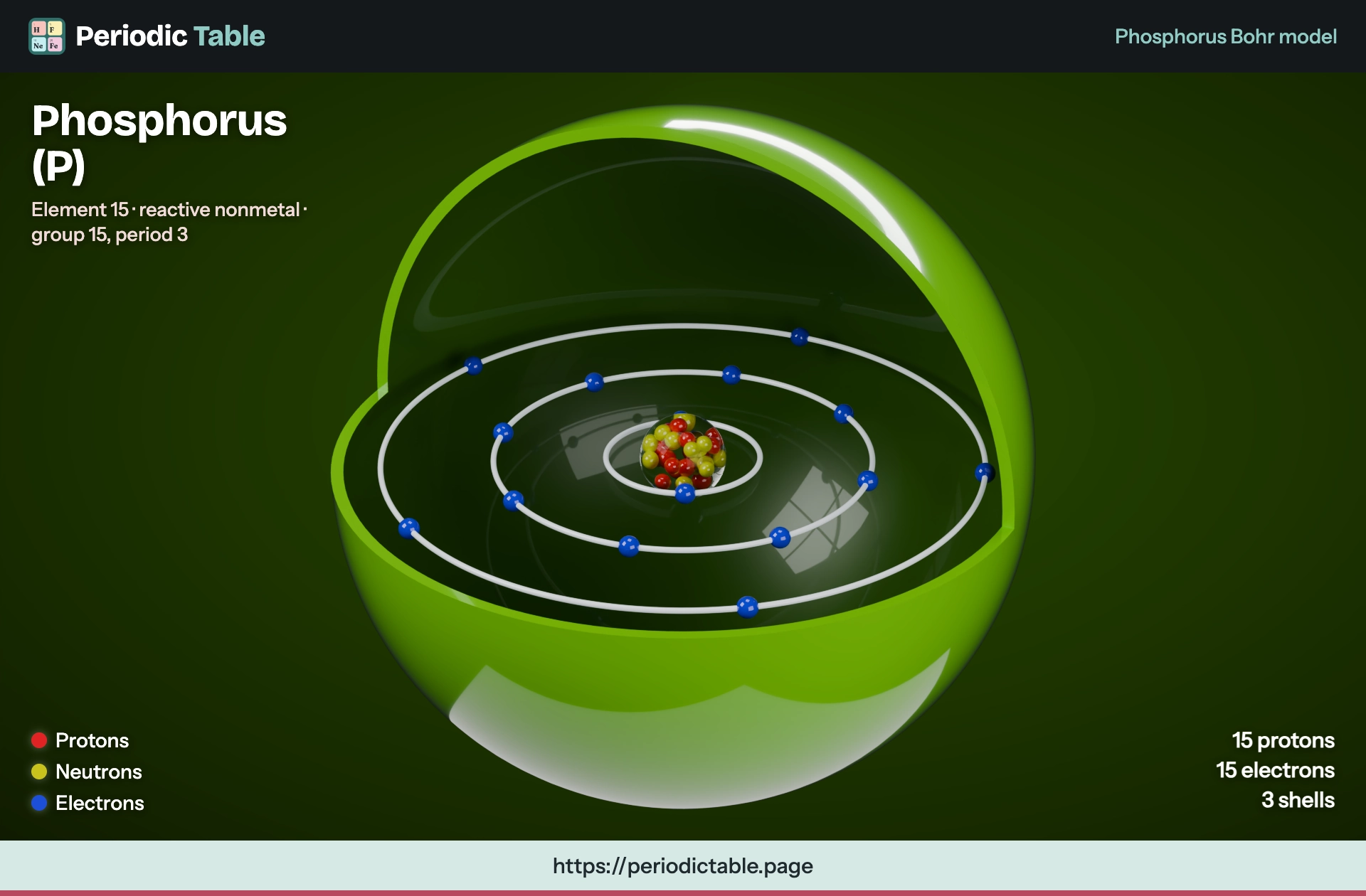
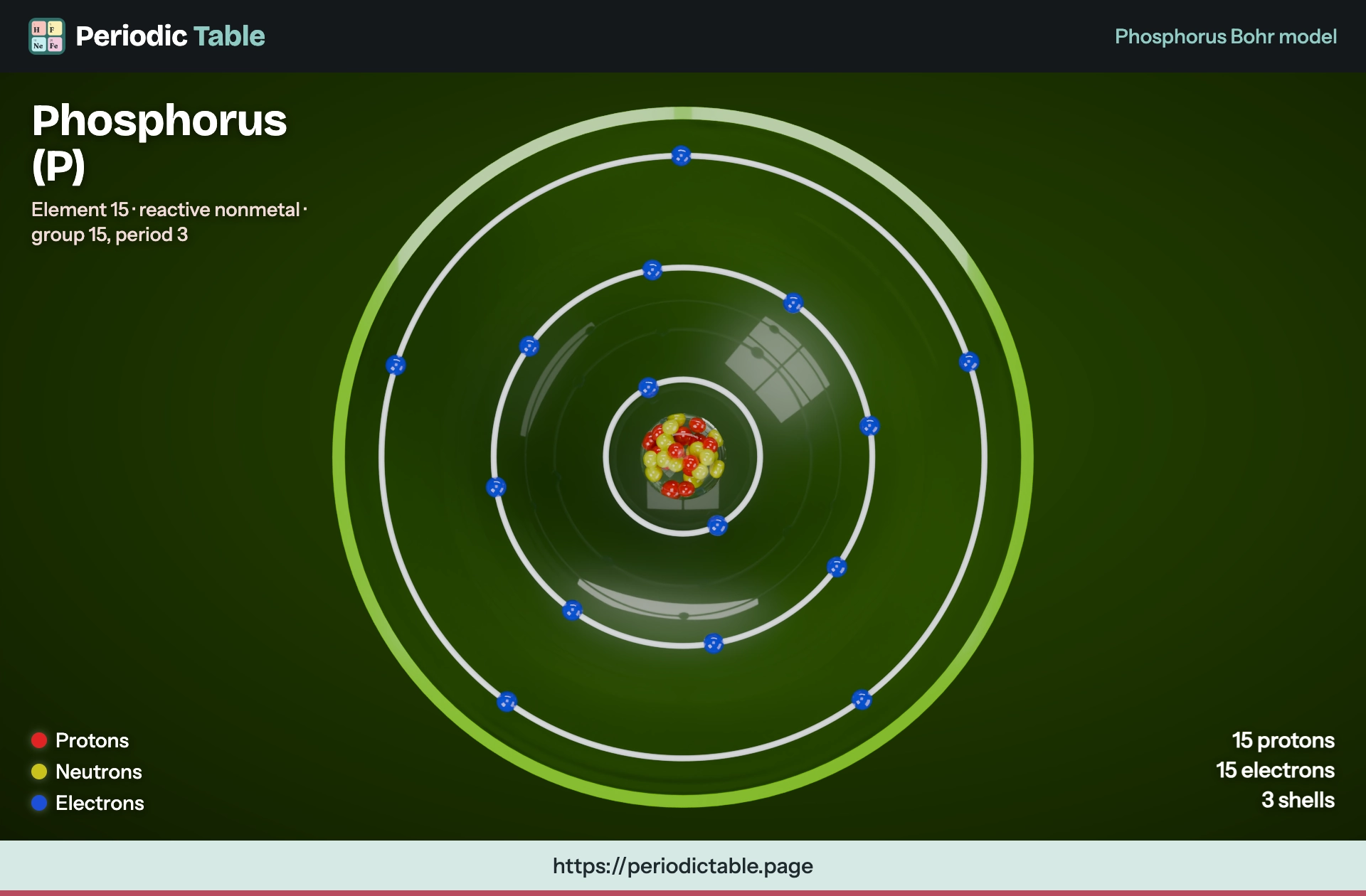
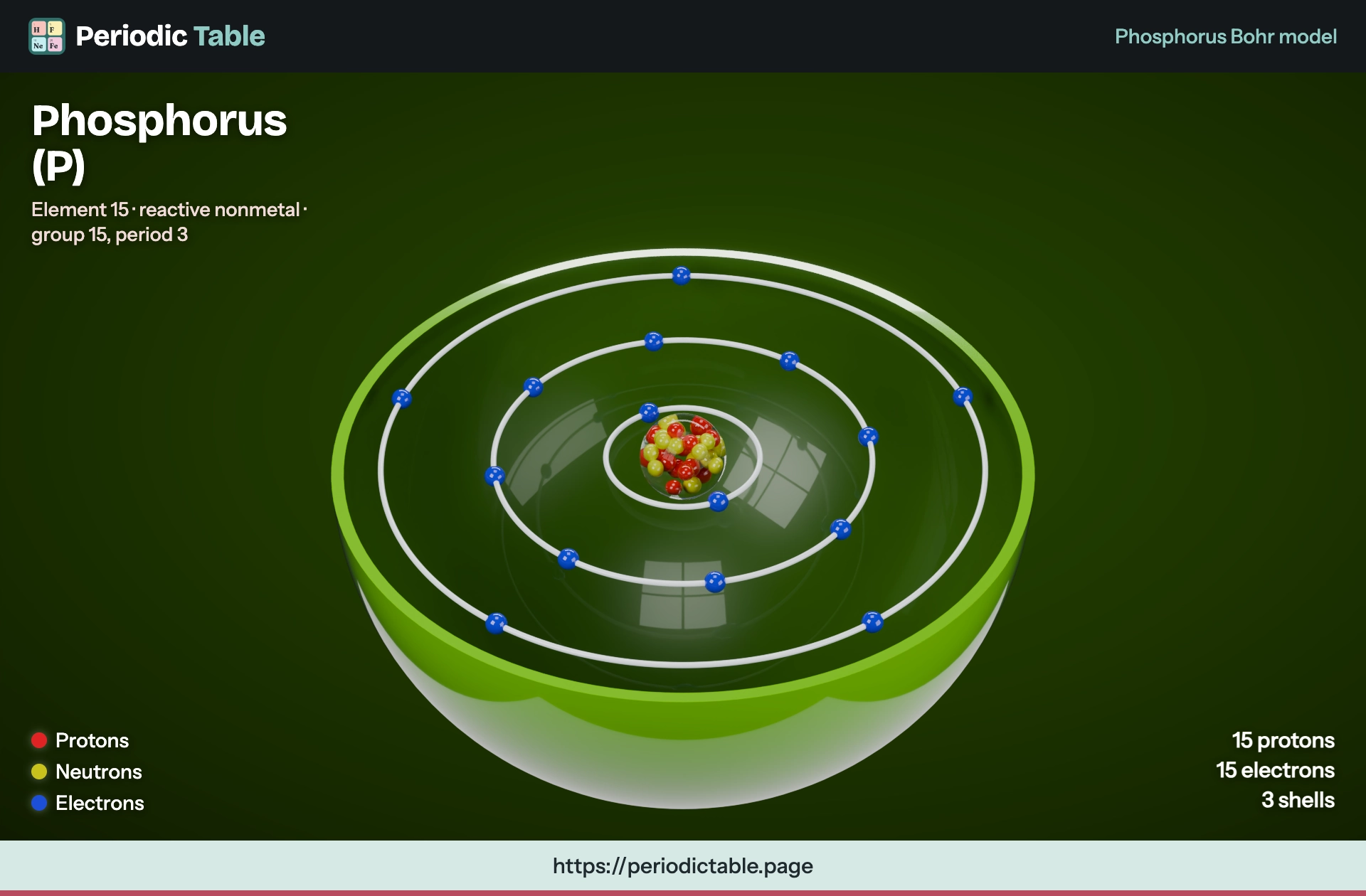
This is a Bohr model of phosphorus (P), a simplified picture of a single phosphorus atom. Its nucleus holds 15 protons, and a neutral phosphorus atom has 15 electrons, arranged around it in 3 shells (2 in shell K, 8 in shell L and 5 in shell M).
Phosphorus periodic table electron configuration
- Shorthand
- [Ne] 3s2 3p3
- Full
- 1s2 2s2 2p6 3s2 3p3
- Electrons per shell
- 2, 8, 5
Phosphorus element properties and atomic data
- Atomic number
- 15
- Atomic mass
- 30.9738 u
- Phase at STP
- Solid
- Melting point
- 44.15°C (317.3 K)
- Boiling point
- Unknown
- Density
- 1.823 g/cm³
- Electronegativity (Pauling)
- 2.19
- Period
- 3
- Group
- 15
- Block
- p-block
- Appearance
- Colourless, waxy white, yellow, scarlet, red, violet, black
- Discovery date
- 1669
- Discovered by
- Hennig Brand
- Named by
- —
Phosphorus element facts at a glance
Before you get into allotropes and compounds, it helps to know the numbers that define the phosphorus element. Its chemical symbol is P, and nearly every property depends on which form you are looking at, because white, red and black forms melt, dissolve and conduct electricity in very different ways. The table below lists the standard reference values. Before choosing a surgical implant material, read the titanium melting point page on the passivation layer and corrosion resistance.
| Property | Value for P |
|---|---|
| Symbol and proton number | P, 15 |
| Standard atomic weight | 30.974 |
| Classification | Nonmetal (pnictogen) |
| State at room temperature | Solid |
| Melting point (white form) | 44.15 °C (317.3 K) |
| Boiling point (white form) | 280.5 °C (553.7 K) |
| Density | 1.823 g/cm³ (white) to 2.69 g/cm³ (black) |
| Electronegativity (Pauling) | 2.19 |
| Stable isotope | P-31, 100% natural abundance |
| Abundance in Earth's crust | About 0.1% by mass |
White phosphorus melts at a low temperature, while red phosphorus is a dark solid that only sublimes above about 400 °C. Their crystal structure differs too: alpha-white crystals are cubic, and the black form is orthorhombic, with puckered layers.
Atomic number, electron configuration and oxidation states
An atomic number of 15 means each phosphorus atom holds 15 protons and 15 electrons. The full arrangement is 1s² 2s² 2p⁶ 3s² 3p³, usually shortened to [Ne] 3s² 3p³. The five outer electrons are the valence electrons that do the chemistry.
To fill its outer shell, phosphorus can gain three electrons (−3) or share them, so its main oxidation states are −3, +3 and +5. With an electronegativity of 2.19, it pulls on electrons less strongly than carbon or sulfur.
Group 15 and period 3: where P sits
Phosphorus sits in group 15 and period 3, directly below nitrogen and above arsenic, with silicon to its left and sulfur to its right. Members of this family are called pnictogens. You can predict a lot about phosphorus from its place on the periodic table: like its neighbours it forms both covalent oxides and acids, but it is also the lightest element that regularly forms more than four bonds, as in PCl5.
Isotopes, phosphorus-31 and radioactive tracers
Researchers know of more than twenty isotopes, but only phosphorus-31 is stable, so natural samples are a single isotope. That makes P-31 ideal for NMR spectroscopy. Two radioactive versions are useful as tracers in labs: phosphorus-32, a beta emitter with a half-life of about 14.3 days that is used to label DNA probes, and P-33, which lasts about 25.4 days and gives off weaker radiation.
History and discovery of phosphorus, the light-bearer
The discovery happened by accident. In 1669, the Hamburg alchemist Hennig Brand was hunting for the philosopher's stone, the mythical substance meant to turn base metals into gold. Anyone studying paramagnetic behavior, malleable metal traits and f-block neighbors like neodymium can find details on element 59 too, including its magnetic behavior.
He boiled down large quantities of urine, heated the residue to red heat and collected a white, waxy material that glowed in the dark. Brand called it phosphorus mirabilis, the "miraculous bearer of light," borrowing the Greek name for the morning star, the planet Venus.
Phosphorus became the 13th known element and the first discovered since ancient times. Brand kept his method secret and later sold it, but Robert Boyle worked out his own route to phosphorus in 1680 and published it. Nearly a century later, in 1777, Antoine Lavoisier listed phosphorus as a true element, the light bearer of the new chemistry.
From bone ash and guano to mined ore
Urine was never a practical source. In 1769, chemists showed that bones contain calcium phosphate, and bone ash treated with acid became the main industrial source of phosphorus until the 1840s. Bird and bat guano from Pacific and Peruvian islands supplied fertiliser through the mid-1800s, until the deposits ran out and producers turned to phosphate rock and to superphosphate made with acid.
Early matches and phossy jaw
The first friction matches of the 1830s had heads made of white phosphorus, often aged until it turned yellow (so-called yellow phosphorus). Factory workers who breathed the fumes developed phossy jaw, a painful decay of the jawbone, and the danger helped spark the 1888 London matchgirls' strike. Countries banned these matches between 1872 and 1925.
Allotropes of phosphorus: four very different forms
Allotropes are different structural forms of the same element, and few elements show the idea as clearly as phosphorus. The same atoms can be a soft solid that bursts into flame in warm air, a stable dark red solid, or a black flaky solid that conducts electricity. Here is how the main forms of phosphorus compare.
White phosphorus and its ghostly glow
White phosphorus is made of P4 molecules, each a tiny pyramid of four atoms, and in the solid these tetrahedra pack into a waxy, translucent material that does not dissolve in water. It is highly flammable and pyrophoric, catching fire on its own at about 30 °C, and extremely toxic, which is why it is always stored under water.
Exposed to air, white phosphorus glows in the dark with a faint green light. That light is not phosphorescence at all but chemiluminescence, light given off by a slow chemical reaction with air at its surface.
$$\mathrm{P_4 + 5\,O_2 \rightarrow P_4O_{10}}$$Red phosphorus and violet phosphorus
Heat white phosphorus to about 250 °C without air, or leave it in sunlight, and the P4 units link into long polymer chains. The result, red phosphorus, does not ignite on its own at room temperature and is far less toxic. If you anneal red phosphorus above 550 °C, it crystallises into violet phosphorus, also called Hittorf's form after the chemist who made it in 1865 from molten lead.
Black phosphorus and phosphorene
Black phosphorus is the most stable and most dense form, made by squeezing white phosphorus at about 1.2 gigapascals. It looks and behaves like graphite: flaky, shiny and able to conduct electricity. Peel off one atom-thick sheet and you get phosphorene, a two-dimensional material researchers are testing for transistors and batteries.
Chemical properties and phosphorus compounds
As a non-metal, phosphorus is never found uncombined in nature because it reacts with oxygen so readily. Both white phosphorus and red phosphorus act as a strong reducing agent, giving up electrons to almost any oxidiser. Most of the chemistry you meet in daily life involves phosphorus compounds in the +5 oxidation state, where the element is bonded to four oxygen atoms as phosphate.
Phosphoric acid and buffers
Burning phosphorus in air gives phosphorus pentoxide (P4O10), a white solid that reacts violently with water to form phosphoric acid, H3PO4. That acid gives up its three hydrogen ions one at a time:
$$\mathrm{H_3PO_4 \rightleftharpoons H_2PO_4^- \rightleftharpoons HPO_4^{2-} \rightleftharpoons PO_4^{3-}}$$Each species has its own pH in water. When you mix two neighbouring ones you get a buffer, a solution that resists changes in acidity.
Phosphate mixtures can be blended to hold almost any pH, which is why they are used in foods, drinks and lab work. The fully stripped phosphate ion, PO43−, is strongly basic, so trisodium phosphate makes an effective heavy-duty cleaner.
Phosphates, halides and phosphine
With metals, phosphate forms salts that are often insoluble, so many occur as minerals. Calcium phosphate is the most important of these, used in baking powder and toothpaste. Condensed phosphates link several PO4 units through shared corners.
Phosphorus chlorides and hydrides
With chlorine, phosphorus forms PCl3 and PCl5, key industrial reagents. With hydrogen it forms phosphine (PH3), a foul-smelling, poisonous gas that resembles ammonia but is much less basic.
Organophosphorus compounds, pesticides and nerve agents
Compounds with P–C or P–O–C bonds are grouped as organophosphorus chemistry. Many organophosphates are useful flame retardants and plasticisers. Others block a key nervous-system enzyme, which makes them effective insecticides such as malathion, and in their most potent forms, nerve agents like sarin and VX.
Biological role of phosphorus in living things
Its biological role is hard to overstate. Phosphorus is the sixth most common element in the human body, making up about 1% of your mass, so a 70 kg adult carries roughly 0.7 kg.
Plants and animals alike use phosphorus to store genetic information, move energy around and build structure. In biology the element almost always appears as phosphate, never as the free element.
Phosphate inside every living cell
Inside cells, phosphorus does nearly all of its work as phosphate. Phosphate groups form the backbone of DNA and RNA, linking one sugar to the next along each strand.
Your cells capture energy in adenosine triphosphate (ATP), then release it by breaking off the last phosphate group to power muscle contraction, nerve signals and protein building. Every cell membrane is a double layer of phospholipids, and adding or removing a phosphate group is one of the main ways cells switch enzymes on and off.
Bones, teeth and enamel minerals
About 85-90% of the phosphorus in your body sits in your bones and teeth as hydroxyapatite, Ca5(PO4)3OH. Working out its formula mass of about 502.3 g/mol shows that this mineral is about 18.5% phosphorus by weight. Fluoride in drinking water swaps into the crystal to form fluorapatite, which is harder and resists decay better.
Nutrition, daily intake and deficiency
For adults, the U.S. Recommended Dietary Allowance is 700 mg per day, with a tolerable upper limit of 4,000 mg. Protein-rich food such as milk, meat, fish, beans and nuts supplies most of your phosphorus, so a diet with enough protein and calcium usually covers your needs.
Too little in the blood, called hypophosphatemia, causes muscle weakness and nerve problems. Too much, often from processed foods and colas, can upset calcium balance and has been linked to kidney stones.
The phosphorus cycle and fertilisers
The phosphorus cycle is unusually slow because, unlike carbon or nitrogen, phosphorus has no common gas phase. Rock weathers, plants take up dissolved phosphate through their roots, animals eat them, and decay returns it to the soil, where much of it binds tightly to minerals. Some washes into rivers and settles on the sea floor, and it can take millions of years to lift back up as new rock.
Modern fertilisers speed up the land part of this loop, but runoff from fields carries the excess into lakes and coasts. There it feeds algal blooms that use up oxygen when they die, a process called eutrophication that harms the wider environment.
Why fertilizers matter: P as a limiting nutrient
After nitrogen, phosphorus is the element most often in short supply for crops, which is why commercial fertilizers list it as the middle number on the bag. That number is the percentage of P2O5, not of the element itself, so you convert it to the real phosphorus content with the oxide's mass ratio:
$$\text{P fraction} = \frac{2 \times 30.974}{2 \times 30.974 + 5 \times 15.999} = 0.436$$A 20 kg bag labelled 12-24-12 therefore contains 24% × 0.436 = 10.5% phosphorus, or about 2.1 kg of the element that agriculture depends on.
Natural occurrence and production of elemental P
Phosphorus makes up about one gram per kilogram of the Earth's crust, always locked up in phosphate minerals. The main ore mineral is apatite, a calcium mineral that also contains fluoride, chloride or hydroxide. Astronomers have even traced the element to a supernova remnant, Cassiopeia A, confirming that it is forged inside exploding stars.
Phosphate rock mining and reserves
Almost all phosphorus now comes from phosphate rock, dug from open-pit mines in Morocco, China, the United States and Russia. The U.S. Geological Survey puts economically recoverable reserves at about 72 billion tonnes, with Morocco holding around two-thirds of the world's phosphate rock. At current extraction rates that is centuries of supply, but because the deposits are so concentrated in a few countries, prices can swing sharply, and recovering phosphorus from sewage sludge is gaining interest.
Wet process vs thermal process
- Wet process: crushed phosphate rock is treated with sulfuric acid to make phosphoric acid, the base for most fertiliser. It leaves about five tonnes of gypsum waste per tonne of acid.
- Thermal process: rock, sand and coke are heated to 1,200-1,500 °C in a submerged-arc furnace, which drives off P4 vapour that condenses as white phosphorus for high-purity chemistry.
- Output: roughly 900,000 tonnes of elemental phosphorus a year come from the thermal route, a small slice of total P use.
Everyday uses of phosphorus in industry and food
Around 90% of mined phosphorus ends up on farmland, but the remaining uses reach almost every part of daily life and industry:
- Food additives: phosphoric acid gives soft drinks their tang, and acidic phosphates make cakes rise in baking powder.
- Cleaning: phosphates act as water softeners in some detergents, although many countries now limit them because of algal growth.
- Dental care: calcium-based P salts are the gentle abrasive in toothpaste.
- Animal feed: phosphorus supplements support bone growth in livestock.
- Laboratory chemistry: P reagents are used to make medicines, dyes and plastics.
Safety matches and the striking strip
Safety matches keep the two ignition chemicals apart. The striking strip on the box holds red phosphorus mixed with powdered glass, and the match head holds potassium chlorate.
Friction blends a tiny amount of each, which ignites at once. Similar chemistry appears in pyrotechnics, while phosphate fire retardant is the red slurry dropped from aircraft over wildfires, and other P compounds serve as flame retardants in plastics.
Steel, phosphor bronze and semiconductors
Metallurgists add phosphorus to make phosphor bronze, a tough, springy copper-tin alloy, and to deoxidise copper. In steel it is usually an impurity to control, though phosphate coatings protect iron parts from rust. In electronics, P is a key dopant that turns silicon into n-type semiconductors, because each P atom brings one extra electron to carry current.
Hazards of white phosphorus
Nearly all the danger comes from the white form. Red phosphorus is relatively safe, but white phosphorus burns at very high temperatures and sticks to skin, causing deep chemical and thermal burns. Armies have used it in incendiary weapons, tracer rounds and smoke screens, and its use is now restricted by international law.
Swallowing it is just as serious: about 1 mg per kg of body weight can be fatal, and there is no antidote. It was once sold as a rodenticide, and children have been poisoned by mistaking it for food.
In the workplace, U.S. limits cap exposure at 0.1 mg/m³ over an eight-hour shift, and 5 mg/m³ is immediately dangerous to life. Burning fragments should be kept wet with water or covered until they can be removed. Because phosphorus can be used to make illegal drugs, both forms are also controlled substances in the United States.