


Titanium element (Ti): titanium periodic table facts
Titanium periodic table facts: titanium (Ti) is element 22, a transition metal in group 4, period 4. If you have ever wondered why the same metal turns up in jet engines, hip joints and the white paint on your walls, the answer is titanium (Ti), the transition metal with atomic number 22. When comparing isotopes, readers can use properties of chlorine for chlorine-35, chlorine-37 and the trace of chlorine-36 found in nature.
The element titanium pairs high strength with low density and shrugs off corrosion, and it is far from rare: William Gregor first spotted it in Cornwall in 1791, and today it is mined from rutile and ilmenite on several continents. Below you will find its key data, chemistry, history, production and uses in one place.
Rotate the 3D Bohr model of titanium
Drag to orbit, scroll to zoom.
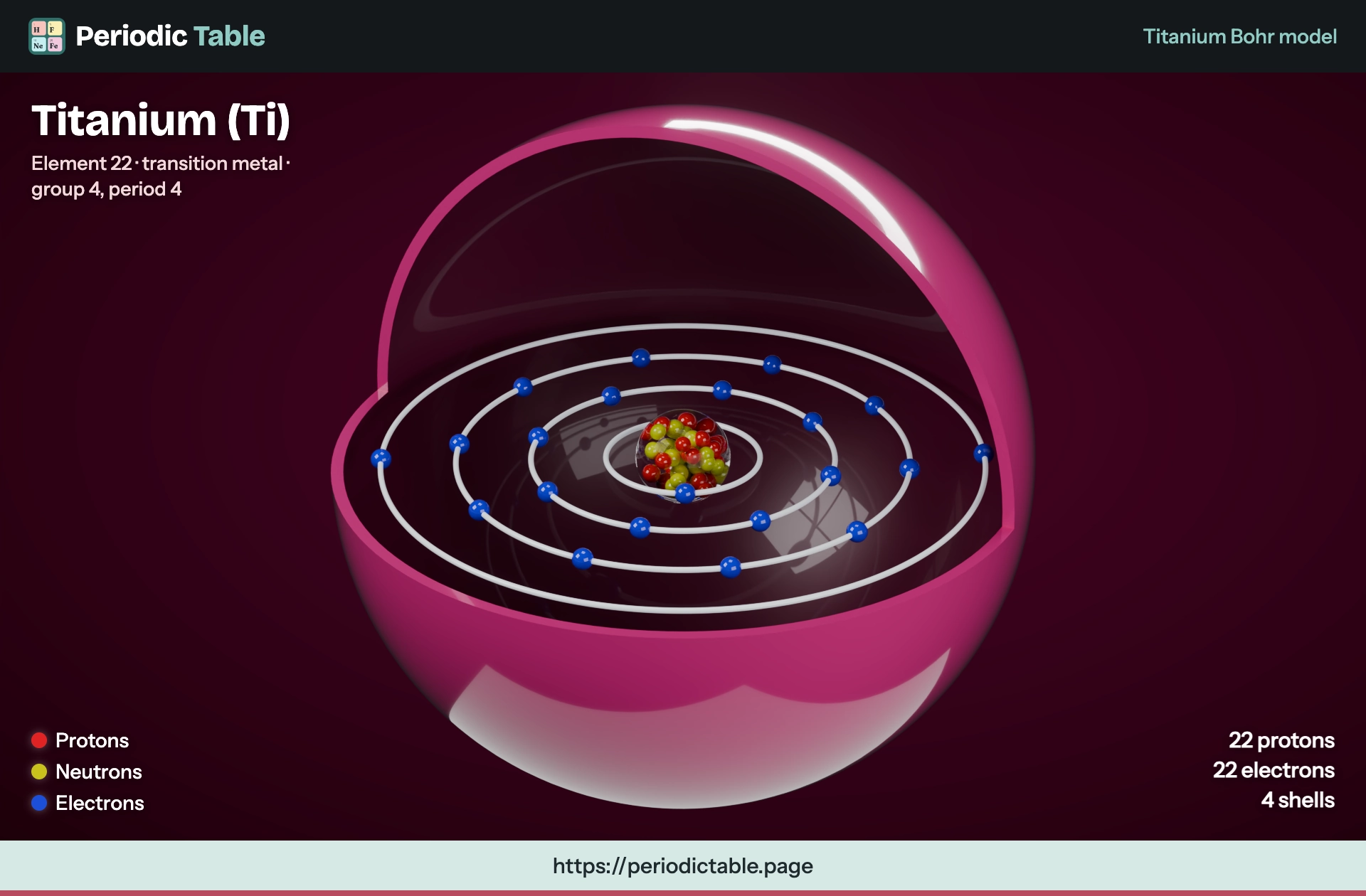
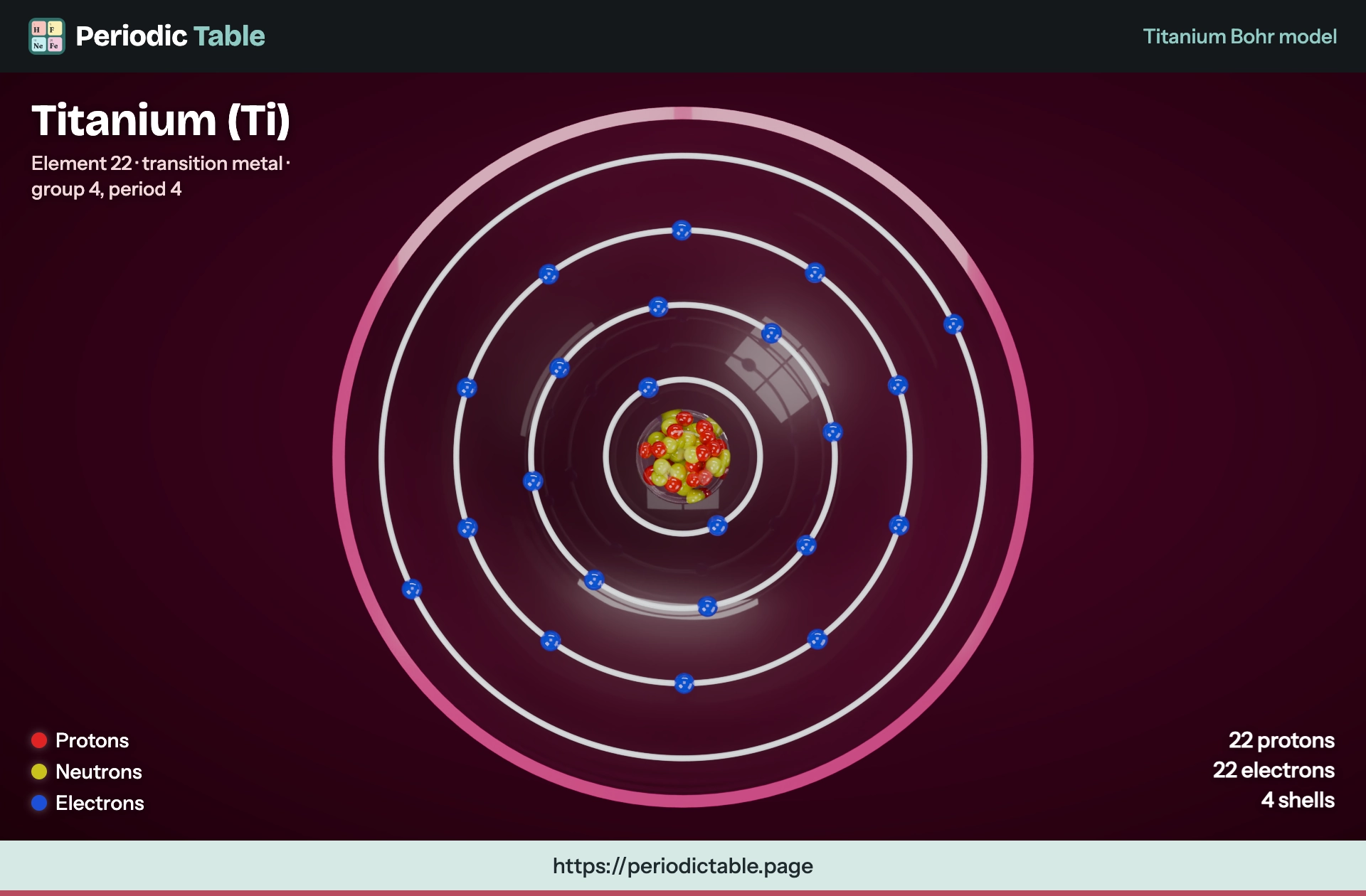
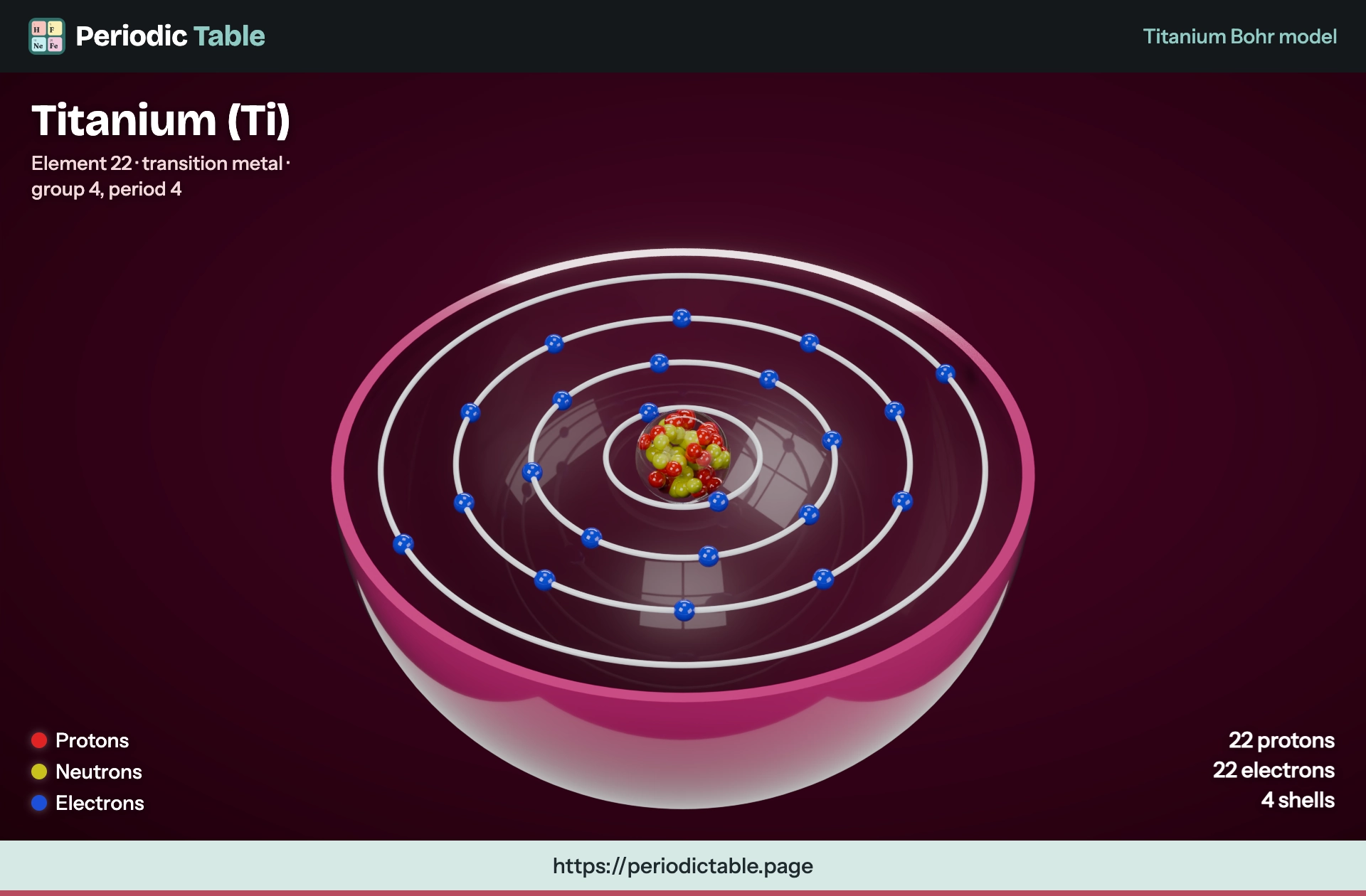
This is a Bohr model of titanium (Ti), a simplified picture of a single titanium atom. Its nucleus holds 22 protons, and a neutral titanium atom has 22 electrons, arranged around it in 4 shells (2 in shell K, 8 in shell L, 10 in shell M and 2 in shell N).
Titanium periodic table electron configuration
- Shorthand
- [Ar] 3d2 4s2
- Full
- 1s2 2s2 2p6 3s2 3p6 4s2 3d2
- Electrons per shell
- 2, 8, 10, 2
Titanium element properties and atomic data
- Atomic number
- 22
- Atomic mass
- 47.8671 u
- Phase at STP
- Solid
- Melting point
- 1667.85°C (1941 K)
- Boiling point
- 3286.85°C (3560 K)
- Density
- 4.506 g/cm³
- Electronegativity (Pauling)
- 1.54
- Period
- 4
- Group
- 4
- Block
- d-block
- Appearance
- Silvery grey-white metallic
- Discovery date
- 1791
- Discovered by
- William Gregor
- Named by
- Martin Heinrich Klaproth
Titanium (Ti) on the periodic table: element 22 facts
Titanium sits in group 4 and period 4 of the periodic table, in the d-block between scandium and vanadium. It heads its group, with zirconium, hafnium and the synthetic rutherfordium below it, so the four elements share a habit of forming stable +4 compounds. In a chemistry class on atomic number and periodic trends, how they react with nonmetals is covered for the metalloid family and their typical compounds.
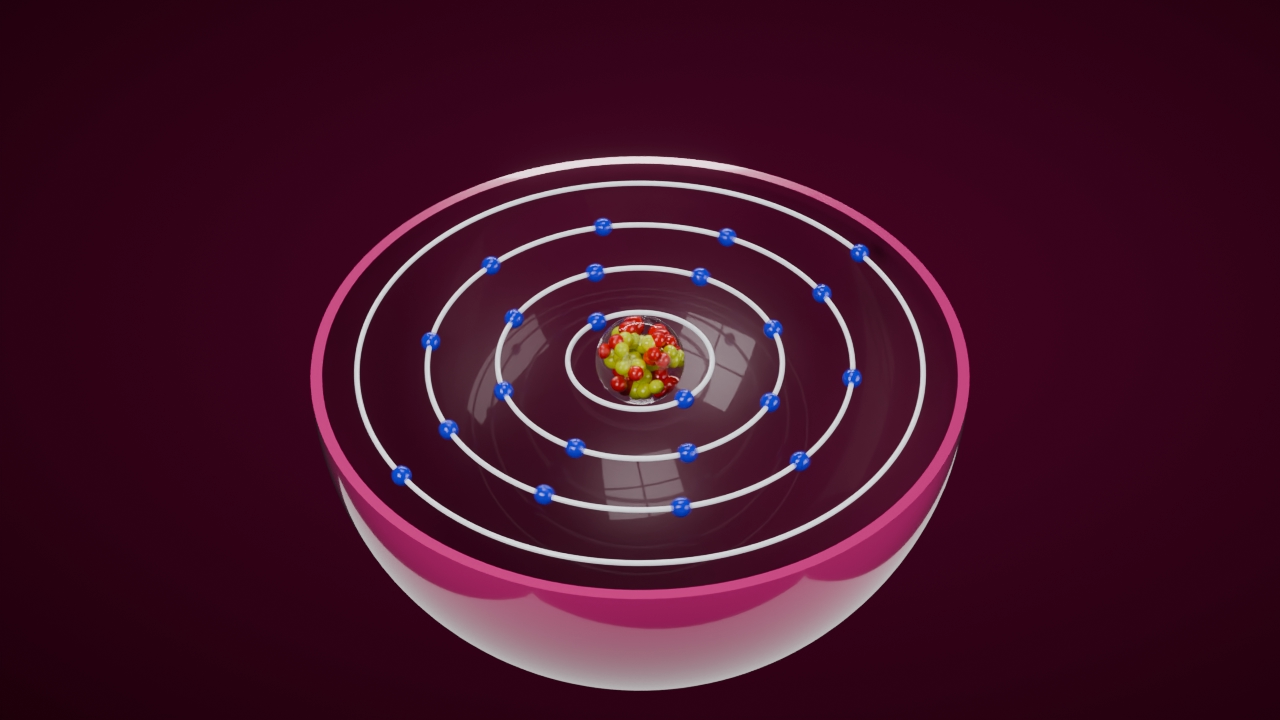
As a chemical element it is a lustrous, silver-grey metallic element that is solid at room temperature. Its standard atomic weight is 47.867, the value you will see in most data tables as its atomic mass.
| Property | Value for titanium |
|---|---|
| Symbol | Ti |
| Atomic number | 22 (atomic number 22, element 22) |
| Atomic mass | 47.867 |
| Group / period / block | Group 4 / period 4 / d-block |
| Category | Transition metal |
| Electron configuration | [Ar] 3d2 4s2 |
| State at 20 °C | Solid, silver-grey metal |
| Density | 4.506 g/cm3 |
| Common oxidation states | +4, +3 |
| Discovered | 1791, William Gregor |
Physical properties of titanium metal
The physical titanium properties that engineers care about come down to a short list: it is light, strong, stiff enough for structures and stable at high heat. Pure titanium metal is ductile when free of oxygen, paramagnetic rather than ferromagnetic (so in everyday terms it is nonmagnetic), and a fairly poor conductor of heat and electricity. Cool it below about 0.5 K and it becomes superconducting, a curiosity rather than a practical use. If you wonder how Hennig Brand found a glowing substance, the black phosphorus page tells it while he sought the philosopher's stone.
Melting point, boiling point and density
Titanium has a high melting point of 1,668 °C and a boiling point of about 3,287 °C, yet it is not classed as a refractory metal. Its density is roughly 56% of steel's, which is the root of most of its applications.
| Physical property | Value |
|---|---|
| Melting point | 1,668 °C (1,941 K) |
| Boiling point | 3,287 °C (3,560 K) |
| Heat of fusion | 14.15 kJ/mol |
| Heat of vaporization | 425 kJ/mol |
| Specific heat capacity | 523 J/(kg·K) |
| Thermal conductivity | 21.9 W/(m·K) |
| Thermal expansion | 8.6 µm/(m·K) at 25 °C |
| Electrical resistivity | 420 nΩ·m at 20 °C |
| Young's modulus / shear modulus / bulk modulus | 116 GPa / 44 GPa / 110 GPa |
| Mohs hardness / Vickers hardness | 6.0 / 830–3,420 MPa |
Strength-to-weight ratio and stiffness
Titanium's headline trait is its strength-to-weight ratio, the highest of any metallic element when you measure tensile strength. Commercially pure grades are about as strong as low-grade structural steel at nearly half the weight, and the best alloys pass 1,400 MPa. Against aluminium it is about 60% denser but more than twice as strong, which is why designers swap aluminum parts for titanium where space is tight and loads are high.
Its modulus of elasticity is roughly half that of steel, so titanium flexes more under load, a drawback in a stiff frame but a benefit in springs and implants. It also has a true fatigue limit and resists creep at moderate heat, though it loses strength above about 430 °C. Titanium is also non-magnetic, which matters near sensitive instruments.
Alpha and beta: the two crystal forms
Titanium is allotropic. At room temperature it has a hexagonal close-packed structure called the alpha phase.
At 882 °C the atoms rearrange into a body-centered cubic beta phase, which is easier to work. Alloy makers add elements that stabilise one phase or the other, and that choice drives an alloy's strength, toughness and weldability.
Chemical behaviour and corrosion resistance of the element titanium
Exposed to air, titanium instantly grows a thin oxide layer of TiO2. This passivation layer starts only a few nanometres thick and heals itself if scratched, as long as oxygen is present.
It gives the metal outstanding corrosion resistance in seawater, chloride solutions, wet chlorine and even aqua regia, a mixture that dissolves gold. Further oxidation of the bulk metal is blocked, which is why a titanium part can sit in brine for decades with little loss.
Electron configuration and oxidation states
Titanium's electron configuration is [Ar] 3d2 4s2: four outer electrons that it gives up readily. That explains its preferred oxidation states of +4 and, less often, +3, with rarer states down to −2 in special complexes. Its electronegativity is 1.54 on the Pauling scale.
The first three ionization energies are 658.8, 1,309.8 and 2,652.5 kJ/mol, and its electron affinity is about 7.6 kJ/mol. (British sources list these as ionisation energies; the numbers are the same.) Each electron removed costs more energy, and the big jump after the fourth is why Ti4+ is the end of the line.
How titanium reacts with oxygen, nitrogen and acids
Beneath its oxide skin titanium is quite reactive. It burns in air well below its melting point, so it can only be melted under vacuum or argon. It combines with oxygen at about 1,200 °C in air (610 °C in pure oxygen) and is one of the few metals that burns in nitrogen, forming a nitride at about 800 °C that causes embrittlement.
At room temperature it ignores most halogens, but at 550 °C it reacts violently with chlorine and bromine. Hydrofluoric acid, hot hydrochloric acid and hot sulfuric acid dissolve the protective film, and high-pressure oxygen can trigger a reaction even at room temperature.
Titanium isotopes and atomic structure
Natural titanium is a mix of five stable isotopes, from titanium-46 to titanium-50. Titanium-48 (48Ti) dominates, making up almost three-quarters of every sample. Each titanium atom has 22 protons in its nucleus; the isotopes differ only in their neutrons.
| Isotope | Natural abundance (%) | Stability |
|---|---|---|
| 46Ti | 8.25 | Stable |
| 47Ti | 7.44 | Stable |
| 48Ti | 73.72 | Stable |
| 49Ti | 5.41 | Stable |
| 50Ti | 5.18 | Stable |
More than 20 radioisotopes have been made in the lab. The longest-lived, 44Ti, has a half-life of about 60 years and decays by electron capture to scandium.
Lighter isotopes decay mainly by positron emission towards scandium, and heavier ones by beta emission towards vanadium. Titanium's empirical atomic radius is about 147 pm and its covalent radius about 160 pm.
Where titanium is found: minerals and reserves
Titanium is the ninth-most abundant element in Earth's crust, at about 0.6% by mass, and the fourth most abundant structural metal after aluminium, iron and magnesium. Some sources phrase it as the 9th most abundant element overall. It turns up in almost all igneous rocks, as well as in soils and natural water.
The problem is never supply: it is getting the metal out of its mineral cheaply. Known reserves of titanium ore run to well over 2 billion tonnes.
Rutile, ilmenite and other titanium minerals
Only two minerals matter commercially: rutile, which is natural titanium dioxide (TiO2), and ilmenite (FeTiO3). Rutile is the richer mineral, while ilmenite is the more plentiful mineral and supplies most of the world's feedstock. Both are concentrated in heavy beach sand deposits, which are dredged or strip-mined.
Other titanium minerals include anatase and brookite (both TiO2), perovskite, titanite (also called sphene) and leucoxene, an altered form of ilmenite. Main mining countries include China, Mozambique, South Africa, Australia and Canada. The Royal Society of Chemistry rates titanium's supply risk as moderate.
Titanium beyond the crust: plants, meteorites and the Moon
Titanium is found in meteorites and in the spectra of cool M-type stars, and basalt brought back by Apollo 17 contains about 12% TiO2, far richer than most rocks on Earth. Living things carry it too. Most plants hold about 1 ppm, while nettles and horsetail can reach 80 ppm, possibly because it stimulates growth.
History and discovery of titanium
The history of titanium spans two discoveries in two countries and more than a century before anyone held the pure metal.
William Gregor and the black sand of Manaccan
In 1791 the clergyman and amateur mineralogist William Gregor found black sand in a stream near Manaccan, Cornwall, that was drawn to a magnet. He split it into iron oxide and a white oxide he could not identify, and named the new substance manaccanite (sometimes spelled maccanite). His discovery drew little attention at the time.
Martin Heinrich Klaproth and the titans
In 1795 the German chemist Martin Heinrich Klaproth found the same oxide in rutile from Hungary. He named the element after the Titans of Greek mythology, the sons of the Earth. When he later tested a sample of Gregor's sand, he confirmed it held titanium too, and Gregor got the credit for the discovery.
From laboratory curiosity to strategic material
Pure titanium proved hard to make, and it stayed a lab curiosity until the Kroll method arrived in the 1940s. During the Cold War it became a strategic material.
The USSR built titanium-hulled submarines, the US kept a national stockpile of sponge, and Lockheed's SR-71 Blackbird used titanium for most of its airframe. Today China makes most of the world's sponge, with Japan and Russia next.
Production of pure titanium: from ore to titanium sponge
Titanium production is costly because the oxide cannot simply be smelted with carbon the way iron ore is: the carbon forms titanium carbide instead. Ore first goes through extraction steps that make a purer feed.
The Becher process turns ilmenite into synthetic rutile by removing the iron, the chloride process makes pure titanium dioxide via the tetrachloride, and the sulfate process leaches ilmenite with sulfuric acid. Metal is then made from that purified feed as a porous titanium sponge.
The Kroll process
Almost all titanium metal today comes from the Kroll process, developed by William Kroll in the 1930s and 1940s. Rutile is heated with chlorine and carbon (as coke) to make titanium tetrachloride, a fuming liquid nicknamed "tickle". After distillation, the TiCl4 is reduced by molten magnesium under an argon blanket, an inert atmosphere that keeps air out:
$$\mathrm{TiO_2 + 2\,Cl_2 + 2\,C \rightarrow TiCl_4 + 2\,CO}$$
$$\mathrm{TiCl_4 + 2\,Mg \rightarrow Ti + 2\,MgCl_2}$$
The product is a porous sponge that must be leached or vacuum-distilled to remove salt. The batch nature of the Kroll process is the main reason titanium costs many times more than steel.
The Hunter process and newer methods
- Hunter process (1910): Matthew Hunter reduced TiCl4 with sodium to make the first 99.9% pure metal; it is now rarely used.
- Iodide process (1925): van Arkel and de Boer decomposed titanium tetraiodide on a hot filament for very high purity.
- Armstrong process: a continuous sodium-reduction method that makes titanium powder directly.
- FFC Cambridge and other molten-salt routes: electrolysis of TiO2, still at pilot scale.
Melting, fabrication and mill products
Sponge is pressed, mixed with alloying additions and melted into an ingot by vacuum arc remelting or in a cold hearth furnace. The ingot is then rolled, forged or drawn into mill products: sheet, plate, bar, tube and wire, plus forgings and castings. Welding needs an argon or helium shield, because oxygen, nitrogen and hydrogen pick-up makes welds brittle.
Machining works with the same tools as stainless steel, but you need sharp cutters and good coolant to stop galling. Hot forging leaves a brittle, oxygen-rich surface called alpha case that has to be milled or etched off. Each step is a reason titanium manufacturing demands careful metallurgy.
Titanium alloys and commercial grades
About fifty grades of titanium alloys exist, and ASTM International recognises more than thirty for titanium metal and its alloys. Grades 1 through 4 are commercially pure titanium, which differ mainly in oxygen content: more oxygen means more strength but less ductility.
Common alloying elements are aluminium, vanadium, molybdenum, iron, nickel, zirconium and tin. The workhorse alloy is Ti-6Al-4V (Grade 5), with 6% aluminium and 4% vanadium; this 6Al-4V composition makes up roughly half of all titanium used in aircraft.
| Grade | Type | Typical use |
|---|---|---|
| Grade 1 | Commercially pure, lowest oxygen | Chemical plant linings, where you need maximum formability |
| Grade 2 | Commercially pure | General industry, heat exchangers |
| Grade 4 | Commercially pure, highest oxygen | Dental and surgical parts needing more strength |
| Grade 5 (Ti-6Al-4V) | Alpha-beta alloy | Airframes, engine parts, implants |
| Beta C | Beta alloy | Springs, oil and gas downhole parts |
Picking the right alloy is an engineering trade-off between strength, ductility, weldability and cost.
Titanium compounds and their uses
By tonnage, titanium compounds matter more than the metal. The +4 state rules titanium chemistry, and almost every compound is made from the ore or from TiCl4.
Titanium dioxide: the brightest white pigment
About 95% of refined titanium ends up as titanium dioxide, the world's leading white pigment. It is bright, opaque, inert and non-toxic, so you find it in paint, plastics, paper, toothpaste and food colouring.
In sunscreen it blocks UV light, and the same property makes it a photocatalyst that can break down dirt and bacteria on coated glass. Related titanates such as barium titanate (BaTiO3) are piezoelectric, turning pressure into voltage in sensors and transducers.
Titanium nitride and titanium carbide
Titanium nitride (TiN) is nearly as hard as sapphire and has a gold-colored sheen, so it coats drill bits, cutting tools and decorative fittings. Titanium carbide (TiC) is even harder and is used in cutting tools and wear coatings. Both coatings have wide applications wherever a steel edge would dull too quickly.
Titanium tetrachloride and other halides
Besides feeding the Kroll process, TiCl4 fumes in moist air, so it is used for smoke screens, and it acts as a Lewis acid in organic synthesis. Violet titanium trichloride (TiCl3) is a catalyst for making polypropylene, and the organometallic titanocene dichloride is a common lab reagent.
Uses of titanium across industries
The main applications of titanium follow its strengths: low weight, corrosion resistance and biocompatibility. Each industry below leans on a different one.
Aerospace and marine applications
Aerospace takes roughly two-thirds of all titanium metal. It goes into jet engines (fan and compressor blades, discs), landing gear, firewalls and airframe structures; a Boeing 787 uses well over 100 tonnes of titanium mill products.
Missiles and spacecraft rely on it for the same reasons. At sea it resists salt water, so it is used for propeller shafts, desalination plants and heat exchangers.
Medical implants and biocompatibility
Titanium's biocompatibility makes it the standard for implants. Bone grows directly onto it (the metal can osseointegrate), so dental implants can last over 30 years, and it has been used in surgery since the 1950s for joint replacement, orthopedic implants, bone plates and screws, pacemaker cases and surgical instruments.
Because it is not ferromagnetic, people with titanium implants can still have MRI scans. Titanium(IV) complexes have also been tested as anticancer drugs in medicine.
Jewelry, sports gear and consumer products
In jewelry titanium is light, hypoallergenic and can be anodized into blue, purple and gold colours, which makes it popular for rings, watch cases and body piercing. You will also find it in golf clubs, bicycle frames, tennis rackets, spectacle frames, laptop cases and phones such as the iPhone 15 Pro. In architecture the Guggenheim Museum Bilbao is famous for its titanium cladding.
Chemical plants and other industrial uses
Welded titanium pipes, tanks, valves and heat exchangers handle chlorine, bleach and seawater in chemical, pulp and paper plants. Titanium powder makes bright sparks in fireworks, and containers for long-term nuclear waste storage have been studied because the metal protects the environment from leaks for a very long time.
Is titanium safe? toxicity and fire hazards
Solid titanium is non-toxic even in large amounts, and you swallow roughly 0.8 mg a day in food without effect. The real fire hazard is fine powder or shavings, which can burn or explode when heated in air.
Water and carbon dioxide make a titanium fire worse, so a Class D dry powder extinguisher is needed. Fresh, unoxidised titanium can also ignite in dry chlorine gas or on contact with liquid oxygen.