


Chlorine element (Cl): chlorine periodic table facts
Chlorine periodic table facts: chlorine (Cl) is element 17, a halogen in group 17, period 3. If you have ever smelled a swimming pool or poured household bleach, you have met chlorine, element 17 on the periodic table with the symbol Cl. Chemists turn to the periodic table chart for atomic weight, electron configuration and periodic trends in one view.
Chlorine is an extremely reactive halogen that exists as a yellow-green gas at room temperature, yet most of it on Earth sits quietly locked away as table salt. Below you will find its key atomic data, physical and chemical behaviour, isotopes, compounds, history, uses and hazards, all in one place.
Rotate the 3D Bohr model of chlorine
Drag to orbit, scroll to zoom.
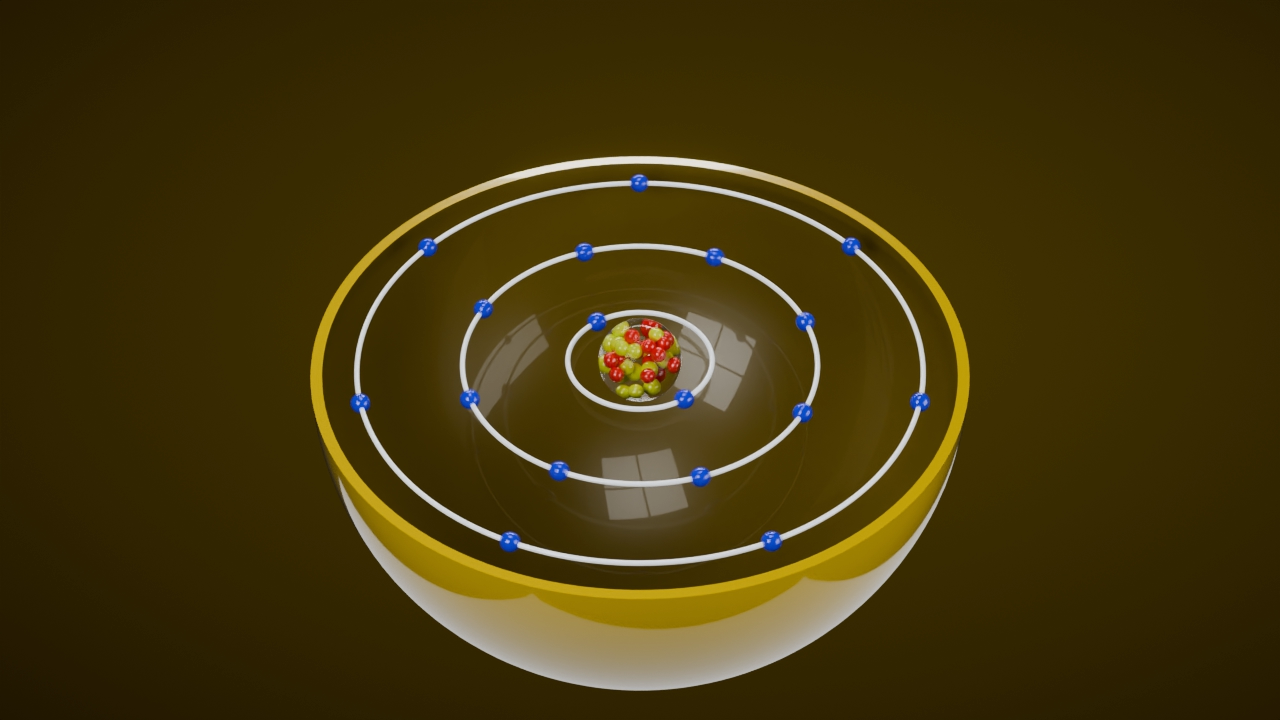
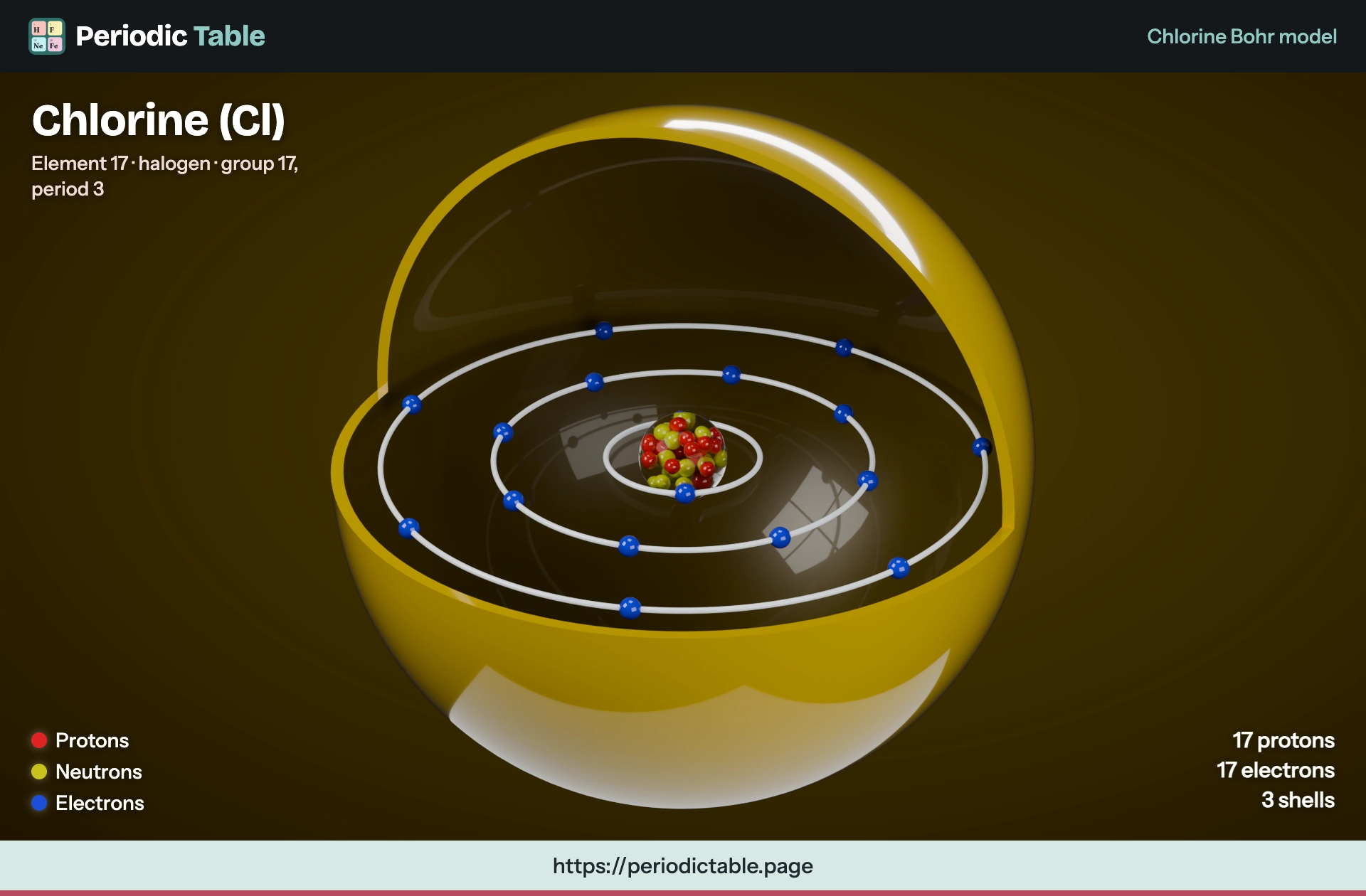
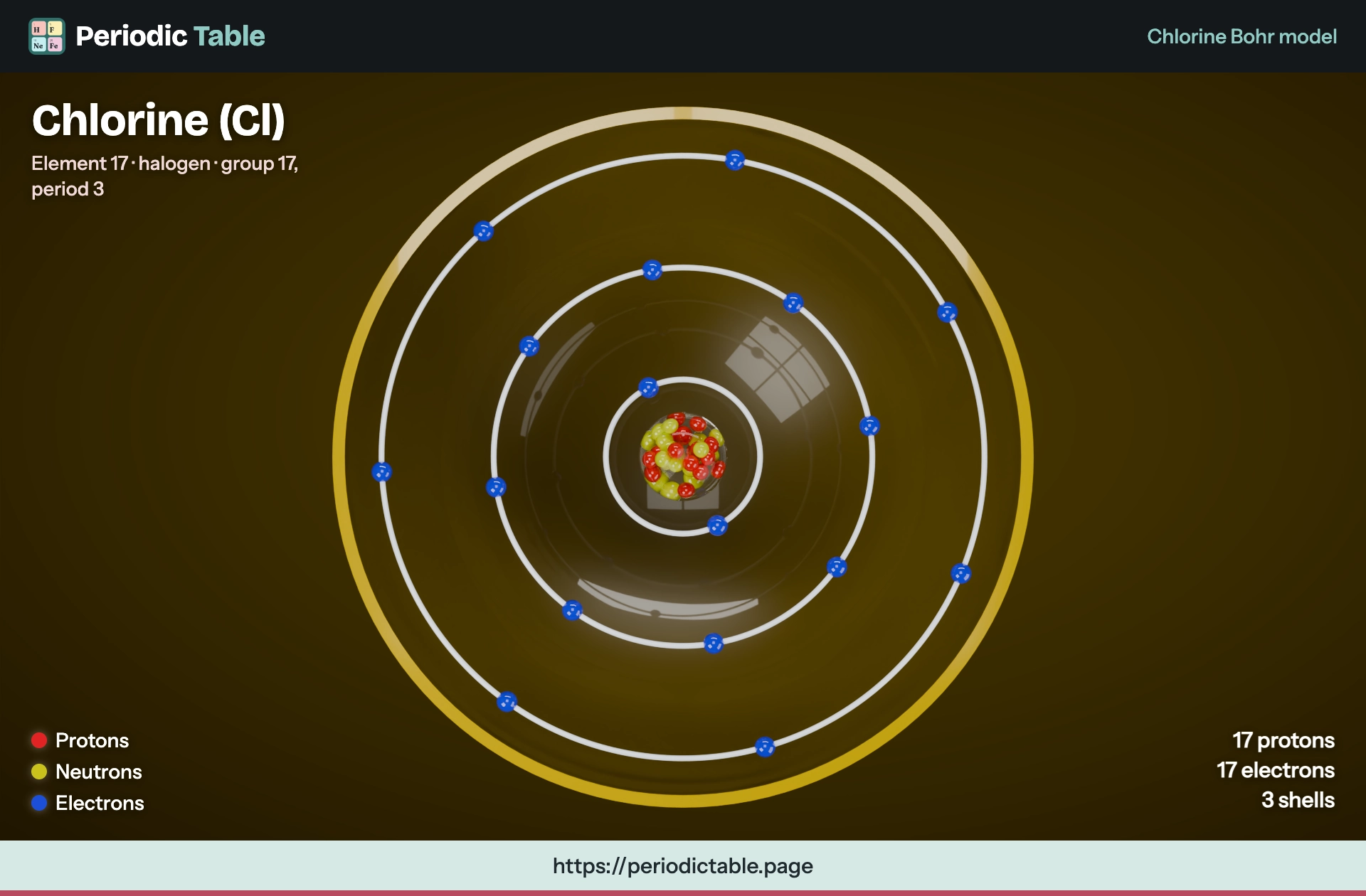
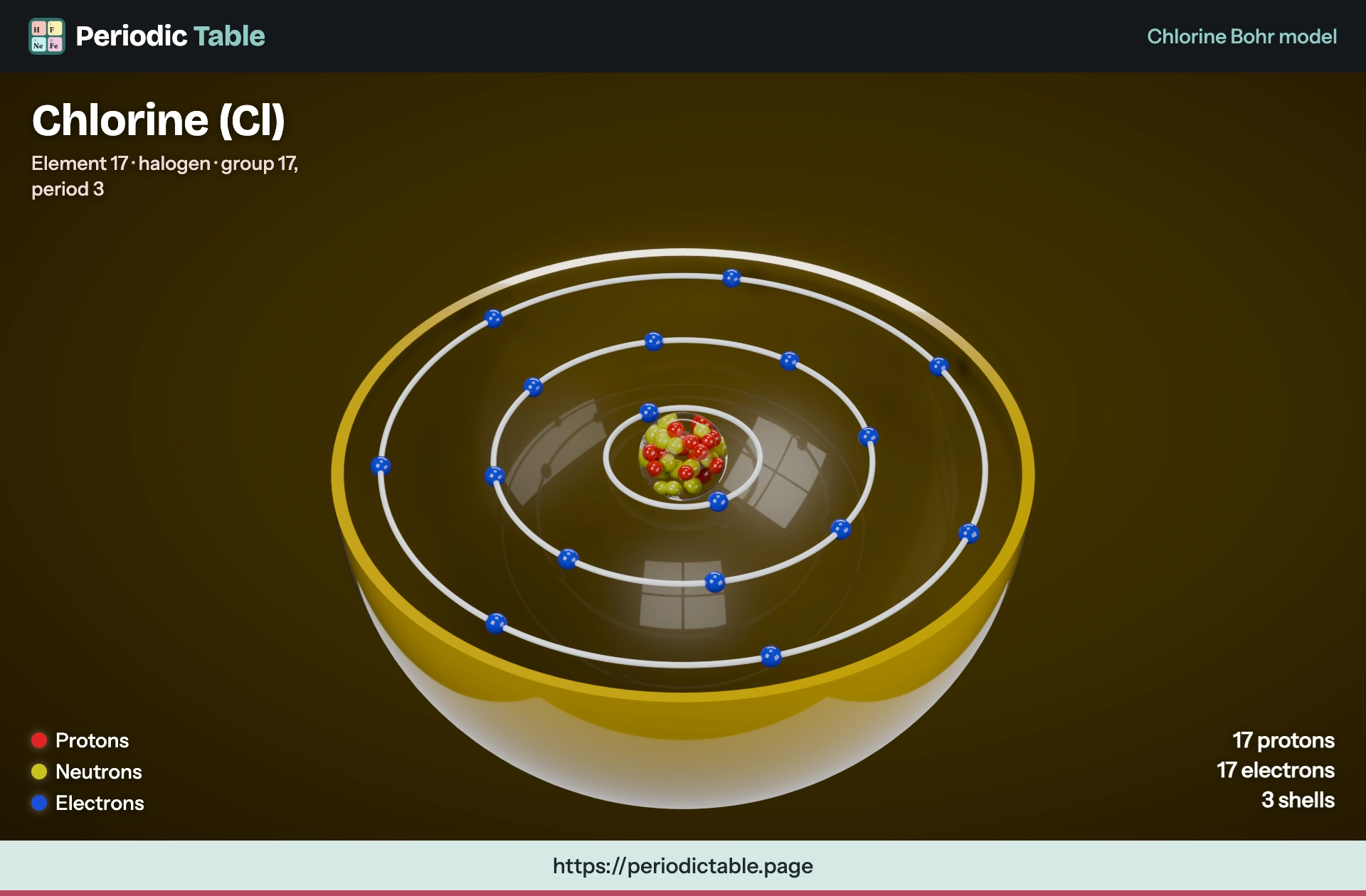
This is a Bohr model of chlorine (Cl), a simplified picture of a single chlorine atom. Its nucleus holds 17 protons, and a neutral chlorine atom has 17 electrons, arranged around it in 3 shells (2 in shell K, 8 in shell L and 7 in shell M).
Chlorine periodic table electron configuration
- Shorthand
- [Ne] 3s2 3p5
- Full
- 1s2 2s2 2p6 3s2 3p5
- Electrons per shell
- 2, 8, 7
Chlorine element properties and atomic data
- Atomic number
- 17
- Atomic mass
- 35.45 u
- Phase at STP
- Gas
- Melting point
- -101.55°C (171.6 K)
- Boiling point
- -34.04°C (239.11 K)
- Density
- 0.0032 g/cm³
- Electronegativity (Pauling)
- 3.16
- Period
- 3
- Group
- 17
- Block
- p-block
- Appearance
- Pale yellow-green gas
- Discovery date
- 1774
- Discovered by
- Carl Wilhelm Scheele
- Named by
- —
Chlorine element at a glance: key facts and atomic data
This halogen is a nonmetal and a chemical element that sits in group 17, period 3 and the p-block, directly below fluorine and above bromine. In its free form it is diatomic: two atoms pair up to form Cl2, often called dichlorine to separate the molecule from the single atom. The table below gathers the reference figures you are most likely to need. Among mineral specimens, hopper crystals with a rainbow oxide film are photographed and explained in the bismuth atomic number entry for collectors.
| Property | Value |
|---|---|
| Symbol | Cl |
| Atomic number | 17 |
| Standard atomic weight | 35.45 |
| Group / period / block | Group 17 (halogens) / Period 3 / p-block |
| Electron configuration | [Ne] 3s2 3p5 (shells 2, 8, 7) |
| State at 20 °C | Gas (Cl2) |
| Electronegativity (Pauling) | 3.16 |
| CAS number | 7782-50-5 |
The atomic weight of 35.45 is not a whole number because natural chlorine is a mix of two stable isotopes, which you will see in detail further down.
Electron configuration and valence electrons of the chlorine atom
A neutral atom of the element carries 17 electrons arranged as 1s2 2s2 2p6 3s2 3p5. The seven valence electrons in the outer shell leave it exactly one short of a stable octet, and that single gap explains almost everything chlorine does: it grabs one more electron to become the chloride ion, Cl−, or shares one in a covalent bond.
Removing them is far harder. The first three ionisation energies are about 1251, 2298 and 3822 kJ/mol, and the energy climbs steeply once the 3p subshell is emptied.
Physical properties of chlorine gas
At normal conditions chlorine gas is a dense, pale green to yellow-green vapour with a sharp, choking smell that most people notice at well under one part per million. A molecule of Cl2 weighs about 70.9 g/mol, roughly 2.5 times as much as the average for air, so a leak sinks and pools in low spots such as basements, trenches and pits. Beyond simple chemistry, molecules, atoms and the nucleus, from a single proton to astrophysics, are explored in the hydrogen element page for curious readers.
The gas is easily liquefied: a pressure of about 7 bar at room temperature turns it into an amber liquid, which is how it is shipped in steel cylinders and rail tank cars. Cooled further, it freezes into an orthorhombic crystal made of layered Cl2 units, and its colour fades almost to nothing at very low temperatures. Solid or liquid, it barely conducts electricity.
Melting point, boiling point and density
| Quantity | Celsius | Kelvin | Notes |
|---|---|---|---|
| Melting point | −101.5 °C | 171.6 K | Triple point 172.22 K |
| Boiling point | −34.04 °C | 239.11 K | Liquid at 7 bar and 20 °C |
| Density | 3.2 g/L as a gas at STP; 1.56 g/cm3 as a liquid at its boiling point | Heavier than air | |
| Critical point | 143.8 °C | 416.9 K | 7.99 MPa |
Because it boils at −34 °C, chlorine is a gas everywhere people live, which is why storage relies on pressure, not refrigeration.
Chemical properties and reactivity of chlorine
Chlorine gas is a highly reactive, strong oxidising agent: it takes electrons from almost every other element, and it combines directly with most metals and nonmetals, often with heat or flame. Sodium burns in it to give white sodium chloride, and hydrogen mixed with it can explode in sunlight to form hydrogen chloride. For anyone comparing corrosion resistance, atomic number 77 is given and its standing among the toughest metals is shown in the iridium element in plain words.
That high reactivity sits between its neighbours. It is a weaker oxidiser than fluorine but a stronger one than bromine, which is why chlorine water can release bromine from a bromide solution in a classic school chemistry test.
With metals in low oxidation states it usually forms ionic salts; with nonmetals and metals in high oxidation states it forms covalent molecular chlorides. Dissolved in water, part of it reacts to form a mix of hydrochloric and hypochlorous acids, the chemistry behind its bleaching action.
Electronegativity, electron affinity and the Pauling scale
On the Pauling scale chlorine scores 3.16, the third highest value of any element after fluorine (3.98) and oxygen (3.44). Its electron affinity, about 349 kJ per mole, is the highest of all the elements, slightly above fluorine.
The two numbers measure different things: electronegativity describes how hard an atom pulls on shared electrons inside a bond, while electron affinity is the energy released when an isolated atom gains an electron. It sits near the top of both lists, so it wins most tugs of war it enters.
Bond enthalpies of chlorine atoms
The strength of the bonds that chlorine atoms form tells you which reactions release energy. The Cl–Cl bond is relatively weak, so ultraviolet light easily splits the molecule into two radicals, the first step in many chlorination reactions.
| Bond | Bond enthalpy (kJ/mol) | Found in |
|---|---|---|
| Cl–Cl | 242 | Chlorine molecule |
| H–Cl | 431 | Hydrogen chloride |
| C–Cl | 327 to 339 | Organic chlorides |
Breaking one Cl–Cl bond and forming an H–Cl or C–Cl bond releases energy, which is why chlorine attacks hydrogen and hydrocarbons so readily.
Oxidation states of the element chlorine
Fluorine can only sit at −1, but chlorine can use empty 3d orbitals and be pulled into positive states by oxygen. Its common oxidation states are −1, +1, +3, +5 and +7, and each has a family of compounds and ions with its own name.
| Oxidation state | Ion | Name | Matching acid | Typical use |
|---|---|---|---|---|
| −1 | Cl− | Chloride | Hydrochloric acid | Table salt, stomach acid |
| +1 | ClO− | Hypochlorite | Hypochlorous acid | Laundry whitener, pool sanitiser |
| +3 | ClO2− | Chlorite | Chlorous acid | Source of chlorine dioxide |
| +5 | ClO3− | Chlorate | Chloric acid | Pulp bleaching, weedkillers |
| +7 | ClO4− | Perchlorate | Perchloric acid | Rocket propellant oxidiser |
Its compounds are most stable at the two extremes, −1 and +7. The middle states tend to disproportionate, splitting into a lower and a higher state, which is why a bottle of household cleaner slowly loses strength as hypochlorite turns into chloride ions and chlorate, especially when warm. Perchloric acid is the strongest of the oxoacids, because the charge on its anion is spread over four oxygen atoms.
Chlorine isotopes: Cl-35, Cl-37 and Cl-36
Natural chlorine is made of two stable isotopes, Cl-35 and Cl-37, in a ratio of roughly three to one. That mix gives the average atomic weight of 35.45 and produces the tell-tale double peak, about 3:1 in height and two mass units apart, that chemists look for when a mass spectrum contains a chlorine atom.
| Isotope | Atomic mass (u) | Natural abundance | Half-life |
|---|---|---|---|
| Cl-35 | 34.969 | 75.76% | Stable |
| Cl-37 | 36.966 | 24.24% | Stable |
| Cl-36 | 35.968 | Trace | About 301,000 years |
Chlorine-36 is radioactive and forms in the upper atmosphere when cosmic rays strike argon, and in rock when neutrons hit Cl-35. Its long half-life makes Cl-36 useful for dating groundwater up to about a million years old, and nuclear tests in the 1950s left a spike of it in polar ice that scientists still use as a time marker. Shorter-lived Cl-38 (about 37 minutes) can be made in a reactor for tracer work.
Chlorine compounds: chlorides, oxides and oxoacids
Nearly every element forms a binary chloride. The exceptions are most of the noble gases, which are too inert, a few very heavy unstable elements, and oxygen and fluorine, which are more electronegative than chlorine and so form chlorine oxides and fluorides instead.
Common chlorides range from solid salts such as potassium chloride and calcium chloride to liquids such as sulfur dichloride and titanium tetrachloride. Silver chloride is so insoluble that a white cloud on adding silver nitrate is the standard test for chlorides in solution.
Hydrogen chloride and hydrochloric acid
The simplest compound of chlorine is hydrogen chloride, HCl, a colourless, sharp-smelling gas. Dissolved in water it becomes hydrochloric acid, one of the strongest common acids and a staple of every laboratory.
It is made by burning hydrogen in chlorine, by heating salt with sulfuric acid, or as a by-product when hydrocarbons are chlorinated. Your stomach makes its own dilute version, with a pH of about 1.5 to 3.5, to break down food.
Chlorine oxides, fluorides and oxoacids
None of the chlorine oxides can be made by mixing the elements directly, and all are unstable. The most important is chlorine dioxide, ClO2, a yellow gas made on site at paper mills and water plants because it explodes at high concentrations. Dichlorine heptoxide, Cl2O7, is the most stable oxide and the anhydride of perchloric acid.
Hypochlorous acid, HOCl, is the active germ-killer in chlorinated water. With fluorine, chlorine forms three interhalogen compounds; chlorine trifluoride, ClF3, is so aggressive that it sets glass, sand and even concrete on fire and is used to clean semiconductor equipment.
Organochlorine compounds and solvents
In organic chemistry, bonding chlorine to carbon creates a huge family of organochlorine chemicals. Chloroform, dichloromethane and carbon tetrachloride were once everyday solvents, and chlorination of benzene and alkanes feeds the production of dyes, drugs and resins.
Some chlorinated molecules are harmless, but others, such as the insecticides DDT and the dioxins formed when chlorinated material burns, persist in the environment and build up in food chains. Nature also makes more than 2,000 chlorinated organic molecules of its own, many of them in marine algae and fungi.
History of chlorine: from muriatic acid to an element
People handled chlorine compounds long before anyone knew the element existed. Salt has been mined for thousands of years, and medieval alchemists heated sal ammoniac and salt with vitriol to make hydrogen chloride. Adding sal ammoniac to nitric acid gave aqua regia, a mixture able to dissolve gold that constantly gave off free chlorine.
Around 1630 Jan Baptist van Helmont recognised that gas as a separate substance, but no one isolated it for another 140 years. The acid made from salt was known as muriatic acid, from the Latin for brine, a name still printed on hardware-store hydrochloric acid today.
How Scheele and Davy identified chlorine
In 1774 the Swedish chemist Carl Wilhelm Scheele warmed muriatic acid with the mineral pyrolusite, which is manganese dioxide, and collected a dense, greenish gas. He saw that it bleached litmus paper, leaves and flowers and killed insects, but he believed it was an oxygen compound and called it "dephlogisticated muriatic acid air." In 1809 Joseph Louis Gay-Lussac and Louis-Jacques Thénard failed to pull oxygen out of it with hot charcoal.
In 1810 Humphry Davy repeated the work, concluded the gas was an element, and named it chlorine from the Greek chloros, meaning pale yellow-green. In 1823 Michael Faraday became the first to turn it into a liquid under pressure.
Where chlorine occurs in nature
The element is too reactive to exist free in nature, so it is found almost entirely as chloride. It is roughly the 20th most abundant element in Earth's crust, at around 130 to 145 parts per million, concentrated in thick beds of rock salt (sodium chloride) and potash minerals such as sylvite and carnallite left behind by ancient evaporated seas.
The oceans hold far more. Seawater carries about 19 grams of chloride per kilogram, making chlorine the most common dissolved element in the sea and nearly 2% of its mass. Closed basins concentrate it further: the Dead Sea and the Great Salt Lake are many times saltier than the open ocean.
Because the raw material is salt and supplies are effectively unlimited, chlorine has one of the lowest supply risks of any element, even though production is concentrated in a few countries led by China, the United States and India. Chloralkali plants draw their salt either from those buried crust deposits, mined or dissolved in place, or from evaporated seawater.
Producing elemental chlorine: the chloralkali process
Almost all elemental chlorine is made by the electrolysis of salt water. In the chloralkali process, an electric current passes through concentrated brine; chlorine gas forms at the positive electrode, hydrogen at the negative one, and sodium hydroxide stays in solution:
$$2\,\mathrm{NaCl} + 2\,\mathrm{H_2O} \rightarrow \mathrm{Cl_2} + \mathrm{H_2} + 2\,\mathrm{NaOH}$$
All three products are sold, so a plant's economics depend on balancing demand for both chlorine and caustic soda. Modern plants use a membrane cell that keeps the two sides apart; older mercury and diaphragm cells are being phased out because of pollution and asbestos concerns.
The chemical industry uses most of the output on site, since moving large volumes of the gas is costly and risky. Small amounts of chlorine gas for the lab are still made the way Scheele did it, from hydrochloric acid and an oxidiser, but the need rarely arises because cylinders are easy to buy.
Uses of chlorine in water treatment, plastics and industry
The properties of chlorine that make it dangerous, its reactivity and oxidising power, are exactly what make it valuable. A large share of output never reaches consumers as the element; it is consumed inside factories to make other products, and many of them, such as titanium dioxide pigment and some polymers, end up containing no chlorine at all.
Disinfection of drinking water and swimming pools
Chlorine first earned its place in public health after John Snow traced an 1854 London cholera outbreak to a contaminated pump, proving that water carried disease. Continuous chlorination of city supplies followed in the early 1900s and is credited with sharply cutting typhoid and cholera deaths, one of the biggest wins in the history of sanitation. Today a small dose kills bacteria, viruses and parasites, and a low residual, usually below 4 mg/L in tap water and 1 to 3 parts per million in pools, keeps protecting the water as it travels.
Chlorine-based disinfectants and antiseptics are also used in hospitals and wound care, building on Antoine Labarraque's work in the 1820s. It remains the cheapest disinfectant that keeps working after the water leaves the plant.
PVC, bleach and other chlorinated products
About a fifth of all chlorine goes into polyvinyl chloride, and by weight PVC is about 57% chlorine, which lets the plastic use less oil than polyethylene. You meet it in pipes, flooring, window frames, cable insulation and medical tubing.
Household bleach is a dilute solution of sodium hypochlorite, first made near Paris in 1789 as "Javel water", while calcium hypochlorite powder is the tablet form used for pools. Chlorine compounds also bleach textiles and paper pulp, and go into pharmaceuticals, plastics, pesticides, refrigerants and solvents.
Chlorine hazards, toxicity and use as a chemical weapon
Breathing chlorine gas is dangerous because it reacts with the moisture in your eyes, throat and lungs to form acids that burn tissue. A few parts per million cause coughing and stinging eyes, 10 parts per million is considered immediately dangerous to life, and about 1,000 parts per million can be fatal after a few deep breaths.
It is also toxic, and even dilute releases are poisonous to fish and other aquatic life. A common household accident is mixing bleach with acidic cleaners or ammonia, which releases chlorine or chloramine fumes, so never combine cleaning products.
Its weight and colour made it the first large-scale poison gas. On 22 April 1915, at the Second Battle of Ypres in World War I, the German army released about 150 tonnes from cylinders and sent a green cloud across Allied trenches.
It was soon replaced by deadlier agents, but chlorine has been used as a crude weapon in more recent conflicts and is controlled under the Chemical Weapons Convention. Industry also has to watch subtler risks: dry chlorine can ignite carbon steel above about 250 °C, and chloride ions cause stress-corrosion cracking in stainless steel and some plastic fittings.
Chlorofluorocarbons and the ozone layer
Chlorine also reaches the stratosphere. Chlorofluorocarbons (CFCs), once common in refrigerators and aerosol sprays, drift upward and are broken apart by ultraviolet light, releasing chlorine radicals.
A single radical can destroy thousands of ozone molecules before it is captured, which drove the ozone depletion behind the Antarctic ozone hole. The 1987 Montreal Protocol phased out CFCs, and the layer is now slowly recovering.
Chloride and chlorine in living things
In the form of chloride, chlorine is essential to every known form of life. In your body it is the main negatively charged ion outside cells, helping control fluid balance, blood pressure and nerve signals, and it supplies the acid in gastric juice.
Normal blood chloride runs about 96 to 106 mmol/L, and you get almost all of it from salt in food. Your immune system even makes tiny amounts of oxidised chlorine: white blood cells called neutrophils turn chloride into hypochlorous acid to kill invading microbes, the same chemical that disinfects pool water.
How chlorine compares with the other halogens
It is the second member of the group, and its properties fall neatly between fluorine above it and bromine below it. Moving down the group, atoms get bigger, colours darken, melting and boiling points rise and reactivity falls.
| Element | Atomic number | State at 20 °C | Colour | Electronegativity | Boiling point |
|---|---|---|---|---|---|
| Fluorine | 9 | Gas | Pale yellow | 3.98 | −188.1 °C |
| Chlorine | 17 | Gas | Yellow-green | 3.16 | −34.0 °C |
| Bromine | 35 | Liquid | Red-brown | 2.96 | 58.8 °C |
| Iodine | 53 | Solid | Violet-black | 2.66 | 184.3 °C |
Astatine, below iodine, is so radioactive that only tiny amounts have ever existed at once. Next to chlorine on the right sits argon, a noble gas that shows how one extra electron turns a fierce oxidiser into an almost inert element.