


Iridium element (Ir): iridium periodic table facts
Iridium periodic table facts: iridium (Ir) is element 77, a transition metal in group 9, period 6. Hold a cube of iridium the size of a sugar lump and you would feel it pull down like a fishing weight. To see how Carl Wilhelm Scheele and Humphry Davy identified a greenish-yellow gas, open the chlorine element page for the full story.
Its symbol is Ir, and it is a hard, brittle, silvery-white transition metal from the platinum group, and it is the second-densest chemical element known. What makes it special for you as a reader is the combination: almost nothing can dissolve it, and it keeps its strength far hotter than most metals can survive.
Rotate the 3D Bohr model of iridium
Drag to orbit, scroll to zoom.
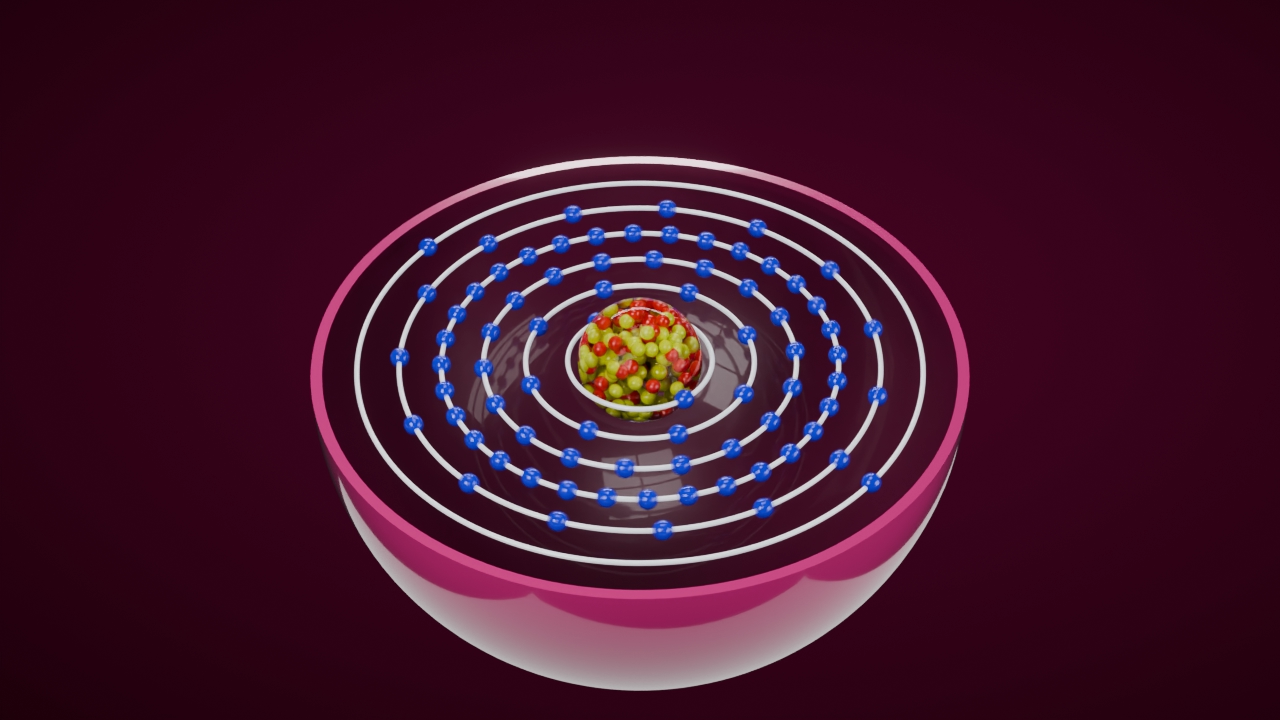
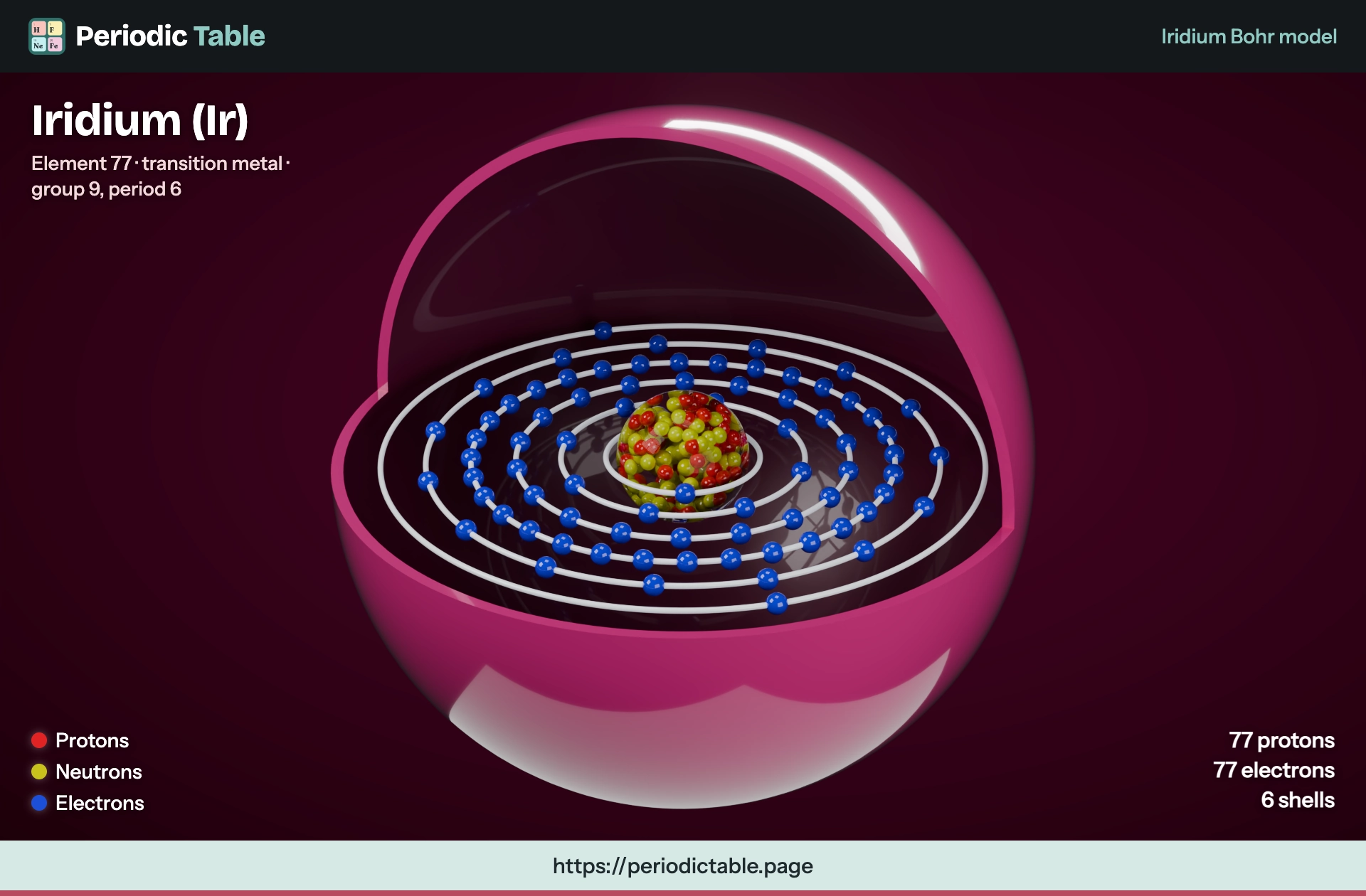
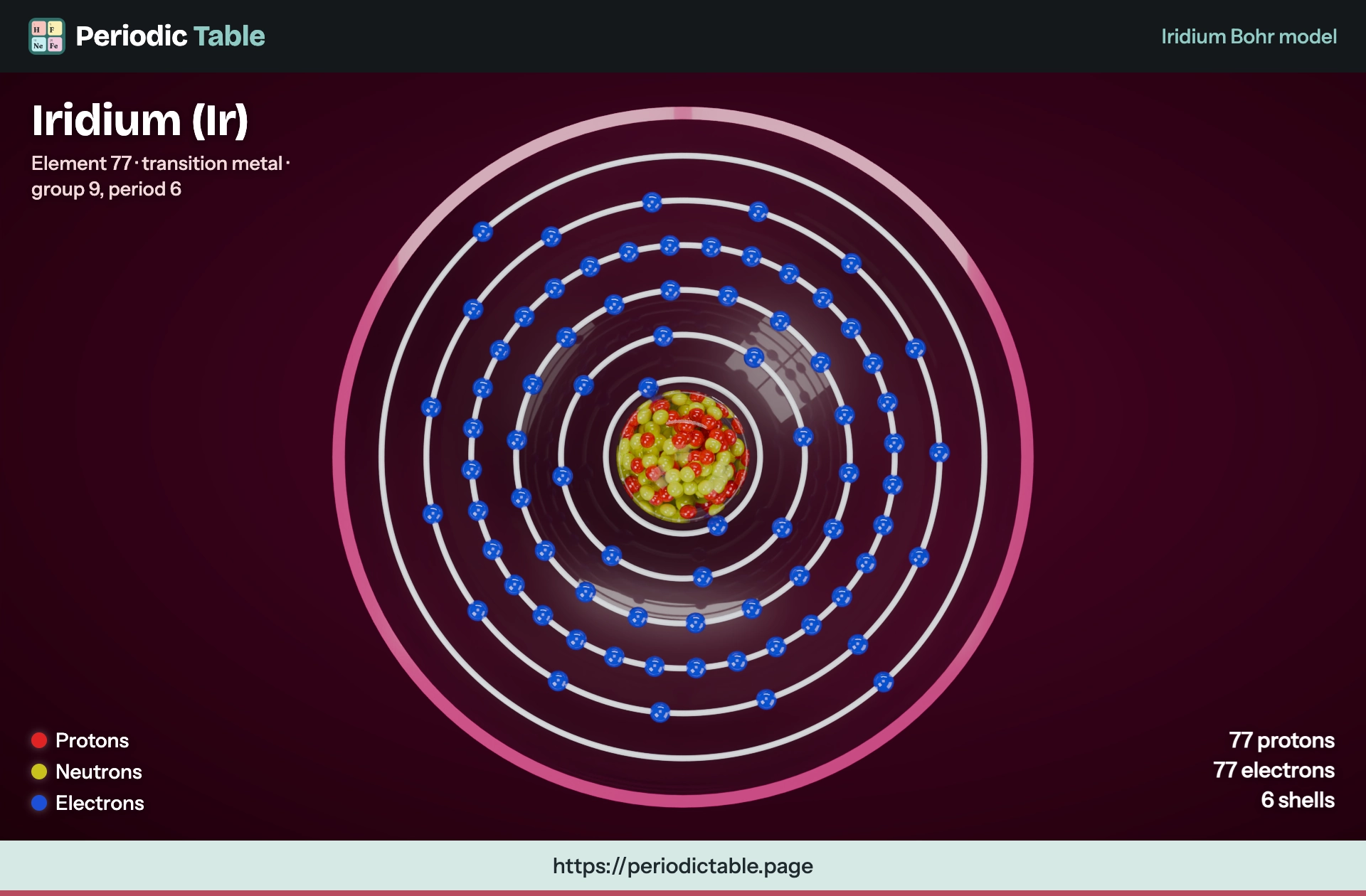
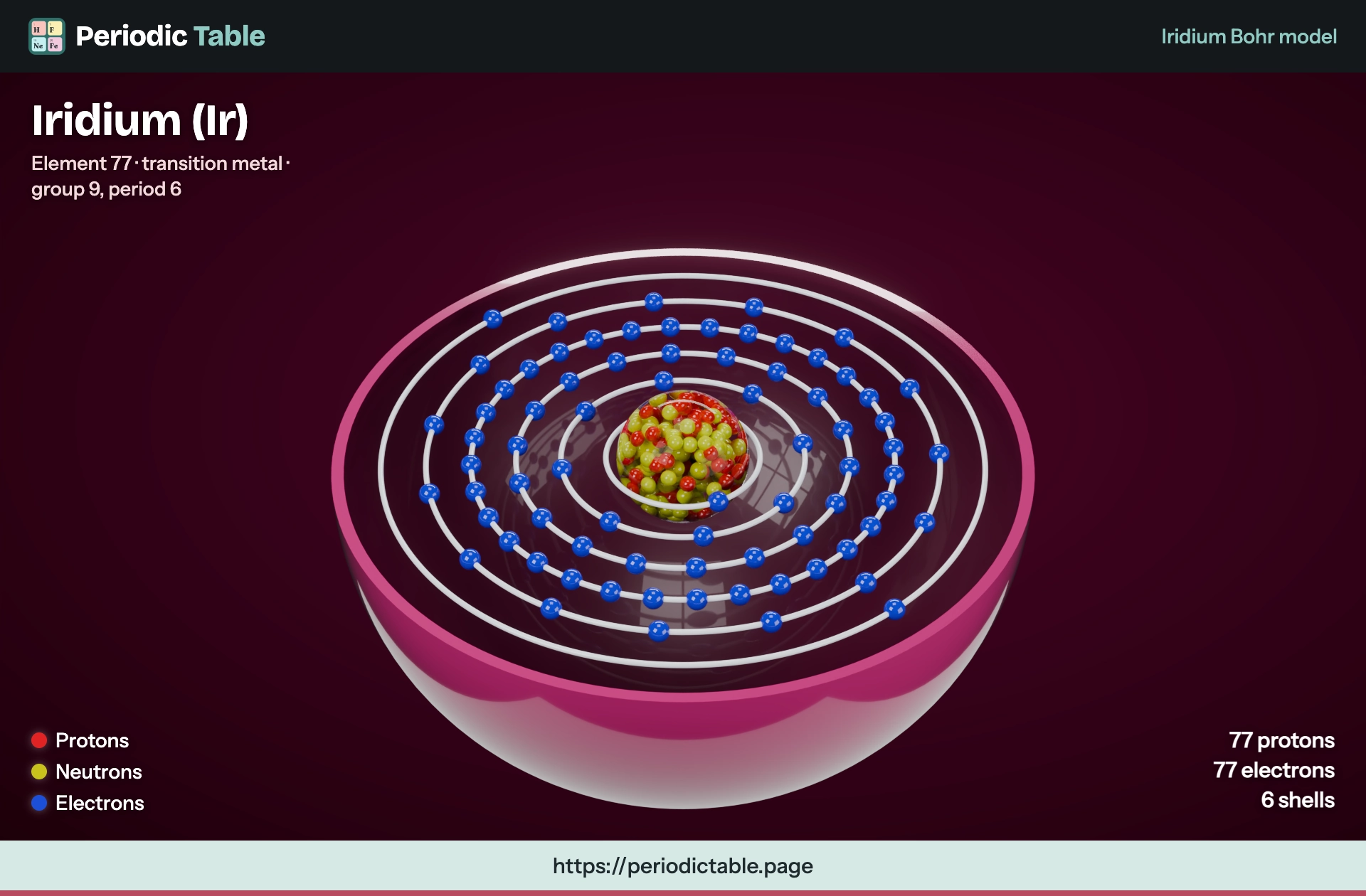
This is a Bohr model of iridium (Ir), a simplified picture of a single iridium atom. Its nucleus holds 77 protons, and a neutral iridium atom has 77 electrons, arranged around it in 6 shells (2 in shell K, 8 in shell L, 18 in shell M, 32 in shell N, 15 in shell O and 2 in shell P).
Iridium periodic table electron configuration
- Shorthand
- [Xe] 4f14 5d7 6s2
- Full
- 1s2 2s2 2p6 3s2 3p6 4s2 3d10 4p6 5s2 4d10 5p6 6s2 4f14 5d7
- Electrons per shell
- 2, 8, 18, 32, 15, 2
Iridium element properties and atomic data
- Atomic number
- 77
- Atomic mass
- 192.2173 u
- Phase at STP
- Solid
- Melting point
- 2445.85°C (2719 K)
- Boiling point
- 4129.85°C (4403 K)
- Density
- 22.56 g/cm³
- Electronegativity (Pauling)
- 2.2
- Period
- 6
- Group
- 9
- Block
- d-block
- Appearance
- Silvery white
- Discovery date
- 1803
- Discovered by
- Smithson Tennant
- Named by
- —
Iridium (Ir) element facts at a glance
The element sits at atomic number 77 on the periodic table, between osmium and platinum in the sixth row. The table below gathers the core data you will see quoted most often for the element, rounded to the precision that standard references report. A note on rutherfordium isotopes explains spontaneous fission and alpha decay in the shortest-lived isotopes.
| Property | Value |
|---|---|
| Symbol | Ir |
| Atomic number | 77 |
| Atomic weight | 192.217 |
| Group / period / block | Group 9, period 6, d-block |
| Electron configuration | [Xe] 4f14 5d7 6s2 |
| Melting point | 2,446 °C (2,719 K) |
| Boiling point | about 4,130 °C (4,403 K) |
| Density at 20 °C | 22.56 g/cm3 |
| Electronegativity (Pauling scale) | 2.20 |
| Ionization energies (1st, 2nd) | 880 kJ/mol, 1,600 kJ/mol |
| Electron affinity | about 151 kJ/mol |
| Atomic radius / covalent radius | 136 pm / 141 pm |
| CAS number | 7439-88-5 |
Read the configuration as seven electrons in the 5d subshell sitting on a full 4f shell. That d-electron count is what places it in the cobalt column (group 9) alongside rhodium, and it explains why the element forms so many stable complexes, which you will meet further down.
Physical properties of iridium
The pure element has a white, platinum-like luster with a faint yellow cast. It crystallises in a face-centered cubic lattice, the same crystal structure as gold and platinum, yet it behaves nothing like those soft metals once you try to bend it. A reader curious about the green flame in fireworks and flare mixtures will find the chemistry in the barium toxicity entry for further reading.
Second-densest metal after osmium
For decades chemists argued over whether iridium or osmium was heavier, because the two values differ by only about 0.1 percent. X-ray crystallography settled it: Ir measures 22.56 g/cm3 and osmium 22.59 g/cm3.
In practical terms a one-litre block would weigh about 22.6 kg, roughly twice as much as the same block of lead. Few substances pack more mass into a given volume.
Stiffness, brittleness and heat tolerance of iridium
It is extremely stiff: its Young's modulus is the second highest among all metals. It is also brittle, so welds crack and machining is slow, which is why manufacturers rely on powder metallurgy to shape it. It stays strong in air above 1,600 °C, a temperature at which most structural alloys have already sagged or melted.
| Mechanical or thermal property | Typical value |
|---|---|
| Young's modulus | 528 GPa |
| Shear modulus | 210 GPa |
| Bulk modulus | 320 GPa |
| Mohs hardness | 6.5 |
| Vickers hardness | 1,760–2,200 MPa |
| Thermal conductivity | 147 W/(m·K) |
| Electrical resistivity | 47.1 nΩ·m at 20 °C |
| Specific heat capacity | 131 J/(kg·K) |
Magnetically, it is weakly paramagnetic, and it turns into a superconductor only below 0.14 K, a fraction of a degree above absolute zero.
Chemical properties and corrosion resistance of iridium
It is usually ranked as the most chemically resistant of all metals. Solid pieces shrug off every common acid, including aqua regia, the mixture of nitric and hydrochloric acid that dissolves gold.
To get it into solution you need harsh treatment: fusing with sodium peroxide, chlorinating it at red heat, or attacking it with fused alkalis. At high heat it slowly reacts with oxygen, the halogens and sulfur, but in everyday conditions it stays essentially inert.
Iridium oxidation states from -3 to +9
Its chemistry spans an unusually wide range of oxidation states, from −3 to +9. The common ones are +1, +3 and +4.
The +9 state, found in the gaseous cation [IrO4]+ and reported in 2014, is the highest oxidation number confirmed for any element. Ir(III) and Ir(IV) centres usually adopt octahedral shapes, and its complexes are almost always low-spin.
Iridium compounds and complexes
Most iridium compounds start from chlorides. Iridium trichloride, IrCl3, and hexachloroiridic acid, H2IrCl6, are the usual laboratory feedstocks, and ammonium hexachloroiridate is the salt refiners precipitate to purify it.
The only well-characterised binary oxide is iridium dioxide, IrO2, a blue-black solid, while iridium hexafluoride, IrF6, is a volatile yellow solid. The colourful salts of these compounds, from deep brown to olive green, are what gave the element its name.
Organoiridium chemistry: Vaska's complex and Crabtree's catalyst
Two organometallic complexes made the element famous in research chemistry. Vaska's complex, IrCl(CO)[P(C6H5)3]2, showed chemists how metals add small molecules in a step called oxidative addition. Crabtree's catalyst then put that idea to work for hydrogenation of crowded alkenes, and related compounds led the field of C–H bond activation.
Isotopes of iridium and the Mössbauer effect
The natural element is a mix of two stable isotopes, Ir-191 and Ir-193. Around forty radioactive forms have also been made in reactors and accelerators. The ones you are most likely to read about are listed here.
| Isotope | Natural abundance | Half-life | Why it matters |
|---|---|---|---|
| Ir-191 | 37.3% | stable | Mössbauer spectroscopy; target for making Ir-192 |
| Ir-193 | 62.7% | stable | Most abundant natural form |
| Ir-192 | synthetic | 73.8 days | Gamma source for medicine and weld testing |
| Ir-192m2 | synthetic | 241 years | Longest-lived nuclear isomer of the element |
Iridium-192 is the workhorse radioisotope: it is produced by neutron activation of Ir-191 and decays with a half-life of about 74 days, long enough to ship and short enough to replace regularly. In 1957 Rudolf Mössbauer used Ir-191 to discover recoil-free gamma-ray absorption, now called the Mössbauer effect, and won the 1961 Nobel Prize in physics for it. The technique is still used across physics, chemistry and mineralogy.
History and discovery of iridium
The story begins with platinum. Spanish colonists in South America regarded platinum nuggets as a nuisance mixed into gold, and when European chemists began dissolving crude platinum in the 1700s they kept finding a stubborn black residue that would not dissolve. That stubborn residue is where iridium had been hiding all along.
How Smithson Tennant named iridium after a rainbow
In 1803 the English chemist Smithson Tennant worked through a larger quantity of that residue than anyone before him and found two new metals in it: osmium and iridium. He announced both to the Royal Society in 1804.
Because the salts he made shifted through so many colours, he named the new metal after Iris, the Greek goddess of the rainbow. The discovery came at almost the same moment that French chemists were studying the same black powder.
Melting and working the iridium metal
Turning the powder into usable iridium metal took decades. John George Children first melted a sample in 1813 using an enormous battery, and Henri Sainte-Claire Deville and Jules Henri Debray melted it in quantity in 1860 with an oxyhydrogen flame. By 1834 gold pen nibs with hard Ir tips were on sale, and in 1933 iridium alloyed with ruthenium appeared in thermocouples able to read temperatures near 2,000 °C.
Where iridium occurs on Earth and in space
It is one of the rarest stable elements in Earth's crust, averaging only about 0.001 ppm in crustal rock. The reason is geology: the element is siderophile, or "iron-loving", so most of the planet's supply sank with molten iron into Earth's core when the planet formed. Like other heavy elements, it was forged by the r-process in events such as neutron star mergers.
- Native alloys: osmiridium (osmium-rich) and iridosmium (iridium-rich)
- Platinum ores of the Bushveld Igneous Complex in South Africa, the largest known reserve
- Copper-nickel sulfide deposits around Norilsk in Russia and the Sudbury Basin in Canada
- Alluvial sands, where a few rare iridium-dominant minerals also turn up
The iridium anomaly and the dinosaur extinction
Meteorites carry hundreds of times more iridium than crustal rock. In 1980 a team led by physicist Luis Alvarez found a thin clay layer, laid down 66 million years ago at the Cretaceous–Paleogene boundary, loaded with the element.
Their Alvarez hypothesis proposed that a giant asteroid or comet had struck the planet and triggered the mass extinction of the non-avian dinosaurs. The buried Chicxulub crater under Mexico's Yucatán Peninsula later supplied the impact site, although some researchers argue volcanoes could have contributed part of the signal.
Reading an iridium spike in sediment
Geologists now treat a sharp rise of the element in a sediment core as a fingerprint of a meteor or comet impact. Core samples from the Pacific, for instance, pointed to the Eltanin impact roughly 2.5 million years ago, and the same test helps separate cosmic dust from volcanic sources.
Iridium production, supply and price
No mine digs for iridium on its own. It comes out as a by-product of platinum mining and of nickel and copper refining, where the platinum group metals collect in the anode mud left at the bottom of electrolytic cells. Extraction then follows a long chain of steps:
- The concentrate is dissolved with chlorine and hydrochloric acid, or by fusing it with sodium peroxide.
- Ir is then separated as ammonium hexachloroiridate, or pulled out with organic amines in a solvent extraction.
- The purified chloride salt is reduced with hydrogen to a grey metal powder or sponge.
- The powder is pressed and sintered into bars, wire or crucible blanks.
World production is only a few tonnes a year, around 7–8 t, and more than four-fifths comes from South Africa. Zimbabwe, Russia and Canada supply most of the rest. Because consumption swings with demand for electrodes and electronics, the price is volatile: it moved from a few hundred US dollars per troy ounce in the early 2000s to around US$5,000 in the 2020s.
Uses of iridium in industry, medicine and science
Nearly every one of the uses of iridium comes back to the same two traits: it is corrosion-resistant and it tolerates heat that destroys other materials. That makes it valuable to industry even in tiny amounts.
Spark plugs, crucibles and iridium alloys
Fine-wire spark plugs with an iridium centre electrode last far longer than standard ones because the tip resists arc erosion; aviation engines use them too. Crucibles of the pure element hold molten oxides at up to 2,100 °C in the Czochralski process, which grows single crystals for lasers and electronics. Other iridium alloys and coatings show up in:
- Electrodes coated with iridium oxide for the chloralkali process, which makes chlorine and caustic soda
- Multi-hole spinnerets that extrude polymer fibres such as rayon
- Aerospace engine parts and high-temperature electrical contacts
- An iridium-titanium alloy for deep-water pipes
Catalysis, photocatalysis and OLEDs
In catalysis, iridium catalysts drive the Cativa process, which turns methanol and carbon monoxide into acetic acid on an industrial scale, and chiral iridium complexes produce the herbicide (S)-metolachlor. Phosphorescent iridium complexes give many OLEDs their bright, efficient light, and similar molecules power light-driven photocatalysis in organic synthesis.
Iridium in brachytherapy and radiography
Sealed Ir-192 sources deliver gamma radiation in brachytherapy, a form of cancer treatment where the source sits inside or beside the tumour, for example in prostate and cervical treatments. The same isotope is one of the main sources used in industrial radiography, the non-destructive testing of welds in pipelines, pressure vessels and steel structures.
Iridium in measurement standards, pens and space
From 1889 a 90 percent platinum, 10 percent iridium alloy formed the International Prototype Kilogram and the standard meter bar kept near Paris; the kilogram standard was finally retired in 2019. Other uses past and present:
- Hard fountain pen nibs, although modern "iridium" tips rarely contain the element
- Vent pieces of nineteenth-century cannon
- Iridium black, a pigment for painting porcelain a deep black
- Cladding around plutonium fuel in spacecraft power sources
- The coating on the mirrors of the Chandra X-ray Observatory
Alongside platinum, gold and the other noble metal group members, iridium is prized precisely because it barely changes over decades of use.
Is iridium toxic? safety and hazards
In bulk form iridium is not considered toxic: it does not react with body tissue, and your body naturally contains only trace amounts, about 20 parts per trillion. Finely divided powder is different.
It can act as an irritant to the eyes and lungs and may ignite in air, so labs handle it like other fine powders. Most of its compounds are insoluble, which limits absorption, but soluble halides deserve more caution.
The real hazard is radioactive Ir-192. Lost or mishandled industrial sources have caused serious burns and radiation injuries, so these sources are tightly licensed and shielded.