


Barium element (Ba): barium periodic table facts
Barium periodic table facts: barium (Ba) is element 56, an alkaline earth metal in group 2, period 6. If you have ever swallowed a chalky drink before an X-ray or watched a green burst light up the sky, you have already met barium. To see how Carl Wilhelm Scheele and Humphry Davy identified a greenish-yellow gas, open the chlorine electronegativity page for the full story.
Ba sits in group 2 of the periodic table, a soft and highly reactive alkaline earth metal that never turns up free in nature. Below you will find its key numbers, how it behaves, where it comes from and why some of its salts heal while others poison.
Rotate the 3D Bohr model of barium
Drag to orbit, scroll to zoom.
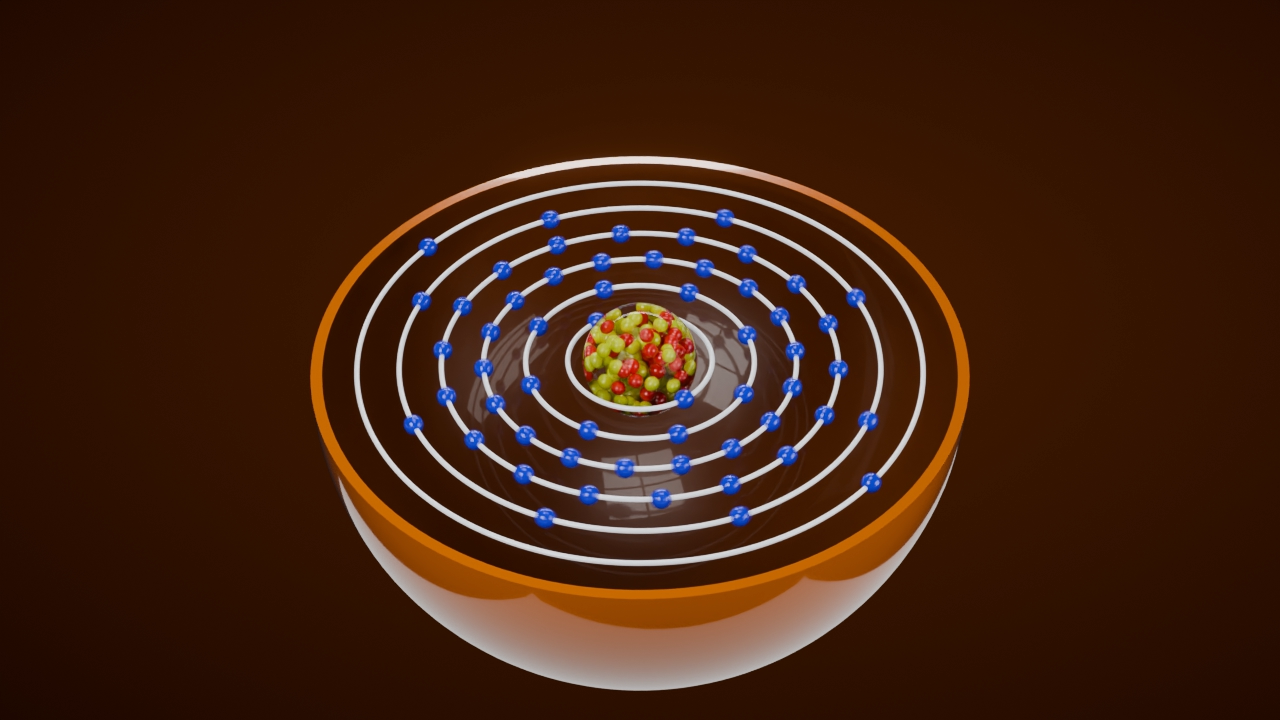
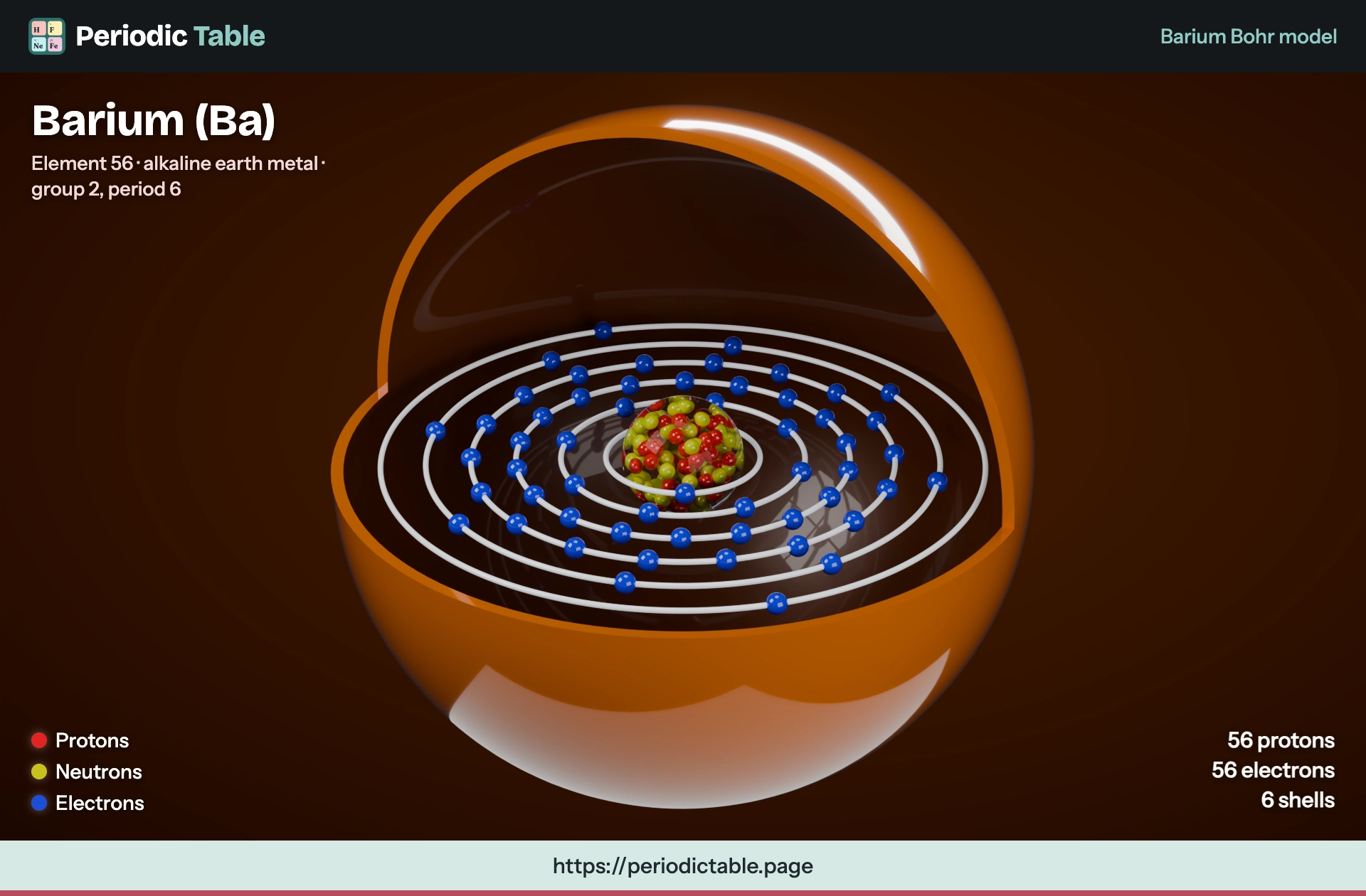
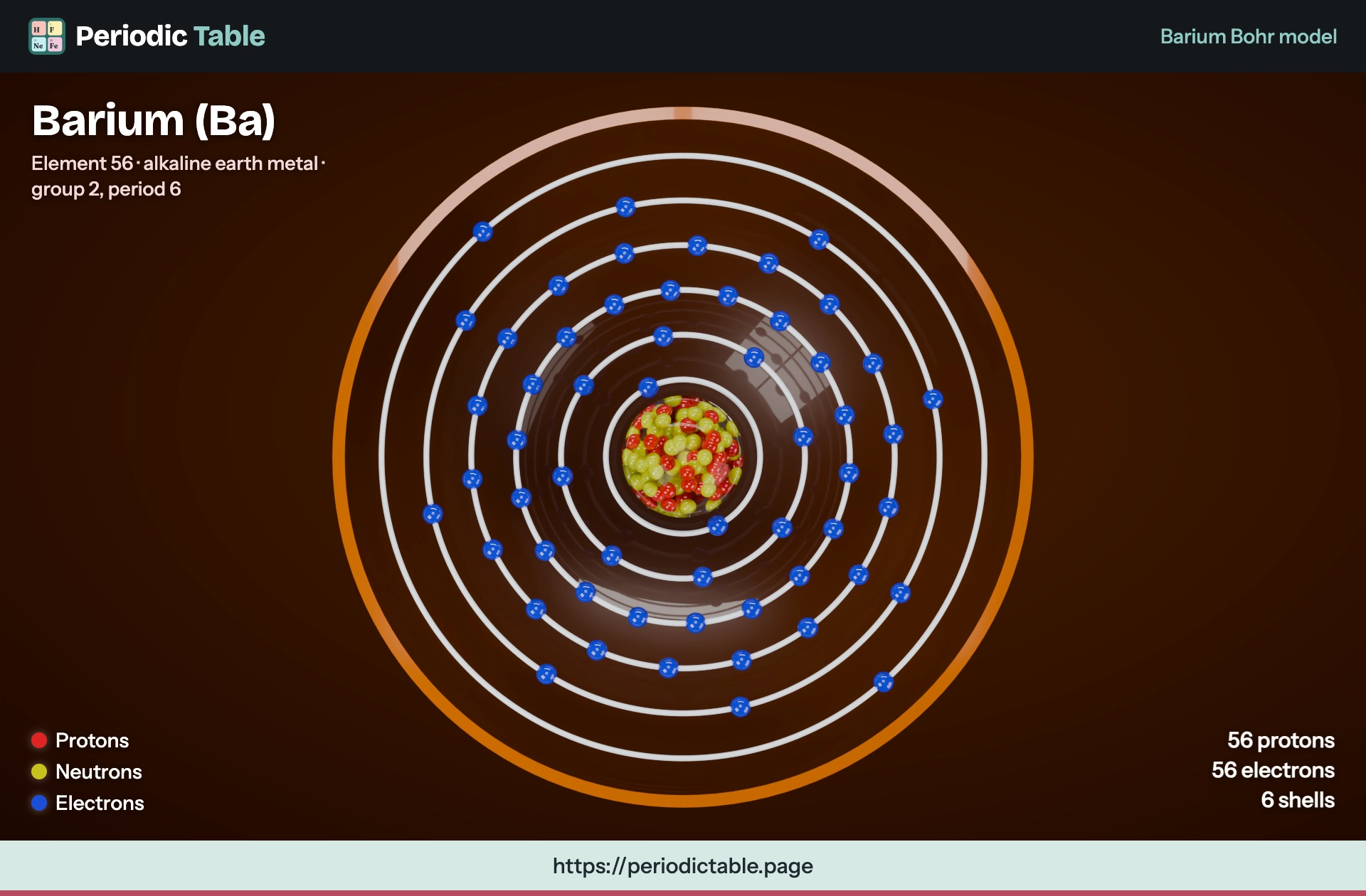
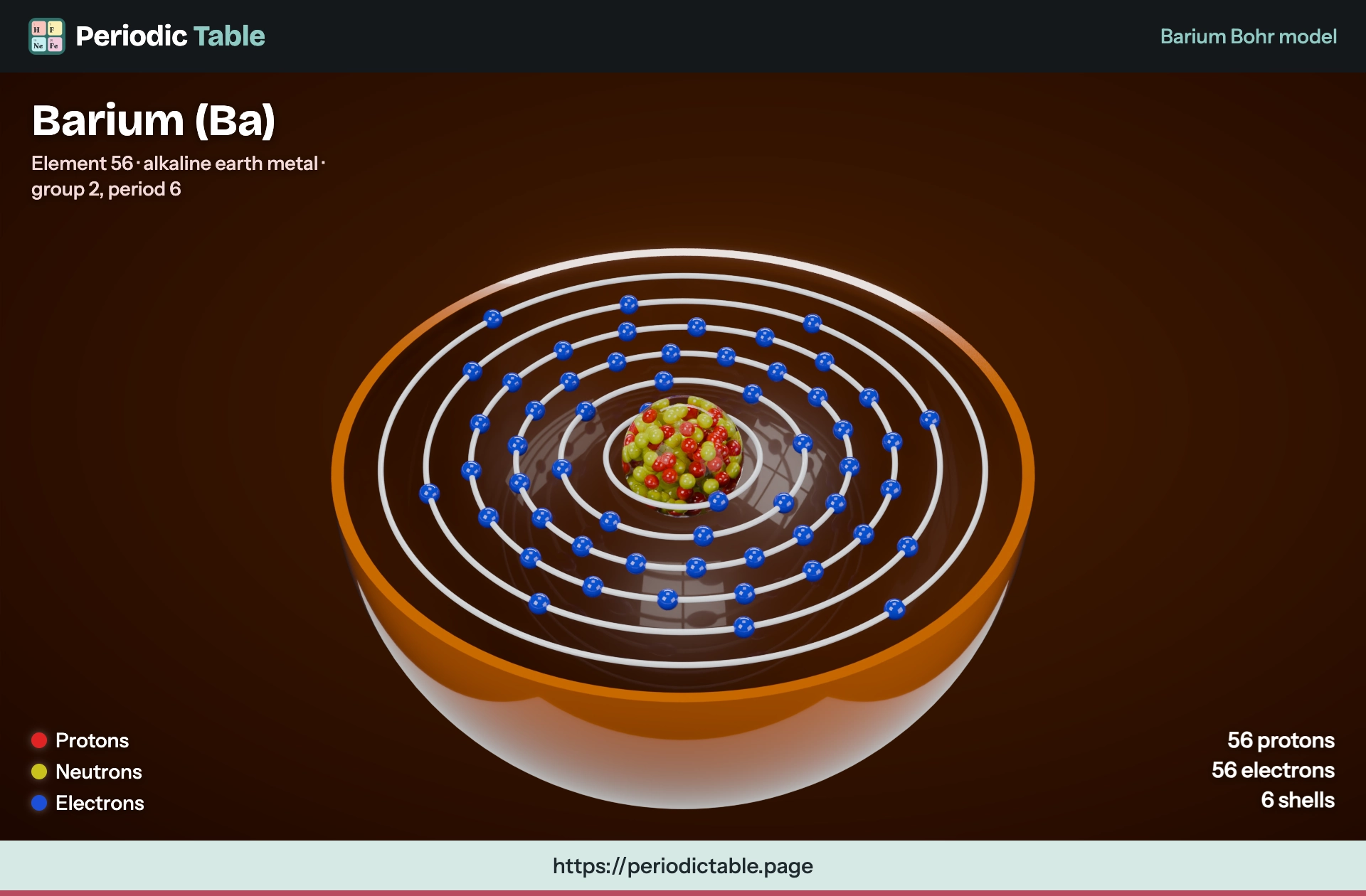
This is a Bohr model of barium (Ba), a simplified picture of a single barium atom. Its nucleus holds 56 protons, and a neutral barium atom has 56 electrons, arranged around it in 6 shells (2 in shell K, 8 in shell L, 18 in shell M, 18 in shell N, 8 in shell O and 2 in shell P).
Barium periodic table electron configuration
- Shorthand
- [Xe] 6s2
- Full
- 1s2 2s2 2p6 3s2 3p6 4s2 3d10 4p6 5s2 4d10 5p6 6s2
- Electrons per shell
- 2, 8, 18, 18, 8, 2
Barium element properties and atomic data
- Atomic number
- 56
- Atomic mass
- 137.3277 u
- Phase at STP
- Solid
- Melting point
- 726.85°C (1000 K)
- Boiling point
- 1844.85°C (2118 K)
- Density
- 3.51 g/cm³
- Electronegativity (Pauling)
- 0.89
- Period
- 6
- Group
- 2
- Block
- s-block
- Appearance
- Unknown
- Discovery date
- 1808
- Discovered by
- Carl Wilhelm Scheele
- Named by
- —
Barium element facts: Ba at atomic number 56
The barium element carries the symbol Ba and atomic number 56. It is the fifth member of the alkaline earth metals, after beryllium, magnesium, calcium and strontium, and it sits in period 6 of the s-block. As a chemical element, it is heavier than its lighter neighbours, easy to oxidise and almost always found locked inside ores, which is why so much of its chemistry is really the chemistry of its salts. In both catalysis with Vaska's complex and radiation therapy sources, the key facts feature in the iridium element page for curious readers.
| Property | Value |
|---|---|
| Symbol / atomic number | Ba / 56 |
| Group, period, block | Group 2, period 6, s-block |
| Relative atomic mass | 137.327 |
| Electron configuration | [Xe] 6s2 |
| State at 20 °C | Solid |
| Crystal structure | Body-centered cubic |
| CAS number | 7440-39-3 |
Atomic mass, atomic weight and electron configuration
A typical sample comes in at 137.327, the standard atomic weight chemists use in stoichiometry. The configuration [Xe] 6s2 leaves two outer electrons in a large, loosely held shell.
That explains the low electronegativity of 0.89 on the Pauling scale and the modest first two ionization energies (502.9 and 965.2 kJ/mol), while the third jumps to about 3,600 kJ/mol. The empirical atomic radius is 222 pm, the covalent radius about 215 pm and the van der Waals radius 268 pm.
Physical properties of barium (Ba)
Freshly cut, the solid is silvery-white with a faint golden tint, but the shine fades to a dull grey within minutes in air. It is soft, with a Mohs hardness of 1.25, and adopts a body-centered cubic crystal structure at room temperature. Its specific heat capacity is about 204 J/(kg·K), the heat of fusion 7.12 kJ/mol and the heat of vaporization 142 kJ/mol. How oxygen, moisture and air tarnish the metal are noted in the actinium electron configuration, along with laboratory handling by scientists.
Other measured values include a thermal conductivity of 18.4 W/(m·K), an electrical resistivity of 332 nΩ·m, a Young's modulus of 13 GPa, a shear modulus of 4.9 GPa and a bulk modulus of 9.6 GPa. It is weakly paramagnetic, and its vapor pressure only reaches 1 Pa at around 911 K. These physical properties are hard to pin down precisely because the pure solid is so difficult to purify.
Melting point, boiling point and density
The melting point is 727 °C (1,000 K) and the boiling point about 1,845 °C (2,118 K). Both the melting temperature and the measured 3.594 g/cm3 of the solid fall between lighter strontium (2.64 g/cm3) and heavier radium (about 5.5 g/cm3), exactly the trend you would expect walking down the group. It is the element's compounds, rather than the solid itself, that are famous for their high density.
Chemical properties of metallic barium
Metallic barium behaves like calcium and magnesium, only more so. Its reactivity is high because it is strongly electropositive: it gives up its valence pair readily, and reactions with the chalcogens (oxygen, sulfur and their relatives) release a lot of heat. Room-temperature air tarnishes it within minutes, so samples are stored under oil or in an inert atmosphere such as argon.
- With water or alcohols, it reacts exothermically and releases hydrogen gas.
- Most acids attack it quickly, but sulfuric acid stalls because an insoluble sulfate skin forms on the surface.
- Heated with carbon, nitrogen, silicon or hydrogen it forms carbides, nitrides, silicides and hydrides.
- It combines with aluminium, zinc, lead and tin to form intermetallic phases and alloys.
Oxidation state and the green flame
Almost every compound you will meet shows the +2 oxidation state; the element is reliably divalent, forming doubly charged cations. Put one of its salts into a burner and you get a green flame, produced by spectral lines at 455.4, 493.4, 553.6 and 611.1 nm. That apple-green colour is a quick bench test for spotting the element in an unknown sample.
Isotopes of Ba and their natural abundance
Natural barium is a mix of seven primordial nuclides. Barium-138 dominates at about 71.7%, and the abundance of the other stable isotopes falls as mass number drops.
Barium-130 is technically radioactive, undergoing double beta radioactive decay to xenon-130 with a half-life on the order of 1021 years, so slow it is effectively stable. In total 41 isotopes are known, from mass 114 to 154.
| Isotope | Natural abundance | Half-life |
|---|---|---|
| 130Ba | 0.11% | ~1021 years |
| 133Ba | Synthetic | 10.538 years |
| 134Ba | 2.42% | Stable |
| 136Ba | 7.85% | Stable |
| 137Ba | 11.2% | Stable |
| 138Ba | 71.7% | Stable |
The longest-lived artificial isotope is barium-133, at about 10.5 years, which is why it shows up as a calibration source for gamma detectors. A short-lived excited state at mass 137 also forms during the decay of the fission product caesium-137.
History of pure barium: from Bologna stones to electrolysis
The story starts with Bologna stones, smooth pebbles of baryte found in volcanic rock near Bologna in Italy. Seventeenth-century alchemists prized them because, after heating with organic matter and exposing to light, they would glow for years, an early recorded case of phosphorescence.
In 1772 the Swedish chemist Carl Wilhelm Scheele showed that baryte contained a new element, though Carl Scheele could only isolate its oxide. The French chemist Guyton de Morveau called that oxide "barote", and Lavoisier renamed it baryta. Pure barium had to wait for a new tool: in 1808 Humphry Davy passed a current through molten barium salts to free the element for the first time.
Davy built the name from baryta, itself from the Greek barys, meaning "heavy", a nod to how dense its ores are. The adjective form, rarely used, is "baric". Davy's 1808 work made barium one of the first elements ever isolated with an electric current, a milestone in the chemistry of the alkaline earths.
Where the alkaline earth metal occurs
Because it reacts with almost everything, it exists only in combined form. It makes up roughly 0.0425% of the Earth's crust, which is more common than many people assume.
Mining focuses on one main mineral, with China producing more than half of world output, followed by India, Morocco and the United States. Global reserves of the ore are estimated in the hundreds of millions to billions of tonnes.
Baryte, barite and witherite
Baryte (also spelled barite, and known to miners as heavy spar) is the sulfate BaSO4 and the primary commercial source of barium. Witherite, the carbonate, is a distant second, historically mined in northern England. Both minerals feel surprisingly weighty in the hand, which is how they got noticed long before anyone knew what was inside them.
Seawater and palaeoceanography
In seawater, dissolved barium averages about 109 nmol/kg and stays in the ocean for around 10,000 years. Tiny barite crystals form as plankton debris sinks, so marine sediments rich in them record how productive the ancient sea water was. That makes the element a useful tool in palaeoceanography for reconstructing past ocean circulation, ocean chemistry and the carbon cycle.
How elemental barium is produced
Mined ore is washed, crushed and separated from quartz, then roasted with carbon to give water-soluble barium sulfide, the starting point for most other salts. To make elemental barium, producers use reduction of barium oxide with aluminium at about 1,100 °C:
$$4\,\text{BaO} + 2\,\text{Al} \rightarrow 3\,\text{Ba} + \text{BaAl}_2\text{O}_4$$
The vapour is condensed under argon. Not all of the oxide is reduced, and commercial grades are about 99% pure, with strontium as the main impurity. An electrolytic route is avoided today because barium dissolves in molten halides and comes out impure.
Uses of barium metal: getters, alloys and superconductors
Barium metal has few large markets, but its eagerness to react is exactly what made it valuable. For decades it served as a getter in vacuum tubes and TV picture tubes: a small barium charge, flashed inside the sealed tube, mops up stray oxygen, nitrogen and water. Gettering faded with the switch to flat screens.
- As an oxide coating on hot cathodes and the electrodes of fluorescent lamps, where it makes electrons escape easily.
- In nickel blends for spark plugs and in lead-tin solders to improve creep resistance.
- As an inoculant in steel and cast iron, and in silicon-based blends used as deoxidizers.
- In YBCO (yttrium barium copper oxide), the first high-temperature superconductor that works above the boiling temperature of liquid nitrogen, at 93 K.
That last superconductor keeps barium relevant in research, industry and electroceramics today.
Barium compounds and their uses
Most of the ore is never reduced at all. Instead it goes straight into barium compounds, whose weight, colour and optical behaviour do the work. Here are the compounds you are most likely to encounter.
Barium sulfate as a radiocontrast agent and drilling fluid
Barium sulfate is dense and almost completely insoluble, which makes it opaque to X-rays yet harmless to swallow. As a radiocontrast agent, it coats the gastrointestinal tract so an X-ray or CT scan can outline the esophagus, stomach and bowel; this contrast agent passes through the digestive tract unchanged, and has been used to image the digestive system since 1908.
By tonnage, its biggest job is as a weighting agent in drilling fluid for oil and gas wells, where the petroleum industry uses it to hold back high-pressure formations. Precipitated grades, sold as blanc fixe, whiten paints, plastics and rubber, and lithopone pairs it with zinc sulfide.
Barium nitrate in fireworks
Barium nitrate is the classic green colourant in fireworks and signal flares; adding a chlorine donor such as barium chloride or chlorate deepens the shade to emerald. Elsewhere in pyrotechnics, barium peroxide serves as an igniter in thermite used to weld rail track and as a green trace in tracer ammunition.
Other compounds: titanate, fluoride and hydroxide
A handful of other salts fill specialist roles where their optical, electrical or magnetic behaviour matters more than their weight.
Barium titanate
A ferroelectric ceramic used in capacitors and sensors.
Barium fluoride
A window material for infrared optics, transparent from about 0.15 to 12 µm.
Barium hydroxide
A strong base that absorbs little CO2, handy for calibrating pH equipment.
Barium carbonate in glass
Raises the refractive index and luster of optical glass and once blocked stray X-rays in CRT screens.
Barium oxide in ferrite magnets
Sintered with iron oxide, it forms ferrite, a cheap, non-conducting permanent magnet.
One mineral stands out for collectors: benitoite, a blue barium titanium silicate that glows under UV light and is the official state gem of California.
Toxicity of barium salts
The same ion that makes the sulfate useful makes the soluble ones dangerous. Toxicity depends almost entirely on solubility: water-soluble forms such as the chloride, nitrate and acetate are poisonous, with an oral LD50 in rats near 10 mg/kg. The carbonate dissolves in stomach acid, which is why it has been sold as rat poison and remains a rodenticide in some countries.
Once absorbed, the free barium ion blocks potassium channels in muscle cells, causing low blood potassium, an irregular heartbeat, weakness and in severe cases paralysis. Doses under a gram can be fatal to adults. Inhaled dust of the sulfate can collect in the lungs and cause baritosis, a benign condition.
The US EPA does not consider oral exposure likely to be carcinogenic, but the pure element is still classed as toxic and water-reactive. For your health, treat any unknown salt as hazardous until you know it is the sulfate.