


Actinium element (Ac): actinium periodic table facts
Actinium periodic table facts: actinium (Ac) is element 89, an actinide in period 7 of the f-block. If you have ever wondered why a whole row of the periodic table is named after one rarely seen substance, actinium (Ac) is the answer. Readers asking about bleach can check element 17, chlorine for calcium hypochlorite and the chloride ions it leaves behind.
Actinium is a soft, intensely radioactive element with atomic number 89, found only as a trace in uranium ores, and it was the first non-primordial radioactive substance ever isolated. Today you are most likely to meet actinium through Ac-225, an isotope being developed to destroy cancer cells from the inside.
Rotate the 3D Bohr model of actinium
Drag to orbit, scroll to zoom.
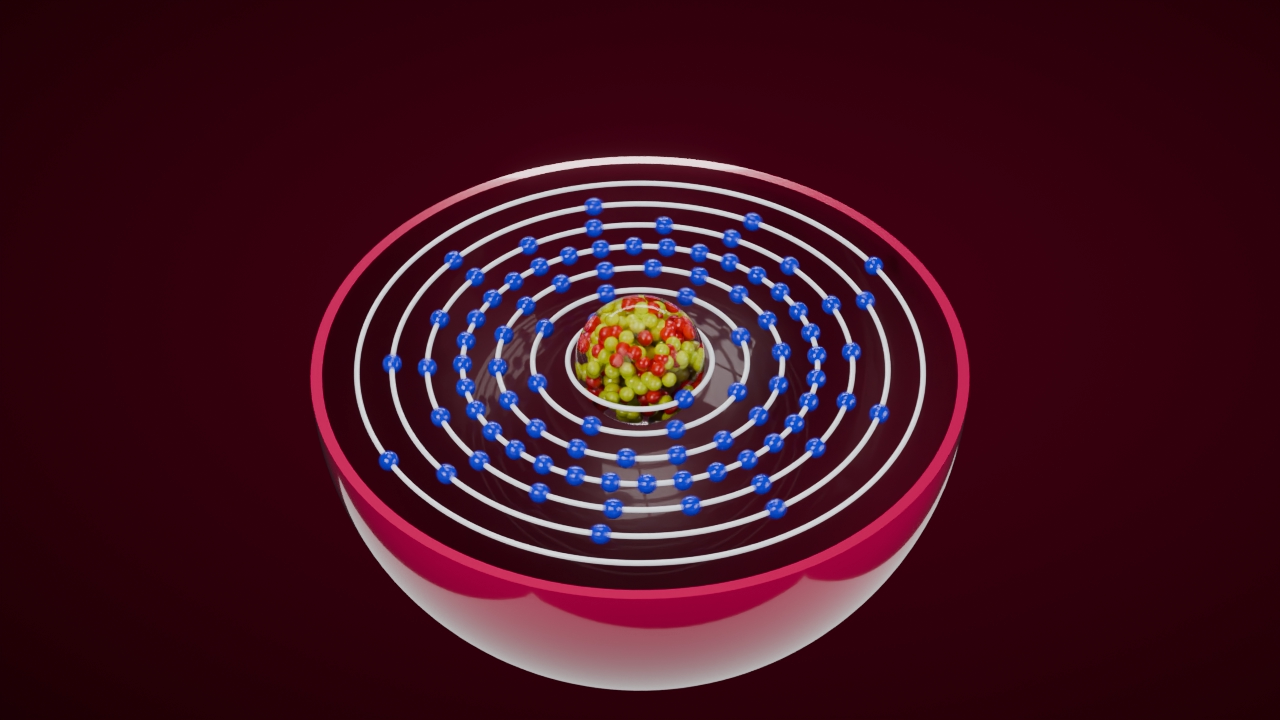
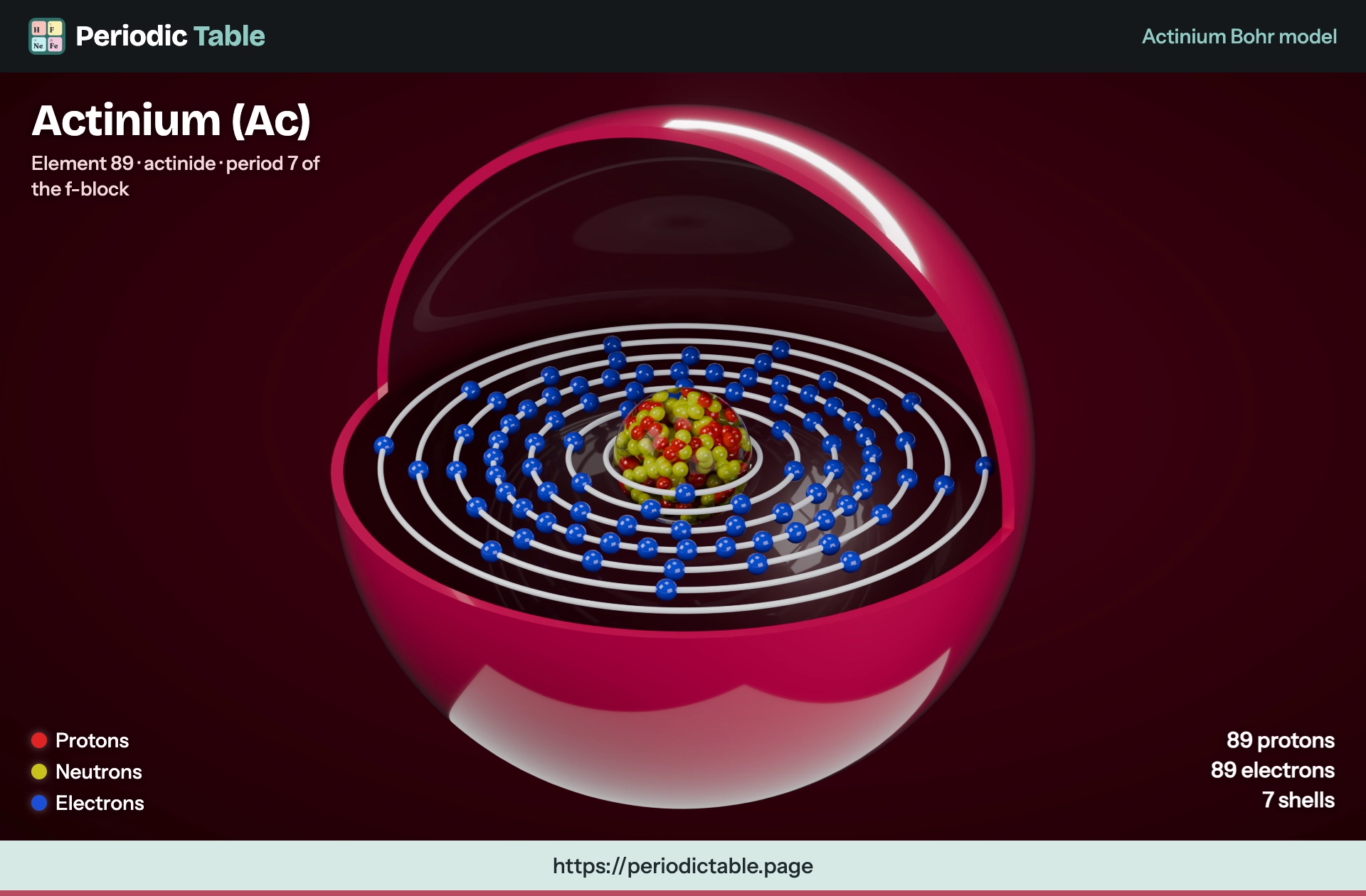
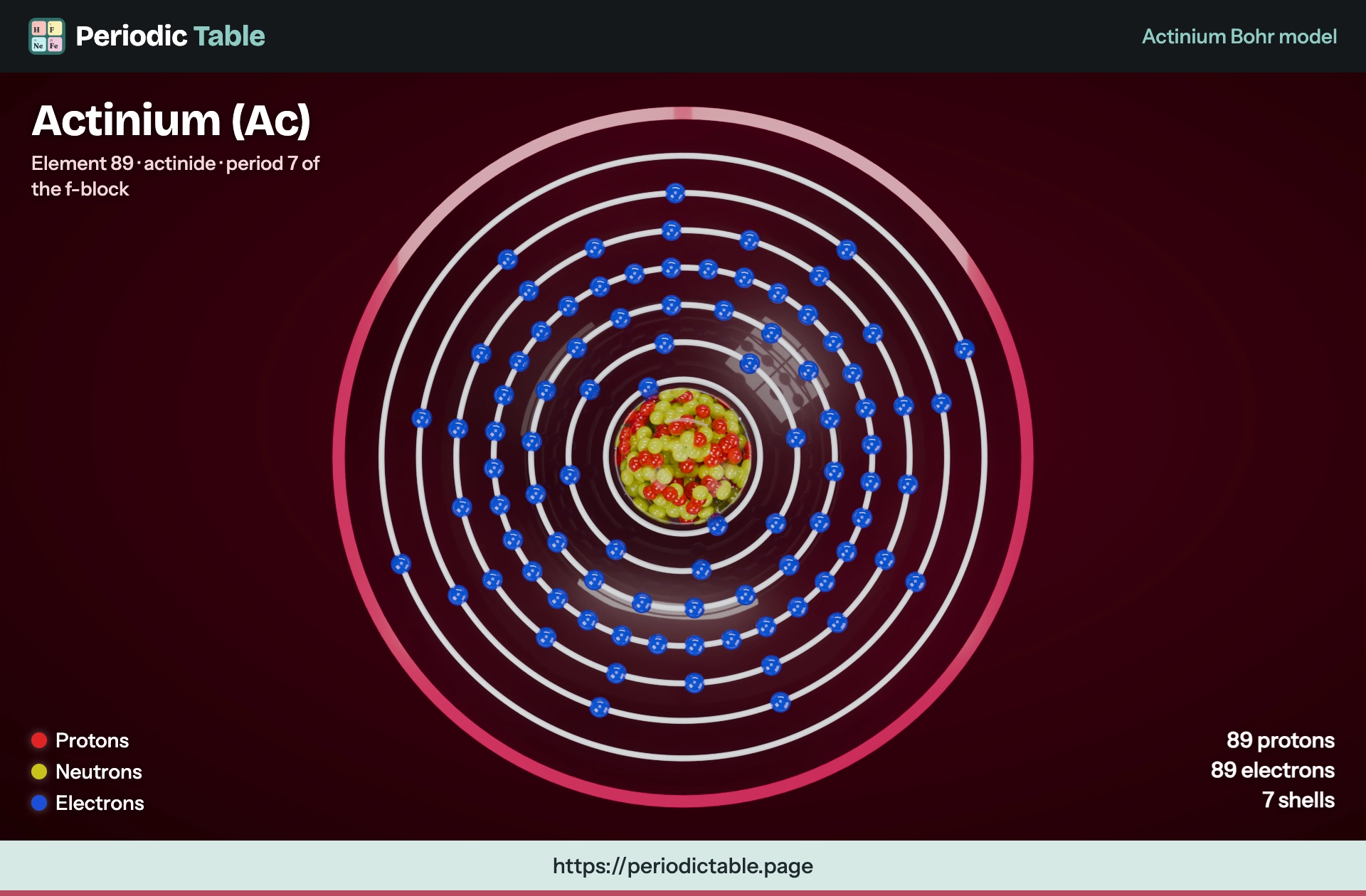
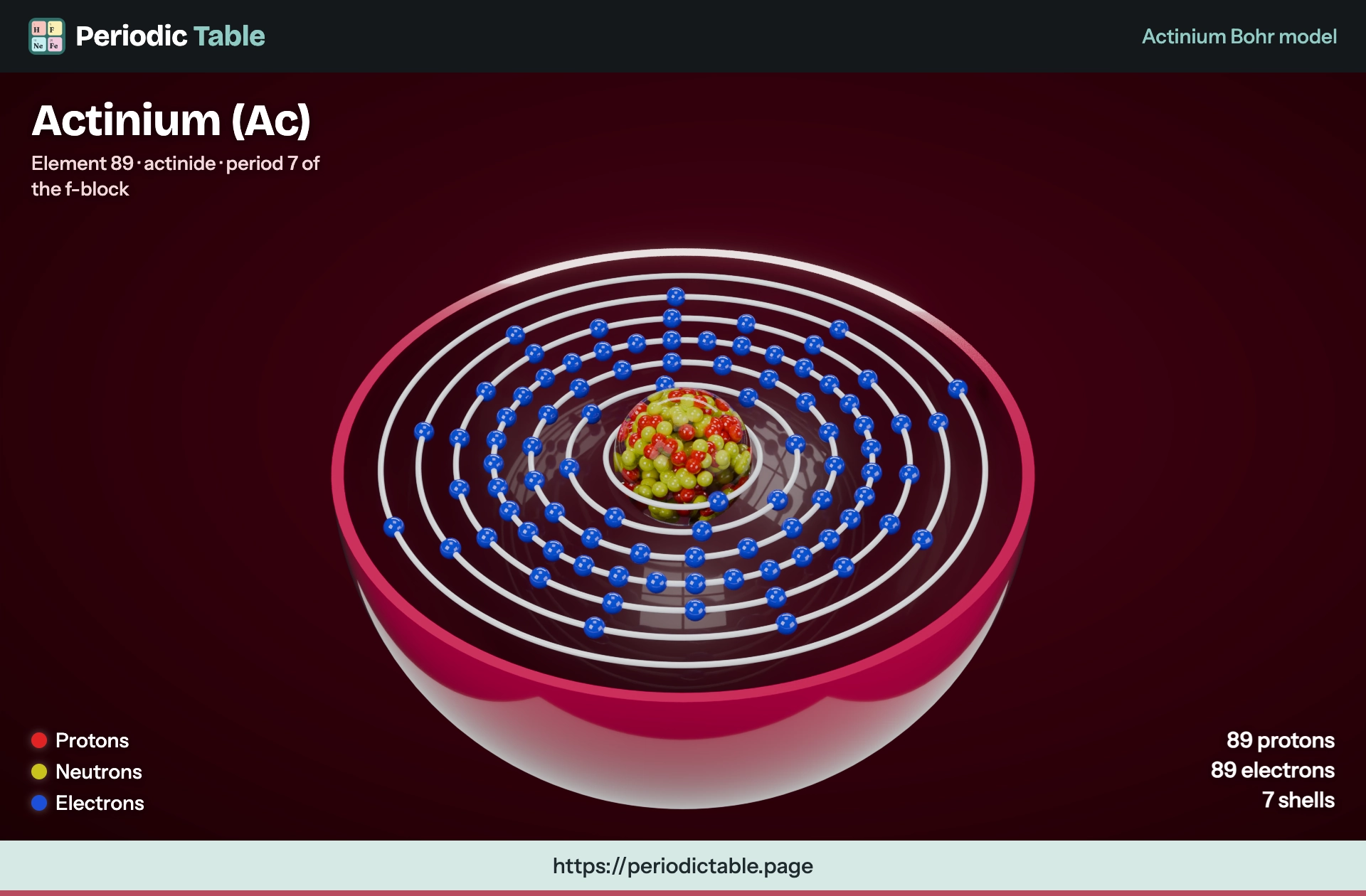
This is a Bohr model of actinium (Ac), a simplified picture of a single actinium atom. Its nucleus holds 89 protons, and a neutral actinium atom has 89 electrons, arranged around it in 7 shells (2 in shell K, 8 in shell L, 18 in shell M, 32 in shell N, 18 in shell O, 9 in shell P and 2 in shell Q).
Actinium periodic table electron configuration
- Shorthand
- [Rn] 6d1 7s2
- Full
- 1s2 2s2 2p6 3s2 3p6 4s2 3d10 4p6 5s2 4d10 5p6 6s2 4f14 5d10 6p6 7s2 6d1
- Electrons per shell
- 2, 8, 18, 32, 18, 9, 2
Actinium element properties and atomic data
- Atomic number
- 89
- Atomic mass
- [227] u
- Phase at STP
- Solid
- Melting point
- 1226.85°C (1500 K)
- Boiling point
- 3226.85°C (3500 K)
- Density
- 10 g/cm³
- Electronegativity (Pauling)
- 1.1
- Period
- 7
- Group
- —
- Block
- f-block
- Appearance
- Unknown
- Discovery date
- 1899
- Discovered by
- Friedrich Oskar Giesel
- Named by
- —
Actinium at a glance: atomic number, atomic mass and key data
Because every isotope of the element decays, its atomic weight is quoted in square brackets as [227], the mass number of its longest-lived isotope rather than a weighted natural average. The quick-reference figures below are the ones you will need most often; where published sources disagree, the range is shown. Pyrotechnics, electronics and manufacturing all draw on the barium element, which also covers health risks of soluble salts.
| Property | Value |
|---|---|
| Symbol | Ac |
| Atomic number | 89 |
| Atomic mass | [227] |
| Position in the periodic table | Actinides, period 7, f-block (some tables list it in the d-block, group 3) |
| Electron configuration | [Rn] 6d1 7s2 |
| Melting point | about 1,050–1,227 °C |
| Boiling point | about 3,200 °C |
| Density | about 10.07 g/cm3 |
| Common oxidation state | +3 |
| Electronegativity (Pauling scale) | 1.1 |
| Covalent radius | 215 pm |
| Lattice constant | 531.5 pm |
| Longest-lived isotope | Ac-227, 21.77 years |
| Discovered | 1899 by Debierne; first pure sample by Giesel |
| CAS number | 7440-34-8 |
With 89 protons, the element sits directly after radium (88) and before thorium (90), the first of a long run of heavy, unstable neighbours.
Where actinium sits in the periodic table and the actinide series
Actinium opens the actinide series, the run of 15 elements from 89 through lawrencium (103). It lends the group its name in the same way lanthanum names the lanthanides, which is why it is often called the first actinide. The idea that these heavy elements form their own row is younger than you might think. Readers wanting electronics, industry and compounds in one view can see how its oxide ends up in lenses by opening the lanthanide lanthanum and its uses section.
Mendeleev's original table had no place for them, and it was Glenn Seaborg who, after struggling to isolate americium and curium during his work on the transuranium elements, proposed the separate actinides row in 1945. That change is still regarded as the biggest revision to the periodic table since the rare earths were recognised.
Its placement is still debated. Some tables put it under scandium and yttrium in group 3, others start the f-block with it. Its behaviour in solution looks like that of its lighter cousin, yet chemists who study actinium complexes argue the empty 5f orbitals can take part in bonding, which makes actinium the first true 5f member of the table.
Electron configuration and oxidation state of actinium
The ground state is [Rn] 6d1 7s2: three valence electrons sitting outside a radon core. Giving up all three leaves a stable closed shell, so the +3 state dominates almost every compound.
The resulting Ac3+ ion is colorless in solution and is the largest tripositive ion known, holding roughly 10.9 water molecules in its first coordination sphere. A +2 state has been reported, so some data tables list the oxidation states as 3 and 2, but you will rarely see it outside specialist work.
History of the element actinium: Debierne, Giesel and emanium
In 1899 the French chemist André-Louis Debierne, a colleague of Marie and Pierre Curie, announced a new substance in the pitchblende residues left after the Curies had extracted radium. His descriptions shifted, though: in 1899 he compared it to titanium, in 1900 to the next element in the table. Historians have since argued that his samples may have held more protactinium, not identified until fourteen years later, than element 89 itself.
In 1902 the German chemist Friedrich Oskar Giesel independently found a material that behaved like a rare earth and, in 1904, called it emanium for the emanation it gave off. Comparisons of decay rates by Debierne, Harriet Brooks, Otto Hahn and Otto Sackur showed both men had the same thing, and Debierne's earlier name was kept. Giesel, who admired the Curies' laboratory, did not press his claim, but he is credited with the first radiochemically pure sample and with fixing its place at 89.
The discovery mattered for another reason: it was the first radioactive substance found that is not primordial, meaning none of it has survived since the Earth formed. Every atom of it present today was made recently by natural decay.
Why actinium (Ac) is named after a ray
The name comes from the Ancient Greek word aktis, genitive aktinos, meaning ray or beam (some sources put it as "beam or ray"), a nod to the faint glow its radiation produces. Be aware that the letters "Ac" are also used in organic chemistry as shorthand for acetyl and acetate, which have nothing to do with the element.
Physical properties of actinium metal
The physical properties of this element are hard to measure because only milligram quantities have ever been handled, and the radiation damages samples as they are studied. What is known is that it is a soft, silvery-white metal, sometimes with a golden cast, with an estimated shear modulus close to that of lead.
Its crystal structure is face-centered cubic (face-centred cubic in British spelling), and it conducts heat and electricity well, with a thermal conductivity of about 12 W/(m·K). Its specific heat capacity is about 120 J/(kg·K), equal to 27.2 J/(mol·K).
Melting point, boiling point and density
Expect to see two figures for melting: older reference tables give about 1,050 °C (1,323 K), while newer estimates put it near 1,227 °C (1,500 K). It boils at an extrapolated 3,200 °C or so, with an uncertainty of several hundred degrees, and at about 10 g/cm3 it is a little heavier than silver. The heat of fusion is about 14 kJ/mol and the heat of vaporization about 400 kJ/mol.
Why actinium glows in the dark
A sample of the pure element glows in the dark with a pale blue light. The glow does not come from the solid itself: its intense radioactivity sends out energetic particles that knock loose charges in the surrounding air, and the ionized gas gives off that eerie blue glow as it recombines.
Chemical properties of actinium
The chemical properties of element 89 track lanthanum and the other rare earth elements so closely that separating them is one of the hardest jobs in its chemistry. Exposed to oxygen and moisture, actinium reacts quickly and grows a thin white coating of actinium oxide (Ac2O3), which slows any further attack.
It dissolves in acids to give the trivalent ion, which then binds chloride, nitrate or fluoride ligands to form coordination complexes. Those complexes are useful models for how the heavier actinides behave in nuclear and environmental chemistry, because actinium has no complicating f-shell occupancy of its own.
Electronegativity and ionization energy
On the Pauling scale it scores 1.1, typical of a strongly electropositive substance. The first ionization energy is about 499 kJ/mol and the second about 1,170 kJ/mol, with the third near 1,900 kJ/mol; the electron affinity is about 33.77 kJ/mol. Those low first values explain why it gives up its outer shell so readily and why its chemistry is almost all trivalent.
Actinium compounds: oxides, halides and other salts
Because every sample is so radioactive, only a short list of actinium compounds has been prepared, and nearly all of them are trivalent. Their lattice constants differ from the matching compounds of its lighter cousin by only a few percent, which is why their structures were often worked out by analogy.
| Compound | Formula | Colour | How it is made |
|---|---|---|---|
| Oxide | Ac2O3 | White | Heating the hydroxide at 500 °C, or the oxalate at 1,100 °C, in vacuum |
| Trifluoride | AcF3 | White | Adding hydrofluoric acid to a solution of the ion |
| Trichloride | AcCl3 | White | Carbon tetrachloride vapour at more than 960 °C |
| Tribromide | AcBr3 | White | Aluminium bromide reacting with the oxide |
| Oxychloride | AcOCl | White | Hydrolysing the trichloride with ammonium hydroxide at 1,000 °C |
| Sulfide | Ac2S3 | Black | Hydrogen sulfide passed over heated actinium oxalate |
| Phosphate hemihydrate | AcPO4·0.5H2O | White | Monosodium phosphate added to a hydrochloric acid solution |
| Hydride | AcH2 | Unknown | Reducing the chloride with potassium at 300 °C |
The halides show one odd difference from lanthanum. Its trifluoride burned in air turns into the oxyfluoride, but the same treatment only melts the heavier trihalide, so AcOF has to be made through the ammonium route instead:
$$\text{AcF}_3 + 2\,\text{NH}_3 + \text{H}_2\text{O} \rightarrow \text{AcOF} + 2\,\text{NH}_4\text{F}$$
The bromide and oxybromide follow the same pattern, and a nitrate, Ac(NO3)3, completes the list of well-described salts.
Actinium isotopes and half-life data
All actinium isotopes are radioactive. Around three dozen isotopes have been identified, with mass numbers from 203 to 236, and most of them last under a minute; the shortest-lived, actinium-217, survives just 69 nanoseconds.
Natural samples contain only two: actinium-227, from the 235U family, and actinium-228, a granddaughter of 232Th. These are the isotopes that matter in practice:
| Isotope | Half-life | Main decay mode | Where it comes from |
|---|---|---|---|
| Ac-225 | 9.92 days | Alpha | Decay of 229Th, or accelerator production |
| Ac-226 | 29.37 hours | Beta, electron capture, alpha | Deuteron bombardment of 226Ra |
| Ac-227 | 21.77 years | Beta (98.62%), alpha (1.38%) | Natural, 235U chain |
| Ac-228 | 6.15 hours | Beta | Natural, the thorium series |
Actinium-227 mostly undergoes beta decay, emitting a beta particle of very low energy (at most 44.8 keV) to become thorium-227. In 1.38% of cases it undergoes alpha decay instead and becomes francium-223.
Because those beta particles are so weak, it is hard to detect directly, so laboratories trace it through its daughters or pick out the rare alpha particle by alpha spectrometry. Each beta particle is simply an electron thrown out of the nucleus.
How much of a sample is left after a given time follows the standard half-life rule:
$$\frac{N}{N_0} = \left(\frac{1}{2}\right)^{t / t_{1/2}}$$
Take a sealed Ac-227 source you store for 50 years: \(\left(\tfrac{1}{2}\right)^{50/21.77} \approx 0.204\), so about 20.4% of the original atoms remain. For a medical Ac-225 dose that spends 14 days in transit and storage, the same formula gives \(\left(\tfrac{1}{2}\right)^{14/9.92} \approx 0.376\), so only 37.6% is left to use, which is why producers ship it fast.
The actinium series decay chain
The actinium series is the natural decay chain that starts with uranium-235 (or plutonium-239) and ends at stable 207Pb, passing through Ac-227 on the way. A purified sample comes into equilibrium with its decay products in about half a year. A second natural sequence, the thorium series, passes through Ac-228, while Ac-225 appears in the neptunium series, which ends at thallium-205 and near-stable bismuth-209.
Where actinium is found in nature
You will only find actinium in trace amounts. One tonne of uranium in ore holds about 0.2 mg of Ac-227, and thorium ores contain roughly 5 nanograms of Ac-228 per tonne. That works out to a crustal abundance of about 5.5 × 10⁻¹⁰ ppm.
Uraninite and similar minerals in the Earth's crust carry the most, yet extraction from ore is impractical: the rare earths that always accompany actinium behave almost identically, and the best sample ever concentrated from raw ore was 7 micrograms of it in less than 0.1 mg of La2O3. Supply-risk indicators such as recycling rate or top producers are listed as unknown simply because there is no commercial market.
How actinium is produced in a nuclear reactor
Instead of mining it, laboratories make the element in milligram amounts by neutron irradiation of radium-226 in a nuclear reactor. A 226Ra nucleus captures one of the neutrons, becomes 227Ra, and that beta-decays within 42.2 minutes into Ac-227:
$$^{226}_{88}\text{Ra} + {}^{1}_{0}\text{n} \rightarrow {}^{227}_{88}\text{Ra} \xrightarrow{\beta^-,\ 42.2\ \text{min}} {}^{227}_{89}\text{Ac}$$
The yield is about 2% of the starting target's weight. The product is then separated from the leftover target and from polonium, bismuth and other by-products, either by solvent extraction with thenoyltrifluoroacetone in benzene at a pH near 6, or by ion exchange in nitric acid, which can reach a separation factor of a million in two stages.
Ac-225 for medicine is made differently, by bombarding the same radium-226 targets with 20–30 MeV deuterons in a cyclotron. The metallic form is obtained by reducing the fluoride with lithium vapour in vacuum at 1,100–1,300 °C, a step that belongs to radiochemistry rather than ordinary metallurgy.
Actinium uses: neutron source, research and spacecraft power
Scarcity, price and radioactivity mean there is no significant industrial use, but a few niches rely on it:
- Neutron source: Ac-227 oxide pressed with beryllium gives off neutrons more strongly than the standard americium or radium pairs, because the beryllium captures each alpha particle from the actinium daughters and releases a neutron.
- Neutron probe: those sources sit inside instruments that measure water in soil and the moisture of highway foundations, and they are used for well logging and neutron radiography.
- Ocean science: the 21.77-year half-life of Ac-227 suits modelling the slow vertical mixing of oceanic waters, where actinium depth profiles let scientists estimate mixing rates too slow to measure directly.
- Space power: its heat output led to studies of Ac-227 for radioisotope thermoelectric generators in spacecraft.
- Research: it serves as a reference for actinide behaviour and for calibrating radiation detectors.
Actinium-225 in targeted alpha therapy and cancer treatment
The use drawing the most attention is actinium-225 in targeted alpha therapy, a form of cancer treatment in nuclear medicine. Ac-225 and its daughters release four net alpha particles per decay, and each one travels only a few cell diameters. Attached to a molecule that seeks out tumor cells, the carrier can deliver a lethal dose to the tumour while sparing most of the healthy tissue around it.
Its 10-day half-life is long enough to ship and attach to a carrier, unlike bismuth-213 (46 minutes), and its chain ends at near-stable bismuth-209 rather than toxic 208Pb or 206Pb. Ac-225 can also be loaded into a reusable generator that supplies Bi-213 on site.
In oncology trials, the antibody-linked drug Actimab-A, built around this isotope, has been studied in older patients with acute myeloid leukemia, including those unable to tolerate intensive chemotherapy, and the U.S. FDA granted it orphan-drug designation for that indication in 2014.
Radiation therapy delivery: chelating agents and antibodies
Early radiation therapy attempts with actinium ran into a delivery problem: injected simple complexes collected in the bones and liver and stayed for decades, raising the risk of new mutations after the tumour was gone. Binding it to a stronger chelating agent such as DOTA or HEHA, and coupling that to a monoclonal antibody like trastuzumab, kept it on target. In mice this combination worked against leukemia, lymphoma and breast, ovarian, neuroblastoma and prostate tumours.
Actinium as a radioactive element: hazards and handling
Treat actinium as a severe hazard. Ac-227 is about 150 times as radioactive as radium, and the alpha emitters in its chain do the most harm once inhaled, swallowed or taken in through a wound.
Inside the body actinium behaves like the other heavy trivalent ions and deposits mainly in bone and the liver, where its emissions raise the long-term risk of malignancy. For these reasons actinium is handled only in specialised facilities, in shielded glove boxes, by trained staff, and waste is kept under strict containment to stop it reaching soil or water.