


Lanthanum element (La): lanthanum periodic table facts
Lanthanum periodic table facts: lanthanum (La) is element 57, a lanthanide in period 6 of the f-block. Pick up a camera lens, a hybrid car battery or a lighter flint and there is a good chance you are holding some lanthanum, the soft, ductile chemical element with atomic number 57 and the prototype of the whole lanthanide row. Before handling a strong oxidising agent in the laboratory, open the chlorine on the periodic table to see why it needs care.
It tarnishes within hours in air, it lent its name to a family of rare-earth elements, and it stayed hidden inside the mineral cerite until 1839. Here you get its key data, compounds, isotopes, uses and the story of its discovery, with the numbers laid out in tables you can scan.
Rotate the 3D Bohr model of lanthanum
Drag to orbit, scroll to zoom.
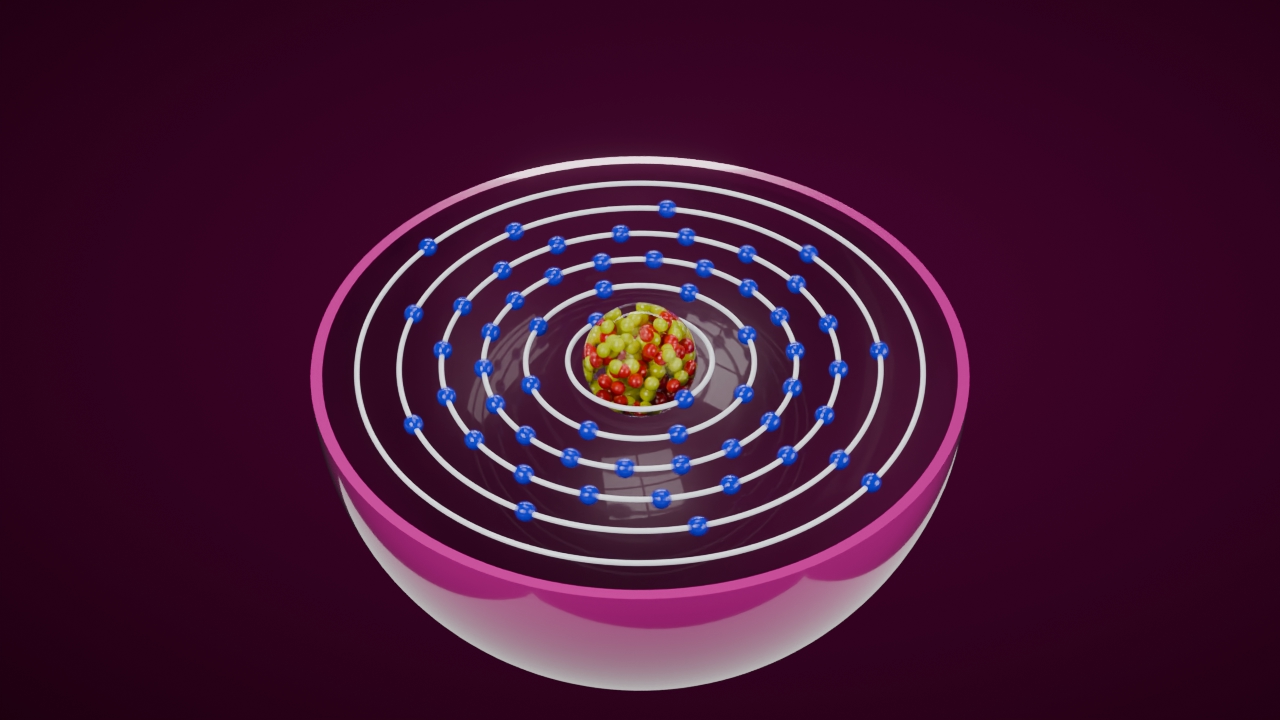
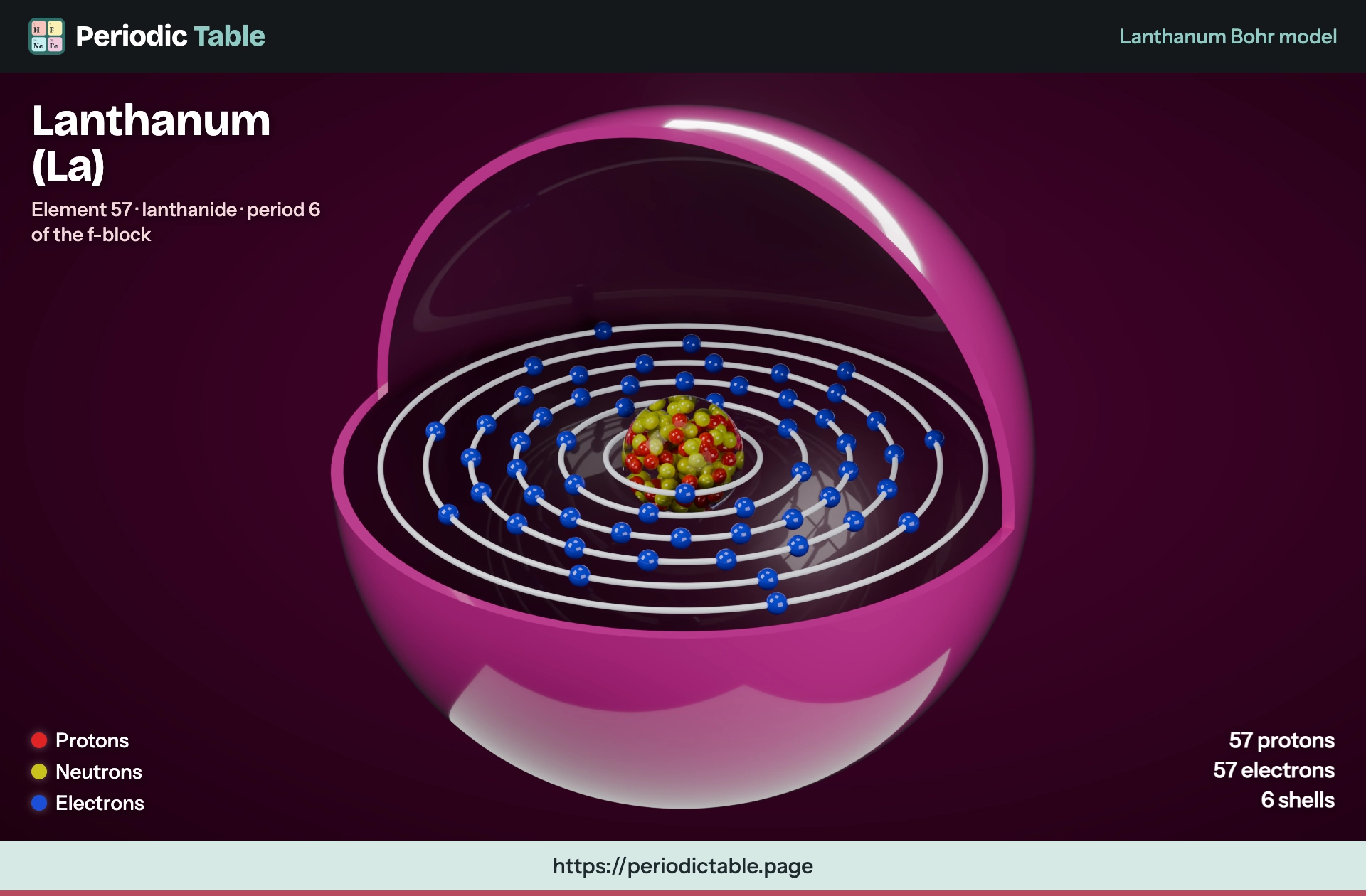
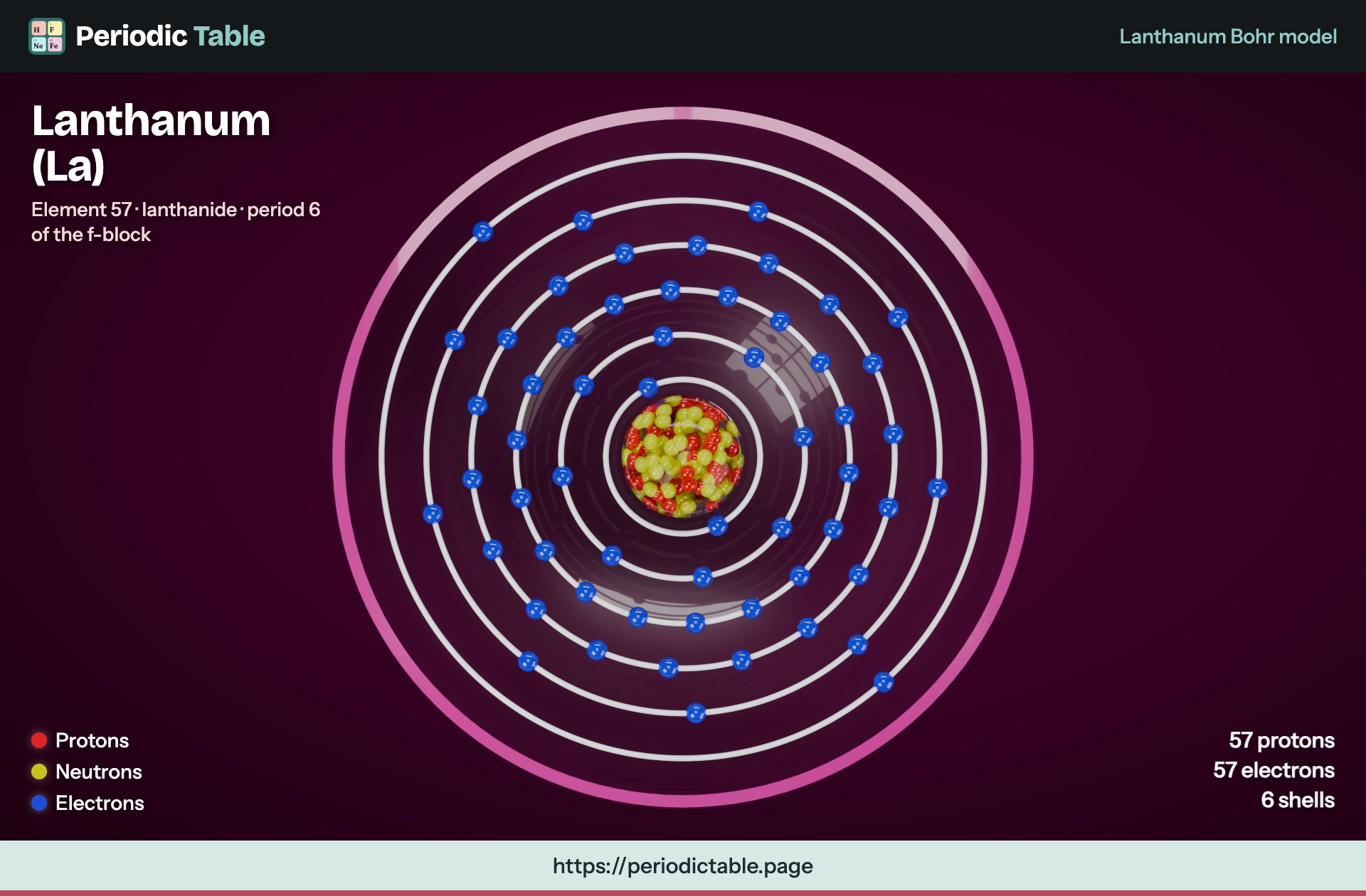
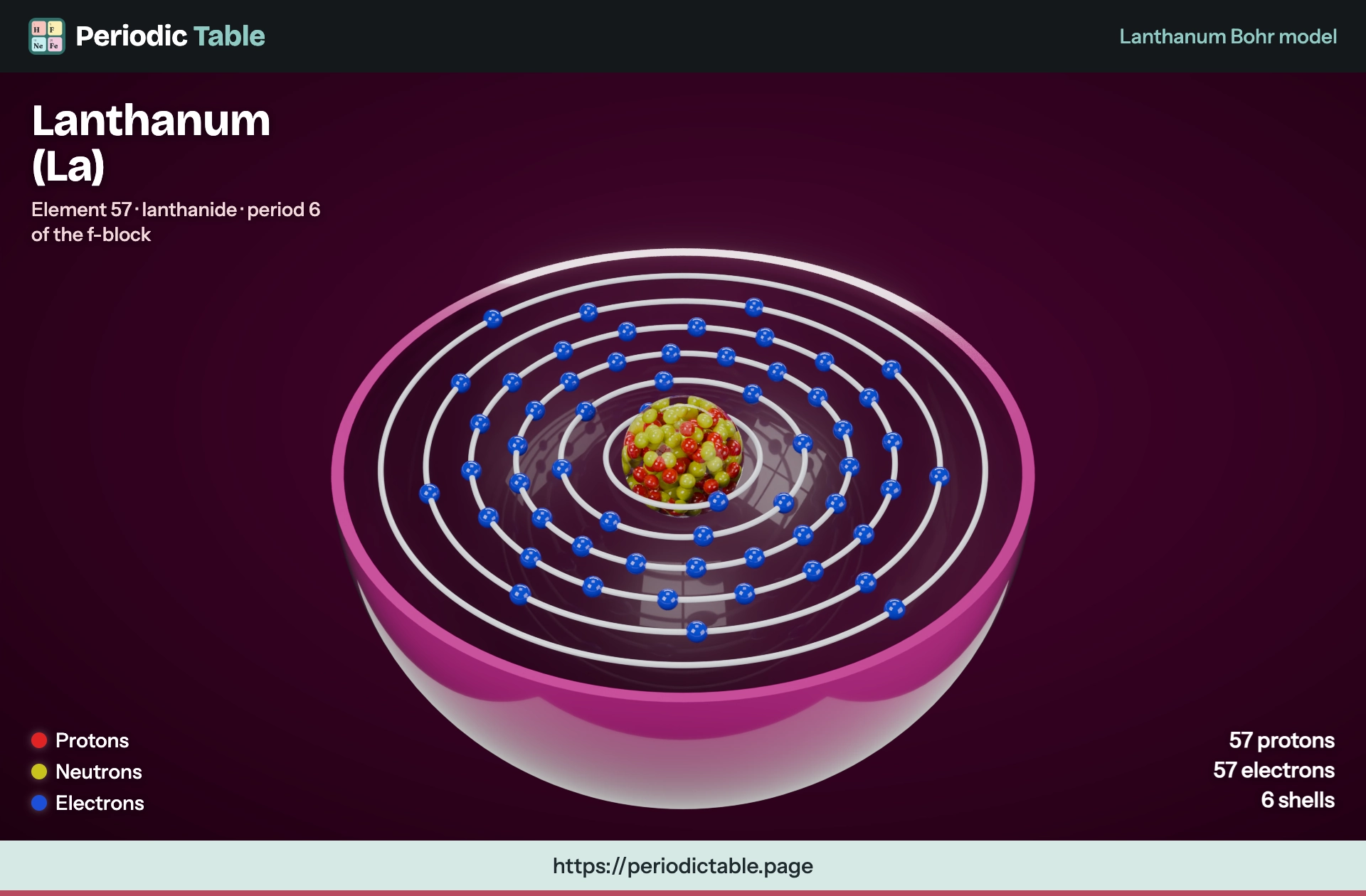
This is a Bohr model of lanthanum (La), a simplified picture of a single lanthanum atom. Its nucleus holds 57 protons, and a neutral lanthanum atom has 57 electrons, arranged around it in 6 shells (2 in shell K, 8 in shell L, 18 in shell M, 18 in shell N, 9 in shell O and 2 in shell P).
Lanthanum periodic table electron configuration
- Shorthand
- [Xe] 5d16s2
- Full
- 1s2 2s2 2p6 3s2 3p6 4s2 3d10 4p6 5s2 4d10 5p6 6s2 5d1
- Electrons per shell
- 2, 8, 18, 18, 9, 2
Lanthanum element properties and atomic data
- Atomic number
- 57
- Atomic mass
- 138.9055 u
- Phase at STP
- Solid
- Melting point
- 919.85°C (1193 K)
- Boiling point
- 3463.85°C (3737 K)
- Density
- 6.162 g/cm³
- Electronegativity (Pauling)
- 1.1
- Period
- 6
- Group
- —
- Block
- f-block
- Appearance
- Silvery white
- Discovery date
- 1839
- Discovered by
- Carl Gustaf Mosander
- Named by
- —
Lanthanum element at a glance: atomic number 57
These are the figures most people look up first. Lanthanum carries atomic number 57, so every atom holds 57 protons, and its standard atomic weight is 138.905. In chemistry it is written with the symbol La, and the table below collects the basic atomic properties that identify it. A short route to francium-223 and thorium-227 decay links is the actinide actinium, plus research and medicine uses.
| Property | Value |
|---|---|
| Symbol | La |
| Atomic number | 57 |
| Atomic weight (abridged) | 138.91 |
| Group / period | Group 3, period 6 |
| Block | f-block (older tables: d-block) |
| Appearance | Silvery white, tarnishing to grey |
| State at 20 °C | Solid |
| CAS number | 7439-91-0 |
Where it sits on the periodic table: group 3, period 6
On the periodic table, La sits in the sixth row, directly below scandium and yttrium. To its left is barium, an alkaline earth metal; to its right comes cerium, the second member of its family. Because the 15 lanthanides are usually pulled out into a separate strip below the main grid, many printed versions of the periodic table show only a placeholder in the main grid and list La again at the head of that floating strip.
Is La an F-block or D-block metal?
Chemists still debate this. A single gas-phase La atom has no 4f electrons: its outer electrons are one in 5d and two in 6s, which is why many textbooks file it with the d-block transition metals.
Most authors who write on the question now start the f block with it, because its 4f orbitals do take part in bonding once it sits inside a compound. The same argument runs one row down for actinium, and the rival candidate for the group 3 slot is lutetium, the last of the lanthanides.
Electron configuration and oxidation state of the lanthanum atom
Its 57 electrons fill the shells as 2, 8, 18, 18, 9, 2, written in short form as [Xe] 5d1 6s2: a xenon core plus three valence electrons. In almost every reaction La gives up all three to reach the stable arrangement of that noble gas, so the +3 oxidation state dominates its chemistry. When tracing how Axel Fredrik Cronstedt isolated it in 1751 from kupfernickel, the nickel production tells the full tale.
The trivalent La3+ ion left behind has no d or f electrons, which is why its salts are colourless in solution. Compounds in the +2 and +1 states exist but are far less stable.
| Atomic data | Value |
|---|---|
| Atomic radius (empirical) | 187 pm |
| Covalent radius | 207 pm |
| Electronegativity (Pauling scale) | 1.10 |
| Ionization energies, 1st / 2nd / 3rd | 538.1 / 1067 / 1850.3 kJ/mol |
| Common oxidation number | +3 |
The jump to the fourth value, about 4,819 kJ/mol, is the numerical reason +3 is the ceiling: removing a fourth electron would mean breaking into the xenon core.
Physical properties of lanthanum metal
Fresh lanthanum is a silvery-white metal, soft enough to cut with a knife and both ductile and malleable, so it can be drawn into wire or hammered flat. Its Mohs hardness is only 2.5, and its electrical resistivity of 615 nΩ·m is high for a metal, more than 20 times that of aluminium. Cooled below about 6 K it becomes a superconductor at ordinary pressure.
| Mechanical and thermal data | Value |
|---|---|
| Young's modulus | 36.6 GPa |
| Shear modulus | 14.3 GPa |
| Bulk modulus | 27.9 GPa |
| Thermal conductivity | 13.4 W/(m·K) |
| Specific heat capacity | 195 J/(kg·K) |
| Vapor pressure of 1 Pa reached at | 2005 K |
Melting point, boiling point and density
The metal melts at 920 °C (1193 K) and boils at 3464 °C (3737 K), a liquid range of more than 2,500 degrees. At 20 °C it weighs 6.145 g/cm³, and the liquid at its melting temperature is slightly lighter, at about 5.94 g/cm³.
Crystal structure shifts with temperature
At room temperature La has a double hexagonal crystal structure (α-La). Heat it to 310 °C and the atoms rearrange into a face-centered cubic lattice (β-La); at 865 °C they shift again to body-centered cubic (γ-La), the form that lasts up to melting.
Lanthanum properties in chemical reactions
Because it has the largest atomic radius in its series, it is one of the most reactive lanthanides. A clean surface dulls within hours, and unlike aluminium it does not build a protective film: the oxidation product flakes away like rust, so a centimetre-sized piece can corrode completely within a year. That is why suppliers ship the metal under oil or argon, and why finely divided powder, which is pyrophoric, can ignite on its own.
It also combines readily with nonmetals. With the halogens it forms trihalides at room temperature, and on warming it gives binary compounds with nitrogen, carbon, sulfur, phosphorus, boron and silicon. Even its hydroxide keeps reacting, pulling carbon dioxide out of the air to form a basic carbonate.
Reaction with water and lanthanum hydroxide
La reacts slowly with cold water and faster when warm, releasing hydrogen gas and leaving white lanthanum hydroxide:
$$2\,\text{La} + 6\,\text{H}_2\text{O} \rightarrow 2\,\text{La(OH)}_3 + 3\,\text{H}_2$$
In dilute acids the metal dissolves quickly instead, giving the colourless hydrated La3+ ion.
Lanthanum compounds and their formulas
Nearly every La compound is built on the +3 ion, and because that ion is large and strongly electropositive, its bonding is mostly ionic. Oxygen is the favourite donor atom, and a coordination number of 8 is typical, rising to 12 with bulky chelating ligands. Organometallic chemistry is limited; the best-known example is the cyclopentadienyl complex La(C5H5)3.
The workhorse is lanthanum(III) oxide, a white solid that reacts with water with a hiss and a burst of heat. Lanthanum chloride is deliquescent, like the other heavier halides, and heating its hydrate gives the oxychloride LaOCl instead of the dry salt.
Lanthanum fluoride is the exception: it is so insoluble that its precipitate serves as a qualitative test for La3+. Heated in hydrogen, the metal forms a black, brittle dihydride, LaH2, that can absorb more gas on the way to the salt-like LaH3.
| La compound | Formula | Where you meet it |
|---|---|---|
| Oxide | La2O3 | Camera lenses, refinery catalysts |
| Chloride | LaCl3 | Catalysts, radiation detectors |
| Trifluoride | LaF3 | ZBLAN optical fibre |
| Hexaboride | LaB6 | Electron-microscope cathodes |
| Carbonate | La2(CO3)3 | Kidney-disease medication |
| Nickel alloy | LaNi5 | Hydrogen storage, rechargeable cells |
Lanthanum trifluoride and fluoride glass
LaF3 is an essential ingredient of ZBLAN, a heavy fluoride glass that transmits infrared light far better than silica, which suits it to specialist optical fibres. Mixed with europium fluoride, the same crystal also forms the membrane of fluoride ion-selective electrodes.
Lanthanum isotopes and natural abundance
Natural lanthanum is a mix of just two isotopes. 139La makes up 99.91% and is the only stable isotope.
The remaining 0.09% is 138La, a primordial radioisotope with a half-life so long that most of what formed before the Earth is still here. Every other form is synthetic; apart from 137La they all decay within two days, most within a minute.
| Isotope | Natural abundance | Half-life | Decay |
|---|---|---|---|
| 137La | Synthetic | About 60,000 years | Electron capture to barium-137 |
| 138La | 0.09% | 1.03 × 10¹¹ years | Electron capture to barium-138 or β− to cerium-138 |
| 139La | 99.91% | Stable | None |
| 140La | Synthetic | 40.3 hours | β− to cerium-140 |
Both 139La and 140La also appear among the fission products of uranium.
Where the rare-Earth element is found and mined
Despite the label, this rare-earth element is not scarce. It makes up about 39 mg per kg of Earth's crust, making it the 28th most abundant element there and nearly three times as common as lead. The "rare" part comes from how hard it is to pull out of its minerals, not from how little of it exists.
Monazite and Bastnäsite ores
Commercial supply comes mostly from monazite, a heavy sand mineral, and bastnäsite, a fluorocarbonate. In both, La makes up roughly a quarter of the rare-earth content. Bastnäsite is the easier of the two to process because it carries few radioactive impurities, while monazite almost always contains thorium, so its residues need careful handling.
Separating it from other rare earth elements
Because the rare earths behave so alike, separation is the hard part. Crushed ore is digested in hot concentrated sulfuric acid, and the dissolved sulfates are precipitated as oxalates and roasted to oxides. Its neighbour Ce is removed first by oxidising it to the +4 state.
La then comes out either the historical way, by fractional crystallization of its double salt with ammonium nitrate, or by ion-exchange and solvent extraction when high purity is needed. The purified oxide is converted to chloride or fluoride and reduced with an alkali or alkaline-earth metal under vacuum or argon.
Supply risk and price
The Royal Society of Chemistry rates its relative supply risk at 9.5 out of 10, mainly because China produces almost all of the world's output. The oxide price is usually quoted FOB China, and it has been volatile: the 2011 rare-earth spike multiplied it many times over before it fell back within about a year.
Uses of lanthanum in industry and technology
Lanthanum rarely plays the lead, but it turns up in a surprising number of products. Its first commercial job was in gas lantern mantles in the 1880s; today its applications fall into four broad groups.
Nickel-metal hydride batteries and hydrogen storage
- The negative electrode in many nickel-metal hydride batteries is a La-rich nickel alloy of the AB5 type.
- A 2008 Toyota Prius NiMH battery pack holds roughly 10 to 15 kg of La.
- La–nickel alloys act as a hydrogen sponge, soaking up as much as 400 times their own volume of hydrogen gas, which is why they are studied for hydrogen storage.
Optical glass, camera and telescope lenses
- Adding lanthanum oxide raises the refractive index of glass while keeping low dispersion, so lenses stay sharp without extreme curvature.
- That is why it appears in camera, binocular and telescope lenses, where optics makers need clear images at the edges of the frame.
- It also improves resistance to alkali and is used in infrared-absorbing specialty glass.
Mischmetal, catalysts and carbon arc lamps
- Mischmetal, a cerium-rich alloy that contains 25% to 45% La, is combined with iron to make lighter flints; striking the flint throws off the sparks in cigarette lighters and gas lighters.
- La compounds are part of petroleum cracking catalysts that break heavy oil fractions into fuel.
- Carbon arc lamps used rare-earth mixtures to give light close to sunlight; studio lighting and cinema projectors once took about a quarter of all rare-earth compounds produced.
- Small additions improve the malleability and impact resistance of steel and reduce the hardness of molybdenum, while the oxide added to tungsten makes welding electrodes that replace thorium. It works alongside these metals rather than replacing them.
Electron sources, scintillators and water treatment
- LaB6 crystals are hot cathode emitters in electron microscopes and Hall-effect thrusters; the oxide and boride also served as cathode material in vacuum tubes because of their strong thermionic emission.
- Cerium-doped lanthanum bromide and LaCl3 crystals are scintillators that detect gamma rays and neutrons with sharp energy resolution.
- Small amounts in pool products bind the phosphates that feed algae, and La-modified bentonite (Phoslock) is used in lake treatments.
Outside industry it also serves laboratory science: La–Ba radiometric dating, based on the very slow decay of 138La, is a research method for estimating the age of rocks, while the water-treatment products above help protect the wider environment.
Biological role of La and its use in medicine
La has no known biological role in humans, and the gut absorbs it very poorly. That poor absorption is exactly what makes lanthanum carbonate useful. Sold as Fosrenol, it is a phosphate binder: taken with meals, it locks dietary phosphate into an insoluble salt in the gut, helping people with kidney disease avoid hyperphosphatemia.
The La3+ ion is close in size to calcium, so it blocks calcium channels and works as an electron-dense tracer in molecular biology, a research probe rather than a medical treatment. It also modulates the GABA receptor. Some bacteria go further: a methanotrophic bacterium, Methylacidiphilum fumariolicum, needs it as a cofactor for its methanol dehydrogenase enzyme.
Lanthanum toxicity and safe handling
Lanthanum is not especially toxic when swallowed, but dust is another matter. Inhaled particles linger in the airways and can cause pneumoconiosis, with coughing and irritation of the lung, and rare-earth deposits have been found in the lung tissue of people exposed to carbon arc light. The metal carries a GHS "Danger" signal word because it releases flammable hydrogen on contact with water.
How La compares with the other lanthanides
Lanthanum is the prototype of the lanthanide series, yet in several ways it is the odd one out. Its atoms are the largest of the 15, so it is the strongest base among the rare earths and the least volatile of the group.
Among the trivalent members only cerium melts lower, and divalent europium and ytterbium, which release two electrons per atom instead of three, also melt below it. And because it has no 4f electrons, it is only weakly paramagnetic, while the lanthanides that follow are strongly magnetic until the shell fills at ytterbium and lutetium.