


Nickel element (Ni): nickel periodic table facts
Nickel periodic table facts: nickel (Ni) is element 28, a transition metal in group 10, period 4. Pick up a coin, a kitchen sink or a phone battery and you are probably holding nickel. Across the whole column, guides on chlorine compounds contrast the reactive gas with bromine, iodine and astatine further down.
It is the tough element that keeps stainless steel bright, turns ordinary alloys into jet-engine parts and stores energy in modern cells. Below you get the key numbers, the chemistry and the real-world uses in one place, from its atomic structure to why some people cannot wear cheap jewellery.
Rotate the 3D Bohr model of nickel
Drag to orbit, scroll to zoom.
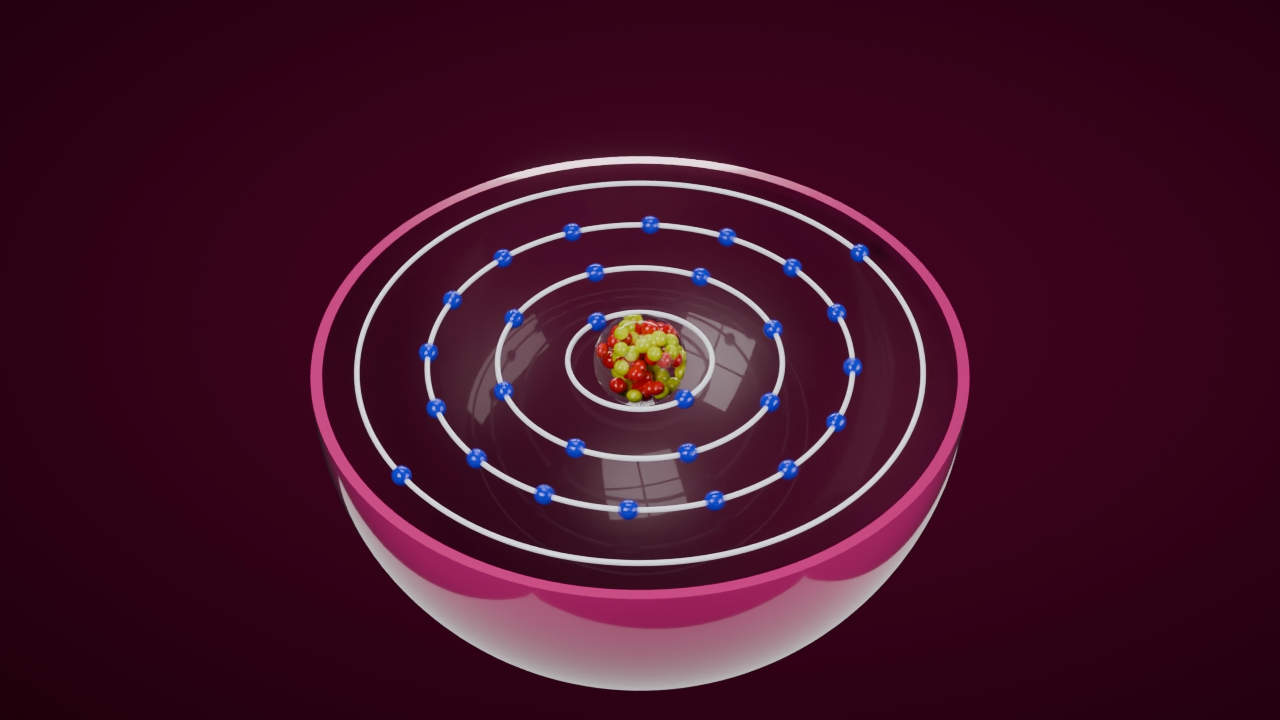
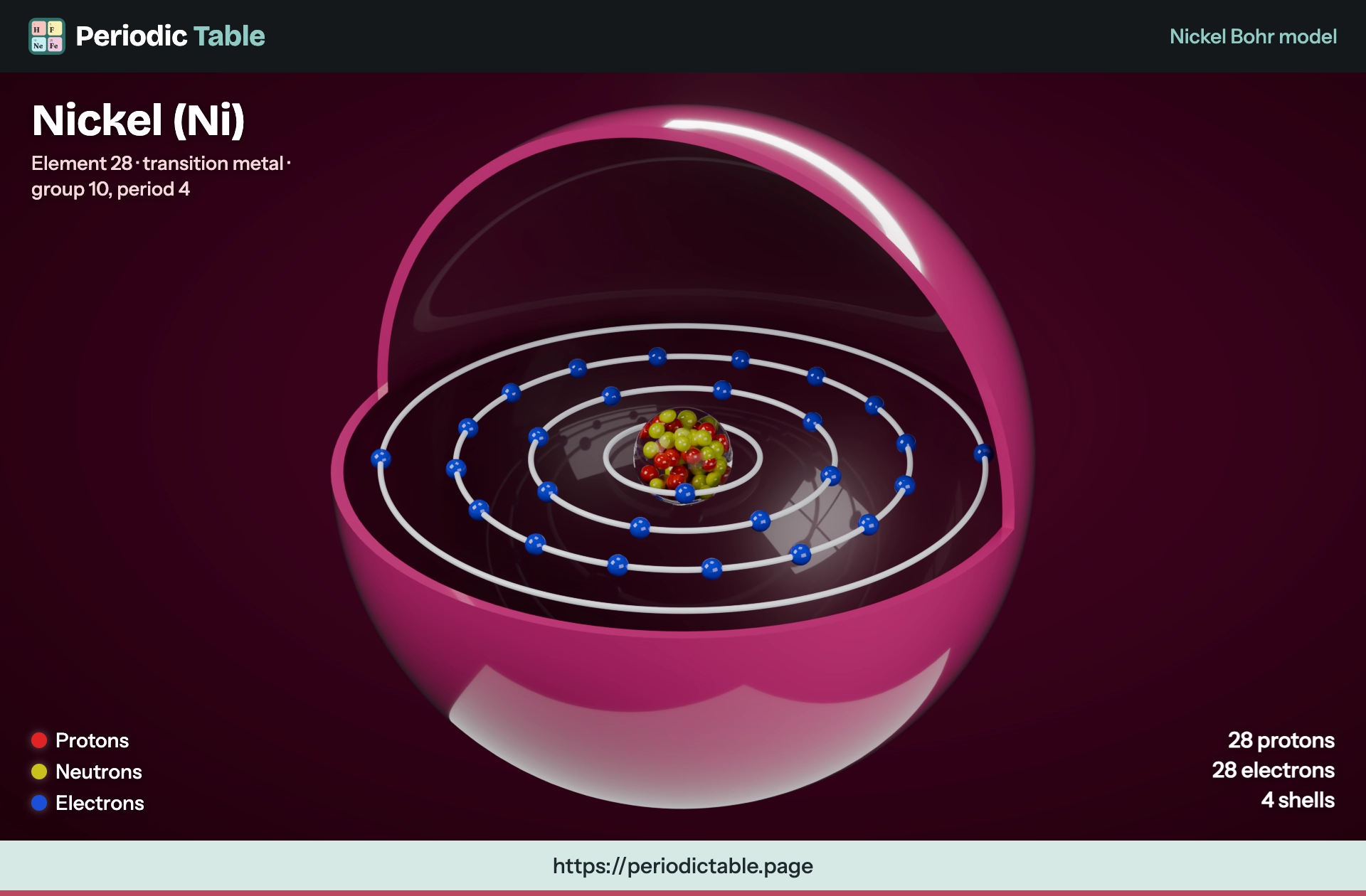
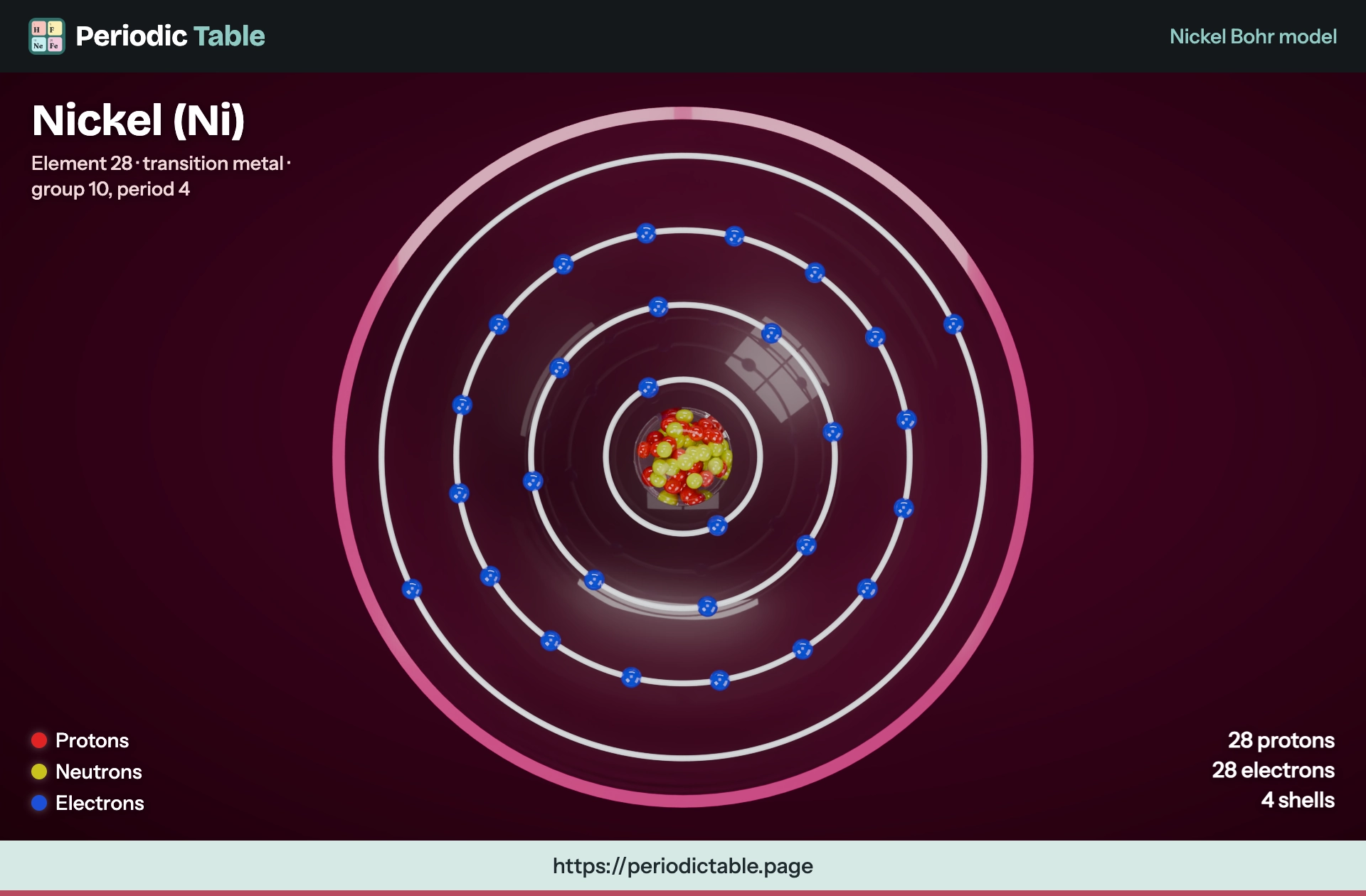
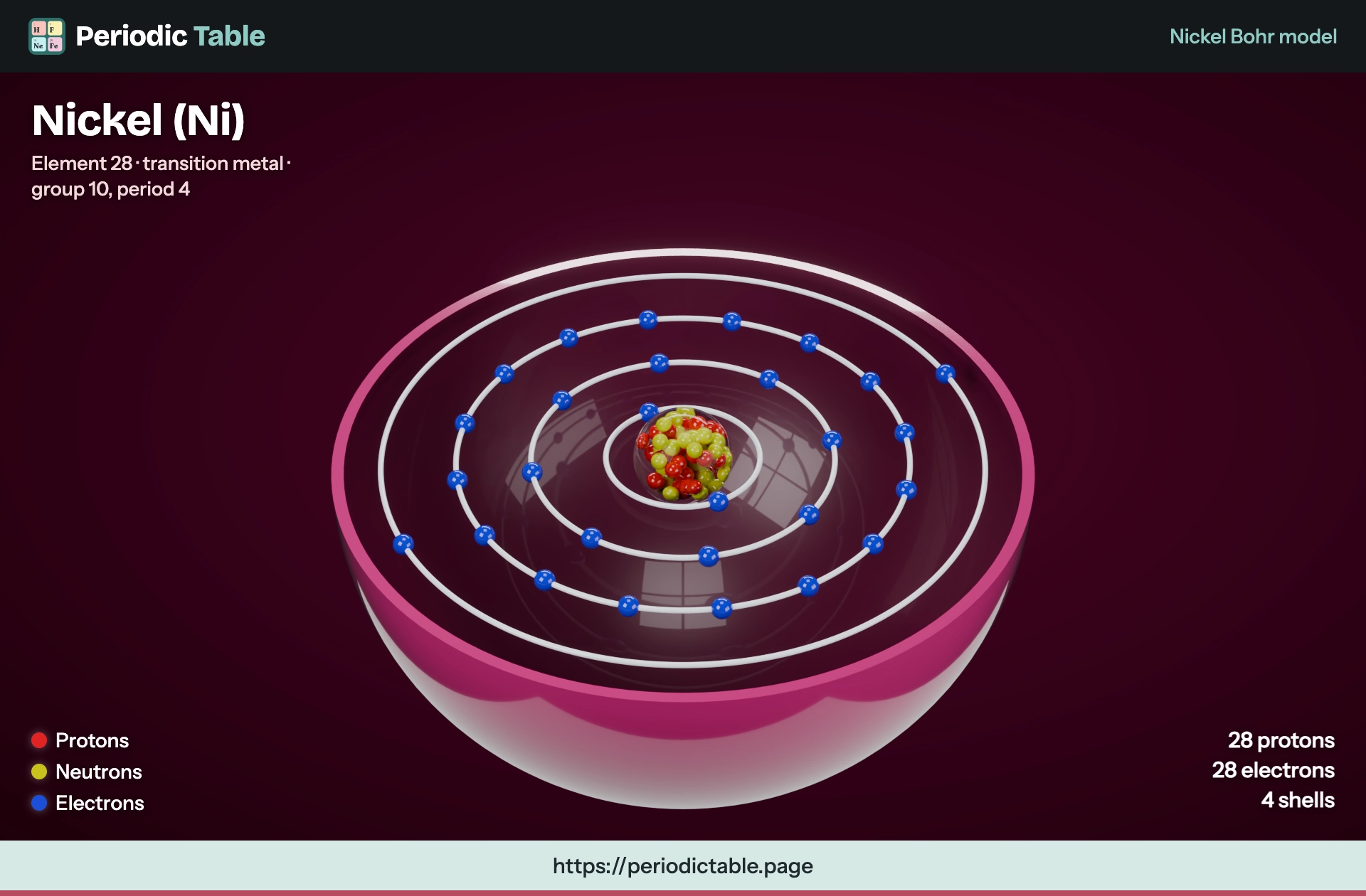
This is a Bohr model of nickel (Ni), a simplified picture of a single nickel atom. Its nucleus holds 28 protons, and a neutral nickel atom has 28 electrons, arranged around it in 4 shells (2 in shell K, 8 in shell L, 16 in shell M and 2 in shell N).
Nickel periodic table electron configuration
- Shorthand
- [Ar] 3d8 4s2
- Full
- 1s2 2s2 2p6 3s2 3p6 4s2 3d8
- Electrons per shell
- 2, 8, 16, 2
Nickel element properties and atomic data
- Atomic number
- 28
- Atomic mass
- 58.6934 u
- Phase at STP
- Solid
- Melting point
- 1454.85°C (1728 K)
- Boiling point
- 2729.85°C (3003 K)
- Density
- 8.908 g/cm³
- Electronegativity (Pauling)
- 1.91
- Period
- 4
- Group
- 10
- Block
- d-block
- Appearance
- Lustrous, metallic, and silver with a gold tinge
- Discovery date
- 1751
- Discovered by
- Axel Fredrik Cronstedt
- Named by
- —
Nickel element facts at a glance
Nickel is a chemical element with the symbol Ni and atomic number 28. It sits in group 10 and period 4 of the periodic table, in the d-block, between cobalt on its left and copper on its right, with palladium and platinum below it in the same column. On batteries and hybrid cars, a reader curious about rechargeable hydride cells will find the details in the lanthanum boiling point article for curious readers.
Its usual charge in compounds is +2, and it is a solid at room temperature. The facts below are the figures you will look up most often.
| Property | Value for nickel |
|---|---|
| Symbol | Ni |
| Group / period / block | 10 / 4 / d-block |
| Standard atomic weight | 58.693 |
| Density at 20 °C | 8.908 g/cm³ |
| Melting point | 1,455 °C (2,651 °F) |
| Boiling point | 2,913 °C (5,275 °F) |
| Electronegativity (Pauling scale) | 1.91 |
| Crystal lattice | Face-centred cubic, a = 352.4 pm |
| Magnetic ordering | Ferromagnetic below about 355–358 °C |
| Discovered | 1751, Sweden |
Atomic mass, atomic weight and density
The relative atomic mass is 58.693, which is lower than the 58.933 of element 27 even though element 27 has one fewer proton. That small inversion happens because natural nickel is dominated by the light Ni-58 nucleus. The standard value is simply the abundance-weighted average of the masses of its stable forms:
$$A_r(\text{Ni}) = \sum_i x_i \, m_i \approx 0.6808(57.935) + 0.2622(59.931) + 0.0114(60.931) + 0.0363(61.928) + 0.0093(63.928) \approx 58.69$$
At about 8.9 g/cm³, a 10 cm solid cube weighs roughly 8.9 kg. On the Pauling scale its electronegativity is 1.91, close to its d-block neighbours, which is why it bonds readily with sulfur and oxygen in nature.
Melting point and boiling point
Nickel melts at 1,455 °C and boils at roughly 2,913 °C (some data sets give a lower figure near 2,730 °C). Those values sit only about 80 °C under the figure for steel's base element, so nickel stays solid and strong at the high temperatures found in furnaces, turbines and chemical reactors. Its thermal conductivity of 90.9 W/(m·K) is modest, about a quarter of the best conductors', which helps alloyed parts hold heat where it is needed instead of shedding it.
Physical properties of nickel metal
A freshly polished surface is silvery-white with a faint golden tinge, and it takes a bright, lustrous finish. Nickel is hard yet ductile and malleable, so it can be drawn into wire or rolled into sheet without cracking. Because radiation from this toxic metal confines research to a laboratory, the fermium melting point explains the handling limits for scientists.
Key nickel properties include a Mohs hardness of 4.0, a Young's modulus of about 200 GPa (similar to steel), an electrical resistivity of 69.3 nΩ·m at 20 °C and a fairly good ability to conduct both heat and electricity. These traits, plus its stubborn resistance to rust, explain why nickel is so rarely used alone and so often used to upgrade other metals.
Crystal structure: face-centered cubic
Its crystal structure is face-centered cubic (fcc): each cube-shaped unit cell has an atom at every corner and one in the middle of every face. The lattice edge is 0.352 nm, which gives an atomic radius of about 0.124 nm. This packing stays stable to at least 70 GPa of pressure, and it is the reason nickel keeps its toughness from cryogenic cold to red heat.
Why it is ferromagnetic below the Curie temperature
Nickel is one of only a handful of elements that are ferromagnetic at room temperature; iron and cobalt are the others, and gadolinium joins them only on a cool day below about 20 °C. In a ferromagnet, the spins of neighbouring atoms line up in parallel, so a sample is pulled firmly toward a magnet and can stay magnetised afterwards.
Heat breaks that alignment. Above its Curie temperature of roughly 355–358 °C, nickel becomes paramagnetic: it is only weakly attracted to a field and holds no permanent magnetism. Its moment is also modest, about 0.6 Bohr magnetons per atom.
Nickel is also magnetostrictive, meaning a nickel rod contracts by around 50 parts per million when you put it in a magnetic field, an effect once used in sonar transducers. These magnetic properties carry into its alloys, from shielding sheet to alnico.
Electron configuration of element nickel (Ni)
A neutral atom of element nickel has 28 electrons. Most chemistry textbooks write its ground-state electron configuration as [Ar] 3d8 4s2, which follows the usual rule that 4s fills before 3d. Shell by shell, that is 2, 8, 16, 2.
There is a well-known twist. The alternative arrangement [Ar] 3d9 4s1 sits extremely close in energy.
The single lowest energy level of the atom belongs to the 3d84s2 set, but when you average over all the fine-structure levels, the 3d94s1 set comes out slightly lower, so physicists running atomic calculations often quote it instead. For everyday chemistry, the practical point is that nickel (Ni) behaves as a typical transition metal: it loses its two 4s electrons first to form the Ni2+ ion, which carries a 3d8 configuration and is responsible for the green colour of most nickel salts.
- Neutral atom: [Ar] 3d8 4s2 (textbook form)
- Ni2+ ion: [Ar] 3d8
- Ni3+ ion: [Ar] 3d7
Chemical properties and oxidation states of nickel
The metal is chemically reactive in powder form, yet bulk pieces are slow to react with air. It dissolves slowly in dilute acids, releasing hydrogen, and resists alkalis very well, which is why caustic soda plants line their equipment with it. Its oxidation states run all the way from −2 to +4, and in 2024 a crystalline complex containing a hexavalent centre was reported, but almost all real chemistry happens at +2.
- Ni(0)
- Found in nickel tetracarbonyl and organonickel catalysts.
- Ni(I)
- Uncommon; thought to matter in hydrogen-handling enzymes.
- Ni(II)
- The everyday state, present in almost every common salt.
- Ni(III) and Ni(IV)
- Seen in rechargeable-cell electrodes and a few mixed oxides.
Corrosion resistance and the passivation layer
Nickel owes its corrosion resistance to a thin, tightly bonded film of nickel oxide that forms on the surface as soon as nickel meets air. This passivation layer blocks oxygen and moisture from reaching the nickel underneath, so a nickel surface stays bright for decades instead of flaking like rusty steel. When nickel is alloyed into steel or plated over it, it brings this protective behaviour along.
Nickel compounds: nickel carbonyl, sulfate and chloride
Nickel compounds span a wide range, from industrial salts to delicate catalysts. Three matter most:
- Nickel(II) sulfate, made by dissolving nickel or its oxide in sulfuric acid, is the workhorse salt of metal-finishing baths and battery precursor plants.
- Nickel chloride, usually sold as the green hexahydrate NiCl2·6H2O, turns yellow when its water is driven off.
- Nickel carbonyl, Ni(CO)4, is a colourless, volatile and extremely poisonous liquid formed when nickel reacts with carbon monoxide; it boils just above room temperature.
Dissolve almost any simple nickel salt in water and you get green solutions of the hexaaqua ion [Ni(H2O)6]2+. Swap the water for ammonia and the colour shifts to violet-blue, a handy classroom demonstration of how ligands tune the 3d shell.
Nickel isotopes and radioisotopes
Every nickel atom carries 28 protons, but the number of neutrons varies. Known nuclei run from mass number 48 to 82, and at least 26 radioisotopes have been characterised. Most of those decay in seconds; only a few last long enough to be useful.
Stable isotopes and nickel-62
Natural nickel is a mixture of five stable isotopes. Their shares are fixed enough to calculate the average mass shown earlier:
| Isotope | Natural abundance | Notes |
|---|---|---|
| Ni-58 | 68.08% | Most common; 28 protons, 30 neutrons |
| Ni-60 | 26.22% | Daughter of extinct iron-60 |
| Ni-61 | 1.14% | Only stable isotope with nuclear spin |
| Ni-62 | 3.63% | Highest binding energy per nucleon of any nuclide |
| Ni-64 | 0.93% | Rarest stable form |
Nickel-62 holds the record for binding energy per nucleon, about 8.795 MeV, slightly ahead of iron-56, which is often wrongly credited with the title. Among the radioactive forms, Ni-59 (half-life about 76,000 years) dates meteorites, Ni-56 powers the glow of Type Ia supernovae as it decays to cobalt and then iron, and nickel-63 (about 100 years) is studied as a long-life source for betavoltaic batteries.
History of nickel and the kupfernickel legend
People used nickel long before anyone knew it existed. Bronzes from ancient Syria contain up to 2% of it, and Chinese "white copper", or cupronickel, was made well over 3,000 years ago. Bactrian kings struck coins from a similar alloy in the 2nd century BCE.
The name comes from the mines of medieval Saxony. German miners found a reddish ore that looked exactly like copper ore, yet none of the red metal could be smelted from it.
They blamed a mischievous spirit of mountain folklore, Nickel, and called the mineral Kupfernickel, roughly "copper demon". Today that mineral is known as nickeline, a nickel arsenide.
In 1751 the Swedish chemist and mineralogist Axel Fredrik Cronstedt tried to smelt this mineral at a mine in Los, Sweden, and instead obtained a new white substance. He recognised it as an element and shortened the name in 1754. Large-scale supply only arrived later: New Caledonia's deposits, found in 1865, fed most of the world until the giant Sudbury Basin in Canada and the Norilsk deposits in Russia came online.
Where nickel ore is found
Most of Earth's nickel is out of reach. Together with iron it is thought to make up much of the planet's outer core and inner core, so nickel is hundreds of times more concentrated deep down than in the crust, where it averages only around 80 ppm. On the surface, native nickel (the free metal) turns up only in tiny amounts in ultramafic rocks and in iron meteorites, where it forms the natural nickel–iron alloys kamacite and taenite.
Commercial mining relies on two very different types of ore. Global output is dominated by Indonesia, which now supplies about 60% of mine production, followed at a distance by the Philippines, Russia's Norilsk region, Canada's Sudbury Basin, New Caledonia, China and Australia.
Mining in the United States comes down to a single active producer, the Eagle Mine in Michigan. Known reserves are largest in Australia, Brazil and Southeast Asia.
Pentlandite and other sulfide ores
Deep, underground sulfide ores such as those in Canada and Arctic Russia carry nickel mainly in pentlandite, an iron–nickel sulfide, along with pyrrhotite and the brassy mineral millerite (NiS). Sulfide deposits are smaller in total but have historically been easier and cheaper to refine to high purity.
Laterite deposits
Laterite forms where tropical weathering strips other components out of ultramafic rock and leaves nickel behind near the surface. These oxide deposits, rich in nickel-bearing limonite and green garnierite, hold about 60% of identified land-based resources and drive the recent boom in Southeast Asian output.
Nickel production and refining
Nickel production starts by crushing the rock and concentrating the valuable minerals, usually by froth flotation for sulfides. From there, two routes dominate:
- Pyrometallurgical treatment: smelting the concentrate in a furnace produces a nickel-rich sulfide matte, which is then refined further. Product of roughly 75% purity from roasting and reduction can go straight into many stainless steel melts.
- Hydrometallurgical treatment: the ore or matte is leached with acid or ammonia solutions, dissolved impurities are separated by precipitation or solvent extraction, and the nickel is recovered by electrowinning onto a cathode.
Oxide deposits are increasingly processed by high-pressure acid leaching to make battery-grade intermediates, while lower-grade material is smelted into ferronickel or nickel pig iron for steelmaking.
The Mond process
The purest commercial grade comes from the Mond process, patented by Ludwig Mond in 1890. The impure feed reacts with carbon monoxide at about 50–60 °C to form volatile Ni(CO)4 gas, leaving impurities behind. Heating the gas to around 220–250 °C reverses the reaction:
$$\text{Ni} + 4\,\text{CO} \;\rightleftharpoons\; \text{Ni(CO)}_4$$
The released product deposits on pellets or as fine powder, sold as carbonyl nickel, and the gas is reused. The result is pure nickel of better than 99.99%.
Nickel uses: stainless steel, alloys and plating
Around two-thirds of all nickel goes into stainless steel, where 8–12% nickel stabilises the austenitic structure of grades such as 304 and 316, making them tough, easy to weld and non-magnetic when annealed. Among other nickel uses, about a tenth goes into non-ferrous alloys, a similar share into plating, and smaller amounts into alloy steels, foundry castings and batteries. Very little is used as pure metal.
The metal also earns its keep in chemistry and industry. Raney nickel, a spongy nickel–aluminium alloy with the aluminium leached out, is a classic catalyst for hydrogenation, used to harden vegetable oils into margarine and to make many fine chemicals. Foam and mesh made from it serve as electrodes in alkaline fuel cells, and it binds cemented tungsten carbide cutting tools.
Nickel alloys and superalloys
Nickel blends readily with chromium, cobalt, molybdenum, titanium and aluminum, and each partner unlocks a different job. The main alloy families are:
Nickel–chromium alloys
Inconel holds its strength and oxidation resistance in exhaust systems and combustion chambers, while nichrome is the glowing heating element in toasters and kilns.
Nickel–copper alloys
Monel shrugs off seawater and even fluorine, so it is common in marine hardware and chemical plants.
Nickel–iron alloys
Mu-metal and permalloy give very high-permeability shielding for sensitive electronics, and invar barely expands with temperature, which suits precision instruments.
Nickel–titanium shape-memory alloys
Nitinol, a near 1:1 mix of the two metals by atoms, springs back to a set shape when warmed and is used in stents and eyeglass frames.
Nickel–aluminium–cobalt magnets
Alnico is the classic horseshoe permanent magnet, stronger than plain steel magnets but weaker than rare-earth types.
Nickel-based high-temperature grades
At the top end sit superalloys, which are typically half or more nickel by weight. Their gamma matrix, reinforced by tiny gamma-prime precipitates, gives outstanding heat resistance and creep strength, letting turbine blades in jet engines run in gas that would soften them without internal cooling. Grades such as Inconel 718 are the backbone of aerospace engines and power-plant turbines, and no cheaper base metal does the same job.
Electroplating and coinage
In electroplating, a thin layer is deposited on steel, brass or zinc to give a bright, wear-resistant surface on taps, fasteners, car trim and electronics. It is also the usual base coat under a chrome finish.
Nickel's role in coinage began in the 19th century, and it still appears in many coins worldwide, including the bimetallic one- and two-euro coins. The U.S. nickel, the American five-cent coin, is a cupronickel alloy of 25% nickel and 75% copper, so despite its name it is mostly copper and is not magnetic.
Canada once struck coins of 99.9% nickel, which were magnetic. Here is a quick calculation of how much nickel one 5.000 g U.S. coin contains:
| Step | Working | Result |
|---|---|---|
| Nickel mass | 5.000 g × 0.25 | 1.25 g |
| Moles of nickel | 1.25 g ÷ 58.693 g/mol | 0.0213 mol |
| Number of atoms | 0.0213 × 6.022 × 1023 | about 1.28 × 10²² |
The United Kingdom switched its 5p and 10p coins to nickel-plated steel in 2012, partly to cut costs, which also prompted debate about allergic reactions to coins.
Nickel in rechargeable batteries
Nickel has powered rechargeable batteries for more than a century, first in nickel–iron and nickel–cadmium cells and later in nickel–metal hydride packs for hybrid cars and power tools. In all of these, a nickel oxide hydroxide electrode does the work, cycling between Ni(II) and Ni(III).
Today the growth is in lithium-ion cells for electric vehicles. Cathodes such as NMC (nickel–manganese–cobalt) and NCA use nickel because more of it means more stored energy and longer driving range.
In an NMC 811 cathode, about 80% of the transition-metal content is nickel. Lithium iron phosphate cells contain none and are cheaper, but they store less energy per kilogram.
Class 1 nickel and the battery cathode
Not all refined nickel is equal. Class 1 nickel is 99.8% pure or better and is the only grade suitable for a high-performance battery cathode, usually converted to nickel sulfate first.
Class 2 material, such as ferronickel and nickel pig iron, is lower in purity and goes mainly into steel. Because both stainless producers and cell makers compete for supply, the split between the two grades has become one of the biggest themes in the nickel market.
Nickel price, supply risk and recycling
Nickel trades as a commodity on the London Metal Exchange, and its price can swing wildly. In March 2022, fears over Russian exports set off a short squeeze that pushed the price above US$100,000 per tonne within two days, and the exchange halted trading for more than a week and cancelled billions of dollars of trades. Prices later fell back below US$20,000 as Indonesian supply surged.
That dependence on one dominant producer, plus the battery boom, is why the United States lists it among its critical minerals. The good news is that it is easy to reuse: it can be melted down repeatedly without losing quality, and most end-of-life material is already recovered, mainly through stainless steel scrap. As the first large wave of EV packs retires, battery recovery should become a second major source.
Biological role of Ni in living things
Nickel was not recognised as biologically important until the 1970s, but many bacteria, archaea, fungi and plants need it. Ni sits at the active site of urease, the enzyme that breaks urea into ammonia, which is why nickel is an essential nutrient for crops such as soybeans. Microbes also use Ni in [NiFe]-hydrogenase enzymes to split or make hydrogen gas, and methane-producing archaea rely on a nickel cofactor called F430.
Whether humans need nickel at all is still unsettled, so no recommended daily allowance exists. A typical diet supplies roughly 70–100 µg a day, mostly from chocolate, nuts, legumes and grains, and less than a tenth of that is absorbed; the kidneys clear the rest. Cooking acidic foods in stainless pans can add a little more.
Nickel toxicity and nickel allergy
The solid metal is safe to handle, and everyday exposure from food and water poses no threat to health. The toxicity risks come from specific forms and routes:
- Inhalation of dust, fumes or soluble salts at work can damage the lungs; certain nickel compounds are classed as a human carcinogen for the respiratory tract, based on studies of refinery workers.
- The carbonyl Ni(CO)4 is acutely poisonous even at low concentrations, which is why Mond-process plants are sealed systems.
- The U.S. workplace limit for the pure element and most of its compounds is 1 mg/m³ over an eight-hour shift.
The most common problem is nickel allergy. It is the leading cause of allergic contact dermatitis worldwide: sweat dissolves tiny amounts of nickel from earrings, watch backs, belt buckles and jeans studs, and sensitised skin reacts with an itchy red rash.
The European Union now limits how much nickel items worn against the skin may release. If you react, look for jewellery labelled nickel-free or made from titanium, surgical-grade alloys rated low-release, or solid gold and platinum, and keep in mind that the reaction is a lifelong sensitivity rather than something you grow out of, so protecting your health means avoiding the trigger.