


Fermium element (Fm): fermium periodic table facts
Fermium periodic table facts: fermium (Fm) is element 100, an actinide in period 7 of the f-block. You will never hold a piece of fermium, and neither has any chemist alive: every atom of this synthetic element ever made has been counted one by one, because it is highly radioactive and disappears within days. What you can know is where it came from (the debris of the first hydrogen bomb, a secret nuclear test), what its predicted properties are, and why it marks the last of the elements a reactor can build by adding neutrons. Chemistry readers can use the chlorine boiling point to link sanitation and public health to disinfection.
Rotate the 3D Bohr model of fermium
Drag to orbit, scroll to zoom.
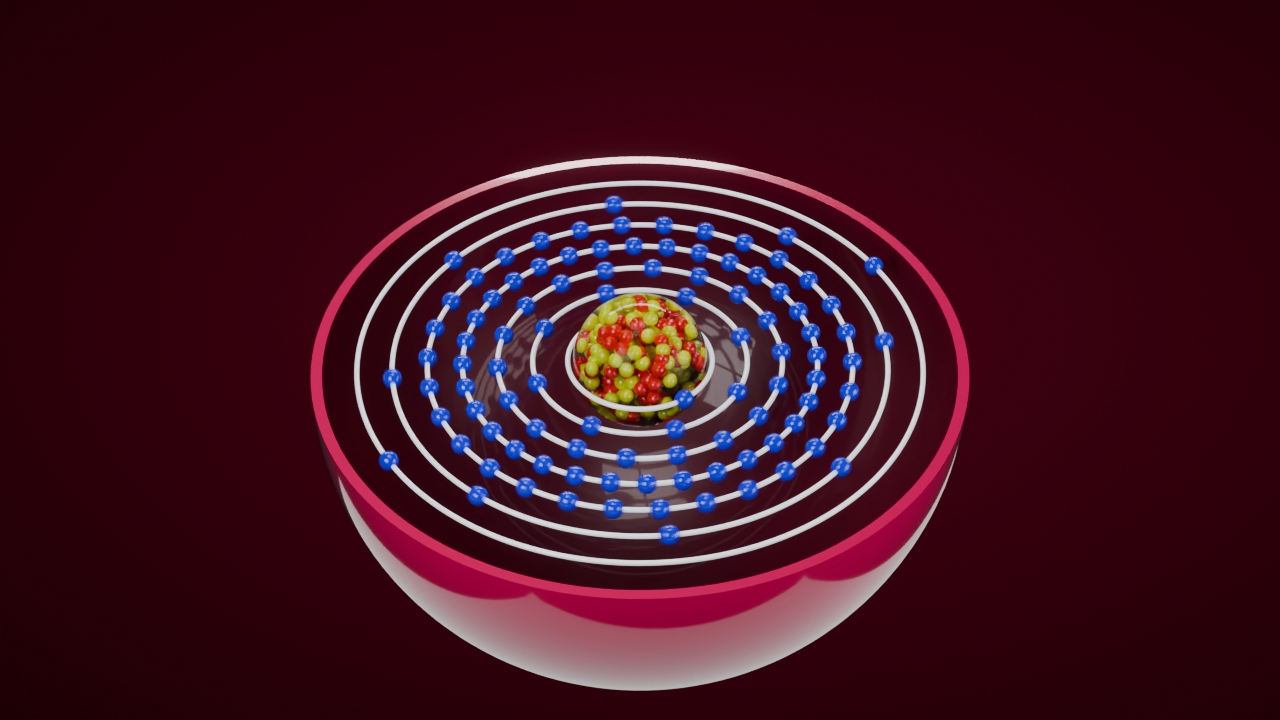
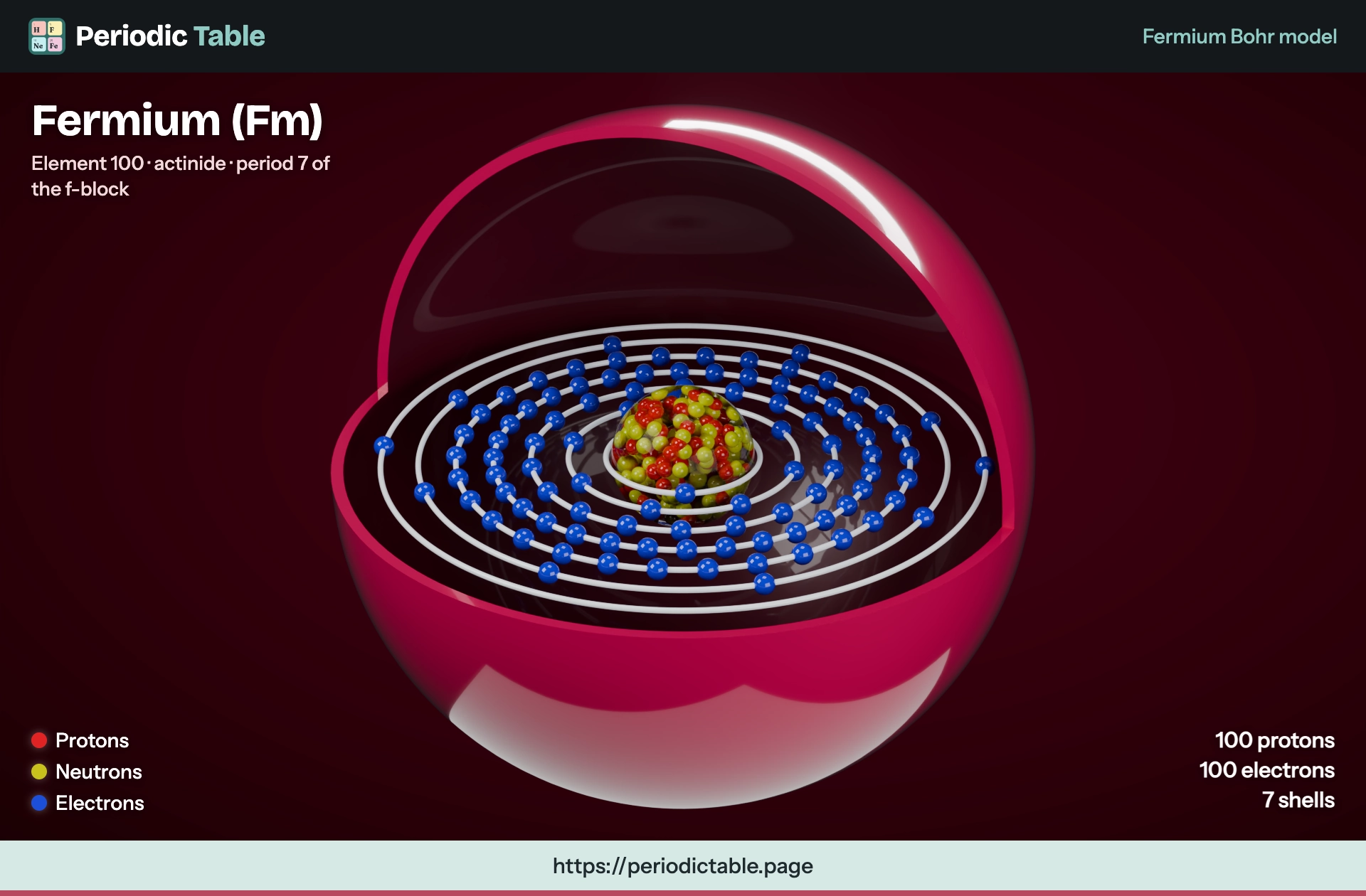
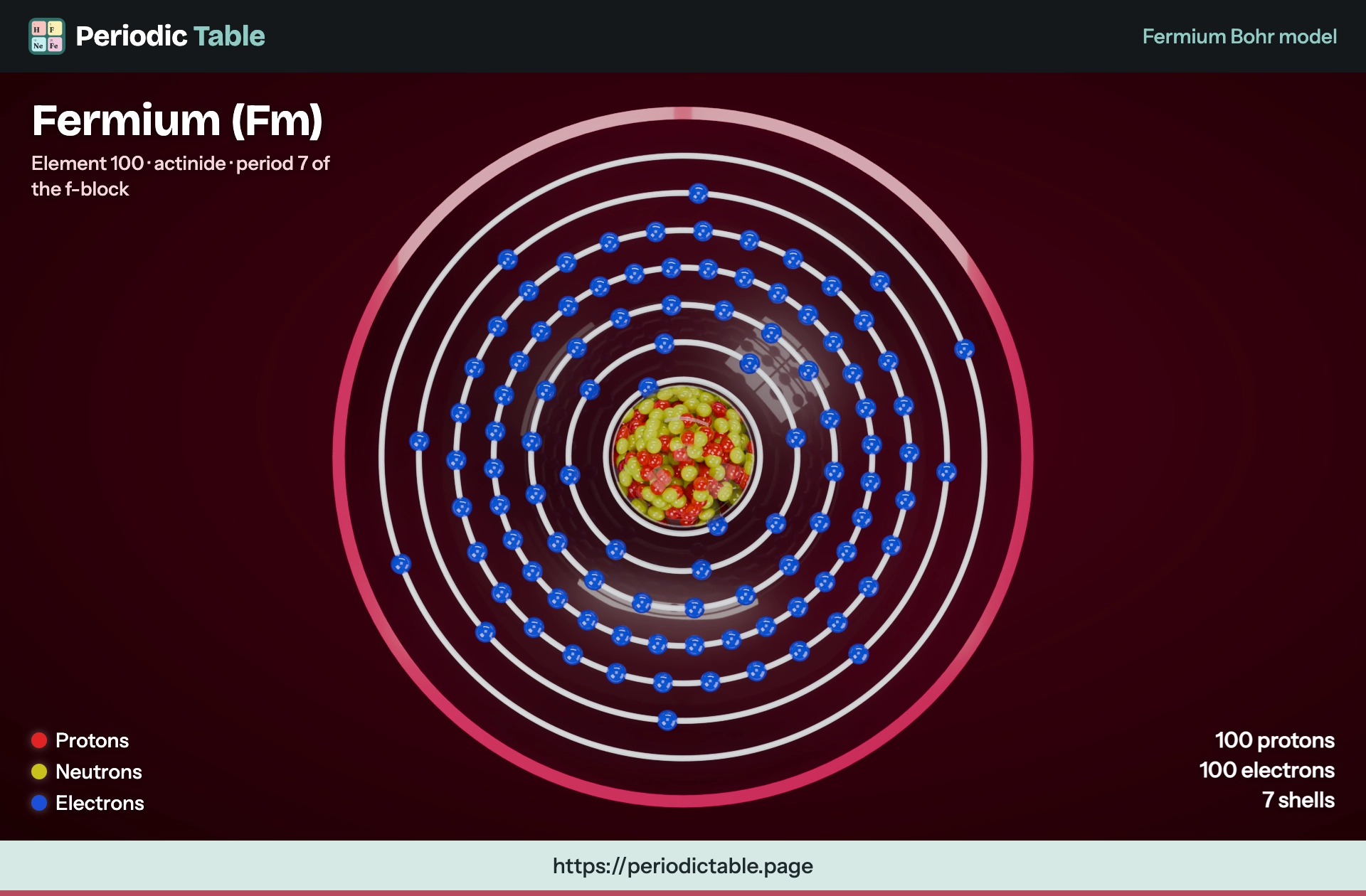
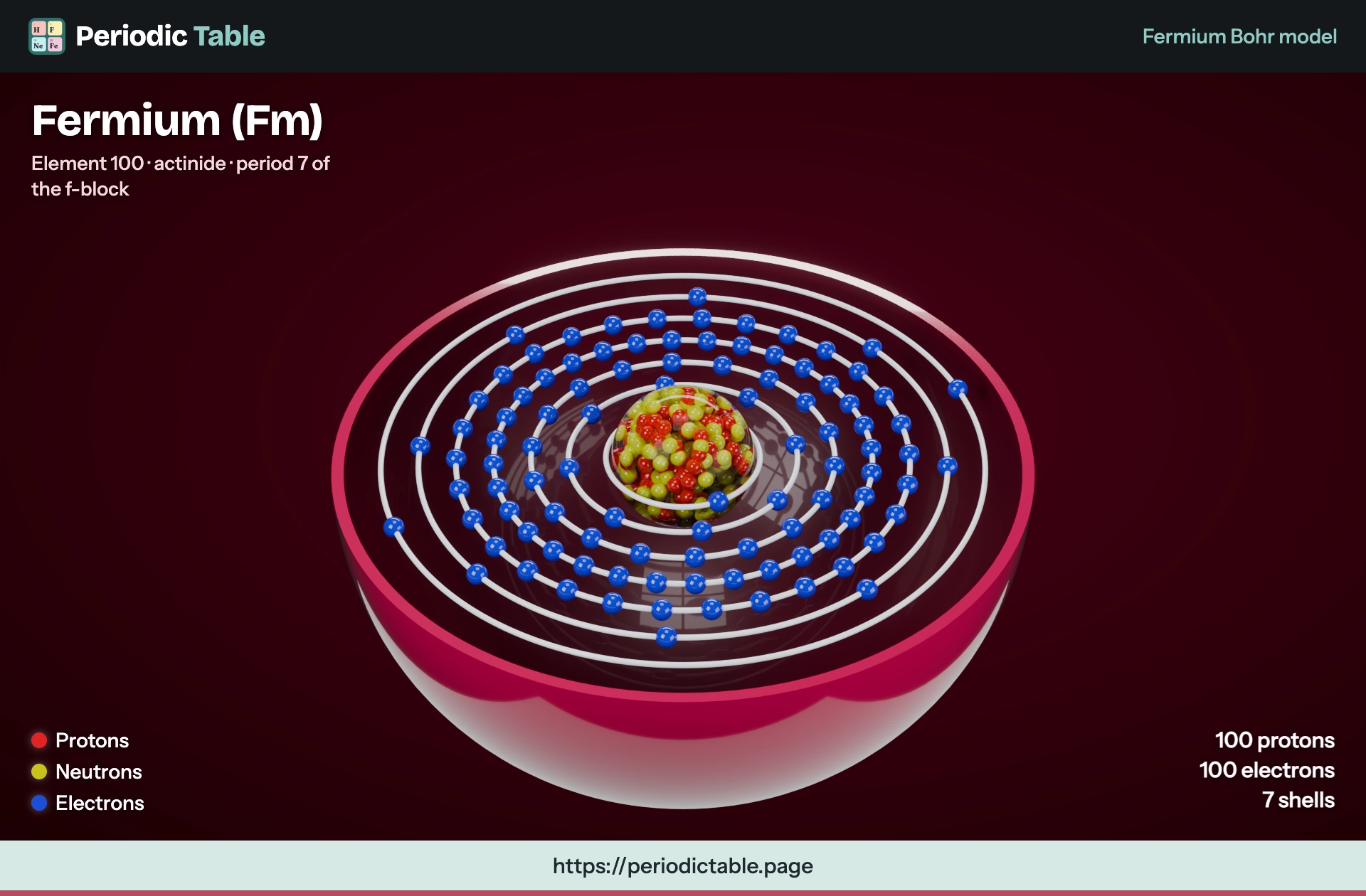
This is a Bohr model of fermium (Fm), a simplified picture of a single fermium atom. Its nucleus holds 100 protons, and a neutral fermium atom has 100 electrons, arranged around it in 7 shells (2 in shell K, 8 in shell L, 18 in shell M, 32 in shell N, 30 in shell O, 8 in shell P and 2 in shell Q).
Fermium periodic table electron configuration
- Shorthand
- [Rn] 5f12 7s2
- Full
- 1s2 2s2 2p6 3s2 3p6 4s2 3d10 4p6 5s2 4d10 5p6 6s2 4f14 5d10 6p6 7s2 5f12
- Electrons per shell
- 2, 8, 18, 32, 30, 8, 2
Fermium element properties and atomic data
- Atomic number
- 100
- Atomic mass
- [257] u
- Phase at STP
- Solid
- Melting point
- 1526.85°C (1800 K)
- Boiling point
- Unknown
- Density
- Unknown
- Electronegativity (Pauling)
- 1.3
- Period
- 7
- Group
- —
- Block
- f-block
- Appearance
- Unknown
- Discovery date
- 1952
- Discovered by
- Lawrence Berkeley National Laboratory
- Named by
- —
Element 100 at a glance: atomic number, atomic mass and period 7
Element 100 carries the symbol Fm, so its atomic number of 100 means 100 protons in the nucleus and 100 electrons around it in a neutral atom. Its atomic mass is written in brackets, [257], because no stable form exists and the figure simply names the longest-lived isotope. To see how a ductile, malleable metal resists corrosion thanks to its passivation layer, consult the nickel element for more detail.
Older references list the atomic weight the same way, and a few non-English sources call it fermio. The table below collects the fermium information most references agree on.
| Property | Value |
|---|---|
| Symbol | Fm |
| Atomic number | 100 |
| Atomic weight | [257] (mass number of the longest-lived isotope) |
| Block, group, period | f-block, actinides, period 7 |
| Electron configuration | [Rn] 5f12 7s2 |
| Protons / electrons / neutrons | 100 / 100 / 157 (in the mass-257 isotope) |
| CAS number | 7440-72-4 |
| State at room temperature | Solid (predicted) |
Note the period 7 placement: it sits in the bottom row of the main table but is printed in the detached f-block strip below it.
How the fermium element was discovered
It was not found in a laboratory first. It turned up in 1952 in the fallout of a hydrogen bomb, where uranium-238 in the device absorbed so many neutrons in a fraction of a second that it built nuclei up to mass 255. Among known superconductors, yttrium barium copper oxide gets its own coverage in the yttrium density entry as a well-known example of the class.
The work stayed classified because of the Cold War, and the findings were only declassified and published in 1955. Earlier, a drone flying through the cloud had already collected filter papers carrying a new plutonium-244, the first hint that much heavier nuclei were waiting in the debris.
Ivy Mike fallout and Albert Ghiorso's Berkeley team
The Ivy Mike test vaporised Elugelab island at Enewetak Atoll. Contaminated coral from the site was shipped to Berkeley, where Albert Ghiorso, Gregory Choppin, Stanley Thompson, Bernard Harvey and colleagues at what is now Lawrence Berkeley National Laboratory picked out about 200 atoms of the new element next to einsteinium.
While the bomb data were secret, the team made more by bombarding plutonium-239 in a cyclotron. A group at the Nobel Institute in Stockholm independently produced an isotope of element 100 in 1954, but priority went to Berkeley.
Why the name honours Enrico Fermi
The discoverers named it after Enrico Fermi, the Italian-born physicist who won the Nobel Prize in 1938 and who, in 1942, ran the first self-sustaining chain reaction in a pile of graphite blocks under the stands of a Chicago football field. His work on slow neutrons opened the door to nuclear fission and to modern nuclear physics.
Fermi died in late 1954, shortly before the name went public. The Stockholm group had proposed centurium for element 100.
Where Fm sits on the periodic table as an actinide
On the periodic table it is an actinide, the eleventh of the 15 actinides that run from actinium to lawrencium, and the eighth transuranic element to be discovered. Its neighbours in the actinide series are einsteinium (99) and mendelevium (101), with californium, berkelium and curium just before them. Elements heavier than 100 are grouped as the transfermium elements, so this one also marks a boundary in chemistry: everything past it has to be made one atom at a time in an accelerator.
Physical fermium properties: melting point, density and boiling point
No one has made enough pure fermium to see, weigh or melt, so every bulk figure is a prediction based on its actinide neighbours. A single fermium atom can be studied; a lump of the metal cannot. These are the physical properties most often quoted:
- Melting point: about 1527 °C (1800 K), predicted
- Boiling point: unknown
- Density: predictions range from about 8.8 to 9.7 g/cm³
- Appearance: expected to be a silvery, metallic solid
- Atomic radius (non-bonded): 2.45 Å; covalent radius: 1.67 Å; Van der Waals radius: 245 pm
Treat the density and melting point as estimates, not measurements, since sources disagree on both.
Chemical properties of the fermium ion and its oxidation states
Its chemical properties have only been studied in tracer amounts, and no solid compound has been made. In solution the fermium ion is mostly trivalent, so the common oxidation states are +3 and, less often, +2: Fm(III) is fairly easy to reduce to fermium(II). The +3 ion forms complexes with ligands that bond through hard donor atoms such as oxygen, and anionic complexes with chlorides and nitrates that are more stable than those of einsteinium or californium.
Electron configuration, electronegativity and ionization energy
The electron configuration [Rn] 5f12 7s2 puts twelve electrons in the 5f shell, giving shell counts of 2, 8, 18, 32, 30, 8, 2. Its Pauling electronegativity is about 1.3, and the first ionization energy is estimated at roughly 627 kJ/mol. The electron affinity has not been measured reliably.
Fermium isotopes and their half-life values
About 20 fermium isotopes are known, with mass numbers from 241 to 260, and none has stable isotopes to fall back on. Every fermium isotope is radioactive, decaying mainly by alpha emission, electron capture or spontaneous fission. Its radioactivity is why the half-life of each form is the number researchers care about most.
| Mass number | Half-life | Main decay mode |
|---|---|---|
| 257 | 100.5 days | Alpha |
| 253 | 3.0 days | Electron capture |
| 252 | 25.4 hours | Alpha |
| 255 | 20.1 hours | Alpha |
| 258 | 370 microseconds | Spontaneous fission |
Why the longest-lived isotope vanishes in a nuclear reactor
The mass-257 isotope should last long enough to study, yet a nuclear reactor cannot stockpile it. Inside the core it absorbs one more neutron, becomes the mass-258 isotope, and that splits in well under a millisecond. This is why element 100 is the heaviest that neutron capture can reach: the chain stops here.
How a synthetic element is made by neutron bombardment
Any primordial Fm atoms present when Earth formed decayed long ago. Some were probably made in the natural nuclear reactor at Oklo in Gabon two billion years ago, but none survive. Today every sample comes only from neutron bombardment of lighter actinides such as plutonium, or from accelerators.
The high flux isotope reactor route
The main source is the High Flux Isotope Reactor (HFIR) at Oak Ridge National Laboratory. Irradiating tens of grams of curium there yields only picogram quantities of element 100, which must then be separated chemically before it decays.
Uses of element fermium in scientific research
Outside the lab, this metal has no commercial or industrial use. Its only role is in scientific research: testing how heavy nuclei behave, checking models of nuclear structure, and studying the trends that carry chemistry into the transfermium elements. The mass-255 isotope, a strong alpha emitter with a half-life of about 20 hours, has been suggested for cancer radiotherapy, but it has never been used that way because so little can be made.
Is this artificial element toxic? health and environment risks of Fm
As an artificial element that does not occur in Earth's crust, Fm poses no practical risk to your health or to the environment. Its alpha decay and spontaneous fission are genuinely hazardous, but the amounts produced are so tiny that they exist only inside shielded research labs.