Yttrium element (Y): yttrium periodic table facts
Yttrium periodic table facts: yttrium (Y) is element 39, a transition metal in group 3, period 5. If you have ever looked at a white LED, a laser cutter or a hospital's liver-cancer ward, you have met yttrium without knowing it. Before handling a strong oxidising agent in the laboratory, open the chlorine on the periodic table to see why it needs care.
It is the chemical element with symbol Y and atomic number 39: a soft, silvery metal that is usually grouped as a rare-earth element because it shares their minerals and their chemistry. Below you will find the key properties of yttrium, how it was discovered, where it comes from and why industry depends on it.
Rotate the 3D Bohr model of yttrium
Drag to orbit, scroll to zoom.
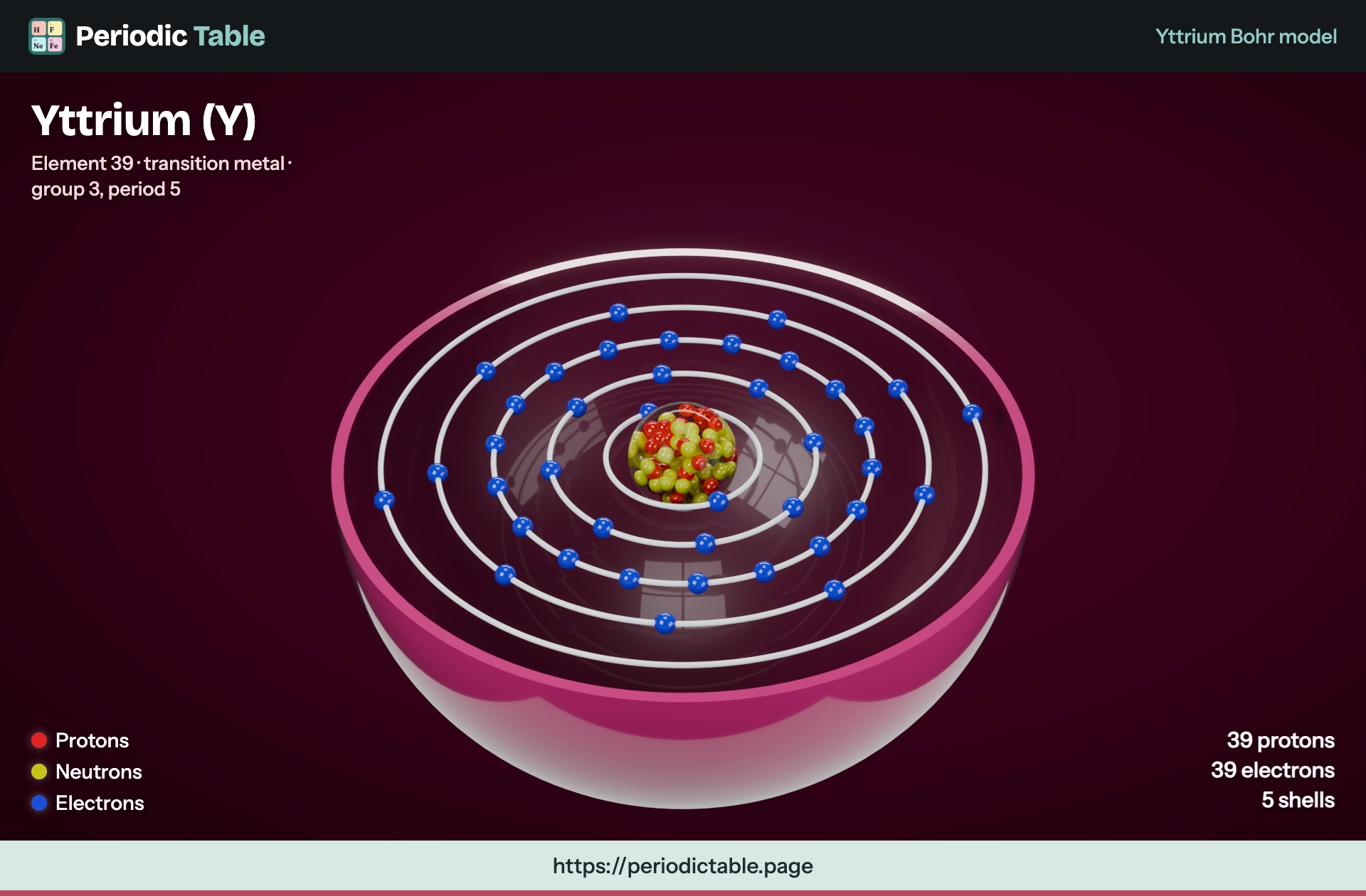
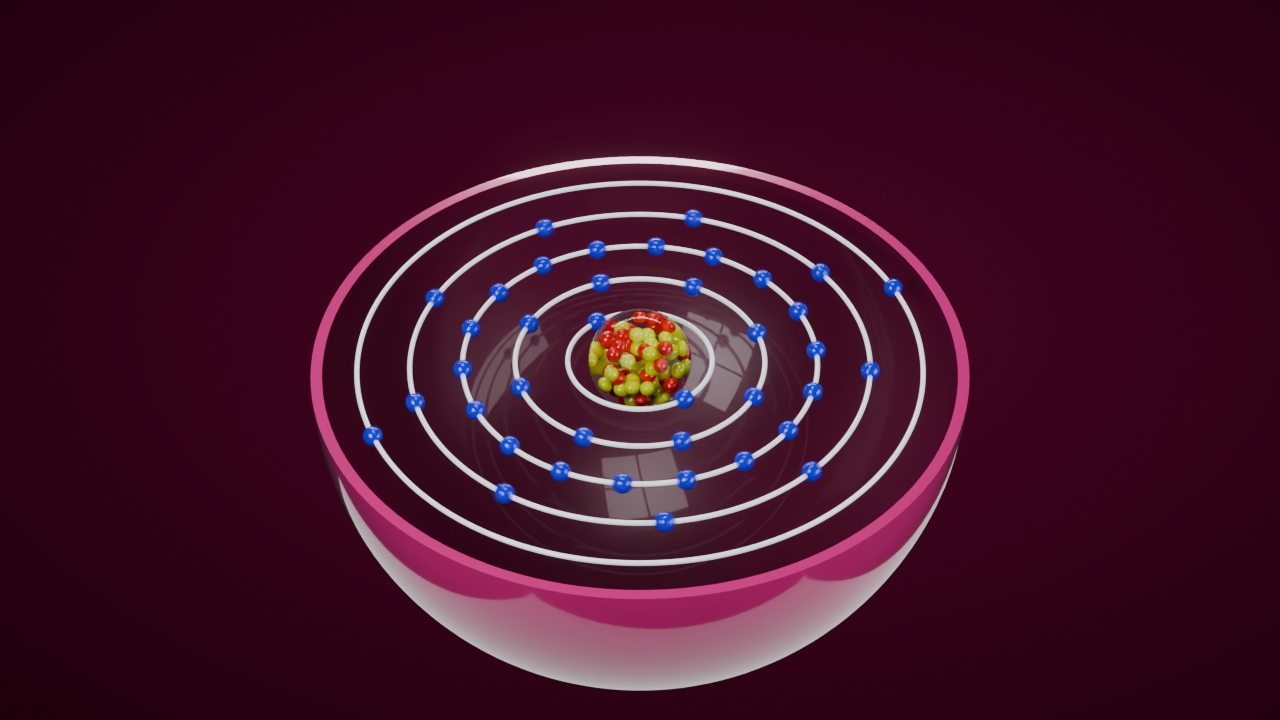
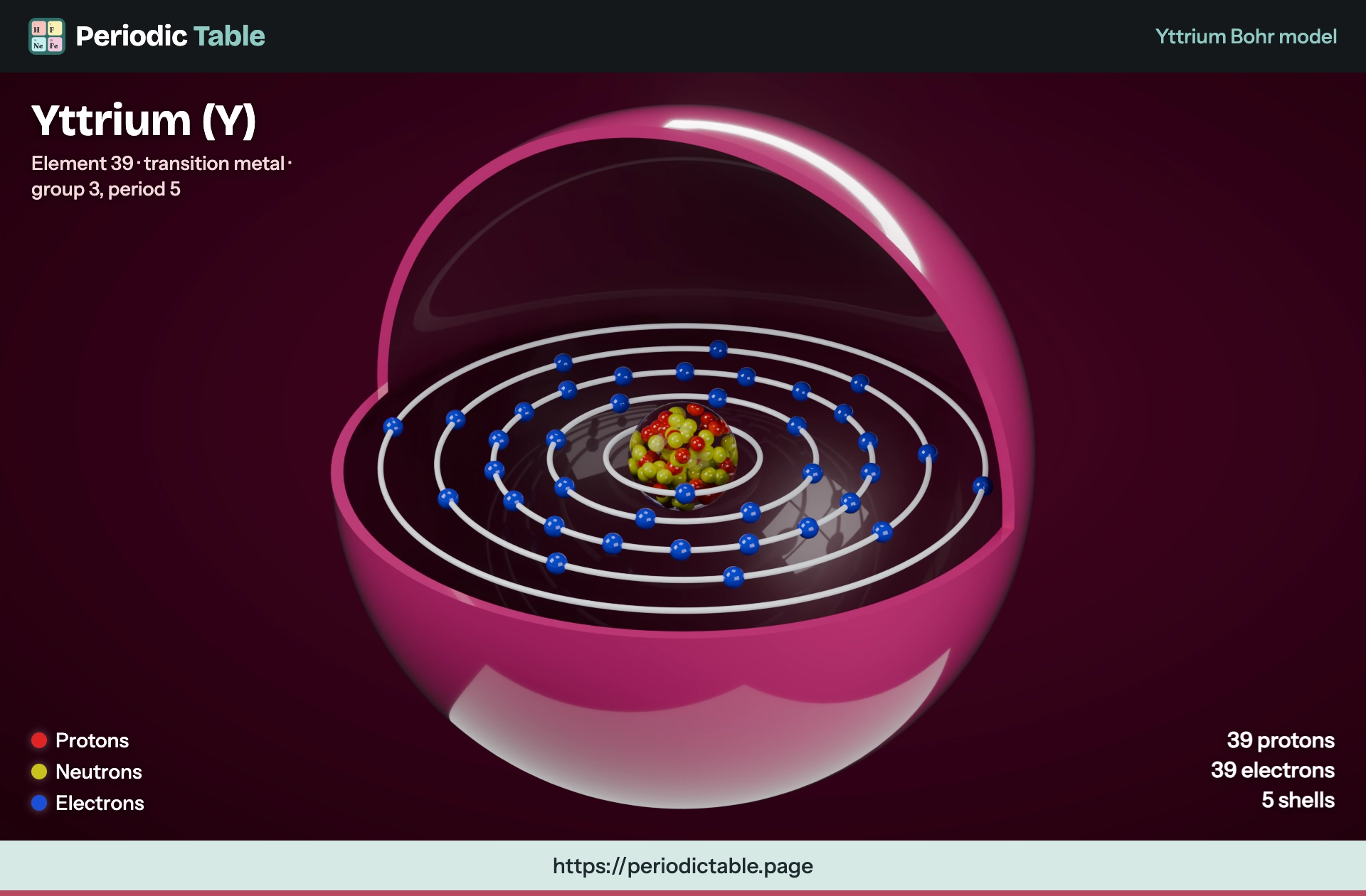
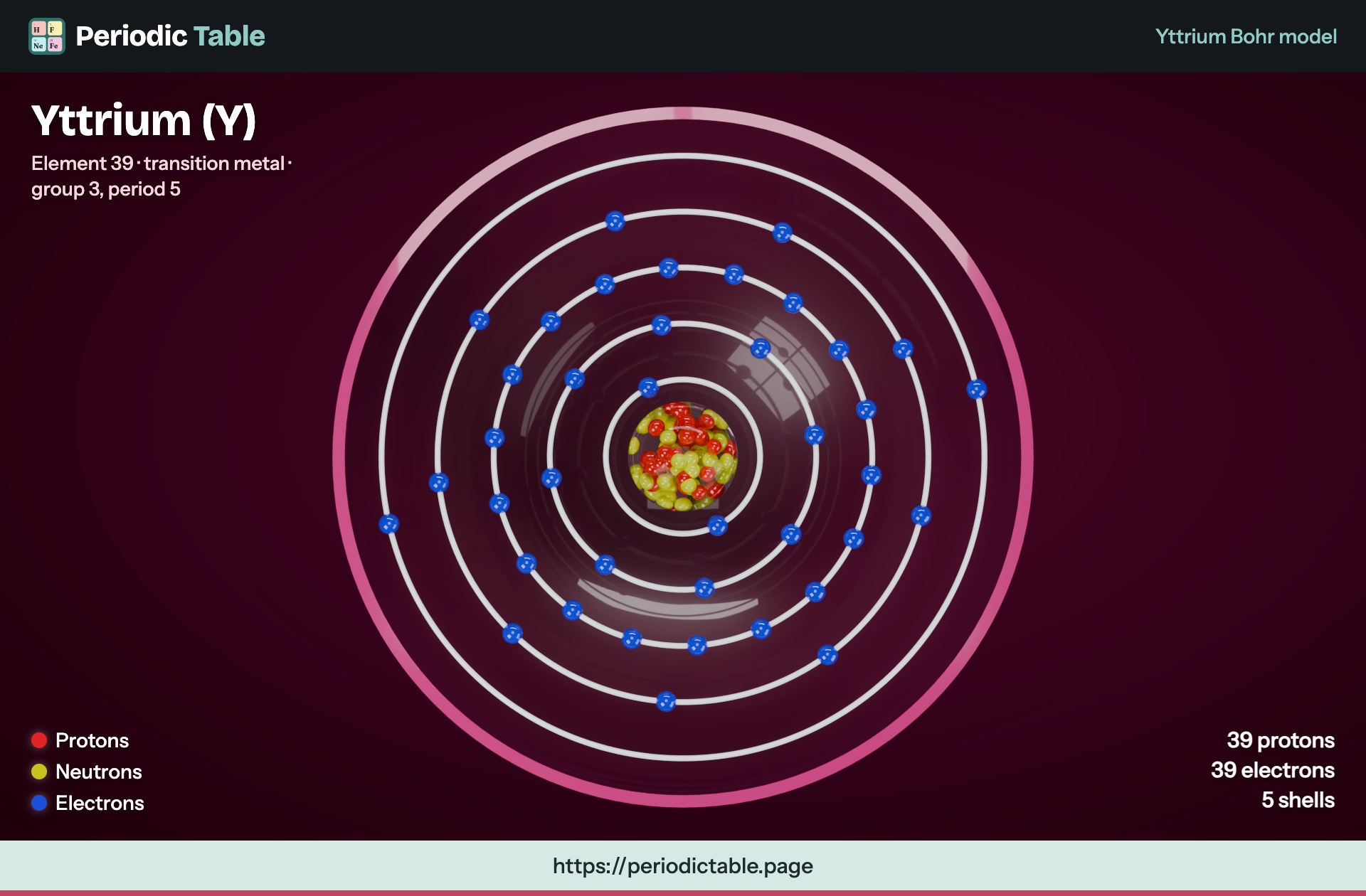
This is a Bohr model of yttrium (Y), a simplified picture of a single yttrium atom. Its nucleus holds 39 protons, and a neutral yttrium atom has 39 electrons, arranged around it in 5 shells (2 in shell K, 8 in shell L, 18 in shell M, 9 in shell N and 2 in shell O).
Yttrium periodic table electron configuration
- Shorthand
- [Kr] 4d1 5s2
- Full
- 1s2 2s2 2p6 3s2 3p6 4s2 3d10 4p6 5s2 4d1
- Electrons per shell
- 2, 8, 18, 9, 2
Yttrium element properties and atomic data
- Atomic number
- 39
- Atomic mass
- 88.9058 u
- Phase at STP
- Solid
- Melting point
- 1525.85°C (1799 K)
- Boiling point
- 2929.85°C (3203 K)
- Density
- 4.472 g/cm³
- Electronegativity (Pauling)
- 1.22
- Period
- 5
- Group
- 3
- Block
- d-block
- Appearance
- Silvery white
- Discovery date
- 1794
- Discovered by
- Johan Gadolin
- Named by
- —
Element 39 facts: group 3, period 5 and the D-block
On the periodic table, yttrium sits in the third column of the fifth row, directly below scandium and beside strontium on one side and zirconium on the other. It is the first transition element in its row, and in the group-3 column it stands above lutetium. The table below collects the values you will most often need when you work with element 39. Scientists working in nuclear physics will find the fermium on the periodic table a clear summary of a rare, short-lived metal.
| Property | Value |
|---|---|
| Symbol | Y |
| Atomic number | 39 |
| Atomic mass | 88.906 |
| Group / period / block | Group 3, period 5, d-block |
| Electron configuration | [Kr] 4d1 5s2 |
| State at 20 °C | Solid, hexagonal close-packed crystal |
| Melting point | 1,526 °C (1,799 K) |
| Boiling point | 2,930 °C (3,203 K) |
| Density | 4.47 g/cm3 |
| Atomic radius / covalent radius | 180 pm / 190 pm |
| Common oxidation state | +3 |
| Natural isotope | Y-89 (100%) |
| CAS number | 7440-65-5 |
| Discovered | 1794 by Johan Gadolin |
The electron configuration explains most of what follows: Y gives up its single 4d electron and both 5s electrons easily, which is why its chemistry is dominated by one ion, Y3+.
Yttrium properties: a soft, silvery transition metal
As a transition metal, yttrium is lustrous and fairly malleable, and a clean bar of yttrium metal looks much like tin with a slightly grey cast. In bulk it is surprisingly stable in air because a thin oxide film forms on the surface and stops further attack, a process called passivation. Biology readers can follow the magnesium element from plants and the human body to nutrition and health.
That protection disappears when the solid is finely divided: turnings and powder can catch fire above roughly 400 °C, so the dust is treated as flammable. When hot, it also reacts with water, splitting it and releasing hydrogen gas.
Melting point, boiling point and density
Yttrium melts at about 1,526 °C and boils near 2,930 °C, so it handles heat far better than common structural metals such as magnesium. At 4.47 g/cm3 it sits between titanium and iron, light enough to matter in alloy design. Other bulk figures you may need are a specific heat capacity of about 298 J/(kg·K) and a Young's modulus of 63.5 GPa, which makes Y a relatively flexible solid compared with steel at around 200 GPa.
Electronegativity and ionization energies
On the Pauling scale, the element scores 1.22, which marks it as strongly electropositive: it would rather lose electrons than share them. Its first three ionization energies are roughly 600, 1,180 and 1,980 kJ/mol.
The jump to the fourth, about 5,850 kJ/mol, is huge because a fourth electron would have to come from the stable krypton core. That single step is why you will almost never see it in any state other than +3.
Why yttrium sits so close to the lanthanides
Although yttrium lies one row above the lanthanides, its ion is almost exactly the same size as theirs. The cause is the lanthanide contraction: as the 4f shell fills, the heavier lanthanide ions shrink until they match the radius of Y3+.
Plot its physical properties against proton count and it lands between gadolinium and erbium, and in solution it behaves much like terbium or holmium. Being strictly trivalent, it is effectively a heavy lanthanide without f electrons, and nature never separates it from that group.
Yttrium compounds and the +3 oxidation state
Almost all yttrium compounds contain the element as the Y3+ ion. The most important is yttrium oxide, Y2O3, a white, high-melting solid long known as yttria. With the halogens it forms trihalides such as YF3 and YCl3; the fluoride, hydroxide and oxalate are insoluble, while the chloride, nitrate and sulfate dissolve readily in water.
That split in solubility is the basis of practical yttrium chemistry. Adding oxalic acid to a solution of the chloride throws down a white precipitate of yttrium oxalate, which you can then heat to Y2O3. To get the free element, the fluoride is reduced with calcium:
$$2\,\mathrm{YF_3} + 3\,\mathrm{Ca} \rightarrow 2\,\mathrm{Y} + 3\,\mathrm{CaF_2}$$
Because Y3+ has no unpaired d or f electrons, its compounds are colourless and magnetically quiet. That sounds dull, but it makes the element an ideal host lattice for other ions, and some organoyttrium complexes work as a catalyst for polymerising ethylene.
Yttrium isotopes: why yttrium-89 is the only stable isotope
Every atom found in nature is yttrium-89, so the element is mononuclidic. Y-89 carries 50 neutrons, a "magic" number that makes the nucleus unusually resistant to capturing another neutron. That stability is why the slow s-process inside red giant stars piles it up: about 72% of the yttrium in the solar system came from s-process nucleosynthesis, the rest from the rapid r-process in supernovae.
More than 30 synthetic yttrium isotopes have been made, with mass numbers from 76 to 108. All of them are radioactive, and the longest-lived, Y-88, has a half-life of about 107 days. Lighter ones decay towards strontium; heavier ones decay towards zirconium.
Yttrium-90 in medicine
The isotope that matters most outside a reactor is yttrium-90. It emits high-energy beta particles over a short range and has a half-life of about 64 hours, which suits targeted therapy in medicine.
In radioembolization, millions of glass or resin microspheres loaded with Y-90 are injected into the arteries feeding a tumour to treat primary liver cancer and liver metastases. Y-90 is also attached to antibodies to treat lymphoma, and it is used to calm inflamed joints by radiation synovectomy.
How yttria led to the discovery of yttrium
The story begins in 1787 in a quarry at Ytterby, a village near Stockholm in Sweden. Carl Axel Arrhenius, an army officer and amateur chemist, found a heavy black stone there and named the new mineral ytterbite.
In 1794 the Finnish chemist Johan Gadolin analysed it and reported a new "earth", which Anders Ekeberg later named yttria. The mineral itself was renamed gadolinite in Gadolin's honour.
Turning that earth into metal took decades. Friedrich Wöhler produced an impure sample in 1828 by reducing a chloride with potassium. In 1843 Carl Gustaf Mosander showed that this oxide was really a mixture, and the extra oxides he found led to erbium and terbium.
Later chemists pulled ytterbium out of the same material, so four elements now carry the Ytterby name. The symbol Yt was used until the 1920s before Y became standard.
Where yttrium comes from: ores, mining and production
Yttrium never occurs free. It makes up about 31 to 33 ppm of the Earth's crust, more than lead, and shows up in almost every rare earth mineral and in some uranium ores.
Samples returned from the Moon were found to be relatively rich in it, one of the odder facts about moon rocks. The commercial sources are:
- Xenotime, a phosphate that can hold up to 60% yttrium phosphate
- Monazite sands, with roughly 2-3% yttrium
- Bastnäsite, which carries only about 0.1%
- Ion-adsorption clays of southern China, plus minor fergusonite and samarskite
Mining history has moved with those deposits: India and Brazil led early in the 20th century, the United States and Australia later, and China dominates today's production. World output of the oxide grew from about 600 tonnes in 2001 to several thousand tonnes a year, against reserves estimated in the hundreds of thousands.
Separating a rare-Earth element from its neighbours
Because it shares the same size and charge as the heavy lanthanides, it is one of the hardest elements to purify. Ore is dissolved in sulfuric acid and passed through ion exchange or solvent-extraction stages that pull each element out by small differences in binding strength. Very little pure metal is made each year; most buyers want Y2O3 instead.
Uses of yttrium in modern technology
Yttrium rarely does the visible work itself. Instead it holds, strengthens or stabilises something else, which is why it turns up across electronics, optics, energy and engineering.
Phosphors, LEDs and lasers
For decades the red dots in colour television cathode ray tubes were yttrium oxysulfide doped with europium: the host lattice absorbs the energy and the europium emits red light. The same host idea now runs through phosphors in fluorescent lamps and, above all, white LEDs, where a cerium-doped YAG crystal turns blue light yellow. Doping the same crystals with neodymium or erbium gives solid-state lasers used for cutting, welding and surgery.
Yttrium aluminium garnet and microwave filters
Yttrium aluminium garnet, Y3Al5O12, is the synthetic crystal behind most of those laser rods. YAG has a hardness of about 8.5 and was once sold as a diamond simulant. Its iron cousin, yttrium iron garnets (YIG), are among the best microwave filters available and appear in radar and satellite hardware.
Yttrium barium copper oxide: a liquid-nitrogen superconductor
In 1987, yttrium barium copper oxide, YBa2Cu3O7, became the first superconductor to work while bathed in liquid nitrogen. YBCO loses all electrical resistance at about 93 K, so it can be cooled with cheap nitrogen at 77 K instead of liquid helium. That jump in superconductivity temperature drives research into YBCO tapes for cables, fault-current limiters and magnets.
Alloys, ceramics and other uses
- A fraction of a percent of yttrium strengthens alloys of aluminium and magnesium and refines the grain of chromium, titanium and molybdenum.
- In cast iron, yttrium helps form round graphite nodules, making the iron tougher and less brittle.
- Yttria-stabilised zirconia conducts oxygen ions, so it powers solid-oxide fuel cells and car oxygen sensors.
- Yttrium oxide in glass resists heat and shock, which suits camera lenses.
- Y-tipped electrodes appear in high-performance spark plugs.
- YInMn blue, made from yttrium, indium and manganese in 2009, was the first new blue pigment in about 200 years.
Health effects of yttrium and safe handling
Yttrium has no known biological role, and the whole human body holds well under a milligram. The health effects of yttrium come almost entirely from dust and fumes in the workplace.
When its compounds are inhaled over long periods, they can cause lung disease, and animal studies link heavy exposure to lung and liver damage; some sources also flag a raised risk of lung cancer. Soluble salts are mildly toxic, while insoluble compounds such as the oxide show low toxicity.
US regulators cap airborne exposure at 1 mg/m3 over an 8-hour day, and 500 mg/m3 is treated as immediately dangerous to life. If you handle the powder, keep it away from ignition sources, work with local ventilation and use a respirator, because the dust can both harm your lungs and burn.
Yttrium in the environment and supply risk
Yttrium in the environment comes mostly from industrial discharges and discarded electronics, such as old televisions and lamps. Once released, it slowly builds up in soil and water, and studies in aquatic animals show damage to cell membranes that can affect reproduction and nerve function.
Supply is the bigger worry for industry. Output is concentrated in a handful of countries, with one producer far ahead of Russia and Malaysia, and less than 10% is recycled. Because LED lighting, laser optics and superconductors all depend on it, it regularly appears on critical-mineral lists, and recovering it from spent lamp powders is one of the clearest ways to reduce that risk.