


Magnesium element (Mg): magnesium periodic table facts
Magnesium periodic table facts: magnesium (Mg) is element 12, an alkaline earth metal in group 2, period 3. If you have ever struck a fire starter, swallowed an antacid or opened a laptop with a cool, featherweight shell, you have already handled magnesium. A reference on properties of chlorine shows how the chemical industry and manufacturing rely on a hazardous reagent.
This chemical element, symbol Mg, is a shiny gray, lightweight metal with a low density and high reactivity, and as an alkaline earth metal it almost always gives up two electrons to take an oxidation state of +2. Here you will find its atomic data, how it behaves, where it comes from and why industry and your own body both depend on it.
Rotate the 3D Bohr model of magnesium
Drag to orbit, scroll to zoom.
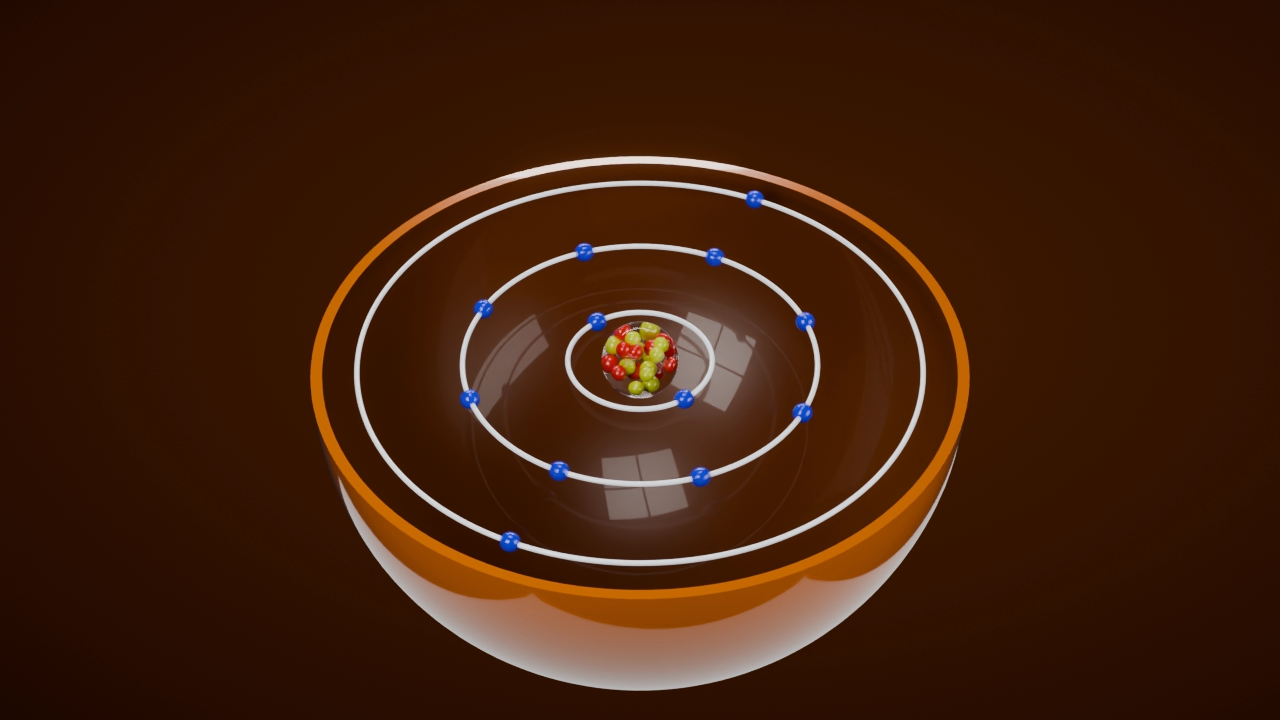
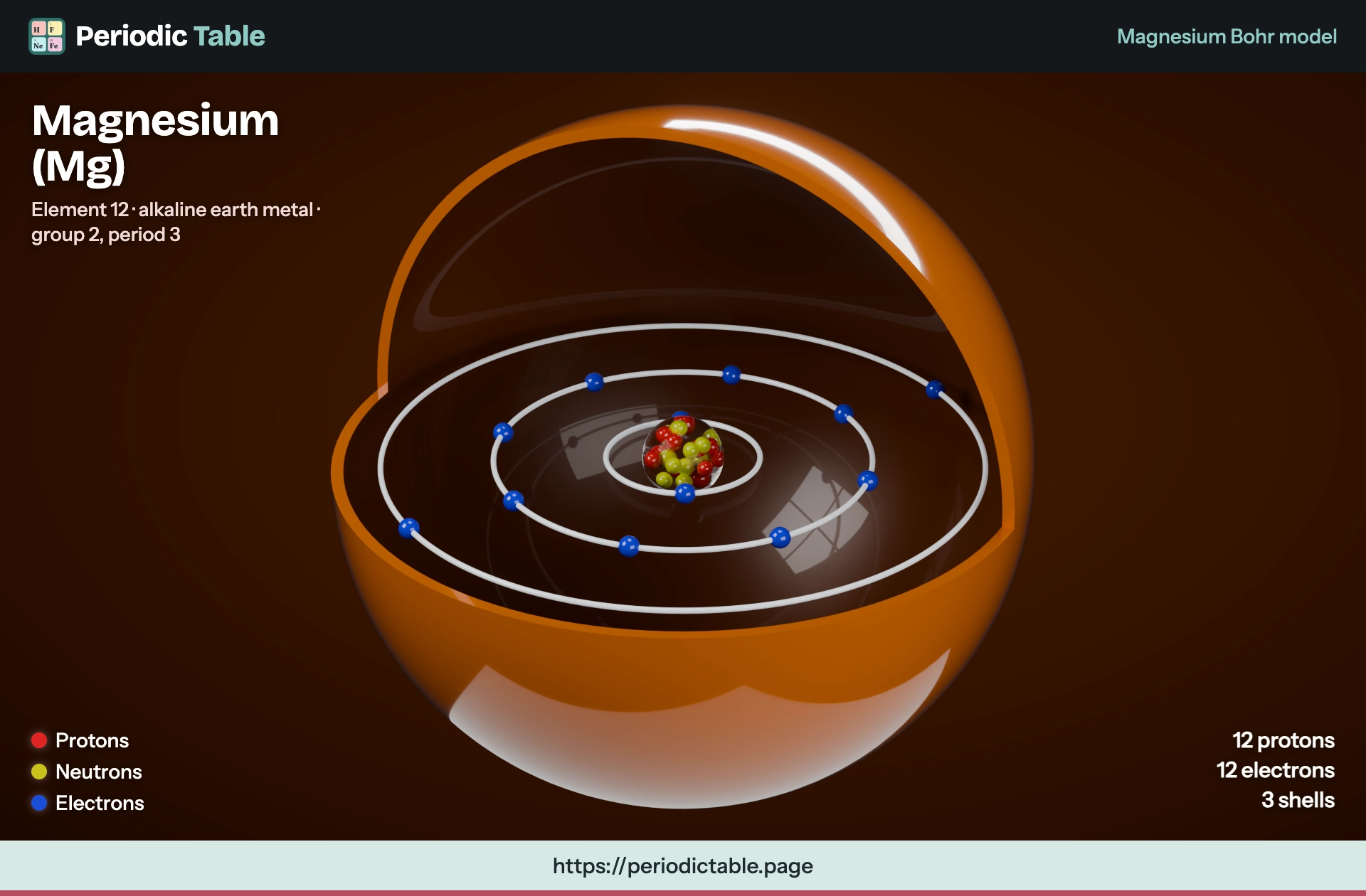
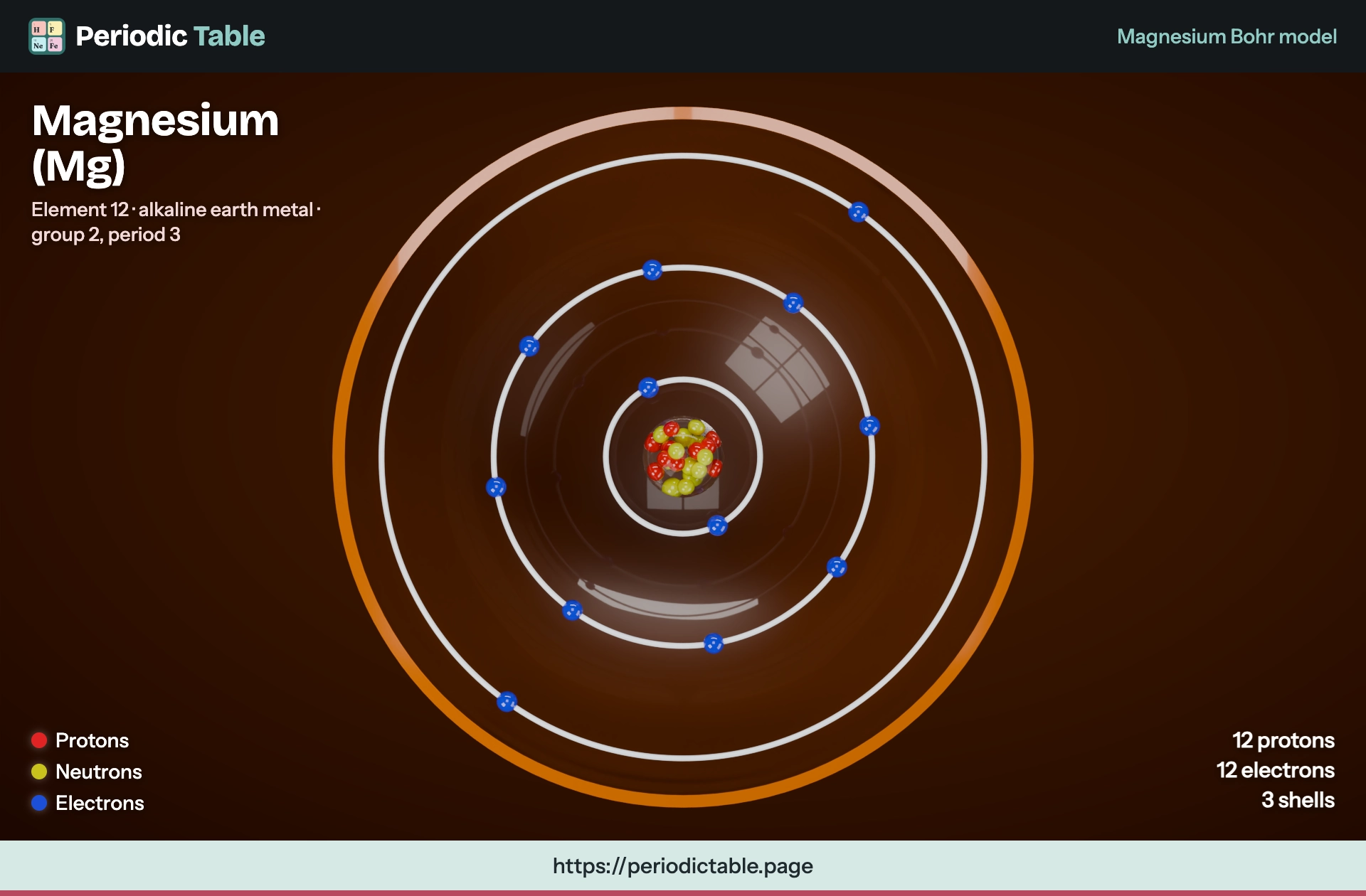
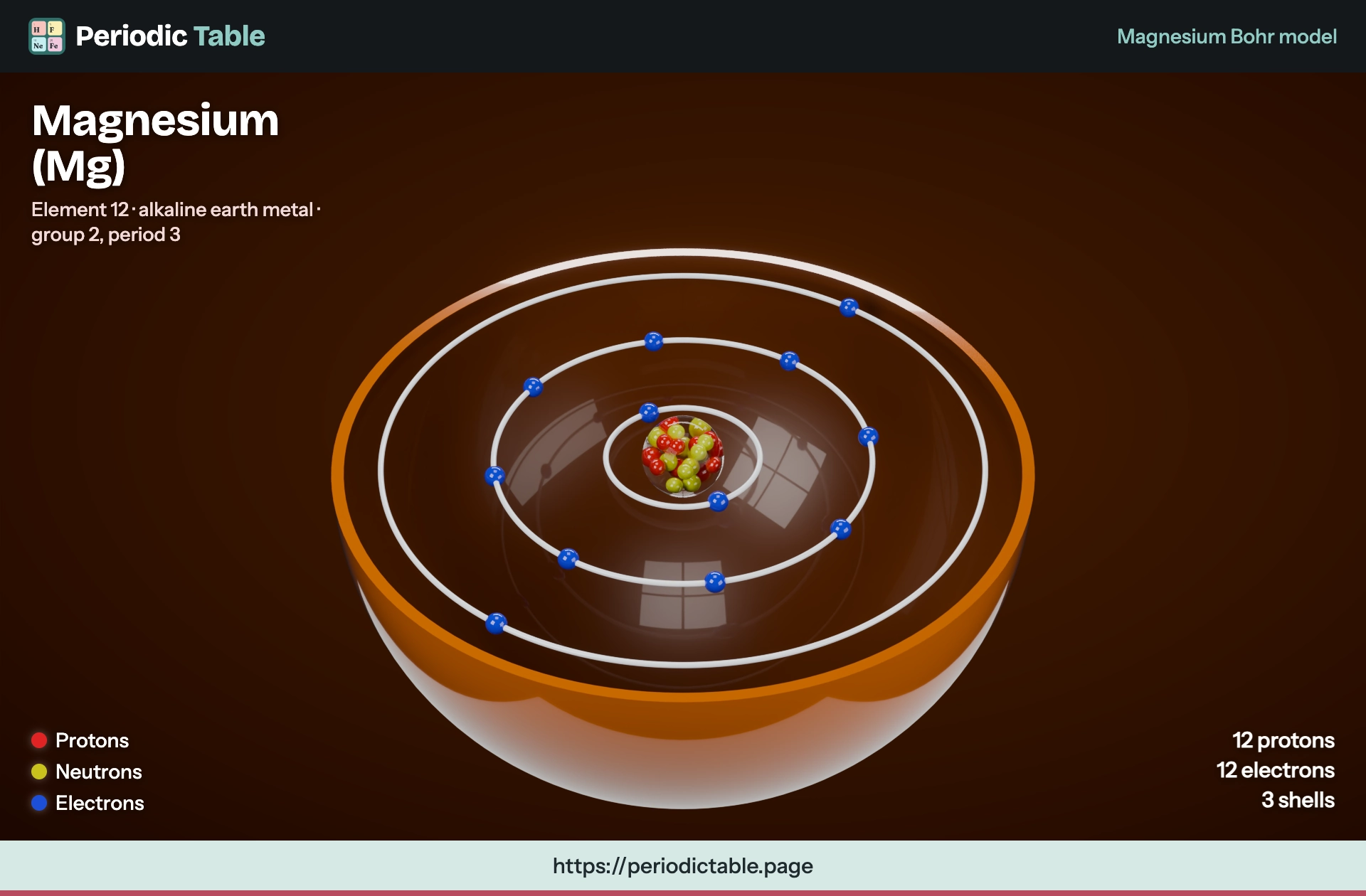
This is a Bohr model of magnesium (Mg), a simplified picture of a single magnesium atom. Its nucleus holds 12 protons, and a neutral magnesium atom has 12 electrons, arranged around it in 3 shells (2 in shell K, 8 in shell L and 2 in shell M).
Magnesium periodic table electron configuration
- Shorthand
- [Ne] 3s2
- Full
- 1s2 2s2 2p6 3s2
- Electrons per shell
- 2, 8, 2
Magnesium element properties and atomic data
- Atomic number
- 12
- Atomic mass
- 24.305 u
- Phase at STP
- Solid
- Melting point
- 649.85°C (923 K)
- Boiling point
- 1089.85°C (1363 K)
- Density
- 1.738 g/cm³
- Electronegativity (Pauling)
- 1.31
- Period
- 3
- Group
- 2
- Block
- s-block
- Appearance
- Shiny grey solid
- Discovery date
- 1755
- Discovered by
- Joseph Black
- Named by
- —
Magnesium element facts: atomic number, mass and electron configuration
The magnesium element sits in period 3 and group 2 of the periodic table, between sodium and aluminium, which places it in the s-block alongside the other alkaline earth metals. Every magnesium atom carries 12 protons, so you will also see it called element 12. Its two outer 3s electrons are loosely held, which explains almost everything else on this page: the low electronegativity, the eagerness to form Mg2+ ions and the bright, energetic reactions. When toxicity matters, the yttrium periodic table reference gives melting point, density and electronegativity for a silvery transition metal, with advice on safety.
| Property | Value for Mg |
|---|---|
| Atomic number | 12 |
| Standard atomic mass | 24.305 |
| Electron configuration | [Ne] 3s2 (1s2 2s2 2p6 3s2) |
| Group / period / block | 2 / 3 / s |
| Common oxidation state | +2 |
| Electronegativity (Pauling scale) | 1.31 |
| Atomic radius (empirical) | 160 pm |
| Covalent radius | 141 pm |
| First and second ionization energies | 737.7 and 1,450.7 kJ/mol |
| CAS number | 7439-95-4 |
Notice the jump in ionization energy: removing a third electron costs about 7,733 kJ/mol, more than five times the second. That gap is why magnesium never shows up as Mg3+ and why chemists treat it as a textbook group 2 metal.
Physical properties of magnesium
In physical properties, magnesium is a silvery-white solid at room temperature that melts at 650 °C (923 K) and boils at about 1,090 °C (1,363 K), the lowest melting point and boiling point of the alkaline earth group. Pure polycrystalline magnesium is fairly brittle, but a small addition of other elements makes it far easier to roll and shape. A guide to properties of cobalt ties the chemistry of this metal to batteries, minerals, health and the table.
How light is magnesium metal compared with aluminium and steel
The figure engineers care about most is weight per volume. Magnesium metal weighs 1.738 g/cm3, so a one-litre block comes in at just 1.74 kg. The table puts that next to the structural metals it competes with; the ratios are simple divisions of the published densities.
| Material | Density (g/cm3) | Mass of 1 litre | Mg as a share of its mass |
|---|---|---|---|
| Magnesium | 1.738 | 1.74 kg | 100% |
| Aluminium | 2.70 | 2.70 kg | 64% |
| Titanium | 4.51 | 4.51 kg | 39% |
| Carbon steel | 7.85 | 7.85 kg | 22% |
Its Young's modulus of about 45 GPa is lower than aluminum's, so a magnesium part needs slightly thicker walls for the same stiffness, yet it still wins on specific strength, the strength you get per kilogram.
Crystal structure, heat and conductivity
Elemental magnesium crystallises in a hexagonal close-packed lattice. That arrangement has few easy slip directions at room temperature, which is why the metal resists cold forming and is usually shaped warm. Thermal conductivity is about 156 W/(m·K), high enough that magnesium housings double as heat spreaders in cameras and phones.
Chemical properties and reactivity of magnesium
The chemical properties and much of its chemistry follow from that loosely held outer pair. Magnesium is a strong reducing agent: it pulls oxygen, chlorine and other non-metals away from their partners and forms ionic compounds built on the Mg2+ ion.
Oxidation and the protective oxide layer
Left in air, a fresh surface dulls within hours as a thin film of oxide forms. This passivation layer is what lets you store it without an inert gas, although it gives much weaker corrosion resistance than an anodised aluminum part. Heated strongly, a ribbon burns with a bright light to form the white oxide, and in nitrogen it forms magnesium nitride:
$$\mathrm{2Mg + O_2 \rightarrow 2MgO} \qquad \mathrm{3Mg + N_2 \rightarrow Mg_3N_2}$$
In almost all of these products magnesium ends up as the Mg2+ ion.
How magnesium reacts with water, steam and acids
Magnesium reacts with water only slowly at room temperature, because the hydroxide it forms coats the surface and slows the reaction. Hot water speeds it up, and steam reacts briskly to give the oxide. Acids are much faster: a strip dropped into dilute hydrochloric acid fizzes at once, releasing hydrogen gas.
$$\mathrm{Mg + 2H_2O \rightarrow Mg(OH)_2 + H_2}$$
$$\mathrm{Mg + 2HCl \rightarrow MgCl_2 + H_2}$$
The first reaction makes magnesium hydroxide, the same base that later turns up in your medicine cabinet.
Grignard reagents and detecting magnesium ions
In organic chemistry, magnesium turnings react with alkyl or aryl halides in dry ether to form Grignard reagents (R–MgX), workhorses of organic synthesis that build new carbon–carbon bonds. In the lab, you can confirm magnesium ions in solution by adding ammonium chloride, ammonia and a phosphate salt: a white precipitate confirms that Mg2+ is present.
Magnesium isotopes and atomic forms
Natural magnesium is a mix of three stable isotopes, so the atomic mass on the periodic table is a weighted average rather than a whole number.
| Isotope | Isotopic mass (u) | Natural abundance | Half-life |
|---|---|---|---|
| 24Mg | 23.985 | 78.99% | stable |
| 25Mg | 24.986 | 10.00% | stable |
| 26Mg | 25.983 | 11.01% | stable |
| 28Mg | 27.984 | none (synthetic) | about 21 hours |
You can reproduce the standard value yourself from the three stable rows:
$$\bar{A} = (23.985 \times 0.7899) + (24.986 \times 0.1000) + (25.983 \times 0.1101) \approx 24.305$$
The radioactive isotope with the longest half-life, magnesium-28, decays too quickly to be useful outside research. Geologists also use the extra 26Mg left behind when short-lived 26Al decayed in early meteorites to date the first solids in the Solar System.
Where magnesium comes from: the cosmos, rocks and oceans
Magnesium is one of the most abundant elements in the universe, and on Earth it is the eighth most common element in the crust by mass.
Made in aging stars
Magnesium nuclei are forged in large, aging stars, where carbon nuclei fuse and capture helium nuclei under extreme heat. When they die as supernovas, they scatter the new magnesium into interstellar gas, which later condenses into planets like ours.
Magnesium in Earth's crust, oceans and brines
Because it reacts so readily, magnesium never occurs as free metal in nature. It sits locked inside more than 60 minerals, of which dolomite, magnesite, brucite, carnallite, talc and olivine matter commercially.
In Earth's crust it averages about 2.8% by mass, and in the mantle olivine makes it even more common. Seawater holds roughly 1.3 grams of dissolved magnesium per litre, and salt lakes and the Dead Sea carry far richer brine, so natural brines are a practical second source next to mined rock.
Magnesium production: from rock and brine to pure metal
Modern magnesium production follows two main routes: thermal reduction of oxide roasted from mined rock, and electrolysis of magnesium chloride drawn from salt water. Both are energy-hungry, because you are undoing a very stable chemical bond.
The Pidgeon process
In the Pidgeon process, dolomite is roasted to a mixed magnesium oxide and calcium oxide, then heated with ferrosilicon under vacuum at around 1,200 °C. Silicon strips the oxygen away, magnesium boils off as vapour and condenses as crowns of pure crystals:
$$\mathrm{2(MgO \cdot CaO) + Si \rightarrow 2Mg + Ca_2SiO_4}$$
The method needs little capital and gives high purity, which is why it dominates world output today.
Electrolysis and the dow process
The Dow process starts with seawater. Lime precipitates magnesium hydroxide, acid turns it into magnesium chloride, and the molten salt is split by electric current at about 700 °C:
$$\mathrm{MgCl_2 \rightarrow Mg + Cl_2}$$
Liquid magnesium collects at the cathode while chlorine gas forms at the anode and is recycled back into the plant.
Carbothermic and newer routes
The carbothermic route reduces the oxide with carbon at very high temperature, but the vapour must be quenched fast or it turns back into oxide. Solid oxide membrane cells and other experimental methods aim to cut the energy and carbon footprint of both older routes.
World output and supply risk
China now makes the large majority of the world's primary magnesium, with Russia and a few smaller producers far behind, so a single policy change can move global prices. Scrap recycling is cheap in energy terms, yet only a modest share of supply comes back that way, which keeps supply risk a live concern for car makers.
History of magnesium
The story of the element runs from a farm pool to a laboratory battery, and its name changed along the way.
Henry wicker and the bitter farm pool
In 1618, during a drought, farmer Henry Wicker found that his cattle refused to drink from a pool on Epsom Common in England. The water was bitter, and when it was boiled down it left a salt that eased cuts and worked as a purgative. That salt became famous as Epsom salt, and much later chemists identified it as hydrated magnesium sulfate.
From Joseph black to Humphry Davy
Scottish chemist Joseph Black showed in 1755 that magnesia (the oxide) was distinct from lime, and so contained a new element. Anton Rupprecht made an impure metal in 1792 by heating that oxide with charcoal.
In 1808 Humphry Davy isolated a tiny pure sample by electrolysis and suggested the name "magnium," and in 1831 Antoine Bussy produced it in useful amounts. The final name traces back to Magnesia, a district of Thessaly in Greece where the mineral was first found.
Uses of magnesium metal and magnesium alloys
Magnesium is the third most used structural metal after iron and aluminium. Pure magnesium is rarely used on its own; the main uses of magnesium are as an alloying addition for can and car-body sheet, as die-casting stock and as a reactive chemical in industry.
Lightweight parts for cars, aircraft and electronics
Most magnesium alloys add a few percent of aluminium plus traces of zinc and manganese. Automotive makers use die-cast parts for steering-wheel cores, seat frames and transmission cases, where every kilogram saved helps fuel economy or battery range.
German aircraft builders called their alloy Elektron, and aerospace still uses it in helicopter gearboxes. Electronics makers rely on it for laptops, camera bodies and phone frames, and the same light parts appear in luggage, power tools and bicycles.
Fireworks, flares and flash photography
Burning magnesium ribbon gives a brilliant white light rich in ultraviolet. Early photography used it as flash powder, and today it feeds fireworks, signal flares and incendiary devices. Because bulk metal is hard to ignite, a thermite charge is often used to start it.
Sacrificial anodes that stop rust
Because magnesium is more reactive than iron, a block bolted to an iron hull corrodes first and protects the hull around it. These galvanic sacrificial anode blocks protect ships, buried pipelines, storage tanks and domestic water heaters from rust.
Iron casting, the Kroll process and other metallurgy
In metallurgy, magnesium removes sulfur from molten iron, turns graphite into the round nodular form found in ductile cast iron, and reduces titanium tetrachloride to the pure metal in the Kroll process. Other magnesium uses include primary batteries, research into rechargeable cells, biodegradable bone implants and magnesium hydride for storing hydrogen.
Magnesium alloy limits: corrosion, creep and fire
Every magnesium alloy has three weak points. Corrosion is the first: traces of iron, nickel or copper set up tiny galvanic cells, so producers keep those impurities very low. Creep, slow deformation under load at high temperature, is the second, and adding rare-earth elements cuts it sharply.
The third is fire: thin sections and chips are flammable, and calcium additions help raise the ignition point. Coatings and careful design handle the rest, which is why the element can now sit in engine blocks.
Magnesium compounds and what they do
Most of the world's magnesium is used not as metal but as magnesium compounds, each chosen for the partner element it carries.
Magnesium oxide in refractories, cement and fertilizer
Magnesium oxide (MgO), made by heating magnesite, survives temperatures above 2,800 °C, so refractory bricks made from it form the furnace linings used in steelmaking and glassmaking. It also goes into special cements, fire-resistant cable insulation and animal feed.
As a fertilizer it restores magnesium for plants growing in depleted soils, and magnesium-based fertilizers can improve crop yields. Magnesium carbonate serves as a drying chalk for climbers and a filler in paper and toothpaste.
Epsom salts, milk of magnesia and other medicinal salts
Epsom salts, or magnesium sulfate, are used in baths for sore muscles and, in hospitals, by injection to prevent seizures in pregnancy. Milk of magnesia is a suspension of the hydroxide that works as both an antacid and a mild laxative. Magnesium citrate is another common laxative and supplement salt.
Magnesium in biology and nutrition
In biology, magnesium is essential to the basic chemistry of every living cell. More than 300 enzymes need it, and the ATP molecule that powers cells is normally bound to a magnesium ion.
It also stabilises DNA and RNA. An adult human body holds about 25 grams, mostly stored in bones.
Chlorophyll and plant growth
A magnesium ion sits at the centre of every chlorophyll molecule, so plants cannot carry out photosynthesis without it. Shortage shows up as yellowing between the veins of older leaves, which is why growers watch soil magnesium closely.
Dietary sources and recommended intake
Good nutrition sources include nuts, seeds, whole grains, bran, beans, cocoa and leafy vegetables such as spinach. In the United States the recommended daily intake is 400-420 mg for adult men and 310-320 mg for adult women. Your muscle and nerve cells use it to relax after each contraction, so most people get enough from food, and supplements are mainly for those with a diagnosed need.
Magnesium deficiency and excess
Low blood magnesium, called hypomagnesemia, can cause cramps, tremor and irregular heart rhythm; it often follows alcohol use, some diuretics or gut disease. Because bones release stored magnesium, a magnesium deficiency can hide behind normal blood tests. Higher intake from food may modestly lower blood pressure, but too much from supplements causes diarrhoea and, with poor kidney function, real health risks.
Magnesium safety: handling powder and fighting metal fires
Solid bars and castings are safe to handle, but magnesium powder, shavings and fine chips ignite easily and burn at around 3,100 °C. Never use water on burning magnesium: it reacts and releases hydrogen that feeds the fire, and carbon dioxide does not smother it either.
Cover small fires with dry sand, and keep a Class D metal-fire extinguisher near any shop that machines magnesium. Store powder dry and sealed, away from acids and oxidisers.