


Cobalt element (Co): cobalt periodic table facts
Cobalt periodic table facts: cobalt (Co) is element 27, a transition metal in group 9, period 4. If you have ever held a phone battery, a jet-engine turbine part or a piece of deep blue glassware, you have met cobalt without knowing it. When comparing isotopes, readers can use element chlorine for chlorine-35, chlorine-37 and the trace of chlorine-36 found in nature.
This element cobalt carries the symbol Co and atomic number 27, and it is a hard, lustrous, slightly brittle, bluish gray chemical element that sits among the transition metal group in the middle of the periodic table. Below you will find the facts that matter most: what the element is made of, how it behaves, where it is mined, why batteries depend on it, and why the same atom that keeps you alive through vitamin B12 can be toxic in larger doses.
Rotate the 3D Bohr model of cobalt
Drag to orbit, scroll to zoom.
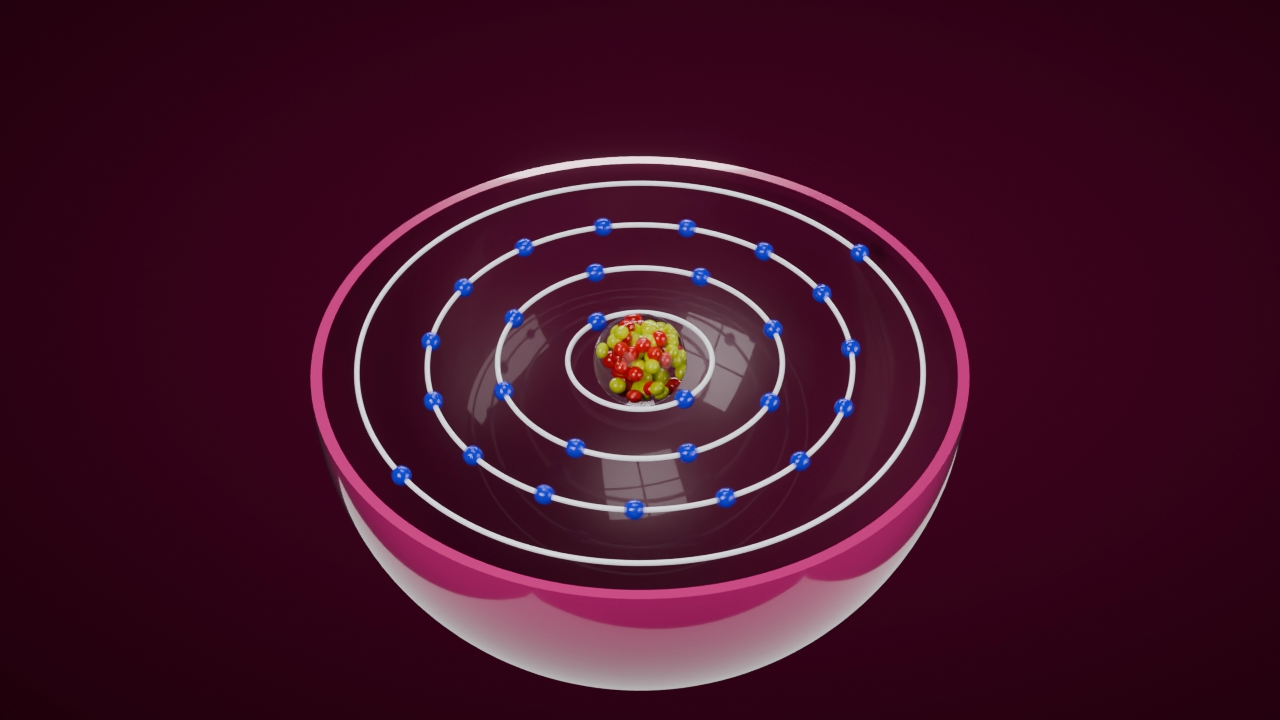
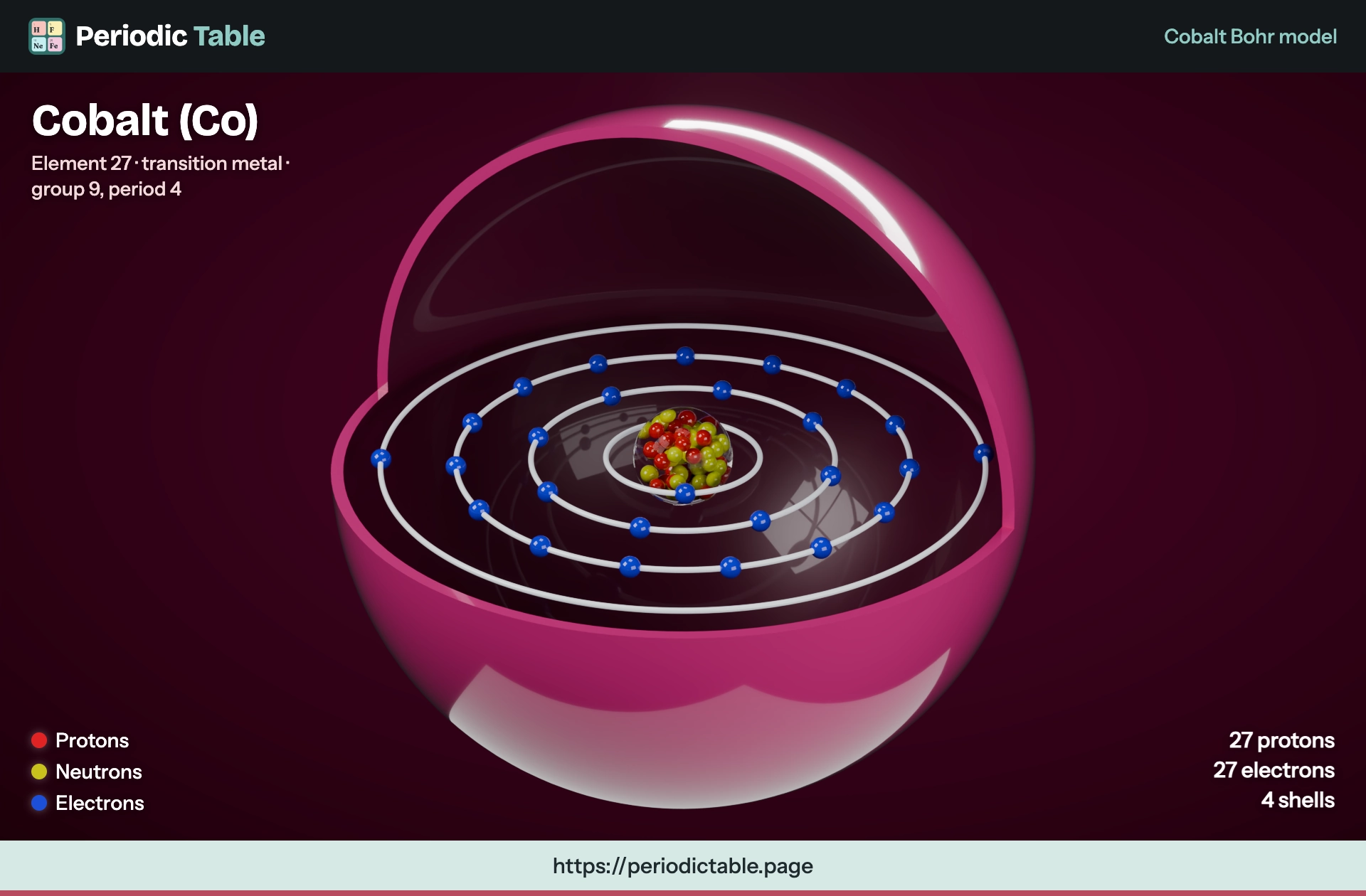
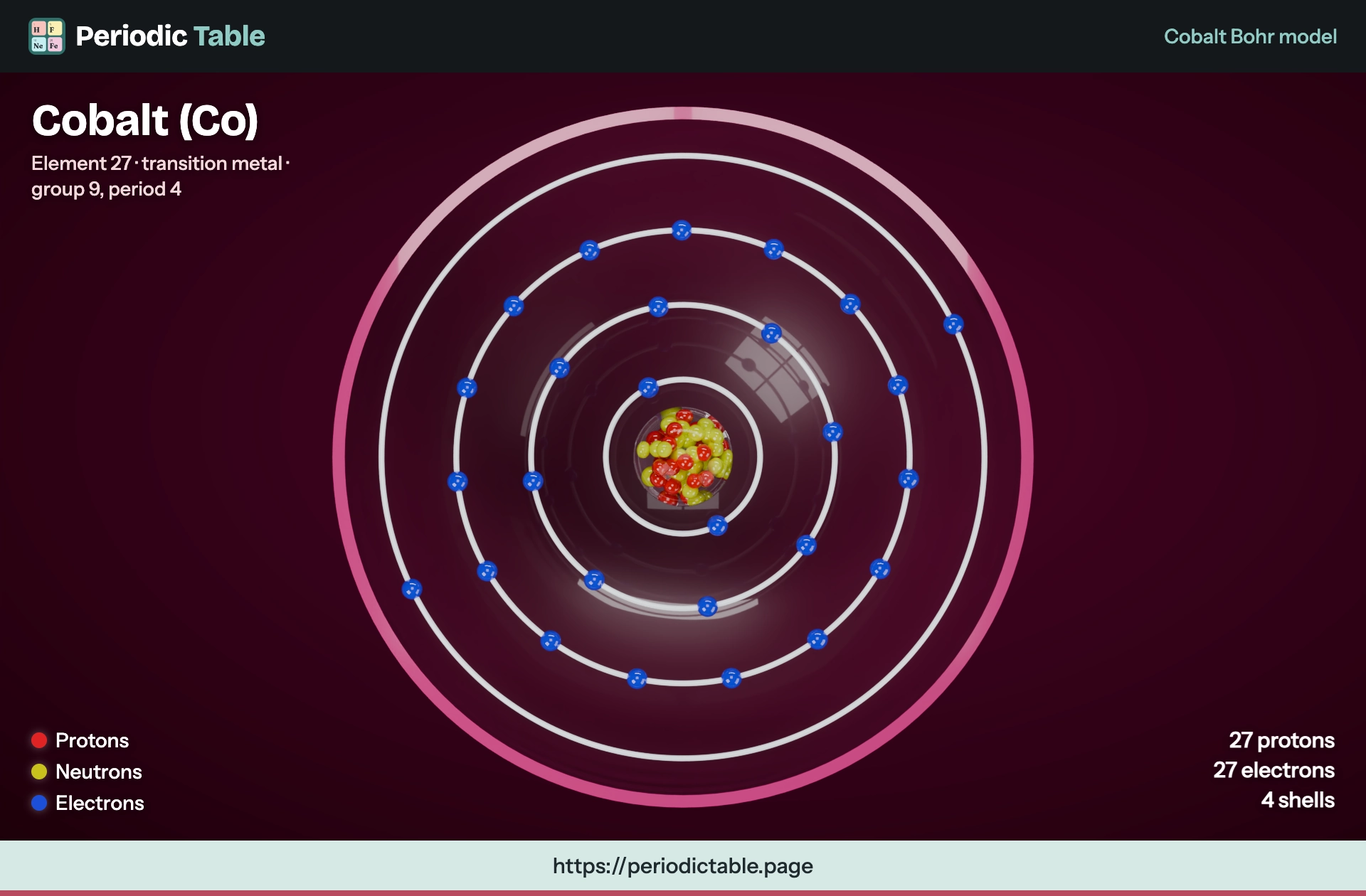
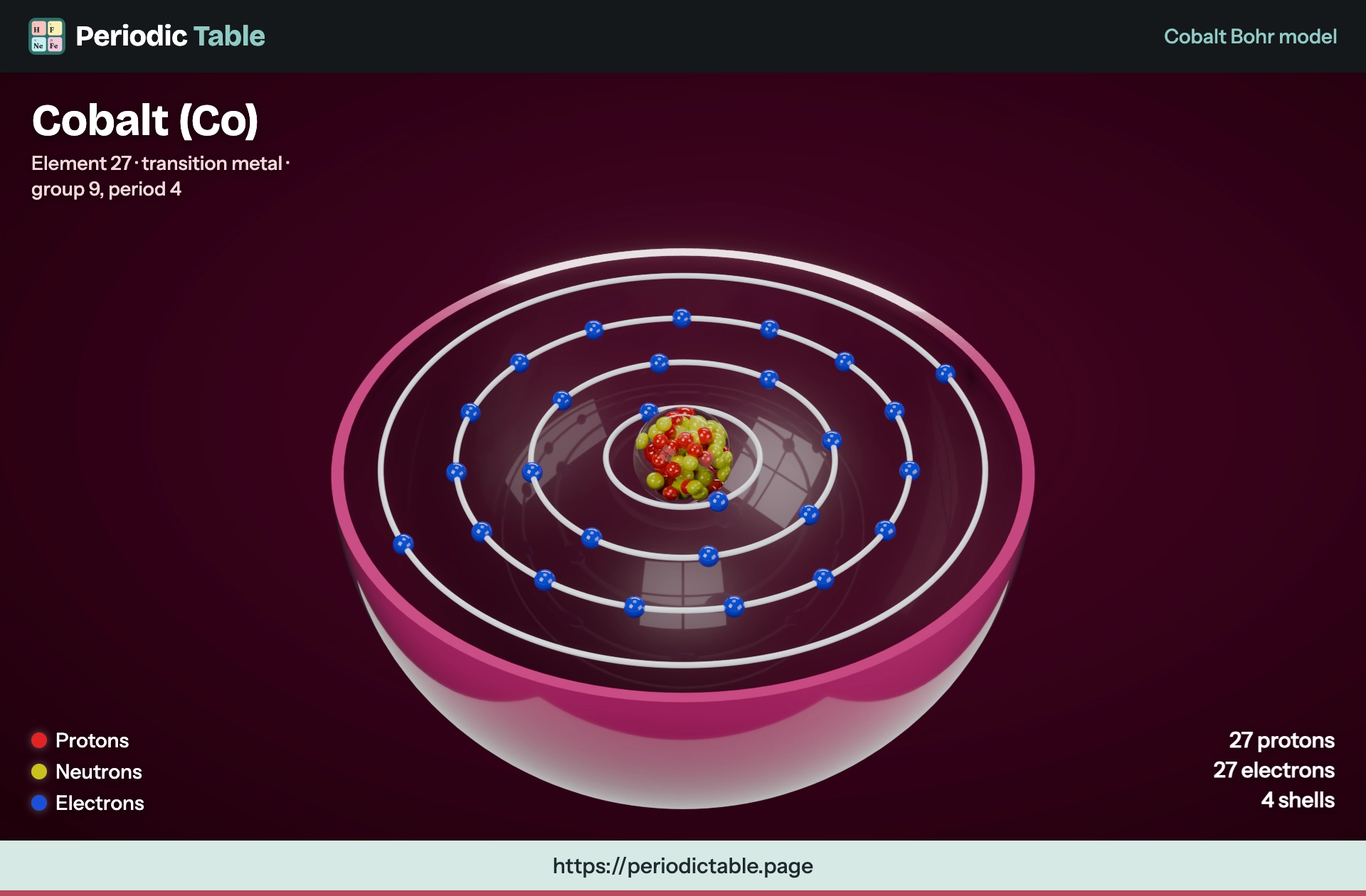
This is a Bohr model of cobalt (Co), a simplified picture of a single cobalt atom. Its nucleus holds 27 protons, and a neutral cobalt atom has 27 electrons, arranged around it in 4 shells (2 in shell K, 8 in shell L, 15 in shell M and 2 in shell N).
Cobalt periodic table electron configuration
- Shorthand
- [Ar] 3d7 4s2
- Full
- 1s2 2s2 2p6 3s2 3p6 4s2 3d7
- Electrons per shell
- 2, 8, 15, 2
Cobalt element properties and atomic data
- Atomic number
- 27
- Atomic mass
- 58.9332 u
- Phase at STP
- Solid
- Melting point
- 1494.85°C (1768 K)
- Boiling point
- 2926.85°C (3200 K)
- Density
- 8.9 g/cm³
- Electronegativity (Pauling)
- 1.88
- Period
- 4
- Group
- 9
- Block
- d-block
- Appearance
- Hard lustrous gray metal
- Discovery date
- 1735
- Discovered by
- Georg Brandt
- Named by
- —
Element cobalt facts: atomic number, group 9, period 4 and D-block
Cobalt sits in group 9 and period 4 of the d-block, between iron and nickel, with rhodium directly beneath it. Like its neighbours among the transition metals, it is dense and slow to melt, with partly filled d orbitals that explain its colourful compounds and its magnetism. Because of its oxide layer and corrosion resistance, fireworks and flares use it, and the magnesium periodic table covers why in the properties section.
Freshly cut, the surface looks silver-white to grayish-white with a faint blue cast. The table below collects the reference values you are most likely to need.
| Property | Value |
|---|---|
| Symbol and Z (protons) | Co, 27 |
| Standard atomic weight | 58.933 u |
| Electron configuration | [Ar] 3d7 4s2 |
| Melting point | 1,495 °C (1,768 K) |
| Boiling point | 2,927 °C (3,200 K) |
| Density at 20 °C | about 8.9 g/cm3 |
| Electronegativity (Pauling) | 1.88 |
| Crystal structure | Hexagonal close-packed at room temperature |
| CAS number | 7440-48-4 |
Atomic mass, electron configuration and ionization energies
The atomic mass is 58.933 u, and because only one isotope occurs in nature, that figure is known with unusual precision. The electron arrangement [Ar] 3d7 4s2 means the atom gives up its two 4s electrons first, which is why the +2 state is so common.
The first three ionization energies are roughly 760, 1,648 and 3,232 kJ/mol; the steep jump to the third explains why the +3 state usually needs stabilising ligands. The empirical atomic radius is about 125 pm, the covalent radius about 126 pm in its low-spin form, and the ionic radius shrinks from about 78 pm for the +2 ion to about 63 pm for the +3 ion.
Melting point, boiling point and density
Cobalt melts slightly below iron, and the specific gravity of cobalt of about 8.9 puts it alongside copper. Other handy values: a specific heat capacity of about 421 J/(kg·K), a thermal conductivity of about 100 W/(m·K), a Young's modulus of about 209 GPa and a Mohs hardness of 5. Its vapor pressure stays negligible until well above 1,500 K, so solid cobalt survives furnace temperatures that would boil off zinc or magnesium.
Physical and chemical properties of cobalt
Pure cobalt metal resembles its two neighbours in many ways: all three are tough, magnetic and resistant to corrosion, and all three form a huge family of salts. Where cobalt stands apart is in how well it keeps its strength and magnetism when hot, and in how vivid its compounds are. That combination is why so much of its chemistry ends up in high-value products rather than bulk steel. Solar cells, galinstan and the supply risk of a byproduct metal feature in the pure gallium article, with notes on the semiconductor industry.
A ferromagnetic metal: Curie temperature and crystal structure
Cobalt is one of only three elements that are ferromagnetic at room temperature, and it holds that magnetism to a higher temperature than any other: its Curie temperature is about 1,115 °C, against roughly 770 °C for iron and 358 °C for nickel. Each atom carries a magnetic moment of about 1.6-1.7 Bohr magnetons, and its relative permeability is about two-thirds that of iron.
Below roughly 420 °C the atoms pack in a hexagonal close-packed (hcp) lattice; above it they shift to face-centred cubic (fcc). The energy difference is so small that real samples usually contain a mixture of both, which affects how parts behave when they are machined or heat-treated.
Electronegativity and how cobalt reacts
A Pauling value of 1.88 marks cobalt as only modestly reactive. A thin passivating oxide film protects metallic cobalt in dry air, so a polished surface stays bright for years, and water does not attack it at room temperature. Cobalt dissolves slowly in mineral acids, reacts with the halogens to form dihalides (and with fluorine to give CoF3), and combines directly with sulfur, carbon, phosphorus and boron when heated.
Hydrogen and nitrogen leave it untouched. The reduction potential from the +3 ion to the +2 ion is about +1.9 V, so the +3 ion is a strong oxidiser in solution and reverts to +2 unless something holds it in place.
Cobalt compounds and their oxidation states
Most cobalt salts use the +2 or +3 oxidation states, although chemists have made species from −3 up to +5. In solution, simple +2 salts form the pink aquo complex [Co(H2O)6]2+; add chloride and the colour turns an intense blue as tetrahedral [CoCl4]2− forms. That pink-to-blue switch is the basis of the humidity-indicator strips packed with electronic goods.
Oxides, sulfides and halides
Green cobalt(II) oxide, CoO, has the rocksalt structure; heated in oxygen at 600-700 °C it converts to black cobalt(II,III) oxide, Co3O4, which has the spinel structure and mixes +2 and +3 ions just as magnetite does. Cobalt(III) oxide, Co2O3, is also known. Both of these cobalt oxides become antiferromagnetic when cooled.
The sulfide minerals CoS2 and Co3S4 are what most ores contain. Among the halides, anhydrous cobalt(II) chloride is blue and its hydrate is red-pink, while cobalt(III) fluoride is one of very few stable simple +3 salts and is used as a fluorinating agent. Cobalt sulfate is the workhorse salt for plating baths and battery precursors.
Coordination complexes and organometallic chemistry
The +3 ion forms exceptionally stable coordination complexes with ammonia and amines, the ammine complexes such as [Co(NH3)6]3+. Alfred Werner used these cobalt compounds to work out how ligands arrange around a central ion, research that earned the 1913 Nobel Prize and founded modern coordination chemistry.
In organometallic chemistry, cobaltocene is the cobalt analogue of ferrocene, and cobalt carbonyl, Co2(CO)8, is an industrial catalyst for adding carbon monoxide to alkenes. Vitamin B12, covered further down, is nature's own organometallic example.
Cobalt isotopes: stable cobalt-59 and the radioisotope cobalt-60
Natural cobalt is 100% cobalt-59, its only stable isotope, so every cobalt atom you dig out of the ground has 27 protons and 32 neutrons. More than twenty radioactive isotopes have been made, ranging from Co-50 to Co-78.
Those lighter than Co-59 decay mainly by electron capture into iron; heavier ones decay mainly by beta decay into nickel. Co-59 is also a useful nucleus for nuclear magnetic resonance: its NMR signals spread over a wider chemical-shift range than any other active nucleus.
The most important radioisotope is cobalt-60, made by exposing Co-59 to neutrons in a reactor. It decays by emitting an electron and two gamma rays of 1.17 and 1.33 MeV:
$$^{60}_{27}\mathrm{Co} \;\rightarrow\; ^{60}_{28}\mathrm{Ni} + e^{-} + \bar{\nu}_e + 2\gamma$$
That steady, penetrating gamma-ray source has made Co-60 useful for external-beam radiotherapy, for sterilization of syringes and surgical gloves, for food irradiation (sometimes called cold pasteurisation, used to irradiate food against spoilage and insects), and for industrial radiography of welds. Hospitals have largely moved from cobalt units to linear accelerators for radiation therapy, partly because the source loses strength and must be replaced. The darker side: a hypothetical "cobalt bomb" would surround a nuclear weapon with Co-59 to create long-lasting Co-60 nuclear fallout.
Half-life of cobalt-57 and the shorter-lived radioisotopes
Co-60 has a half-life of 5.27 years, so a source loses about 12% of its activity each year: after 10 years 26.8% remains, and after 20 years only 7.2%. Cobalt-57 lasts about 272 days and serves as a radioactive tracer for vitamin B12 absorption tests in medicine and as the source in Mössbauer spectroscopy; after one year about 39% of it is left. Co-56 (77 days) and Co-58 (71 days) are shorter-lived still, and every other radioactive form disappears in hours or less.
History and discovery of cobalt by Georg Brandt
Blue cobalt colourants were tinting objects thousands of years before anyone isolated the element. Egyptian craftsmen tinted glass with cobalt during the eighteenth dynasty (around 1550-1292 BC), a blue glass ingot was recovered from a Bronze Age shipwreck, and traces turn up in the ruins of Pompeii and in Chinese porcelain from the Tang dynasty and the Ming dynasty, whose blue-and-white wares are still the best-known use of the colour.
The name comes from German mining folklore. Sixteenth-century silver miners in the Erzgebirge found ores that looked promising but gave no silver when roasted and released choking fumes. They blamed a mischievous mine spirit, a kobold or goblin, and the ore became known as kobelt or kobald.
The real culprit was arsenic, which these ores almost always contain and which heating turns into poisonous arsenic oxide. For a long time the blue colour was credited to bismuth found alongside the ore.
The discovery of the element itself is credited to the Swedish chemist Georg Brandt, who around 1735 showed that the colour came from a previously unknown substance, not bismuth. Cobalt became the first metal discovered since prehistoric times. Production of smalt, a cobalt glass made by melting roasted smaltite with quartz and potash and then grinding it into a pigment, centred on Saxony and Norway until ore from New Caledonia, then Ontario, then the Congo shifted the trade.
In 1938 John Livingood and Glenn Seaborg identified Co-60, which was later used in the 1956 experiment that demonstrated parity violation in beta decay. After World War II, demand for high-purity supply for jet engines led the United States to open a mine near Blackbird Canyon in Idaho.
Cobalt geology: where cobalt deposits and minerals form
Cobalt makes up roughly 25-30 ppm of the Earth's crust, and it is almost never found in native form. The atoms in our planet were forged in supernovae through the r-process and related reactions, and small amounts of pure cobalt survive alloyed with nickel in meteoric iron, although iron meteorites carry much less of it than nickel.
On Earth cobalt is locked into sulfide and arsenide ores, usually alongside copper. Economic geology recognises three main deposit types:
- Magmatic nickel-cobalt sulfides, where pentlandite and linnaeite crystallise as cooling magma forms ultramafic igneous rocks such as dunite and basalt.
- Sediment-hosted copper-cobalt deposits, layered in shales and carbonates, as in Central Africa.
- Laterites, where tropical weathering of ultramafic rocks concentrates cobalt in the regolith.
Hydrothermal veins, like those at Bou-Azzer, are the rare places mined for cobalt alone. Large but remote cobalt resources also sit on the ocean sea floor in manganese nodules and crusts, a target for future deep-sea mining. The table below shows the main minerals and how much cobalt each holds by weight, calculated from its ideal formula.
Cobalt content of the main ore minerals
| Mineral | Formula | Cobalt by weight |
|---|---|---|
| Linnaeite | Co3S4 | 58.0% |
| Cattierite | CoS2 | 47.9% |
| Carrollite | CuCo2S4 | 38.1% |
| Cobaltite | CoAsS | 35.5% |
| Erythrite | Co3(AsO4)2·8H2O | 29.5% |
| Safflorite | CoAs2 | 28.2% |
| Skutterudite | CoAs3 | 20.8% |
Glaucodot, a close cousin of cobaltite, and siegenite, a mixed cobalt sulfide, round out the list. When sulfide ores weather at the surface they turn into pink erythrite, the "cobalt bloom" prospectors once used as a sign of buried ore. Reading that surface geology is still a first step in exploration.
Cobalt mining as a by-product of copper and nickel
Almost all cobalt mining happens as a by-product of copper and nickel extraction, which makes the supply unusual: cobalt production rises or falls with the prices of those two base metals more than with demand for cobalt itself. World mine output passed 300,000 tonnes a year in 2024, and global cobalt reserves are estimated at around 11 million tonnes.
The democratic republic of the Congo and artisanal mining
The Democratic Republic of the Congo dominates, supplying roughly three-quarters of the world's cobalt output from the Copperbelt that runs through Katanga and into Zambia. Industrial mining firms such as Glencore and CMOC produce most of it, but artisanal mining with hand tools has supplied a large share too, and investigations have documented unsafe tunnels, pollution and child labor.
Electronics and car makers now audit their supply chain more closely, and some have switched to recycled material. In 2025 the DRC paused exports to support prices after a slump.
Indonesia, Cuba, Canada and other producers
Indonesia became the second-largest producer within a few years, recovering cobalt as a byproduct of its fast-growing nickel mining boom. Russia, Australia and Canada each produce several thousand tons, with Canadian output coming from nickel mines in Ontario, Manitoba, Quebec and Newfoundland and Labrador.
Cuba holds large laterite reserves processed by a Canadian partner, and Morocco's Bou-Azzer district is the best-known primary cobalt mine. China mines little but refines most of the world's supply.
Supply risk: why cobalt is a critical mineral
The United States, the European Union and many other governments list cobalt as a critical mineral, because one country mines most of it, another refines most of it, and it is difficult to replace in batteries and aerospace alloys. The US keeps cobalt in its National Defense Stockpile and is import reliant for most of its needs.
Recycling helps: more than 30% is recovered from scrap, and the share is rising as old batteries come back. That keeps cobalt supply a defense and industrial policy issue as well as a market one.
How cobalt ore is refined into cobalt metal
Turning cobalt ore into a usable product takes several stages because the valuable part is only a small fraction of the rock. Froth flotation first concentrates the sulfide minerals. Roasting then converts them to sulfates and oxides, and leaching with water or sulfuric acid separates a cobalt-rich solution from copper and iron.
Residue left over from copper smelting can also be leached. The purified product is converted to Co3O4 and reduced by the aluminothermic reaction or with carbon in a blast furnace, or deposited electrolytically as plates of 99.9% purity.
Applications and uses of cobalt in industry
The main uses of cobalt fall into a few clear groups: batteries, high-temperature alloys, magnets, catalysts and colour. Smaller applications include electroplating for a bright, corrosion-proof finish, a primer coat for enamel on steel, and the propellant initiators used in some airbags. Aerospace and energy markets account for most of the value.
Lithium-ion batteries for electric vehicles
The largest single use today is in lithium-ion batteries. Lithium cobalt oxide, LiCoO2, introduced commercially in 1991, still dominates the cathode chemistry in phones and laptops because it packs a lot of energy into a small space. Electric vehicles use layered NMC cathodes instead, and makers have cut the cobalt share from one-third to one-tenth in NMC 811 cells.
Many electric cars now use cobalt-free lithium iron phosphate packs, which overtook cobalt-based chemistries in installed capacity in 2021. Older rechargeable batteries such as nickel–cadmium and nickel metal hydride also contain some cobalt to improve the positive electrode. Even with thrifting, the growth of the electric vehicle market keeps total demand from batteries climbing.
Superalloys and other cobalt alloys
Cobalt-based superalloys keep their strength at extreme heat, which suits turbine blades and vanes in gas turbines and aircraft engines. In metallurgy, cobalt is added to high-speed steels so cutting tools keep their edge when red-hot, and it binds tungsten carbide grains in cemented carbides used for drilling and machining; it also bonds diamond grit in saw blades. Stellite alloys combine cobalt with chromium and tungsten to make wear-resistant, corrosion resistant coatings for valves.
Cobalt-chromium-molybdenum alloys such as Vitallium are used in hip and knee replacements and other prosthetic parts, and in dental prosthetics as a hypoallergenic option. Platinum jewelry often contains a few percent cobalt for better casting.
Magnetic materials and permanent magnets
A high Curie point makes cobalt vital for magnetic materials that must work hot. Alnico (aluminium, nickel, cobalt and iron) was the first strong permanent magnet alloy and is still used in sensors and guitar pickups.
Samarium-cobalt magnets keep their strength up to about 300 °C, which makes them the choice for motors and actuators in aircraft and missiles; one samarium–cobalt magnet can outperform a much larger ferrite one. Cobalt alloys have also served in magnetic recording media, including the thin films on hard disks.
Catalysts, pigments and cobalt blue
Many cobalt salts are important catalysts. Blends with molybdenum drive hydrodesulfurization, which strips sulfur from petroleum fuels; cobalt acetate helps oxidise xylene to terephthalic acid for PET plastic; and cobalt is used in the Fischer–Tropsch process that turns synthesis gas into liquid fuels, and in hydroformylation of alkenes. Cobalt soaps act as drying agents in oil paints, varnishes and printing inks, though each drying agent of this type is being phased out over safety concerns.
The oldest use is colour. Cobalt blue (cobalt aluminate, CoAl2O4) gives a stable, intense blue to ceramics, glazes, porcelain, pottery and stained glass.
Related pigments include cerulean blue, cobalt green and cobalt violet, all prized by painters because they barely fade. Cobalt ink and enamel colours appear on everything from tiles to jewelry.
Cobalt in vitamin B12: cobalamin and its biological role
Cobalt is an essential nutrient because it sits at the centre of cobalamin, vitamin B12, the only vitamin that contains a metal atom. B12 enzymes help make DNA, form red blood cells and break down certain fats and proteins, so a shortage causes anaemia and nerve damage.
Only bacteria and archaea can build B12, so humans have to get it from animal foods or supplements; inorganic forms are not useful to us. Cobalt is also a micronutrient for algae and fungi, and blue-green algae (cyanobacteria) and other nitrogen fixing microbes need it, so it plays a quiet part in global nutrition cycles.
Cobalt deficiency in grazing animals
Ruminant livestock are the exception: bacteria in the rumen of cattle and sheep make B12 from cobalt salts in their feed. Where the soil is poor in cobalt, pasture carries too little and the herd wastes away.
New Zealand farmers called it "bush sickness" and Australian sheep farmers "coast disease" until scientists in the 1930s traced both to cobalt deficiency. Farmers now fix it by adding cobalt to fertiliser or giving animals slow-release "cobalt bullets" that lodge in the rumen.
Health effects of cobalt and its toxicity
For people, the health picture is a matter of dose. You take in small amounts of cobalt every day from food, drink and the air you breathe, and most passes straight through the body. Problems arise with high exposure, mainly at work.
Breathing cobalt dust in carbide-tool and refining plants can cause asthma, pneumonia and other lung effects, including a scarring disease of the lungs. Skin contact can cause allergic dermatitis. Swallowing large amounts can cause nausea, vomiting, vision problems, heart damage and thyroid damage; "beer drinkers' cardiomyopathy" in the 1960s was traced to cobalt added to beer as a foam stabiliser.
The toxicity of cobalt salts is moderate: the oral LD50 for soluble salts in lab tests ranges from roughly 150 to 500 mg/kg. Cobaltism, or cobalt poisoning, has also appeared in people with worn metal-on-metal hip implants releasing ions into the blood.
The IARC classes cobalt and its compounds as Group 2B, possibly carcinogenic to humans, and some forms are carcinogenic in laboratory studies. Radioactive Co-60 is a separate hazard: lost radiotherapy sources have caused serious radiation accidents.
Environmental effects of cobalt
Cobalt occurs naturally in rocks, soil, water, plants and animals, and it moves through the environment as wind-blown dust and runoff. Human activity adds more through coal burning, mining and ore processing, so ground near mines and refineries can hold far higher levels than average. Cobalt cannot be destroyed once released; it binds to sediment particles and moves mainly under acidic conditions.
Crops growing on contaminated land absorb it, but it does not build up along the food chain, so the fish, fruit and vegetables you eat rarely contain much. Radioactive forms from nuclear plants decay within years. The bigger environmental effects of cobalt come from where it is mined, which is why responsible-sourcing rules now focus on mine sites as much as on the element itself.