


Gallium element (Ga): gallium periodic table facts
Gallium periodic table facts: gallium (Ga) is element 31, a post-transition metal in group 13, period 4. Hold a lump of gallium for a few minutes and it turns into a puddle in your palm. A reference on element 17, chlorine shows how the chemical industry and manufacturing rely on a hazardous reagent.
This chemical element is a soft, silvery metal that melts just below body temperature, yet elemental gallium boils at well over 2,000 °C and has low toxicity. Below you'll find its key data, what makes it behave so oddly, and why modern chips depend on it.
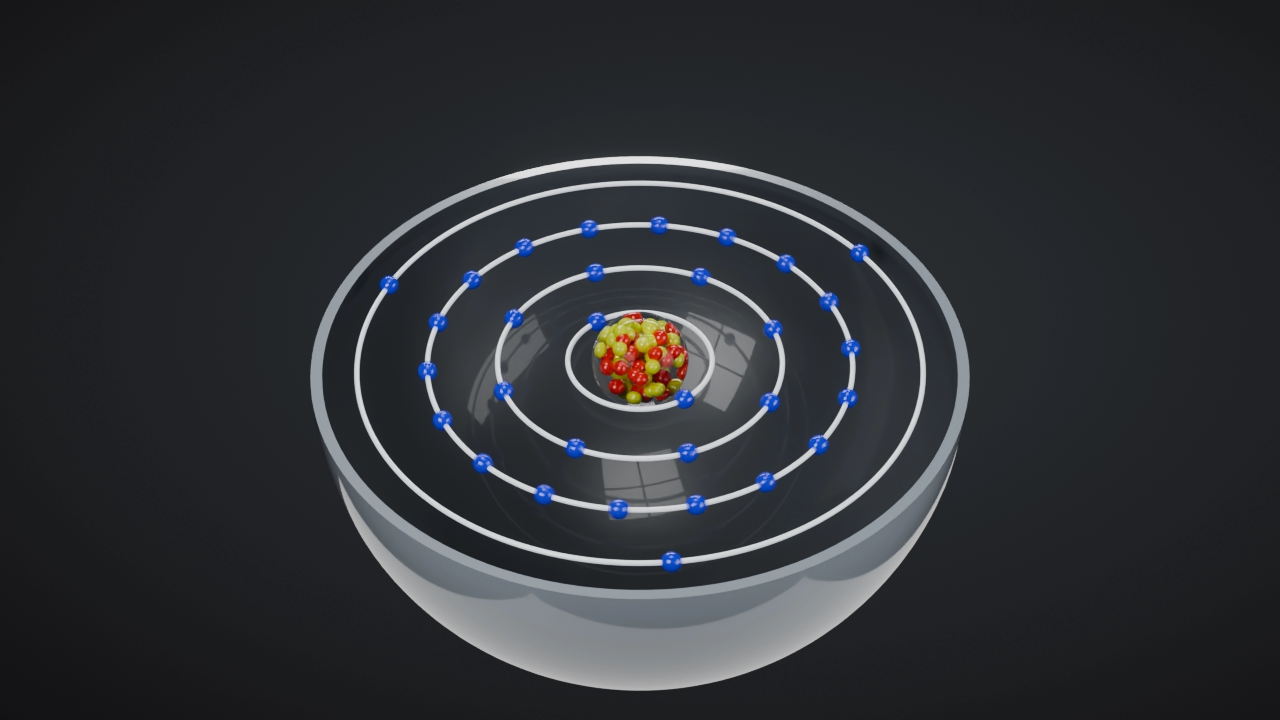
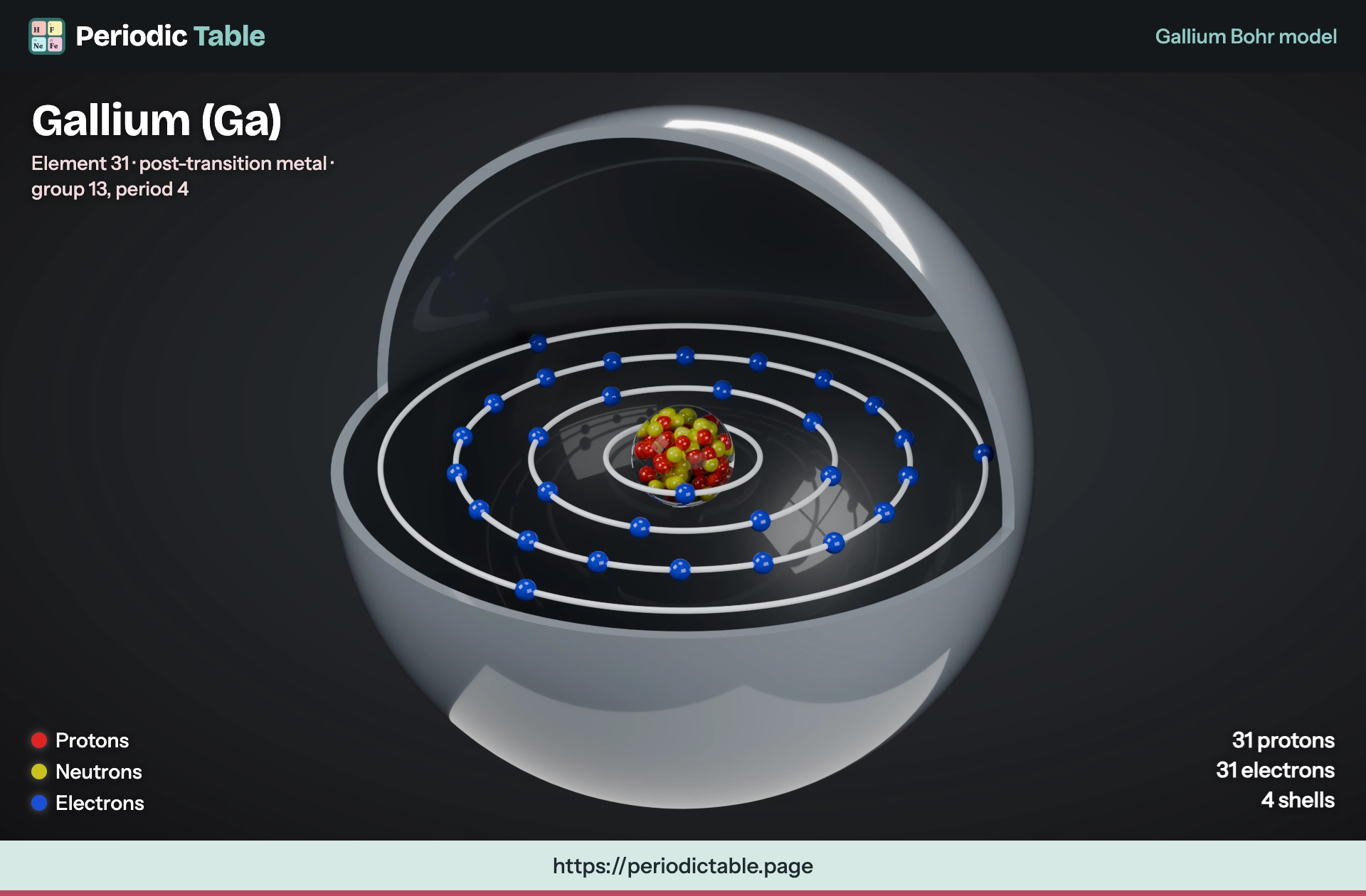
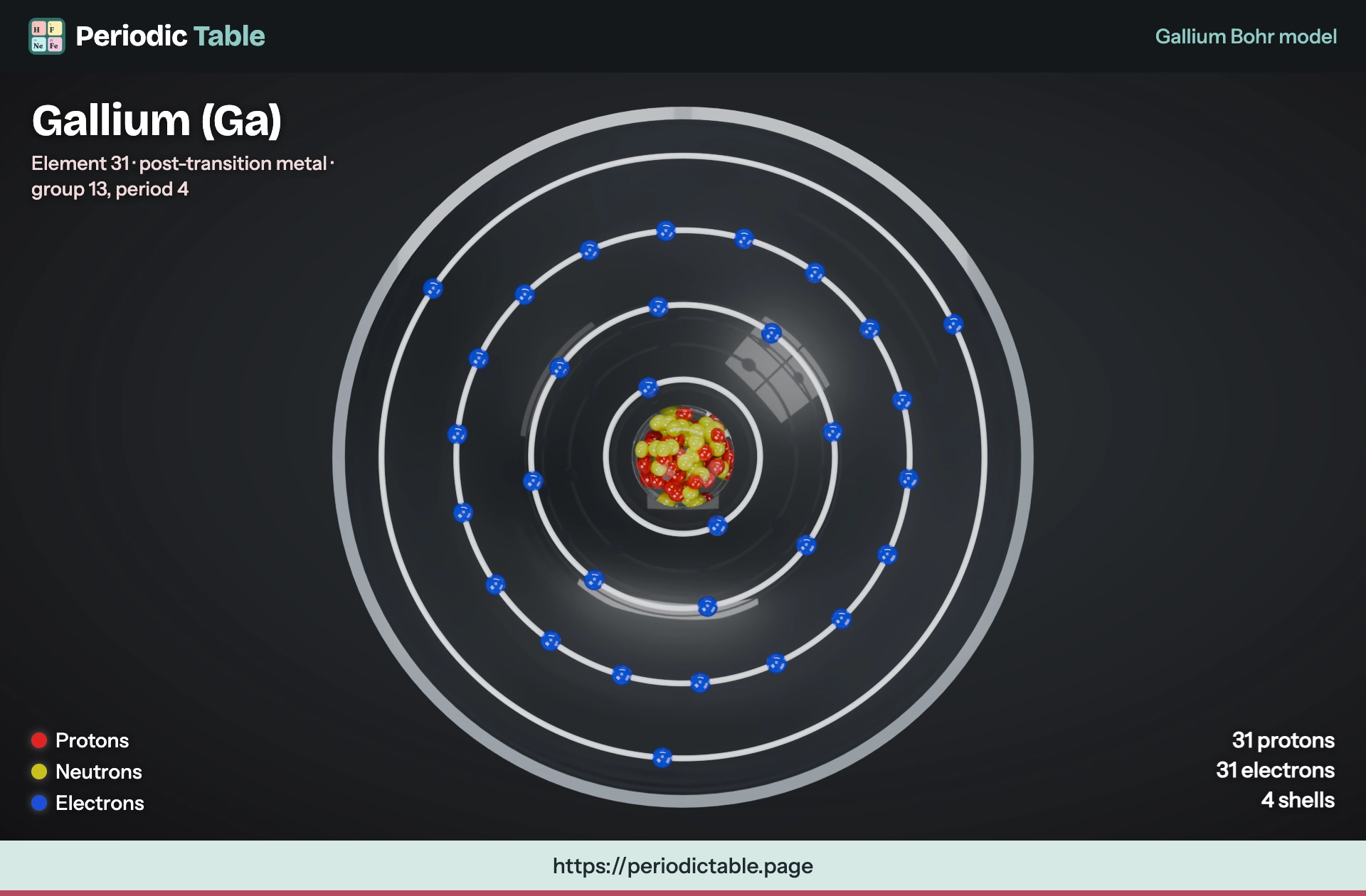
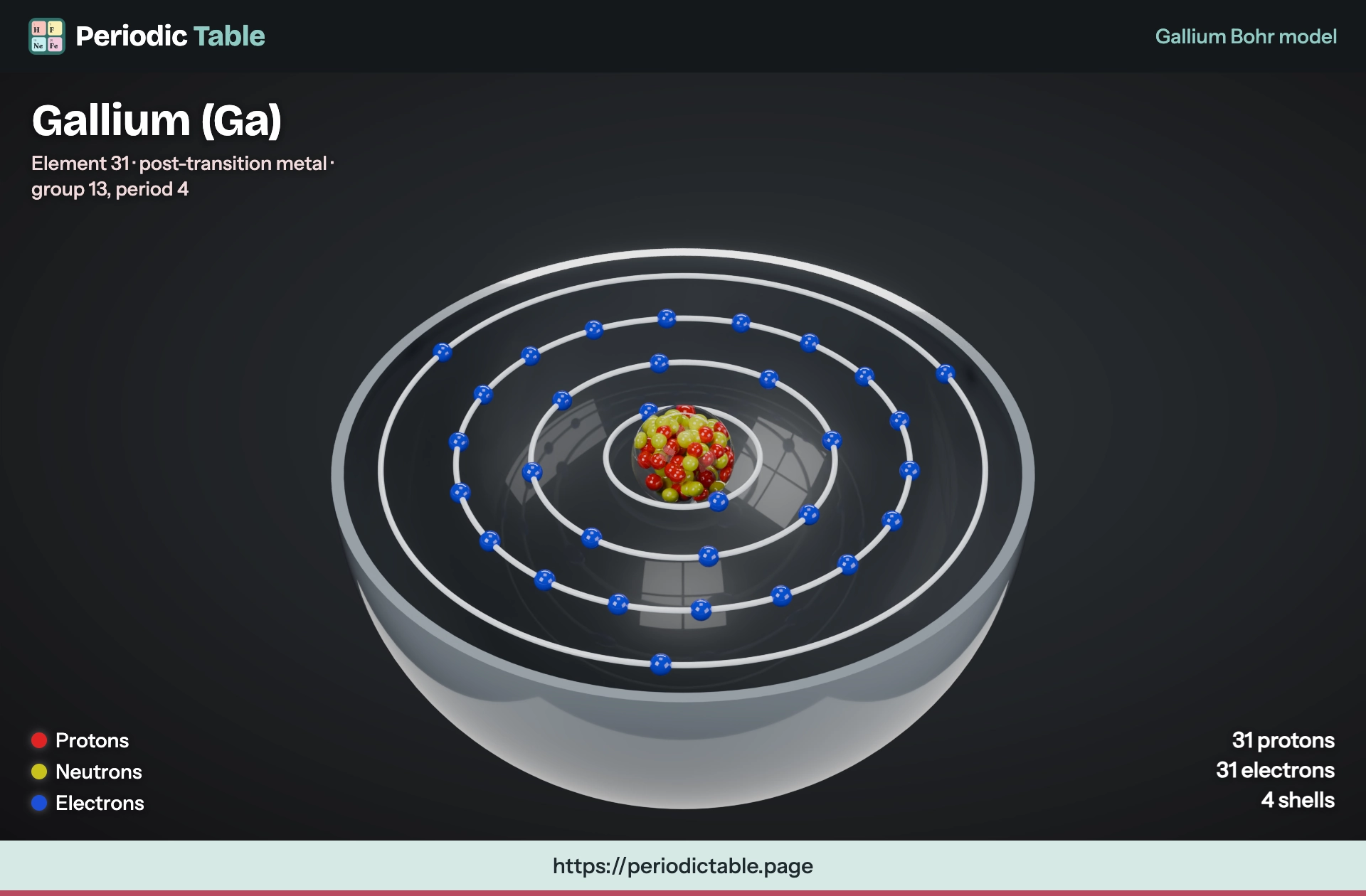
Rotate the 3D Bohr model of gallium
Drag to orbit, scroll to zoom.
This is a Bohr model of gallium (Ga), a simplified picture of a single gallium atom. Its nucleus holds 31 protons, and a neutral gallium atom has 31 electrons, arranged around it in 4 shells (2 in shell K, 8 in shell L, 18 in shell M and 3 in shell N).
Gallium periodic table electron configuration
- Shorthand
- [Ar] 3d10 4s2 4p1
- Full
- 1s2 2s2 2p6 3s2 3p6 4s2 3d10 4p1
- Electrons per shell
- 2, 8, 18, 3
Gallium element properties and atomic data
- Atomic number
- 31
- Atomic mass
- 69.7231 u
- Phase at STP
- Solid
- Melting point
- 29.76°C (302.9146 K)
- Boiling point
- 2399.85°C (2673 K)
- Density
- 5.91 g/cm³
- Electronegativity (Pauling)
- 1.81
- Period
- 4
- Group
- 13
- Block
- p-block
- Appearance
- Silver-white
- Discovery date
- 1875
- Discovered by
- Lecoq de Boisbaudran
- Named by
- —
Gallium (Ga) key facts: atomic number 31 at a glance
Gallium has the symbol Ga and atomic number 31. It sits in group 13 of the periodic table (the boron group), in period 4 and the p-block, directly below aluminium and above indium. Because electric vehicle batteries have changed demand, the pure cobalt explains why this transition metal is now strategically important.
It is classed as a post-transition metal: shiny, a good conductor, but soft enough to cut with a knife. At 20 °C it is a solid, though only just.
| Property | Value for gallium (Ga) |
|---|---|
| Atomic number | 31 |
| Standard atomic weight | 69.723 |
| Group / period / block | 13 (boron group) / 4 / p |
| Electron configuration | [Ar] 3d10 4s2 4p1 |
| Melting point | 29.7646 °C (302.9146 K) |
| Boiling point | about 2,400 °C (2,676 K) |
| Density at 20 °C | 5.907 g/cm3 |
| Crystal structure | Orthorhombic |
| Common oxidation state | +3 |
| Natural isotopes | 69Ga and 71Ga |
| CAS number | 7440-55-3 |
Physical properties of gallium: melting point, boiling point and density
Three numbers explain most of the physical properties of gallium. Its melting point of 29.7646 °C is so reproducible that it serves as a fixed reference point on the International Temperature Scale (ITS-90). If you want physical data, check element 26 for melting point, density and the allotropes called ferrite and austenite.
It boils at 2,676 K, roughly 8.8 times its melting temperature on the kelvin scale, the largest ratio of any element, so the liquid range spans more than 2,370 degrees. At about 5.9 g/cm3 it is a little more than twice as heavy as aluminium for the same volume.
Other properties are less familiar. It has a low vapor pressure even when hot, so the liquid barely evaporates.
Its thermal conductivity is about 40.6 W/(m·K) and its specific heat capacity about 371 J/(kg·K). Many values are strongly anisotropic: electrical resistivity along one axis of the lattice is several times higher than along another.
Why liquid gallium melts in your hand
Gallium is one of only four metals (with mercury, caesium and rubidium) that are liquid at or near room temperature. Unlike the other three, it is neither violently reactive nor highly toxic, which is why it is the one you see in classroom demonstrations. A famous chemistry prank uses a spoon cast from it that dissolves when it is stirred into hot tea.
Liquid gallium has some unusual habits:
- Supercooling: it can stay liquid well below its freezing point, so a molten sample may sit in a cool room for days until a seed grain or a knock starts solidification.
- It wets glass and skin, unlike mercury, so painting it onto glass produces a brilliant mirror.
- Very high surface tension, the largest of any liquid near room temperature, held in check by a thin oxide skin that lets droplets be shaped into wires and cones.
- Liquid metal embrittlement: it seeps into grain boundaries of aluminium and some steels, making them crumble.
Crystal structure, dimers and expansion on freezing
Solid gallium does not adopt any of the simple lattices most metals use. Its stable form is orthorhombic, with eight atoms per unit cell, and each atom has just one close neighbour.
Those covalently bonded Ga2 dimers act as the building blocks of the structure, and they explain the low melting point. Freshly broken pieces fracture conchoidally, with curved faces like glass.
Like water, gallium expands when it freezes, by about 3.1%. Here is what that means for a 150 g sample, using the published densities of the freshly melted liquid (6.095 g/cm3) and the solid at 20 °C (5.907 g/cm3):
$$V = \frac{m}{\rho} \quad\Rightarrow\quad V_{\ell} = \frac{150}{6.095} = 24.61\ \text{cm}^3,\quad V_{s} = \frac{150}{5.907} = 25.39\ \text{cm}^3$$
The sample grows by about 0.78 cm3 (roughly 3.2% with these two densities, which are measured at slightly different temperatures). That is enough to crack a full glass vial, so gallium is shipped in flexible plastic packets.
High-pressure phases of gallium metal
It has one of the most complex phase diagrams of any element. Squeezing the normal Ga-I phase to about 0.5 GPa at room conditions actually melts it, because the liquid is denser. Higher pressures produce a tetragonal Ga-III phase, a 103-atom Ga-II structure below 0 °C, a rhombohedral Ga-V phase, and a face-centred cubic Ga-IV phase near 120 GPa.
Atomic data and electron configuration of element 31
Element 31 has 31 protons in its nucleus and 31 electrons arranged 2, 8, 18, 3. Written out in full, the arrangement is [Ar] 3d10 4s2 4p1: the three outermost ones are the ones it gives up in reactions. The filled 3d shell shields them poorly, so gallium's first ionisation energy is slightly higher than aluminium's.
- Electronegativity: 1.81 on the Pauling scale
- Ionization energies: 578.8, 1,979.3 and 2,963 kJ/mol for the first three removals
- Atomic radius (empirical): 135 pm
- Covalent radius: about 122 pm; van der Waals radius 187 pm
The big jump after the third ionisation energy (to over 6,100 kJ/mol) is why +3 is gallium's dominant charge.
Chemical properties and oxidation state of gallium
The chemical properties of gallium follow from that 4s24p1 shell. It usually reacts as Ga(III), with +1 appearing in a few compounds; that lower state is more common for its heavier neighbours indium and thallium. At room conditions the metal is stable in air and water because a thin, passive oxide layer protects it.
Its chemistry is amphoteric: strong acids dissolve gallium to give Ga3+ salts such as gallium nitrate, while sodium hydroxide and other alkalis dissolve it as gallate ions, [Ga(OH)4]−. Adding ammonia to a gallium(III) solution precipitates Ga(OH)3, which also redissolves in either acid or base. It mixes readily with most other metals and reacts with halogens.
Gallium oxide, halides and other compounds
Heated in air, gallium burns to gallium(III) oxide, Ga2O3, the most stable form of gallium oxide and a wide-bandgap semiconductor in its own right. Reducing it with more gallium in a vacuum gives dark brown Ga2O, a strong reducing agent.
Gallium compounds with the other main groups include:
- Halides: gallium trichloride, also called gallium(III) chloride, exists as Ga2Cl6 pairs that melt at 78 °C and act as Lewis acids; GaF3 is ionic and nearly insoluble.
- Nitrides and pnictides: GaN, GaP, GaAs and GaSb share the same cubic structure as ZnS and all have semiconducting behaviour.
- Chalcogenides: Ga2S3, Ga2Se3 and Ga2Te3, which hydrolyse easily.
- Hydrides and organic compounds: gallane (GaH3) breaks down above −10 °C, and trialkylgalliums are volatile liquids used to grow semiconductor films.
Gallium isotopes: two stable, the rest radioactive
About 30 isotopes of gallium are known, from mass 60 to 89, but only two are stable and occur in nature. The rest are radioactive: lighter ones decay towards zinc, heavier ones towards germanium.
| Isotope | Natural abundance | Half-life | Main use |
|---|---|---|---|
| Gallium-69 | 60.1% | Stable | Bulk of natural gallium |
| Gallium-71 | 39.9% | Stable | Neutrino detectors |
| Gallium-67 | Synthetic | 3.26 days | Gallium scans |
| Gallium-68 | Synthetic | 67.84 minutes | Positron imaging |
That short half-life matters in practice. Starting from a fresh batch of gallium-68, only about 40% is left after 90 minutes and about 16% after three hours, so clinics produce it on site from a germanium-68 generator.
Gallium-67 lasts long enough to ship: about 53% remains after 72 hours. The two stable ones, gallium-69 and gallium-71, make up all natural gallium, which is why its atomic weight sits near 69.7.
History of gallium: Mendeleev's eka-aluminium
Gallium was predicted before anyone saw it. In 1871 Mendeleev left a gap below aluminium in his table and named the missing element eka-aluminium (often spelled eka-aluminum in American texts). He forecast an atomic weight near 68, a density of 5.9 g/cm3, a low melting point, an oxide with the formula M2O3 and an amphoteric hydroxide, and that it would be found with the spectroscope.
In 1875 the French chemist Paul-Émile Lecoq de Boisbaudran used spectroscopy to spot two new violet lines in the spectrum of the mineral sphalerite from the Pyrenees. Later that year he isolated the metal by electrolysis of its hydroxide in potassium hydroxide solution, working through hundreds of kilograms of mineral to collect less than a gram.
His first figure, 4.7 g/cm3, disagreed with the prediction. Mendeleev wrote to suggest he purify the sample and measure again; the new result, about 5.9 g/cm3, matched and became a landmark for chemistry, proof that the periodic system could forecast undiscovered elements.
Lecoq named the element after Gallia, the Latin name for Gaul and his homeland of France. Critics noticed a pun: le coq means rooster, and the Latin for rooster is gallus. He denied naming it after himself.
Where gallium comes from: bauxite, zinc ores and refining
It never occurs as a free element, and it almost never forms its own ore. It averages about 16-19 ppm in the Earth's crust, similar to lead or cobalt, but it is spread thinly through other minerals instead of collecting into deposits. Almost all of it is recovered as a by-product.
- Source rock: the main source is bauxite, the ore of aluminum, at around 50 ppm; smaller amounts come from zinc ores and some coal ashes.
- Extraction: in the Bayer process, which turns bauxite into alumina, gallium builds up in the caustic liquor and is captured with ion-exchange resins.
- Reduction: electrolysis of the recovered solution produces crude ingots.
- Purification: zone melting or the Czochralski process refines it to 99.9999% (6N) purity for chipmaking.
That last step is why pure gallium is sold in grades such as 4N, 6N and 7N, with chipmakers needing the highest.
Gallium supply, China and critical mineral status
Because it only comes out of alumina and zinc refineries, supply depends on how much of those metals is processed, not on gallium prices. China now refines the large majority of the world's primary gallium; US Geological Survey figures put its share of low-purity output at about 98% in 2024.
Beijing introduced export licensing for gallium in 2023, and the US, EU and Japan all list it as a critical mineral. The semiconductor industry and defence suppliers are the most exposed, and new refining capacity outside China is still small.
Uses of gallium in semiconductors and solar cells
The main uses of gallium are in semiconductors, which take about 98% of demand. Very little is used in elemental form; it goes into compounds grown as thin films.
- Integrated circuits: high-speed logic and the microwave amplifiers in phones and radar.
- Power devices: compact fast chargers and electric-vehicle inverters.
- Solar cells: multi-junction cells for satellites and space probes, plus copper-indium-gallium-selenide (photovoltaic CIGS) thin films in some solar panels.
Gallium arsenide, gallium nitride and LEDs
Gallium arsenide (GaAs) moves charge carriers faster than silicon and has a direct bandgap, so it can emit light. It accounts for most gallium consumption and is used in radio-frequency chips, infrared LEDs and laser diodes, and the field of optoelectronics more broadly.
Gallium nitride (GaN) handles higher voltages and temperatures. Combined with indium gallium nitride in the early 1990s, it produced the first bright blue LED, which made white light-emitting diodes possible and earned a Nobel Prize in Physics in 2014. GaN laser diodes at 405 nm read Blu-ray discs, and GaN transistors now sit in 5G base stations.
Gallium alloys and liquid metal technology
It forms alloys with most metals, and many stay molten at room conditions. That makes gallium liquid metal a working material rather than a curiosity:
- Stretchable electronics: a liquid metal wire inside rubber keeps conducting when bent or stretched.
- Cooling: it replaces thermal paste between high-power chips and heat sinks.
- 3D printing: its oxide skin holds printed liquid shapes in place.
- Carbon capture: gallium-indium mixtures are being studied for turning CO2 into carbon powder.
One defence alloy also uses it: a small gallium addition stabilises plutonium in its workable δ phase.
Galinstan and other low-melting gallium alloys
Galinstan is the best-known example: gallium with indium and tin, liquid down to about −19 °C. It and similar low-melting alloys replace mercury in medical thermometers because they are essentially non-toxic and barely evaporate. The trade-off is that they wet glass, so thermometer tubes need an oxide coating inside.
Gallium in medicine, physics and other specialist uses
Gallium has no natural role in the body, but Ga3+ mimics ferric iron closely, and that makes it useful to doctors. Cells and bacteria take it up as if it were the real thing, but it cannot do iron's redox chemistry, so it disrupts their metabolism.
- Gallium nitrate has been given intravenously to treat cancer-related hypercalcemia.
- Gallium maltolate is in trials against some cancers and drug-resistant infections.
- Tonnes of gallium have served as neutrino detectors (the SAGE and GALLEX experiments).
- Focused ion beam microscopes use a liquid gallium source to cut and image samples at the nanoscale.
Gallium scan and PET imaging
In a gallium scan, a citrate salt of the 3.26-day isotope is injected and gathers where inflammation, infection or fast-dividing tumour cells are present. These radiopharmaceuticals are a long-standing tool of nuclear medicine. The shorter-lived isotope is now linked to peptides such as DOTATATE for scans of neuroendocrine tumours.
Is gallium metal toxic? handling and storage
The element itself has low toxicity and is far safer than mercury: it gives off almost no vapour at room conditions, so there is little risk of inhaling it. It is still not harmless. Some gallium salts, especially the halides, are corrosive, and fine particles can irritate skin, eyes and lungs.
A few practical rules cover most situations:
- Wear gloves; the metal leaves grey stains on skin and is hard to wipe off.
- Keep it away from aluminium items such as cans, foil, bike frames and aircraft parts, which it can weaken badly. That is why airlines restrict it.
- Store it in flexible plastic, not filled glass, to allow for expansion when it freezes.