


Iron element (Fe): iron periodic table facts
Iron periodic table facts: iron (Fe) is element 26, a transition metal in group 8, period 4. You use iron every day without thinking about it: it is in the steel frame of your building, the cast pan on your stove and the red pigment of your own blood. This guide to the iron element walks you through what makes this chemical element special, from its place on the periodic table as Fe (from the Latin ferrum) to the reasons this cheap, strong material still holds the modern world together. Water treatment chemistry with sodium hypochlorite, hydrogen chloride and hypochlorous acid is what the chlorine element covers in detail.
Rotate the 3D Bohr model of iron
Drag to orbit, scroll to zoom.
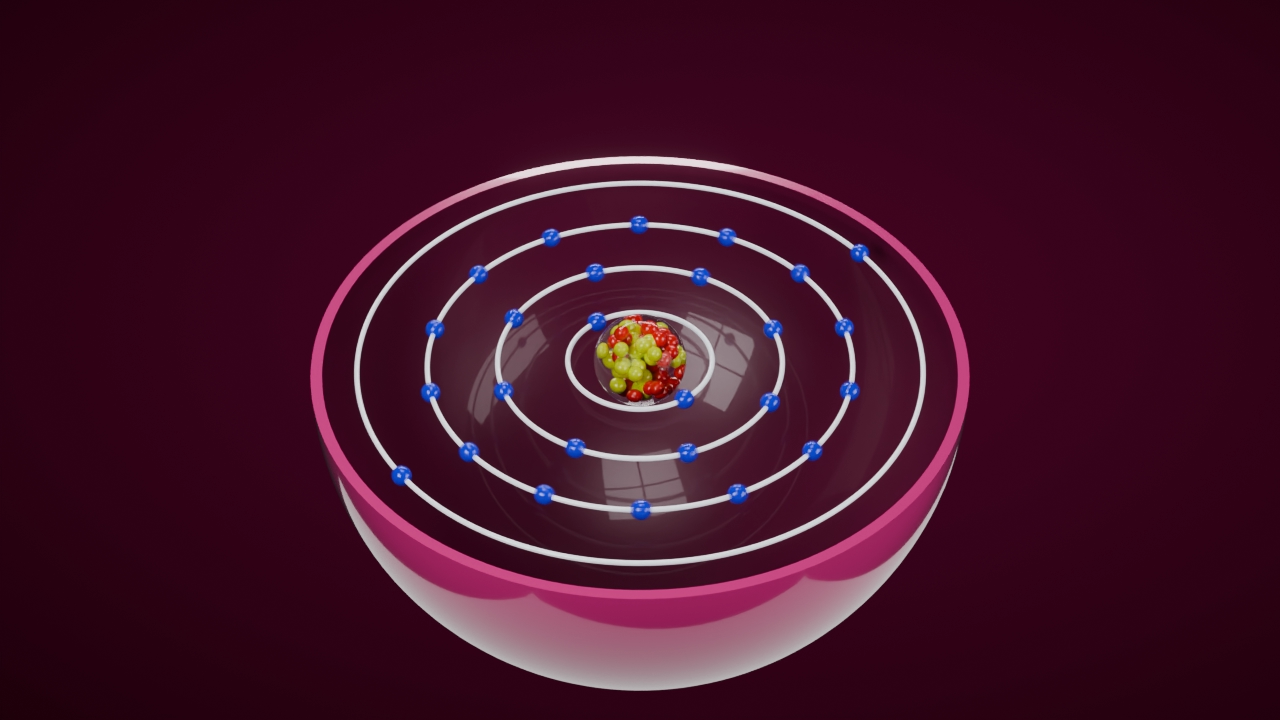
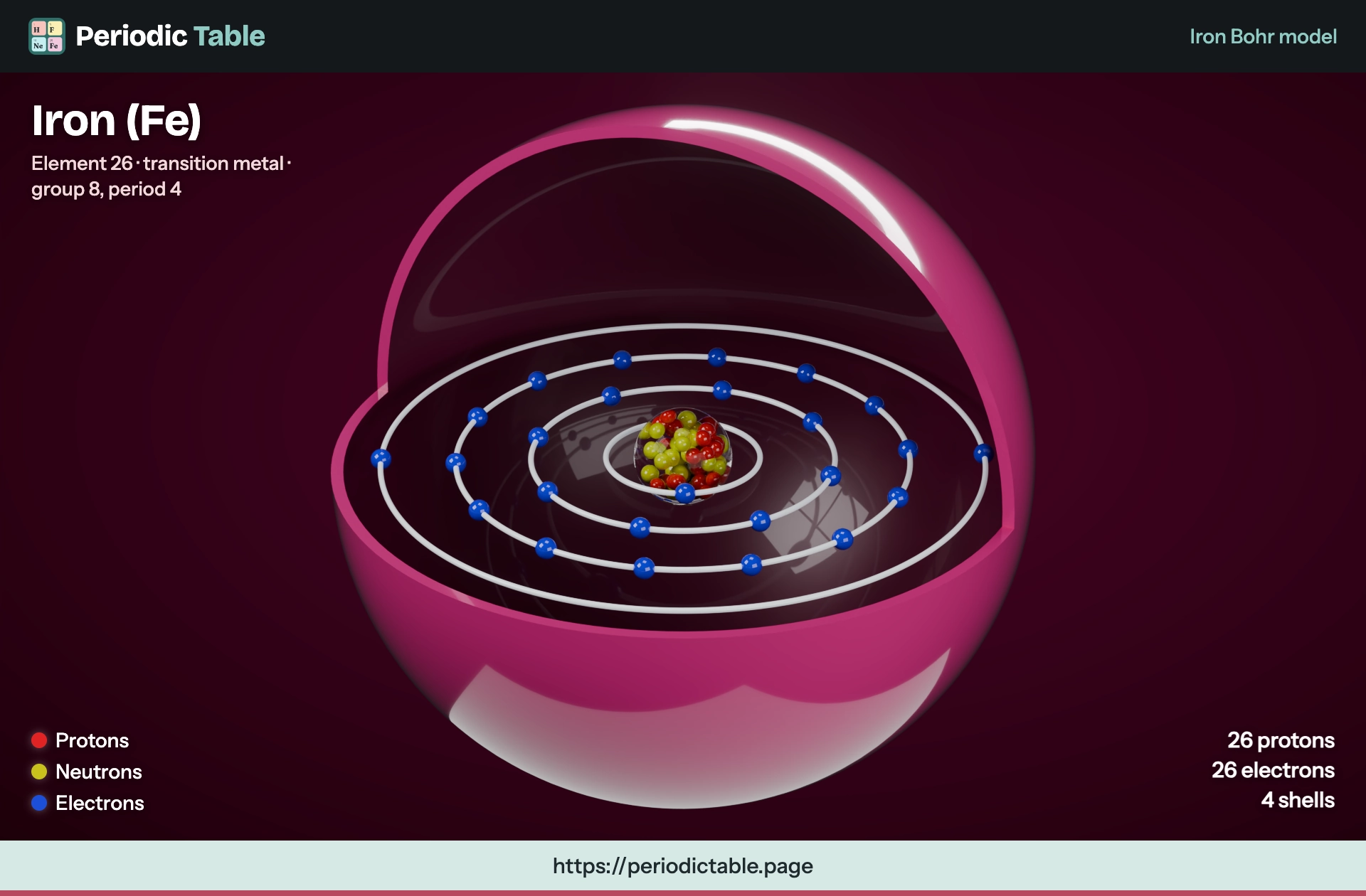
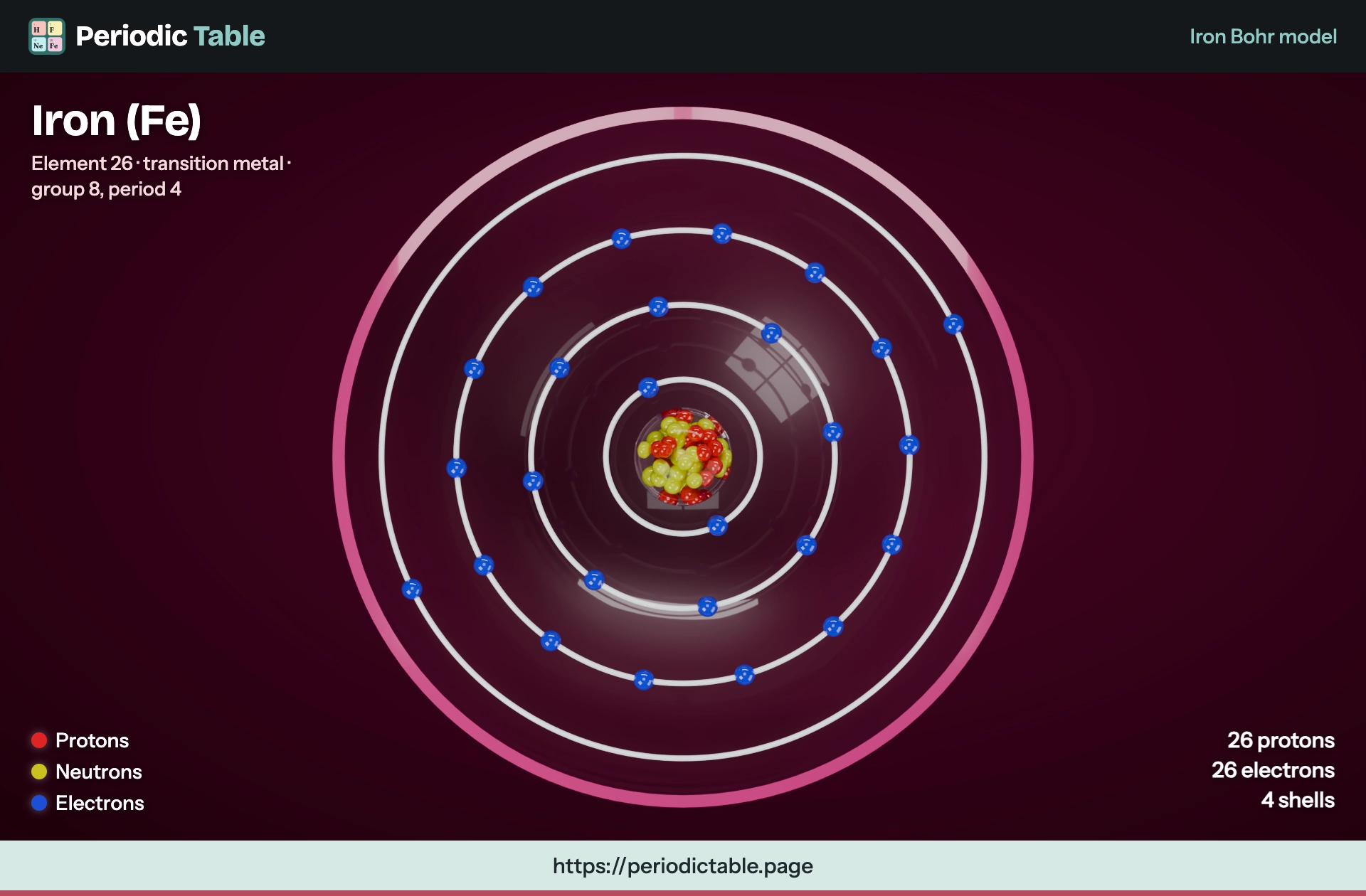
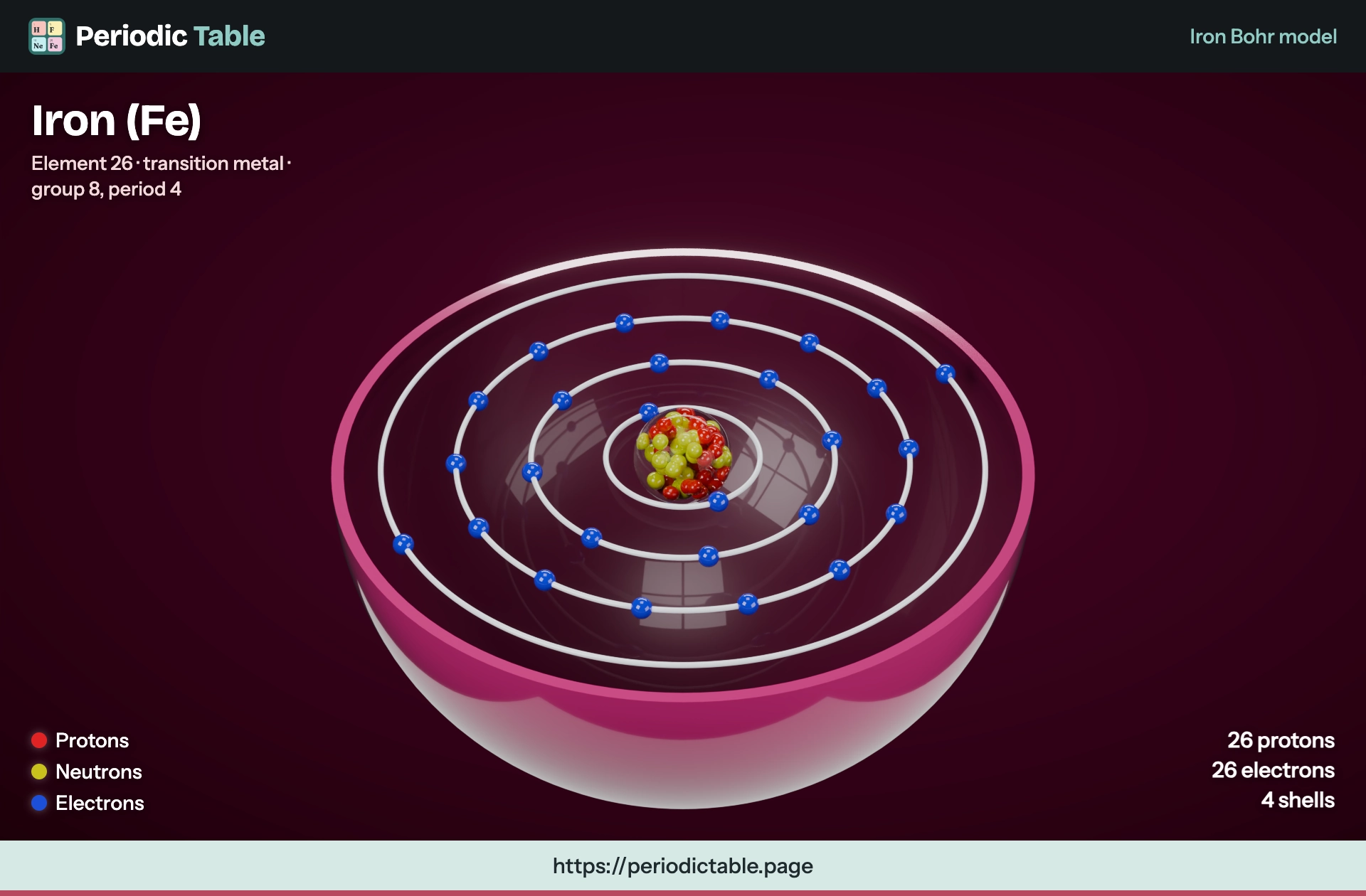
This is a Bohr model of iron (Fe), a simplified picture of a single iron atom. Its nucleus holds 26 protons, and a neutral iron atom has 26 electrons, arranged around it in 4 shells (2 in shell K, 8 in shell L, 14 in shell M and 2 in shell N).
Iron periodic table electron configuration
- Shorthand
- [Ar] 3d6 4s2
- Full
- 1s2 2s2 2p6 3s2 3p6 4s2 3d6
- Electrons per shell
- 2, 8, 14, 2
Iron element properties and atomic data
- Atomic number
- 26
- Atomic mass
- 55.8452 u
- Phase at STP
- Solid
- Melting point
- 1537.85°C (1811 K)
- Boiling point
- 2860.85°C (3134 K)
- Density
- 7.874 g/cm³
- Electronegativity (Pauling)
- 1.83
- Period
- 4
- Group
- 8
- Block
- d-block
- Appearance
- Lustrous metallic with a grayish tinge
- Discovery date
- Ancient
- Discovered by
- Unknown
- Named by
- —
Iron element at a glance: key facts and atomic data
Iron is element 26, a hard-working transition metal that has been known since antiquity, with no single discoverer on record. The quick facts below are the numbers you will reach for most often when you look it up, whether you are checking a homework answer or comparing it with a neighbor on the table. Because it is a soft, silvery metal that melts at body temperature, the gallium atomic mass page explains why it melts in your hand.
| Property | Value for iron (Fe) |
|---|---|
| Symbol | Fe |
| Proton count (Z) | 26 |
| Standard atomic weight | 55.845 |
| Group / period / block | 8 / 4 / d |
| Electrons per shell | 2, 8, 14, 2 |
| State at 20 °C | Solid |
| Common oxidation states | +2, +3 |
| CAS number | 7439-89-6 |
| Discovered | Antiquity (before 3000 BC) |
Iron sits between manganese and cobalt in its row, with ruthenium and osmium below it in the same column. Together with cobalt and nickel it forms the iron triad, three neighboring metals that share similar chemistry and are all magnetic at room temperature. Individual iron atoms are small and dense, which helps explain why a bar of it packs so much mass into a small volume.
Atomic number, atomic mass and electron configuration
An atomic number of 26 means every iron nucleus holds 26 protons, and a neutral atom carries 26 electrons. Its atomic mass of 55.845 is a weighted average of its naturally occurring forms, dominated by Fe-56. The electron configuration is written [Ar] 3d6 4s2: the 3d and 4s electrons sit close in energy, so iron can give up two, three or more of them, which is the root of its varied chemistry.
- Electronegativity: 1.83 on the Pauling scale
- First ionization energy: 762.5 kJ/mol
- Atomic radius: about 126 pm (empirical)
- Covalent radius: about 132 pm (low spin)
Where iron sits: group 8, period 4 and the d-block
Iron is in group 8 and period 4, in the middle of the d-block. Chemists sometimes treat it as the model for all transition metals, because it shows their typical traits so clearly: several oxidation states, colored compounds, catalytic activity and magnetic behavior. Unlike ruthenium and osmium, though, iron never reaches the +8 state its group number suggests; its highest well-confirmed state is +6, with +7 seen only in exotic laboratory conditions.
Physical properties of iron
Freshly cut or polished, iron is a lustrous, silvery-gray metal. It is ductile enough to draw into wire and malleable enough to hammer into sheet, and it conducts heat and electricity well. Most of the properties of iron people notice in daily life, though, come from its mixtures with other elements rather than from the element on its own. Stibnite, froth flotation and roasting with scrap iron explain how the antimony mining is turned from ore into a brittle, bluish-white solid.
Melting point, boiling point and density
Iron melts at 1538 °C and boils at 2861 °C, both lower than chromium and the earlier 3d metals but higher than manganese next door. At 7.874 g/cm³, a one-liter block of it weighs almost 7.9 kg.
| Physical property | Value |
|---|---|
| Melting point | 1538 °C (1811 K, 2800 °F) |
| Boiling point | 2861 °C (3134 K, 5182 °F) |
| Density at 20 °C | 7.874 g/cm³ (6.98 g/cm³ as a liquid) |
| Specific heat capacity | 449 J/(kg·K) |
| Thermal conductivity | 80.4 W/(m·K) |
| Mohs hardness | 4 |
The specific heat capacity of 449 J/(kg·K) is modest, which is why an iron pan heats quickly once the burner is on.
Allotropes of pure iron
Pure iron changes its crystal structure as it heats and cools. These solid forms, called allotropes, are labeled with Greek letters, and the switches between them are what make heat treatment of steel possible.
| Allotrope | Stable range | Crystal structure |
|---|---|---|
| α-iron (ferrite) | Below 912 °C | Body-centered cubic |
| γ-iron (austenite) | 912–1394 °C | Face-centered cubic |
| δ-iron | 1394–1538 °C | Body-centered cubic |
| ε-iron | Above about 10 GPa | Hexagonal close-packed |
The α form holds very little carbon, while face-centered cubic austenite can dissolve up to about 2% carbon. Trapping or releasing it on cooling is the basis of hardening and softening steel.
Mechanical strength and hardness
A single crystal of very pure iron is surprisingly soft, softer even than aluminium, and the purest industrial grades measure only 20–30 on the Brinell scale. Small amounts of carbon change that dramatically, raising hardness and tensile strength many times over.
The stiffness of the element itself is high: a Young's modulus of about 211 GPa, a shear modulus of about 82 GPa and a bulk modulus of about 170 GPa. That combination of stiffness, toughness and low cost is why iron-based materials still outsell everything else in construction.
Magnetic iron: ferromagnetic behavior and the Curie point
Iron is the best known ferromagnetic element, and the strongest of the three members of the iron triad that stay magnetic at room temperature. In each atom, two unpaired d electrons have spins that line up with those of their neighbors. A piece of it splits into tiny magnetic domains, each about 10 micrometers across, in which all the spins point the same way.
In an ordinary nail the domains point in random directions, so their effects cancel. Put the nail in an external magnetic field and the domains aligned with it grow at the expense of the others, so the iron becomes a strong magnet for as long as the field is there.
Defects and impurities can pin the domains in place afterwards, leaving a permanent magnet. This easy, reversible magnetization is why iron cores sit inside electrical transformers, electric motors, relays and recording heads.
Above the Curie point of 770 °C (1043 K), heat scrambles the spins faster than they can align, and iron becomes paramagnetic: still weakly attracted to a magnet, but unable to hold its own field. Cool it again and the ferromagnetism returns.
The natural mineral magnetite shows a related effect; pieces of it, called lodestones, were the first compass needles. Today neodymium-iron-boron magnets carry the element's magnetism into hard drives, headphones and electric vehicle motors.
Chemistry of iron: oxidation states and reactions
The chemistry of iron is dominated by two oxidation states, +2 and +3, although the element can range from −2 to +6 (and briefly +7). Iron is the most reactive element in its group: finely divided powder can ignite in air, and it dissolves readily in dilute acids.
It forms a huge range of compounds, and a technique called Mössbauer spectroscopy, which relies on Fe-57, is often used to work out which oxidation state an iron atom is in. Some minerals contain both states at once.
Iron(II) and iron(III): ferrous versus ferric
Iron(II) compounds are called ferrous and contain \(\mathrm{Fe}^{2+}\); iron(III) compounds are called ferric and contain \(\mathrm{Fe}^{3+}\). Ferrous solutions are pale green, while ferric solutions turn yellow to reddish-brown as the ion hydrolyzes. When iron reacts with hydrochloric acid, it gives iron(II) chloride and hydrogen gas:
$$\mathrm{Fe} + 2\,\mathrm{HCl} \rightarrow \mathrm{Fe}\mathrm{Cl}_2 + \mathrm{H}_2$$
In air, iron(II) slowly oxidizes to iron(III), which is why iron(II) salts are stored sealed. The two compounds made on the largest scale are iron(II) sulfate, used to fortify foods and treat deficiency, and iron(III) chloride.
Ferric chloride is a water-treatment flocculant and the etchant that dissolves copper from printed circuit boards. A blood-red color with thiocyanate is the classic test for \(\mathrm{Fe}^{3+}\) in a lab.
Rust and iron oxide formation
Rust is hydrated iron(III) oxide, formed when iron meets both oxygen and water. Unlike the thin protective film on aluminium, this brown crust takes up more space than what it replaces, so it flakes away and exposes a fresh surface to further corrosion. The overall reaction is:
$$4\,\mathrm{Fe} + 3\,\mathrm{O}_2 + 6\,\mathrm{H}_2\mathrm{O} \rightarrow 4\,\mathrm{Fe}(\mathrm{OH})_3$$
Rusting speeds up in salty sea air and in polluted city air, and it costs the world economy over 1% of its output every year. You protect iron by keeping water and oxygen away from it, with paint, plastic coatings and bluing, or by galvanization, which coats the steel in zinc that corrodes first.
The three main iron oxides are FeO, the red iron oxide \(\mathrm{Fe}_2\mathrm{O}_3\) and black \(\mathrm{Fe}_3\mathrm{O}_4\). Ground into fine powders, the red and yellow ones become ochre and other earth pigments that people have painted with since prehistory.
Coordination and organometallic compounds
Iron's partly filled d shell lets it bind many kinds of molecules. Prussian blue, an iron cyanide complex, was the traditional blue of blueprints. Iron pentacarbonyl, \(\mathrm{Fe}(\mathrm{CO})_5\), decomposes on heating into very fine iron powder.
The 1951 discovery of ferrocene, a "sandwich" of an iron atom between two five-membered rings, launched modern organometallic chemistry. Iron is also a workhorse catalyst: the Haber–Bosch process uses it to make ammonia for fertilizer, and the thermite reaction between red oxide powder and aluminium powder still welds railway lines in the field:
$$\mathrm{Fe}_2\mathrm{O}_3 + 2\,\mathrm{Al} \rightarrow 2\,\mathrm{Fe} + \mathrm{Al}_2\mathrm{O}_3$$
Iron isotopes and the element's cosmic origin
Natural iron is a mix of four stable isotopes. The heaviest share by far belongs to iron-56, written 56Fe, which makes up about 92% of every iron atom on Earth.
| Isotope | Natural abundance | Notes |
|---|---|---|
| Fe-54 | 5.845% | Stable |
| Fe-56 | 91.754% | Stable, most abundant |
| Fe-57 | 2.119% | Stable, the only one with nuclear spin |
| Fe-58 | 0.282% | Stable |
| Fe-60 | Trace | Radioactive, half-life about 2.6 million years |
About two dozen artificial versions are known as well. Fe-55, with a half-life of 2.7 years, and Fe-59, at 44.5 days, are used as tracers in research.
Iron's abundance comes from nucleosynthesis in massive stars. Fusion chains build heavier nuclei until they reach nickel-56, which decays through cobalt-56 to Fe-56. Fusing past this point releases no energy, so iron marks the end of a star's life: once its core fills with iron, the star collapses.
A supernova then scatters the iron into space, where it ends up in new planets. That is why iron is the sixth most abundant element in the universe and the most common heavy element in rocky worlds.
Where iron is found in nature
By mass, iron is the most common element on Earth, yet you rarely see it in bare form. Almost all of it is either locked deep inside the planet or combined with other elements in minerals, which is why geology and mining matter so much to the iron supply. The other rocky planets, Mercury, Venus and Mars, are also thought to have iron-rich cores.
Metallic iron in the core and in meteorites
Earth's inner core and outer core together account for about a third of the planet's mass, and both are believed to be mostly an iron-nickel alloy. Electric currents in the liquid outer core generate Earth's magnetic field. At the surface, metallic iron rusts quickly, so the main natural source of it is space: about one in twenty meteorites is made of iron-nickel alloy.
These iron meteorites show striking crisscross crystal patterns when cut, polished and etched. Rarer still is telluric iron, formed where molten rock met coal-rich sediments, as on Disko Island in Greenland.
Iron ore minerals in Earth's crust
In Earth's crust iron is only the fourth most abundant element, after oxygen, silicon and aluminium, at about 5% by mass. Most commercial iron ore comes from banded iron formations, rocks laid down between about 3.7 and 1.8 billion years ago, when oxygen in the oceans turned dissolved iron into thin layers of oxide.
| Mineral | Formula | Iron content by mass |
|---|---|---|
| Magnetite | Fe₃O₄ | 72.4% |
| Hematite | Fe₂O₃ | 69.9% |
| Goethite | FeO(OH) | 62.9% |
| Siderite | FeCO₃ | 48.2% |
| Pyrite | FeS₂ | 46.6% |
Hematite and magnetite are the main ores; siderite, goethite and limonite are mined too, and the hard, low-grade rock taconite feeds the mines of Minnesota and Michigan. Iron pyrite looks like gold, earning it the name fool's gold, but extracting the element from it is too costly, so the sulfur-rich ore is left alone.
Top producers and recycling
China, Australia and Brazil lead world iron production, while Australia, Brazil and Russia hold the largest reserves. Iron is cheap, plentiful and easy to substitute in some uses, so its supply risk is low compared with most metals. Scrap is collected on a huge scale, and over 30% of what is in use is recycled, mostly through electric furnaces that melt old steel into new.
History of iron: from ancient beads to the iron age
People worked iron long before they could smelt it, and the element gave its name to a whole stage of human history. Our own iron age begins, in most regions, around 1200 BC.
Meteoric iron and the first smelting
The oldest iron objects are beads from Gerzeh in Egypt, dating to before 3000 BC and hammered from meteoric iron; their 7.5% nickel content gives away their origin from space. A dagger in the tomb of Tutankhamun was made the same way. Early smelting, which reduces ore at high heat, needed furnaces about 500 °C hotter than those used for copper.
The Hittites of Anatolia were among the first to master it, between 1500 and 1200 BC. When their empire fell, ironworking spread across the Near East and gradually replaced bronze, ending the bronze age. Smelted iron appears in India from about 1800 BC, in China around 700–500 BC and in Greece late in the 11th century BC.
Cast iron, wrought iron and the industrial revolution
Cast iron, melted and poured into molds, was made in China by the 5th century BC but reached Europe only in medieval times. Wrought iron, nearly pure and worked by hammering, was the blacksmith's material for centuries. In 1709 Abraham Darby fueled a furnace with coke instead of charcoal, making iron cheap enough to help start the industrial revolution; the first iron bridge followed in 1779 and still stands in Shropshire.
Henry Cort's puddling process of 1783 refined furnace iron into the wrought form, and in the 1850s Henry Bessemer blew air through molten iron to make cheap steel. Each step in metallurgy lowered the price and raised the quality, and in 1774 Lavoisier even used steam over red-hot iron to make hydrogen in his experiments on conservation of mass.
Where the name and the symbol Fe come from
The English word comes from the Anglo-Saxon iren, which may trace back to an old root meaning "holy metal" or "blood", for the red of its oxides. The symbol Fe comes from the Latin ferrum, which also gives us the prefix ferro-. Iron has symbolic weight too: the Greek poet Hesiod named an age of man after it, alchemists linked it to Mars, and in 1813 Prussian families gave gold jewelry to the war effort in exchange for iron pieces stamped "I gave gold for iron."
How iron metal is produced
Turning ore into usable iron metal happens in two stages: first the ore is reduced, then the excess impurities are burned out. The iron and steel industry runs this cycle on a scale of nearly two billion tonnes a year.
Inside the blast furnace
A blast furnace is loaded from the top with iron ore, coke (coal baked to drive off volatile gases) and limestone. Hot air blasted in near the bottom burns it to carbon monoxide, raising the temperature to about 2000 °C:
$$2\,\mathrm{C} + \mathrm{O}_2 \rightarrow 2\,\mathrm{CO}$$
The carbon monoxide then pulls oxygen out of the ore, leaving molten iron:
$$\mathrm{Fe}_2\mathrm{O}_3 + 3\,\mathrm{CO} \rightarrow 2\,\mathrm{Fe} + 3\,\mathrm{CO}_2$$
The limestone breaks down to lime, which reacts with sand and other rock in the ore to form slag. It floats on the liquid iron, so the two are tapped off separately; slag later goes into cement and road beds. The process puts a great deal of carbon dioxide into the air, which is why steelmaking is one of the largest industrial sources of emissions.
Refining pig iron into steel
What leaves a blast furnace is pig iron, which holds 3.5–4.5% carbon and is too brittle to use directly. Basic oxygen steelmaking blows pure oxygen through the molten pig iron to burn the carbon content down to between about 0.002% and 2.1%, producing steel.
Electric arc furnaces do the same job mostly from scrap, melting it with an electric arc instead of burning fuel. Other metals can be added at this stage to tune the finished steel.
Direct reduction and lower-carbon routes
Direct reduction treats ore with natural gas or hydrogen without melting it, giving a porous solid called sponge iron that is then melted in an electric furnace. Run on hydrogen, the only by-product is water vapor.
Researchers are also testing molten oxide electrolysis, which splits the molten ore with electricity and releases oxygen, so it emits no greenhouse gas directly. In the lab, small amounts of very pure iron are made by reducing the oxide with hydrogen or by heating iron pentacarbonyl.
Uses of iron in industry and everyday life
Iron accounts for over 90% of all metal produced worldwide, and almost all of it is turned into steel. Its low cost and high strength make it the first choice wherever a material has to carry a load: construction beams and concrete reinforcing bars, rails, ship hulls, cars, machine tools and pipelines.
Each person on the planet has, on average, about 2.2 tonnes of the metal in use around them. Beyond structures, iron shields against radiation, carries magnetic flux in motors and transformers, and holds heat evenly in cookware.
- Structural steel for buildings, bridges and towers
- Rails, ship hulls, car bodies and engine blocks
- Cast iron pipes, stoves, radiators and cookware
- Electrical steel for transformer and motor cores
- Iron powder for sintered parts, hand warmers and food fortification
Steel grades, alloys and carbon
Nearly every iron product is one of its alloys, and carbon is the ingredient that decides how it behaves. Cooling a high-grade tool steel slowly gives soft, layered pearlite; quenching it fast traps carbon in hard, brittle martensite, which is then tempered to the right balance. Hard cementite (iron carbide) is what makes white cast iron so brittle.
Iron products compared
The table lists the main commercial forms, from the nearly pure wrought form to the furnace product that feeds everything else.
| Iron product | Carbon content | Typical traits |
|---|---|---|
| Wrought iron | Below 0.25% | Fibrous, corrosion resistant, now rare |
| Mild steel | About 0.05–0.25% | Easy to weld and form |
| Carbon steel | Up to about 2% | Harder and stronger as carbon rises |
| Cast iron | 2–4% | Hard, castable, brittle under impact |
| Pig iron | 3.5–4.5% | Intermediate product, not sold for use |
Specialty iron grades
Even the most specialized grades are still mostly iron; the small additions only change how its crystal lattice behaves. Mild steel is the everyday grade, while carbon steel with a higher share goes into springs, blades and tools. Alloy steels add vanadium, molybdenum or tungsten for special jobs, and stainless steel adds at least 10.5% chromium, which forms a self-healing oxide film over the underlying iron and keeps your cutlery and sinks bright.
Iron compounds and catalysts at work
Its chemicals are just as useful as the bulk material. Iron salts clean drinking water and sewage, iron oxides color paint, concrete and cosmetics, and iron-based catalysts produce ammonia and synthetic fuels. Powdered iron reduces nitrobenzene to aniline for dyes, and sodium nitroprusside, an iron complex, is an essential medicine in hypertensive emergencies.
Iron in the human body and living things
Iron is essential to almost every living thing, making it as central to biology as it is to engineering. Your human body holds about 4 grams of it, roughly 0.005% of body weight, almost none of it as free elemental iron; most of it is busy moving oxygen around in your blood. Plants need iron to make chlorophyll, and in the oceans a lack of dissolved iron limits how much plankton can grow.
Hemoglobin and oxygen transport
How iron carries oxygen
About two thirds of your iron sits in hemoglobin, the protein that fills red blood cells and gives them their color. Each hemoglobin molecule has four heme groups, each with an iron atom at its center that binds one oxygen molecule in the lungs and releases it in the tissues.
Myoglobin does a similar job inside muscles. This oxygen transport system depends on iron staying in the +2 state.
Where the body stores iron
The protein transferrin carries iron through the blood, and ferritin stores it in the liver and bone marrow. Iron also sits at the heart of enzymes such as cytochromes and catalase, which drive energy production and break down harmful peroxides.
Iron deficiency, overload and daily intake
Iron deficiency is the most common nutritional shortfall in the world. Without enough of it your body cannot make enough hemoglobin, leading to anemia, with tiredness, pale skin and shortness of breath.
Daily iron intake and food sources
Recommended intakes in the US are about 8 mg a day for adult men and 18 mg for women aged 19 to 50, rising to 27 mg in pregnancy. Red meat, liver, beans, lentils and fortified cereals are good sources; vitamin C helps absorption, while tea and coffee reduce it.
Iron overload and toxicity
Too much iron is harmful as well, because the body has no way to excrete the excess. Hereditary hemochromatosis lets it build up in the liver, heart and pancreas, and an overdose of supplements is a leading cause of poisoning in young children. Iron that leaks from its proteins in the brain has also been linked to diseases such as Parkinson's and Alzheimer's, which is why doctors test your levels before recommending supplements.