


Antimony element (Sb): antimony periodic table facts
Antimony periodic table facts: antimony (Sb) is element 51, a metalloid in group 15, period 5. You have almost certainly handled antimony today without knowing it, because this lustrous, silvery and brittle solid hides inside car battery plates, plastic housings and old television screens. For a closer look at industrial chemistry, learn from the chlorine element how electrolysis of brine makes sodium hydroxide alongside the gas.
Known to chemists as Sb, after its old Latin name stibium, it is a metalloid: a chemical element that looks like a shiny solid but behaves partly like a nonmetal. Its biggest modern job is helping flame retardants stop plastics from catching light, and that job is why governments now watch its supply so closely.
Rotate the 3D Bohr model of antimony
Drag to orbit, scroll to zoom.
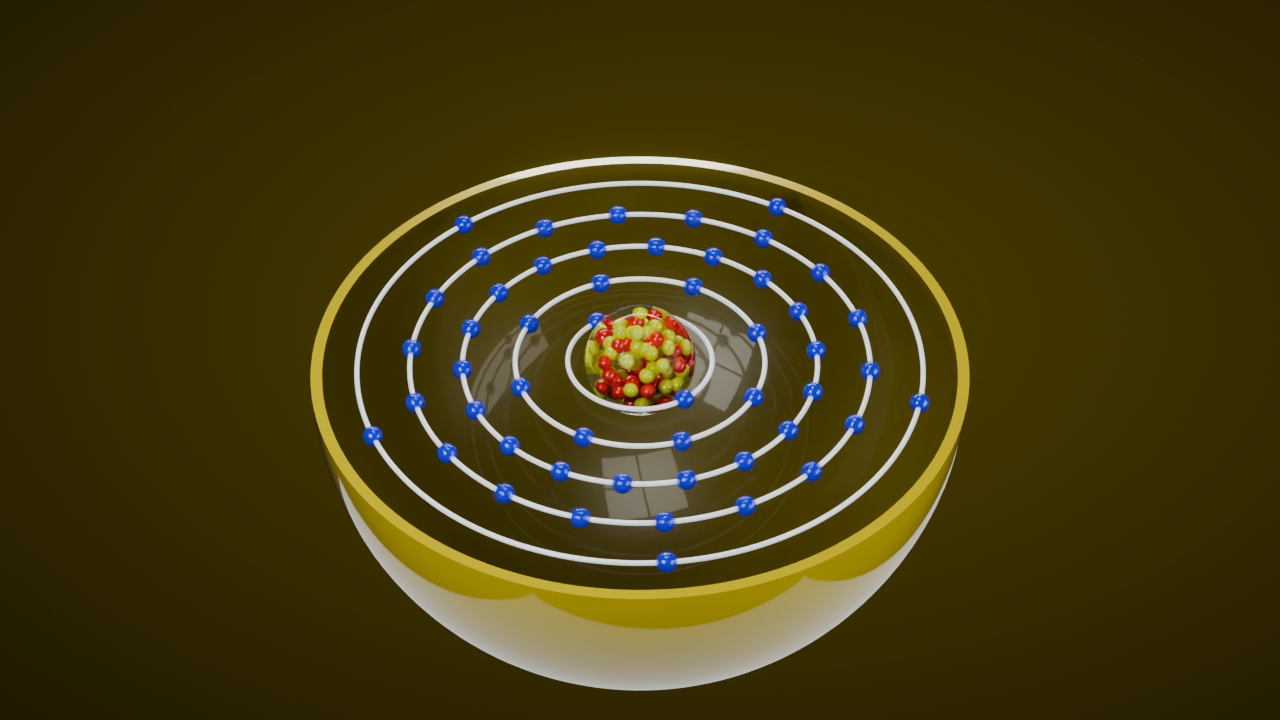
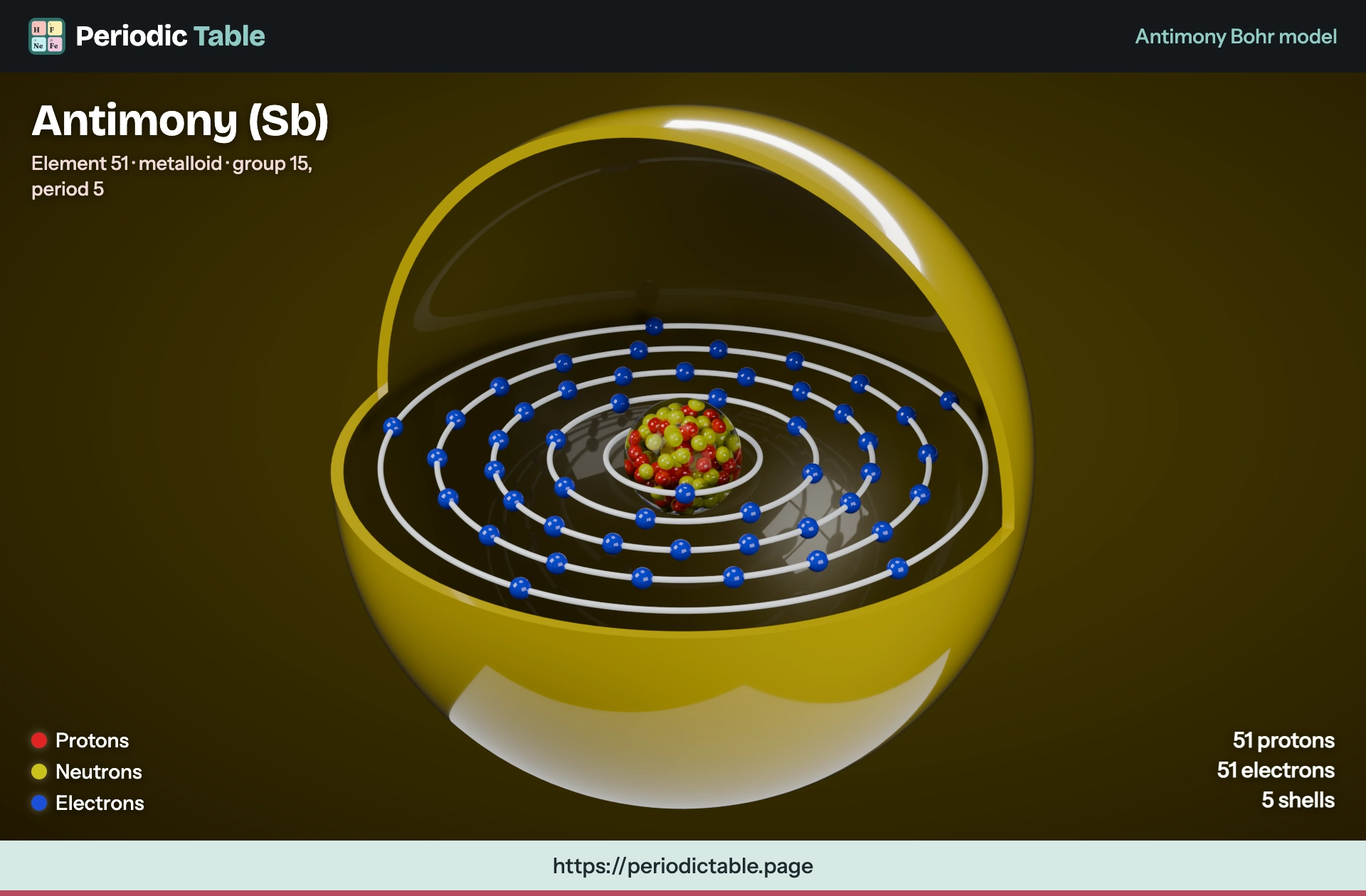
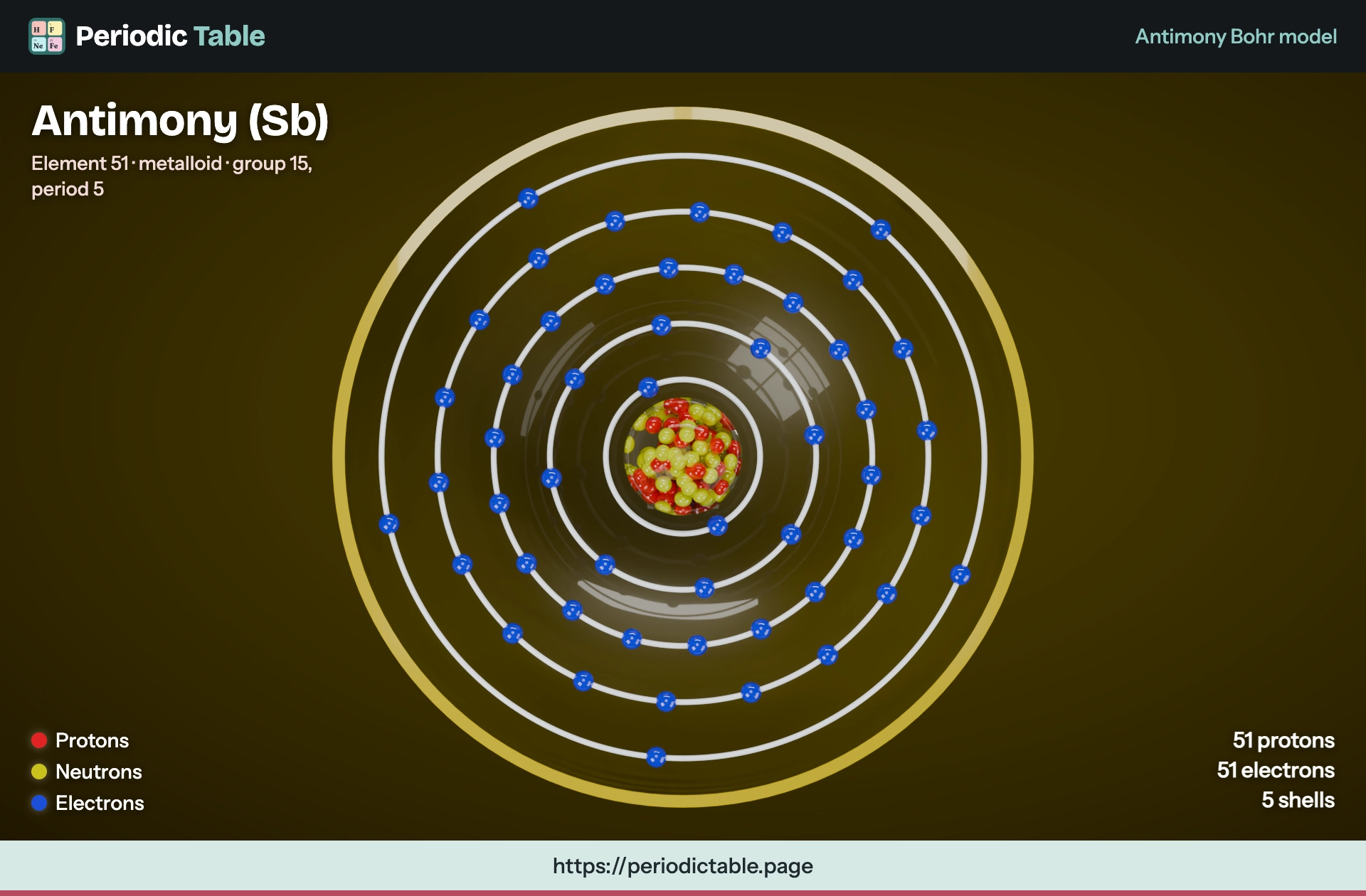
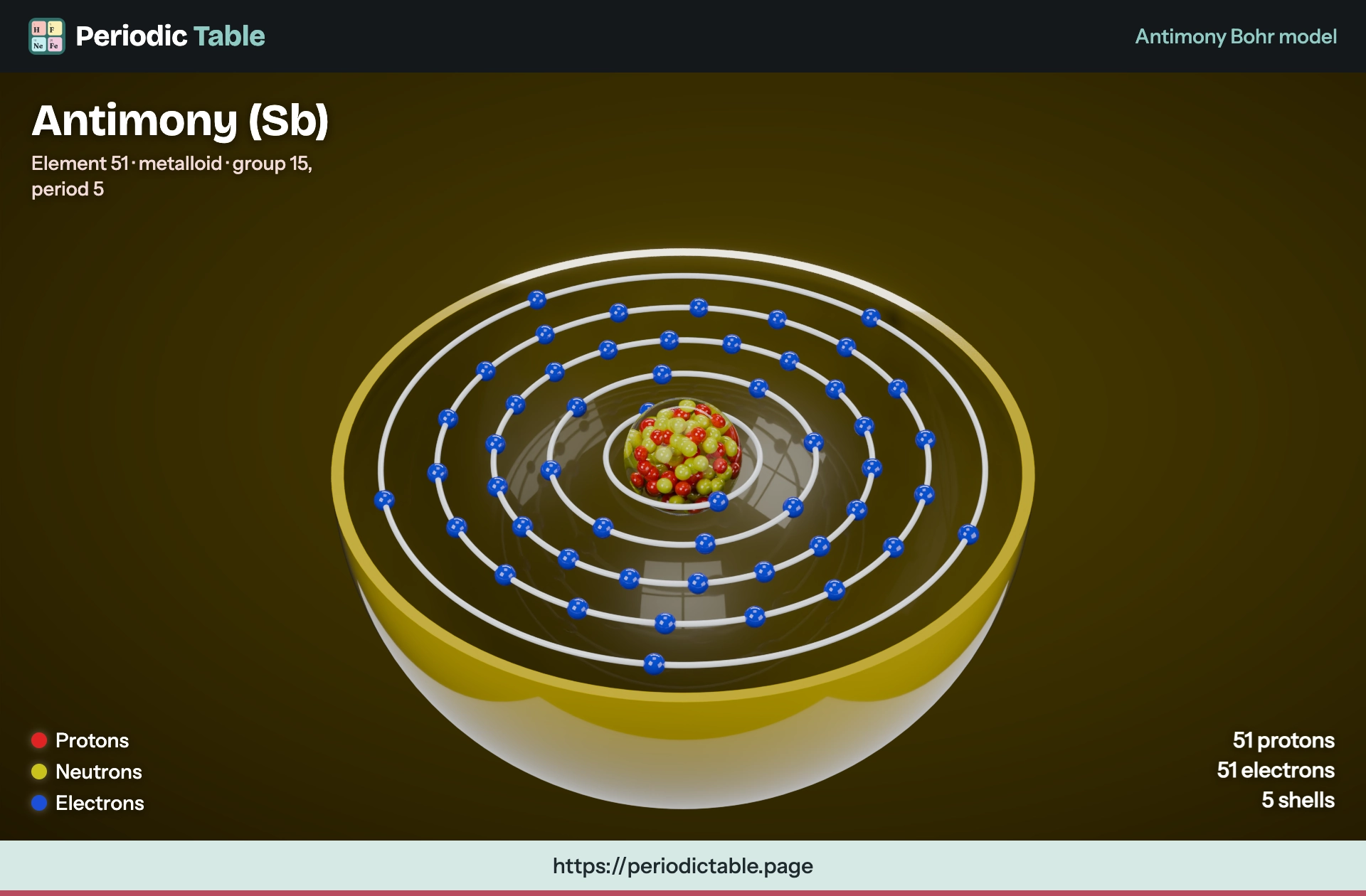
This is a Bohr model of antimony (Sb), a simplified picture of a single antimony atom. Its nucleus holds 51 protons, and a neutral antimony atom has 51 electrons, arranged around it in 5 shells (2 in shell K, 8 in shell L, 18 in shell M, 18 in shell N and 5 in shell O).
Antimony periodic table electron configuration
- Shorthand
- [Kr] 4d10 5s2 5p3
- Full
- 1s2 2s2 2p6 3s2 3p6 4s2 3d10 4p6 5s2 4d10 5p3
- Electrons per shell
- 2, 8, 18, 18, 5
Antimony element properties and atomic data
- Atomic number
- 51
- Atomic mass
- 121.7601 u
- Phase at STP
- Solid
- Melting point
- 630.63°C (903.78 K)
- Boiling point
- 1634.85°C (1908 K)
- Density
- 6.697 g/cm³
- Electronegativity (Pauling)
- 2.05
- Period
- 5
- Group
- 15
- Block
- p-block
- Appearance
- Silvery lustrous gray
- Discovery date
- Ancient
- Discovered by
- Unknown
- Named by
- —
What is the element antimony?
The antimony element is number 51 on the periodic chart, a gray to bluish-white solid that is stable in air at room temperature and snaps rather than bends when you strike it. Antimony has a bright, mirror-like shine, yet it carries current and warmth poorly, which is why chemists file it with the metalloids rather than with true metals. For a view of the body, students of properties of iron find oxidation, compounds and the metal's biology in hemoglobin in one profile.
In nature you rarely meet native antimony as a free lump. Most of it is locked up with sulfur in minerals, and a large part of its value to industry comes from compounds rather than from the pure solid. People have used antimony in some form for more than 5,000 years, first as eye paint and later in type foundries and munitions, so antimony chemistry touches ancient trade as much as modern factories.
Antimony facts table: key atomic data
The table below gathers the standard reference values for antimony. These are published constants for the element itself, the same figures you would find in any chemistry handbook, rounded where noted. Research teams and nuclear physics teachers use berkelium compounds to see why milligram samples are rare and hard to handle.
| Property | Value for Sb |
|---|---|
| Atomic number | 51 |
| Standard atomic weight | 121.760 |
| Electron configuration | [Kr] 4d10 5s2 5p3 |
| Melting point | 630.63 °C (903.78 K) |
| Boiling point | 1,635 °C (1,908 K) |
| Density at 20 °C | 6.69 g/cm3 |
| Electronegativity (Pauling) | 2.05 |
| Atomic radius (empirical) | 140 pm |
| Covalent radius | 139 pm |
| Specific heat capacity | 207 J/(kg·K) |
| Bulk modulus | 42 GPa |
| CAS number | 7440-36-0 |
Two of these numbers explain a lot of everyday behaviour. A melting point near 631 °C is low enough for easy casting with other soft metals, and a density close to that of zinc makes it a useful hardener that does not add much bulk. The boiling point varies a little between sources (some list about 1,587 °C), so treat the last digits as approximate.
The symbol for antimony and the origin of its name
The symbol for antimony, Sb, does not match its English name because it comes from stibium, the classical word for the black sulfide used as kohl. The Swedish chemist Berzelius fixed the abbreviation in the early 1800s when he standardised chemical symbols, and the two letters have stayed on every periodic chart since.
The word "antimony" itself is a puzzle. Medieval writers used the Latin form antimonium, but nobody knows for certain where that came from. One popular story reads it as Greek anti-monos, "not alone", because the substance is almost never found by itself in nature.
Another links it to "anti-monk", the tale that early alchemists, many of them in holy orders, were poisoned by it. Scholars also point to Arabic and Egyptian words for the cosmetic powder, so the honest answer is that the name has several plausible roots and no proven one.
Where Sb sits on the periodic table
Antimony belongs to group 15, the pnictogens, and to period 5, which puts it in the p-block. Reading down the column you meet nitrogen, phosphorus, arsenic, antimony and then bismuth, and each of these atoms carries five electrons in its outer shell. That shared outer arrangement is why they bond in similar ways.
Following the usual periodic trends, antimony is more electronegative than its neighbours tin and bismuth but less electronegative than arsenic and tellurium. Its closest chemical relative is arsenic, the element directly above it, and the two share toxicity, similar salts and a borderline position between metals and nonmetals.
Is antimony a metalloid or a metal?
Antimony is classed as a metalloid, sometimes called a semimetal. It has the shine and density you expect from metals, but it is a poor conductor of both electricity and heat; its thermal conductivity is only about 24 W/(m·K), a small fraction of copper's. It also bonds more like a nonmetal, forming covalent bonds and acidic oxides.
This in-between character is useful rather than a weakness. It lets antimony act as a hardener in alloys and also as a dopant in semiconductors, two jobs that a pure metallic or a pure nonmetallic element could not do equally well.
Physical and chemical antimony properties
The main antimony properties follow from how its atoms stack together. Elemental antimony is dense and shiny but soft and easily crushed to powder, and that combination comes straight from its crystal arrangement.
Crystal structure and allotropes
The stable form has a rhombohedral crystal structure: a layered structure of puckered six-membered rings stacked on top of one another. Atoms bond tightly inside each layer but only weakly between layers, so the solid is heavy yet scores just 3 on the Mohs scale.
That low hardness is why it shatters under a hammer. Besides this gray form, there is a yellow allotrope that exists only at very low temperatures and a black allotrope that forms when the yellow one warms up.
How metallic antimony reacts
Metallic antimony resists air and water at room temperature, but strong oxidising acids attack it. When it is heated in air it burns to antimony trioxide, Sb2O3, and the same roasting step is used in industry to turn sulfide concentrates into oxide.
Antimony isotopes and oxidation states
Two short topics round out the atomic picture: which forms of the nucleus exist, and which charges the atom takes in compounds.
Two stable forms in nature
Natural antimony is a mix of two stable isotopes: 121Sb with a natural abundance of about 57.2% and 123Sb at about 42.8%. Dozens of radioactive forms have been made in reactors. The longest-lived, 125Sb, has a half-life of about 2.76 years, and 124Sb paired with beryllium is used in neutron sources.
Sb(III) and Sb(V)
The common oxidation states are +3, +5 and −3. Trivalent compounds such as the trichloride and pentavalent ones such as the pentafluoride are the two big families, and the −3 state appears in antimonides. The difference matters in medicine and toxicology, because the body handles Sb(III) and Sb(V) differently.
Antimony compounds and their chemistry
Most practical antimony compounds fall into three groups: oxides and sulfides, halides, and antimonides with their hydride, stibine.
Oxides and sulfides
Burning the element in air gives the trioxide, while strong nitric acid takes it further to antimony pentoxide. A mixed oxide holds both oxidation states at once.
Unlike the oxides of phosphorus and arsenic, these oxides are amphoteric: they react with both acids and bases. The black antimony sulfide, Sb2S3, is the parent of the whole industry, and the orange-red pentasulfide was once a common pigment for rubber.
Halides and a famous superacid
Antimony forms two series of halides, SbX3 and SbX5. Antimony trichloride is made by dissolving the sulfide in hydrochloric acid:
$$\mathrm{Sb_2S_3 + 6\,HCl \rightarrow 2\,SbCl_3 + 3\,H_2S}$$
Antimony pentafluoride is an extremely strong Lewis acid. Mixed with hydrogen fluoride it gives fluoroantimonic acid, a superacid that protonates substances normally considered far too weak to accept a proton.
Antimonides and stibine
With electropositive metals, antimony forms antimonides such as indium antimonide (InSb) and gallium antimonide (GaSb), both valued as semiconductor crystals. Treating reactive antimonides with acid releases stibine, SbH3, a toxic gas that decomposes on its own at room temperature, which is why antimony never combines with hydrogen directly.
Antimony history: from kohl to the antimony war
Few elements have a stranger history. The element moved from make-up to medicine to murder, and it helped start a bitter scholarly feud in early modern Europe.
Ancient cosmetics in Egypt
The ground sulfide was used in predynastic Egypt as a black eye cosmetic around 3100 BC, and later writers called it kohl. Antimony-plated copper and fragments of what may be an antimony vessel survive from the ancient Near East, and traces turn up in old glazes and pottery. The Roman writer Pliny described several ways to prepare the sulfide for medical use around AD 77.
Alchemy, Biringuccio and Basil Valentine
Medieval alchemy treated antimony as a near-magical substance, and alchemists wrote about it constantly. The Italian metallurgist Vannoccio Biringuccio gave a clear recipe for isolating it in his 1540 book on metalworking. In 1604 a book called The Triumphal Chariot of Antimony appeared under the name Basil Valentine, supposedly a fifteenth-century monk; historians now agree it was written much later, probably by its own editor.
Its use as a purge sparked the so-called Antimony War in France and Germany during the 1600s, fought with pamphlets between followers of Paracelsus and traditional physicians. French chemist Nicolas Lemery later wrote a whole treatise on its properties. The fashion for antimony remedies lasted for centuries, and it later became a favoured slow poison in criminal cases.
Where native antimony ores occur
Antimony is scarce in Earth's crust, at roughly 0.2 parts per million, yet it appears in more than 100 minerals. Free crystals do occur, but the commercial supply almost always comes from sulfide deposits.
Stibnite and other antimony-bearing mineral species
The key ore is stibnite, Sb2S3, a soft gray mineral that grows in long, blade-like crystals. Other sources include tetrahedrite, jamesonite, boulangerite, ullmannite and the silver mineral pyrargyrite. Many deposits are hydrothermal veins that also carry gold, so antimony is often recovered as a by-product of lead, zinc and gold operations.
How antimony mining and refining work
Antimony mining uses underground or open-pit methods depending on the shape of the deposit. Low-grade ore is crushed and upgraded by froth flotation; richer material is heated to 500–600 °C so the sulfide melts away from the waste rock. The liquid sulfide can then be stripped of its sulfur with scrap iron:
$$\mathrm{Sb_2S_3 + 3\,Fe \rightarrow 2\,Sb + 3\,FeS}$$
Alternatively the sulfide is roasted to oxide and finished by carbon reduction in a furnace, which yields refined antimony metal:
$$\mathrm{2\,Sb_2O_3 + 3\,C \rightarrow 4\,Sb + 3\,CO_2}$$
Antimony production, reserves and supply risk
Antimony production is concentrated in very few countries, which makes the market fragile and keeps supply risk high on government lists.
Top producing countries
According to US Geological Survey figures for 2022, world mine output was about 110,000 tonnes, with these leading producers:
| Country | Mine output (tonnes) | Share of world total |
|---|---|---|
| China | 60,000 | 54.5% |
| Russia | 20,000 | 18.2% |
| Tajikistan | 17,000 | 15.5% |
| Myanmar | 4,000 | 3.6% |
| Australia | 4,000 | 3.6% |
The largest single source has long been the Xikuangshan district in Hunan province. Known reserves are also led by China, followed by Russia and Bolivia, but Chinese output has been falling as old mines close under stricter pollution rules.
Why antimony is a critical mineral
The United States, the European Union and the United Kingdom all list it as a critical mineral. Its role in ammunition gives it a national security angle, and its role in flame retardants and battery grids ties it to construction and cars. When China restricted the export of critical minerals in late 2024, the antimony supply chain for importing regions tightened sharply, and prices rose.
Recycling and new recovery methods
Less than 10% of antimony is recycled today, mostly from spent battery plates. Researchers are testing selective leaching of mine waste and plastic scrap, followed by electrowinning to plate out high-purity product, both to reduce damage to the environment and to open supply outside the current producers.
Uses of antimony across industry
The uses of antimony split roughly into flame retardants (close to half of demand in recent surveys), battery alloys (about a third) and a long tail of plastics, glass and chip making.
Flame retardants in plastics and textiles
Antimony trioxide is the classic synergist in halogenated flame retardants. On its own it does little, but with chlorine or bromine compounds it forms volatile halides that interrupt the chemistry of a fire. Antimony is added to cable insulation, appliance casings, upholstery, toys and children's clothing.
Alloys, bullets and lead-acid batteries
A few percent of antimony makes lead much harder and stiffer, and it reduces shrinkage when the mix is cast. That is why it is used in the grid plates of lead-acid batteries, in lead shot and ammunition, in cable sheathing, in lead keels for yachts and in solder. Older uses include type metal for printing, Babbitt metal for bearings, and pewter, a tin-based alloy.
Semiconductors and electronics
In chip making antimony serves as an n-type dopant in silicon wafers for diodes, Hall-effect sensors and older transistors. Indium antimonide is the standard material for mid-range infrared detectors, and the alloy Ge2Sb2Te5 stores data in phase-change memory. Research into liquid-electrode cells for grid energy storage also uses antimony.
Glass, pigments and PET plastic
In glass making it acts as a fining agent that removes tiny bubbles and greenish tints. Its compounds colour enamels and ceramics, and antimony trioxide is the main catalyst used to make polyethylene terephthalate, the plastic of drinks bottles.
Medicine and other uses
Old antimonials were given as an emetic, and potassium antimony tartrate (tartar emetic) treated parasitic disease for decades. Pentavalent compounds are still a first-line drug for leishmaniasis in parts of the world. The sulfide also turns up in the heads of safety matches and in vehicle brake pads.
Antimony toxicity and health risks
Antimony toxicity resembles arsenic poisoning, but it is much milder because the body absorbs at most about a fifth of what is swallowed. The element has no known biological role, and certain compounds, especially the trioxide and the tartrate, are clearly toxic.
- Workplace inhalation of dust can cause lung irritation, spots on the skin and dermatitis, and skin irritation is common among exposed workers.
- The most serious acute effect is cardiotoxicity, damage to the heart muscle, and large doses can also harm the liver.
- Antimony trioxide is classed as possibly carcinogenic to humans.
For most people, everyday exposure is tiny and comes from food, dust and plastic containers.
Sb limits in drinking water
Small amounts of Sb leach from the trioxide catalyst left in PET bottles, especially when they sit warm for long periods. Regulators therefore cap how much of the element tap and bottled supplies may carry: the World Health Organization guideline is 20 µg/L, the US EPA and Health Canada use 6 µg/L, and the EU limit is 5 µg/L. Bottled water normally tests well below these values, so the bigger health concern is long-term workplace contact.
Interesting facts about antimony
A few facts about antimony that rarely make it into textbooks:
- China's Guizhou province issued antimony coins in 1931, but they wore badly and were soon withdrawn.
- Rubbing one unstable electrolytic form in a mortar can set off a small explosion, a quirk early chemists found the hard way.
- Single "everlasting" antimony pills were once swallowed as a laxative, recovered and reused, sometimes passed down in families.
- Some historians have suggested that antimony remedies played a part in Mozart's death in 1791, though the claim is unproven.