


Berkelium element (Bk): berkelium periodic table facts
Berkelium periodic table facts: berkelium (Bk) is element 97, an actinide in period 7 of the f-block. If you have ever wondered what sits at atomic number 97, the answer is berkelium, a transuranium element that nobody has ever dug out of the ground. Before handling a strong oxidising agent in the laboratory, open the chlorine atomic mass to see why it needs care.
Every atom of Bk described here was made inside a reactor or a particle accelerator, one painstaking microgram batch at a time. Below you get its core data, how it was discovered, how it behaves chemically, and why scientists still bother to make it.
Rotate the 3D Bohr model of berkelium
Drag to orbit, scroll to zoom.
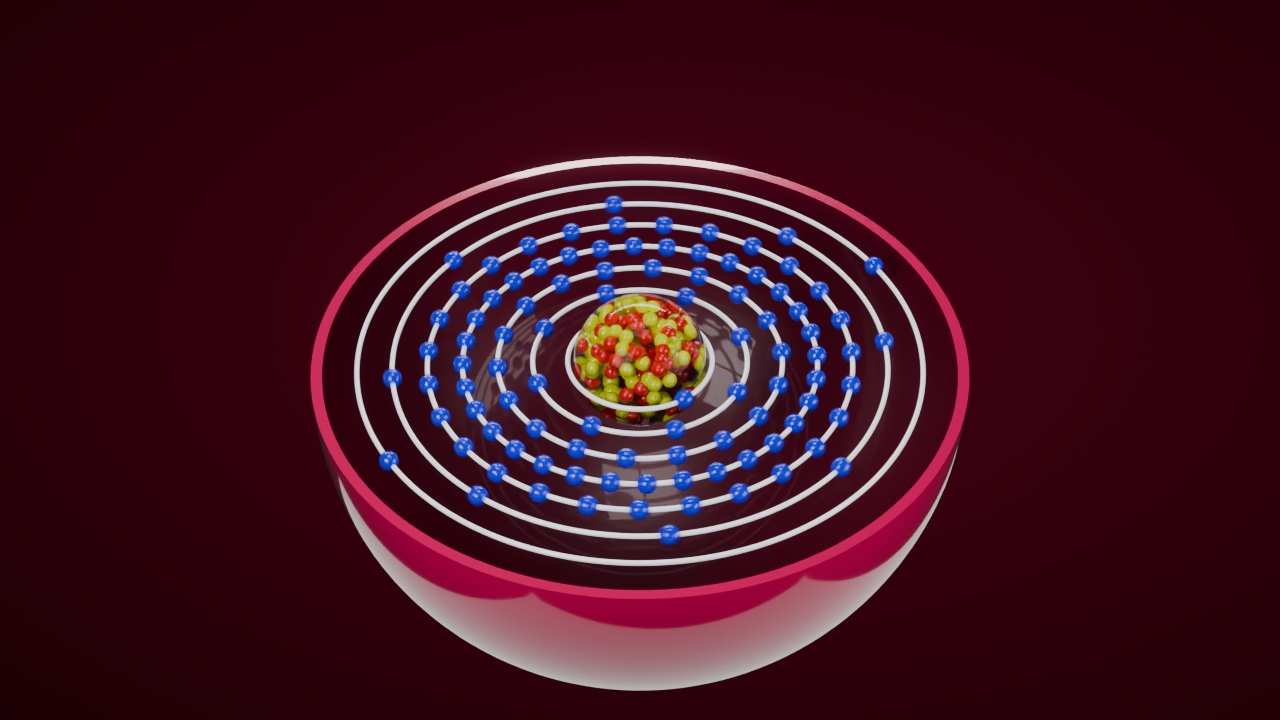
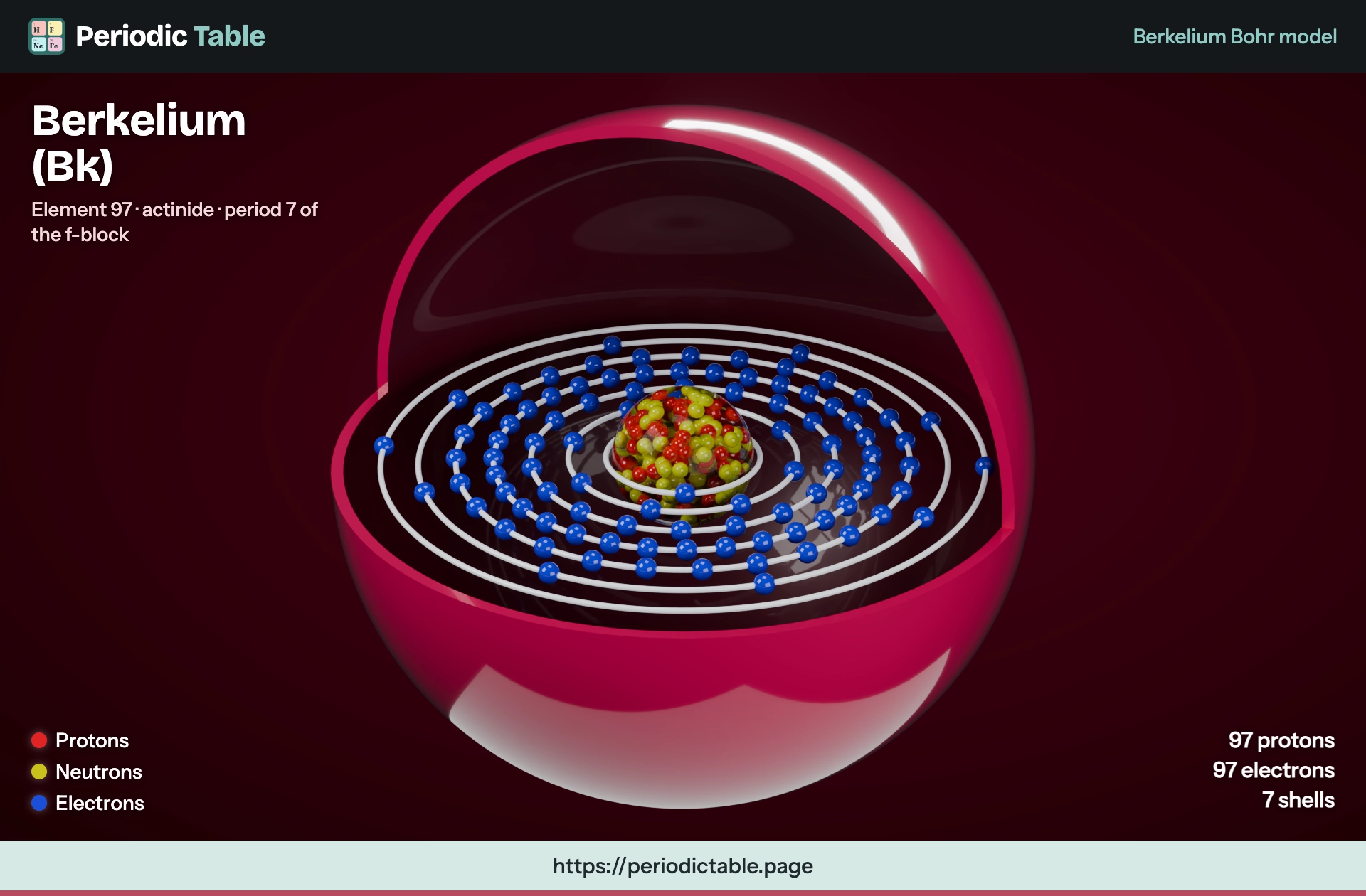
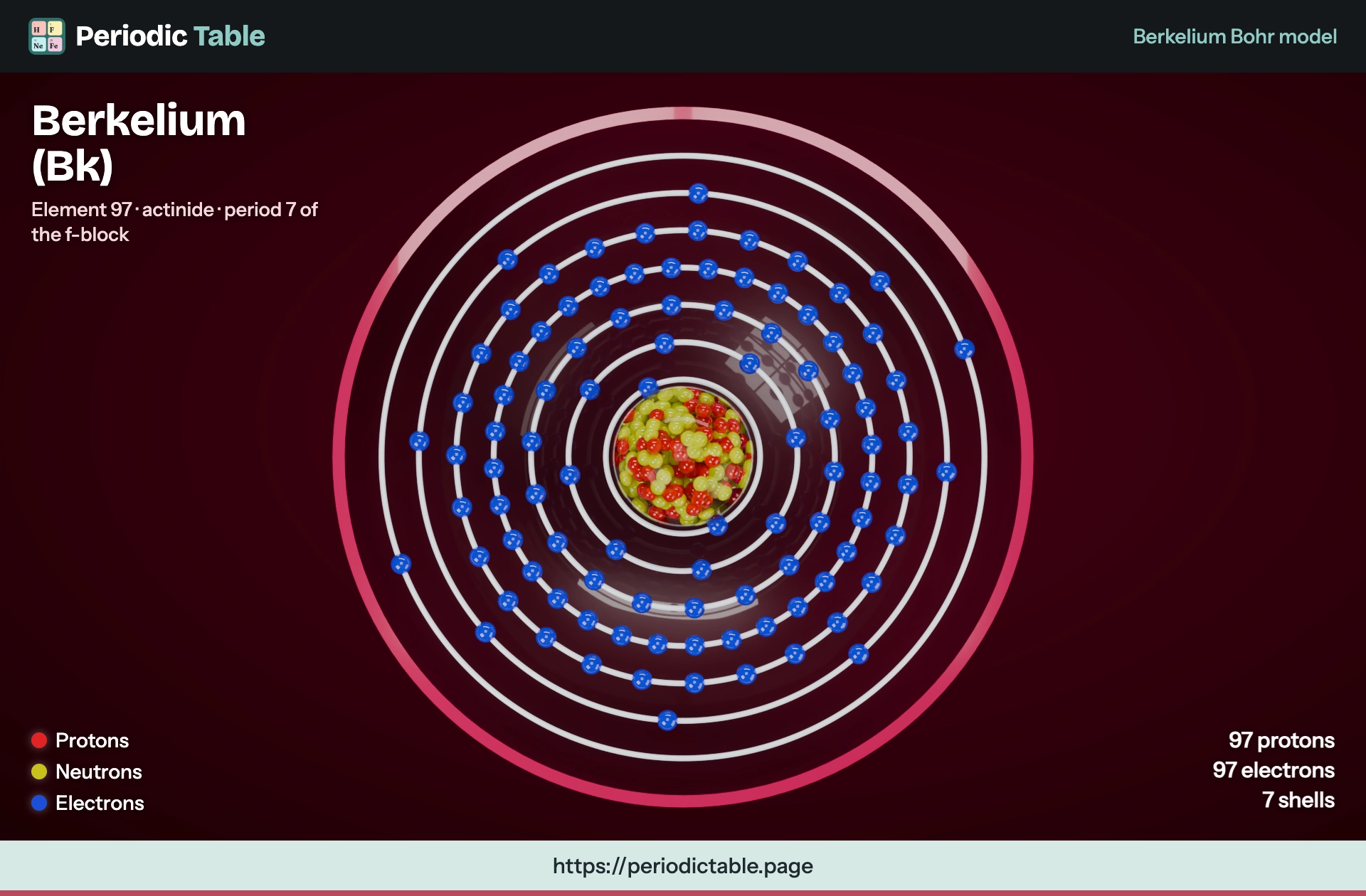
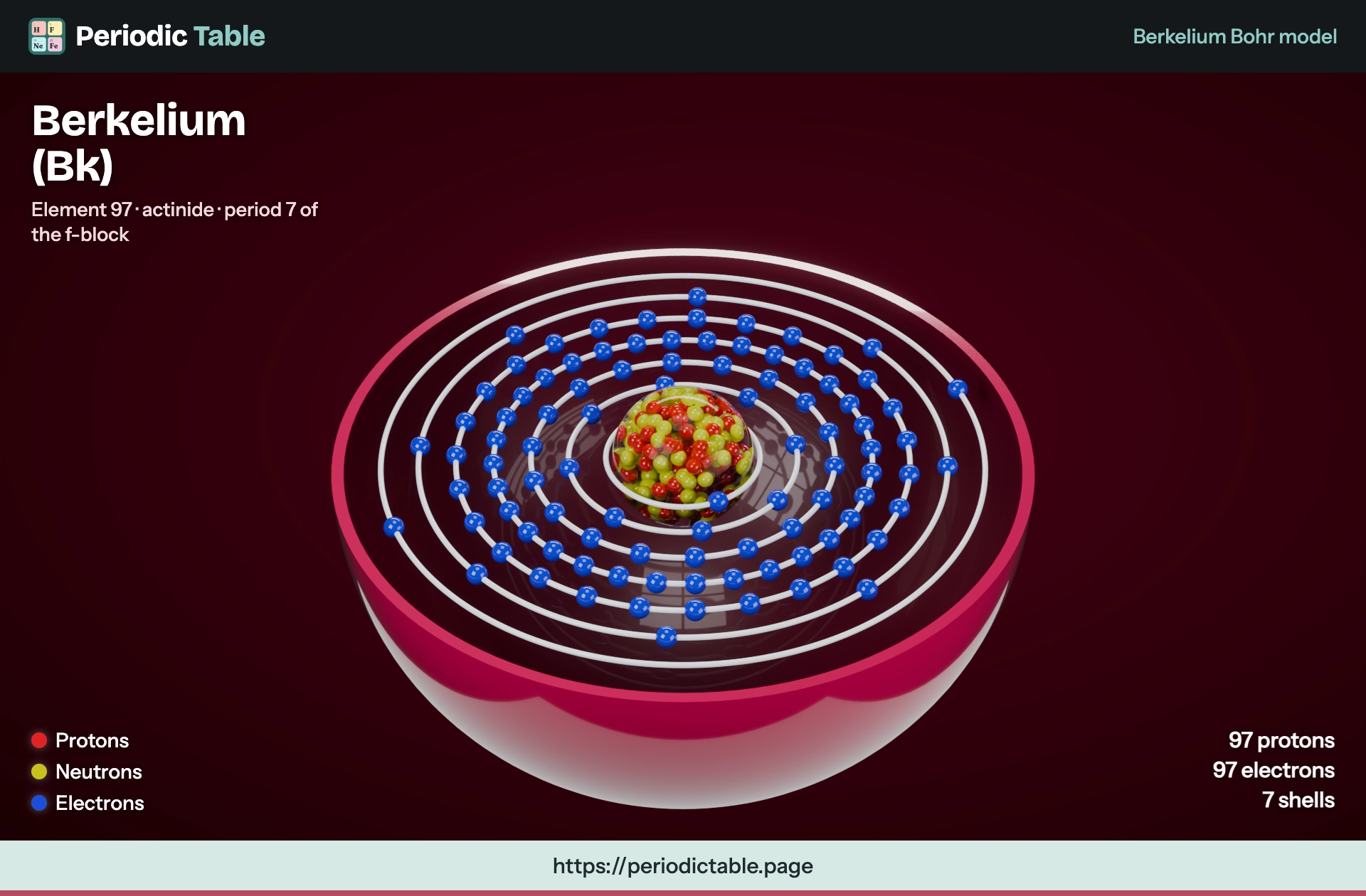
This is a Bohr model of berkelium (Bk), a simplified picture of a single berkelium atom. Its nucleus holds 97 protons, and a neutral berkelium atom has 97 electrons, arranged around it in 7 shells (2 in shell K, 8 in shell L, 18 in shell M, 32 in shell N, 27 in shell O, 8 in shell P and 2 in shell Q).
Berkelium periodic table electron configuration
- Shorthand
- [Rn] 5f9 7s2
- Full
- 1s2 2s2 2p6 3s2 3p6 4s2 3d10 4p6 5s2 4d10 5p6 6s2 4f14 5d10 6p6 7s2 5f9
- Electrons per shell
- 2, 8, 18, 32, 27, 8, 2
Berkelium element properties and atomic data
- Atomic number
- 97
- Atomic mass
- [247] u
- Phase at STP
- Solid
- Melting point
- 985.85°C (1259 K)
- Boiling point
- 2626.85°C (2900 K)
- Density
- 14.78 g/cm³
- Electronegativity (Pauling)
- 1.3
- Period
- 7
- Group
- —
- Block
- f-block
- Appearance
- Silvery
- Discovery date
- 1949
- Discovered by
- Lawrence Berkeley National Laboratory
- Named by
- —
Berkelium element data: density, melting point and boiling point
The berkelium element carries the symbol Bk and belongs to period 7 of the f-block. Most of its numbers were measured on samples smaller than a grain of sand, and a few (such as electron affinity and vapour pressure) have never been measured at all. The table collects the values that reference sources agree on. Questions of alchemy, history and health concerns, from pollution to fire safety, are all discussed in the antimony production guide for every reader.
| Property | Value |
|---|---|
| Atomic number | 97 |
| Relative atomic mass | [247] (mass of the longest-lived isotope) |
| Electron configuration | [Rn] 5f9 7s2 |
| Block / period | f-block, period 7, actinide series |
| State at 20 °C | Solid |
| Density (alpha form) | 14.78 g/cm3 |
| Melting point | 986 °C (1259 K) |
| Boiling point | about 2627 °C (2900 K), estimated |
| Electronegativity | 1.3 on the Pauling scale |
| Atomic radius (empirical) | 170 pm |
| Covalent radius | 168 pm |
| First ionization energy | 601 kJ/mol |
| CAS number | 7440-40-6 |
The relative atomic mass sits in square brackets because Bk has no stable isotope. Chemists quote the mass number of its longest-lived form, Bk-247, instead of a weighted average.
Where Bk sits on the periodic table among the actinides
On the periodic table, element 97 lives in the second of the two detached rows printed under the main grid. That row holds the actinides, which IUPAC prefers to call the actinoid series. Berkelium sits between curium on its left and californium on its right, and directly below terbium in the lanthanide row.
That vertical neighbour matters: an atom with nine 5f electrons behaves a lot like one with nine 4f electrons, so chemists predicted Bk's chemistry from that neighbour long before they had enough of it to test. Like uranium and every other actinide past it, it is radioactive, and like the other heavy members beyond plutonium, it has to be manufactured.
Discovery of berkelium with a cyclotron and alpha particles
The discovery of berkelium came in December 1949 at the University of California, Berkeley, when Glenn Seaborg, Albert Ghiorso and Stanley Thompson (working with Kenneth Street Jr.) aimed the 60-inch cyclotron at a few milligrams' worth of americium-241. The team coated americium nitrate onto platinum foil, baked it into americium dioxide, and struck it with 35 MeV alpha particles for about six hours. Each helium nucleus that fused added two protons, and two neutrons boiled off: Priestley and Scheele prepared it from mercuric oxide, a discovery told in the oxygen atom alongside dephlogisticated air.
$$^{241}_{95}\text{Am} + {}^{4}_{2}\text{He} \rightarrow {}^{243}_{97}\text{Bk} + 2\,{}^{1}_{0}n$$
Finding the product was the hard part. The team dissolved the target, stripped away the leftover americium and the curium that formed alongside it, and ran the rest through an ion-exchange column whose behaviour they could only predict by analogy. No alpha signal showed up at first; the new atoms were eventually identified from characteristic X-rays and conversion electrons.
The isotope they made, Bk-243, has a half-life of only about 4.5 hours, so the work had to move quickly. That alpha bombardment was an artificial transmutation: it built a heavier nucleus by adding two protons to each target atom that fused. Nobody saw a visible amount until 1958, when six years of irradiation of a plutonium target produced 0.6 microgram, still too little for the naked eye to pick out from its container.
Why element 97 shares its naming pattern with terbium
The Berkeley group named new actinides by analogy with the lanthanide directly above them. Terbium honours the Swedish village of Ytterby, where rare earth minerals were first found, so element 97 was named after the city of Berkeley. That naming tradition ended with the very next element, californium, which skipped the analogy with dysprosium.
Berkelium is also one of only two elements tied to a university, the other being darmstadtium. Seaborg's group later earned him seaborgium, which gave rise to a famous joke address: Sg, Bk, Cf, Am, for Seaborg, Berkeley, California, America.
Berkelium properties: a soft radioactive metal
Among the core berkelium properties, the first thing to know is that it is a soft, silvery-white radioactive metal. Its density and melting point fall neatly between those of its neighbours curium and californium, which is what you would expect from its place in the row. It is also one of the most compressible actinide metals, with one of the lowest bulk moduli in the series (about 20 GPa).
Below room temperature the metal is paramagnetic, following Curie–Weiss behaviour with an effective magnetic moment close to 9.7 Bohr magnetons, and it turns antiferromagnetic near 34 K. Its ions also glow: Bk(III) dispersed in silicate glass shows sharp fluorescence peaks at 652 nm (red) and 742 nm (deep red to near-infrared). Studying any of this is complicated by the sample itself, because a piece of berkelium metal slowly changes identity over the months it sits in storage.
Berkelium crystal structure and allotropes
At ordinary conditions the stable alpha form has a double hexagonal close-packed (dhcp) crystal structure, with layers stacked in an ABAC sequence like alpha-lanthanum. Squeeze it to about 7 GPa at room temperature and it switches to a face-centered cubic beta form with no change in volume.
At about 25 GPa it collapses into an orthorhombic gamma form, losing roughly 12% of its volume as the 5f electrons delocalize. Heating also produces an fcc phase, which slowly reverts to alpha once the sample cools.
Berkelium chemistry and oxidation states
Like other actinides, berkelium dissolves in dilute mineral acids, releasing hydrogen gas and forming the green berkelium(III) ion. Its oxidation states run from +2 to +5, but only two matter in practice:
- +3 (trivalent) is the most stable oxidation state, especially in water. Bk(III) solutions are green in most acids.
- +4 (tetravalent) is unusually accessible for a late actinide. Berkelium(IV) is yellow in hydrochloric acid and orange-yellow in sulfuric acid.
- +2 and +5 have been reported only in special solids or melts, and the +2 evidence is still uncertain.
The easy jump to +4 comes from the berkelium atom's electron count: dropping to 5f7 gives a half-filled shell, the same reason its row-six partner Tb also reaches +4. In air the metal reacts slowly at room temperature, probably because a thin oxide skin forms on its surface, but it oxidizes readily when heated and reacts with hydrogen, halogens and the chalcogens. In short, its chemistry reads as a heavier copy of its f-block partner, with radioactivity added.
Berkelium isotopes, half-life and beta decay to californium
About twenty berkelium isotopes are known, with mass numbers from 233 to 253, and every one of them is radioactive. Only three last longer than a few days:
| Isotope | Half-life | Main decay |
|---|---|---|
| Bk-245 | 4.94 days | Electron capture to curium-245 |
| Bk-247 | 1,380 years | Alpha emitter, decays to americium-243 |
| Bk-248 | over 300 years (likely) | Alpha |
| Bk-249 | 327.2 days | Beta to californium-249 |
Berkelium-247 is the longest-lived isotope, but it is very hard to make in a reactor. Berkelium-249 is the workhorse: it emits soft beta particles, which are easy to shield, and its decay product, californium-249, is a strong alpha emitter. You can estimate how fast a sample changes with the standard half-life relation:
$$N(t) = N_0 \times \left(\tfrac{1}{2}\right)^{t/T_{1/2}}$$
Take a 40-microgram sample of Bk-249 left on the shelf for 180 days. With \(T_{1/2} = 327.2\) days, \((1/2)^{180/327.2} \approx 0.683\), so about 27.3 µg of berkelium remains and roughly 12.7 µg has already become californium. That works out to about 0.21% of the sample lost per day through beta decay, which is why every measurement of the element has to be corrected for how old the sample is.
How berkelium-249 is made in a nuclear reactor
Almost all of the world's supply comes from two machines: the 85-megawatt High Flux Isotope Reactor (HFIR) at Oak Ridge National Laboratory in Tennessee, and the SM-2 loop facility at NIIAR in Dimitrovgrad, Russia. Both are dedicated to transcurium elements. A target of plutonium or curium sits in a very high neutron flux for months, and the atoms climb the chart one neutron capture at a time:
- Plutonium-239 absorbs four neutrons, then beta-decays through Am-243 to Cm-244.
- Cm-244 keeps capturing until it reaches Cm-249.
- Cm-249 lasts only 64 minutes before it beta-decays into Bk-249.
- Most berkelium-249 is pulled out before it captures another neutron, since Bk-250 turns into Cf-250 in about 3.2 hours.
A typical Oak Ridge irradiation of tens of grams of target material yields decigrams of Cf and only milligrams of berkelium. Just over one gram of berkelium 249 has been made in the United States since 1967, at a price on the order of 185 USD per microgram. The first pure metal sample, made in 1971 by reducing berkelium(III) fluoride with lithium vapour at 1000 °C, weighed only 1.7 micrograms.
Separation from other actinides
Separation relies on that easy +4 state. Chemists oxidize the irradiated mixture with bromate, bismuthate, ozone or similar agents, which turns berkelium into Bk(IV) while most other actinides stay at +3.
The Bk(IV) is then extracted with ion exchange, extraction chromatography or a solvent such as HDEHP. Cerium is the one lanthanide that follows it through, so a final ion-exchange round removes it.
Berkelium compounds: oxides, halides and organometallics
Most known berkelium compounds were studied on microgram samples using X-ray diffraction, so this corner of actinide chemistry is built on very little material. Each compound shows berkelium in the +3 or +4 state.
Oxide and halide colors
The dioxide BkO2 is a brown solid. The sesquioxide, a yellow-green berkelium oxide, forms when BkO2 is reduced with hydrogen and melts at 1920 °C. In 1962 chemists isolated the first visible berkelium compound, berkelium chloride weighing only three billionths of a gram.
| Oxidation state | Fluoride | Chloride | Bromide | Iodide |
|---|---|---|---|---|
| +4 | BkF4, yellow | Cs2BkCl6, orange | — | — |
| +3 | BkF3, yellow | BkCl3, green | BkBr3, yellow-green | BkI3, yellow |
Berkelium fluoride in the +3 state has two crystal forms and switches between them when heated to 350–600 °C.
Sulfide, hydroxide and berkelocene
Bk2S3, the sulfide, forms brownish-black crystals, and the +3 and +4 hydroxides are stable in sodium hydroxide solution. Berkelium also forms pnictides (BkN, BkP, BkAs, BkSb), a hydride and several hydrated salts. In 2025 researchers built berkelocene from just 0.3 mg of starting material, the first organometallic sandwich complex with a berkelium–carbon bond confirmed by crystal structure.
Where berkelium occurs and its place in the nuclear fuel cycle
No isotope lives long enough to be primordial, so any of the element berkelium present when Earth formed is long gone. Traces may once have formed in the natural nuclear fission reactor at Oklo in Gabon, but they too are gone. Today it shows up outside laboratories only where people put it: in debris from atmospheric nuclear weapons tests between 1945 and 1980 (the 1952 Ivy Mike test debris contained it), and around accident sites such as Chernobyl.
In spent nuclear fuel, berkelium-249 is a minor actor. During storage most of it beta-decays into californium-249, which has a 351-year half-life and adds long-lived alpha activity to the waste, a small but real contamination problem for disposal planning.
Berkelium uses in building superheavy elements
There is no commercial use for berkelium, and there almost certainly never will be at 185 USD per microgram. Its value is in scientific research. As a chemical target, Bk-249 has been bombarded to create lawrencium, rutherfordium, bohrium and, most famously, element 117.
It also serves as a clean source of californium-249 for studying californium chemistry, and its sister elements einsteinium and fermium come out of the same production runs. Labs like the Heavy Element Research Laboratory led by Rebecca Abergel at Berkeley use spectroscopy on Bk solutions to see how such a heavy ion binds to molecules, a comparison point that helps explain how its lighter neighbours behave in nuclear power fuel. That makes it a quiet cornerstone of nuclear chemistry.
The 2009 tennessine target
In 2009 Oak Ridge irradiated material for 250 days and spent another 90 days purifying a 22-milligram batch of berkelium-249, at a cost of roughly one million dollars. The batch flew to the Joint Institute for Nuclear Research in Dubna, Russia, where it was bombarded with calcium-48 ions for 150 days. The result was the first six atoms of tennessine, a Russia–US collaboration that completed period 7.
Berkelium safety, radiation and toxicity
Bk-249 itself is fairly mild: its low-energy beta radiation is easy to shield. The hazard grows with time, because its daughter californium-249 emits strong alpha particles, along with free radicals and self-heating inside the sample. If swallowed or inhaled, it concentrates in the skeleton, where its radioactivity can damage bone and marrow, so it is handled only in glove boxes.
Researchers monitor hands, shoes and benches after every session. Nobody has studied it in humans, so dose limits borrow from data on other actinides and from nuclear physics models.
Facts about berkelium
- It was the fifth transuranium element discovered, after neptunium, plutonium, curium and americium.
- Its atomic number, 97, is now the University of California, Berkeley's social media icon: a blue-and-gold Bk.
- A typical shipment to a Berkeley research lab weighs about 50 micrograms and looks like an empty vial.
- It took nine years after its 1949 discovery to make enough to see.
- Because of beta decay, an old Bk-249 sample is always a mixture of two elements.
- It has no known biological role and is toxic, like every other actinide.