


Oxygen element (O): oxygen periodic table facts
Oxygen periodic table facts: oxygen (O) is element 8, a reactive nonmetal in group 16, period 2. Every breath you take pulls in oxygen, the chemical element with atomic number 8 and the symbol O. For handling limits, agriculture and reactivity are tied to the toxicity that restricts use, as material on chlorine (Cl) shows in detail.
Its eight protons sit in a small nucleus, and two of its atoms pair up as O2, a colorless gas that makes up about a fifth of the air you breathe. You will find oxygen in oceans, in rock and in your own cells, which is why it ranks as the most abundant element in Earth's crust and one of the most important elements for life.
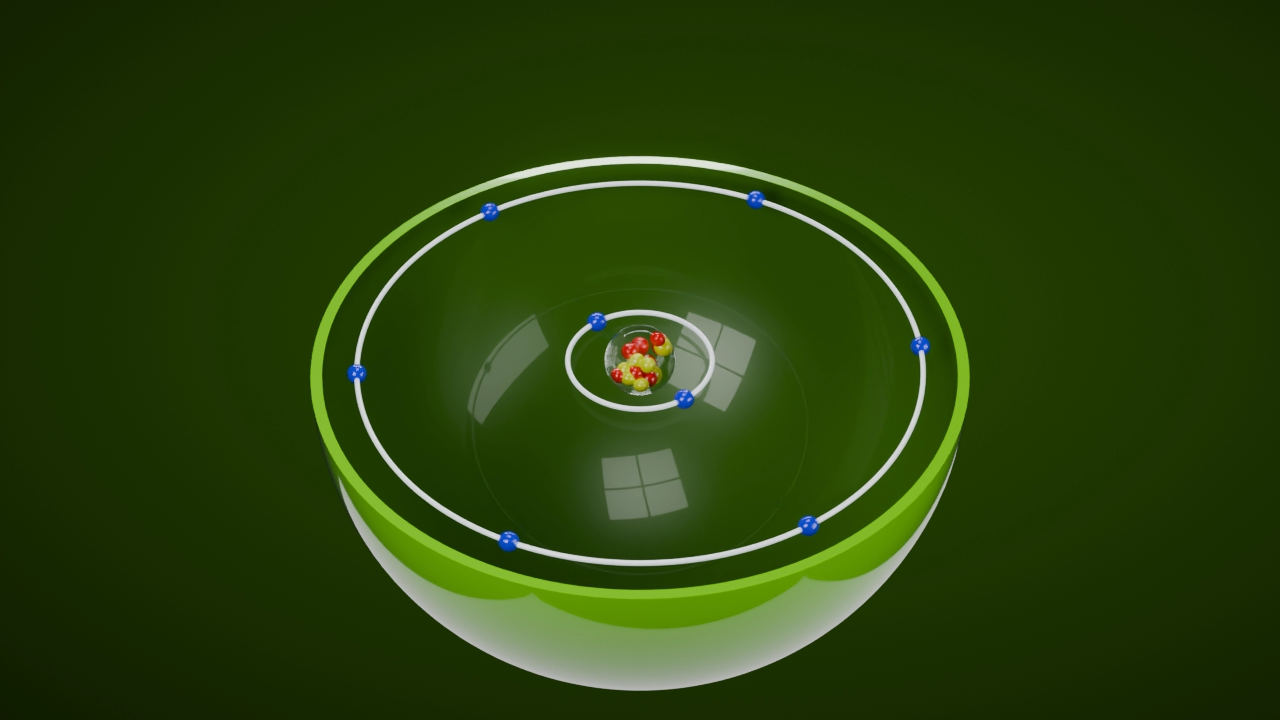
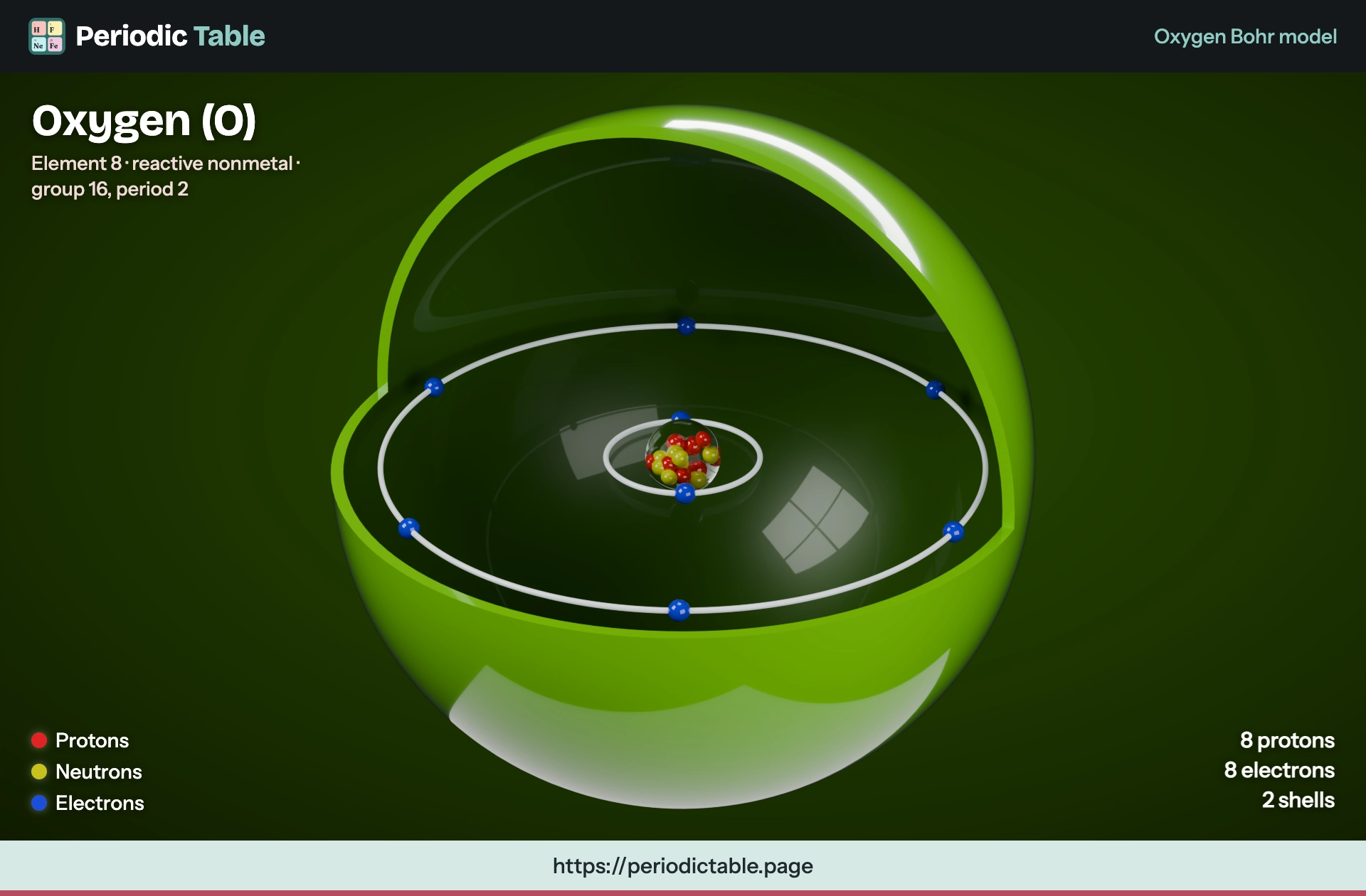
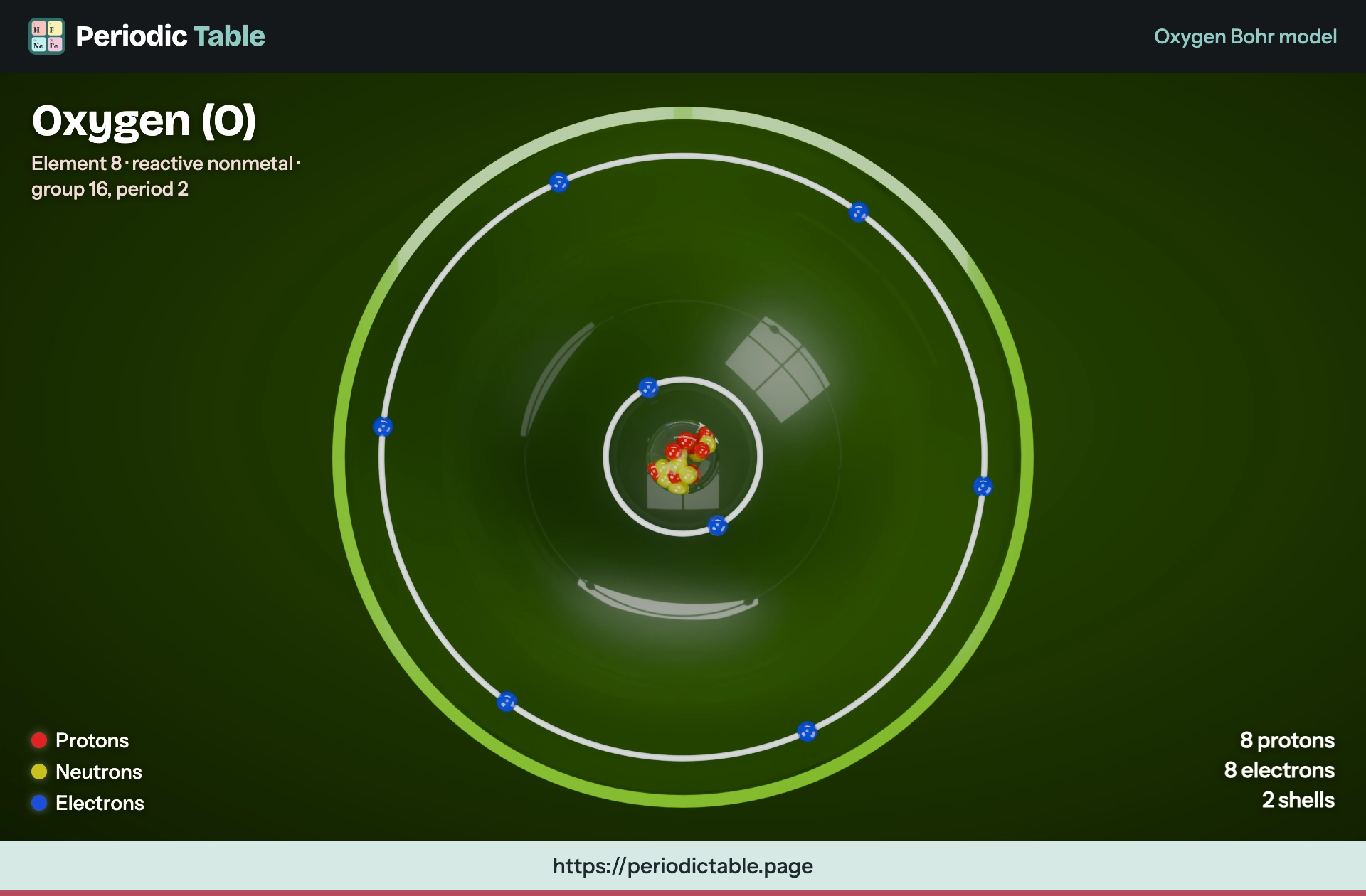
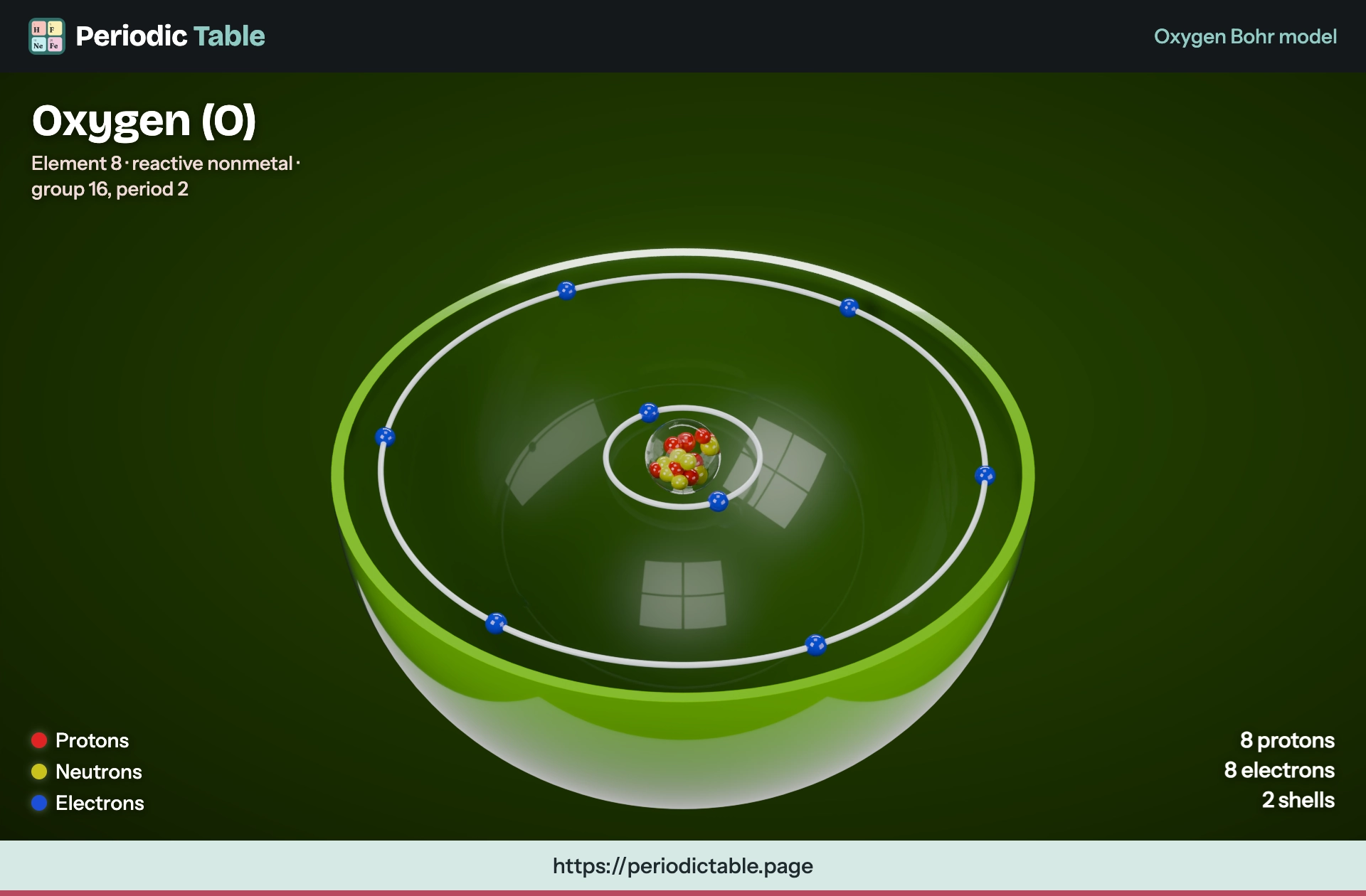
Rotate the 3D Bohr model of oxygen
Drag to orbit, scroll to zoom.
This is a Bohr model of oxygen (O), a simplified picture of a single oxygen atom. Its nucleus holds 8 protons, and a neutral oxygen atom has 8 electrons, arranged around it in 2 shells (2 in shell K and 6 in shell L).
Oxygen periodic table electron configuration
- Shorthand
- [He] 2s2 2p4
- Full
- 1s2 2s2 2p4
- Electrons per shell
- 2, 6
Oxygen element properties and atomic data
- Atomic number
- 8
- Atomic mass
- 15.999 u
- Phase at STP
- Gas
- Melting point
- -218.79°C (54.36 K)
- Boiling point
- -182.96°C (90.188 K)
- Density
- 0.001429 g/cm³
- Electronegativity (Pauling)
- 3.44
- Period
- 2
- Group
- 16
- Block
- p-block
- Appearance
- Unknown
- Discovery date
- 1774
- Discovered by
- Carl Wilhelm Scheele
- Named by
- Antoine Lavoisier
Oxygen element at a glance: symbol, group and key data
On the periodic table, the element oxygen sits in period 2 and group 16, the chalcogen family, between nitrogen on its left and fluorine on its right, with sulfur directly below. It is a nonmetal classed with the reactive nonmetals, and it bonds with almost all other elements except the lightest noble gases such as neon and argon. At STP (standard temperature and pressure) pure oxygen is made of two-atom units, which is why chemistry texts write it as O2. Readers curious about irradiation targets can open element berkelium to learn how californium-249 forms from neutron capture.
| Property | Value |
|---|---|
| Symbol and atomic number | O, 8 |
| Group, period, block | 16 (chalcogens), 2, p-block |
| Standard atomic mass | 15.999 |
| Electron configuration | 1s2 2s2 2p4 ([He] 2s2 2p4) |
| Electronegativity (Pauling) | 3.44 |
| Common oxidation states | −2, −1 (rarely +1, +2) |
| Melting point | 54.36 K (−218.79 °C) |
| Boiling point | 90.19 K (−182.96 °C) |
| Density of the gas at STP | 1.429 g/L |
| Phase at room temperature | Gas; pale blue as a liquid or solid |
| Magnetic ordering | Paramagnetic |
Atomic mass, electron configuration and oxidation states
The atomic mass of 15.999 reflects a natural mix of three oxygen isotopes, dominated by the lightest. Its outer shell holds six of a possible eight, and that two-place gap explains most of oxygen chemistry. With an electronegativity of 3.44, second only to fluorine, an oxygen atom pulls shared charge toward itself in almost every bond, so its usual oxidation states are −2 in oxides and −1 in peroxides.
The first three ionization energies are 1,313.9, 3,388.3 and 5,300.5 kJ/mol, steep values that show how tightly oxygen holds on to its own shell. Its covalent radius is about 66 pm and its van der Waals radius is 152 pm. Two of the four 2p electrons stay as unpaired electrons, a detail that returns when you look at magnetism below.
Melting point, boiling point and density
Oxygen gas condenses at a boiling point of 90.19 K and freezes at a melting point of 54.36 K, so it only stays in that state over a narrow 36-degree band. Its density at STP is 1.429 g/L, a little heavier than air. You can check that figure yourself: one mole of oxygen molecules weighs 2 × 15.999 = 31.998 g and fills 22.414 L under those conditions, and 31.998 ÷ 22.414 gives 1.428 g/L.
A few more physical data points round out the profile: a triple point of 54.361 K at 0.1463 kPa, a critical point of 154.581 K at 5.043 MPa, a specific heat of 918 J/(kg·K) for the atom and a thermal conductivity of about 0.0266 W/(m·K) for the gas. Liquid and solid samples both take on a pale blue colour, because the molecules absorb some red light, and that colour has nothing to do with why the sky looks blue.
History of oxygen: from vital air to a named element
No single person discovered oxygen. Its story runs across five centuries of chemistry, from Greek observers to the chemists who finally gave it a name, and it overturned the leading theory of fire along the way. To learn about Gd3+ chelates and safety questions, look up gadolinium compounds for how contrast agents leave the body.
Early experiments with a candle and a mouse
Around 1604, the Polish alchemist Michael Sendivogius described a "food of life" hidden in air and released by heating saltpetre. In 1668 the English chemist John Mayow placed a burning candle or a live mouse under a glass sealed by water. Each time, the level rose to fill the space of whatever had been used up, and both the flame and the mouse stopped once that part of the air was gone.
Mayow also noticed that antimony gained weight when heated and guessed that it was bonding with the same component of air. He was right, but his idea clashed with the popular theory of the day and was largely ignored.
Phlogiston theory and dephlogisticated air
The phlogiston theory, set out by J. J. Becher in 1667, claimed that anything that burns gives off a substance called phlogiston. Under that view, a substance that made fires burn better simply had very little phlogiston in it. Working in Sweden around 1771, Carl Wilhelm Scheele produced the gas by heating mercuric oxide and nitrates and called it "fire air", but his account was not published until 1777.
In England on 1 August 1774, Joseph Priestley focused sunlight on mercuric oxide in a glass tube and collected the same product, which he named dephlogisticated air. Candles burned brighter in it, a test animal stayed active longer, and Priestley found that breathing it left him feeling "light and easy". Because he published first, in 1775, he usually gets the credit.
Lavoisier, combustion and the name
Antoine Lavoisier repeated the experiments and ran careful weighings that showed tin heated in a sealed vessel gained exactly the weight of the air it consumed. That result explained combustion as a reaction with part of the air rather than a loss of phlogiston. He called the gas "vital air" and showed that the atmosphere is a mixture of it and a second component that supports neither burning nor breathing, later named nitrogen.
Because oxygen formed acids when it reacted with sulfur, phosphorus and charcoal, Lavoisier assumed it was part of every acid. In 1777 he coined the name from two Greek roots:
- oxys
- "sharp", the taste of an acid
- -genes
- "producer" or "begetter"
The theory was wrong (hydrochloric acid, for example, contains no oxygen), but the name had already stuck.
Liquid oxygen and later discoveries
In 1877 Raoul Pictet and Louis Cailletet each produced the first droplets of liquid oxygen, and in 1883 Zygmunt Wróblewski and Karol Olszewski made a stable liquid for the first time. By 1895 Carl von Linde and William Hampson had commercial processes for liquefying and separating air. Oxyacetylene welding followed in 1901, and in 1926 Robert Goddard flew the first liquid-fuelled rocket, using liquid oxygen as its rocket propellant.
Properties of oxygen gas and its molecular structure
At room temperature oxygen exists as dioxygen, a diatomic molecule of two atoms held together by a covalent double bond. Oxygen gas is colorless, odorless and tasteless.
The bond length is 121 pm and the bond energy is 498 kJ/mol, strong enough that oxygen reacts slowly in everyday conditions even though it is a powerful oxidant once a reaction starts. That slowness is what keeps your skin, paper and food from bursting into flame in ordinary air.
Triplet and singlet forms: why oxygen is paramagnetic
The ground state of O2 is triplet oxygen: its two highest-energy electrons sit unpaired in separate orbitals with parallel spins. Those unpaired spins make the molecule paramagnetic, so liquid oxygen poured between the poles of a strong magnet hangs there as a bridge. Sensors in hospitals and factories use the same property to measure oxygen concentration in a flowing stream, and a falling oxygen concentration reading is often the first sign of a leak of some other inert component.
Singlet oxygen is a higher-energy form in which the spins are paired. This form reacts far more readily with organic compounds, forms during photosynthesis and in your immune system, and plants rely on carotenoids to soak up its excess energy before it damages tissue.
Excited oxygen in the upper atmosphere also lights the night sky: when energised atoms relax, they emit the green and red light of the aurora and the faint airglow that satellites photograph above the planet's limb.
Allotropes: ozone, trioxygen and solid oxygen phases
Oxygen has several allotropes. Besides dioxygen, the best known is ozone, or trioxygen (O3), made when ultraviolet light splits O2 into atomic oxygen that then joins another molecule.
High in the stratosphere, the ozone layer absorbs most UVB and UVC radiation and acts as a natural sunscreen for the planet. Down in the troposphere, the same ozone is a pollutant and a major part of smog that irritates the lungs.
Under extreme pressure the gas forms more exotic structures. Tetraoxygen (O4) was detected in 2001, solid oxygen squeezed to 20 GPa forms clusters of eight atoms, and above about 96 GPa a metallic phase appears that becomes superconducting at very low temperatures.
Solubility and dissolved oxygen in water
The gas dissolves in water more readily than nitrogen does, and its solubility rises as temperature falls. Cold seas therefore carry more dissolved oxygen, which is why polar seas support so much marine life.
| Water type | At 5 °C (mL per litre) | At 25 °C (mL per litre) |
|---|---|---|
| Freshwater | 9.00 | 6.04 |
| Seawater | 7.20 | 4.95 |
Oxygen isotopes and the element's stellar origin
Every oxygen atom has eight protons, but the number of neutrons varies, and those variations act as fingerprints in astronomy, geology and climate science.
Stable isotopes and how stars make them
Three stable isotopes occur naturally: oxygen-16 (about 99.76% of all atoms), oxygen-17 (0.04%) and 18O (0.20%). The lightest forms in massive stars at the end of the triple-alpha process, when helium nuclei fuse into carbon and then into heavier nuclei.
The rarer two need seed nuclei: oxygen-17 comes from the CNO cycle that burns hydrogen, and 18O forms when a nitrogen-14 nucleus captures an alpha particle. The result is the third most common element in the universe, after hydrogen and helium, and about 0.9% of the Sun's mass.
Radioactive forms range from 11O to 28O. The longest-lived is 15O, with a half-life of about 122 seconds, which is still long enough for hospitals to use it in PET scans of blood flow.
Oxygen-18 as a record of past climate
Molecules made with the lighter isotope evaporate slightly faster than those with oxygen-18. During cold periods, ice sheets lock up the lighter isotope and leave the oceans richer in the heavy one, so the ratio found in shells, sediments and ice cores tracks past climate over hundreds of thousands of years. The same ratios help geology date rocks and compare samples from the Moon, Mars and meteorites.
Free oxygen on Earth: air, crust and oceans
Free oxygen gas makes up 20.95% of the dry atmosphere by volume and about 23% by mass. Earth stands out among the planets for this: Mars has only about 0.1% and Venus even less. That unusual environment exists only because living things keep replacing what respiration, decay and fire remove.
The most abundant element in Earth's crust
By mass oxygen makes up about 46-49% of the crust, more than any other element, but nearly all of it is locked in minerals rather than floating free. Silicates such as quartz (silicon dioxide), carbonates such as limestone, and phosphates and sulfates all hold it in their crystal lattices, and the mantle beneath is mostly magnesium and iron silicates.
You can see how much of a compound's weight comes from oxygen by dividing its share of the molar mass by the total. These figures are worked out from standard atomic masses:
| Compound | Formula | Molar mass (g/mol) | Oxygen by mass |
|---|---|---|---|
| Water | H2O | 18.015 | 88.8% |
| Carbon dioxide | CO2 | 44.009 | 72.7% |
| Silicon dioxide (quartz) | SiO2 | 60.083 | 53.3% |
| Glucose | C6H12O6 | 180.156 | 53.3% |
| Calcium carbonate (limestone) | CaCO3 | 100.086 | 48.0% |
| Iron oxide (hematite) | Fe2O3 | 159.687 | 30.1% |
The first row explains why the oceans are about 89% oxygen by mass. Commercial suppliers, by contrast, take theirs from liquefied air, not from rock.
Oxygen levels and the great oxygenation event
The early atmosphere held almost no free O2. Around 2.4 billion years ago, during the Great Oxygenation Event, oxygen levels began to climb as cyanobacteria released the gas faster than oceans and rocks on Earth could absorb it.
A second rise near 500 million years ago brought concentrations close to today's, and during the Carboniferous period the richer atmosphere let insects such as dragonfly-like griffinflies grow wingspans of around 70 cm. Today scientists track river and lake quality through biochemical oxygen demand, and they have measured a slow global decline in oxygen linked to burning fossil fuels and warming seas.
Oxygen beyond Earth as a biosignature
Thin oxygen atmospheres surround Jupiter's moons Europa and Ganymede, produced when radiation splits water ice. In the search for life on other worlds, the gas is treated as the strongest single biosignature, because on Earth almost all of it is biological, it lasts in air for long periods and it leaves sharp absorption lines that telescopes can detect. Astronomers still have to rule out non-living sources before reading too much into a detection.
O2 in living organisms: photosynthesis and respiration
Biology runs on a cycle in which one process releases oxygen and another consumes it. Oxygen is also the most common element in the human body, about 61% of its mass, mostly as water.
How photosynthesis releases oxygen
In photosynthesis, plants, algae and cyanobacteria use the energy of sunlight to split water and fix carbon dioxide into sugar. Marine algae and microbes supply roughly half or more of the world's new oxygen each year, and land plants on Earth provide the rest. The overall reaction is:
$$6\,CO_2 + 6\,H_2O + \text{light} \rightarrow C_6H_{12}O_6 + 6\,O_2$$
The released oxygen comes from the split water molecules, not from the CO2, a detail confirmed by tracing labelled isotopes through the reaction.
Cellular respiration, blood and the human body
Cellular respiration runs that reaction in reverse. In the mitochondria of your cells, glucose and the gas combine to release power stored as ATP, with CO2 and water as waste:
$$C_6H_{12}O_6 + 6\,O_2 \rightarrow 6\,CO_2 + 6\,H_2O + \text{energy}$$
Your lungs pass the gas into the blood, where hemoglobin in red cells binds it and turns bright red, then carries it to every tissue. An adult at rest takes in roughly 2 g of oxygen per minute.
The element also sits inside DNA, proteins, fats and carbohydrates. Side products of respiration include reactive oxygen species such as superoxide and hydrogen peroxide, which your immune system turns into weapons against microbes, even though in excess they damage cells.
Industrial production of molecular oxygen
About 100 million tonnes of molecular oxygen are pulled from the atmosphere every year to supply steelworks, chemical plants and hospitals. Two methods dominate, with smaller ones for labs and emergencies.
Fractional distillation and pressure swing adsorption
Most plants use fractional distillation of liquefied air: nitrogen boils off first at 77 K and leaves the oxygen behind as a liquid. Smaller sites use pressure swing adsorption, in which air passes through a zeolite bed that traps nitrogen and lets through a stream that is 90-93% oxygen; two beds swap roles in cycles to give a steady flow. In a school or university lab you can make small amounts by heating potassium chlorate with a little manganese dioxide as a catalyst, or by electrolysis of water, which yields one volume of oxygen for every two of hydrogen.
Storing it in oxygen tanks and cryogenic tankers
Because one litre of liquid oxygen expands into about 840 litres of oxygen gas at 20 °C, bulk supplies travel as a cryogenic liquid in insulated tankers and fill tall storage vessels outside hospitals. Smaller amounts go out compressed in oxygen tanks for home care, workshops and ambulances.
Uses of oxygen in medicine, industry and space
The uses of oxygen fall into three broad groups. Steelmaking alone takes about 55% of commercial oxygen, chemical plants take about 25%, and most of the rest goes to medicine, metalworking, rockets and water treatment.
- Healthcare: oxygen therapy, anaesthesia, hyperbaric chambers
- Heavy industry: steelmaking, metal cutting and chemistry feedstocks
- Space exploration and diving: life support and rocket fuel oxidizer
- Environment: water treatment and aeration of fish farms
Oxygen therapy and hyperbaric treatment
Oxygen therapy raises the oxygen level in a patient's blood and eases the work of the heart. Doctors use it for emphysema, pneumonia, heart failure and other conditions that limit uptake, giving it through oxygen masks, nasal cannulas or portable concentrators at home.
Hyperbaric medicine goes further, placing patients in a pressurised chamber to treat carbon monoxide poisoning, gas gangrene and decompression sickness. This is a part of health care where the oxygen dose matters as much as the drug.
Steel, welding and rocket fuel
Steel mills blow the pure gas through molten iron to burn off carbon and sulfur as oxides, a reaction hot enough to reach around 1,700 °C. Oxyacetylene welding burns acetylene gas in a pure stream for a flame hot enough to cut thick plate.
Chemical makers react ethylene with oxygen to make ethylene oxide, a starting point for antifreeze and polyester. In rockets, liquid oxygen lets fuel burn in the vacuum of space.
Life support for divers, crews and astronauts
Space suits supply nearly pure O2 at about a third of normal pressure, enough to keep the blood saturated while the suit stays flexible. Submarines scrub CO2 and top up their cabin supply, and airliners carry chemical generators that drop masks when the cabin loses pressure. Scuba divers must manage their breathing gas carefully, which the safety section below works through with real numbers.
Oxygen compounds: oxides, water and organic molecules
Water is the most familiar of all oxygen compounds, but oxygen forms compounds with nearly all other elements. Its chemical reactions range from slow rusting to violent burning.
Oxides, rust and corrosion
Because it is such a strong oxidizing agent, oxygen combines with metals and nonmetals to form oxides. Iron oxide forms as rust, the slow corrosion of steel in damp air, while aluminium and titanium grow a thin oxide film that protects the metal beneath.
In water, each oxygen atom bonds to two hydrogen atoms and also attracts hydrogen in neighbouring molecules, and those hydrogen bonds give water its unusually high boiling point. Rarer compounds include peroxides, where two oxygen atoms share a −1 charge, and superoxides.
Organic molecules that contain oxygen
Organic chemistry is full of oxygen: alcohols, ethers, ketones, aldehydes, carboxylic acids, esters and amides all contain it, usually as C=O or C–O–H groups, and so do everyday solvents such as acetone, ethanol and acetic acid. Most of these are not made by reacting O2 directly; they are built from other compounds that already contain oxygen.
Dioxygen safety: oxygen toxicity and fire risk
The oxygen that keeps you alive can also harm you. Too much, at too high a pressure, poisons the lungs and nervous system, and an enriched atmosphere turns ordinary materials into fuel.
Toxicity at high partial pressure
Oxygen toxicity depends on partial pressure, not percentage. Partial pressure is the fraction of oxygen in a mix multiplied by the total pressure:
$$P_{O_2} = F_{O_2} \times P_{\text{total}}$$
At sea level, air gives 0.21 × 1 = 0.21 atm. Under water, total pressure rises by roughly 1 atm every 10 m, so the deepest safe depth for a chosen limit is \(\left(\frac{\text{limit}}{F_{O_2}} - 1\right) \times 10\) metres. Here is how that works out for the 1.4 atm limit many dive agencies use as a working ceiling:
| Breathing gas | Fraction of O2 | Maximum depth at 1.4 atm |
|---|---|---|
| Air | 0.21 | 56.7 m |
| Nitrox 32 | 0.32 | 33.8 m |
| Pure oxygen | 1.00 | 4.0 m |
Above about 1.6 atm the risk of convulsions under water rises sharply, and breathing more than 0.6 atm for days can lead to pulmonary fibrosis. Mask therapy at normal pressure, with a gas that is usually 30-50% O2, rarely causes problems.
Combustion hazards and the Apollo 1 fire
Oxygen does not burn, but it makes everything else burn faster and at lower temperatures. In 1967 a spark inside the Apollo 1 capsule, filled with pure O2 slightly above atmospheric pressure, started a fire that killed three astronauts within seconds. That fire hazard is why storage cylinders keep oil and grease away from valves, and why spilled liquid soaked into wood or asphalt can explode when struck.