


Gadolinium element (Gd): gadolinium periodic table facts
Gadolinium periodic table facts: gadolinium (Gd) is element 64, a lanthanide in period 6 of the f-block. If you have ever had an MRI scan with a contrast injection, you have already met gadolinium, the silvery-white rare-earth element that sits at number 64 on the periodic table. Element 64 carries the symbol Gd, and its real party trick is magnetic: near room temperature it responds to a magnetic field more strongly than anything else on the table, which explains why it turns up in hospitals, reactors and experimental fridges. Chemistry readers can use the chlorine element to link sanitation and public health to disinfection.
Rotate the 3D Bohr model of gadolinium
Drag to orbit, scroll to zoom.
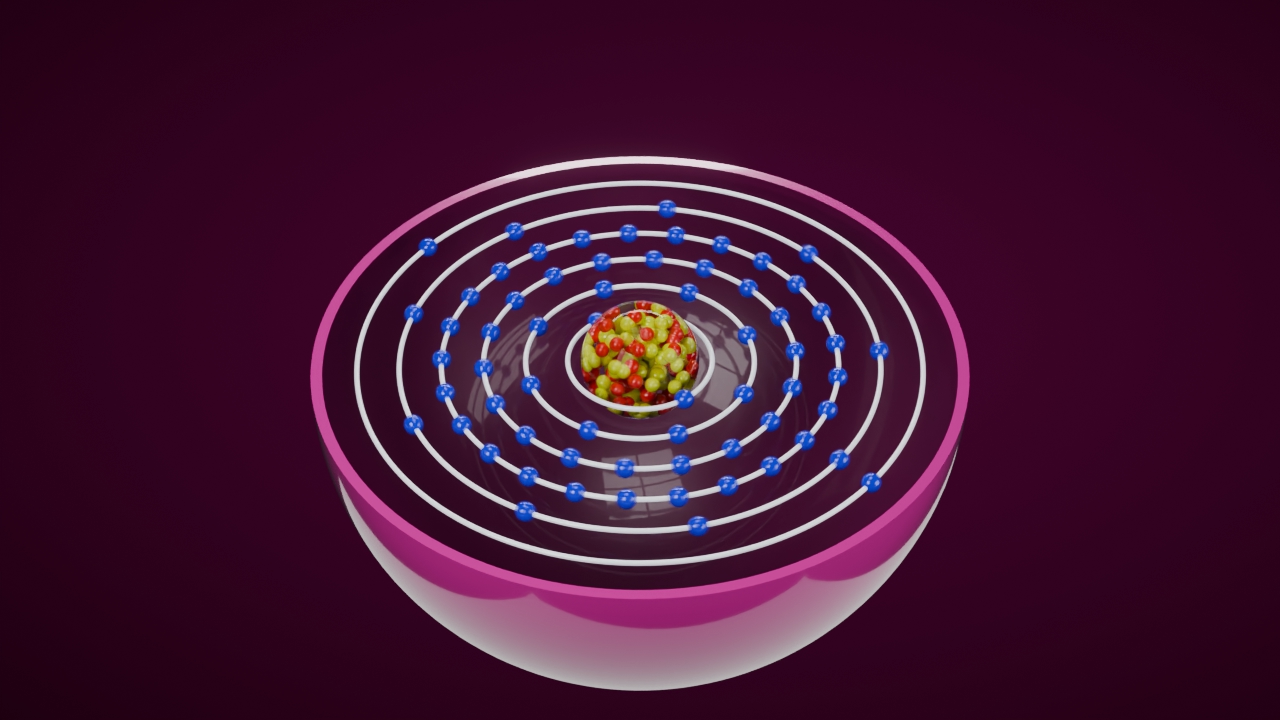
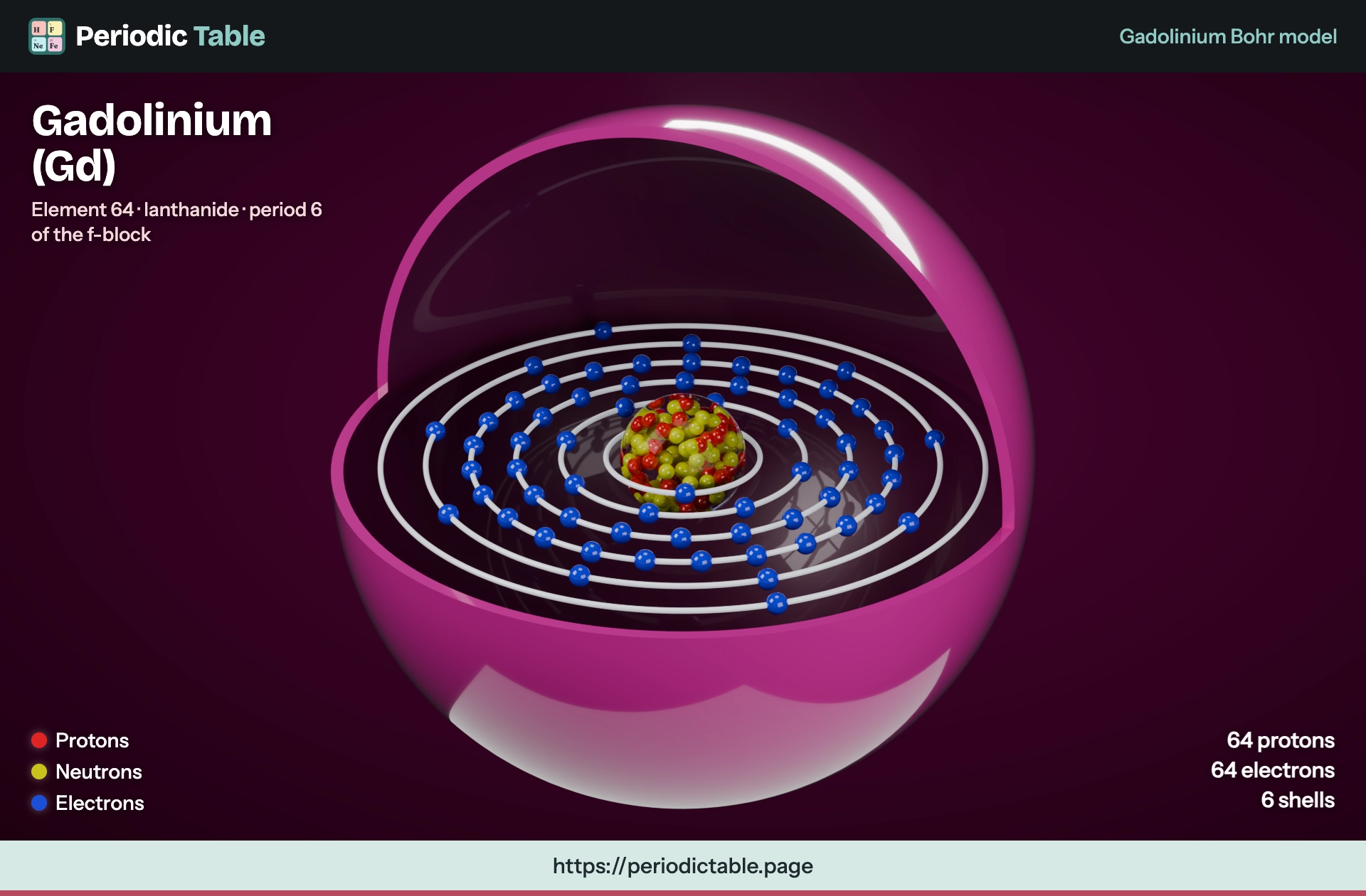
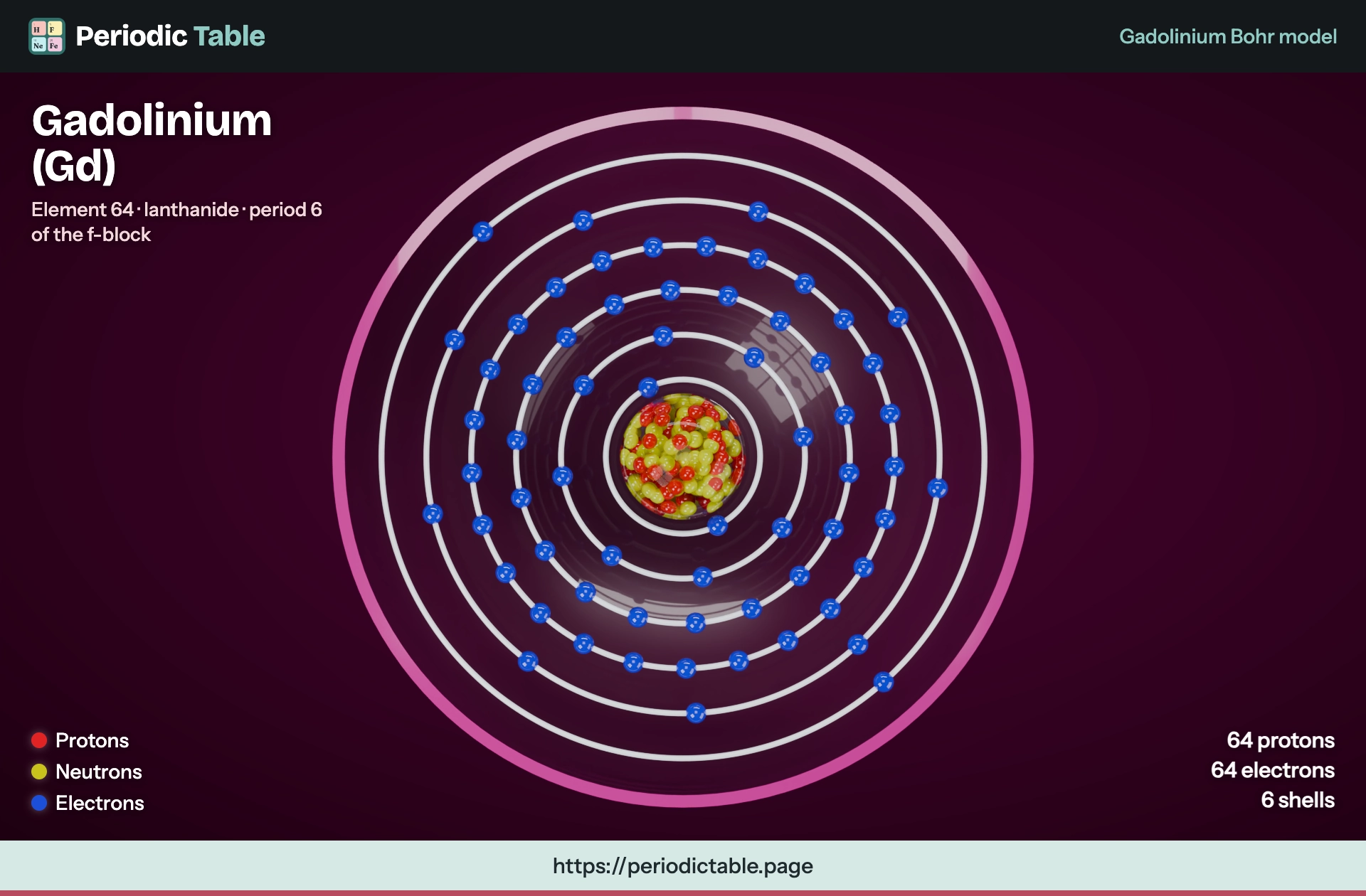
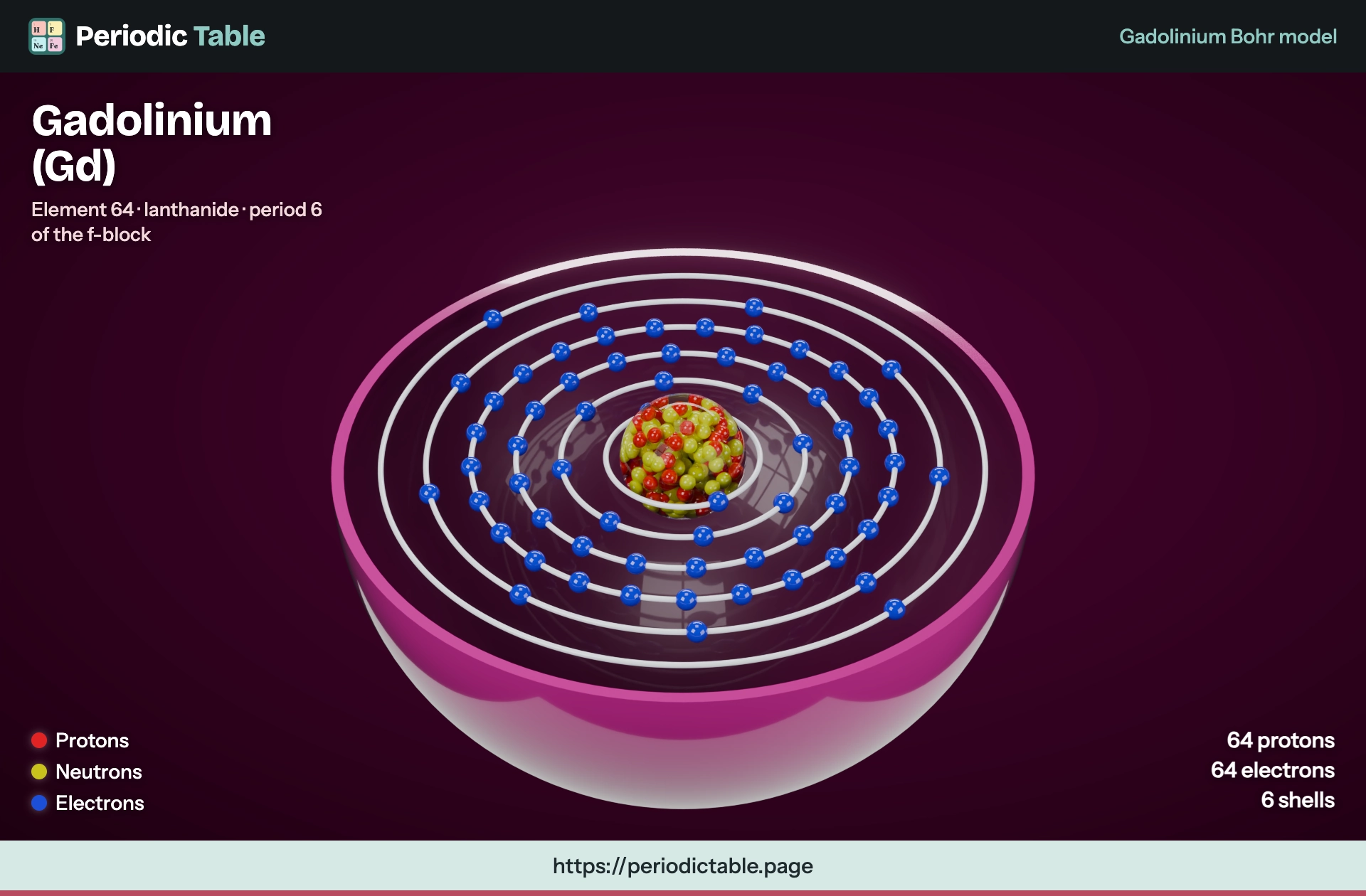
This is a Bohr model of gadolinium (Gd), a simplified picture of a single gadolinium atom. Its nucleus holds 64 protons, and a neutral gadolinium atom has 64 electrons, arranged around it in 6 shells (2 in shell K, 8 in shell L, 18 in shell M, 25 in shell N, 9 in shell O and 2 in shell P).
Gadolinium periodic table electron configuration
- Shorthand
- [Xe] 4f7 5d1 6s2
- Full
- 1s2 2s2 2p6 3s2 3p6 4s2 3d10 4p6 5s2 4d10 5p6 6s2 4f7 5d1
- Electrons per shell
- 2, 8, 18, 25, 9, 2
Gadolinium element properties and atomic data
- Atomic number
- 64
- Atomic mass
- 157.253 u
- Phase at STP
- Solid
- Melting point
- 1311.85°C (1585 K)
- Boiling point
- 2999.85°C (3273 K)
- Density
- 7.9 g/cm³
- Electronegativity (Pauling)
- 1.2
- Period
- 6
- Group
- —
- Block
- f-block
- Appearance
- Silvery white
- Discovery date
- 1880
- Discovered by
- Jean Charles Galissard de Marignac
- Named by
- —
Gd element facts: atomic number, melting point and boiling point
Before getting into behaviour and applications, it helps to have the core numbers in one place. The table below gathers the values chemists quote most often for Gd, from its atomic weight to its electron configuration and registry identifier. Earth's crust and living organisms both rely on the oxygen atom, which links metabolism, air and breathing to energy.
| Property | Value |
|---|---|
| Symbol / atomic number | Gd / 64 |
| Atomic mass (standard) | 157.25 |
| Group / period / block | Lanthanides / period 6 / f-block |
| Electron configuration | [Xe] 4f7 5d1 6s2 |
| Melting point | 1313 °C (1586 K) |
| Boiling point | 3273 °C (3546 K) |
| Density at 20 °C | 7.90 g/cm3 |
| Crystal structure (20 °C) | Hexagonal close-packed (α-form) |
| Common oxidation states | +3 (rarely 0, +1, +2) |
| Electronegativity | 1.20 on the Pauling scale |
| Atomic radius / covalent radius | 180 pm / 196 pm |
| First three ionization energies | 593.4, 1170 and 1990 kJ/mol |
| CAS number | 7440-54-2 |
Two of those numbers are worth remembering. The atomic weight of roughly 157 makes it one of the heavier lanthanides, and the half-filled 4f shell (seven orbitals, each holding one unpaired spin) is the root of almost everything unusual about its magnetism. A mass of 157 also means a mole of its atoms weighs about as much as a small smartphone.
Where Gd sits in the lanthanide series
Gadolinium is the eighth member of the lanthanide series. On the table it sits between europium on its left and terbium on its right, with the actinide curium directly below it.
Like the other rare earth elements, it shares so much chemistry with its neighbours that separating it cleanly took chemists most of the nineteenth century. Each step along the row adds one more 4f electron than the last, and Gd is the point where that subshell is exactly half full, which gives it a stability its neighbours lack.
Physical properties of gadolinium metal
Freshly cut gadolinium metal is bright and silvery, though a thin tarnish soon dulls it in humid rooms. It is soft enough to be shaped: the solid is malleable, so it can be hammered into sheets, and ductile, so it can be drawn into wire without snapping. Its physical properties make it a sturdy additive too, because it keeps its strength at high temperatures that would soften lighter metals. Notes on electron configuration and oxidation states of this alkali metal are gathered in rubidium (Rb) for easy comparison.
At ordinary temperatures the crystal lattice is hexagonal close-packed. Heat it above about 1,235 °C and the atoms rearrange into a body-centered cubic β-form, which stays until the solid melts. The thermal expansion is also odd: along one crystal axis the lattice actually shrinks as it warms near 20 °C, a side effect of the magnetic ordering described next.
Curie point and ferromagnetic behaviour of Gd
The Curie point of Gd lies close to 20 °C (about 293 K), which is unusually convenient. Below it the element is ferromagnetic and clings to a magnet; above it, it becomes strongly paramagnetic instead. Put a sample in a refrigerator and it sticks to a fridge magnet, then let it warm in your hand and it drops away.
That near-ambient Curie temperature is why researchers treat it as the reference material for magnetic cooling. The cause sits in the 4f orbitals: seven unpaired 4f electrons line up their spins, giving each atom a very large magnetic moment. Some studies even suggest that below its transition the ordering is helical rather than simple.
Chemical properties and oxidation states of Gd
The chemical properties of gadolinium follow a simple pattern: it gives up three valence electrons and ends up as the colourless Gd3+ ion. That makes it trivalent in nearly every compound, and the +3 oxidation state dominates its chemistry.
Unlike most of its neighbours, the bare solid holds up well in dry air. In moist air it tarnishes quickly, forming a flaky oxide that spalls away and exposes fresh surface:
$$4\,\text{Gd} + 3\,\text{O}_2 \rightarrow 2\,\text{Gd}_2\text{O}_3$$
It reacts slowly with cold water and briskly with hot water, giving the hydroxide and hydrogen gas:
$$2\,\text{Gd} + 6\,\text{H}_2\text{O} \rightarrow 2\,\text{Gd(OH)}_3 + 3\,\text{H}_2$$
Dilute sulfuric acid dissolves it readily, leaving hydrated ions in solution. Because it is so electropositive, Gd is also a strong reducing agent that can strip oxygen from the oxides of several other metals. At elevated temperatures it combines directly with nitrogen, carbon, sulfur, boron and phosphorus.
Gadolinium compounds and halides
Most familiar gadolinium chemistry involves salts of the +3 ion, and the main families are easy to tell apart.
Gadolinium oxide
Gadolinium(III) oxide is the usual starting material. Dissolving it in acid gives the nitrate and sulfate, and older colour TV tubes used compounds made from it.
Gadolinium trihalides
All four trihalides exist. Gadolinium(III) chloride is the one you meet most, and the iodide is the only coloured one (yellow).
Gadolinium chelates
Because the ion likes a high coordination number, it binds tightly to a large ligand that wraps around it, forming a stable chelate.
Reduced gadolinium halides
Heating the trichloride with the element gives lower halides such as GdCl, which forms platelets with a layered, graphite-like structure.
Gd isotopes, half-life and neutron capture
Natural Gd is a blend of seven isotopes. Six are stable isotopes, and the seventh, Gd-152, is so weakly radioactive that it barely counts as unstable at all:
| Isotope | Natural abundance (%) | Half-life |
|---|---|---|
| 152Gd | 0.20 | 1.08 × 10¹⁴ years (alpha decay) |
| 154Gd | 2.18 | Stable |
| 155Gd | 14.80 | Stable |
| 156Gd | 20.47 | Stable |
| 157Gd | 15.65 | Stable |
| 158Gd | 24.84 | Stable |
| 160Gd | 21.86 | Stable (double beta decay predicted) |
Gadolinium-158 is the most common, at just under a quarter of every natural sample. The long-lived Gd-152 decays into an isotope of samarium, on a timescale thousands of times longer than the age of the universe. Over 30 artificial radioisotopes have also been made, most lasting only seconds or minutes.
The real star is gadolinium-157. Its thermal neutron cross-section is about 259,000 barns, the highest of any stable nuclide; only radioactive xenon-135 beats it.
In practice that means slow neutrons passing near one of these nuclei are almost certain to be swallowed. That appetite for neutron capture drives several of the applications covered below.
History and discovery of the rare-Earth element
The story starts with a black mineral from Ytterby, Sweden. In 1794 the Finnish chemist and mineralogist Johan Gadolin analysed it and extracted yttrium oxide, and in 1802 the mineral was named gadolinite in his honour. Ironically, gadolinite holds only traces of the substance that would later carry his name, so Gadolin himself never knew it was there.
In 1880 the Swiss chemist Jean Charles Galissard de Marignac spotted unfamiliar spectroscopic lines while studying gadolinite and the mineral cerite, which turned out to be far richer in the new substance. De Marignac isolated its oxide and gave it the placeholder symbol Yα. Six years later, in 1886, the French scientist Lecoq de Boisbaudran named it gadolinium after gadolinite.
Its discovery is a good example of how spectroscopy unlocked the lanthanides. Metallic gadolinium itself did not appear until 1935, when Félix Trombe finally isolated it.
Where Gd occurs: minerals and the Earth's crust
It is far too reactive to exist in a free state, so it always turns up locked inside other minerals. The main commercial ores are monazite and bastnäsite, both of which carry a mix of rare earths.
Only one mineral, the very scarce lepersonnite-(Gd), needs it as an essential ingredient. Its average abundance in the Earth's crust is around 6 mg per kilogram, which makes it more common than tin or tungsten despite the "rare" label.
Mining is concentrated in China, with further deposits in the US, Brazil, Sri Lanka, India and Australia. Known reserves are expected to exceed a million tonnes, while world output of the refined rare earth metal is only around 400 tonnes a year, so supply depends heavily on a few producers.
How pure gadolinium is produced
Turning ore into a usable product is a long chain of separations. Crushed monazite or bastnäsite is treated with acid to turn insoluble oxides into soluble salts.
After thorium is removed, ammonium oxalate precipitates the rare earths as oxalates, which are roasted back to oxides. Nitric acid then leaves cerium behind, and the remaining lanthanides are pulled apart one by one by ion exchange or solvent extraction, the slow step that sets the price of the final product.
To get metallic gadolinium, the purified oxide or fluoride is heated with calcium to roughly 1,450 °C under argon. Any trace of air ruins the batch, which is why high-purity material costs far more than the oxide sold to the rest of industry.
Uses of Gd in industry and medicine
Gadolinium has no bulk, tonnage-scale market, yet its magnetic and nuclear quirks give it a long list of specialist roles. The most important ones fall into five groups.
Gadolinium contrast agent for magnetic resonance imaging
The best-known application is in magnetic resonance imaging. Gd3+ speeds up the relaxation of nearby water protons, which brightens the tissues it reaches on the scan. Because the free gadolinium ion is harmful, it is locked inside a chelating agent such as DOTA before use, and the resulting chelated complex is given as an intravenous injection.
Magnevist was the first widely used product, and around a dozen MRI contrast agents are now approved worldwide. Doctors rely on them to outline tumors, map blood vessels during MRA (magnetic resonance angiography) and spot damage to the blood–brain barrier. Roughly one in three MRI examinations relies on gadolinium-based contrast agents, which makes this the element's biggest link to radiology and modern medical imaging.
Neutron absorber role in nuclear reactors
The huge cross-section of gadolinium-157 makes it an efficient neutron absorber. In CANDU reactors it is injected as a solution for emergency shutdown, and in many fuel designs it serves as a burnable poison that soaks up excess neutrons early in a fuel cycle and fades as it is used up.
It also provides shielding in neutron radiography, and research into neutron therapy aims to load tumours with the isotope so that a neutron beam destroys them from within. All of this keeps it a quiet but important part of nuclear reactors.
Phosphors, X-ray detectors and gamma ray sources
In medical X-ray detectors, terbium-doped gadolinium oxysulfide is the phosphor that converts invisible radiation into green light, turning up to a fifth of the incoming energy into visible photons. A doped gadolinium oxyorthosilicate crystal works as a scintillator in PET scanners.
Older colour televisions used green phosphors made from the same family of compounds. On the nuclear side, gadolinium-153, made in reactors, loses half its activity in about 240 days and emits gamma rays at 41 and 102 keV, which makes it ideal for calibrating imaging cameras and for bone density scanners used in osteoporosis screening.
Alloys, magnets and optical crystals
As little as 1% gadolinium noticeably improves the workability of iron, chromium and related metals, and makes them more resistant to scaling when hot. Its magnetic character also earns it a place in specialist magnets and data-storage electronics. Gadolinium yttrium garnet has microwave applications and is cut into various optical components, while gadolinium gallium garnet once served as a diamond imitation and as the substrate for computer bubble memory.
Fuel cells, superconductors and magnetic refrigeration
Doping cerium oxide with gadolinium produces an electrolyte that conducts oxide ions well at relatively low temperatures, a useful combination in solid oxide fuel cells. Gadolinium barium copper oxide (GdBCO) is a high-temperature superconductor; in 2014 a pair of GdBCO bulks trapped a record 17.6 tesla field.
Finally, the magnetocaloric effect means gadolinium warms when it enters a magnetic field and cools when it leaves. Cycling it through a magnet can pump heat without ozone-depleting gases, so this kind of refrigeration could one day cut both energy use and harm to the environment.
Gadolinium ions, toxicity and MRI safety
Free gadolinium is toxic. Its ionic radius is close to that of calcium, so a free ion can jam the ion channels that cells depend on. Chelation reduces that toxicity roughly thirty-fold, and in people with healthy kidneys most of an injected dose leaves the body within a day.
The risks rise when filtration is poor. In patients with kidney failure, contrast exposure has been linked to nephrogenic systemic fibrosis, a rare but serious thickening of the skin and organs. Radiology guidelines therefore restrict these agents for people on dialysis and suggest scheduling a scan just before a session.
Small amounts are also retained in brain, bone and skin, depending on kidney function and on whether the chelate is linear or macrocyclic. Regulators ask clinicians to weigh this for pregnant patients, children and anyone needing repeated scans; serious allergic-type reactions are rare.
Gd in biological and biomedical research
Gadolinium has no known natural role in living things, but lab researchers find it handy. The trivalent ion blocks stretch-activated ion channels in electrophysiology experiments, and spin labels built on it let scientists measure distances inside proteins with electron paramagnetic resonance. Early work in mice even suggests it might limit lung scarring in asthma, though that remains far from clinical use.