


Rubidium element (Rb): rubidium periodic table facts
Rubidium periodic table facts: rubidium (Rb) is element 37, an alkali metal in group 1, period 5. Hold a sealed ampoule of rubidium in a warm hand and the soft, silvery solid inside starts to slump into a liquid. Readers asking about bleach can check uses of chlorine for calcium hypochlorite and the chloride ions it leaves behind.
Rubidium (Rb) is a chemical element and an alkali metal that sits between potassium and caesium, and since its discovery in 1861 it has gone from a curiosity to the heart of precision timekeeping and cardiac scans. Below you get the key numbers, how natural rubidium splits into a stable isotope and a long-lived emitter, and where the element turns up in everyday technology.
Rotate the 3D Bohr model of rubidium
Drag to orbit, scroll to zoom.
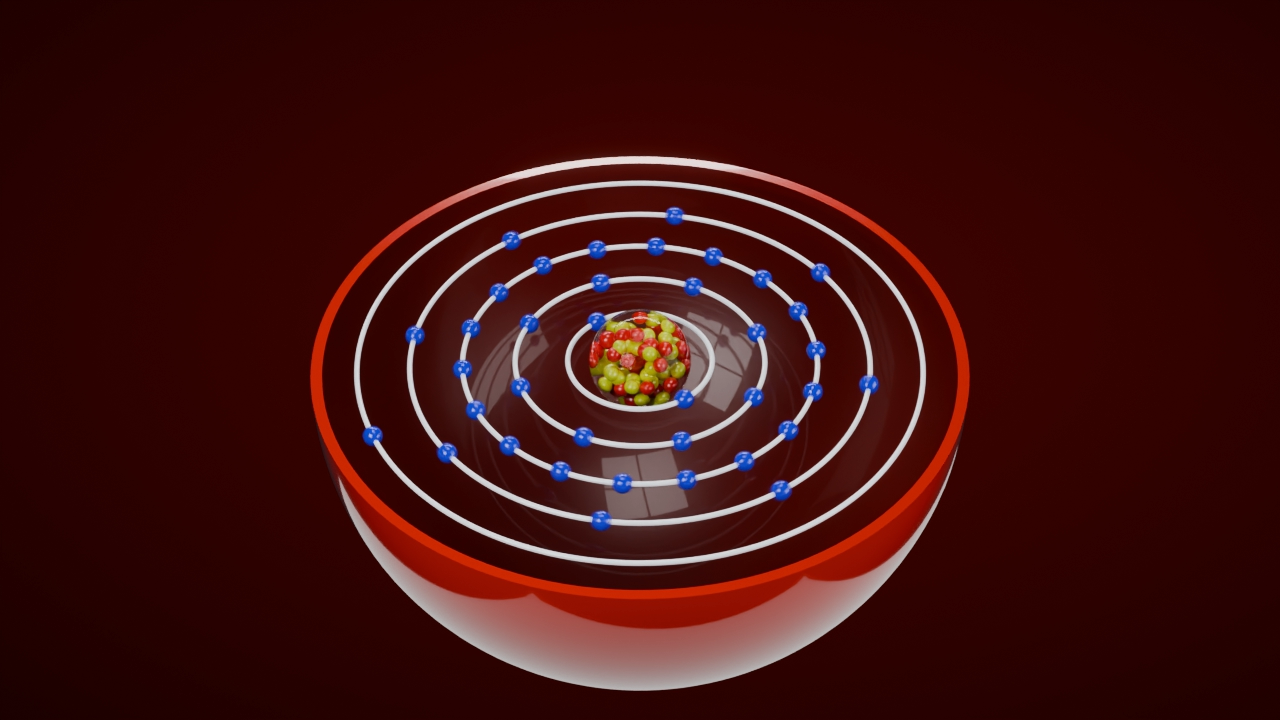
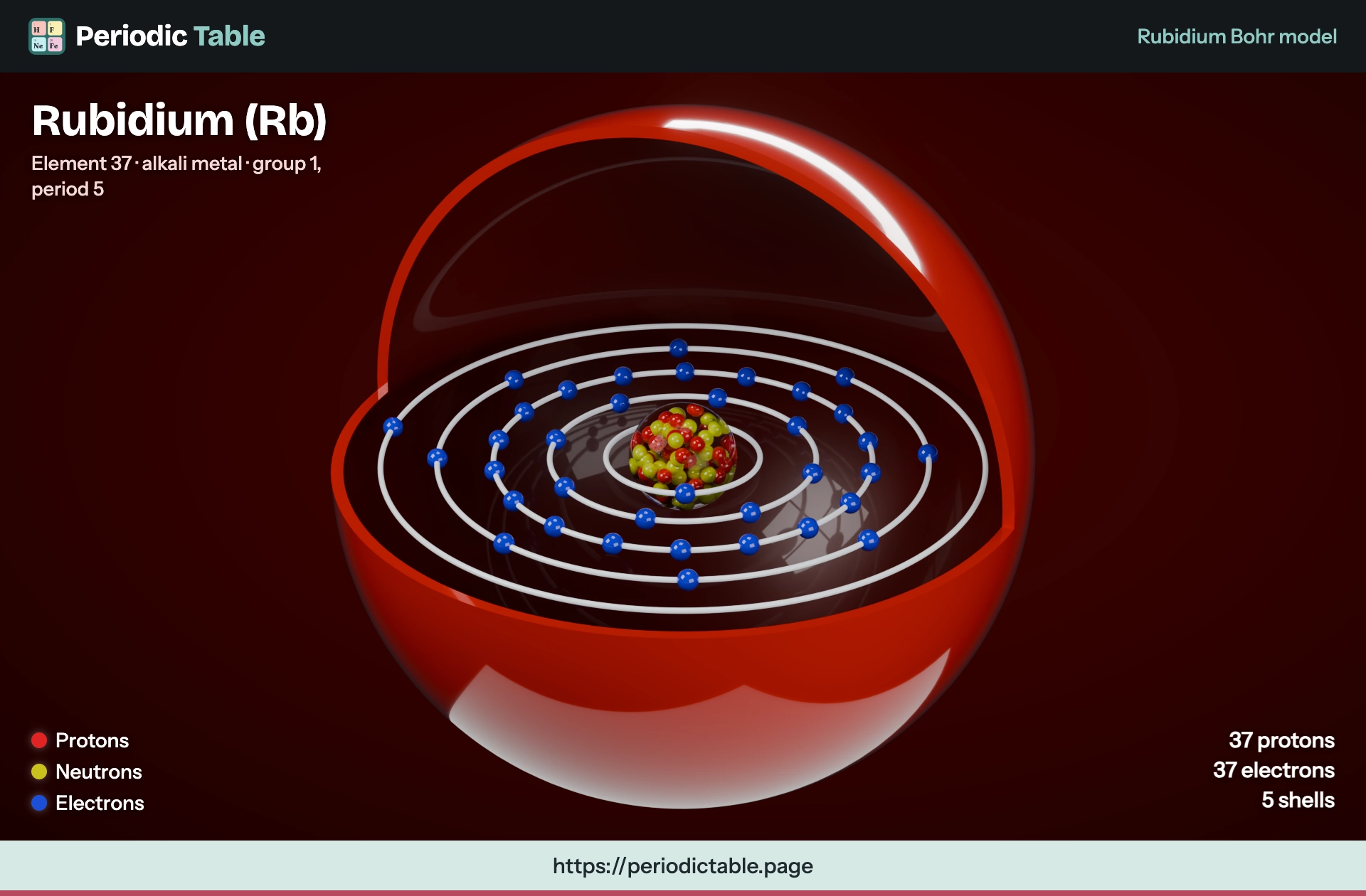
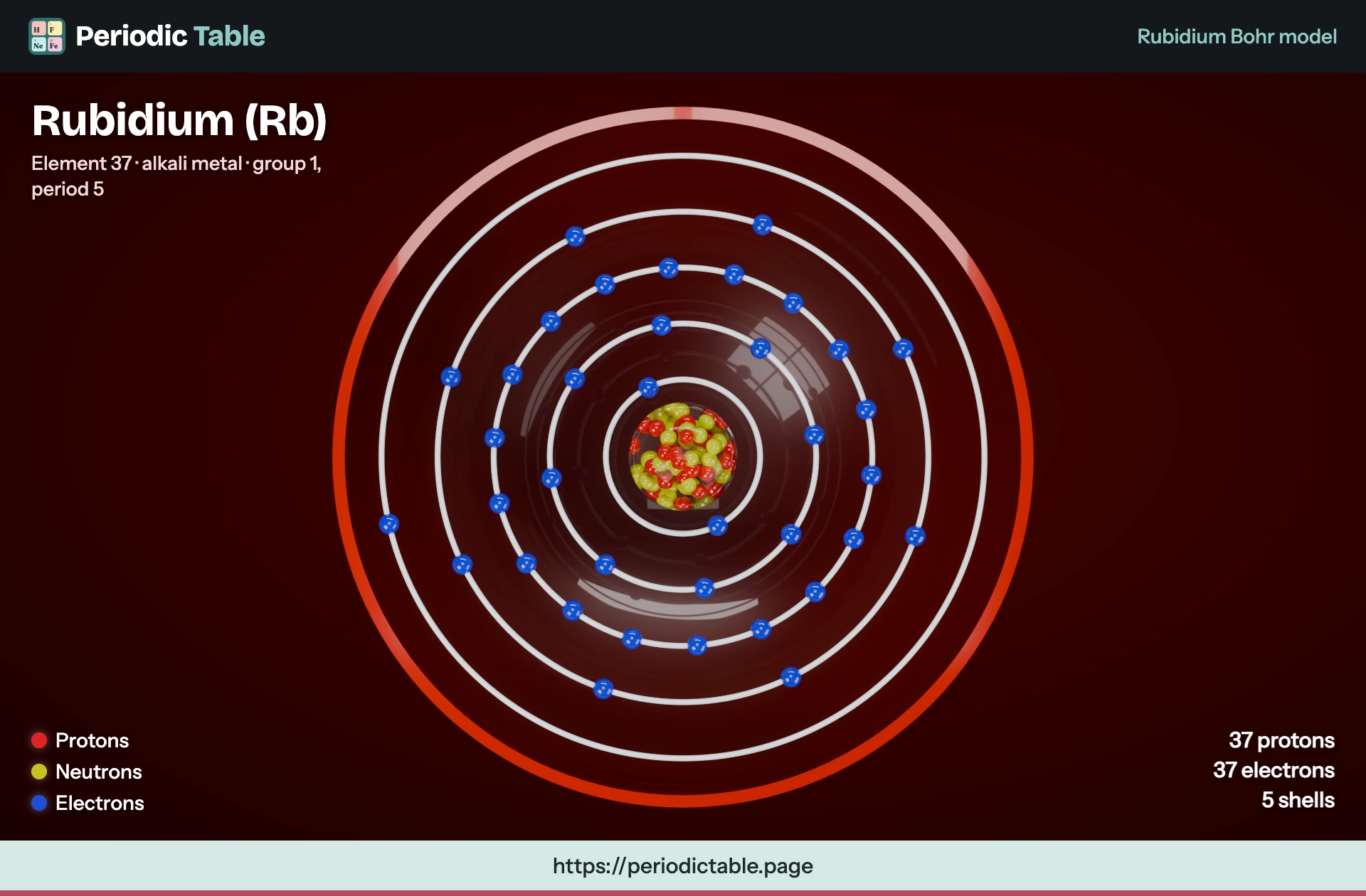
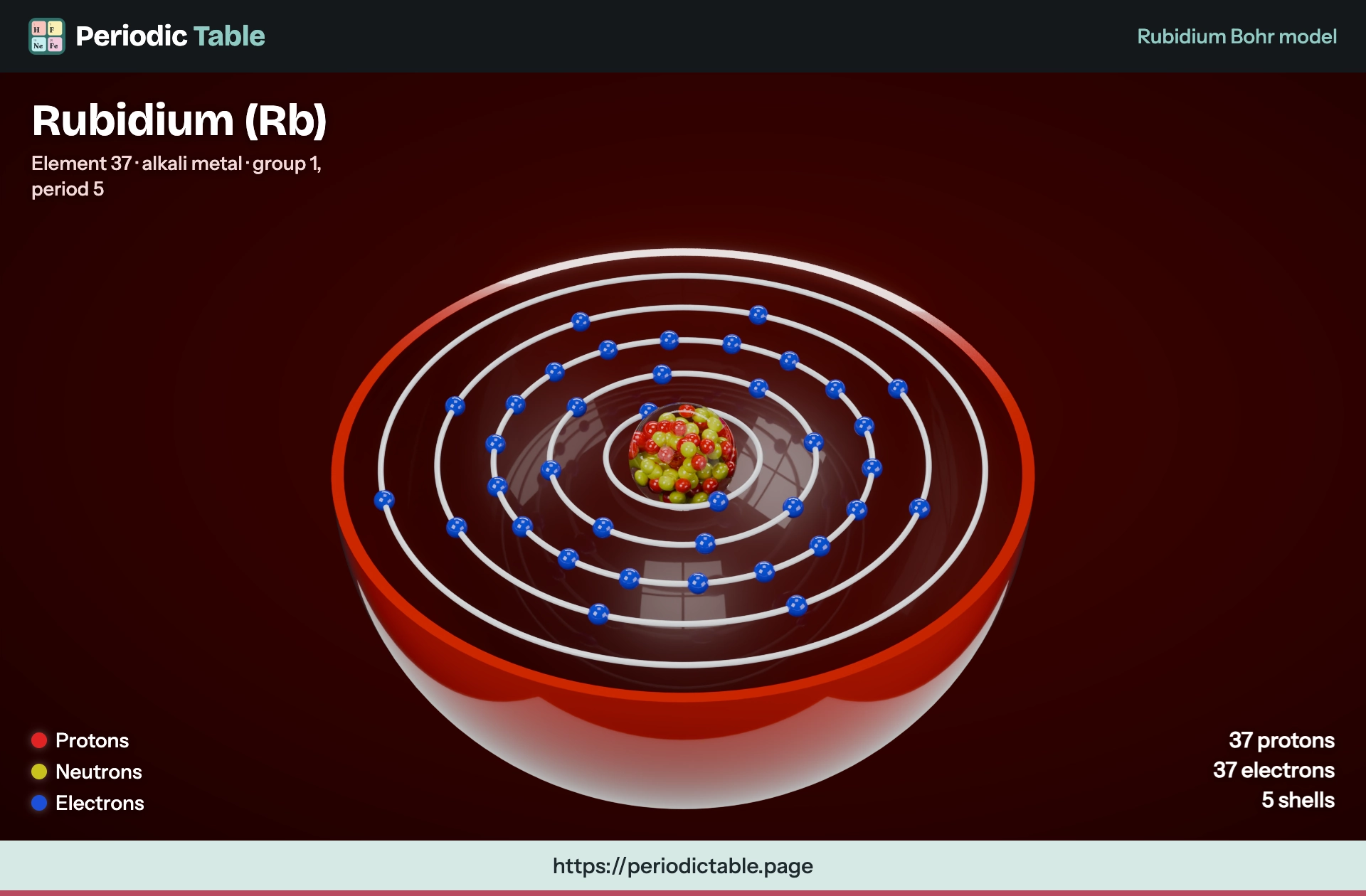
This is a Bohr model of rubidium (Rb), a simplified picture of a single rubidium atom. Its nucleus holds 37 protons, and a neutral rubidium atom has 37 electrons, arranged around it in 5 shells (2 in shell K, 8 in shell L, 18 in shell M, 8 in shell N and 1 in shell O).
Rubidium periodic table electron configuration
- Shorthand
- [Kr] 5s1
- Full
- 1s2 2s2 2p6 3s2 3p6 4s2 3d10 4p6 5s1
- Electrons per shell
- 2, 8, 18, 8, 1
Rubidium element properties and atomic data
- Atomic number
- 37
- Atomic mass
- 85.4678 u
- Phase at STP
- Solid
- Melting point
- 39.3°C (312.45 K)
- Boiling point
- 687.85°C (961 K)
- Density
- 1.532 g/cm³
- Electronegativity (Pauling)
- 0.82
- Period
- 5
- Group
- 1
- Block
- s-block
- Appearance
- Grey white
- Discovery date
- 1861
- Discovered by
- Robert Bunsen
- Named by
- —
Rubidium (Rb) basics: atomic number, atomic weight and periodic table place
The element rubidium occupies group 1, period 5 and the s-block of the periodic table, directly after the noble gas krypton and just before Sr. Its single outer electron is what drives almost all of rubidium's chemistry. The core identifiers you will see in any reference work are collected here. In radiology and healthcare imaging, contrast agents for magnetic resonance take centre stage in the gadolinium element for curious readers of medicine.
| Property | Value |
|---|---|
| Symbol | Rb |
| Atomic number | 37 |
| Standard atomic weight | 85.468 |
| Group / period / block | 1 / 5 / s |
| Electron configuration | [Kr] 5s1 |
| Melting point | 39.30 °C (312.45 K) |
| Boiling point | 688 °C (961 K) |
| Density at 20 °C | 1.53 g/cm3 |
| State at room temperature | Solid |
| CAS number | 7440-17-7 |
Those values make it the heaviest alkali element most chemists will ever handle in quantity, since the next one down, francium, is too short-lived to collect.
Physical properties of Rb
Freshly cut, rubidium metal is silvery-white and so ductile that it can be pressed like cold butter. It dulls within seconds once exposed, so most photographs show it sealed in an ampoule. When reading about Sharpless dihydroxylation, which earned a Nobel Prize and used the tetroxide, see element 76, osmium for more notes.
Melting point, boiling point and density
Rubidium melts at 39.3 °C, only a couple of degrees above body temperature, which is why it liquefies on a warm summer day or in the palm of your hand. It stays liquid across a wide range before boiling at 688 °C. With a value of 1.53 g/cm3 rubidium is the first alkali element denser than water, so a lump sinks rather than skating across the surface the way sodium does.
Hardness, crystal structure and thermal data
The solid packs into a body-centered cubic lattice and rates about 0.3 on the Mohs hardness scale, softer than talc. Its specific heat capacity is roughly 363 J/(kg·K) and its bulk modulus only 2.5 GPa, so it compresses easily. The vapor pressure climbs quickly once it melts, a trait that later sections show is useful in physics labs.
Chemical properties of the alkali metal
Rubidium is the second most electropositive of the stable alkali metals, beaten only by caesium. Its lone 5s electron sits far from the nucleus in the outer shell, so it gives that electron up with very little push, and that is the root of its fierce reactivity.
How Rb reacts with water, air and halogens
Drop a pea-sized piece of rubidium into a beaker and it reacts violently, forming rubidium hydroxide and hydrogen gas; the heat released usually ignites that gas. Left in the open, rubidium also ignites spontaneously in air. With oxygen it forms a family of oxides, from the monoxide to an orange superoxide when oxygen is plentiful, and it combines readily with the halogens to give white crystalline salts.
Oxidation states and electronegativity
In nearly every compound rubidium carries a +1 charge, existing as a monovalent ion. A −1 state is known only in unusual rubidide salts, so tables list its oxidation states as +1 and −1. Its electronegativity is 0.82 on the Pauling scale, which makes it a powerful reducing agent that hands electrons to almost anything it touches.
Rb electron configuration and ionization energies
Written in full, rubidium's arrangement is 1s2 2s2 2p6 3s2 3p6 4s2 3d10 4p6 5s1. The gap between its ionization energies tells the whole story of its chemistry:
- First ionization energy: about 403 kJ/mol, among the lowest of any element.
- Second ionization energy: about 2,633 kJ/mol, more than six times higher, because it means breaking into the stable krypton-like core.
- Electron affinity: about 46.9 kJ/mol.
- Atomic radius (empirical): 248 pm, with a covalent radius near 220 pm and a van der Waals radius of 303 pm.
That jump of more than 2,200 kJ/mol is why you never meet a doubly charged form of this element in ordinary chemistry.
Common Rb compounds and salts
Because the free element is so reactive, almost all practical work uses rubidium compounds instead. The most important are:
- Rubidium chloride (RbCl)
- The most widely used salt; molecular biologists use it to make bacterial cells take up DNA, and it serves as a tracer because living tissue normally holds very little of it.
- Rubidium hydroxide (RbOH)
- A strongly corrosive base and the usual starting point for making other salts.
- Rubidium carbonate
- Added to certain optical glasses to lower conductivity and improve stability.
- Rubidium silver iodide
- An ionic crystal with exceptionally high room-temperature conductivity, explored for thin-film batteries.
- Halide salts
- Rubidium fluoride, rubidium bromide and rubidium iodide, all soluble and colourless.
Rb isotopes and half-life
About 30 synthetic rubidium isotopes are known, but nearly all disappear within weeks. Only two exist in nature, and one of them makes every natural sample slightly radioactive, enough radioactivity to fog photographic film over a few months.
The two natural Rb isotopes
| Isotope | Natural abundance | Behaviour |
|---|---|---|
| Rubidium-85 | 72.17% | Stable |
| Rubidium-87 | 27.83% | Beta emitter, half-life about 4.9 × 10¹⁰ years |
Because rubidium-87 lives far longer than the age of the universe, it is a primordial nuclide and the sample in your lab is only mildly radioactive. To put that slow clock in perspective: running the exponential decay law over Earth's 4.54 billion years shows that only about 6.2% of the heavier isotope present when the planet formed has turned into 87Sr through beta decay since then.
Rubidium–strontium dating of rocks
That same slow clock makes rubidium–strontium dating one of geology's standard tools for dating rocks. As magma cools, fractional crystallization leaves the element enriched in the remaining melt, so different minerals start with different parent-to-daughter ratios. Measuring today's 87Sr/86Sr ratio alongside the rubidium content of several minerals from one rock gives its age, provided the rock has not been altered since it formed.
How Rb was discovered by flame spectroscopy
The history of rubidium begins in 1861, when the German chemists Robert Bunsen and Gustav Kirchhoff found it in Heidelberg using flame spectroscopy, the technique they had just invented.
The deep red emission spectrum behind the name
Working with the new spectroscope, Bunsen and Kirchhoff heated the mica lepidolite and saw two bright red lines in its emission spectrum that matched no known substance. They named the element from the Latin rubidus, meaning deepest red.
In an ordinary flame test the colour looks red-violet and is hard to tell apart from potassium by eye, which is exactly why the spectroscope mattered. Rubidium was only the second element, after caesium a year earlier, to be identified this way.
Isolating the free element
Getting metallic rubidium out of its salts proved harder. Electrolysis of molten chloride gave a blue mixture rather than shiny metal, so Bunsen turned to heating charred rubidium tartrate.
The product caught fire almost as soon as it formed, yet he still measured its properties remarkably close to modern values. Truly pure samples were not prepared until 1928.
Rb occurrence in lepidolite, pollucite and seawater
Rubidium is more common than you might guess: at roughly 90 parts per million of Earth's crust it outranks copper and zinc. It never forms a mineral of its own, though. Its large ion slips into potassium sites, so it is scattered through lepidolite, carnallite, leucite and zinnwaldite, rarely above a few percent.
Seawater and some mineral springs carry it in trace amounts. The richest concentrations sit in pegmatite ore bodies, where the element gathered in the last liquid to crystallize; pollucite deposits at Bernic Lake in Manitoba, Canada, are the best-known source.
Rb production and refining
World output is tiny, only a few tonnes of compounds a year, and there is no dedicated mine. The usual path to pure rubidium is:
- Recover it as a by-product of caesium refining or of lithium refining.
- Separate it from potassium and caesium by repeated crystallization or by the chlorostannate and ferrocyanide processes.
- Finish with reduction of rubidium chloride by metallic calcium at about 750 °C under low pressure, then distil off elemental rubidium.
Because supply follows lithium and cesium demand, the industry has little control over how much rubidium reaches the market in a given year.
Rb uses and applications
Rubidium's applications lean heavily toward research and precision electronics. Smaller niches include photocells (a photocell turns light into current), special types of glass, fireworks with a red-purple tint, and atomic magnetometers.
Atomic clocks and GPS timing
The hyperfine transition of rubidium atoms ticks at a steady 6.8 GHz, which makes it a compact, low-cost frequency standard. Rubidium atomic clocks are less accurate than cesium fountains on their own, but when steered by GPS they deliver excellent timing at a fraction of the price, which is why telecommunications networks and cell-site transmitters rely on them.
Laser cooling and bose-Einstein condensate research
Rubidium vapor absorbs light at wavelengths that cheap diode lasers produce, so it became a workhorse for laser cooling. In 1995 a cloud of the heavier isotope's atoms chilled to billionths of a degree formed the first Bose–Einstein condensate, earning a share of the 2001 Nobel Prize in physics.
Rb-82 in medical imaging
Rubidium-82, made on site from a 82Sr generator, is used in positron emission tomography. Heart muscle takes it up like potassium, so myocardial perfusion imaging can show which areas get poor blood flow, and it also helps locate brain tumors in nuclear medicine. It vanishes fast: our own calculation shows only about 6.5% remains five minutes after elution and roughly 0.4% after ten, so the dose must be produced beside the scanner.
Rb health effects and safe handling
Rubidium salts are only mildly toxic; your body treats the dissolved cation much like potassium ions and stores it in the intracellular fluid, with a biological half-life of roughly one to one and a half months. Researchers have even tested it in bipolar disorder and depression.
The bare element is a different matter: contact causes caustic skin and eye damage, and a burning sample causes thermal burns. Store it under dry mineral oil or sealed in glass under an inert atmosphere, keep it away from moisture, and use a class D extinguisher rather than water on a fire.
How Rb compares with other alkali metals
Lining element 37 up against its group 1 neighbours shows the trends you learn in chemistry class: going down the group, atoms get bigger, the outer electron is held more loosely, melting temperatures fall and reactivity climbs.
| Element | Melts at (°C) | g/cm3 at 20 °C | 1st ionization (kJ/mol) |
|---|---|---|---|
| Lithium | 180.5 | 0.53 | 520 |
| Sodium | 97.8 | 0.97 | 496 |
| Potassium | 63.5 | 0.86 | 419 |
| Rubidium | 39.3 | 1.53 | 403 |
| Caesium | 28.5 | 1.93 | 376 |
Element 37 is where the reaction with moisture shifts from lively to dangerous, and it is the first metal in the sequence that is denser than the liquid it reacts with.