


Osmium element (Os): osmium periodic table facts
Osmium periodic table facts: osmium (Os) is element 76, a transition metal in group 8, period 6. Pick up a small bead of osmium and you will notice the weight before anything else: this chemical element, symbol Os and atomic number 76, is the densest stable metal known. Water treatment chemistry with sodium hypochlorite, hydrogen chloride and hypochlorous acid is what the chlorine atom covers in detail.
It is a hard, brittle, bluish-white member of the platinum family, first identified in 1803 and so scarce in the Earth's crust that the world produces it by the kilogram, not the tonne. Below you will find its properties, isotopes, compounds, uses and the safety issue every precious metal buyer should know about.
Rotate the 3D Bohr model of osmium
Drag to orbit, scroll to zoom.
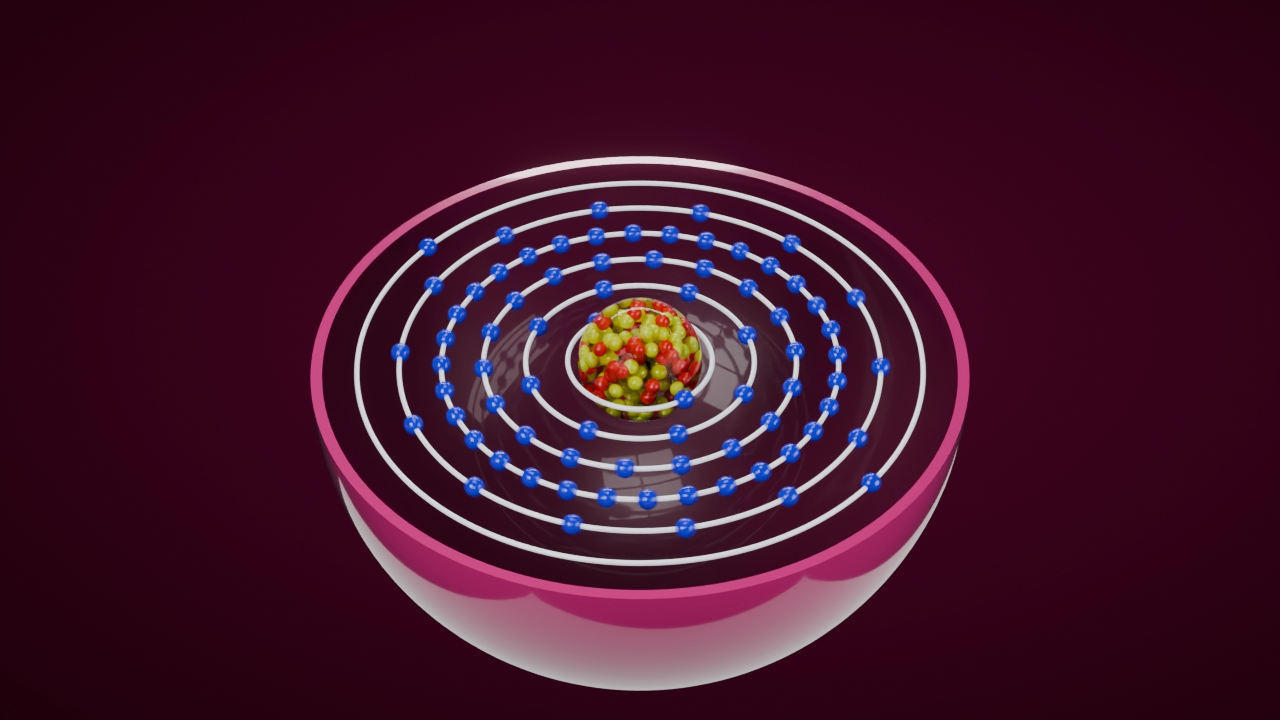
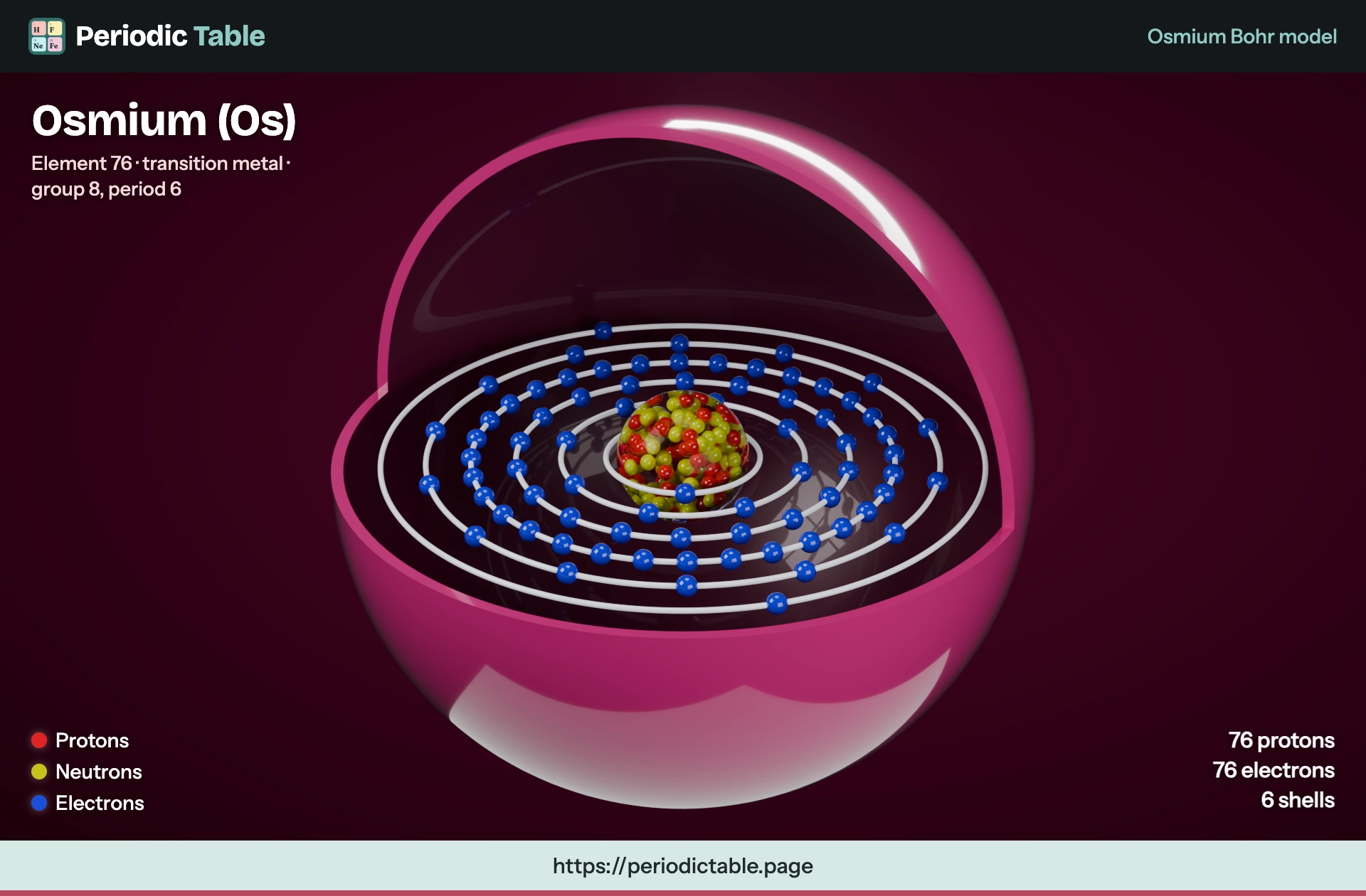
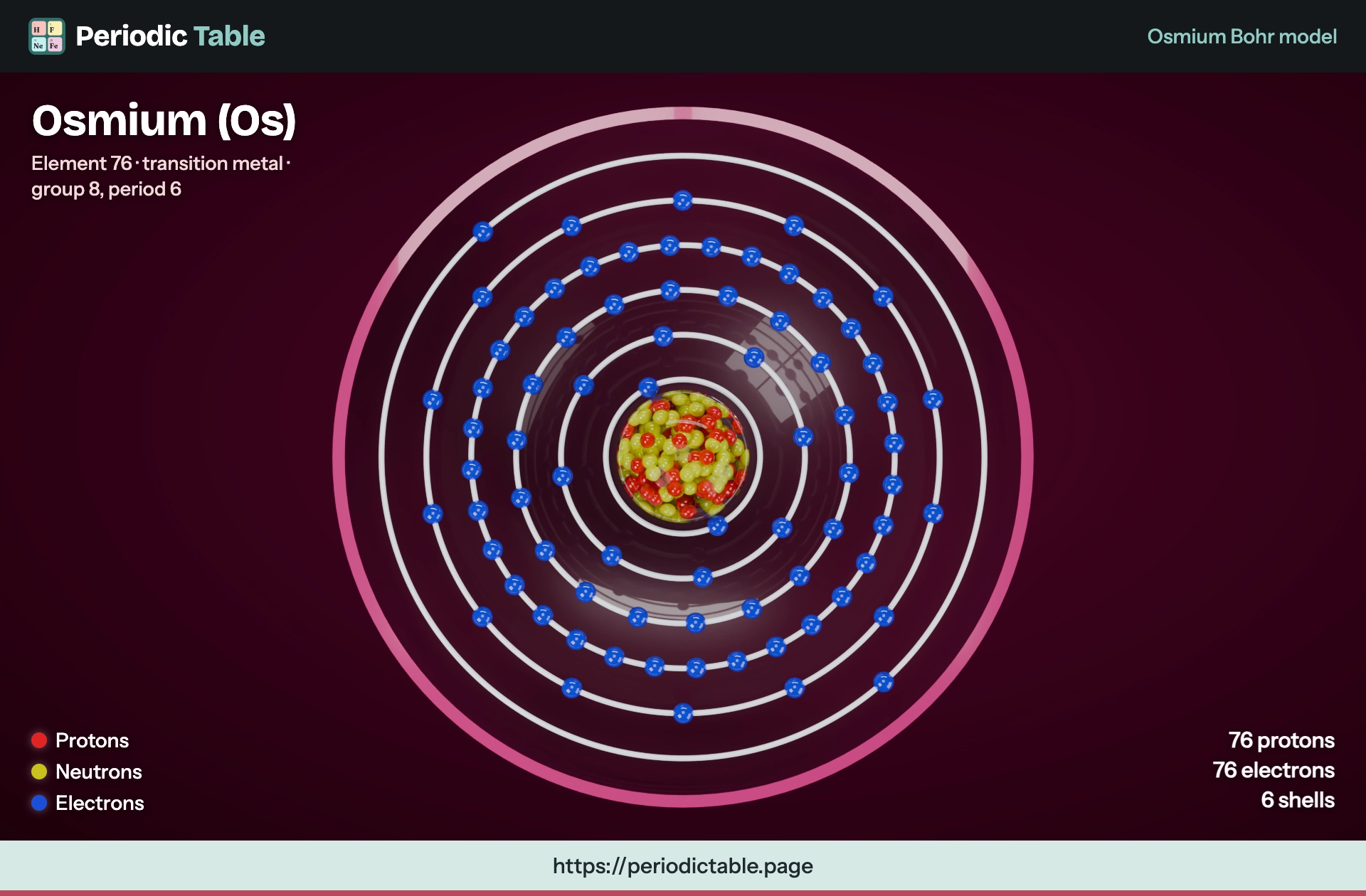
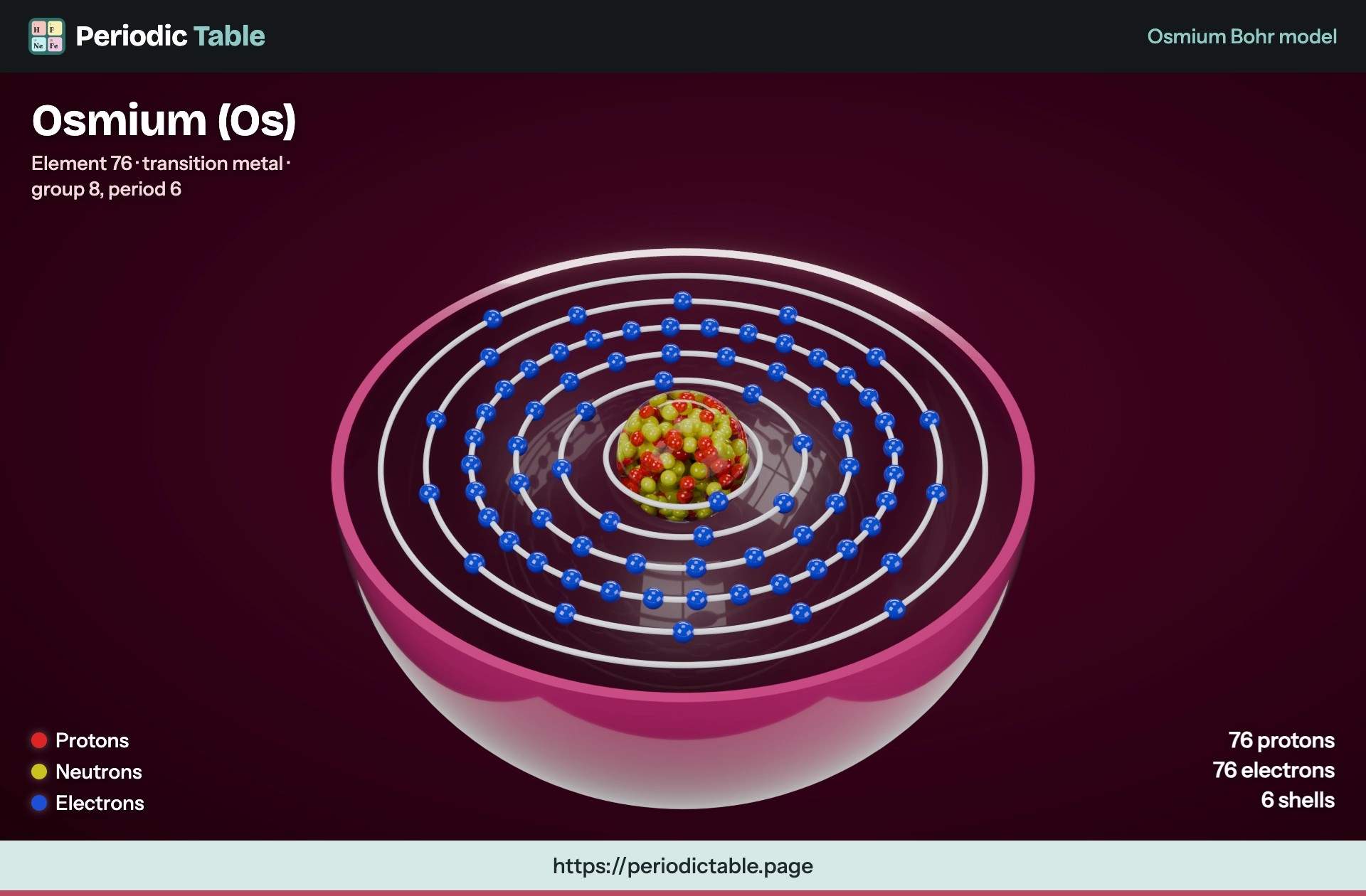
This is a Bohr model of osmium (Os), a simplified picture of a single osmium atom. Its nucleus holds 76 protons, and a neutral osmium atom has 76 electrons, arranged around it in 6 shells (2 in shell K, 8 in shell L, 18 in shell M, 32 in shell N, 14 in shell O and 2 in shell P).
Osmium periodic table electron configuration
- Shorthand
- [Xe] 4f14 5d6 6s2
- Full
- 1s2 2s2 2p6 3s2 3p6 4s2 3d10 4p6 5s2 4d10 5p6 6s2 4f14 5d6
- Electrons per shell
- 2, 8, 18, 32, 14, 2
Osmium element properties and atomic data
- Atomic number
- 76
- Atomic mass
- 190.233 u
- Phase at STP
- Solid
- Melting point
- 3032.85°C (3306 K)
- Boiling point
- 5011.85°C (5285 K)
- Density
- 22.59 g/cm³
- Electronegativity (Pauling)
- 2.2
- Period
- 6
- Group
- 8
- Block
- d-block
- Appearance
- Silvery, blue cast
- Discovery date
- 1803
- Discovered by
- Smithson Tennant
- Named by
- —
Osmium element at a glance
The table gathers the core data for the element osmium in one place. Values are the accepted reference figures, rounded where sources differ in the last digit. Using a spectroscope in 1861, Bunsen and Kirchhoff made the discovery that the rubidium on the periodic table entry recounts in some detail.
| Property | Value |
|---|---|
| Symbol | Os |
| Atomic number | 76 |
| Atomic weight | 190.23 |
| Group / period / block | Group 8, period 6, d-block |
| Electron configuration | [Xe] 4f14 5d6 6s2 |
| State at 20 °C | Solid |
| Density at 20 °C | 22.587 g/cm3 |
| Crystal structure | Hexagonal close-packed |
| Mohs hardness | 7.0 |
| Electronegativity (Pauling) | 2.2 |
| First ionization energy | about 840 kJ/mol |
| Atomic radius / covalent radius | 135 pm / 144 pm |
| CAS number | 7440-04-2 |
| Discovered by | Smithson Tennant |
Two of these figures explain most of what makes osmium unusual: the atomic mass of about 190 packed into a very tight hexagonal lattice gives the record weight per volume, and the electron configuration with six 5d electrons lets the metal take part in a remarkably wide range of bonding.
What is osmium? a hard platinum group metal
Osmium is a platinum group metal: one of six heavy, corrosion-resistant elements that share ore deposits and much of their chemistry. Its nearest relative, iridium, was found in the same sample at the same time and is almost as heavy. As an osmium metal sample, it is grey with a faint blue tint, keeps its shine and resists most acids, yet it shatters rather than bends when struck. A profile of chromium isotopes places the nucleus, electrons and everyday chemistry of the metal side by side.
That combination makes it a strange precious metal. Its rarity puts it alongside gold in scarcity, but it cannot be rolled, drawn or cast like the softer noble metals, so almost all of the world's supply ends up blended into tougher materials or turned into chemicals rather than in bars or coins.
Where osmium sits on the periodic table as a transition metal
On the periodic table, osmium sits in group 8 and period 6, in the middle of the d-block. That makes it a transition metal, with iron and ruthenium above it and synthetic hassium below.
It is also one of the six platinum group metals, which split into two rows:
- Light platinum metals (period 5): ruthenium, rhodium and palladium
- Heavy platinum metals (period 6): osmium, iridium and platinum
The heavy row is denser than gold, and all six elements are noble enough to survive conditions that dissolve ordinary metals, which is why they are refined together and separated late in the process.
Osmium characteristics
The osmium properties that matter in practice fall into two groups: how the bulk metal behaves under load and heat, and how its atoms react with other substances. These osmium characteristics pull in opposite directions, a metal that barely reacts in bulk yet forms an unusual number of compounds.
Physical properties: hardness, brittleness and stiffness
These physical properties are extreme across the board. Its bulk modulus, a measure of resistance to compression, has been reported between 395 and 462 GPa, in the same range as diamond.
It is also among the stiffest metals, with a Young's modulus around 556 GPa. The metal stays lustrous at high temperature and has the lowest vapor pressure of the platinum group.
- Crystal lattice: hexagonal close-packed, which makes some optical and thermal properties direction-dependent
- Thermal conductivity: about 87.6 W/(m·K)
- Specific heat capacity: about 130 J/(kg·K), low per kilogram because each atom is so heavy
- Magnetism: paramagnetic, weakly attracted to a magnetic field
The catch is brittleness. Because it is so stiff and brittle, solid osmium is difficult to machine, form or roll, which is why it is pressed from powder rather than worked like other metals.
Chemical properties and reactivity
In bulk, its chemical properties are those of an inert noble metal. At room temperature it resists most acids and bases, including aqua regia, and shows almost no corrosion. It does react with fluorine and chlorine at high temperatures and with hot concentrated nitric acid, and it dissolves in molten alkali fused with an oxidizer such as sodium peroxide.
The big exception is air. Finely divided powder slowly combines with oxygen even at room temperature, and the product is the volatile tetroxide covered below. This is the single most important fact in its chemistry: the bulk metal is safe, the fine powder is not.
Osmium melting point and boiling point
The osmium melting point is 3,033 °C (3,306 K, 5,491 °F), and its boiling point is about 5,008 °C (5,281 K). Only carbon, tungsten and rhenium melt at higher temperatures. The comparison below shows how far above familiar metals it sits.
| Metal | Melting point (°C) |
|---|---|
| Silver | 962 |
| Gold | 1,064 |
| Platinum | 1,768 |
| Iridium | 2,446 |
| Osmium | 3,033 |
| Tungsten | 3,422 |
It needs roughly 1,970 °C more heat than gold before it turns liquid. Casting is therefore impractical, and older textbooks quoting about 2,700 °C reflect measurements made before the 1960s redetermination.
Density of osmium: the densest stable element
The density of osmium is 22.587 g/cm3 at 20 °C, which makes it the densest stable element. Iridium follows at 22.562 g/cm3, a gap of only about 0.1 percent, and for decades the two traded the title of densest element. X-ray crystallography in the 1990s settled the matter in osmium's favour.
| Material | g/cm3 at 20 °C | Times heavier than water |
|---|---|---|
| Osmium | 22.59 | 22.6 |
| Iridium | 22.56 | 22.6 |
| Platinum | 21.45 | 21.5 |
| Gold | 19.30 | 19.3 |
| Lead | 11.34 | 11.3 |
| Silver | 10.49 | 10.5 |
To put the densest metal in human terms: a 10 cm cube of it, about the size of a large mug, would weigh 22.6 kg, roughly double the same cube of lead. Even a cube only 3 cm across comes to about 610 g.
Why osmium looks bluish
Most metals look silvery because they reflect visible light almost evenly. Osmium has a bluish, blue-gray tint because its reflectivity peaks in the blue part of the spectrum, so the light bouncing off a polished surface is slightly filtered toward blue. Its hexagonal crystals also reflect light differently depending on direction, mostly in the red and infrared where the eye cannot tell.
The colour depends on the surface. Fine powder looks almost black, a pressed piece shows a muted bluish lustre, and a mirror-polished or crystalline surface shows the strongest blue. Osmium's reflectivity in the far ultraviolet is also high, about twice that of gold at some wavelengths, which led to osmium-coated mirrors being tested on Space Shuttle flights before atomic oxygen in orbit was found to tarnish them.
Oxidation states and osmium compounds
Few elements match its range of oxidation states, from −2 to +8, with +2, +3, +4 and +8 the most common. That range explains why osmium compounds are so varied even though the bulk metal is so unreactive.
Osmium tetroxide (OsO4)
Osmium tetroxide is the best-known compound and the one that carries the +8 state. It is a pale yellow, volatile, water-soluble solid with a sharp, chlorine-like and garlicky smell.
It reacts with alkali to give red perosmates and with ammonia to give nitrido-osmates. Its ability to add oxygen across carbon–carbon double bonds is behind almost every modern use of the element, and its toxicity is behind almost every safety warning.
Lower oxidation states, oxides and halides
At +4, osmium dioxide is dark, non-volatile and far less reactive than the tetroxide. Osmium pentafluoride is known, as are the trichloride, tribromide and triiodide, while carbonyl clusters such as triosmium dodecacarbonyl represent the zero state. The non-volatile osmates, salts of the +6 state, are used as safer oxidants in the laboratory.
Osmium isotopes and natural abundance
Natural osmium is a mix of seven isotopes. Five are stable isotopes, and the other two decay so slowly that for practical purposes they count as stable too. The table lists each one's natural abundance.
| Isotope | Natural abundance (%) | Half-life |
|---|---|---|
| Os-184 | 0.02 | about 1.1 × 10¹³ years |
| Os-186 | 1.59 | about 2.0 × 10¹⁵ years |
| Os-187 | 1.96 | stable |
| Os-188 | 13.24 | stable |
| Os-189 | 16.15 | stable |
| Os-190 | 26.26 | stable |
| Os-192 | 40.78 | stable |
Os-192 alone makes up about two atoms in five. More than 30 artificial radioisotopes are also known, the longest-lived being Os-194 with a half-life of about six years.
Is osmium radioactive?
Not in any meaningful sense. Os-184 and Os-186 undergo alpha decay, but the half-life of Os-186 is roughly 140,000 times the age of the universe. A natural sample therefore gives off no measurable radiation over a human lifetime, which is why it is handled and worn like any other noble metal.
Rhenium-osmium dating and NMR
Os-187 forms from the slow beta decay of rhenium-187, so the ratio between the two in a rock acts as a clock. Geologists use this rhenium-osmium dating on ores, meteorites and mantle rocks. Os-187 also has a nuclear spin of ½, but its low abundance makes it one of the hardest natural isotopes to study by NMR.
Discovery of osmium by Smithson Tennant
Osmium was found in London in 1803 by Tennant, working alongside William Hyde Wollaston. Chemists dissolving crude platinum in aqua regia kept seeing a black residue that refused to dissolve; most assumed it was graphite or dirt.
Tennant, who had far more residue to work with than the French chemists studying the same material, showed it held two new metals: iridium and osmium. He reported both to the Royal Society in June 1804.
A century later, it briefly mattered to industry: Fritz Haber used it as the catalyst in his early Haber process demonstrations, and BASF bought up most of the world's supply before cheaper iron catalysts made it unnecessary.
How osmium got its name
Tennant named the metal after the Greek word osme, meaning smell or odor, because heating the residue released a sharp vapour. Modern descriptions compare that odor to chlorine, garlic or radish. The culprit is the tetroxide, not the metal itself: solid osmium has no smell at all.
Where osmium is found: crustal abundance and osmiridium
Osmium is one of the rarest stable elements. Its crustal abundance is estimated at about 50 parts per trillion in the continental crust by mass, though some sources quote figures closer to 1 part per billion. Either way, it is scarcer than gold.
It occurs uncombined or in natural mixtures with iridium: osmiridium is the iridium-rich form and iridosmium the osmium-rich form. Traces also substitute into platinum minerals found in nickel and copper deposits. The main sources are:
- The Bushveld Igneous Complex in South Africa, the largest known reserve
- The copper–nickel ores of Norilsk in Russia
- The Sudbury Basin in Canada
- Alluvial deposits in the Ural Mountains and in Colombia
Osmium production and refining
Osmium production is a by-product of nickel and copper mining. During electrorefining, the noble metals settle at the bottom of the cell as anode mud, which is the starting material for recovery.
- The mud is brought into solution, and platinum and palladium dissolve in aqua regia while osmium and three sister metals stay behind as residue.
- The residue is oxidized so osmium turns into the volatile tetroxide.
- Osmium is separated by distillation or solvent extraction of that tetroxide.
- The recovered salt is reduced with hydrogen to give a fine metal powder or sponge.
- The sponge is consolidated by powder metallurgy, since the metal is too brittle to cast or roll.
World output is tiny, estimated from a few hundred kilograms to around a tonne a year, and production figures are rarely published because demand is easily met from refining other metals.
Uses of osmium
The uses of osmium are few but specialised, because the pure metal is nearly impossible to work and the tetroxide is dangerous. Its applications divide into wear-resistant tipping materials and chemistry.
Osmium alloys in industry
Osmium alloys with platinum are among the hardest metal combinations available, and industry uses them where wear resistance matters most:
- Fountain pen tips and pen nibs
- Electrical contacts that open and close millions of times
- Instrument pivots and compass needles
- Phonograph and record player needles from roughly 1945 to 1955
- Early ball point pen tips
In these applications each alloy relies on osmium for hardness, with platinum supplying the workability.
Osmium staining in electron microscopy and medicine
Osmium staining is its best-known scientific use. In electron microscopy, the tetroxide reacts with unsaturated lipids in cell membranes, fixing tissue in place while its heavy atoms add contrast to the image.
The same chemistry is used for fingerprint detection on difficult surfaces. In medicine, osmium–platinum blends have gone into surgical instruments and pacemakers, and its complexes are being studied as possible anticancer drugs.
Organic synthesis and the Sharpless dihydroxylation
In organic synthesis, osmium tetroxide and potassium osmate turn carbon–carbon double bonds into a vicinal diol. Karl Barry Sharpless shared the 2001 Nobel Prize in Chemistry partly for the asymmetric version of this dihydroxylation, which uses only catalytic amounts of the expensive metal.
Osram light bulb filaments
Carl Auer von Welsbach introduced a light bulb with osmium filaments in 1902. Tungsten soon replaced it, but the lighting company Osram still carries both names: "Os" from osmium and "ram" from Wolfram.
Is osmium toxic? safety and precautions
The short answer to is osmium toxic depends on its form. Solid, sintered or crystalline metal is generally harmless because it does not oxidize below about 400 °C. Osmium powder, by contrast, slowly forms the tetroxide in air, and that compound is highly toxic:
- Its vapour irritates and can damage the eyes, lungs and skin
- It can stain the cornea and cause temporary vision problems at very low exposure
- It passes easily through the air, so containers must stay sealed
Laboratories handle it in fume hoods with sealed ampoules. For buyers, the practical rule is to avoid loose powder entirely; its toxicity is the reason for most of the warnings around this metal.
Osmium forms: crystals, bars and fusion beads
Because it cannot be cast, collector osmium comes in a handful of forms, each with a different look and price:
- Osmium crystals: grown by vapour transport, they show the strongest blue sparkle and are used in jewelry
- Osmium bars: sintered (pressed and heated) from powder, with a muted bluish sheen
- Fusion beads: small melted droplets, cheaper to make and shiny
- Powder or sponge: black, toxic and of no collector value
Whatever the form, purity matters. A piece at 99.95 percent or better is the norm for collectors, and impurities such as sulfur make the purity of cheap beads uncertain.
Osmium price and supply risk
The osmium price is not set on any exchange. Between 1990 and 2010 the nominal price per troy ounce barely moved, so inflation cut its real value by about a third. Today, prices quoted per gram vary widely with form: pressed bars cost less per gram than gold, while cut crystals cost several times more.
Supply is concentrated. South Africa and Russia hold most reserves, and the Royal Society of Chemistry rates osmium's relative supply risk at 7.6 out of 10. As an investment, it offers little liquidity because there is no central market to resell into.
Osmium facts worth knowing
- A platinum metal so scarce that its annual production weighs about as much as a small car.
- The two candidates for the densest element were discovered together, in the same black residue.
- The metal itself is odourless; the name comes from the smell of its oxide.
- It was the catalyst in the first successful laboratory runs of ammonia synthesis.
- Published values for melting temperature, crustal abundance and output still vary between sources, so treat any single figure as approximate.
- Its geology is useful: the same radioactive clock helps date how old a continent's mantle roots are.