


Chromium element (Cr): chromium periodic table facts
Chromium periodic table facts: chromium (Cr) is element 24, a transition metal in group 6, period 4. Pick up a polished kitchen tap, a stainless steel knife or a red ruby, and you are holding chromium at work. Before handling a strong oxidising agent in the laboratory, open the chlorine gas to see why it needs care.
This chromium element guide walks you through what makes the metal so useful: a hard, lustrous, steel-gray transition metal that shrugs off corrosion, colours gemstones and pigments, and turns dangerous only in one specific chemical form. You will find its key numbers, its chemistry, where it is mined and how chromium affects your health.
Rotate the 3D Bohr model of chromium
Drag to orbit, scroll to zoom.
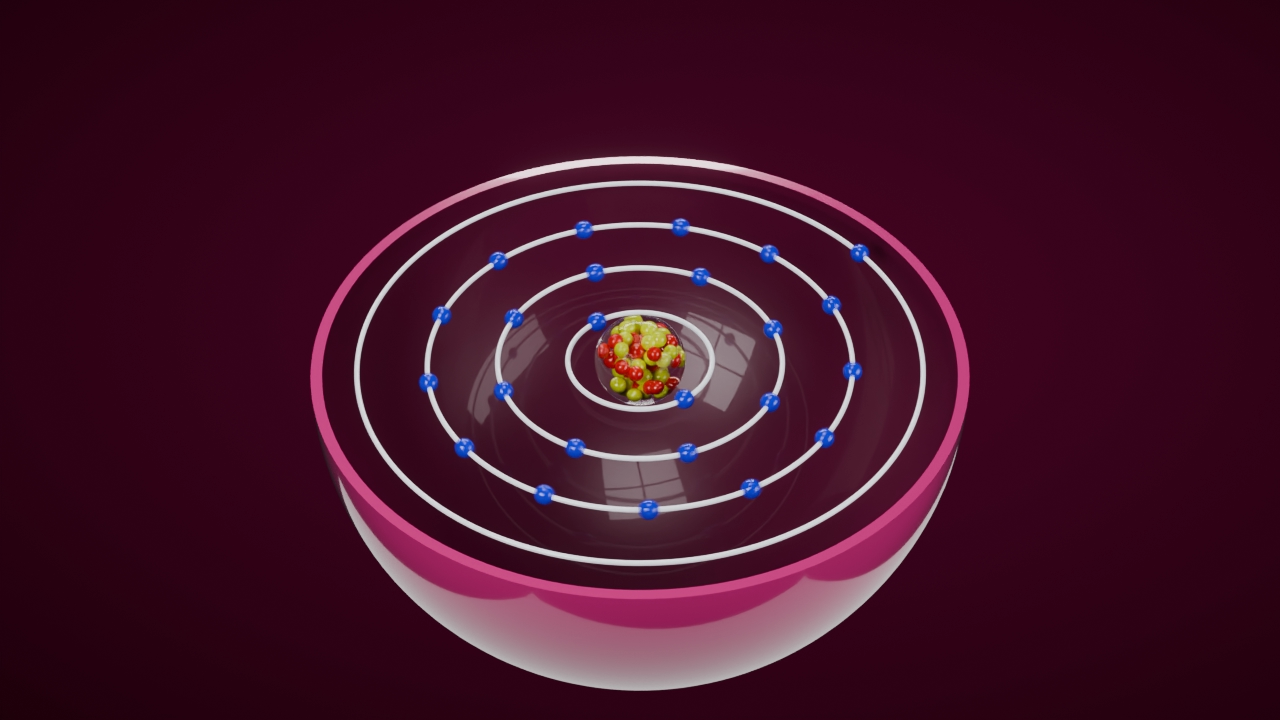
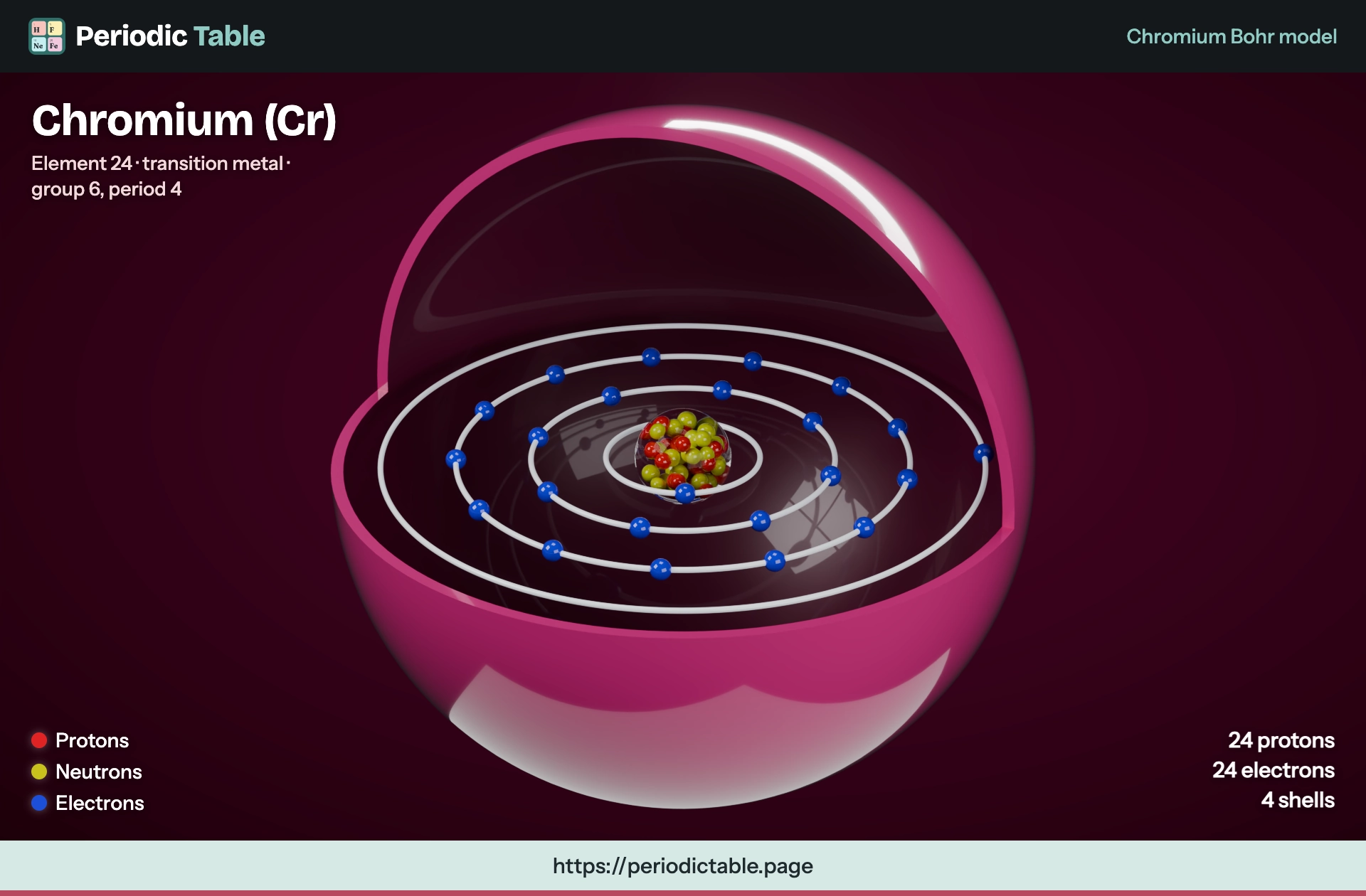
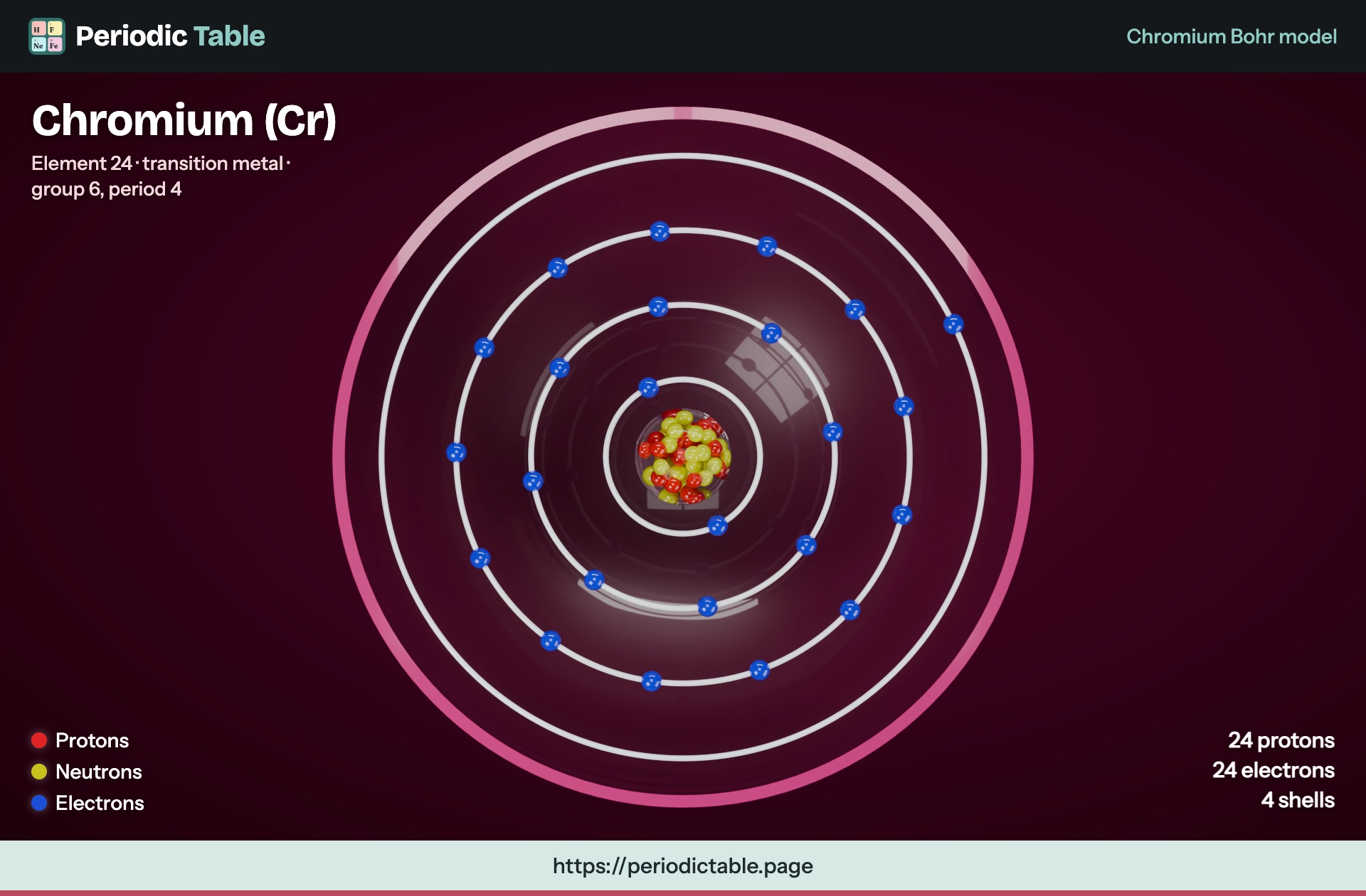
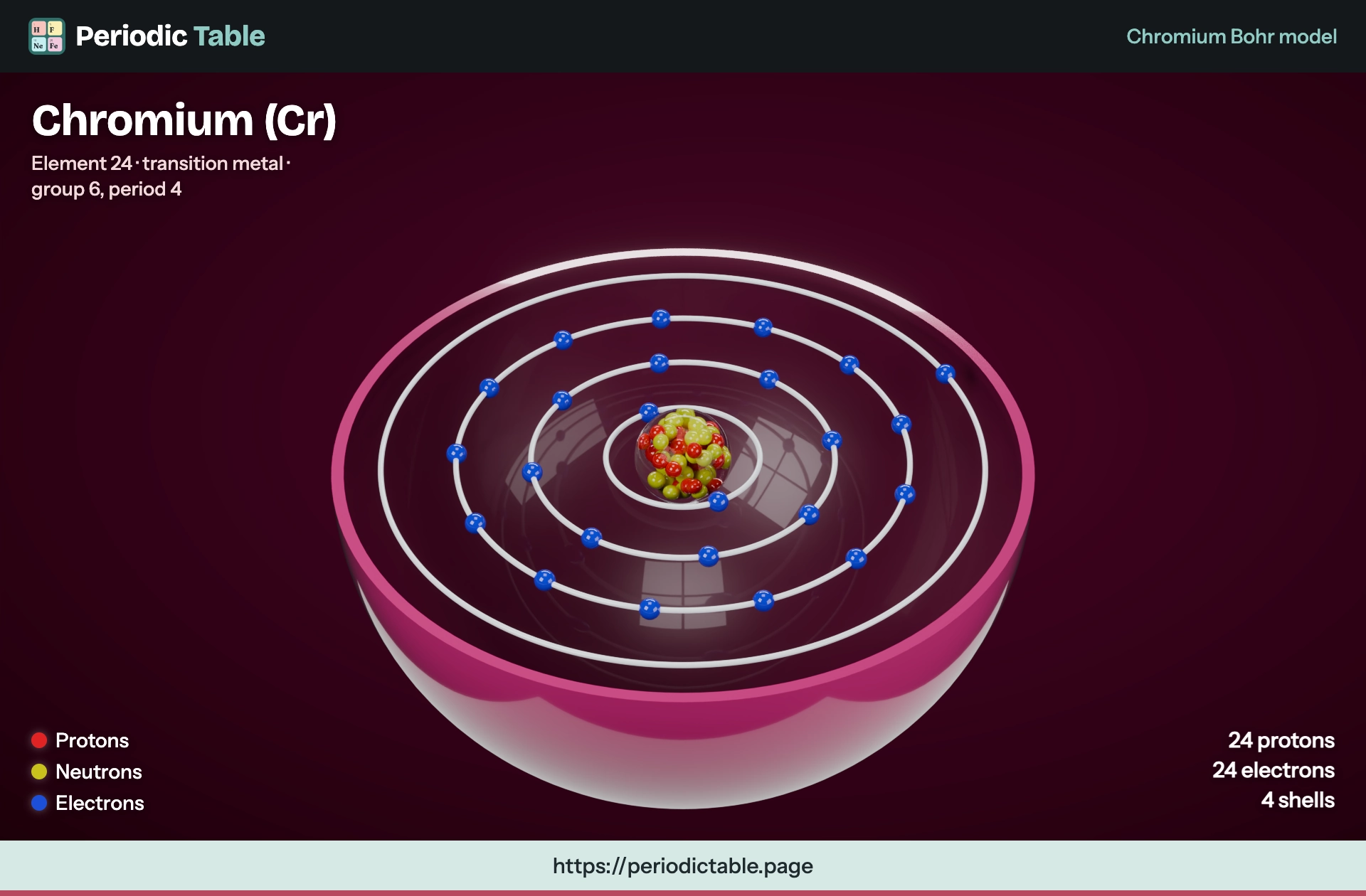
This is a Bohr model of chromium (Cr), a simplified picture of a single chromium atom. Its nucleus holds 24 protons, and a neutral chromium atom has 24 electrons, arranged around it in 4 shells (2 in shell K, 8 in shell L, 13 in shell M and 1 in shell N).
Chromium periodic table electron configuration
- Shorthand
- [Ar] 3d5 4s1
- Full
- 1s2 2s2 2p6 3s2 3p6 4s1 3d5
- Electrons per shell
- 2, 8, 13, 1
Chromium element properties and atomic data
- Atomic number
- 24
- Atomic mass
- 51.9962 u
- Phase at STP
- Solid
- Melting point
- 1906.85°C (2180 K)
- Boiling point
- 2670.85°C (2944 K)
- Density
- 7.19 g/cm³
- Electronegativity (Pauling)
- 1.66
- Period
- 4
- Group
- 6
- Block
- d-block
- Appearance
- Silvery metallic
- Discovery date
- 1797
- Discovered by
- Louis Nicolas Vauquelin
- Named by
- —
Chromium element facts: atomic number, symbol and group
Chromium carries the chemical symbol Cr and atomic number 24, so every Cr nucleus holds 24 protons. It sits at the top of group 6 in the periodic table, in period 4 and the d-block, directly between vanadium and manganese and above molybdenum and tungsten. Its standard atomic weight is 51.996, and its name comes from the Greek word for colour, because so many Cr compounds are brightly coloured. Smithson Tennant discovered it in 1803 in an insoluble residue, and the osmium density follows that discovery.
| Property | Value for chromium (Cr) |
|---|---|
| Atomic number | 24 |
| Atomic weight | 51.996 |
| Group / period / block | Group 6 / period 4 / d-block |
| Electron configuration | [Ar] 3d5 4s1 |
| Electronegativity (Pauling scale) | 1.66 |
| Atomic radius (empirical) | 128 pm |
| Covalent radius | 139 pm |
| State at 20 °C | Solid metal |
| CAS number | 7440-47-3 |
The electronegativity of 1.66 on the Pauling scale places Cr among the moderately electropositive metals: it gives up electrons readily, which is why the metal reacts with acids once its oxide skin is removed. The atomic radius of 128 pm and covalent radius of 139 pm are close to those of iron, one reason the two blend so easily in alloys.
Electron configuration and the Aufbau exception
A neutral chromium atom has 24 electrons arranged 2, 8, 13, 1, giving the electron configuration [Ar] 3d5 4s1. If you follow the Aufbau principle strictly, you would predict 3d4 4s2. Chromium is the first element in the periodic table that breaks the rule: moving one electron into the 3d set leaves five unpaired d electrons in a half-filled shell, which is lower in energy.
Copper does the same trick, and molybdenum, the next group 6 element, follows chromium's pattern. Those six unpaired electrons are also the root of chromium's unusual magnetism and its wide range of oxidation states.
Physical properties of chromium metal
The physical properties of chromium metal explain most of its industrial value. The metal is silvery and brittle at room temperature, with a density of about 7.19 g/cm3, a little lower than iron. It crystallises in a body-centered cubic lattice, conducts heat well and resists tarnishing in air. Anyone comparing density, melting point and relative atomic mass of this heavy metal will find them tabulated in the lead atomic number along with other physical data.
| Physical property | Metric value |
|---|---|
| Density at 20 °C | 7.19 g/cm3 |
| Thermal conductivity | 93.9 W/(m·K) |
| Thermal expansion at 20 °C | 4.81 µm/(m·K) |
| Specific heat capacity | 449 J/(kg·K) |
| Electrical resistivity at 20 °C | 125 nΩ·m |
| Crystal structure | Body-centered cubic |
Its specific heat capacity, low thermal expansion and moderate electrical resistivity are the reason chromium-bearing wires and coatings stay dimensionally stable as they heat up.
Mohs hardness, melting point and boiling point
Chromium is the third hardest element after carbon (as diamond) and boron, with a Mohs hardness of 8.5. That is hard enough to scratch quartz and topaz, though corundum still scratches it. Its melting point is 1907 °C (3465 °F) and its boiling point is 2671 °C (4840 °F).
- Melting point: 1907 °C, only 3 °C below vanadium, the period 4 leader.
- Boiling point: 2671 °C, lower than most period 4 transition metals except copper, manganese and zinc.
- Hardness: Mohs 8.5, with a Vickers hardness near 1060 MPa for the pure metal.
The fairly low boiling point compared with the melting point reflects how the 3d electrons start to sink into the core and contribute less to metallic bonding.
Antiferromagnetic order and reflectivity
Chromium is the only elemental solid that is antiferromagnetic at room temperature: neighbouring atomic magnetic moments point in opposite directions and cancel out. Above about 38 °C, that order breaks down and the metal becomes paramagnetic.
The same electronic structure gives chromium its high reflectivity. Polished chromium reflects almost 70% of visible light and around 90% of infrared, which is why it still dominates mirror-like decorative finishes.
Mechanical properties of elemental chromium
The mechanical properties of elemental chromium show a stiff metal that fails by cracking rather than bending. High stiffness plus low ductility is why engineers rarely use the pure metal in load-bearing parts and instead add it to steels and nickel alloys, where it lends hardness without the brittleness.
| Mechanical property | Value |
|---|---|
| Young's modulus | 279 GPa |
| Shear modulus | 115 GPa |
| Bulk modulus | 160 GPa |
| Poisson's ratio | 0.21 |
| Speed of sound (thin rod) | 5940 m/s |
A Young's modulus of 279 GPa makes chromium about a third stiffer than ordinary steel. Its shear modulus and bulk modulus are likewise high, which is useful in thin hard coatings but explains why bulk pieces shatter under impact. Small traces of nitrogen picked up during hot working make this worse, so commercial chromium metal is handled in protective atmospheres.
Chemical properties of chromium (Cr)
The chemical properties of chromium (Cr) are dominated by two facts: the metal reacts with oxygen almost instantly, and it can lose anywhere from one to six electrons. Freshly exposed chromium dissolves in hydrochloric and sulfuric acid, giving blue Cr(II) solutions that turn green as air oxidises them to Cr(III). Its electrode potential is close to that of zinc, so on paper Cr is a reactive metal.
In practice, the chemistry of chromium in everyday objects is the chemistry of its oxide film. Compared with molybdenum and tungsten below it, chromium's high oxidation states are far stronger oxidisers.
Passivation and corrosion resistance
In air, chromium forms a chromium oxide layer only a few atoms thick. This passivation layer is dense and adheres tightly, so it blocks further attack. Iron, by contrast, forms porous rust that flakes off and exposes fresh metal.
Add at least 10.5–11% chromium to steel and the same protective film forms on the alloy, which is the entire basis of stainless steel's corrosion resistance. Oxidising acids such as nitric acid thicken the film; strong reducing agents strip it, after which the metal corrodes readily. Above about 950 °C, the oxide begins to evaporate as volatile CrO3, which limits protection against high-temperature corrosion.
Oxidation states of chromium compounds
Chromium compounds span oxidation states from −4 to +6, but three valence states matter most: 0 (the metal), +3 and +6. Each oxidation state has a characteristic colour, which makes chromium chemistry unusually easy to follow by eye.
- +2 (chromous)
- Bright blue in water; quickly oxidised by air. Chromium(II) acetate features a Cr–Cr quadruple bond.
- +3 (chromic)
- Green to violet; the most stable state in nature and in the body.
- +4 and +5
- Rare; chromium(IV) oxide is the best-known example.
- +6
- Yellow chromate and orange dichromate; strong oxidisers and toxic.
Trivalent chromium and Cr(III) salts
Trivalent chromium, written Cr(III) or chromium(III), forms octahedral complexes with six surrounding groups. Commercial chromium(III) chloride hydrate is dark green, while the fully hydrated chromium(III) ion is violet, and a solution slowly shifts colour as chloride and water trade places around the metal. The Cr(III) ion has a radius close to that of Al(III), so it can substitute for aluminium in crystals, which is exactly what happens in ruby.
Chromium(III) oxide, Cr2O3, is the green pigment known as chrome green oxide and the polishing compound called green rouge. Chrome alum, a chromium(III) potassium sulfate, is used as a mordant for dyes. Chromium(III) hydroxide is amphoteric and dissolves in both acids and bases.
Hexavalent chromium: chromate and dichromate
Hexavalent chromium, chromium(VI) or Cr(VI), exists mainly as the yellow chromate ion, CrO42−, and the orange dichromate ion, Cr2O72−. The two sit in a pH-dependent equilibrium:
$$2\,\mathrm{CrO_4^{2-}} + 2\,\mathrm{H^+} \rightleftharpoons \mathrm{Cr_2O_7^{2-}} + \mathrm{H_2O}$$Add acid to a yellow chromate solution and it turns orange. In acid, dichromate is a powerful oxidising agent, which is why potassium dichromate is a classic titration reagent and sodium chromate is the main industrial intermediate.
Dark red chromium trioxide, CrO3, is sold as "chromic acid" and drives most hard plating baths. At the other end of the scale, magnetic chromium(IV) oxide once coated high-grade audio cassette tape.
Isotopes of the chromium atom
Natural chromium is a mix of four stable isotopes. Chromium-52 (52Cr) dominates at about 83.8% natural abundance. Of the 25-plus radioactive isotopes, chromium-51 is the longest-lived, with a half-life of 27.7 days, and it is used as a tracer for red blood cells.
| Isotope | Atomic mass | Natural abundance | Stability |
|---|---|---|---|
| Cr-50 | 49.946 | 4.345% | Stable (very long-lived) |
| Cr-52 | 51.941 | 83.789% | Stable |
| Cr-53 | 52.941 | 9.501% | Stable |
| Cr-54 | 53.939 | 2.365% | Stable |
| Cr-51 | Synthetic | None | Half-life 27.7 days |
Chromium-53 is also produced by the decay of manganese-53, so geologists compare Mn/Cr ratios in meteorites to date events in the early Solar System. Each of those atoms still carries 24 protons and 24 electrons; only the neutron count changes.
History of the element chromium
The story of the element chromium begins with a vivid orange-red mineral. In 1761, Johann Gottlob Lehmann found it in the Ural Mountains and named it Siberian red lead; today you know it as crocoite, lead chromate. Peter Simon Pallas noted its value as a paint pigment a few years later, and painters across Europe soon wanted it.
In 1797 the French chemist Louis Nicolas Vauquelin treated crocoite with acid, isolated chromium trioxide, and then reduced it with charcoal to obtain the metal. His colleagues suggested the name from the Greek word chroma, meaning color, because the new compounds came in red, yellow, orange and green.
Vauquelin initially objected, since the metal itself is grey, but the name stuck. He went on to detect chromium in emerald and ruby, the first hint that a trace of this metal is what gives those gemstones their colour.
- 1761: crocoite found in the Urals.
- 1797: Vauquelin isolates the metal.
- 1827: a large chromite deposit near Baltimore makes the United States the leading producer.
- 1848: richer Turkish deposits take over supply.
- 1924: an improved process makes chrome electroplating widespread.
Through the 19th century, chromium went mostly into paints and tanning salts. Only with modern steelmaking in the 20th century did metallurgy become its main market.
Where metallic chromium comes from
Chromium makes up about 100–135 parts per million of the earth's crust, around the 21st most common element. Almost none of it occurs as native metal; instead, mining targets a single family of minerals, the chromite spinels. A little native metallic chromium has been found in diamond-bearing kimberlite pipes in Russia, where conditions were reducing enough to keep it unoxidised.
Chromite ore reserves by country
Essentially all commercial chromium comes from chromite ore, FeCr2O4. Working the molar masses through, chromium makes up about 46.5% of pure chromite by mass (2 × 51.996 out of 223.83 g/mol), against roughly 68.4% in Cr2O3. Supply is highly concentrated.
| Country | Mine production, 2024 (thousand tonnes) | Reserves (thousand tonnes) |
|---|---|---|
| South Africa | 21,000 | 200,000 |
| Turkey | 8,000 | 27,000 |
| Kazakhstan | 6,500 | 320,000 |
| India | 4,100 | 79,000 |
| World total | 47,000 | 1,200,000 |
South Africa alone mines about 45% of the world's chromite ore, and Kazakhstan holds the largest reserves. That concentration is why chromium appears on most critical-minerals lists.
Refining ferrochromium and pure chromium
Most ore never becomes pure chromium. Instead it is smelted with carbon in electric arc furnaces, or reduced in aluminothermic or silicothermic reactions, to make ferrochromium, an iron-chromium alloy that steelmakers add straight to molten iron. Making the pure metal takes more steps: roasting the ore with sodium carbonate in air turns the chromium into soluble sodium chromate, and leaching separates it from the insoluble iron oxide.
$$4\,\mathrm{FeCr_2O_4} + 8\,\mathrm{Na_2CO_3} + 7\,\mathrm{O_2} \rightarrow 8\,\mathrm{Na_2CrO_4} + 2\,\mathrm{Fe_2O_3} + 8\,\mathrm{CO_2}$$The chromate is converted to dichromate, reduced to chromium(III) oxide with carbon, and finally reduced with aluminium:
$$\mathrm{Cr_2O_3} + 2\,\mathrm{Al} \rightarrow \mathrm{Al_2O_3} + 2\,\mathrm{Cr}$$Applications of chrome and chromium alloys
About 85% of chromium goes into alloys, and the rest into the chemical industry, refractories and foundry sands. The main applications fall into a few groups, each using a different property of chrome and its compounds. Even the metallurgical uses alone make chromium a strategic industry metal.
Stainless steel and superalloys
Stainless steel is the single biggest use. Once chromium passes about 11% in steel, the passive oxide film forms and the alloy stops rusting; common 18/10 cutlery contains 18% chromium and 10% nickel. Tool steels carry 3–5% chromium for hardness.
Nickel-based superalloys such as Inconel 718 (about 18.6% chromium) keep their strength at red heat, so they line jet engines and gas turbines. Nichrome, a nickel-chromium alloy, is the resistance wire inside toasters and space heaters.
Chrome plating and electroplating
Chrome plating deposits chromium onto a metal or plastic part by electroplating from an acidic chromic acid bath. Decorative plating is under 1 µm thick, usually laid over nickel, and gives car trim, taps and handles their mirror shine.
Hard chrome is far thicker and protects hydraulic rods, moulds and engine parts from wear. Because traditional baths rely on hexavalent chromium, the industry is moving toward chromium(III) plating chemistry.
Pigments, rubies and other chromium uses
- Pigments: chrome yellow (lead chromate) once painted North American school buses; chromium(III) oxide gives green glass and ceramic glazes.
- Gemstones: chromium(III) in corundum makes ruby, and the same trace in beryl makes emerald. Synthetic rubies doped with chromium powered the first laser in 1960.
- Leather tanning: chromium(III) sulfate cross-links collagen, and most of the world's leather is chrome-tanned.
- Refractory bricks: chromite and chromium(III) oxide line furnaces and cement kilns.
- Catalysts: the Phillips catalyst, made from chromium oxides, produces roughly half the world's polyethylene.
- Wood preservation and data storage: chromated copper arsenate protects timber, and chromium(IV) oxide made premium magnetic tape.
Chromium-free alternatives now exist for several of these uses, especially pigments and tanning, because of the health concerns described below.
Dietary Cr(III): nutrition, supplements and health claims
Trivalent chromium occurs in small amounts in foods such as broccoli, whole grains, meat and brewer's yeast, and is sold as a dietary supplement, most often as chromium picolinate. For decades it was classed as an essential trace element, thought to help insulin work and support glucose metabolism, possibly through a complex once called the glucose tolerance factor. That role has never been firmly established, and its place in human nutrition is now disputed.
- United States: an adequate intake of 35 µg/day for men aged 19–50 and 25 µg/day for women; the label Daily Value is 35 µg.
- Europe: the European Food Safety Authority found no evidence of benefit in healthy people and set no intake value.
- Australia, New Zealand, India and Japan still list Cr(III) as essential.
Trials in people with type 2 diabetes show at most small drops in fasting glucose, and weight-loss studies found changes too small to matter. The FDA allows only a heavily qualified claim about insulin resistance and diabetes. For most people, a normal diet supplies enough, and supplements offer no proven health benefit.
Chromium(VI) toxicity, precautions and the environment
Chromium metal and Cr(III) compounds have low toxicity because they cross cell membranes poorly. Chromium(VI) is different: chromate ions slip into cells through sulfate channels, where their reduction generates reactive species that damage DNA. Hexavalent compounds are carcinogenic when inhaled, linked to lung cancer in chromate and plating workers, and roughly a thousand times more toxic than Cr(III).
- Skin contact with chromates in cement, leather or plating baths can cause allergic contact dermatitis and "chrome ulcers".
- OSHA limits airborne Cr(VI) at work to 5 µg/m3, compared with 1 mg/m3 for chromium metal and Cr(III).
- Swallowing chromium(VI) damages the kidneys and liver; acute toxicity starts at a few mg/kg of body weight.
In the environment, old plating, tanning and pigment sites leave chromium(VI) in soil and groundwater. A 2010 survey found it in the tap water of 31 of 35 US cities. Organic matter and ferrous iron can reduce it back to the less mobile trivalent form, which is the basis of most clean-up methods, and the same chemistry explains why fish downstream of tanneries suffer far more from Cr(VI) than from Cr(III).