


Lead element (Pb): lead periodic table facts
Lead periodic table facts: lead (Pb) is element 82, a post-transition metal in group 14, period 6. Pick up a fishing sinker or a car battery terminal and you are holding lead, the bluish-grey chemical element with the symbol Pb, taken from the Latin plumbum. Here you will find its atomic data, properties and uses, and why lead is also a toxic metal with real health risks, especially for young children and pregnant women. Across the whole column, guides on element 17, chlorine contrast the reactive gas with bromine, iodine and astatine further down.
Rotate the 3D Bohr model of lead
Drag to orbit, scroll to zoom.
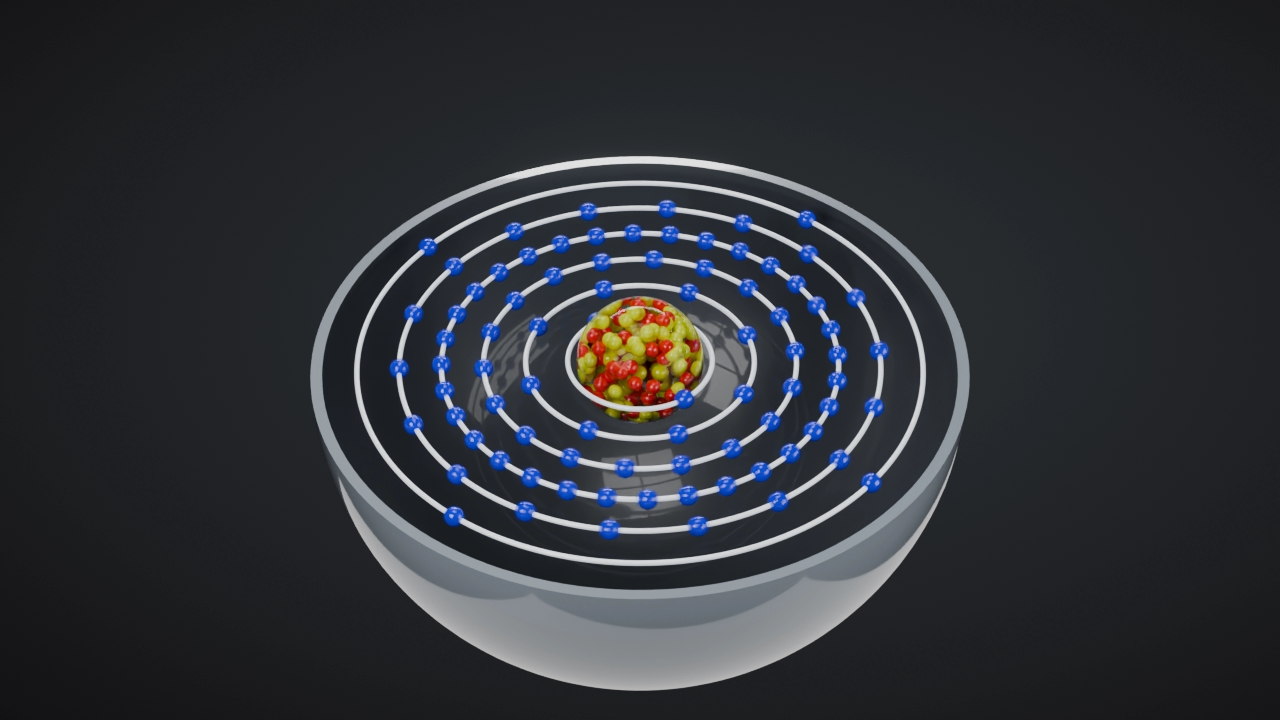
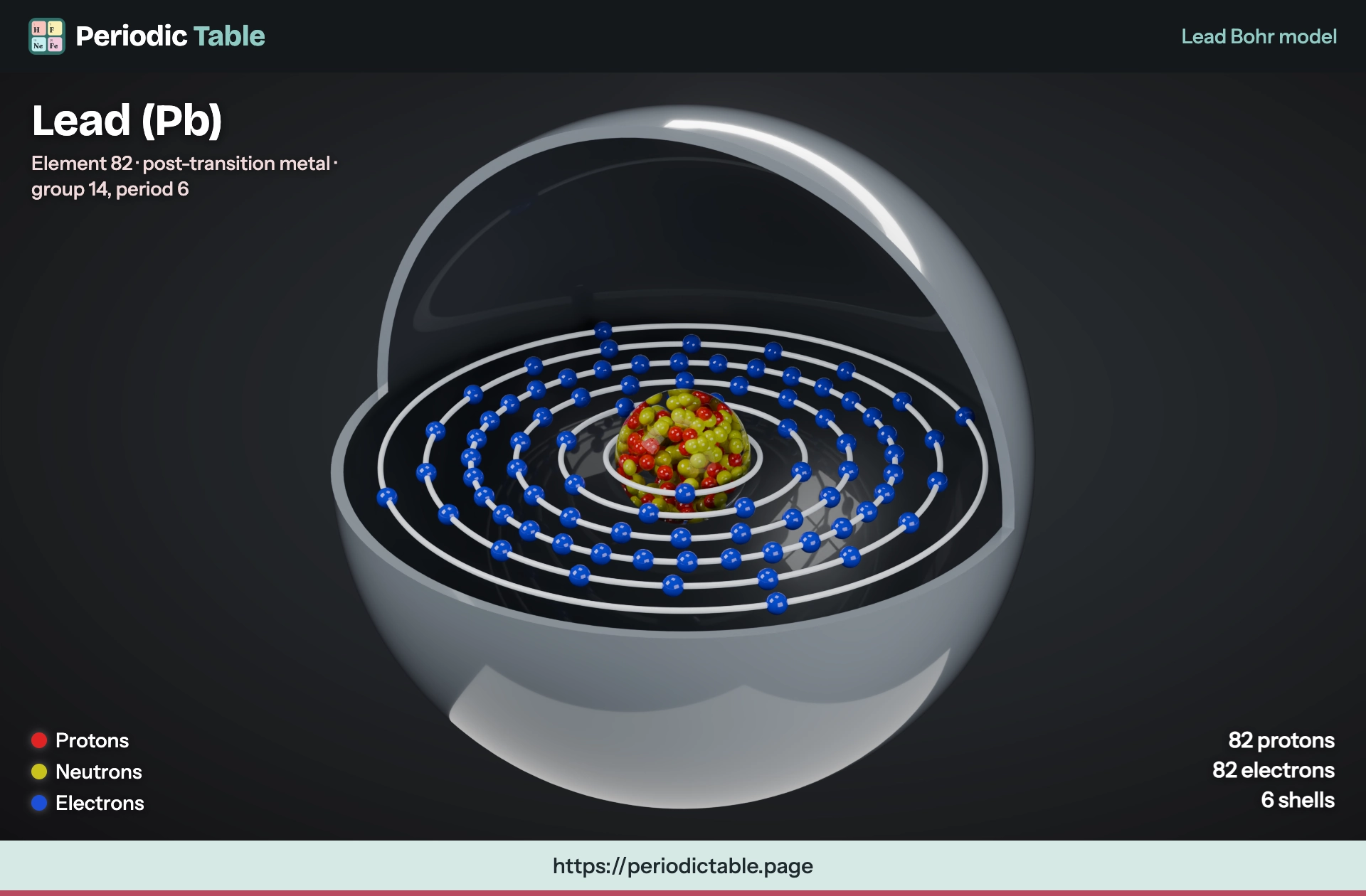
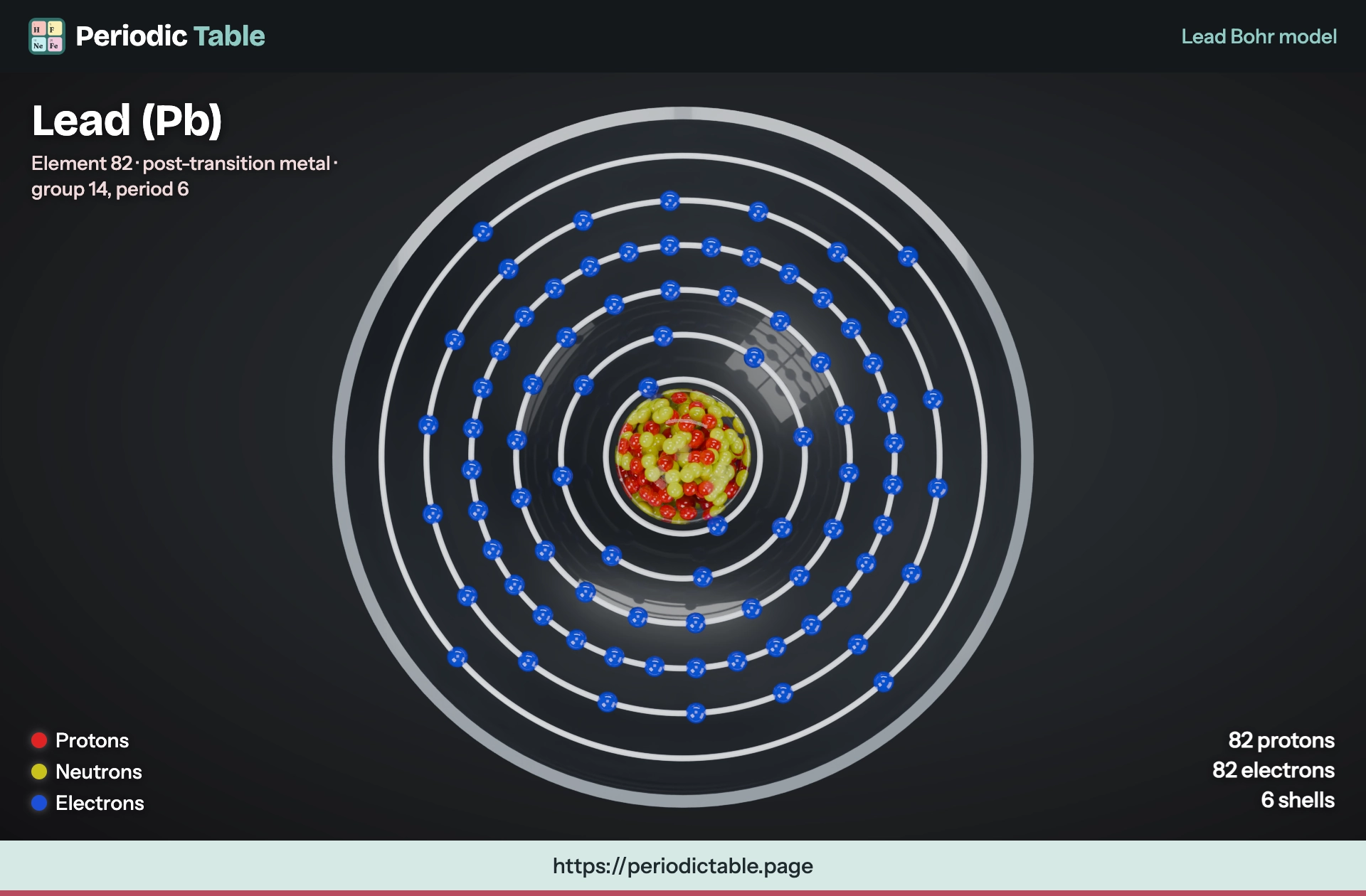
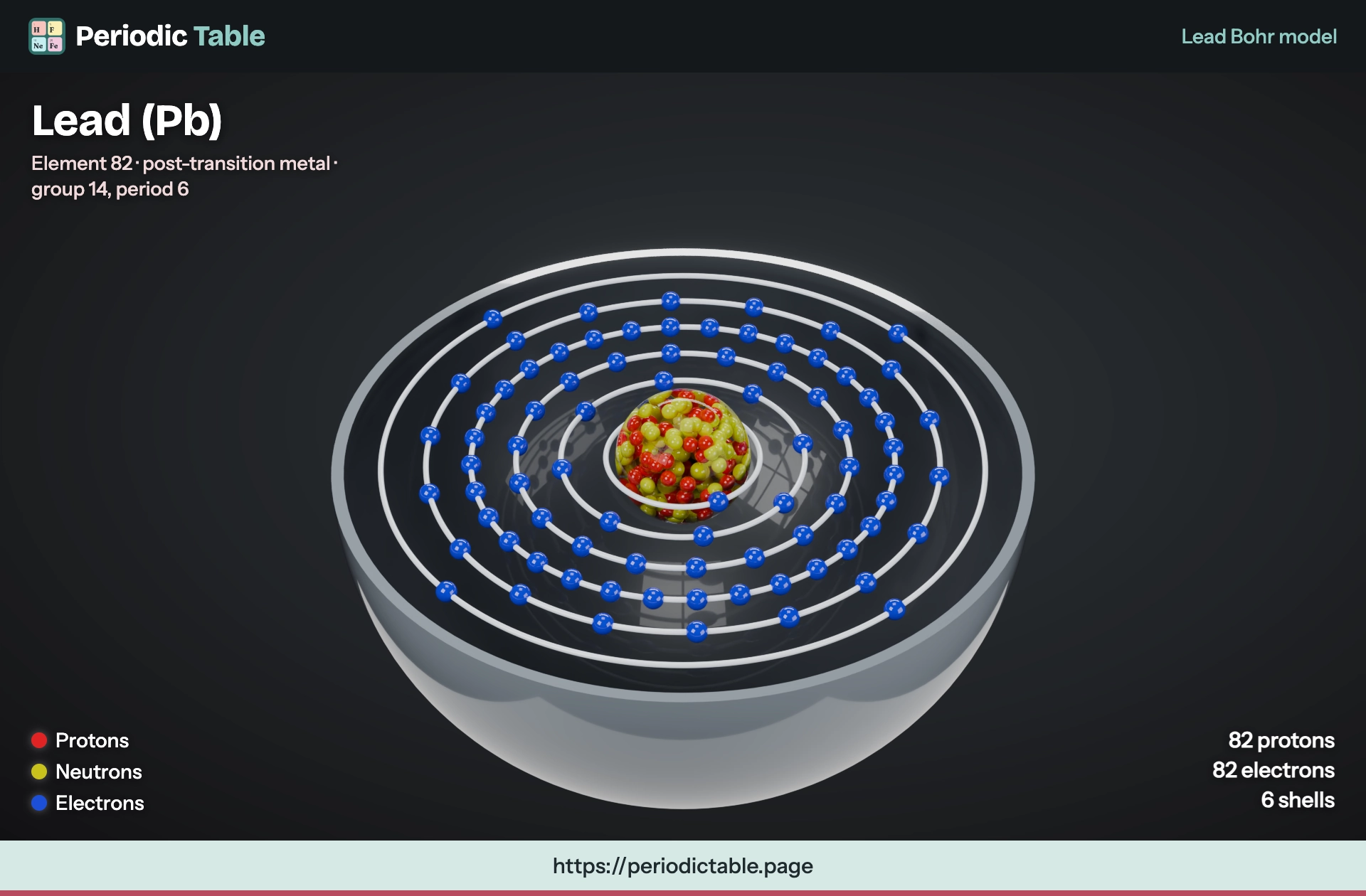
This is a Bohr model of lead (Pb), a simplified picture of a single lead atom. Its nucleus holds 82 protons, and a neutral lead atom has 82 electrons, arranged around it in 6 shells (2 in shell K, 8 in shell L, 18 in shell M, 32 in shell N, 18 in shell O and 4 in shell P).
Lead periodic table electron configuration
- Shorthand
- [Xe] 4f14 5d10 6s2 6p2
- Full
- 1s2 2s2 2p6 3s2 3p6 4s2 3d10 4p6 5s2 4d10 5p6 6s2 4f14 5d10 6p2
- Electrons per shell
- 2, 8, 18, 32, 18, 4
Lead element properties and atomic data
- Atomic number
- 82
- Atomic mass
- 207.21 u
- Phase at STP
- Solid
- Melting point
- 327.46°C (600.61 K)
- Boiling point
- 1748.85°C (2022 K)
- Density
- 11.34 g/cm³
- Electronegativity (Pauling)
- 1.87
- Period
- 6
- Group
- 14
- Block
- p-block
- Appearance
- Metallic gray
- Discovery date
- Ancient
- Discovered by
- Middle East
- Named by
- —
Lead (Pb) at a glance: group 14, period 6 and p-block facts
On the periodic table, lead sits in the carbon group, below carbon, silicon, germanium and tin, and above the synthetic element flerovium. Lead is the last member of that column you can actually hold in your hand, and it behaves like a post-transition metal: weakly metallic, slow to react, and willing to combine with both acids and bases. The table below collects the core reference values for lead that you are most likely to need. Steel-gray, hard and brittle, the metal is described in the chromium element with Mohs hardness and its magnetic ordering.
| Property | Value for lead |
|---|---|
| Symbol | Pb |
| Atomic number | 82 |
| Relative atomic mass | 207.2 |
| Group | Group 14 |
| Period | Period 6 |
| Block | p-block |
| Electron configuration | [Xe] 4f14 5d10 6s2 6p2 |
| State at 20 °C | Solid |
| Melting point | 327.46 °C (621.43 °F, 600.61 K) |
| Boiling point | 1749 °C (3180 °F, 2022 K) |
| Density at 20 °C | 11.34 g/cm3 |
| Common oxidation states | +2, +4 |
| Crystal structure | Face-centered cubic |
| CAS number | 7439-92-1 |
A few more values round out the profile. The electronegativity of Pb is 1.87 on the Pauling scale in the +2 state and 2.33 in the +4 state.
The empirical atomic radius of lead is about 175 pm and its covalent radius about 146 pm. The first three ionization energies of lead are 715.6, 1450.5 and 3081.5 kJ/mol; British references such as the Royal Society of Chemistry list the same lead figures as ionisation energies.
Atomic number, atomic weight and electron configuration
A lead atom has 82 protons and, when neutral, 82 electrons arranged in shells of 2, 8, 18, 32, 18 and 4. The four outer electrons sit in the 6s and 6p orbitals, which is why the atomic number 82 places Pb in the same column as carbon. The standard atomic weight of lead is quoted as 207.2, rounded to one decimal place on purpose: the mix of lead isotopes in a real sample shifts with where it was mined, so a more precise single value would be misleading.
The outer pair of 6s electrons is where lead's atomic physics gets unusual. Electrons close to a nucleus with 82 protons move fast enough that relativistic effects pull the 6s orbital inward and bind it more tightly.
The result is the inert pair effect: those two 6s electrons are reluctant to take part in bonding, so lead prefers to give up only its two 6p electrons. That single quirk explains much of the element's behaviour, from the dominance of the +2 state to the unusually long spacing between atoms in the solid.
Physical properties of bulk lead
Freshly cut bulk lead is bright and silvery with a faint blue tint, but it tarnishes to dull grey within hours in moist air. The physical properties that made lead famous all come from the way its atoms pack. Nuclear chemistry and neutron capture are explained in the neptunium electronegativity page, with the path from uranium to plutonium.
Instead of the rigid diamond lattice that carbon, silicon and germanium form, Pb settles into a close-packed face-centered cubic arrangement held together by loosely shared p electrons. That makes lead:
- Soft: a Mohs hardness of 1.5, so you can scratch lead with a fingernail.
- Malleable and moderately ductile, so lead rolls into sheet and draws into wire without cracking.
- Weak in tension: a tensile strength of only 12-17 MPa, far below aluminium or mild steel.
- Stiffer than it feels: a bulk modulus of about 46 GPa and a Young's modulus of about 16 GPa.
- Quick to heat: a specific heat capacity of roughly 129 J/(kg·K), about a seventh of aluminium's.
- A poor electrical conductor at room temperature, yet a superconductor below 7.19 K, the highest critical temperature of any type-I superconducting element.
That malleability is also a weakness. Unalloyed sheet creeps and sags under its own weight over years, which is why roof flashings and cable sheaths are often stiffened with a little antimony or copper.
Density, melting point and boiling point
Two numbers define how people use lead: its density of 11.34 g/cm3 and its low melting temperature of 327.46 °C. Lead is far more dense than the everyday metals around it, yet it melts on a camp stove.
To get a feel for that density, take a cube 5 cm on each side. Made of lead it would weigh about 1.42 kg (125 cm3 × 11.34 g/cm3); the same cube in aluminium would weigh just 0.34 kg.
| Element | Density (g/cm3) | Melting point (°C) |
|---|---|---|
| Aluminium | 2.70 | 660.3 |
| Zinc | 7.14 | 419.5 |
| Tin | 7.27 | 231.9 |
| Iron | 7.87 | 1538 |
| Copper | 8.96 | 1084.6 |
| Lead | 11.34 | 327.5 |
| Gold | 19.30 | 1064.2 |
Only tin melts at a lower temperature on that list, and only gold is denser than lead. At the other end of the scale, molten lead stays liquid over a very wide range and does not boil until 1749 °C, the lowest boiling temperature in its group. That wide liquid window is what let ancient metalworkers cast lead in simple clay moulds and what still makes lead easy to recover from scrap.
Chemical properties of metallic lead
The chemical properties of metallic lead are those of a reluctant reactant. In moist air it grows a thin protective skin, usually basic lead carbonate, with sulfate or chloride near the sea or in city air.
That film is why exposed roofs and cable sheaths show such good corrosion resistance for decades. Finely powdered lead is the exception: it can catch fire on its own and burns with a bluish-white flame.
Acids split into two camps. Sulfuric and phosphoric acid barely touch it, because the salts they form are insoluble and seal the surface. Hydrochloric and nitric acid dissolve it, and so do organic acids such as acetic acid when oxygen is present, which is why vinegar and fruit juice stored in lead-glazed pots pick up lead.
Strong alkalis also attack it, forming plumbite ions, so its chemistry is genuinely amphoteric. When you weigh up corrosion risk, then, the question is not whether lead resists attack in general but which chemical it is sitting in.
Oxidation states: why +2 usually wins
Every lighter member of lead's column favours the +4 state. Lead turns the trend upside down: thanks to the inert pair effect, most of its inorganic compounds are lead(II) salts, and lead(IV) is a strong oxidiser that wants to fall back to +2.
Lead(II) compounds
Lead(II) oxide, PbO, comes in two forms: red litharge and yellow massicot, the second stable only above about 488 °C. Litharge is the most widely used inorganic lead compound, feeding glassmaking, ceramic glazes and battery paste. Lead(II) ions are colourless in water, and adding dilute hydrochloric acid drops out white lead chloride, a classic test for the ion in solution.
Lead(IV) and unusual lead states
Lead dioxide, PbO2, is a powerful oxidising agent strong enough to turn hydrochloric acid into chlorine gas, and it forms the positive plate of every car battery. Red lead, Pb3O4, is a mixed lead(II,IV) lead oxide long used as a rust-proofing primer. Rarer states (+3, +1 and even negative values in cluster ions such as Pb94−) exist only in specialised compounds made in the laboratory.
Lead compounds and organolead chemistry
Most lead compounds you meet outside a laboratory are lead(II) salts. Lead sulfide, PbS, is the chief mineral source and also a sensitive infrared detector. Lead sulfate is insoluble in water and is the substance that coats battery plates as they discharge.
The nitrate and acetate dissolve readily, which made the acetate (the old "sugar of lead") a dangerous sweetener and makes both useful starting points in synthesis. Lead silicates give crystal glass its sparkle, and for centuries lead carbonates and oxides were among the most important white, yellow and red pigments an artist could buy.
Bonds to carbon form a separate family, organolead chemistry. These organolead compounds almost always hold Pb in the +4 state, because carbon's electronegativity is close enough to let the 6s electrons hybridise after all.
The best known is tetraethyllead, Pb(C2H5)4, once made in larger volumes than any other organometallic compound because a few drops per litre stopped car engines from knocking. Lead tetraacetate remains a useful laboratory oxidant.
Isotopes of the lead element and its decay chains
Natural lead is a blend of four stable isotopes, and three of them are the end points of the great radioactive decay chains. Its nucleus has a "magic" number of 82 protons, a closed shell in the nuclear shell model, and lead-208 adds a second magic number of 126 neutrons. That double closure makes it the heaviest stable nucleus known.
| Isotope | Natural abundance | Where it comes from |
|---|---|---|
| Lead-204 | 1.4% | Primordial only; no decay chain produces it |
| Lead-206 | 24.1% | End of the uranium-238 series |
| Lead-207 | 22.1% | End of the uranium-235 (actinium) series |
| Lead-208 | 52.4% | End of the thorium-232 series |
Because three of the four isotopes keep accumulating as heavier elements decay, the share of each varies from one rock to the next. In rocks rich in thorium, lead-208 can make up close to 90% of the total. Geologists turn that variation into a clock: the ratio of lead-206 and lead-207 to the never-replenished lead-204 tells you how long the parent elements have been decaying, and lead-lead dating of meteorites fixed the age of the Earth at about 4.55 billion years.
Beyond the four stable forms, the isotopes list runs to dozens of radioactive species. Lead-210, with a half-life of 22.2 years, is used to date lake sediments and ice laid down over the last century or so. In nuclear magnetic resonance, the isotope with mass 207 lets chemists study lead compounds in solution and even inside living tissue.
Where lead occurs: galena, ores and Earth's crust
Lead is surprisingly common for such a massive atom. Its crustal abundance is about 11-14 ppm, making it roughly the 36th most abundant element in Earth's crust.
Part of the reason is that lead keeps being made: every radioactive parent atom that finishes decaying adds a little more, so the Solar System's supply has crept up by about 0.75% since it formed. Before that, most of it was built inside stars by slow neutron capture, the s-process, which stops at lead and bismuth.
Lead rarely occurs in native form. It bonds readily with sulfur, so the main ore is galena, lead sulfide, usually found alongside zinc minerals and often carrying enough silver to pay for the dig by itself. Weathering of the sulfide produces the secondary ores you see in mineral collections:
- Cerussite, lead carbonate, sometimes called white lead ore.
- Anglesite, a sulfate mineral formed when the sulfide oxidises.
- Mixed sulfides such as boulangerite and jamesonite, which combine lead with other elements.
The Royal Society of Chemistry rates the supply risk for Pb at 6.2 out of 10, a moderate figure. China, Australia and the United States lead world production, while Australia, China and Russia hold the largest reserves. A recycling rate of more than 30% across all uses (and far higher for batteries) softens that risk.
How pure lead is mined, smelted and refined
Mining is only the first step. The concentrate goes through a two-stage process: roasting in air turns the sulfide into lead oxide and drives off sulfur dioxide, and then smelting the oxide with coke in a blast furnace reduces it to crude bullion. Some newer plants combine both steps in a single direct-smelting furnace that captures the sulfur more efficiently.
Crude bullion still carries copper, antimony, tin, arsenic, bismuth, gold and silver, so it is refined further. Copper is skimmed off as dross; antimony and tin are oxidised away; silver and gold are pulled out with zinc in the Parkes process; and the last traces go in electrolytic refining. The result is pure lead of 99.99% or better, the grade the battery and cable industry buys.
Recycled lead and the recycling loop
Recycling now supplies most of the world's lead. Of roughly twelve million tonnes produced each year, about two thirds is recycled lead, and in many countries more than 95% of spent car batteries are collected.
Secondary production needs far less energy than mining, and the reclaimed material is chemically identical to freshly mined output, so it can be reused indefinitely. The weak point is informal backyard battery breaking, which can poison whole neighbourhoods, as the section on sources explains.
From plumbum to leaded gasoline: a short history
People have smelted lead for at least 9,000 years; beads found in Anatolia date to around 7000 BCE. Its silver content drove early extraction, and the Romans produced it on a massive scale, tens of thousands of tonnes a year at the peak of ancient Rome. They lined aqueducts with lead, rolled it into water pipes, and used its oxides in make-up and to sweeten wine.
Our words plumbing, plumber and plumb line all come from the Latin name, and so does the symbol Pb. The English word lead is Anglo-Saxon, probably from a root meaning "to flow", a nod to how easily it melts.
Medieval alchemists saw lead as the basest of metals, linked to the planet Saturn, and the starting point for their attempts to make gold. Artists valued it more: lead white was the best white paint until the 1800s, and red lead was a favourite red.
Potters used it in glazes, and around 1440 easily cast lead type made the printing press practical. The Royal Society of Chemistry's Chemistry in its element podcast calls it the Eeyore of metals: slow, dull and ponderous.
The twentieth century brought lead's biggest and most harmful use. From the 1920s, tetraethyllead was added to petrol, and leaded gasoline spread fine lead particles along every busy road on Earth. Its phase-out, completed worldwide in 2021, is one of the clearest public-health successes on record.
Uses of lead metal in modern industry
Lead paints, petrol additives and water pipes have mostly gone, but lead metal still has jobs where its weight, low melting temperature and corrosion resistance are hard to match with other metals. Batteries take by far the largest share, followed by radiation protection, rolled sheet for roofing and construction, cable sheathing, ballast and diving weights, and shot and bullets for ammunition. Small amounts still go into specialist electronics and vibration-damping pads under buildings and machinery.
Lead-acid batteries
Most of the world's lead supply, well over 80%, ends up in lead-acid batteries. They start cars, back up telephone exchanges and data centres, and power forklifts. Each cell pairs a spongy Pb negative plate with a lead dioxide positive plate in sulfuric acid; on discharge both plates turn to lead sulfate:
$$\mathrm{Pb + PbO_2 + 2\,H_2SO_4 \rightarrow 2\,PbSO_4 + 2\,H_2O}$$Charging runs the reaction backwards, giving about 2.1 volts per cell. Other batteries store more energy per kilogram, but this chemistry is cheap, rugged and almost fully recoverable.
Radiation shielding, solder and alloys
Dense, high-atomic-number materials stop high-energy photons well, so radiation shielding is a natural fit. Lead aprons, shielded walls and leaded glass protect staff from x-rays in dental and hospital imaging, and thicker bricks block gamma rays around nuclear sources and laboratory instruments.
A low melting temperature also makes it a good base for alloys. Tin-lead solder flows at a lower temperature than either element alone; lead plumbing joints were banned for drinking water in many countries, and electronics solders have largely moved to lead-free tin blends. Pewter, type metal, bearing materials and fusible safety plugs are other traditional examples.
Lead toxicity: how a heavy metal harms your body
The same chemistry that makes lead useful makes it dangerous. Lead is a neurotoxin and a heavy metal with no known role in the body, and its toxicity comes from mimicking calcium and zinc. It slips into enzymes and nerve signalling sites, interferes with making haemoglobin, and is stored in bones for decades, where it can be released again during pregnancy or illness.
According to the EPA, no safe level of lead has been identified for children, and it can harm almost every organ. The main health effects of lead exposure are:
- Damage to the brain and nervous system, with lower IQ, attention problems and learning difficulties.
- Anemia (spelled anaemia in British English), because lead blocks haem production.
- Reduced kidney function and higher blood pressure in adults.
- Reduced fertility in both men and women.
- Harm to a developing fetus, including premature birth and low birth weight, since stored lead can cross the placenta.
Why children and pregnant women face the greatest risk
Lead toxicity is not shared out evenly. A toddler absorbs a far larger share of what it swallows than an adult does, its brain is still wiring itself, and its hands go into its mouth dozens of times an hour, so even low lead exposure can do lasting harm.
During pregnancy and breastfeeding, the body pulls calcium out of the bones and releases stored lead with it, which then reaches the baby. That is why public-health agencies focus testing and clean-up on homes with infants, children and expectant mothers first.
Lead poisoning and blood lead level testing
Lead poisoning often has no obvious symptoms until levels are high, and early signs look like flu. The only reliable check is a blood test. The CDC recommends testing children at 12 and 24 months, and treats a blood lead level at or above 3.5 µg/dL as higher than most children have, calling for follow-up to find the source.
At 45 µg/dL or more, doctors may prescribe chelation therapy to remove it from the body. Signs of lead poisoning to watch for include:
- Headaches, stomach pain, constipation and nausea.
- Tiredness, irritability and loss of appetite.
- Slowed development or new learning problems in toddlers.
- Memory, mood and concentration problems or joint pain in adults with lead poisoning from work.
For adults, the first step after a high result is the same as for a toddler: find and remove the source. The CDC runs a childhood lead poisoning prevention programme with state health departments, and blood lead results from those programmes are how officials map which neighbourhoods still need help.
Common sources of lead exposure
Most lead exposure today comes from past human activity rather than from nature. Lead does not break down, so whatever was released into the environment over the last century is still there, mainly as dust and soil contamination. Lead reaches you in two main ways.
Ingestion is the most common, especially for toddlers who put dusty hands and objects in their mouths. Inhalation of airborne particles matters most at work and near smelters. Skin absorption is rare and mostly limited to the organic compounds once used in fuel.
Lead in paint, dust and soil
In the United States, the leading source of exposure for kids is lead-based paint in homes built before 1978. Old lead paints chip and chalk as they age, and sanding or scraping them during renovation fills a room with fine particles that settles on floors and window sills. Outside, soil near busy roads, old houses and former smelters still carries fallout from leaded gasoline and flaking paints, so bare yard soil is a common source of lead in the environment around a home.
Lead in tap water
Water leaves the treatment plant almost lead-free. It picks up lead on the way to your tap from old lead service lines, brass fittings and soldered joints, especially when the water is soft or acidic and has been standing in the pipes overnight. Because you cannot see, smell or taste dissolved Pb, the only way to know your exposure from tap water is to have it tested.
Lead in food, toys and consumer products
Some of the hardest sources to spot are everyday goods, because the lead is mixed into a glaze, a pigment or a powder rather than sitting on the surface.
Lead-glazed ceramics and cookware
Traditional glazed ceramics and artisanal aluminium cookware cast from scrap can leach lead into acidic food such as tomato sauce, fruit juice or vinegar dressings.
Lead in toys and jewellery
Imported or antique toys and cheap jewellery may hide lead in their paint, plastic or metal parts, which matters most for toddlers who chew on them.
Cosmetics, remedies and spices
Cosmetics such as kohl and some traditional remedies can carry high lead levels, and spices are sometimes adulterated with lead chromate to brighten their colour.
Lead exposure at work and through hobbies
Occupational lead exposure is the main route for adults. Smelting and battery breaking, demolition and renovation of old buildings, auto radiator repair and firing ranges all release lead dust or fumes into the workplace environment. Leadlight window making, casting fishing sinkers and reloading cartridges carry the same risk at home.
Workers can also carry dust home on clothes and shoes, which is how a job turns into a family's exposure. Informal battery recycling is the worst case: plates are melted in open pits, and the contamination and pollution from a single backyard site can reach every household around it.
How to lower your family's contact with this toxic metal
You cannot see lead in dust or water, so prevention comes down to habits that cut the most likely routes of exposure. These steps follow guidance from the EPA and the CDC and, taken together, cover most household sources:
- Clean floors and window sills weekly with a damp mop or cloth; dry sweeping just spreads lead dust.
- Take your shoes off at the door so yard soil stays outside.
- Wash hands, bottles, pacifiers and toys often, especially after outdoor play.
- Use only cold tap water for drinking, cooking and baby formula, run the tap after water has been standing, and consider a filter certified for lead. Boiling does not remove it.
- Serve meals rich in calcium, iron and vitamin C, which reduce how much lead the gut absorbs.
- If you renovate a pre-1978 home, hire certified lead-safe contractors and keep toddlers away until the area is cleaned.
- If you work with lead, change clothes and shoes before going home and wash work clothes separately.
If you think your child has been exposed, ask your doctor for a blood lead test and work with your local public health department to find and remove the source. Cutting off lead exposure early matters more than any treatment afterwards.
Lead rules, restriction and remediation
Because lead toxicity is so well documented, lead is one of the most tightly controlled elements in the world. Key regulations include bans on residential lead paint and on leaded fuel for cars, the U.S. Lead and Copper Rule for public water systems, workplace exposure limits set by occupational safety agencies, and Europe's RoHS directive limiting lead in electronic equipment. The EPA also sets an air-quality standard for Pb and runs clean-up programmes for contaminated sites in the environment.
Remediation follows the same pattern everywhere: find the source, then remove it, cover it or keep people away from it. That means replacing lead service lines, abating or sealing old lead paint, capping or replacing contaminated garden soil, and moving informal battery recycling into licensed plants. Lead exposure data show the payoff: average blood lead in kids in countries that phased out leaded petrol and lead paint has fallen by more than 90% since the 1970s, yet the World Health Organization still counts lead among the chemicals of greatest concern for public health worldwide, and lead poisoning remains common wherever those controls are weak.