


Neptunium element (Np): neptunium periodic table facts
Neptunium periodic table facts: neptunium (Np) is element 93, an actinide in period 7 of the f-block. Squeezed between uranium and plutonium, neptunium is the element almost nobody talks about, yet it was the first transuranic element ever made. To see how Carl Wilhelm Scheele and Humphry Davy identified a greenish-yellow gas, open the chlorine element page for the full story.
Np carries atomic number 93, and it is a silvery, ductile, radioactive actinide metal that today comes almost entirely from nuclear reactors. Below you will find its core data, how it behaves chemically, which isotopes matter, how it was discovered, and where it actually gets used.
Rotate the 3D Bohr model of neptunium
Drag to orbit, scroll to zoom.
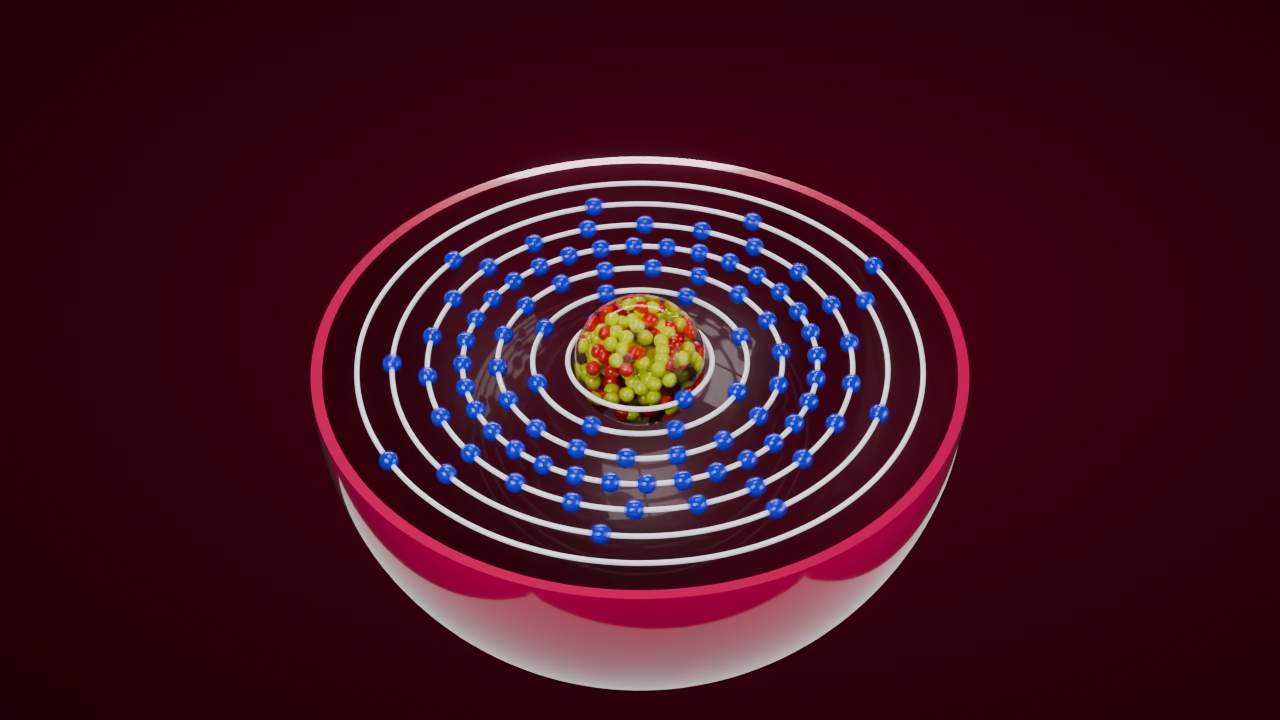
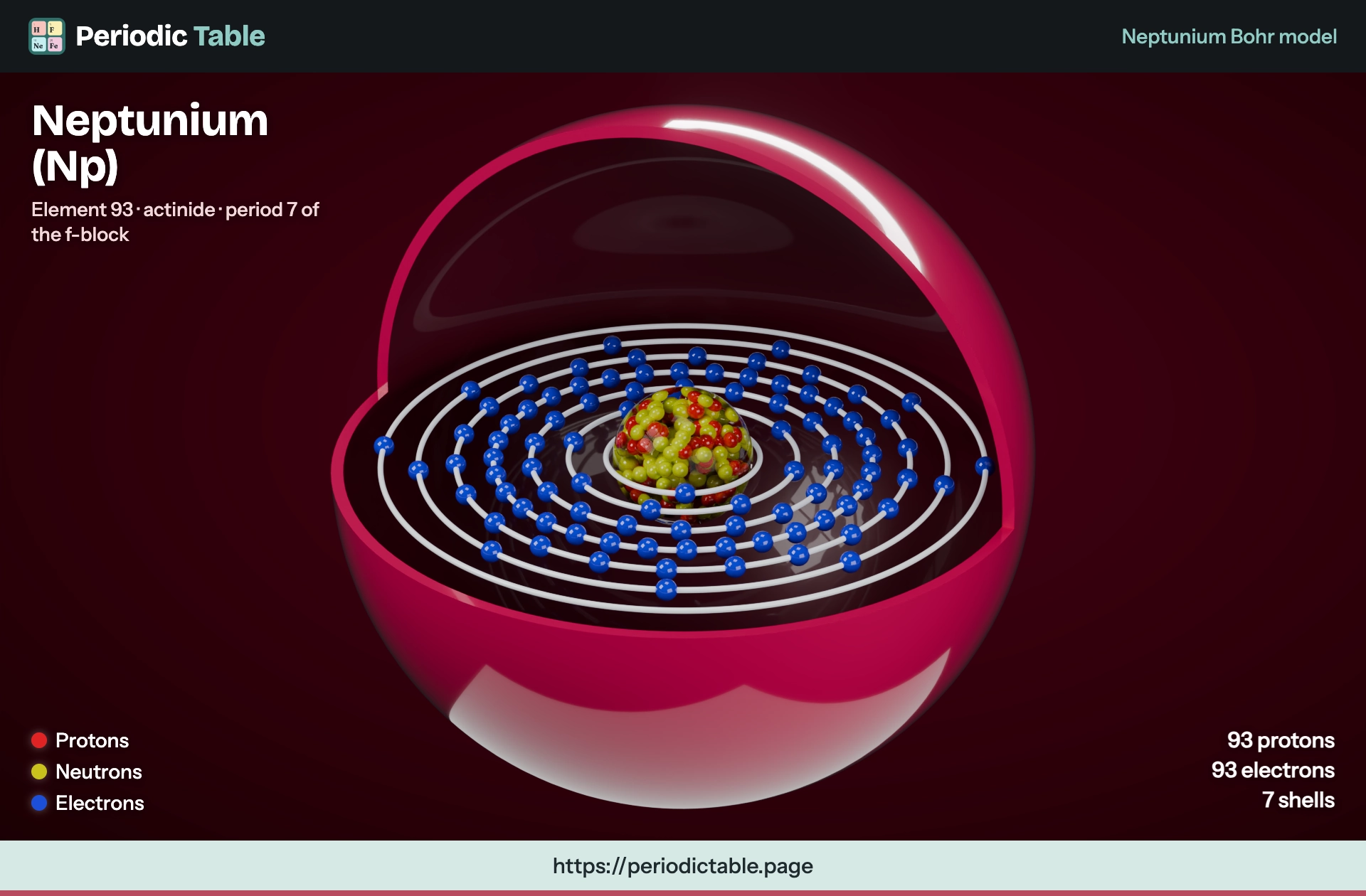
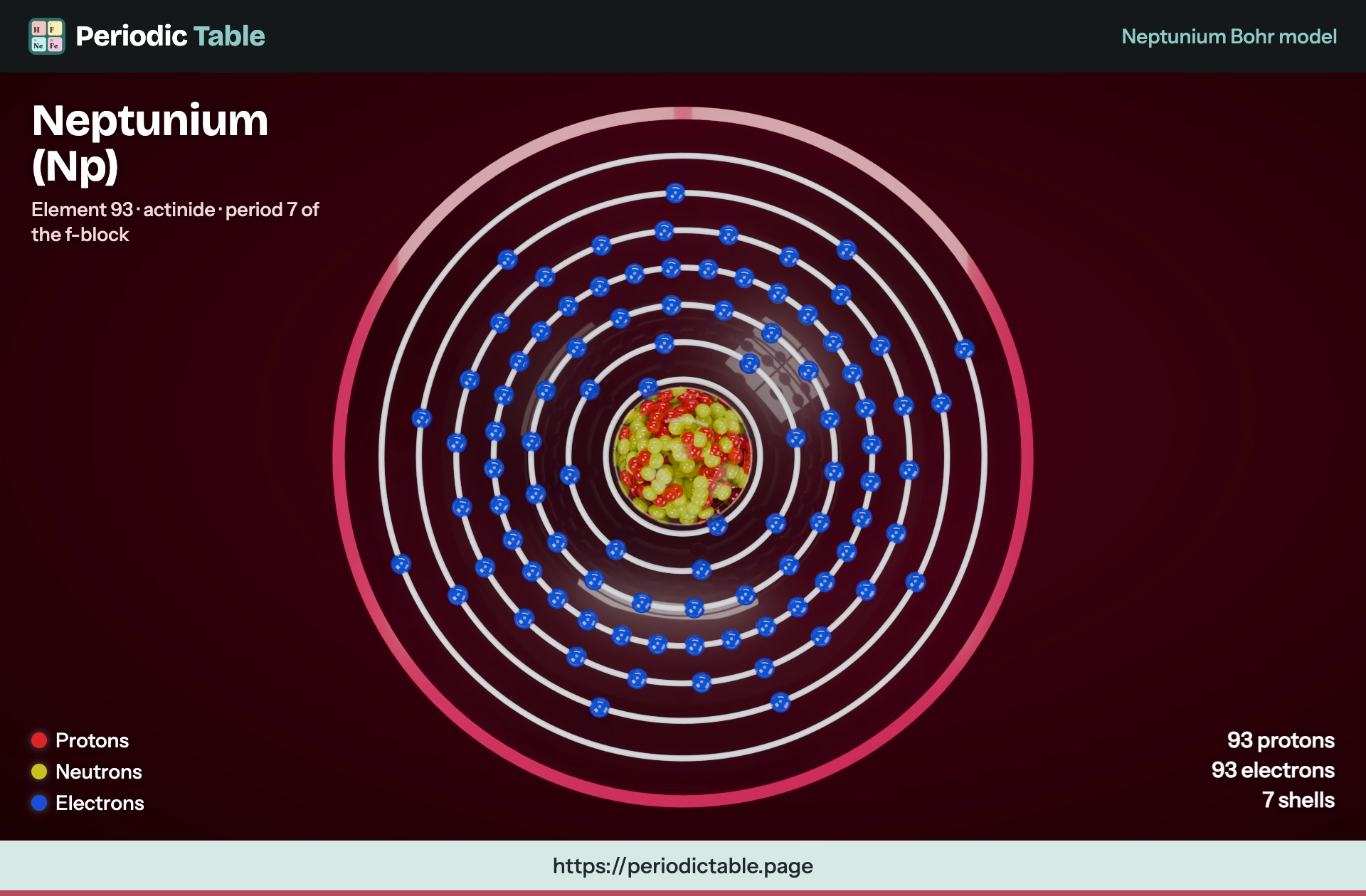
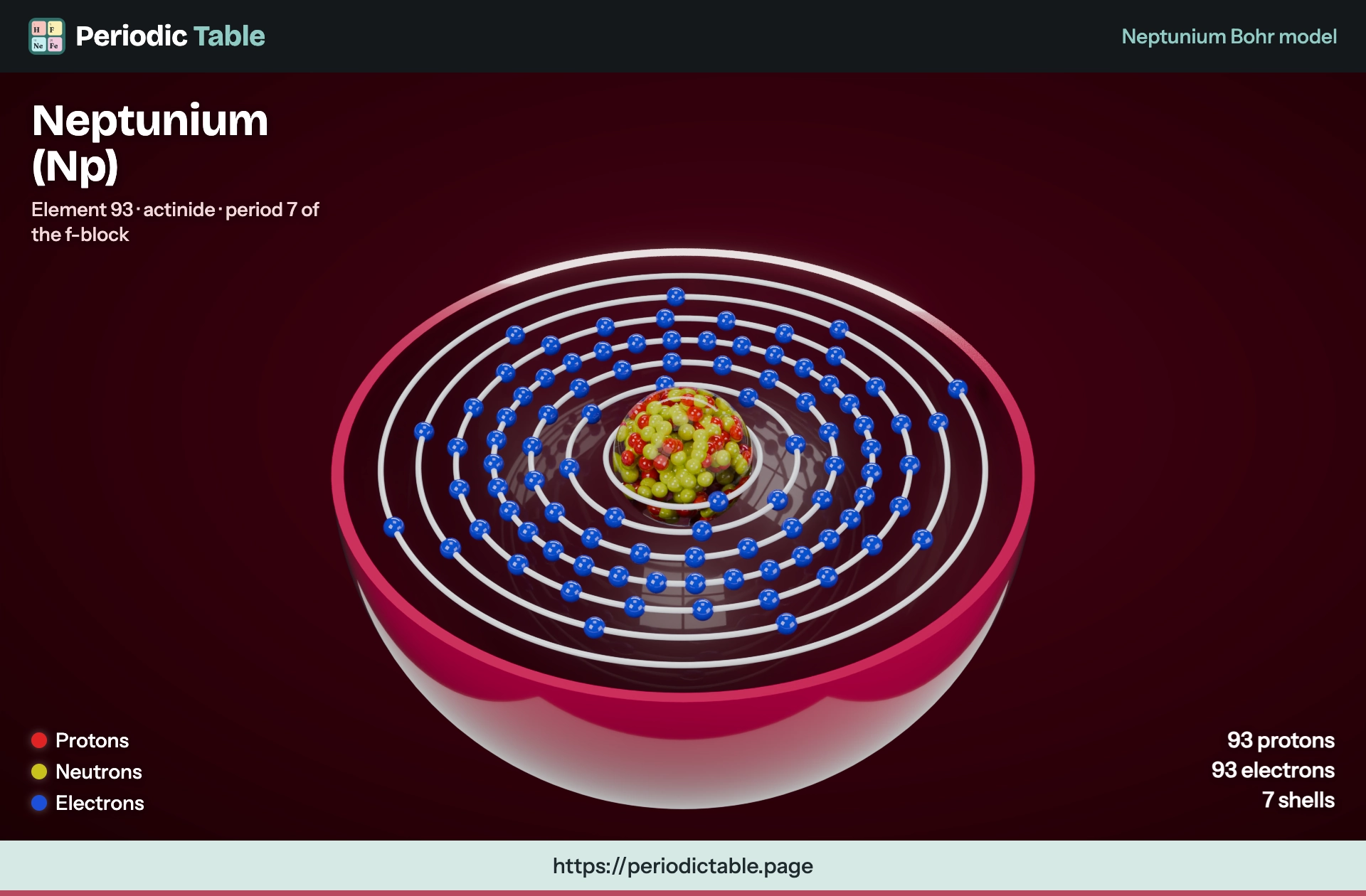
This is a Bohr model of neptunium (Np), a simplified picture of a single neptunium atom. Its nucleus holds 93 protons, and a neutral neptunium atom has 93 electrons, arranged around it in 7 shells (2 in shell K, 8 in shell L, 18 in shell M, 32 in shell N, 22 in shell O, 9 in shell P and 2 in shell Q).
Neptunium periodic table electron configuration
- Shorthand
- [Rn] 5f4 6d1 7s2
- Full
- 1s2 2s2 2p6 3s2 3p6 4s2 3d10 4p6 5s2 4d10 5p6 6s2 4f14 5d10 6p6 7s2 5f4 6d1
- Electrons per shell
- 2, 8, 18, 32, 22, 9, 2
Neptunium element properties and atomic data
- Atomic number
- 93
- Atomic mass
- [237] u
- Phase at STP
- Solid
- Melting point
- 638.85°C (912 K)
- Boiling point
- 4173.85°C (4447 K)
- Density
- 20.45 g/cm³
- Electronegativity (Pauling)
- 1.36
- Period
- 7
- Group
- —
- Block
- f-block
- Appearance
- Silvery metallic
- Discovery date
- 1940
- Discovered by
- Edwin McMillan
- Named by
- —
Neptunium element facts at a glance
The neptunium element sits in period 7 of the periodic table, inside the f-block row of the actinides. It took its name from the planet Neptune, the next planet out past Uranus, in the same way uranium had been named after Uranus a century and a half earlier. Because neptunium has no stable isotopes, its "mass" is given as the mass number of its longest-lived isotope, neptunium-237, and its position on the periodic table is right between uranium and plutonium. A quick route to batteries, uranium and thorium decay endpoints is element 82, lead, which covers the toxic metal in depth.
| Property | Value for Np |
|---|---|
| Symbol / atomic number | Np / 93 |
| Group / block / period | Actinides / f-block / period 7 |
| Standard atomic weight | [237] (mass number of Np-237) |
| State at 20 °C | Solid, silvery metal |
| Melting point | 639 ± 3 °C (912 K) |
| Boiling point | about 4174 °C (4447 K), extrapolated |
| Density (α-Np, room temperature) | 20.45 g/cm³ |
| Named after | The planet Neptune |
| Discovered | 1940, Berkeley, California |
| CAS number | 7439-99-8 |
Two of those figures need a caveat. The boiling point has never been measured directly; it comes from extrapolating vapour-pressure data. And older reference cards list slightly different melting points (anywhere from about 637 to 644 °C), because early samples were small and not always pure.
Atomic number, atomic mass and electron configuration
The atomic number of 93 means every neptunium nucleus holds 93 protons, one proton more than its neighbour on the left, and a neutral atom carries 93 electrons. Its atomic mass is quoted as 237 because that is the isotope you are most likely to meet.
The ground-state electron configuration is [Rn] 5f4 6d1 7s2: one electron sits in the 6d subshell rather than the 5f, because the 5f, 6d and 7s levels lie so close in energy. Its lighter homolog in the lanthanides, promethium, has a matching 4f arrangement once ionised.
| Atomic data | Value |
|---|---|
| Electron configuration | [Rn] 5f4 6d1 7s2 |
| Electrons per shell | 2, 8, 18, 32, 22, 9, 2 |
| Electronegativity (Pauling scale) | 1.36 |
| First of the ionization energies | 604.5 kJ/mol (about 6.27 eV) |
| Atomic radius (empirical) | 155 pm |
| Covalent radius | 190 ± 1 pm |
Only the first ionization energy has been measured with confidence; the higher ones are still blank on most data sheets.
Physical properties of neptunium metal
Pure neptunium metal is hard and ductile, and it works mechanically much like its lighter neighbour, U. In air it slowly tarnishes as a thin oxide film forms, and the reaction speeds up as the temperature climbs. Its bulk modulus of 118 GPa puts its stiffness close to that of manganese. Before learning about valence electrons, open the sodium atomic number to see its Na symbol and how natrium named the metal.
The physical properties that stand out are the extremes:
- Densest actinide: at 20.45 g/cm³, α-neptunium is the densest of the actinides and the fifth-densest naturally occurring element, behind only rhenium, osmium, iridium and platinum.
- Low melting point: it melts at just 639 °C, the same as plutonium, because its 5f and 6d orbitals hybridise into directional bonds.
- Widest liquid range: if the extrapolated boiling point is right, it stays liquid across about 3,535 K, the largest liquid range of any element.
- Vapor pressure: it only reaches 1 Pa at about 2,194 K, which is why the boiling point has to be estimated from vapor pressure data.
Allotropes and crystal lattice
Solid neptunium has three confirmed allotropes, and claims of a fourth have never been proven. Each phase has its own crystal lattice, and the density drops noticeably as it moves to the high-temperature forms:
| Allotrope | Stable range | Crystal structure | Density (g/cm³) |
|---|---|---|---|
| α (alpha) | up to 280 °C | Orthorhombic | 20.45 |
| β (beta) | 280–576 °C | Tetragonal | 19.36 |
| γ (gamma) | 576–639 °C | Body-centered cubic | 18.08 |
The α form behaves more like a metalloid than a true metal, with strong covalent bonding and high electrical resistivity. Its phase diagram also has a β/γ/liquid triple point at 725 °C and 3,200 MPa.
Alloys, magnetism and a superconductor
Because the 5f electrons of neptunium sit right on the border between localised and itinerant, neptunium's magnetism swings widely depending on what it is alloyed with. Pure Np is paramagnetic, NpAl3 is ferromagnetic, and NpGe3 shows no magnetic order at all. One alloy, NpPd5Al2, is a superconductor below 4.85 K, which surprised researchers because strong magnetism usually suppresses superconductivity.
Chemical properties and oxidation states of element 93
The chemical properties of element 93 are dominated by its range of oxidation states: from +3 to +7 in solution, with +2 known only in a few exotic complexes. It is the heaviest actinide that can give up every valence electron in a stable compound (the +7 state). The +5 state is the most stable in water, while +4 is favoured in solid compounds.
The metal itself is very reactive, and its ions readily undergo hydrolysis and form coordination compounds. That combination makes neptunium chemistry unusually rich for such a scarce element, and the solution chemistry alone fills whole review chapters, and it is why so much of the research on it concerns how it moves through water, soil and reprocessing plants.
Neptunium ions and their colours in solution
All five of the common neptunium ions can coexist in one solution, and each has its own colour, which chemists use as a quick visual check of the oxidation state:
| Oxidation state | Ion in acid | Typical colour | Example compound |
|---|---|---|---|
| Np(III) | Np3+ | Dark blue-purple | NpCl3 |
| Np(IV) | Np4+ | Pale yellow-green | NpO2 |
| Np(V) | NpO2+ | Green-blue | NpF5 |
| Np(VI) | NpO22+ | Pink to red | NpF6 |
| Np(VII) | NpO3+ | Dark green | NpO2(OH)3 |
Np(III) and Np(IV) convert into each other easily, as do Np(V) and Np(VI). In the presence of oxygen, Np(III) is quickly oxidised to Np(IV) unless a strong reducing agent is present.
Neptunium oxides and hydroxides
Only two neptunium oxides are firmly established: the greenish-brown neptunium dioxide, NpO2, and the black-brown Np2O5. The dioxide is the workhorse. It forms simply by burning neptunium salts in air and stays stable over a huge range of temperatures and pressures, while Np2O5 breaks back down to NpO2 and oxygen above about 420 °C.
The hydroxides track the ions. Np(III) hydroxide survives only where oxygen is absent, Np(IV) exists mostly as neutral Np(OH)4, and the very stable Np(V) ion forms a solid hydroxide only at high concentration.
Neptunium fluorides, halides and coordination complexes
Of all the halides, the neptunium fluorides have been studied most, because fluoride volatility offers a route for pulling neptunium out of spent fuel. Four binary fluorides are known, NpF3 through NpF6. Neptunium hexafluoride (NpF6) is extremely volatile, just like uranium hexafluoride, and was first prepared in 1943 by heating NpF3 in fluorine gas at very high temperature.
Other neptunium compounds worth knowing:
- Chlorides, bromides and iodides, including the triiodide complexes used as starting materials for many other neptunium compounds
- Sulfides such as Np2S3, nitrides, carbides and hydrides
- Organometallics such as neptunocene, Np(C8H8)2
Interest in neptunium's coordination complexes comes from the fact that each oxidation state binds ligands differently, and from the actinide contraction, which shrinks the ionic radii across the series.
Neptunium isotopes and half-life values
All 24 characterised neptunium isotopes are radioactive, and none comes anywhere near primordial survival. Lighter isotopes mostly decay by electron capture, heavier ones by beta decay, and Np-237 itself by alpha decay (with an extremely rare spontaneous fission branch).
| Isotope | Half-life | Main decay mode | Product |
|---|---|---|---|
| Np-235 | 396.1 days | Electron capture | U-235 |
| Np-236 | 153,000 years | Electron capture / β− | U-236 / Pu-236 |
| Np-237 | 2.144 million years | α (rare spontaneous fission) | Pa-233 |
| Np-238 | 2.099 days | β− | Pu-238 |
| Np-239 | 2.356 days | β− | Pu-239 |
To see what these numbers mean in practice, use the standard half-life relation:
$$\frac{N}{N_0} = \left(\tfrac{1}{2}\right)^{t / t_{1/2}}$$
Take a gram of Np-237 locked in a repository for 10,000 years: \( (1/2)^{10\,000/2\,144\,000} \approx 0.9968 \), so 99.68% of it is still there. Over the 4.54-billion-year age of the Earth, the same formula gives a surviving fraction of about 10−637, which is why no primordial neptunium is left. At the short end, a batch of neptunium-239 is 87.2% converted into plutonium after one week.
The neptunium series decay chain
Np-237 heads the neptunium series, the "4n + 1" decay chain. Unlike the uranium and thorium series, which end at lead, this chain ends at bismuth-209 and thallium-205. It had essentially vanished from Earth, since none of its members above bismuth-209 live long enough, but tonne-scale reactor production of Np-237 has brought this branch of radioactivity back into existence.
History and discovery of the first transuranic element
The history of neptunium is a decade of false starts before a clean discovery. Dmitri Mendeleev's 1871 table already showed an empty slot after uranium, but nobody could make or find the transuranic element that belonged there until 1940.
Early claims: ausenium, eka-rhenium and bohemium
- 1934, Rome: Enrico Fermi's group bombarded uranium with neutrons, saw unexplained half-lives and proposed the new element under the name ausenium (symbol Ao).
- 1934, Czechoslovakia: Odolen Koblic announced bohemium from pitchblende wash water; it turned out to be a mix of tungsten and vanadium.
- 1938, Paris: Horia Hulubei and Yvette Cauchois reported sequanium from X-ray spectra of minerals, a claim dismissed at the time.
- 1938, Stockholm: Fermi received the Nobel Prize in Physics, partly for "new radioactive elements" made by neutron irradiation.
Within weeks, Otto Hahn, Lise Meitner and Otto Frisch explained nuclear fission, and most of Fermi's mystery activities were reassigned to fission products. Part of the confusion came from chemistry: before the actinide series was recognised, the periodic table placed uranium under tungsten, so the next element was expected to behave like manganese's heavy cousin and chemists searched for an eka-rhenium that did not exist. Yoshio Nishina and Kenjiro Kimura came closest in 1940, correctly predicting a very long-lived neptunium-237, but could not measure it.
McMillan and Abelson find element 93 at Berkeley
In 1939 Edwin McMillan, working at the Berkeley Radiation Laboratory, bombarded a uranium oxide target with neutrons from the 60-inch cyclotron. Alongside the known 23-minute activity of uranium-239 he saw a second, unexplained 2.3-day activity.
Emilio Segrè first concluded it was just another fission product, because the chemistry did not resemble rhenium. In 1940 McMillan and Philip Abelson tried again, showed the substance precipitated with hydrogen fluoride under reducing conditions, and proved the 2.3-day activity grew as the 23-minute activity fell:
$$^{238}_{92}\mathrm{U} + {}^{1}_{0}n \rightarrow {}^{239}_{92}\mathrm{U} \xrightarrow[23\ \text{min}]{\beta^-} {}^{239}_{93}\mathrm{Np} \xrightarrow[2.356\ \text{d}]{\beta^-} {}^{239}_{94}\mathrm{Pu}$$
That reaction confirmed the new element, and it also pointed straight at element 94, which is why the work later fed the actinide series concept.
Seaborg, weighable samples and later work
Because Np-239 decays so fast, McMillan and Abelson never had enough to weigh. That changed in 1942, when Glenn Seaborg and Arthur Wahl identified the long-lived isotope, finally giving neptunium chemistry weighable samples.
During the Second World War, as the atomic bomb project took shape, the name chain was settled too: uranium (Uranus), neptunium (Neptune), plutonium (Pluto). The neptunium name itself had been claimed twice before for minerals that turned out to be mistakes, so element 93 was its third outing.
Where neptunium comes from: occurrence and production
Almost all the neptunium on Earth today is a by-product of fuel burned in nuclear reactors. Natural Np exists, but only in quantities you would need a mass spectrometer to find.
Trace amounts in uranium ores
Trace amounts of Np-237 and Np-239 form inside uranium ores when uranium-238 nuclei capture stray neutrons from spontaneous fission or cosmic rays. The ratio of Np-237 to uranium in those ores is about 1 part in 1012 or less; it was first isolated from Belgian Congo ore in 1952.
Most of the neptunium in the environment came from atmospheric nuclear explosions between 1945 and 1963, which released an estimated 2,500 kg. In seawater the Np-237 concentration is roughly 6.5 × 10⁻⁵ mBq per litre. Once out there, it shows much higher mobility than other actinides, because Np(V) dissolves readily and does not bind tightly to soil.
Making it by neutron capture
In a working reactor, the Np-237 route starts with uranium-235. A U-235 nucleus captures a neutron; most of the time it fissions, but about one time in seven it settles into U-236 instead. A second neutron capture gives U-237, which beta-decays with a 6.75-day half-life into Np-237.
A smaller amount comes from fast-neutron (n, 2n) reactions on U-238 and from the alpha decay of americium. Every nuclear power plant therefore makes neptunium continuously, on the order of tonnes a year worldwide, while the neutron irradiation of U-238 also produces the short-lived Np-239.
Separating it from spent nuclear fuel
Np-237 is one of the main minor actinides left in spent nuclear fuel, and recovering it is part of the back end of the nuclear fuel cycle. Separation methods exploit how differently the oxidation states behave in solution:
- Solvent extraction, including adjustments to the PUREX process, which uses tributyl phosphate to pull out uranium and plutonium
- Ion-exchange and chelating-resin chromatography
- Coprecipitation, electrodeposition and, at small scale, biotechnological methods
Uses of neptunium-237
Neptunium has no commercial use as a material. Its real uses all trace back to Np-237's role as a feedstock or a target in nuclear physics, plus a long history as a test subject in nuclear chemistry.
Precursor to plutonium-238 for spacecraft power
The most important job of Np-237 is making plutonium-238. Np-237 targets are irradiated with neutrons to form Np-238, which beta-decays in about two days to Pu-238.
That isotope's steady alpha heat powers radioisotope thermal generators on deep-space spacecraft, where sunlight is too weak for solar panels. Irradiating Np-237 with electron beams also yields fairly pure Pu-236, used as a tracer for measuring plutonium in the environment.
Neutron detectors and basic research
Np-237 fissions only with fast neutrons, which makes it useful in neutron detectors that need to respond to high-energy (MeV) neutrons and ignore slow ones. Beyond that, it is mostly a research material for actinide physics and chemistry.
Critical mass and nuclear weapons
Np-237 is fissionable, and neptunium-235, -236 and -237 are all predicted to be fissile. In 2002, Los Alamos researchers measured the critical mass of a bare Np-237 sphere at somewhere between the high 50s and low 60s of kilograms, close to that of uranium-235.
The US Department of Energy had declassified in 1992 that Np-237 "can be used for a nuclear explosive device", although no nuclear weapons are known to have been built with it, since plutonium-239 and enriched uranium need less material. Because reactors produce far more than one critical mass of Np each year, separated stocks are safeguarded like other weapons-usable material.
Np in nuclear waste and household smoke detectors
The most likely place you will meet neptunium outside a lab is a ceiling. Ionisation smoke detectors use a tiny americium-241 source (about 0.2 micrograms), and with a 432-year half-life that americium slowly decays into Np-237.
Using the half-life formula above, a detector kept for 50 years has had about 7.7% of its americium turned into neptunium. Because Np-237 decays about 5,000 times more slowly than americium-241, that growing sliver of neptunium adds almost no activity of its own; the same Am-241 to Np-237 step also turns up in reactor waste, where curium-245 feeds into it.
In nuclear waste the story is more serious. Under oxidising conditions Np-237 was found to be the most mobile actinide at the planned Yucca Mountain repository in Nevada, and with its 2.144-million-year half-life it becomes the main contributor to radiotoxicity there after about 10,000 years. That is why it is a leading candidate for transmutation: separating it and irradiating it into shorter-lived products.
Is the actinide metal dangerous? toxicity and handling
Neptunium has no biological role, and the chemistry that matters here is how the body handles it. Like the other heavy actinides, it is dangerous for two separate reasons: its radiation, mostly alpha particles, and its chemistry. Animal studies show only about 1% is absorbed through the gut, but injected neptunium collects in the bones and is released very slowly.
Finely divided metal is also pyrophoric, so small grains can catch fire spontaneously in room-temperature air. Work with weighable amounts is done in gloveboxes in licensed nuclear facilities.
How the neptunium atom compares with uranium and plutonium
Placing the neptunium atom next to its neighbours shows how neptunium sits between them. Thorium, protactinium and uranium before it favour high oxidation states, while plutonium after it starts drifting toward the +3 and +4 states typical of the later actinides.
| Property | Uranium (U, 92) | Neptunium (Np, 93) | Plutonium (Pu, 94) |
|---|---|---|---|
| Longest-lived isotope | U-238, 4.47 billion years | Np-237, 2.144 million years | Pu-244, about 80 million years |
| Melting point | 1,132 °C | 639 °C | 639.4 °C |
| Density (g/cm³) | 19.1 | 20.45 | 19.8 |
| Most stable state in water | +6 | +5 | +4 |
| Natural occurrence | Abundant in ores | Trace only | Trace only |
The pattern to notice is that Np is the first point where the "survives from Earth's formation" line is crossed: uranium is still here in quantity, while Np and Pu exist naturally only because uranium keeps making them.