


Sodium element (Na): sodium periodic table facts
Sodium periodic table facts: sodium (Na) is element 11, an alkali metal in group 1, period 3. Drop a pea-sized piece of sodium into water and it skates across the surface, fizzing and melting into a bright ball, yet the same element sits quietly in every shake of your salt. If you are curious where the halogen turns up on Earth, element 17, chlorine adds a note on seawater and chlorides.
Sodium is so soft it can be cut with a knife, light enough to float, and so eager to give away one electron that it never occurs free in nature. Below you'll find its key data on the periodic table, how it compares with its neighbours, where it comes from, why it bonds so readily with other elements, and what sodium does inside your body.
Rotate the 3D Bohr model of sodium
Drag to orbit, scroll to zoom.
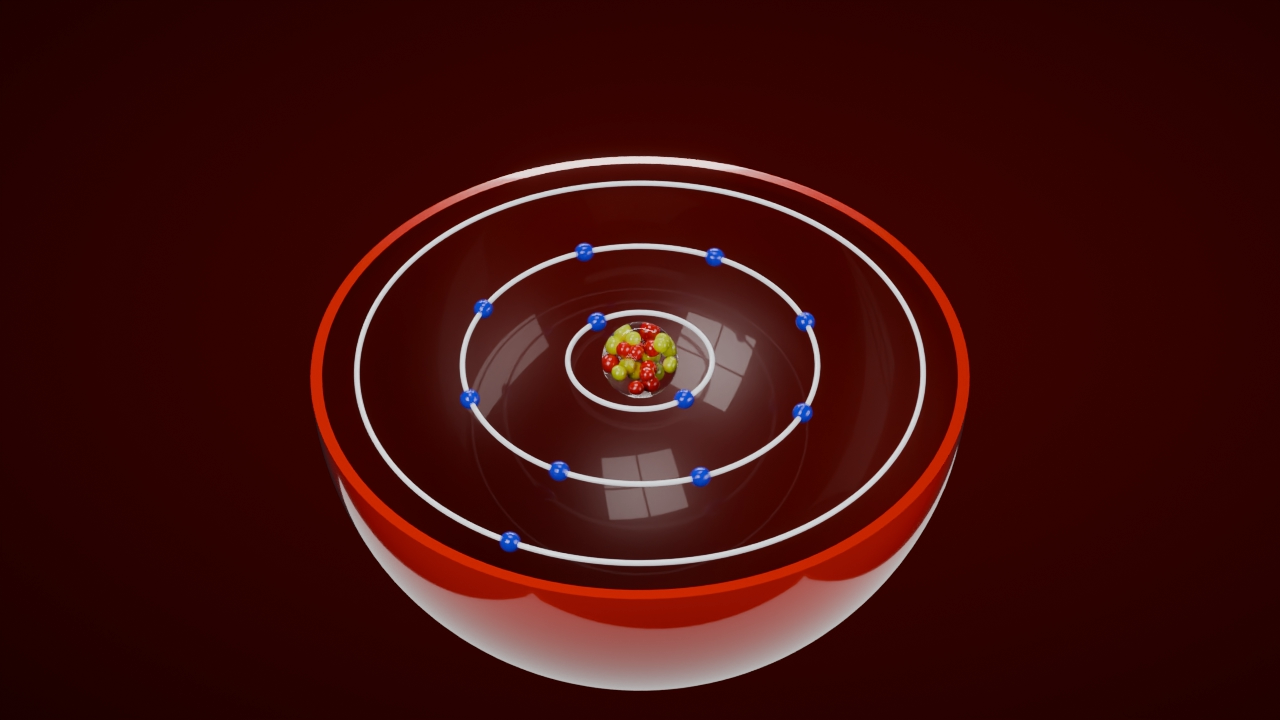
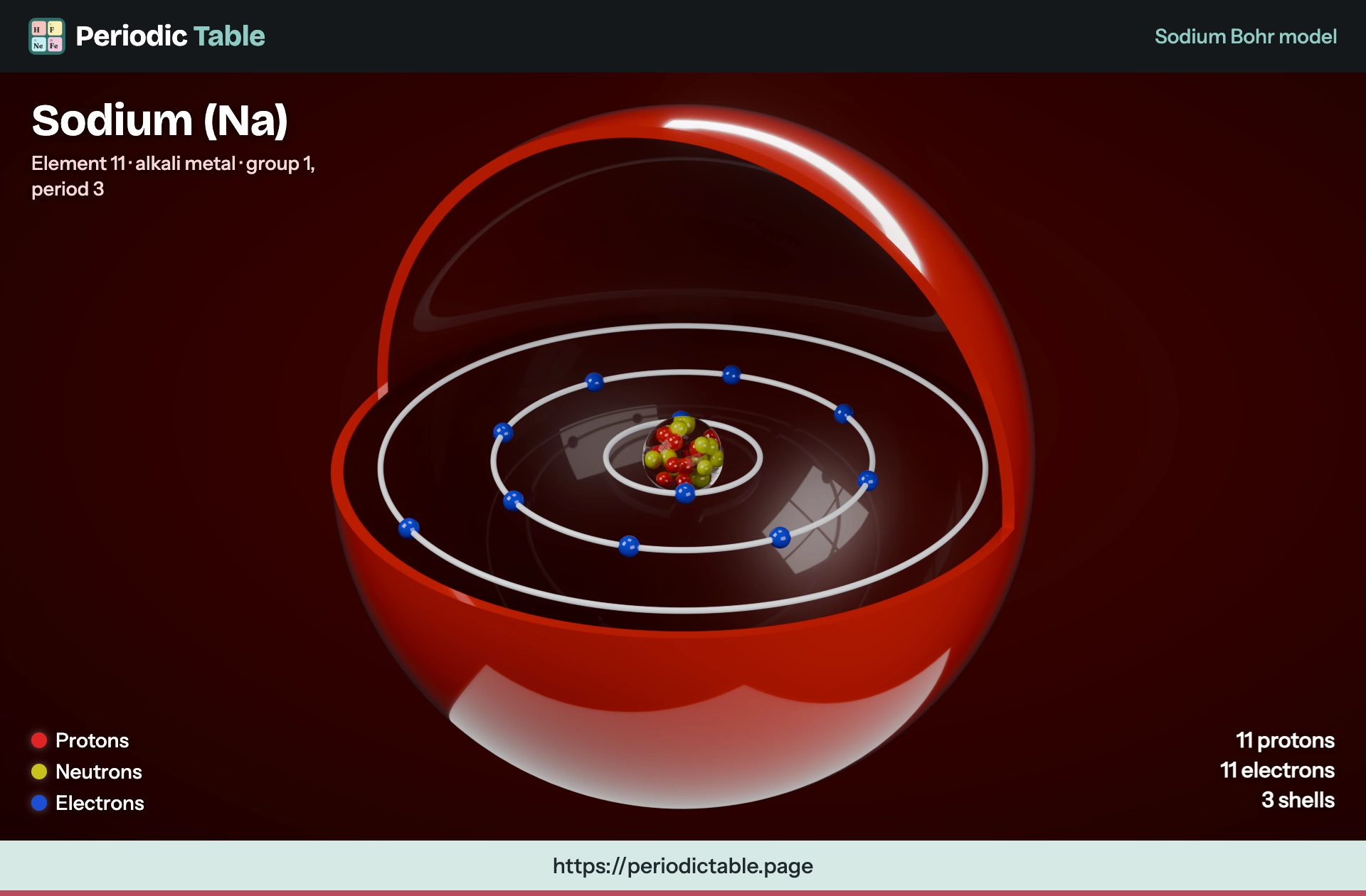
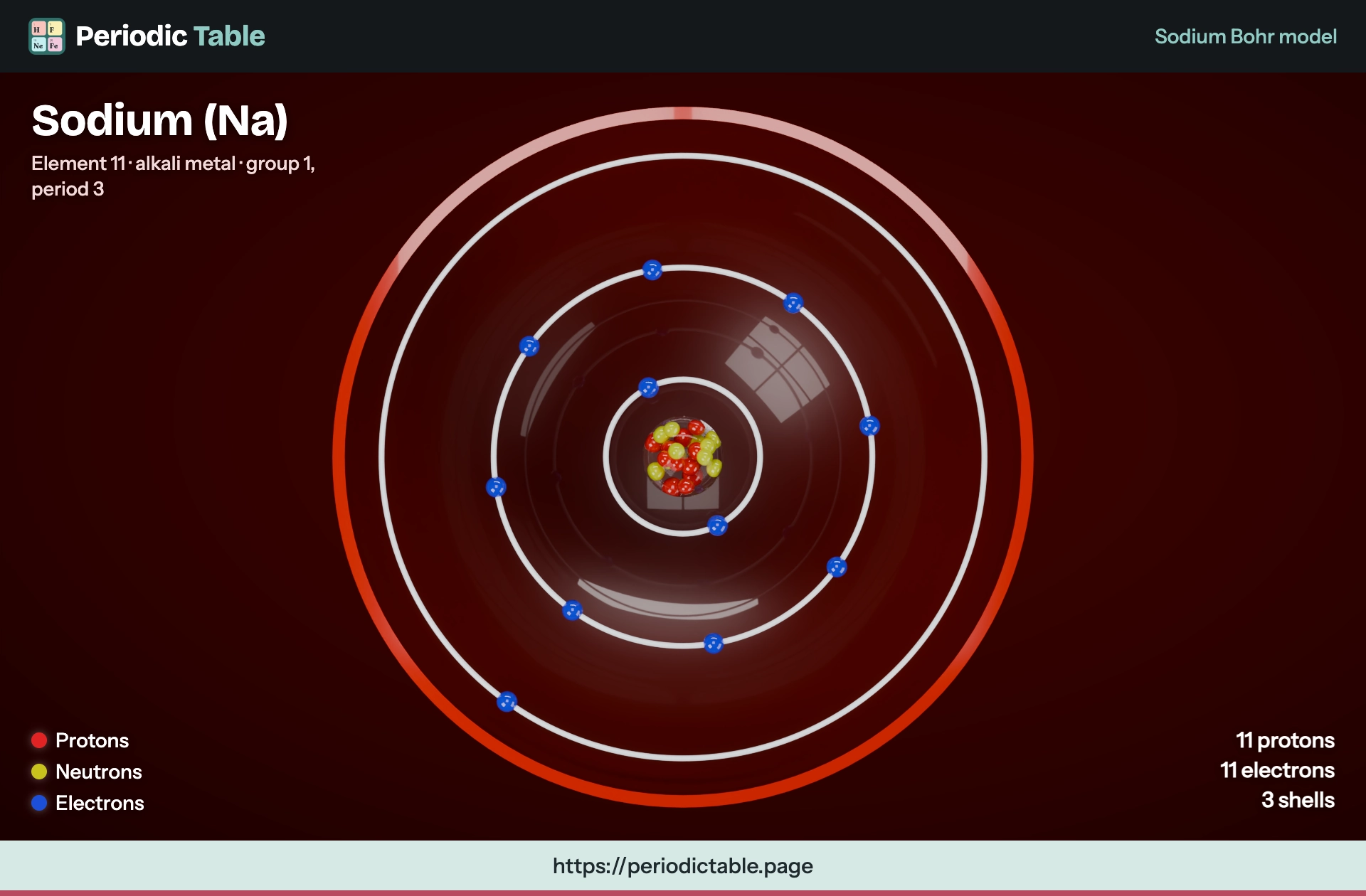
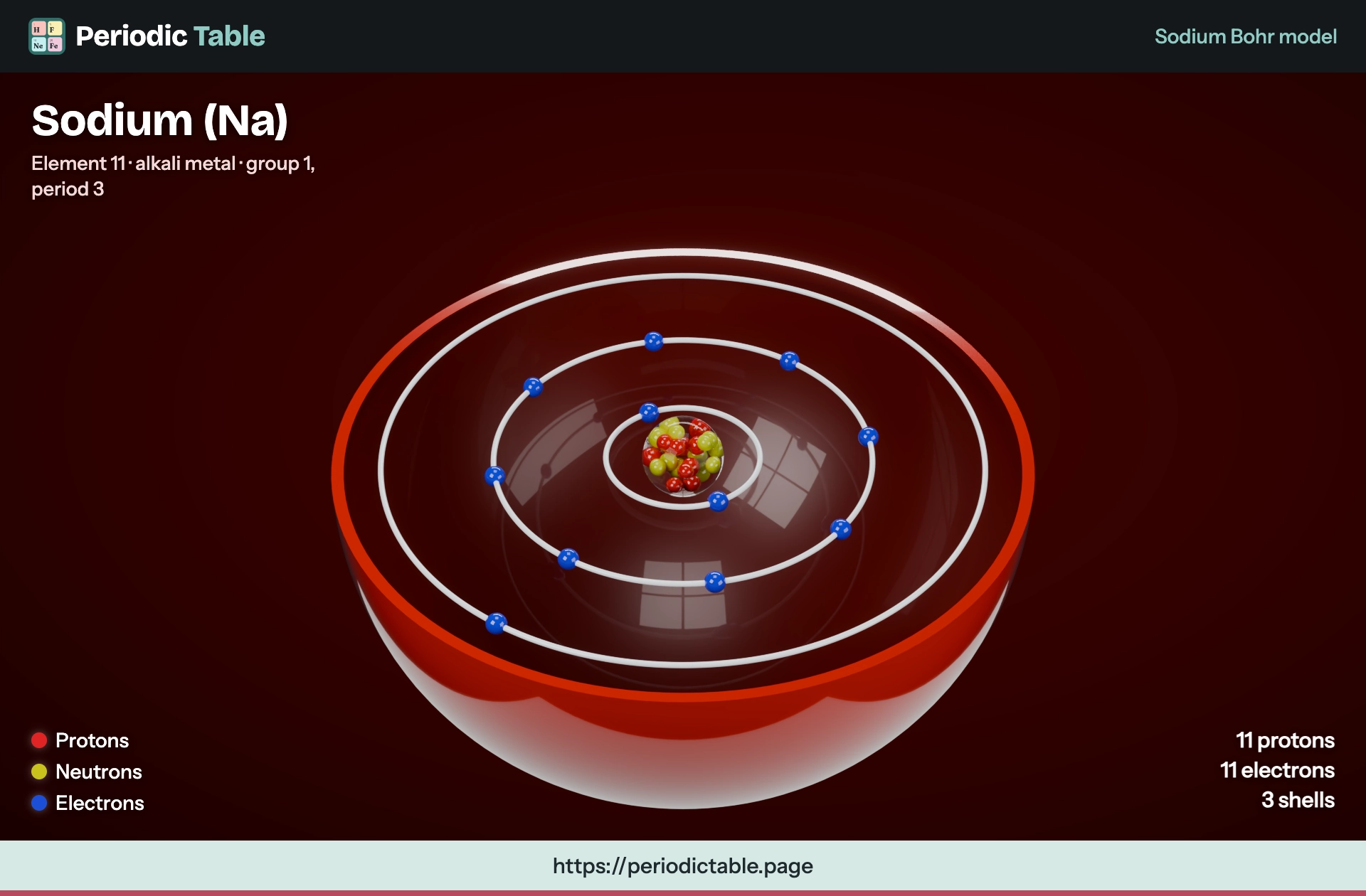
This is a Bohr model of sodium (Na), a simplified picture of a single sodium atom. Its nucleus holds 11 protons, and a neutral sodium atom has 11 electrons, arranged around it in 3 shells (2 in shell K, 8 in shell L and 1 in shell M).
Sodium periodic table electron configuration
- Shorthand
- [Ne] 3s1
- Full
- 1s2 2s2 2p6 3s1
- Electrons per shell
- 2, 8, 1
Sodium element properties and atomic data
- Atomic number
- 11
- Atomic mass
- 22.9898 u
- Phase at STP
- Solid
- Melting point
- 97.79°C (370.944 K)
- Boiling point
- 882.94°C (1156.09 K)
- Density
- 0.968 g/cm³
- Electronegativity (Pauling)
- 0.93
- Period
- 3
- Group
- 1
- Block
- s-block
- Appearance
- Silvery white metallic
- Discovery date
- 1807
- Discovered by
- Humphry Davy
- Named by
- —
Sodium (Na) at a glance: key element facts
Sodium is chemical element number 11, the second alkali metal in group 1 after lithium. Its symbol, Na, comes from the Latin name rather than the English one, which is why it surprises many students. The core reference values are below; every figure is a published standard value, not a sample measurement. When studying beta decay, alpha decay and the long half-life of the longest-lived isotope, students can check history of neptunium for the facts.
| Property | Value |
|---|---|
| Symbol | Na |
| Atomic number | 11 |
| Standard atomic weight | 22.990 |
| Position | group 1, period 3, s-block |
| Electron configuration | [Ne] 3s1 |
| State at 20 °C | Solid |
| Common oxidation state | +1 |
| CAS number | 7440-23-5 |
| Discovered | 1807 |
Read the table from top to bottom and a pattern appears: a light nucleus, one loosely held outer electron and a single common charge. Almost every property described further down follows from that last electron.
Atomic number, electron configuration and atomic radius
Eleven protons give Na eleven electrons, arranged 2, 8, 1. The first ten fill the same shells as neon, and the eleventh sits alone in the 3s orbital, far from the nucleus and well shielded by the inner shells. Losing it leaves a stable core, so the element forms ionic compounds built around the Na+ cation rather than sharing electrons.
That lone electron also makes the atom large for its mass. The empirical atomic radius is about 186 pm, the covalent radius roughly 166 pm, and the van der Waals radius 227 pm.
Once Na+ forms, the radius shrinks to about 102 pm, because the whole outer shell has gone. This size jump explains why the ion fits neatly into crystal lattices and channel proteins that would reject a neutral atom.
Physical properties of sodium metal
Freshly cut, sodium is silvery-white with a bright lustre that dulls within seconds as a grey oxide film forms. It is soft enough to press with a thumb through a glove and has a low density, so a lump floats before the reaction takes over. It crystallises in a body-centered cubic lattice, the arrangement shared by all the alkali metals at room temperature. For a mix of grid and biology topics, the pure vanadium page shows how a chemical element used in a flow battery also acts in enzymes and as a nutrient.
The sea of free electrons makes it a good conductor of electricity and heat, with a thermal conductivity of 142 W/(m·K). Its specific heat capacity of 1,228 J/(kg·K) is high for its class, and its vapour pressure stays tiny below 600 K, two facts that matter for reactor engineering later in this article. Under extreme pressure the behaviour changes completely: above about 1.9 million atmospheres the solid turns transparent and stops conducting.
Melting point and boiling point
Sodium melts below 100 °C, so a hot bath is enough to turn it liquid. Its values sit neatly between its group neighbours, following the downward trend in the alkali metals: the larger the atom, the weaker the metallic bonding and the lower the melting temperature.
| Element | Melting point (°C) | Boiling point (°C) | Density (g/cm³) |
|---|---|---|---|
| Lithium | 180.5 | 1,342 | 0.534 |
| Sodium | 97.8 | 882.9 | 0.968 |
| Potassium | 63.5 | 759 | 0.862 |
Notice the one exception: potassium is less dense than Na despite being heavier, because its atoms are spaced much further apart. The wide 785 °C gap between melting and boiling is what lets engineers keep it molten over a huge working range.
The yellow flame test and the sodium D line
Hold a wire dipped in sodium chloride in a flame and it glows an intense orange-yellow. In a flame test, heat lifts the outer electron from 3s to 3p; as it drops back, it emits light near 589 nm. Spin-orbit coupling splits this into a close pair at 589.0 and 589.6 nm, together called the D line.
In 1860 Kirchhoff and Bunsen showed the signal is so sensitive that a few milligrams of the salt dispersed through a large room can still be detected. The colour is so strong that a trace of contamination masks other elements, a familiar frustration in school labs.
Chemical behaviour of sodium atoms
Sodium atoms give up their single outer electron with very little persuasion, which makes sodium highly reactive and a powerful reducing agent; the standard potential of the Na+/Na couple is −2.71 V. Its reactivity sits between its lighter and heavier neighbours, consistent with its place in the group. With water it reacts exothermically to give a strong alkali and hydrogen gas:
$$2\,\mathrm{Na} + 2\,\mathrm{H_2O} \rightarrow 2\,\mathrm{NaOH} + \mathrm{H_2}$$
The heat released can ignite the hydrogen, and high-speed filming shows the first instant is a Coulomb explosion: electrons leave the surface so fast that the positively charged surface flies apart. In air, burning sodium forms mainly sodium peroxide (Na2O2) with some sodium oxide (Na2O). Dry oxygen at room temperature acts more slowly, which is why a large block tarnishes rather than bursting into flame.
Ionization energies and electronegativity
The gap between the first and second steps tells the whole story. Removing the outer electron is cheap; removing a second one means breaking into the stable inner core.
| Step | Energy (kJ/mol) |
|---|---|
| 1st ionization | 495.8 |
| 2nd ionization | 4,562 |
| 3rd ionization | 6,910 |
| Electron affinity | 52.9 |
The second value is more than nine times the first, so you will never meet Na2+ in ordinary chemistry. On the Pauling scale its electronegativity is 0.93, one of the lowest of any element, so in almost every bond it forms, the electrons sit closer to its partner.
How sodium ions behave in solution
Dissolved, Na+ is surrounded by about six solvent molecules, and nearly all sodium salts dissolve easily, which is why precipitation tests for the ion are rare. Crown ethers such as 15-crown-5 have a cavity just wide enough to grip Na+, a trick used to carry it into organic solvents.
Sodium also dissolves in liquid ammonia to give a deep blue solution of solvated electrons, and with alcohols it forms alkoxides, everyday bases in organic chemistry. With cryptands it can even hold an extra electron, forming the rare Na− anion.
Isotopes and oxidation states of sodium
Twenty forms are known, but natural sodium is a single stable isotope, Na-23, with an abundance of 100%. That makes its standard atomic weight unusually precise. It is forged in massive stars by the carbon-burning process, where two carbon nuclei fuse at temperatures above 600 million kelvin.
- Na-22 is radioactive with a half-life of 2.6 years, made by cosmic rays and used as a positron source.
- Na-24 decays in about 15 hours; after a neutron accident, its level in blood relative to Na-23 reveals the dose received.
- Every other sodium nuclide decays in under a minute.
Chemically the picture is just as simple. The +1 state covers essentially all compounds, and the −1 state appears only in exotic sodide salts. If a formula you are checking needs Na in any other charge, it is almost certainly wrong.
Sodium compounds and alloys
Pure sodium has a few specialist roles, but sodium compounds are made by the million tonnes for the chemical trade. The table lists the most important ones with their formulas and main uses.
| Compound | Formula | Common name | Main uses |
|---|---|---|---|
| Sodium chloride | NaCl | Table salt, halite | Food, road gritting, chlorine production |
| Sodium hydroxide | NaOH | Caustic soda, lye | Saponification, pulping, drain cleaner |
| Sodium carbonate | Na2CO3 | Soda ash | Glassmaking flux, water softening |
| Sodium bicarbonate | NaHCO3 | Baking soda | Raising agent, antacid, fire extinguishers |
| Sodium nitrate | NaNO3 | Chile saltpetre | Fertiliser, curing meat |
Most of these compounds exist as white, water-soluble crystals, and the solubility is useful: sodium salts carry a negative ion into solution without the cation interfering in the chemistry. Bar cleaners are simply sodium salts of fatty acids, harder than their potassium versions.
Sodium also forms alloys. Mixed with potassium it gives NaK, which stays liquid well below room temperature.
It dissolves completely in molten lead and forms amalgams with mercury that once powered industrial processes. Other known alloys pair it with gold, silver, zinc and cadmium.
Where sodium occurs: Earth's crust, oceans and stars
About 2.3% of the Earth's crust is sodium, making it the sixth most abundant element there and the fourth most common metal after aluminium, iron and calcium, just ahead of magnesium. Because sodium salts dissolve so easily, rain has washed the element out of rock for billions of years, and the oceans now hold roughly 10.8 grams per litre.
On land it is locked in minerals. Soluble ones include halite (rock salt) and trona, the ore behind most US carbonate output in Wyoming. Less soluble hosts include feldspar, zeolite, amphibole and cryolite, where a polymeric silicate or fluoride framework traps the ion.
Beyond Earth, the yellow line shows up as a dark absorption feature in the spectrum of the sun; Joseph von Fraunhofer labelled it in 1814. Astronomers have since found sodium in Mercury's thin exosphere, around the Moon, in the tails of some comets and in the atmospheres of exoplanets.
How metallic sodium is made by electrolysis
Because the element is never found native, it has to be pulled out of its salts. Today almost all of it comes from a Downs cell, patented in 1924.
Fused sodium chloride is mixed with calcium chloride to drop the melting temperature below 700 °C, saving energy. A current then splits the melt:
$$2\,\mathrm{NaCl(l)} \rightarrow 2\,\mathrm{Na(l)} + \mathrm{Cl_2(g)}$$
Molten Na collects at the iron cathode while calcium, less easily reduced, stays in the bath. The older Castner process, which used molten caustic, cost more and has been abandoned. Roughly 100,000 tonnes of sodium are produced each year.
Storage matters as much as production. Bars are stored in oil, usually dry mineral oil, or under an inert gas such as argon to keep moisture and air away; any exposed surface quickly grows a crust of oxide and hydroxide.
Uses of sodium in industry and everyday life
Most uses rely on its salts, but elemental sodium still has a place in industry. It reduces titanium and other elements that resist simpler methods, dries organic solvents, and is the starting point for sodium azide and sodium borohydride, the second a workhorse reagent in pharmaceutical labs. Two applications deserve a closer look, because they exploit the physical properties described above.
Liquid sodium coolant in nuclear reactors
Fast-neutron nuclear reactors use liquid sodium as their coolant. It moves heat transfer duty efficiently thanks to high thermal conductivity, absorbs few neutrons, and boils far above the reactor's operating temperature, so the circuit can run near ordinary atmospheric pressure instead of the high pressure a water-cooled design needs. The trade-offs are real: the liquid is opaque, which complicates inspection, and neutron capture produces short-lived Na-24 in the circuit.
Where a reactor shuts down often, engineers switch to NaK so the loop never freezes in the pipes. The same principle works in car engines: hollow exhaust valves partly filled with the element carry heat away from the valve head.
Street lights, glass, soap and batteries
Low-pressure lamps filled with sodium vapour produce almost pure 589 nm light, which is why older street lights bathe roads in amber. Carbonate flux lowers the melting temperature of silica in glass furnaces, caustic alkali turns fats into cleansers and detergents, and both chemicals pulp paper and process textiles.
Rock salt handles winter de-icing and serves as a food preservative. Newest of all, sodium-ion batteries are moving into grid storage and small cars, swapping a scarcer element for sodium, which is cheap and widely available.
Biological role of sodium in your body
Every animal needs sodium, and its biological role centres on charge. Na+ is the main cation in your extracellular fluid, where it controls blood volume and osmotic pressure. Inside cells the concentration is about ten times lower, a gradient kept up by the sodium-potassium pump, which pushes three Na+ out for every two K+ it brings in.
When a nerve fires, gated channels open and Na+ rushes in, producing the action potential that carries signals along neurons and triggers muscle contraction. As an electrolyte it is an essential nutrient for animals; some butterflies even sip mineral-rich puddles to collect it.
Salt, diet and blood pressure
For most people the main dietary source of sodium is salt, much of it hidden in processed foods. Salt is 39.34% Na by mass, so you can convert any label value: multiply grams of salt by 393.4 to get milligrams of Na. A ready meal labelled 3.7 g of salt therefore carries about 1,456 mg of sodium, which is 63% of the 2,300 mg upper limit set in US guidelines and 97% of the 1,500 mg level the American Heart Association recommends.
A high intake raises blood pressure and the risk of hypertension, stroke, heart disease and kidney disease, so watching your diet matters for long-term health. Too little is rarer but dangerous: hyponatremia, a low blood level of Na+ often caused by drinking huge volumes of fluid during endurance events, brings nausea, confusion and, at worst, seizures.
Why plants need little sodium
Most plants treat Na as optional. C4 species use small amounts in photosynthesis, and others can let it stand in for potassium to keep cells firm. Too much sodium in the soil, however, pulls moisture away from roots and poisons leaf enzymes, so only halophytes thrive on saline ground.
History of sodium and the name natrium
People traded and fought over salt long before anyone knew it held sodium. Roman soldiers received allowances, the likely root of the word salary, and levies on it fed revolts from France to Gandhi's Salt March in India. Egyptians used natron, a natural mix of sodium carbonate and bicarbonate, for cleaning and mummification.
In 1807 Humphry Davy passed a current from a large voltaic pile through molten caustic and saw bright droplets form at the cathode, the first electrolysis of an alkali. He named it sodium after soda, the medieval name for its carbonate.
The symbol came later: in 1814 Jöns Jacob Berzelius used Na, short for the Latin natrium, which traces back to the same Egyptian natron. That is why the element's English name and symbol do not match, one of the oddities of chemistry that every student meets early on.
Handling molten sodium safely
Molten sodium is far more dangerous than a solid block, because every sodium atom in the liquid is free to meet air or moisture at once. A splash into a hot pool can trigger a violent explosion that throws burning liquid from its container.
- Never use water, carbon dioxide or halon extinguishers on sodium fires; they feed the reaction.
- Use a Class D agent rated for alkali metals, such as Met-L-X, or smother small fires with dry sand.
- Wear gloves and eye protection when cutting the solid; it burns skin on contact with moisture.
- Dispose of scraps by slow reaction in dry alcohol, never by dropping them into a sink.