Vanadium element (V): vanadium periodic table facts
Vanadium periodic table facts: vanadium (V) is element 23, a transition metal in group 5, period 4. If you have ever held a chrome-vanadium wrench, you have already met vanadium, the chemical element with atomic number 23. On safety questions, hazards and toxicity, from the atmosphere to the oceans and the environment, are explained in the chlorine on the periodic table entry with examples.
Element 23 is a silvery-grey transition metal that is tough, corrosion-resistant and rarely found pure in nature. Its real value shows up in mixtures: a fraction of a percent of it turns ordinary steel into a much stronger material, which is why most of the world's supply ends up in steelmaking.
Rotate the 3D Bohr model of vanadium
Drag to orbit, scroll to zoom.
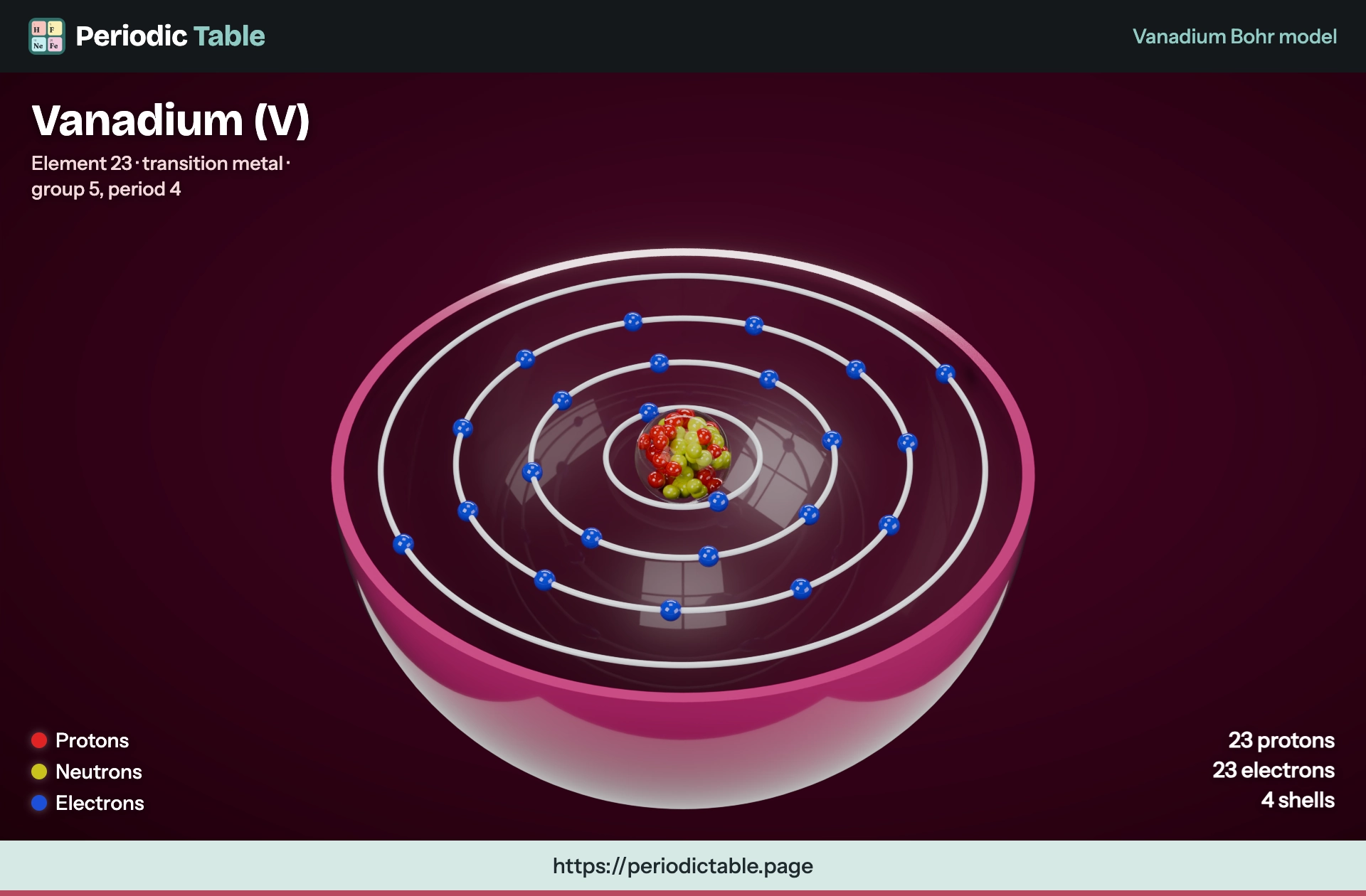
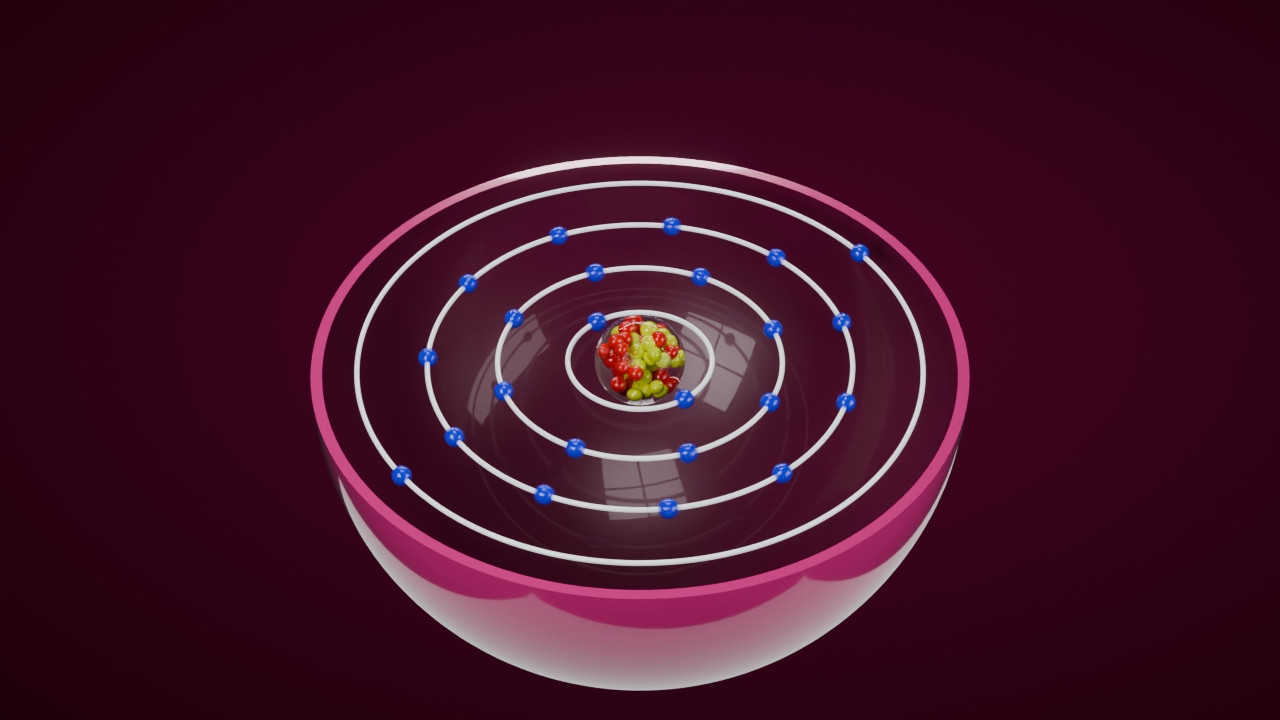
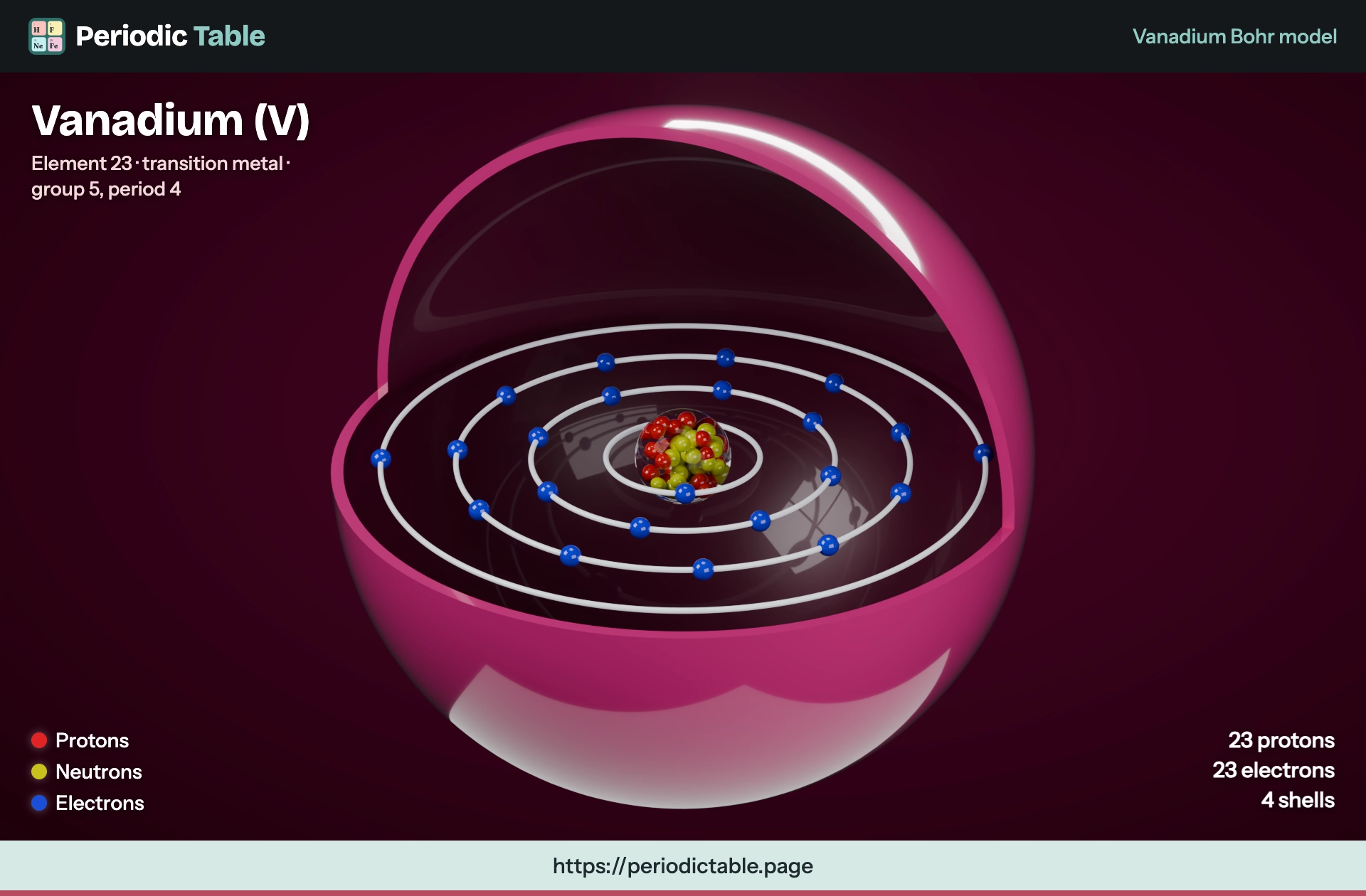
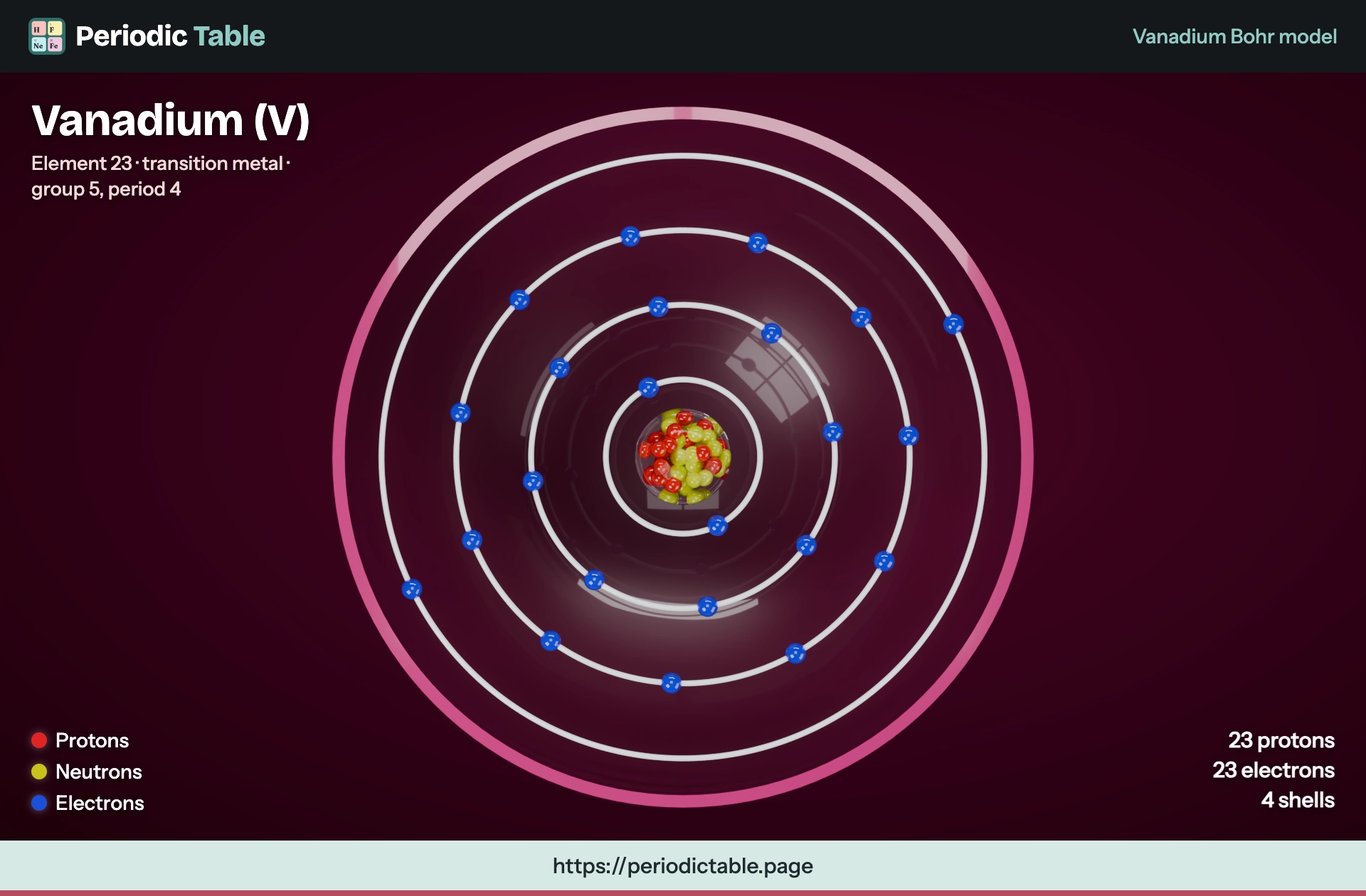
This is a Bohr model of vanadium (V), a simplified picture of a single vanadium atom. Its nucleus holds 23 protons, and a neutral vanadium atom has 23 electrons, arranged around it in 4 shells (2 in shell K, 8 in shell L, 11 in shell M and 2 in shell N).
Vanadium periodic table electron configuration
- Shorthand
- [Ar] 3d3 4s2
- Full
- 1s2 2s2 2p6 3s2 3p6 4s2 3d3
- Electrons per shell
- 2, 8, 11, 2
Vanadium element properties and atomic data
- Atomic number
- 23
- Atomic mass
- 50.9415 u
- Phase at STP
- Solid
- Melting point
- 1909.85°C (2183 K)
- Boiling point
- 3406.85°C (3680 K)
- Density
- 6 g/cm³
- Electronegativity (Pauling)
- 1.63
- Period
- 4
- Group
- 5
- Block
- d-block
- Appearance
- Blue-silver-grey metal
- Discovery date
- 1801
- Discovered by
- Andrés Manuel del Río
- Named by
- Isotopes of vanadium
Atomic weight, melting point and other vanadium facts
Vanadium carries the symbol V and sits in group 5 and period 4 of the periodic table, in the d-block, between elements 22 and 24. The table below collects the core data you will need for most chemistry and materials questions about vanadium metal. Before learning about valence electrons, open the sodium element to see its Na symbol and how natrium named the metal.
| Property | Value |
|---|---|
| Symbol | V |
| Atomic number | 23 |
| Standard atomic weight | 50.9415 |
| Group / period / block | 5 / 4 / d-block |
| Electron configuration | [Ar] 3d3 4s2 |
| Melting point | 1910 °C (2183 K) |
| Boiling point | 3407 °C (3680 K) |
| Electronegativity (Pauling) | 1.63 |
| First ionization energy | 650.9 kJ/mol |
| Atomic radius (empirical) | 134 pm |
| Covalent radius | 153 pm |
| State at 20 °C | Solid |
| Named after | Vanadis, a name of the goddess Freyja |
Two numbers in that table explain a lot of its behaviour. The electron configuration leaves five valence electrons (three 3d plus two 4s), so the atom can give up anywhere from two to five of them, which is the root of its rich chemistry.
The ionization energies climb steeply after the fifth electron, which is why +5 is the highest state you will see in ordinary compounds. A melting temperature near 1,900 °C also places it among the more heat-tolerant common metals.
Physical properties of vanadium: density, crystal structure and hardness
In its pure form it is a grey solid weighing about 6.0 g/cm³. Its crystal structure is body-centered cubic, the same packing that makes many structural metals easy to work. Freshly isolated samples are ductile and malleable: you can draw them into wire or roll them into foil without cracking, so it is often called soft even though it scores about 6.7 on the Mohs hardness scale and is hard compared with most pure metals. Students checking why silicon dominates chips and solar cells will find the answer under the metalloids in this reference.
- Young's modulus: about 128 GPa, stiffer than many light alloys but far below tungsten.
- Magnetism: paramagnetic, weakly attracted by a magnetic field.
- Thermal conductivity: roughly 31 W/(m·K), low by metallic standards.
- Corrosion behaviour: stable against alkalis and dilute sulfuric and hydrochloric acids.
That last point comes from passivation. A thin oxide layer forms on the surface even at room temperature and slows further attack. Only above roughly 660 °C does it oxidize steadily in air, and that heat tolerance is a large part of why engineers specify it for hot parts.
Chemistry of vanadium and its oxidation states
The chemistry of vanadium is famous for one feature: four neighbouring oxidation states, +2, +3, +4 and +5, are all easy to reach. In aqueous solution each one has its own colour, which is the most memorable classroom demonstration for this element. Reduce a V(V) solution with zinc and you watch it pass through four colors in sequence:
- V(V), as the pervanadyl ion VO2+: yellow
- V(IV), as VO2+: blue
- V(III): green
- V(II): violet, sometimes described as lilac
The low states are reducing agents that readily give electrons away, while V(V) species are oxidizing agents. That ability to move up and down the ladder is exactly what catalysts and flow batteries exploit. Lower and even negative states (down to −3) exist, but only in specialised carbonyl chemistry.
Vanadium pentoxide, vanadates and oxyanions
Vanadium pentoxide, V2O5, is the most important commercial compound: an orange-brown powder that is the starting point for both alloys and catalysts. When the +5 state dissolves in water it forms a large family of oxyanions whose shape depends on pH and concentration:
- In strongly basic solution (pH 12–14) the tetrahedral orthovanadate ion, VO43−, dominates.
- As the pH falls, protonated monomers and the divanadate dimer appear, followed by small rings.
- Between about pH 2 and 4, the cage-like decavanadate ion, V10O286−, takes over and gives solutions a strong orange colour.
- Below pH 2 the cation VO2+ is the main species, and concentrated solutions precipitate the pentoxide.
Because a vanadate ion is close in size and charge to phosphate, biochemists use it to imitate phosphate in enzyme and crystallography studies. The vanadyl ion, VO2+, is the signature of the +4 state and shows up again in supplements and catalysts later in this article. Many other compounds, from peroxo complexes to sulfides, branch off these same building blocks.
Halides, coordination complexes and organometallic vanadium compounds
Twelve binary halides are known. The tetrachloride, VCl4, is a red liquid used to start the polymerisation of dienes, and the oxyhalide VOCl3 behaves much like phosphorus oxychloride. In coordination complexes the VO2+ unit typically binds four ligands strongly in a square pyramid, as in vanadyl acetylacetonate, a common laboratory reagent.
Organometallic chemists work with vanadocene dichloride and vanadium carbonyl, V(CO)6, a rare example of a stable paramagnetic carbonyl. At the materials end, vanadium carbide (VC) is an extremely tough ceramic that forms inside steels and gives them their wear resistance, which links these vanadium compounds straight back to industry.
Isotopes of vanadium
The natural element is a mix of two isotopes. Vanadium-51 is the stable isotope and makes up about 99.75% of every sample. Vanadium-50, the other 0.25%, is a radioactive isotope with a half-life of more than 1017 years, so long that it barely decays over the age of the universe.
| Isotope | Natural abundance | Half-life | Main decay |
|---|---|---|---|
| Mass 48 | synthetic | about 16 days | positron emission to element 22 |
| Mass 49 | synthetic | about 330 days | electron capture to element 22 |
| Mass 50 | 0.25% | more than 1017 years | very slow decay |
| Mass 51 | 99.75% | stable | none |
Around two dozen artificial ones have been made, most lasting only seconds. Lighter ones decay mainly by electron capture to element 22, heavier ones by beta decay to element 24. The heavier natural isotope also has a nuclear spin that suits NMR spectroscopy, the tool chemists use to map the oxyanion family described above.
History of element vanadium: from brown lead to vanadinite
The element vanadium was discovered twice. In 1801 the mineralogist Andrés Manuel del Río, working in Mexico, found a new element in a "brown lead" ore.
Its salts showed so many colours that he first called it panchromium, then renamed it erythronium because the salts turned red when heated. In 1805 the French chemist Hippolyte Victor Collet-Descotils declared the sample was only impure chromium, and del Río withdrew his claim.
In 1831 the Swedish chemist Nils Gabriel Sefström found the same element in iron ores and named it after Vanadis, another name for the Norse goddess Freyja, again because of its colourful compounds. Friedrich Wöhler then showed it matched del Río's discovery. The name stuck, and the Mexican mineral became known as vanadinite.
Isolating pure vanadium
Isolating the element took decades. Jöns Jacob Berzelius reported it in 1831, but his product was actually vanadium nitride. Henry Enfield Roscoe finally obtained the metal in 1867 by reducing vanadium(II) chloride with hydrogen, and bulk metal of high purity arrived in 1927, made by reducing the pentoxide with calcium.
Where vanadium ore is found: magnetite, carnotite and patronite
Native vanadium, the free metal, is extremely rare and has been reported only around volcanic gas vents. Instead, the element appears in about 65 minerals, including carnotite, roscoelite and patronite. It is roughly the 19th most abundant element in Earth's crust and the fifth most common transition metal there.
Today the main vanadium ore is magnetite from layered igneous rocks. Uranium-bearing sandstones were worked in the early twentieth century, and uranium mining supplied the element as a side product for years. A large sulfide deposit in Peru briefly supplied most of the world.
The element is also spread through fossil fuels. Crude oil from some fields contains hundreds of parts per million, and it also turns up in coal, oil shale, tar sands and bauxite. Burning those fuels releases tens of thousands of tonnes a year into the air.
Even seawater carries it, at a few micrograms per litre as dissolved vanadate species. Metallic vanadium, in short, is a product of refining, never of digging.
Vanadium production and ferrovanadium
Very little vanadium production comes from mining it directly. About 90% is recovered from steel smelter slag: when these titanomagnetite concentrates are smelted, the element collects in the slag, and that waste becomes the feedstock.
The rest is a byproduct of oil refining residues, uranium processing or direct processing of mined rock. A typical recovery route runs:
- Roast the crushed feed with salt or soda ash at about 850 °C to form sodium metavanadate.
- Leach it with water and acidify the solution to precipitate "red cake", a polyvanadate salt.
- Calcine the red cake to the pentoxide.
- Reduce the oxide with aluminium or magnesium, or smelt it with scrap in an electric furnace.
Ferrovanadium, an iron-based master alloy, is the form steelmakers actually buy. For high-purity samples, the crystal bar process deposits pure crystals from a volatile iodide onto a hot filament.
Vanadium supply risk: China, South Africa and Russia
Output is concentrated: China, Russia and South Africa together produce well over 90% of world supply, with the largest producer alone around two-thirds, largely as a by-product of its steel industry. Recycling rates are low and good substitutes are scarce, so the Royal Society of Chemistry rates its supply risk as moderately high.
Uses of vanadium
Roughly 85% of all vanadium goes into steel. The rest is split between light alloys, chemical catalysts, batteries and smaller specialty uses. The subsections below follow that order, from the biggest market to the smallest.
Vanadium steel, high-speed tool steels and titanium alloys
Vanadium forms tiny, stable carbides and nitrides inside steel that pin the grain structure and raise tensile strength without adding much weight. The Ford Model T made this famous: Ford used a vanadium steel alloy in the chassis around 1908 so the car could be lighter and still survive rough roads.
- High-carbon structural steels carry about 0.15–0.25% of the element and go into axles, crankshafts, gears, bicycle frames and armor plating.
- High-speed tool steels hold 1–5% vanadium and stay hard at cutting temperatures, which suits drill bits, surgical instruments and other tools.
- Powder-metallurgy steels with up to about 18% of it give premium knives their exceptional wear resistance.
In titanium alloys, vanadium stabilises the strong beta phase. Ti-6Al-4V, with 6% aluminium and 4% vanadium, is the workhorse of aerospace frames, jet engines and dental implants. Some vanadium alloys are also superconductors: V3Ga tape is wound into superconducting magnets, and V3Si was the first A15 superconductor identified, in 1952.
Vanadium as a sulfuric acid catalyst
Sulfuric acid is the most produced industrial chemical in the world, and almost all of it is made by the contact process over a vanadium pentoxide catalyst. The oxide takes oxygen from itself to convert sulfur dioxide, dropping from +5 to +4, and air then re-oxidizes it so the cycle continues:
$$2\,\mathrm{SO_2} + \mathrm{O_2} \;\xrightarrow{\;\mathrm{V_2O_5}\;}\; 2\,\mathrm{SO_3}$$The same redox catalysis makes maleic anhydride and phthalic anhydride from cheap hydrocarbons, and mixed oxides containing the element help convert propane and propylene into acrylic acid and acrylonitrile.
The vanadium redox battery: a flow battery for grid storage
A vanadium redox battery stores energy in two tanks of its ions dissolved in acid: one side cycles between +5 and +4, the other between +3 and +2. Because both electrolytes contain the same element, cross-contamination does not ruin the cell, and the tanks can be scaled independently of the power stack. That makes these batteries a strong fit for grid energy storage attached to wind and solar farms, where long life matters more than compact size.
The design dates to the 1930s, with commercial systems from the 1980s on. Vanadium is also being tested in lithium-ion batteries, both as a small cathode additive and in lithium vanadium phosphate, to improve energy storage capacity.
Other uses in ceramics, glass and fusion reactors
Vanadium compounds give stable yellow and blue pigments to ceramics and tint glass. Vanadate coatings fight rust, and thin foils of it join dissimilar metals during cladding. Because its isotopes capture few neutrons and activated atoms decay quickly, vanadium alloys are candidate structural materials for the inside of a fusion reactor.
Biological role of vanadium as a trace element
Vanadium matters far more to sea life than to land animals. Some marine algae build a bromoperoxidase enzyme that holds the element at its core, and these enzymes make most of the natural organic bromine compounds in the oceans. Certain nitrogen-fixing bacteria such as Azotobacter use a vanadium nitrogenase when molybdenum runs short.
The most striking case is tunicates, or sea squirts. Their blood cells, called vanadocytes, concentrate the element millions of times above the level in the surrounding seawater, for reasons that are still debated. On land, the fly agaric mushroom, Amanita muscaria, accumulates the element in a complex called amavadin.
For people, vanadium is treated as a possible trace element but not a confirmed essential nutrient. Deficiency slows growth in rats and chickens, yet no human deficiency disease has been described, so no recommended intake exists. A normal diet supplies only micrograms a day, and less than 5% of it is absorbed.
Vanadium supplements and diabetes research
Vanadyl sulfate is sold as a dietary supplement, often to bodybuilders, and has been studied for improving insulin sensitivity in type 2 diabetes. Reviews have found no rigorous evidence that it works, and trial doses far exceeded the 1.8 mg/day upper intake level, so routine use is not recommended for health reasons.
Vanadium toxicity and safety
All vanadium compounds should be treated as toxic, with the +4 and +5 states generally the most harmful. The main hazard is breathing dust or fumes, which mostly affects the respiratory system: coughing, wheezing and irritated airways in workers handling the pentoxide.
- OSHA sets a workplace exposure limit of 0.05 mg/m³ for the pentoxide's dust and 0.1 mg/m³ for fume, averaged over an 8-hour shift.
- Vanadium pentoxide is classed as possibly carcinogenic after inhalation studies in rodents.
- Vanadium in fine PM2.5 pollution, much of it from burning heavy fuel oil, has been linked to some of that pollution's health effects.
Swallowed vanadium is poorly absorbed, so dietary toxicity is uncommon. The solid itself is far less hazardous than its dusts and soluble salts.
Vanadium vs other transition metals
Comparing vanadium with its neighbours shows why engineers pair it with these metals rather than replacing them. The table uses standard reference values.
| Element | Symbol | Group | Density (g/cm³) | Melts at (°C) | Typical role |
|---|---|---|---|---|---|
| Titanium | Ti | 4 | 4.51 | 1668 | light airframe alloys |
| Vanadium | V | 5 | 6.0 | 1910 | strengthening additive |
| Chromium | Cr | 6 | 7.19 | 1907 | stainless grades, plating |
| Iron | Fe | 8 | 7.87 | 1538 | base of all steels |
| Niobium | Nb | 5 | 8.57 | 2477 | microalloying, superconductors |
Vanadium sits in the middle of this weight range yet melts hotter than most of its neighbours, which is why small amounts improve both lighter and heavier metals. Niobium, its heavier group 5 sibling, does a similar strengthening job and is the usual alternative when vanadium prices spike.