


118 elements · 10 families
Periodic table of elements: interactive periodic table
Every substance you have ever touched is built from just 118 building blocks, and the periodic table lays all of them out on one page. Use this interactive periodic table to look up any element's atomic number, symbol and weight, then follow the rows and columns to see the chemical periodicity that lets you predict how elements behave before you ever open a lab manual. Before studying oxidation states, half-lives and the odd metallurgy of a metal that shrinks on heating, look up history of plutonium for data on its radioactive isotopes and alloys.
Once you can read the grid, the properties of an unfamiliar element stop being a mystery and become a matter of where it sits. For the calculations that come next, browse Joteo Calculator's chemistry calculators.
Explore the table
Tiles are coloured by element family. Click a tile for its card; shift-click one first to pre-select it for comparison. Use Filters to narrow the table by family, block or state.
- Solid
- Liquid
- Gas
- Unknown
Drag the slider or press Play to watch the table fill in as elements were discovered. Elements known since antiquity are shown from the start.
- s-block
- p-block
- d-block
- f-block
Tiles are coloured by block. Click a tile for the orbital-filling diagram.
Click a tile for its full isotope table with half-lives and decay modes.
Keyboard: arrows move · Enter opens · Shift+Enter marks for compare · / finds · Esc closes. The URL updates so any view can be shared.
Element families
Click a tile to open its card
Element families of the periodic table
The periodic table groups its 118 elements into ten families. Pick one to see every member, the properties they share and how they trend across the table.
-
Group 1 6 elements
Alkali Metals
Soft, silvery metals that react violently with water and tarnish in seconds.
Explore → -
Group 2 6 elements
Alkaline Earth Metals
Reactive metals that build bones, fireworks and lightweight alloys.
Explore → -
Groups 3–12 38 elements
Transition Metals
The workhorses of industry: strong, conductive and brilliantly coloured in compounds.
Explore → -
Groups 13–16 12 elements
Post-Transition Metals
Softer, lower-melting metals that sit between the d-block and the metalloids.
Explore → -
Staircase 6 elements
Metalloids
Semiconductors along the staircase line that power every chip you own.
Explore → -
Groups 14–16 7 elements
Reactive Nonmetals
The elements of life: carbon, nitrogen, oxygen, sulfur and their kin.
Explore → -
Group 17 6 elements
Halogens
Salt-formers that are one electron short of a full shell and never shy about it.
Explore → -
Group 18 7 elements
Noble Gases
Colourless, odourless and famously aloof — until you light them up.
Explore → -
Period 6, f-block 15 elements
Lanthanides
Rare-earth metals behind magnets, lasers and smartphone screens.
Explore → -
Period 7, f-block 15 elements
Actinides
Radioactive heavyweights, from reactor fuel to the elements made atom by atom.
Explore →
What is the periodic table of elements?
The periodic table of elements is an ordered grid of the chemical elements, arranged by increasing atomic number into horizontal rows called periods and vertical columns called groups. The standard periodic table you see above is the 18-column layout used in nearly every chemistry classroom, textbook and laboratory. Its full formal name, the periodic table of elements, hints at its job: it is not just a list, it is a map of how the chemical elements relate to each other. For a different page, see the full list of periodic table pages and element families in the site map. The same series of answers also covers “how many elements are on the periodic table of elements”.
An online periodic table adds what paper cannot. Instead of squeezing every fact onto one tile, the periodic table here lets you click through to the deeper data for each of the 118 elements, switch the colour scheme from element category to block or to a numerical property, and compare elements side by side. The visual elements of the grid carry meaning too: position, colour and shading each answer a different question about the elements, so a quick scan of the periodic table often tells you more than a paragraph of text could.
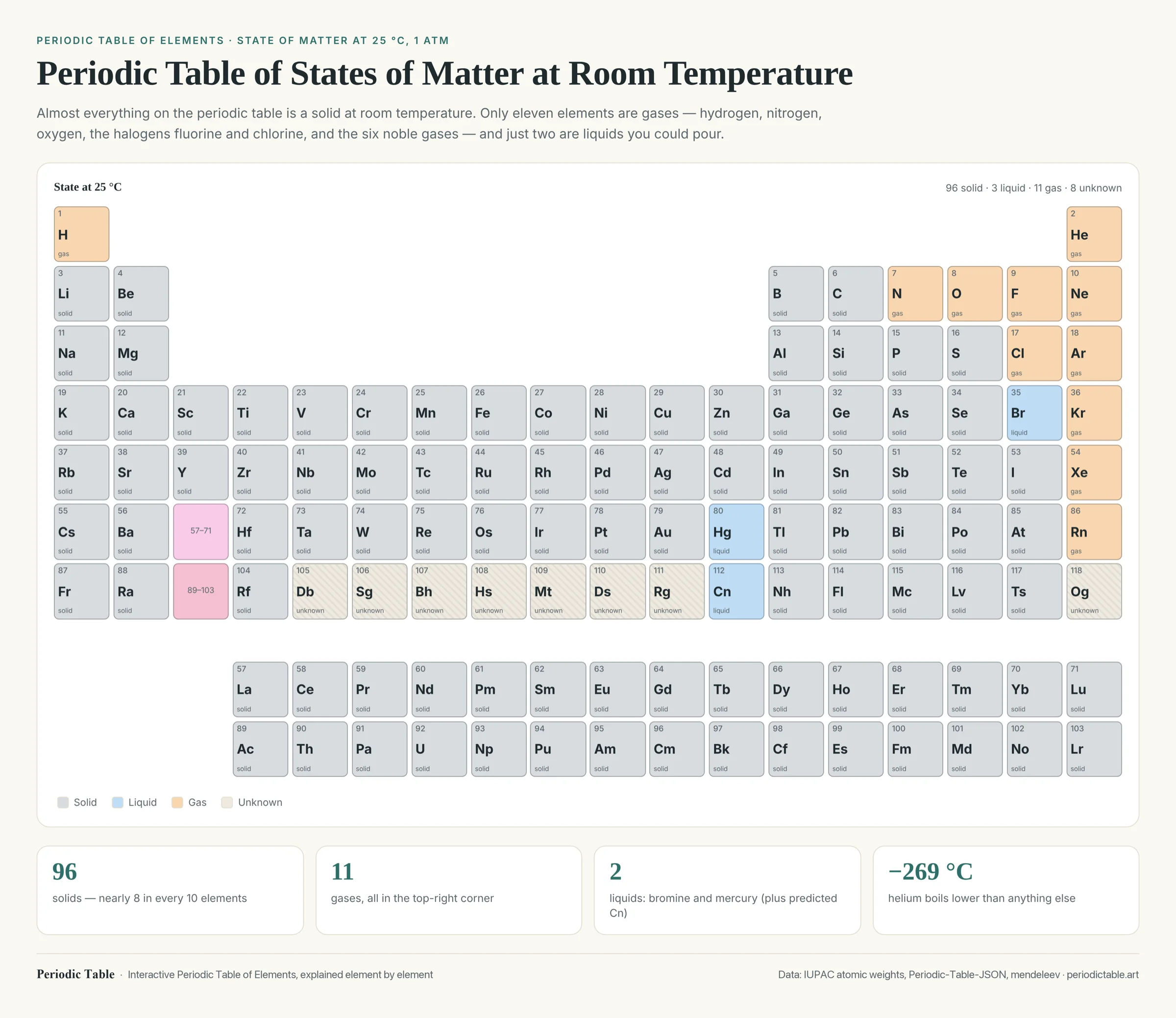
Each square, or tile, holds the core data for one element. Colour tells you which family the element belongs to, and the state view recolours every tile by its state at room temperature: most elements are a solid at 25 °C (all the metals except mercury, plus carbon, sulfur, iodine and several other solid nonmetals), eleven are a gas (hydrogen, nitrogen, oxygen, fluorine, chlorine and the six noble gases), and only two, mercury and bromine, are a liquid. Change the temperature slider and you can watch elements melt and boil as the grid recolours.
Switch to the isotope view and the elements showing zero stable isotopes are the radioactive ones. Reading the periodic table this way, by colour first and numbers second, is the quickest route to the big picture before you zoom into one element.
For all three states on one chart, the periodic table of states of matter at room temperature below colours every element as a solid, liquid or gas at 25 °C.
| What the tile shows | Example (iron) | What it tells you |
|---|---|---|
| Atomic number | 26 | Protons in the nucleus; fixes the element's identity |
| Chemical symbol | Fe | One- or two-letter shorthand used in formulas |
| Element names | Iron | Common name approved by IUPAC |
| Atomic weight | 55.845 | Average mass of a naturally occurring atom, in u |
| Category colour | Transition metal | Which family of elements it behaves like |
Atomic number, chemical symbol and atomic weight
The atomic number (written Z) is the number of protons in an atom's nucleus, and it is the one number that defines an element: every atom with 6 protons is carbon, every atom with 79 is gold. Hydrogen has atomic number 1, helium 2, lithium 3, and the count climbs without a gap all the way to oganesson at 118. The chemical symbol is the one- or two-letter shorthand for that element; most come from English names (H, He, C), while some come from Latin, such as Fe for iron and Pb for lead.
Atoms of the same element can carry different numbers of neutrons. These variants are called isotopes, and they are always grouped under one tile rather than listed separately. Neutrons add mass but do not change chemical identity, so the atomic weight printed on the tile is a weighted average of an element's naturally occurring isotopes.
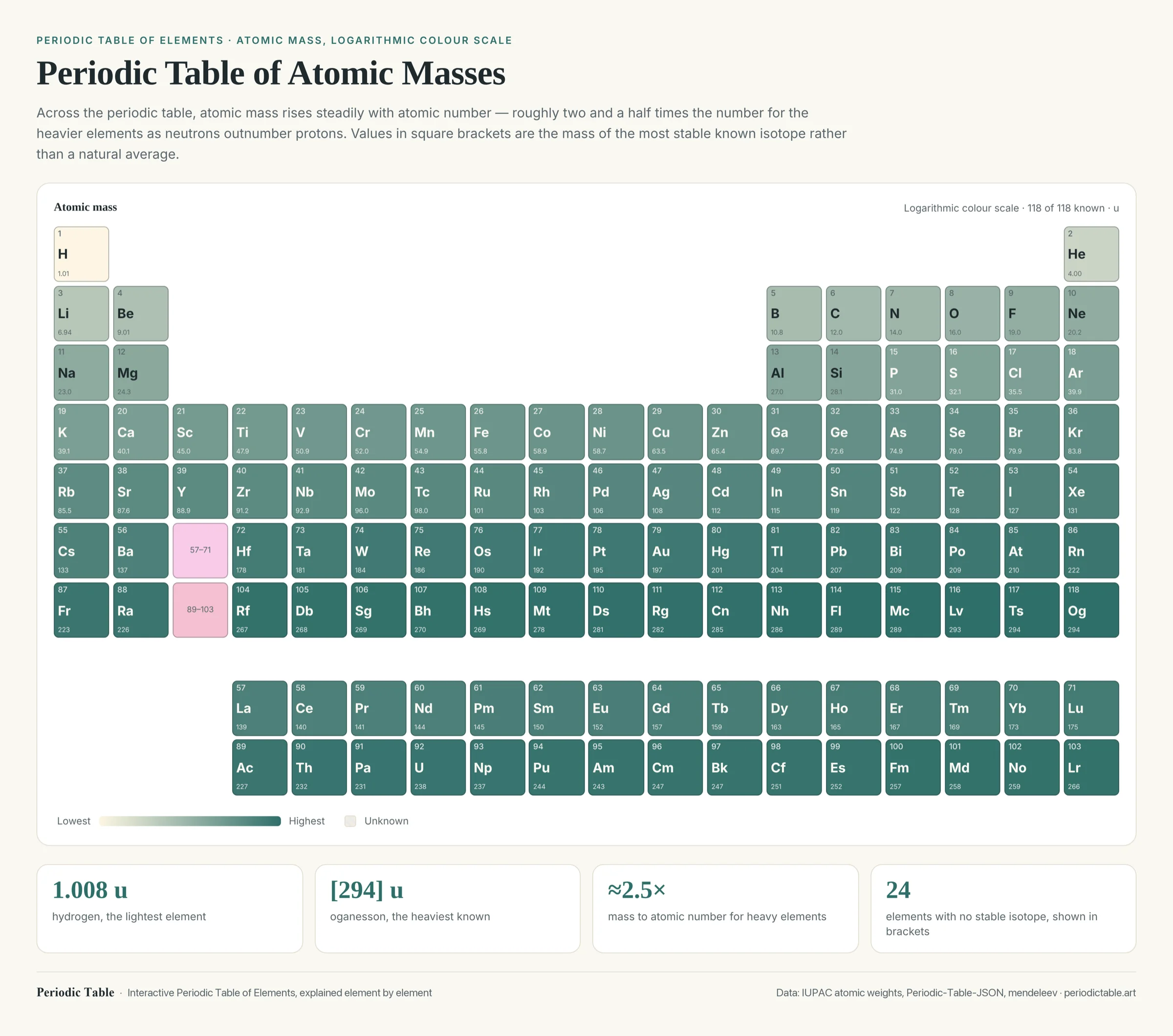
You will also see this called the standard atomic weight or, loosely, the atomic mass. For an element with no stable isotope, the table instead shows, in parentheses, the mass number of its most stable isotope, the one with the longest half-life.
The periodic table of atomic masses below shades each tile by its atomic weight, from hydrogen at 1.008 u to oganesson at [294] u.
Groups and group names
The 18 columns are called groups, numbered 1 to 18 under the current IUPAC system. Elements in the same column share the same arrangement of outer electrons, so they show similar chemical properties. Several columns have traditional group names you will meet constantly in chemistry:
- Group 1 – alkali metals: lithium, sodium, potassium and below; soft, very reactive metals that form +1 ions.
- Group 2 – alkaline earth metals: beryllium to radium; reactive, but less so than the alkali metals.
- Group 15 – pnictogens: nitrogen, phosphorus, arsenic, antimony, bismuth.
- Group 16 – chalcogens: oxygen, sulfur, selenium and the heavier members.
- Group 17 – halogens: fluorine to astatine; reactive nonmetals that readily gain one electron.
- Group 18 – noble gases: helium to oganesson; full outer shells and very low reactivity.
Older European and American tables used Roman numerals with A and B suffixes, which is why you may still see IUPAC numbering placed next to labels such as "VIIA" in older textbooks. If you are reading a pre-1990 source, check which convention it uses before comparing groups.
Periods and blocks
The seven rows are called periods. A new period starts each time a new electron shell receives its first electron, which is why period 1 holds only two elements while periods 6 and 7 hold 32 each.
The table is also divided into four blocks, named after the subshell being filled: the s-block (groups 1–2 plus helium), the p-block (groups 13–18), the d-block (groups 3–12) and the f-block. You will also see these written without the hyphen, as s block, p block, d block and f block.
The two rows printed below the main grid are the f-block: the lanthanides (lanthanum to lutetium in period 6) and the actinides (actinium to lawrencium in period 7). IUPAC also accepts the names lanthanoids and actinoids. They sit at the bottom only to save width; in a 32-column layout the f-block slots in between groups 2 and 3.

Electron configuration: the source of chemical periodicity
The reason the table has its distinctive stepped shape is the electron configuration of each element, the way its electrons are distributed among energy levels. Quantum mechanics shows that electrons occupy regions of space called orbitals, each holding at most two electrons.
Orbitals come in four main types, labelled s, p, d and f, and they group into sets: one s orbital, three p orbitals, five d orbitals and seven f orbitals. That gives the 2, 6, 10 and 14 electrons that set the widths of the four blocks.
The electrons in the outermost shell, the valence electrons, do most of the work in chemistry. Sodium has one valence electron and loses it easily; chlorine has seven and grabs one more.
Because elements in the same group have the same number of valence electrons in the same type of orbitals, they behave alike. This is the physics behind the periodic table's columns, and it is why the table is as useful in physics and materials science as it is in chemistry.
That link between electron structure and behaviour is the deepest idea in the periodic table. Chemistry describes what elements do when they meet; physics explains why, through the energy levels and orbitals quantum theory predicts for each atom.
In practice it means you can read a configuration straight off the grid: chlorine sits in period 3, group 17, so the periodic table tells you it has a neon core plus 3s2 3p5, one electron short of argon, without filling a single orbital by hand. The same reading underlies atomic physics, where those configurations explain each element's spectrum, and every first chemistry course that asks you to predict an ion's charge.
Electron shells and subshell filling order
Electrons are arranged in electron shells numbered 1, 2, 3 and so on, and each shell splits into one or more subshell types. Shell 1 has only a 1s subshell; shell 2 has 2s and 2p; shell 3 has 3s, 3p and 3d.
These atomic orbitals do not fill strictly shell by shell, because orbitals in a higher shell can sit lower in energy than orbitals left empty in the shell below. The aufbau principle says electrons enter the lowest-energy available orbitals first, and the Madelung rule gives the order: subshells fill in order of increasing n + ℓ, and where two share a value, the one with lower n fills first.
That rule produces the sequence 1s, 2s, 2p, 3s, 3p, 4s, 3d, 4p, 5s, 4d, 5p, 6s, 4f, 5d, 6p, 7s, 5f, 6d, 7p. Notice that 4s fills before 3d: this is why potassium and calcium start period 4 before the transition metals appear. An electron configuration table lists each element's configuration in shorthand, for example oxygen as 1s2 2s2 2p4, or iron as [Ar] 3d6 4s2, where [Ar] stands for argon's filled core.
A handful of elements, such as chromium and copper, break the Madelung rule slightly because a half-filled or filled d subshell is more stable. For the heaviest elements the exceptions multiply, since their f and d orbitals lie so close in energy that small effects decide which orbitals fill first.
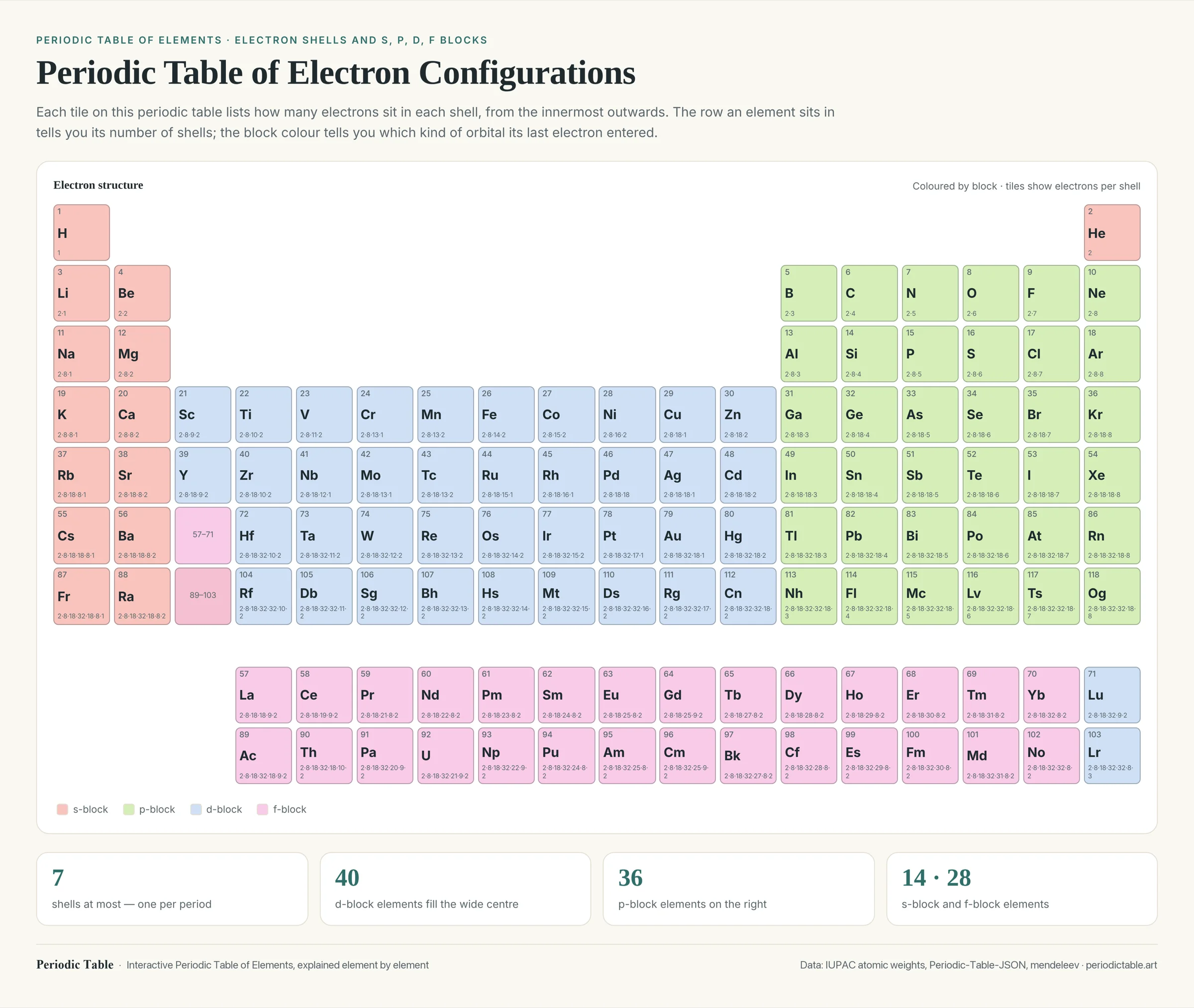
The periodic table of electron configurations below lists the electrons in each shell on every tile and colours the s-, p-, d- and f-blocks, so you can read an element's shell structure straight from its position.
Periodic trends in the periodic system
Because electron arrangements repeat, properties repeat too. These recurring patterns are called periodic trends, and reading them is the single most practical skill the periodic system teaches. Most trends run in two directions at once: across a period from left to right, and down a group from top to bottom.
That periodicity is what lets you predict the reactivity of an element you have never worked with simply from its position on the periodic table. It is also why the periodic table appears on the wall of nearly every science classroom: one chart replaces thousands of separate facts.
Two forces drive almost every trend. Moving across a period, the number of protons in the nucleus rises while new electrons go into the same shell, so the outer electrons are pulled in more tightly. Moving down a group, each step adds a whole new shell, which places the outer electrons farther from the nucleus and shields them from its pull.
Keep those two ideas in mind and the patterns below stop being facts to memorise. Recolour the periodic table by any property and you will see the same diagonal sweep: values rise toward one corner of the periodic table and fall toward the opposite one.
Atomic radius
Atomic radius shrinks from left to right across a period and grows down a group. Lithium is far larger than fluorine even though fluorine has more than three times as many electrons, because fluorine's nine protons pull its electrons inward.
Hydrogen is the smallest atom, and caesium, near the bottom of group 1, is one of the largest atoms of all. Ionic radius follows a related pattern: atoms that lose electrons to form positive ions become smaller, while atoms that gain electrons to form negative ions become larger.
Ionisation energy and electron affinity
Ionisation energy (spelled ionization energy in American English) is the energy needed to remove an electron from an atom in the gas phase. The first ionisation energy rises across a period and falls down a group, the mirror image of atomic radius.
Helium has the highest of all at 2,372 kJ/mol, hydrogen sits at 1,312 kJ/mol, and the alkali metals have the lowest values in each period, which is exactly why they react so readily. Across period 2 the value climbs from 520 kJ/mol at lithium to 2,081 at neon, then collapses to 496 at sodium as a new shell begins.
Electron affinity is the energy released when an atom gains an electron. It generally becomes more favourable across a period toward the halogens, with chlorine releasing the most energy of any element. The noble gases and alkaline earth metals show little or no tendency to accept an extra electron because doing so would disturb a filled subshell.

Electronegativity and metallic character
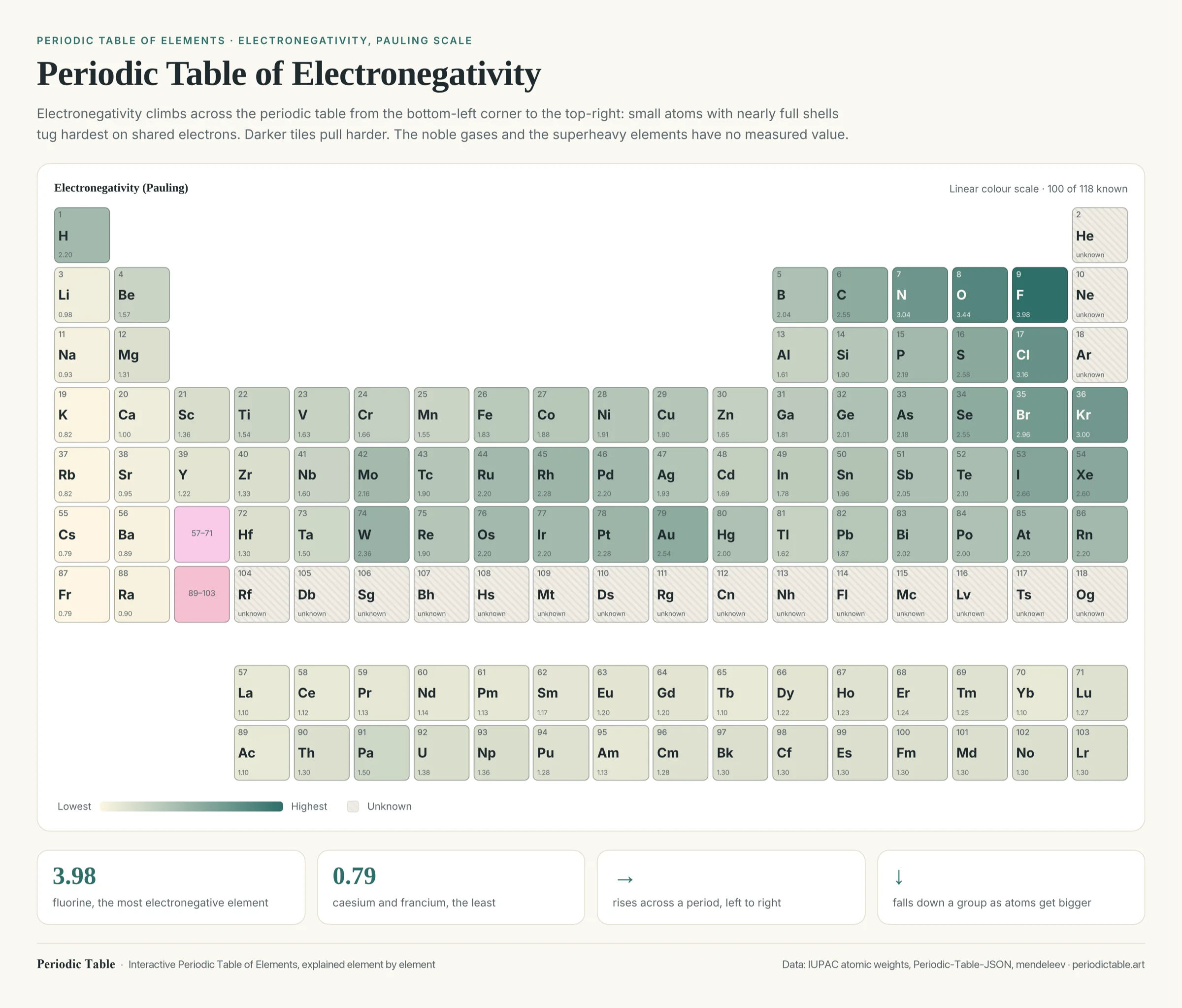
Electronegativity measures how strongly an atom attracts the shared electrons in a chemical bond. On the Pauling scale, fluorine is the most electronegative element at 3.98, followed by oxygen at 3.44, while caesium and francium sit near 0.7–0.8. The difference in electronegativity between two bonded atoms tells you whether a bond is non-polar, polar or ionic.
Metallic character runs the opposite way: it increases down a group and from right to left across a period. That is why a staircase-shaped dividing line runs from boron down to astatine, separating metals and nonmetals, with metallic elements to the lower left and nonmetallic elements to the upper right.
The periodic table of electronegativity below shades every element by its Pauling value, so the climb from caesium and francium in the bottom-left to fluorine in the top-right is easy to see.
Valence and oxidation states
Valence is the number of bonds an atom typically forms, and it follows directly from its valence electrons. Carbon, with four valence electrons, forms four bonds, which is why it can build the chain and ring molecules of organic chemistry. An oxidation state is the charge an atom would carry if all its bonds were ionic; in water, for instance, each hydrogen has an oxidation state of +1 and oxygen an oxidation state of −2.
Main-group elements usually show oxidation states that match their group: +1 for group 1, +2 for group 2, −1 for most halogens in compounds. Transition metals are more flexible; manganese, for example, shows every oxidation state from +2 to +7 across its common compounds, and each molecule it forms takes its colour and chemistry from that choice.
Classification of elements in the modern periodic table
Beyond groups and blocks, the modern periodic table sorts elements into broad categories based on how they actually behave. The classification of elements into metals, metalloids and nonmetals is the most common colour scheme you will see, including on this table. These categories summarise physical properties such as melting point, boiling point, density and crystal structure, along with chemical behaviour.
| Category | Where on the table | Typical properties of elements |
|---|---|---|
| Alkali metals | Group 1 (except hydrogen) | Soft, low density, react vigorously with water |
| Alkaline earth metals | Group 2 | Harder and denser than group 1; form +2 ions |
| Transition metals | d-block, groups 3–12 | High melting point, coloured compounds, several oxidation states |
| Post-transition metals | Lower p-block, e.g. tin, lead | Softer, lower melting point than transition metals |
| Lanthanides and actinides | f-block | Very similar chemistry within each series; many actinides radioactive |
| Metalloids | Along the dividing line: boron, silicon, germanium, arsenic, antimony, tellurium | Mixed metal and nonmetal properties; semiconductors |
| Reactive nonmetals | Upper right: carbon, nitrogen, oxygen, halogens and others | Poor conductors, high electronegativity |
| Noble gases | Group 18 | Colourless gases with very low reactivity |
Notice how the categories map onto the periodic table itself. The metals fill the left side and the middle of the periodic table, roughly three-quarters of all elements; the nonmetals cluster in the upper right; and the metalloids form the thin band between them. The actinides in the bottom row, including uranium and plutonium, are all radioactive, and uranium and plutonium show many oxidation states because their 5f and 6d orbitals lie so close in energy.
All ten families appear together on the periodic table by element family below, colour-coded from the alkali metals to the actinides.
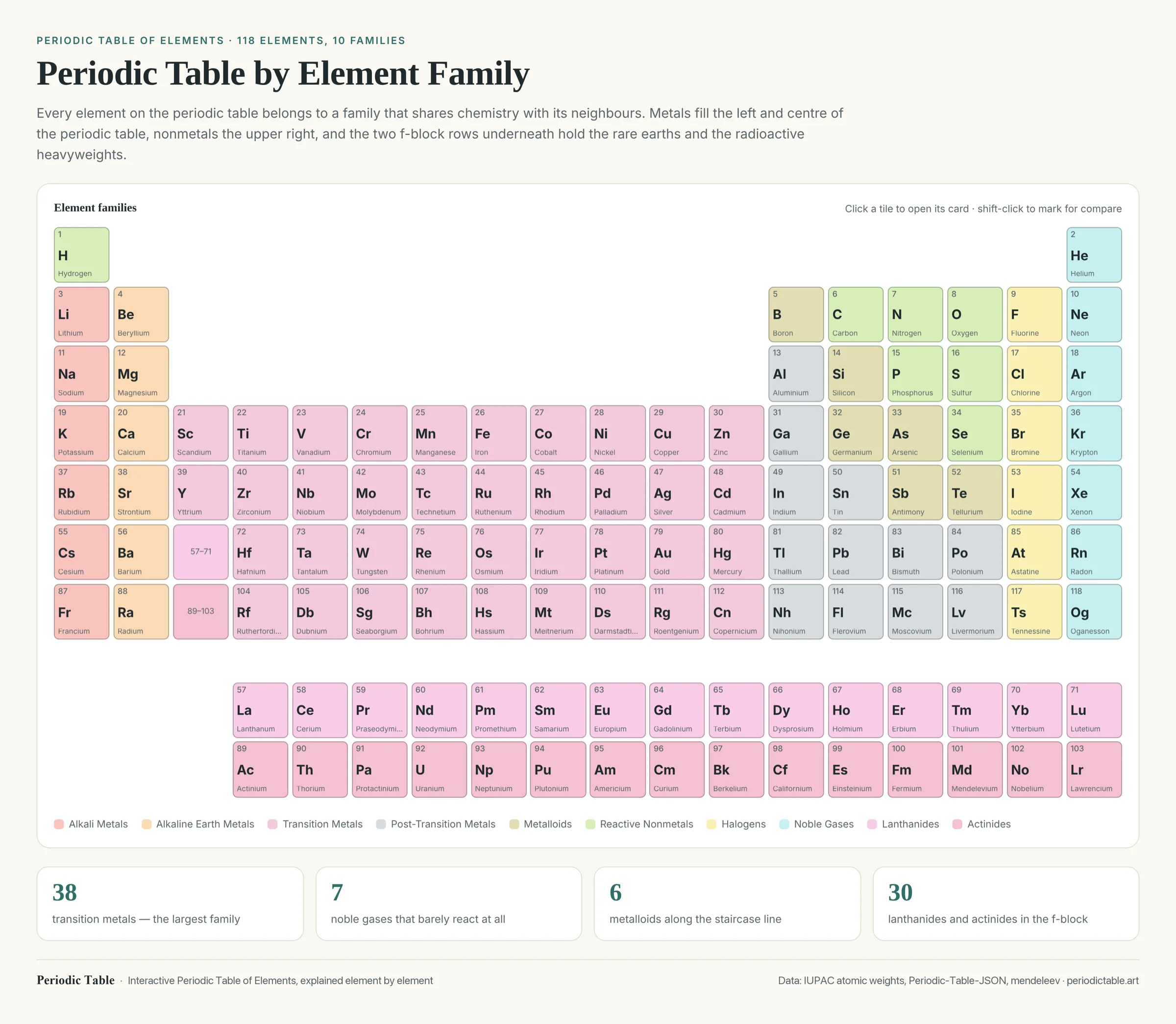
Two other labels are worth knowing. Main-group elements are those in the s-block and p-block of the periodic table, whose chemistry follows the group trends closely.
Rare-earth elements are the lanthanides plus scandium and yttrium; despite the name, most are not especially rare in the crust, but their abundance in workable deposits is low, which is why some tables also flag supply risk. Other useful data you can switch on include heat capacity, density and abundance, each of which reveals its own pattern when the whole grid is coloured by value.
Weighing zinc for a hydroponic reservoir with the standard periodic table
A lettuce grower's newest leaves are coming in pale between the veins, and a tissue test points to zinc. The decision is simple to state: how many milligrams of zinc sulfate go into a 38.5-litre reservoir to bring dissolved zinc to 0.25 mg/L? The answer is 42.33 mg of zinc sulfate heptahydrate, and the way to it runs straight through the periodic table.
First the zinc itself: 38.5 L × 0.25 mg/L = 9.625 mg of Zn. The bag says ZnSO4·7H2O, so I click the zinc, sulfur, oxygen and hydrogen tiles on the periodic table and read their atomic weights, 65.38, 32.06, 15.999 and 1.008, then add them up: 65.38 + 32.06 + 4 × 15.999 gives 161.436 for the salt, and each of the seven waters adds 18.015, for a molar mass of 287.541 g/mol.
Zinc is 65.38 ÷ 287.541 = 22.74% of that mass, so 9.625 ÷ 0.2274 = 42.33 mg. I cross-check by running it backwards: 42.33 mg × 0.2274 returns 9.63 mg of zinc.
The number to watch here is the water of hydration, because it changes the answer more than any other input:
| Form on the label | Molar mass (g/mol) | Zinc share | Mg to weigh for 9.625 mg Zn |
|---|---|---|---|
| Heptahydrate (·7H2O) | 287.541 | 22.74% | 42.33 |
| Monohydrate (·H2O) | 179.451 | 36.43% | 26.42 |
| Anhydrous | 161.436 | 40.50% | 23.77 |
If you forget to add the seven H2O units, using only the 161.436 from the zinc, sulfur and oxygen tiles while weighing the heptahydrate, you add 23.77 mg and deliver only 5.40 mg of zinc, or 0.14 mg/L, which is 56% of the target.
The atomic weights on the periodic table give the exact dose, provided the formula on the label, waters of hydration included, is read correctly. Because 42 mg is too small for a kitchen scale, the next step is a stock solution of 4.233 g per litre, with 10 mL going into the reservoir.
How the periodic law was discovered
The periodic law states that when the elements are arranged by atomic number, their properties recur at regular intervals. Its history runs from medieval alchemy, which knew only a handful of elements, through the scientific revolution of the 1700s and 1800s, when chemists isolated dozens of new ones.
By the early 1800s, every chemist was looking for patterns among them. The history of the periodic table is really the history of modern chemistry: each new discovery added an element that had to fit somewhere, and every attempt to organise them was a test of whether chemistry had underlying rules at all.
In 1829 Johann Döbereiner noticed triads, sets of three similar elements such as chlorine, bromine and iodine, where the middle member's atomic weight is close to the average of the other two. Later in the century, others proposed spirals and octaves.
Each idea captured part of the pattern, but none produced a table that could make a successful prediction, and that is what turned periodicity into science. A classification that only describes known elements is bookkeeping; one that forecasts the discovery of new elements is a scientific theory.
Mendeleev and the missing elements
In 1869 the Russian chemist Dmitri Mendeleev published a table that ordered the known elements by atomic weight and grouped them by chemical behaviour. Its boldest feature was the gaps: where no known element fitted, Mendeleev left a blank and predicted the properties of the element that should fill it. He called one of them eka-aluminium.
When gallium was discovered in 1875, its density and atomic weight matched his prediction closely: gallium's measured density was 5.9 g/cm³ against Mendeleev's forecast of 5.9, and the discovery of germanium in 1886 confirmed his "eka-silicon". Mendeleev's table also swapped a few pairs, such as tellurium and iodine, against their atomic weights because their chemistry demanded it.
The explanation came in 1913, when Henry Moseley used X-ray spectra to show that each element has a whole-number charge in its nucleus. Ordering by that number, the atomic number, removed the anomalies Mendeleev had worked around and gave the periodic law its modern form.

Synthetic elements and superheavy elements
In nature, only elements up to plutonium (atomic number 94) occur, and several of those, like technetium, exist only in trace amounts. Every element beyond them is one of the synthetic elements, made in a nuclear reactor or particle accelerator. In 1945 Glenn T. Seaborg proposed that the elements after actinium form their own f-block series, the actinides, rather than continuing the d-block.
That change gave uranium and plutonium their modern positions and set the layout used today. Seaborg's insight also guided the later synthesis of americium and curium in a nuclear laboratory. Nuclear reactors still breed plutonium from uranium-238, and particle accelerators fire light nuclei at heavy targets to build new elements, which is why so many element names honour nuclear physics laboratories and the scientists who worked in them.
The heaviest of these, the superheavy elements, have been produced only a few atoms at a time, with lifetimes measured in milliseconds or less. IUPAC confirmed elements 113, 115, 117 and 118 in 2015 and named them nihonium, moscovium, tennessine and oganesson in 2016, completing period 7.
For such heavy atoms, relativistic effects change the behaviour of the inner electrons enough that some superheavy elements may not behave like their lighter group partners at all. Many of them decay by alpha emission, spontaneous fission or electron capture before chemists can study their chemistry.
Periodic table forms and alternative periodic tables
There is no single "correct" layout of the periodic table, and the choice is as much about teaching and science communication as about chemistry. Common periodic table forms include the compact 18-column version, a wide 32-column version that keeps the f-block inline, and the short Mendeleev-style 8-column table.
Among alternative periodic tables, you will find circular and spiral designs, three-dimensional models and the left-step table, which places helium above beryllium to match electron configuration rather than chemical behaviour. Each periodic table design emphasises a different relationship; the 18-column version wins because it fits on a page and keeps chemically similar elements in the same column.
Where group 3 and period 1 belong
Two placements are still debated. Period 1 holds only hydrogen and helium, and both are awkward fits.
Hydrogen has one electron like the alkali metals, yet it is a gas and its chemical behaviour also resembles the halogens. Helium has a 1s2 configuration like the s-block, yet it is chemically a noble gas, so most tables place it in group 18.
Group 3 is the other open question: should it contain scandium, yttrium, lanthanum and actinium, or scandium, yttrium, lutetium and lawrencium? A 2021 IUPAC project report favoured the lutetium–lawrencium form, which is consistent with electron configurations and gives the f-block a clean width of 14. This table keeps the more common placeholder layout instead: group 3 holds scandium and yttrium above 57–71 and 89–103 markers, and the two bottom rows run the full 15 elements from lanthanum to lutetium and from actinium to lawrencium.
When you compare periodic tables from different publishers, group 3 is the first place to look: if it holds lanthanum, the f-block rows will start at cerium and thorium instead. The chemistry of group 3 barely changes either way, since scandium, yttrium and lutetium share a stable +3 oxidation state, but the group 3 choice does change which elements count as d-block and which as f-block.
Using the interactive periodic table of chemical elements
The most common reason to open a periodic table of chemical elements is to look up atomic weights and turn a chemical formula into a molar mass, the mass in grams of one mole of a substance. Click an element tile to open its card with its atomic number, symbol, weight, category and, on the Electrons tab, its electron configuration. You can also recolour the whole table by a property, such as electronegativity or melting point, to see a trend at a glance.
In chemistry, the periodic table is the data sheet behind every formula-to-mass conversion: stoichiometry in general chemistry, solution chemistry and analytical chemistry, and weighing reagents in a teaching chemistry lab all start by reading atomic weights off the tiles, exactly as in the example below.
The calculation is a simple weighted sum. For a compound, multiply each element's atomic weight by the number of atoms of that element in the formula, then add the results:
$$M = \sum_{i} n_i \times A_{r,i}$$
Here \(M\) is the molar mass in g/mol, \(n_i\) is the number of atoms of element \(i\) and \(A_{r,i}\) is its relative atomic mass from the table.
As a worked example, take iron(III) oxide, Fe2O3, the reddish compound in rust. The table gives iron an atomic weight of 55.845 and oxygen 15.999:
| Element | Atoms | Atomic weight | Contribution (g/mol) | Share of mass |
|---|---|---|---|---|
| Iron (Fe) | 2 | 55.845 | 111.690 | 69.94% |
| Oxygen (O) | 3 | 15.999 | 47.997 | 30.06% |
| Fe2O3 | 5 | 159.687 | 100% |
So one mole of iron(III) oxide weighs 159.687 g, and almost 70% of that mass is iron. That mass share is the same figure a metallurgist uses to estimate how much iron a given tonne of ore can yield, and it all comes from two numbers read straight off the table.

Other ways to use the periodic table in chemistry and physics coursework:
- Predict an ion's charge from its group, then balance an ionic formula in inorganic chemistry.
- Spot which elements share chemical properties before substituting one for another in a reaction.
- Compare two elements' electronegativity to decide whether a bond is polar, a daily task in organic chemistry.
- Read an element's electron configuration from its position instead of filling orbitals by hand, a shortcut used across chemistry and physics.
- Check which isotope is the most stable for a radioactive element before quoting its mass.