


Plutonium element (Pu): plutonium periodic table facts
Plutonium periodic table facts: plutonium (Pu) is element 94, an actinide in period 7 of the f-block. Few substances carry as much history in a single word as plutonium. Across rows and columns, ionisation energy, electronegativity and atomic radius follow patterns you can read across the periodic table of the elements with plain, simple labels.
It is the radioactive element with atomic number 94 and the symbol Pu, a dense silvery metal that is made almost entirely inside reactors when uranium absorbs neutrons. Here you will find its atomic data, its strange physical behaviour, its isotopes, how it was discovered, how it powers reactors and deep-space probes, and why it demands such careful handling.
Rotate the 3D Bohr model of plutonium
Drag to orbit, scroll to zoom.
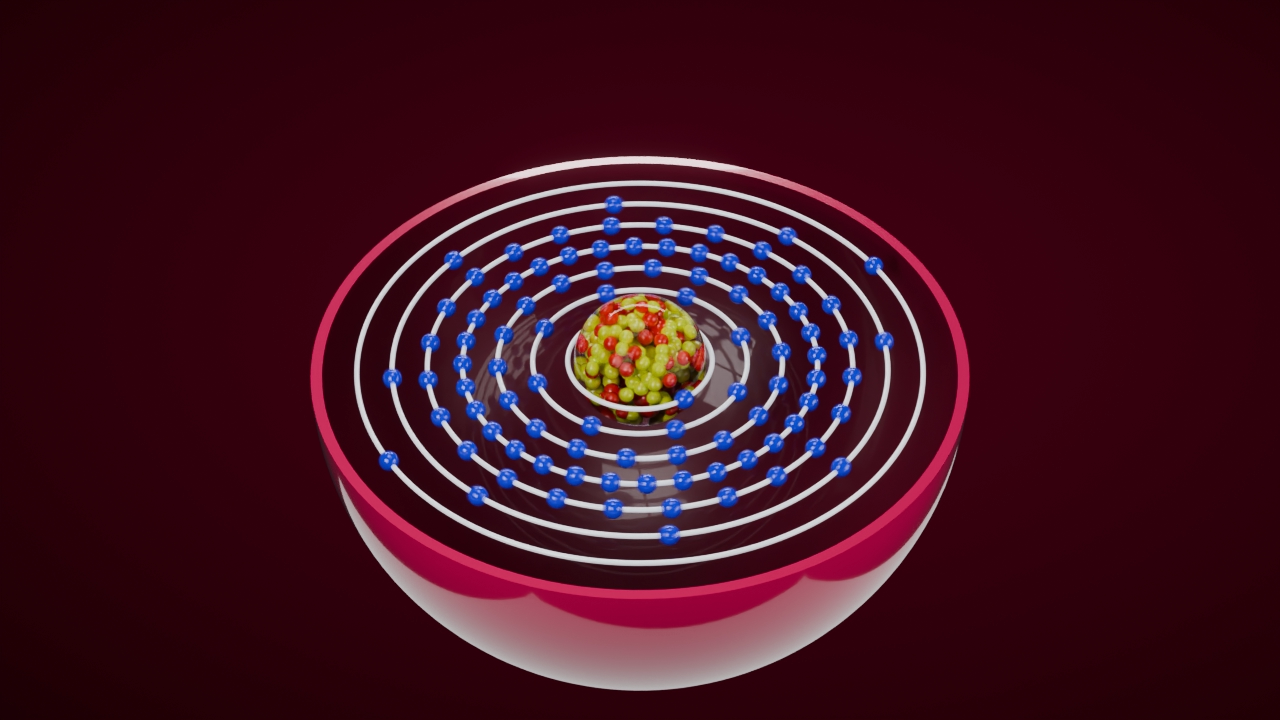
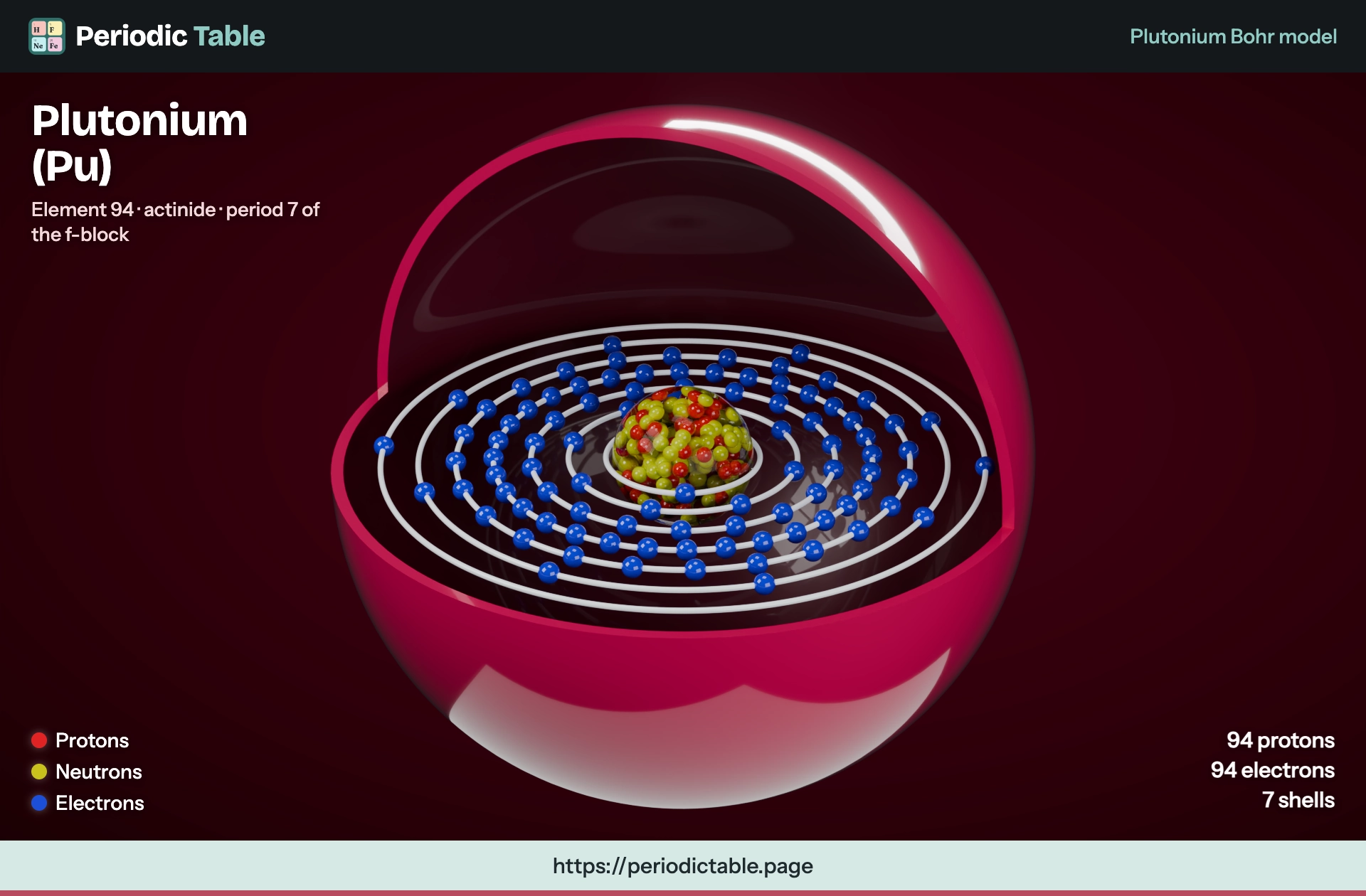
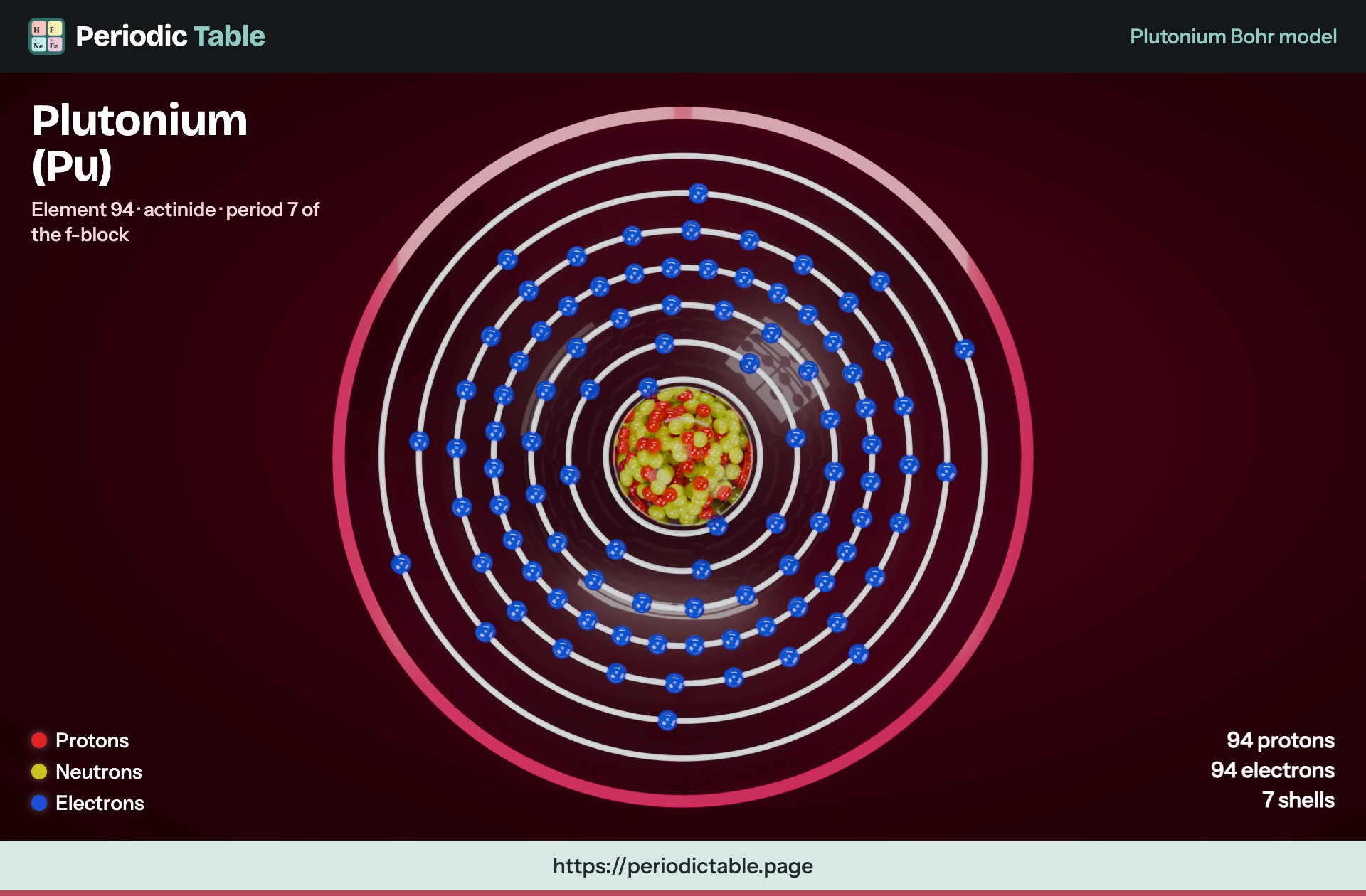
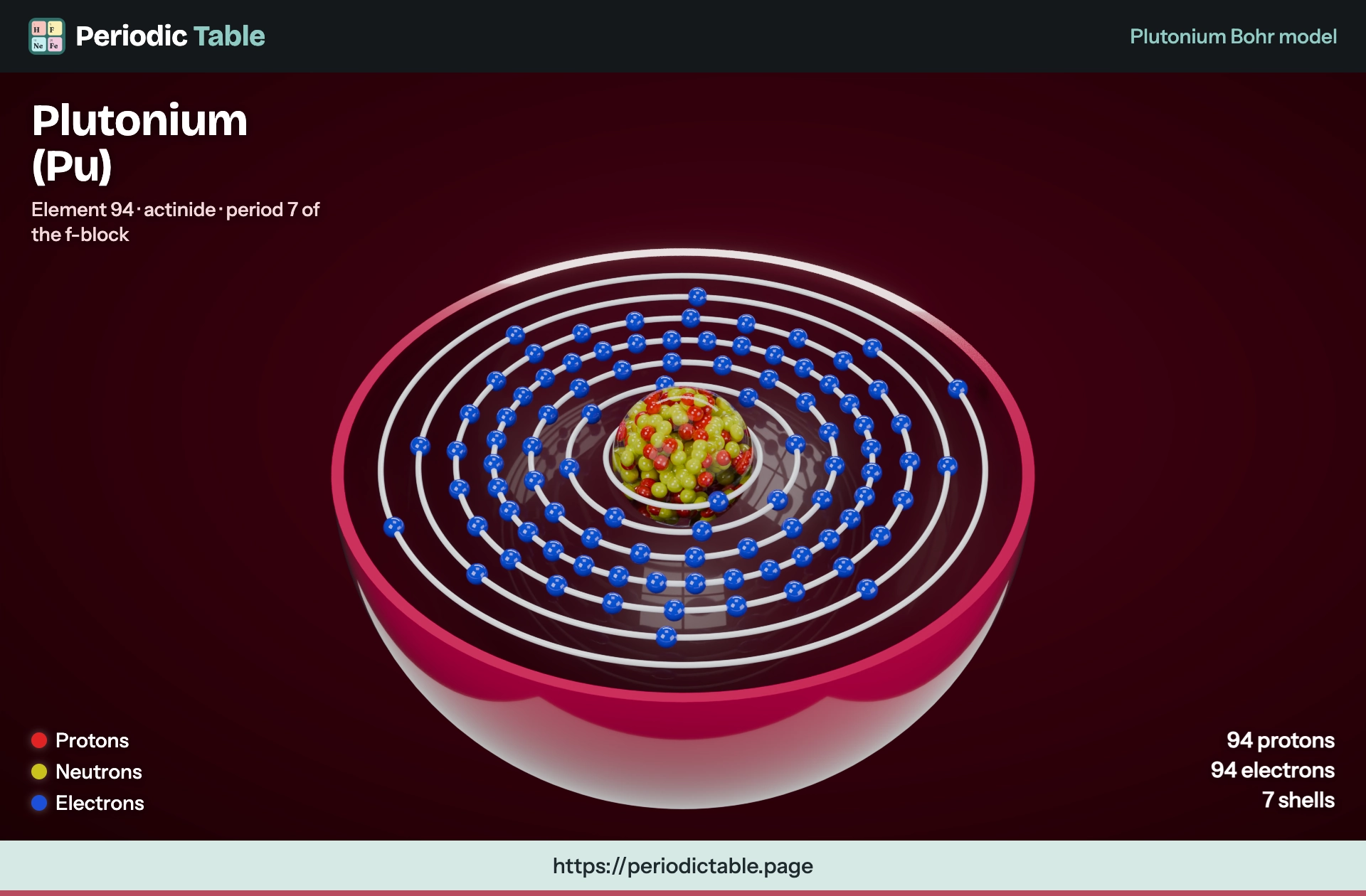
This is a Bohr model of plutonium (Pu), a simplified picture of a single plutonium atom. Its nucleus holds 94 protons, and a neutral plutonium atom has 94 electrons, arranged around it in 7 shells (2 in shell K, 8 in shell L, 18 in shell M, 32 in shell N, 24 in shell O, 8 in shell P and 2 in shell Q).
Plutonium periodic table electron configuration
- Shorthand
- [Rn] 5f6 7s2
- Full
- 1s2 2s2 2p6 3s2 3p6 4s2 3d10 4p6 5s2 4d10 5p6 6s2 4f14 5d10 6p6 7s2 5f6
- Electrons per shell
- 2, 8, 18, 32, 24, 8, 2
Plutonium element properties and atomic data
- Atomic number
- 94
- Atomic mass
- [244] u
- Phase at STP
- Solid
- Melting point
- 639.35°C (912.5 K)
- Boiling point
- 3231.85°C (3505 K)
- Density
- 19.816 g/cm³
- Electronegativity (Pauling)
- 1.28
- Period
- 7
- Group
- —
- Block
- f-block
- Appearance
- Silvery white, tarnishing to dark gray in air
- Discovery date
- 1940
- Discovered by
- Glenn T. Seaborg
- Named by
- —
Plutonium element facts and atomic data
Plutonium sits in period 7 of the periodic table, inside the f-block row that is printed below the main grid. It has no group number of its own.
Like every element after bismuth it is radioactive with no stable form, so the value shown for its mass is the mass number of its longest-lived isotope, given in square brackets. The table below collects the reference figures you are most likely to need.
| Property | Value |
|---|---|
| Symbol and atomic number | Pu, 94 |
| Series and block | Actinide, f-block, period 7 |
| Mass number of longest-lived nuclide | [244] |
| Electron configuration | [Rn] 5f6 7s2 |
| Melting point | 639.4 °C (912.5 K) |
| Boiling point | 3,228 °C (3,505 K) |
| Density of the alpha metal at 20 °C | 19.85 g/cm3 |
| Electronegativity (Pauling scale) | 1.28 |
| First ionisation energy | 584.7 kJ/mol |
| Atomic radius (empirical) | 159 pm |
| Common oxidation states | +3, +4, +5, +6 |
| Natural occurrence | Trace, from uranium decay and neutron capture |
| CAS number | 7440-07-5 |
Two figures in that table explain a lot. The melting point is low for such a heavy element, while the boiling point is very high, so plutonium stays liquid over a span of more than 2,500 degrees.
It is about as dense as gold and tungsten, yet its volume changes far more with temperature than either. An electronegativity of 1.28 on the Pauling scale marks it as electropositive, giving up electrons readily, which is why it oxidises so easily.
Where Pu sits among the actinide elements
Plutonium belongs to the actinide series, the fifteen elements from actinium to lawrencium in which electrons fill the 5f subshell. It lies between neptunium (element 93) and americium (element 95), and it is the last element in that run to be produced in tonne quantities.
What makes Pu unusual is the behaviour of its 5f electrons. In the early actinides, such as uranium, the 5f orbitals spread out and join in bonding, so those elements act a little like transition metals. In the later actinides, the 5f orbitals shrink toward the nucleus and the elements start to behave like lanthanides.
You can see this trend across the actinide row of the periodic table. Plutonium sits right at the crossover. Its 5f electrons are neither fully shared nor fully held, and several electron arrangements of almost equal energy compete with each other.
That balance is the root of nearly every odd property you will read about below. It is why chemistry and solid-state physics both treat plutonium as one of the most complex elements, and why its electron physics still challenges the best electronic-structure theories more than eighty years after it was first made.
Physical properties of plutonium
Freshly cut plutonium metal is bright and silvery, much like nickel. Within minutes it begins to tarnish, first to a dull grey and then to yellow or olive-green as an oxide film grows. The basic properties of plutonium read like a list of exceptions to the physics of ordinary metals: To see how electron capture in potassium-40 builds the radiogenic isotope, check element 18, argon for details and examples.
- At room temperature the unalloyed form is hard and brittle, roughly comparable to grey cast iron.
- Its thermal conductivity is very poor, so warmth moves through it slowly.
- Its electrical resistivity is high and rises as the temperature falls, the opposite of copper or iron.
- It becomes denser when it melts, by about 2.5 percent.
- Some of its solid forms shrink when they are heated.
Plutonium is also warm to the touch, a direct sign of its radioactivity. Every gram of plutonium-239 undergoes about 2.3 billion alpha decays each second, which works out to roughly 1.9 milliwatts of heat per gram. A large piece therefore needs cooling, and a piece of the shorter-lived mass-238 form gets hot enough to glow.
Six allotropes and their density swings
Most metals have one or two crystal forms. Plutonium has six allotropes at ordinary pressure between room temperature and the liquid state, and a seventh that appears only at high temperature under pressure. Each has its own crystal structure and density, so a sample changes volume sharply as it warms.
| Phase | Stable range (unalloyed) | Crystal structure | Density (g/cm3) |
|---|---|---|---|
| Alpha (α) | Below 112 °C | Simple monoclinic | 19.86 |
| Beta (β) | 112–185 °C | Body-centred, low symmetry | 17.70 |
| Gamma (γ) | 185–310 °C | Face-centred orthorhombic | 17.14 |
| Delta (δ) | 310–452 °C | Face-centred cubic | 15.92 |
| Delta prime (δ′) | 452–480 °C | Body-centred tetragonal | 16.00 |
| Epsilon (ε) | 480–640 °C | Body-centred cubic | 16.51 |
The alpha phase is the form you meet at room temperature. Its monoclinic lattice makes it strong but brittle and difficult to machine. The delta phase, by contrast, has a simple cubic lattice and is soft, ductile and malleable, much like aluminium.
Divide the alpha figure by the delta figure (19.86 ÷ 15.92) and you get about 1.25, so the same mass takes up roughly a quarter more space in the delta form. That swing is why engineers in the 1940s found plutonium so hard to cast and shape into precise parts.
Plutonium alloys and delta-phase stabilization
The practical fix for the allotrope problem is alloying. A few atomic percent of gallium, aluminium or cerium keeps the soft delta structure stable all the way down to room temperature, which lets it be cast, rolled, machined and even welded. The plutonium–gallium alloy is the classic example, and much of the metallurgy of the element is built around it.
Plutonium forms plutonium alloys and intermetallic compounds with most other metals, though not with the alkali or most alkaline earth elements, a pattern that materials physics still studies closely. Some of these alloys are fuels in their own right: plutonium–uranium and plutonium–zirconium alloys have been tested in fast reactors. One alloy, PuCoGa5, is a superconductor below about 18.5 K, a high value for this class of material, although self-irradiation slowly damages its crystal lattice and weakens the effect.
Plutonium compounds and oxidation states
In water, plutonium shows four common valences, +3 to +6, and they can coexist in the same solution at measurable concentrations. That is rare among the elements. Each state has its own colour, which made early analysis easier than you might expect: After reading about a mineral or ore, anyone checking radium (ra) will see how minute amounts per tonne are recovered.
- Pu(III) as Pu3+, blue to lavender
- Pu(IV) as Pu4+, yellow-brown
- Pu(V) as PuO2+, light pink
- Pu(VI) as PuO22+, pink-orange
- Pu(VII), a rare green ion found only in strongly alkaline solution
The most important of the plutonium compounds is plutonium dioxide, PuO2, a stable olive-green to yellow powder used in fuel and in heat sources. Halides matter too.
Plutonium tetrafluoride, PuF4, is reduced with calcium or barium at high temperature to make metallic plutonium. In separation plants, irradiated fuel and its oxides are dissolved in nitric acid, where the shifting oxidation state of plutonium is what lets chemists pull it away from uranium and fission products.
The metal is attacked by acids, oxygen and steam but not by alkalis. With hydrogen it forms hydrides, and with carbon, nitrogen and silicon it forms carbides, nitrides and silicides that are studied as advanced reactor fuels. The chemistry of plutonium is so varied because its oxidation states sit so close in energy to one another.
Why Pu metal is pyrophoric
Finely divided plutonium can catch fire on its own. In damp air, a thin hydride layer forms on the surface, and that layer is pyrophoric, meaning it can ignite at room temperature.
As it oxidises it swells by up to 70 percent in volume, which can crack the container holding it. Burning plutonium also scatters radioactive oxide, so a fire is a contamination problem as well as a burn hazard.
Water is not used on a plutonium fire. Dry magnesium oxide sand works better, because it absorbs heat and cuts off oxygen. For everyday safety, plutonium is stored and handled under dry inert gas, usually argon or nitrogen.
Plutonium isotopes and their half-lives
About twenty plutonium isotopes are known, with mass numbers from 226 to 247. None is stable.
Each isotope is radioactive and decays at its own rate, measured by its half-life: the time it takes for half of a sample to decay. The six that matter most are listed below.
| Nuclide | Half-life | Main decay mode | Why it matters |
|---|---|---|---|
| Plutonium-238 | 87.7 years | Alpha | Heat source for deep-space power |
| Plutonium-239 | 24,110 years | Alpha | Main fissile nuclide for reactors and weapons |
| Plutonium-240 | 6,561 years | Alpha, with fast self-fission | Sets the plutonium grade |
| Plutonium-241 | 14.3 years | Beta, to americium-241 | Fissile; ages into a gamma emitter |
| Plutonium-242 | 375,000 years | Alpha | Builds up with repeated irradiation |
| Plutonium-244 | about 81 million years | Alpha | Longest-lived form |
The half-lives range from decades to tens of millions of years, and that spread explains why each form has such a different use. Plutonium-238 decays fast enough to give off useful warmth for decades. Plutonium-239 decays slowly; after 10,000 years about 75 percent of a sample would still be there.
The 241 form, by contrast, loses about three-quarters of itself in 30 years, turning into americium-241. That is why stored plutonium gives off more gamma radiation as it ages.
Nuclides lighter than mass 244 decay mainly by alpha decay, with some spontaneous fission, mostly forming uranium and neptunium. Plutonium-244 is long-lived enough that some may survive from the formation of the Solar System.
Plutonium-242 builds up whenever fuel is recycled through a reactor. In technical writing you will often see the short forms Pu-238 and Pu-239, or a superscript such as 239Pu.
Decay heat from alpha particles
Most forms of plutonium decay by emitting alpha particles, helium nuclei that travel only a few centimetres in air and stop in the outer layer of dead skin. As those particles slow down inside the sample, their energy turns into decay heat.
The amount depends strongly on the mass number. Pu-238 gives off about 0.57 watts per gram, which is about 300 times the rate of plutonium-239.
That high radioactivity combined with weakly penetrating radiation is the reason it is the preferred fuel for long-lived power sources. A thin sheet of material is enough to stop its alphas, so only light shielding is needed.
Weapons-grade and reactor-grade plutonium
Plutonium made in a reactor is always a mix of isotopes, and its grade is set by how much plutonium-240 it contains. This isotope fissions spontaneously at a high rate, about 900 neutrons per gram per second, and that background of stray neutrons makes the material harder to use in a weapon.
- Weapons-grade plutonium: less than 7 percent Pu-240, made by removing fuel from a reactor after a short exposure.
- Fuel-grade plutonium: 7 to 19 percent Pu-240.
- Reactor-grade plutonium: 19 percent or more Pu-240, the normal product of power reactor fuel that has stayed in the core for years.
Reactor-grade material is less suitable for nuclear weapons but is still treated as sensitive under international safeguards.
Pu-239, fission and the chain reaction
Plutonium-239 is one of three main fissile nuclides, alongside uranium-235 and uranium-233. Fissile means that a slow neutron can split the nucleus, and that each split releases enough new neutrons to split more nuclei.
This is nuclear fission, and the self-sustaining cascade it can create is a chain reaction. Plutonium-241 is fissile too, and every form of plutonium can undergo nuclear fission when struck by a fast neutron.
Whether a chain reaction can sustain itself depends on mass, shape and density. The smallest amount that can keep the reaction going is the critical mass. For a bare sphere of the pure 239 metal it is about 10 kilograms, around a third of the figure for uranium-235, and it drops further when the sphere is surrounded by a neutron reflector or squeezed to higher density.
Each fission event releases a large share of the energy that binds the nucleus, the basis of all reactor physics. Fully fissioning a kilogram of plutonium-239 releases energy on the order of 20,000 tonnes of TNT. In a reactor that same nuclear energy is released slowly and turned into steam and electricity; in a weapon it is released in under a microsecond.
How uranium-238 becomes plutonium-239
Almost all plutonium is made in nuclear reactors from uranium-238, which makes up more than 99 percent of natural uranium. The steps are:
- Neutron capture: a U-238 nucleus absorbs a neutron and becomes U-239.
- Beta decay: U-239 (half-life about 23 minutes) turns a neutron into a proton and becomes neptunium-239.
- A second beta decay: neptunium-239 (half-life about 2.4 days) becomes plutonium-239.
This is the same nuclear fission environment that runs the reactor: the longer fuel stays in the core, the more of that new plutonium captures further neutrons and becomes Pu-240, Pu-241 and Pu-242. That is exactly how the isotope mix, and so the grade, shifts with exposure time.
Discovery and history of plutonium
The history of plutonium starts with a false start. In 1934 Enrico Fermi's group in Rome, then leading the world in neutron physics, bombarded uranium with neutrons and believed it had made elements 93 and 94.
Fermi later called the supposed element 94 hesperium. In fact the team had split uranium atoms without realising it, and nuclear fission was not recognised until Otto Hahn and Fritz Strassmann identified it in Berlin in 1938.
The real discovery came at the University of California, Berkeley. In 1940 Edwin McMillan and Philip Abelson made neptunium at the Berkeley Radiation Laboratory, the first transuranic element. Building on that work, Glenn Seaborg, Edwin McMillan, Joseph Kennedy and Arthur Wahl bombarded uranium with deuterons in the 60-inch cyclotron in December 1940.
The first product had mass number 238, and the team confirmed the new element by chemical means on the night of 23 to 24 February 1941. A few weeks later, with Emilio Segrè, the Berkeley group showed that the mass-239 form could be split by slow neutrons, the discovery that made it a wartime priority.
The finding was kept secret. The paper describing the discovery was written in 1941 but was not published until 1946, after World War II had ended.
Naming element 94 after Pluto
Every discovery of that era followed the same pattern. Uranium had been named after the planet Uranus and neptunium after Neptune, so element 94 was named after Pluto, which counted as a planet at the time. Seaborg briefly considered names such as "ultimium" and "extremium", in the belief that this would be the last element ever found, before settling on plutonium.
For the symbol he chose Pu rather than the more obvious Pl, partly as a joke. During the war the element was hidden behind code names, including "49", from the last digit of its atomic number and the last digit of its mass number.
Plutonium production in the Manhattan project
Once it was clear that the new material was fissile, plutonium became one of the two routes to a bomb pursued by the Manhattan Project, the United States' wartime nuclear program. The physics was known; the challenge was scale.
In August 1942, chemists at the Metallurgical Laboratory in Chicago isolated the first weighable sample, a few micrograms. Less than three years later they needed kilograms.
Plutonium production moved from cyclotrons to reactors. The air-cooled X-10 Graphite Reactor at Oak Ridge, Tennessee, began operating in 1943 and supplied the first gram quantities. The large water-cooled reactors at Hanford, Washington, followed in 1944, together with huge remote-controlled separation plants.
The bismuth phosphate process, a carrier method that grew out of early lanthanum fluoride separation chemistry, recovered the plutonium from irradiated fuel. Oak Ridge also trained the operators who would run the Hanford plants. The first Hanford plutonium reached Los Alamos in early 1945.
At Los Alamos, a surprise changed the bomb design. Reactor-made plutonium held more Pu-240 than the cyclotron samples, and its spontaneous fission ruled out the simple gun-type design used for uranium.
Los Alamos scientists turned instead to implosion, and the metallurgists at Los Alamos solved the casting problem with the gallium-stabilised delta alloy. All of this happened in the final years of World War II, and it made the Manhattan Project the largest industrial effort ever built around a single element.
Trinity, fat man and the first atomic bomb
The first nuclear test, code-named Trinity, was carried out near Alamogordo, New Mexico, on 16 July 1945. It used an implosion design, in which shaped conventional explosives crushed a plutonium sphere of about 6 kilograms into a supercritical mass. Its yield was roughly 20 kilotons of TNT.
The same design was used in Fat Man, the atomic bomb dropped on Nagasaki on 9 August 1945. The Nagasaki explosion killed tens of thousands of people.
The public learned the name and existence of plutonium only after the bombings, through the official Smyth Report. From then on plutonium was a central material in nuclear weapons design, and Los Alamos remained the main centre for that work.
Cold war stockpiles and waste
During the Cold War, the United States and the Soviet Union each built up large arsenals of nuclear weapons. American reactors at Hanford and the Savannah River Site made about 100 tonnes, and the Soviet total was higher. Civilian nuclear power plants now add tens of tonnes more each year inside their spent fuel, so the world stockpile runs to several hundred tonnes.
That legacy carries two lasting problems. One is proliferation: separated plutonium could be used in a weapon, so it is tracked under international safeguards. The other is nuclear waste, including contaminated production sites such as Hanford and Rocky Flats that are still being cleaned up decades later.
Uses of plutonium today
Outside weapons, plutonium has three main jobs: as reactor fuel, as a power source where solar panels and batteries will not do, and as a research material for chemistry and physics labs such as Los Alamos. Each use draws on a different mass number and a different property.
Mixed oxide fuel and reprocessing
Ordinary light water reactors burn enriched fuel, but they also make plutonium as they run. When fuel leaves the reactor after a few years, about 1 percent of its mass is plutonium, and part of the power from a typical core already comes from fissioning that plutonium in place.
Reprocessing recovers it. The standard method is PUREX (plutonium uranium reduction extraction), which dissolves spent fuel in nitric acid and uses an organic solvent to separate the two actinides from the waste. The recovered PuO2 is blended with depleted uranium oxide to make mixed oxide fuel, or MOX fuel.
MOX has been in commercial use in Europe since the 1980s and lets nuclear power plants get more energy from the same mined ore. It is also a way to use up surplus weapons plutonium. The United States, however, does not currently reprocess commercial fuel.
Fast and breeder reactors
In a conventional reactor, recycled plutonium gains more of the 240 and 242 isotopes each time, so it can only be reused once or twice. Fast reactors avoid this, because a fast neutron can fission every form of plutonium, which changes the reactor physics completely.
Breeder reactors go a step further: a depleted uranium blanket around the core captures spare neutrons and makes more plutonium than the reactor burns. Only a handful of countries run them today, but they remain the main long-term plan for using plutonium as fuel.
Radioisotope thermoelectric generators for space exploration
The best-known peaceful use of plutonium-238 is in radioisotope thermoelectric generators, or RTGs. An RTG turns the warmth of decay directly into electricity through thermocouples, with no moving parts. It keeps working in the dark, in the cold and far from the Sun, which makes it ideal for space exploration.
NASA has flown plutonium-238 power on the Voyager probes, on Cassini at Saturn and on New Horizons at Pluto, and on the Mars rovers Curiosity and Perseverance. Smaller heater units have also kept instruments warm on many other spacecraft.
You can estimate how such a power source fades using only the half-life. Take a power source holding 4.2 kg of the mass-238 fuel. At about 0.57 watts per gram it starts near 2,400 thermal watts.
After 14 years, 2−14/87.7 ≈ 0.895 of the fuel remains, so it still gives about 2,150 watts. After 46 years, about 70 percent remains. The thermocouples themselves wear out too, so the electrical output falls a little faster than the thermal output.
Before lithium batteries improved, the same isotope also powered some heart pacemakers in the 1970s, giving patients a power source that could last for decades without replacement surgery.
Plutonium toxicity and radiation hazards
Plutonium is dangerous for two reasons: it is a toxic heavy element, and it is a source of ionising radiation. In practice the radiation hazard dominates, and how harmful it is depends mainly on how the plutonium gets into the body.
- Outside the body, alpha radiation is stopped by skin, so a sealed sample poses little external risk.
- Swallowed plutonium is poorly absorbed; most of it passes through the gut.
- Particles that are inhaled are the main concern. Fine oxide can lodge in the lungs and deliver a radiation dose to the tissue around it for years, raising the risk of lung cancer.
- Plutonium that reaches the blood collects mainly in the liver and on bone surfaces, where it stays for decades.
The toxicity of plutonium is sometimes exaggerated as the worst of any substance; that claim is not accurate. It is still a serious internal hazard.
Some isotopes and their decay products also emit gamma rays and neutrons, so large quantities need shielding as well as containment. Workers handle plutonium in sealed glove boxes, and health physics staff monitor every room for airborne radiation.
Much of what is known about plutonium in the human body came from wartime and post-war studies, including the injection of plutonium into eighteen hospital patients without informed consent between 1945 and 1947. Those experiments are now regarded as a serious ethical failure. Plutonium released into the sea also builds up in sediments and in marine life, and is carefully monitored around nuclear sites.
Criticality accidents and the Demon core
A separate hazard is an accidental chain reaction. If too much plutonium is gathered in one place, or a neutron reflector is placed too close, it can go critical and release a lethal burst of radiation.
The best-known criticality accidents involved a single 6.2 kg plutonium sphere at Los Alamos, later nicknamed the demon core. In August 1945, Los Alamos physicist Harry Daghlian dropped a tungsten carbide brick onto a stack surrounding it and died from the radiation 25 days later. In May 1946, Louis Slotin let a beryllium reflector slip while demonstrating the same core, and he died nine days later.
A further fatal accident at Los Alamos in 1958 involved plutonium in solution. These events shaped the hands-off procedures and criticality limits used at Los Alamos and other sites ever since.
Shipping plutonium oxide safely
Plutonium is normally moved as plutonium oxide, which is far more stable than the pure element, sealed inside nested packages in a heavily built container. Shipments go by road, by sea in specialised vessels, and occasionally by air in small regulated quantities. In the United States the Nuclear Regulatory Commission sets the packaging rules, and shipments are planned with armed security because of the material's value.
Where plutonium occurs in nature
Plutonium is usually described as man-made, but tiny trace amounts do occur naturally. In uranium ore, a few U-238 nuclei capture stray neutrons released when neighbouring atoms split, and a small share of those become plutonium-239. The result is a few parts per trillion at most.
A more striking case is Oklo in Gabon, where natural uranium deposits sustained fission chain reactions about two billion years ago. Those natural reactors made plutonium that has long since decayed, but its fission products remain in the rock.
Scientists have also searched for primordial Pu-244 left over from the formation of the Earth. Its half-life is long enough that a vanishingly small amount might survive, but no detection has been confirmed. Atoms of Pu-244 have been found in deep-sea crust, where they are thought to have arrived from distant stellar explosions, and most plutonium in today's environment comes from atmospheric weapons tests carried out before the 1963 test ban.
Plutonium vs uranium
Plutonium and uranium are often mentioned together, and plutonium is made from uranium, but the two elements differ in important ways.
| Feature | Uranium | Plutonium |
|---|---|---|
| Atomic number | 92 | 94 |
| Source | Mined from natural ores | Made in reactors from uranium-238 |
| Main fissile isotope | Uranium-235 (0.7% of natural uranium) | Plutonium-239 |
| Bare-sphere critical mass | About 52 kg (U-235) | About 10 kg (weapons-quality Pu) |
| Main civilian use | Fuel for most nuclear power reactors | MOX fuel and spacecraft heat sources |
| Radiological hazard | Low specific activity | Much higher specific activity |
The key difference is availability. Making uranium weapon-usable means enriching the rare U-235, which is slow and expensive.
Plutonium, by contrast, can be separated chemically from irradiated fuel because it is a different element, a fact the Manhattan Project exploited from the start. That chemical route is why plutonium has always been treated as one of the most sensitive materials in the nuclear world.