


Radium element (Ra): radium periodic table facts
Radium periodic table facts: radium (Ra) is element 88, an alkaline earth metal in group 2, period 7. Radium is the element that made radioactivity famous: a soft metal that glows faintly in the dark and warms itself through its own decay. If you want the facts in one place, you will find its atomic data, its isotopes and their half-life, how Marie Curie and Pierre Curie pulled it out of uraninite in 1898, and why handling radium today is tightly controlled. Physics and chemistry teachers use element 94, plutonium to show neutron capture, beta decay and spontaneous fission side by side.
Rotate the 3D Bohr model of radium
Drag to orbit, scroll to zoom.
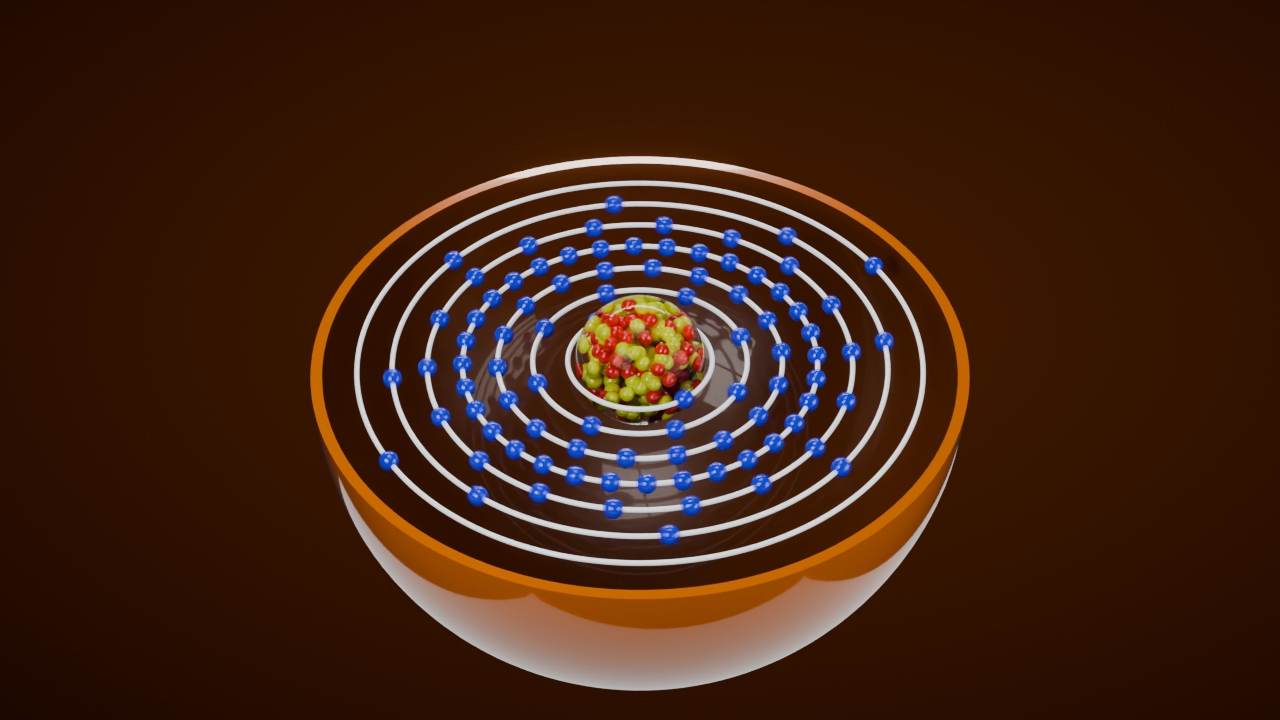
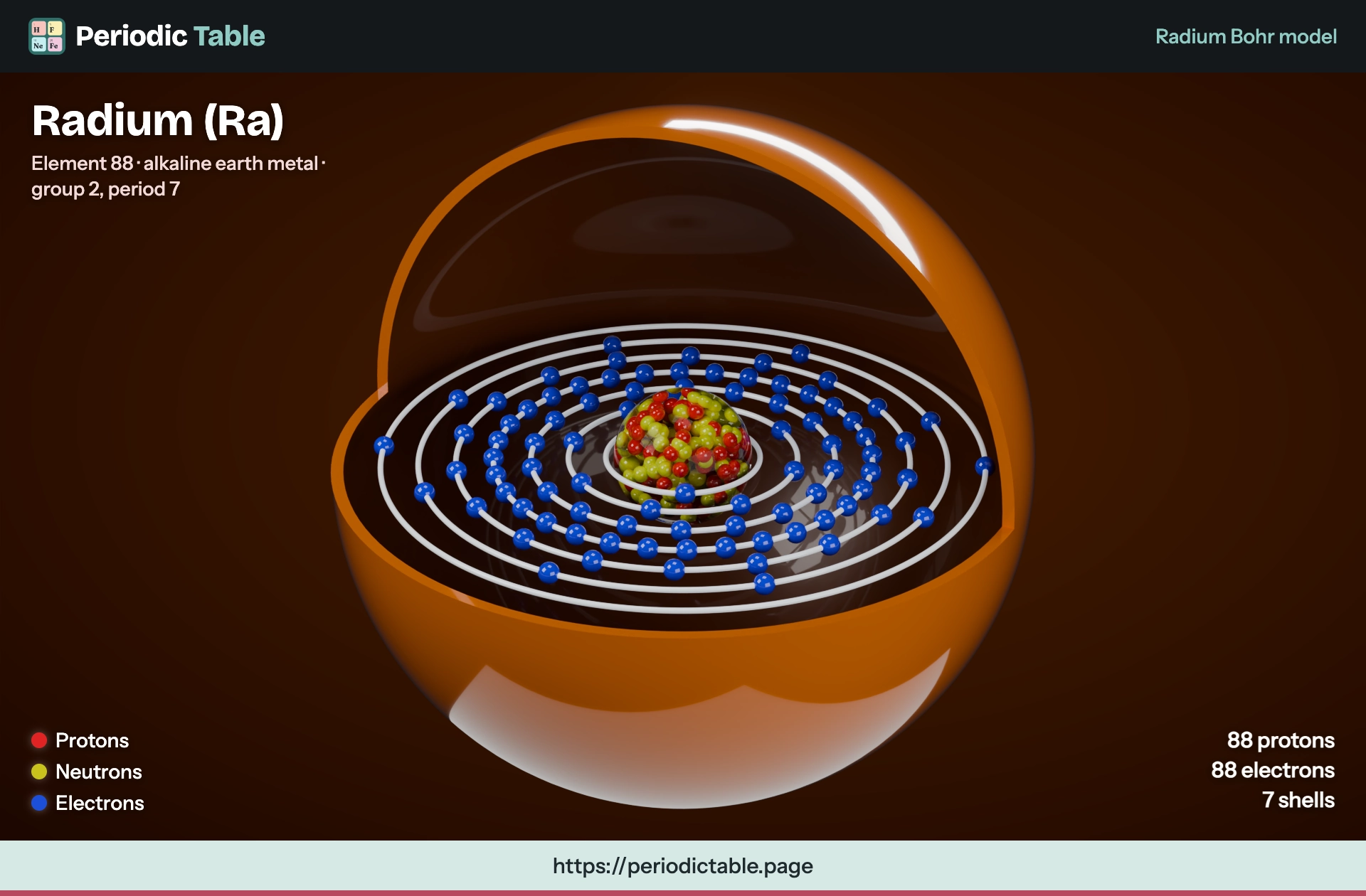
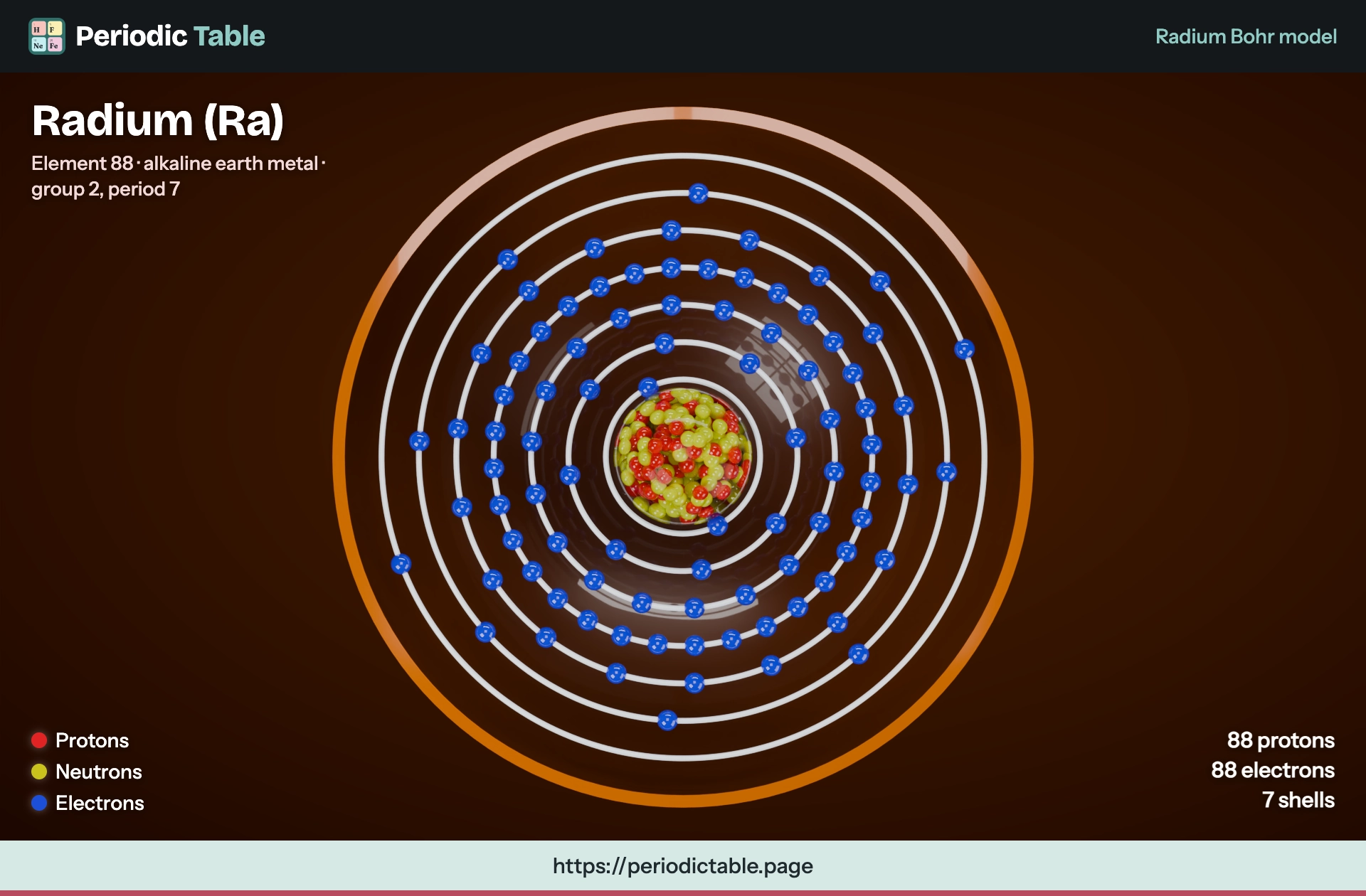
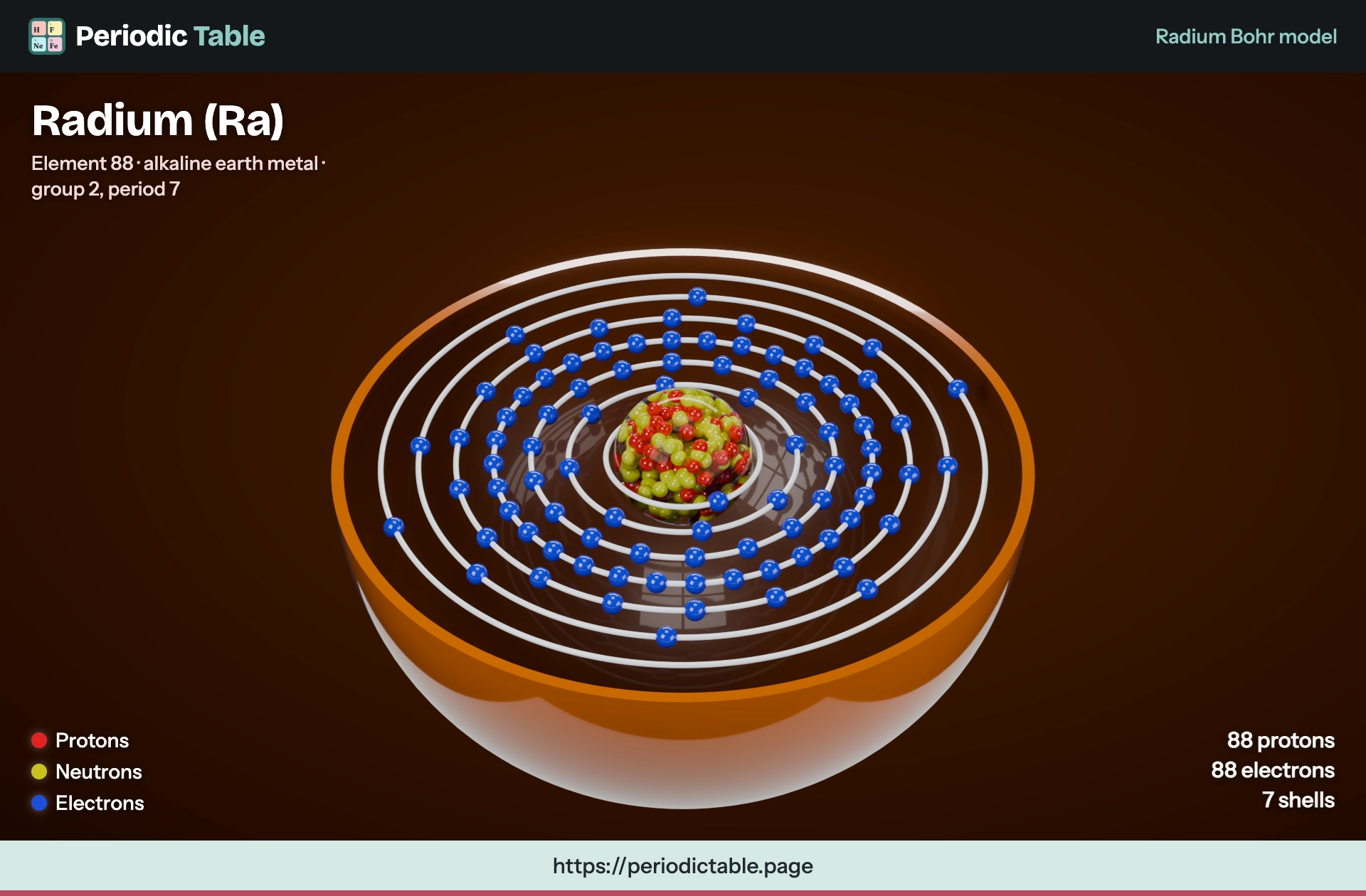
This is a Bohr model of radium (Ra), a simplified picture of a single radium atom. Its nucleus holds 88 protons, and a neutral radium atom has 88 electrons, arranged around it in 7 shells (2 in shell K, 8 in shell L, 18 in shell M, 32 in shell N, 18 in shell O, 8 in shell P and 2 in shell Q).
Radium periodic table electron configuration
- Shorthand
- [Rn] 7s2
- Full
- 1s2 2s2 2p6 3s2 3p6 4s2 3d10 4p6 5s2 4d10 5p6 6s2 4f14 5d10 6p6 7s2
- Electrons per shell
- 2, 8, 18, 32, 18, 8, 2
Radium element properties and atomic data
- Atomic number
- 88
- Atomic mass
- [226] u
- Phase at STP
- Solid
- Melting point
- 959.85°C (1233 K)
- Boiling point
- 1736.85°C (2010 K)
- Density
- 5.5 g/cm³
- Electronegativity (Pauling)
- 0.9
- Period
- 7
- Group
- 2
- Block
- s-block
- Appearance
- Silvery white metallic
- Discovery date
- 1898
- Discovered by
- Pierre Curie
- Named by
- —
Radium (Ra) fact sheet and atomic data
Element 88 sits at the bottom of group 2 on the periodic table, in period 7 of the s-block. Its chemical symbol is Ra, and because every isotope is unstable, the listed atomic weight is the mass of its longest-lived form rather than a natural average. Understanding the boundary with the elements nearest to semimetals becomes clearer after reading about properties of post-transition metals in detail and how the metals compare.
| Property | Value |
|---|---|
| Symbol | Ra |
| Atomic number | 88 |
| Atomic weight | [226] |
| Group / period / block | 2 / 7 / s-block |
| Classification | Alkaline earth metal |
| Electron configuration | [Rn] 7s2 |
| Oxidation state | +2 |
| Electronegativity (Pauling scale) | 0.9 |
| First ionization energy | 509.3 kJ/mol |
| State at room temperature | Solid |
| CAS number | 7440-14-4 |
Atomic number, atomic mass and electron configuration
An atomic number 88 means 88 protons in every nucleus. The atomic mass of the most common isotope is about 226.025 u. Two outer electrons in the 7s orbital explain the steady +2 charge, and with a non-bonded atomic radius near 2.83 Å it is one of the largest atoms in its group, which is why it gives up those electrons so easily.
Melting point, boiling point and density
The melting point is close to 700 °C (about 973 K). Published boiling point figures range from roughly 1,140 °C to 1,500 °C, because so little of the pure metal has ever been measured. Its density is about 5.5 g/cm³, roughly twice that of aluminium.
Discovery of the radioactive element by the curies
The discovery began with a puzzle. The Curies found that pitchblende stayed strongly radioactive after the uranium had been removed, so something else had to be carrying the activity. Flame spectroscopy of the leftover fractions showed deep-red lines that matched no known element, and in 1898 they announced a new radioactive element. Uses and health effects are absent for copernicium isotopes, as nuclear reaction studies involve only a handful of atoms.
They named it from the Latin radius, meaning ray, for the rays it gives off. Early samples were handled as radium bromide and gave off a faint blue glow.
Isolating the pure metal by electrolysis
Making pure radium took another twelve years. In 1910 Marie Curie and Andre Debierne ran an electrolysis of a radium chloride solution with a mercury cathode, then boiled the mercury away to leave the bare metal. The work on this element earned Marie Curie the 1911 Nobel Prize in Chemistry.
Where Ra sits on the periodic table
It is the heaviest member of group 2, below beryllium, magnesium, calcium, strontium and barium. Each step down the group adds an electron shell, so reactivity climbs, and this element is the most reactive of the set.
Chemical properties shared with barium and calcium
Its chemical properties follow barium almost exactly: it forms Ra²⁺ ions, an insoluble sulfate and a soluble chloride. It reacts with water to give radium hydroxide and hydrogen. Because it behaves like calcium in the body, it settles in bone, which matters both for medicine and for its danger.
Properties of the alkaline earth metal in air and water
Freshly cut radium metal is shiny and silvery-white, but it darkens within moments in air. Unlike most metals, the dark film is not mainly oxide: the surface reacts with nitrogen to form a nitride layer. Other key properties of this alkaline earth metal:
- It is soft enough to cut with a blade, much like barium.
- It heats itself, because alpha decay deposits energy in the sample.
- Its compounds glow pale blue as the emitted energy excites the surrounding air.
Radioactivity and decay of the radionuclide
Every form of this radionuclide is unstable, and the metal is highly radioactive: millions of times more active than the same mass of uranium. That level of radioactivity is why a sample stays warm and why decay, not chemistry, decides how it is stored and handled.
Alpha particles, beta particles and gamma rays
Most of its isotopes emit alpha particles, which are helium nuclei that a sheet of paper stops but that do heavy damage inside the body. Some isotopes emit beta particles (fast electrons), and the decay products release gamma rays, the penetrating radiation that makes shielding necessary.
Decay series from uranium to radon gas
Two natural chains produce it. The uranium decay series runs from uranium-238 through radium-226 to radon-222 and ends at stable lead-206.
The thorium decay series supplies radium-228 and radium-224 from thorium-232. In both chains the next step is radon gas, which is why radon follows this metal wherever it is found.
Ra isotopes and their half-life
Around 33 isotopes are known, with mass numbers from 202 to 234, and none is stable. Four occur in nature:
| Isotope | Half-life | Decay mode | Source chain |
|---|---|---|---|
| Ra-223 | 11.43 days | Alpha | Uranium-235 |
| Ra-224 | 3.66 days | Alpha | Thorium-232 |
| Ra-226 | about 1,600 years | Alpha | Uranium-238 |
| Ra-228 | 5.75 years | Beta | Thorium-232 |
Radium-226 is the longest-lived isotope; some sources give its half-life as 1602 years. You can estimate how much of any isotope remains with:
$$N = N_0 \times \left(\frac{1}{2}\right)^{t / t_{1/2}}$$
Take a clock dial painted in 1925. By 2026, after 101 years, \(N/N_0 = 0.5^{101/1600} \approx 0.957\), so about 95.7% of the original Ra-226 is still there. Old luminous items are almost as radioactive as the day they were made.
Radium compounds and salts
Most radium salts are white when fresh and slowly yellow or darken as their own radiation damages the crystal. The main compounds are:
- Chloride (RaCl₂): water-soluble, used to isolate the metal and, as the 223 form, in medicine.
- Bromide (RaBr₂): the form the Curies first concentrated.
- Sulfate (RaSO₄): one of the least soluble sulfates known, which is how it builds up as scale.
Occurrence of Ra in rock, soil and water
Its occurrence is widespread but tiny: trace levels exist in nearly all rock, soil, water, plants and animals, with a crustal abundance near one part per trillion. It is richest where a uranium mineral such as uraninite is present, and groundwater in uranium-bearing rock picks up more of it, so local geology shapes how much reaches the environment.
Higher exposure near mines and oil and gas sites
Human activity can concentrate it. Mill tailings, uranium mining, phosphate mining and oil and gas wells all raise exposure; in oil fields it often collects as pipe scale inside production tubing.
Production: how Ra is extracted from uranium ore
Historically, production started with uranium ore. The ore was crushed and treated with sulfuric acid, which carried the metal down with barium as a mixed sulfate.
That was converted with hydrochloric acid or carbonates into chlorides or bromides, and repeated crystallization slowly separated it from barium. Today the small amounts used are mostly recovered from spent nuclear fuel.
Applications and uses of the radioactive metal
The applications of this radioactive metal peaked in the early twentieth century and have since shrunk to a few medical and research uses.
Luminous paint and the dial painters
Mixed with zinc sulfide, it made luminous paint for watch dials, clocks and aircraft instruments. Factory workers who shaped their brushes with their lips swallowed it, and many developed jaw necrosis, anemia and bone cancer. Their court cases in the 1920s helped create modern worker safety rules.
Medicine and cancer treatment
In medicine, sealed sources were once placed beside tumours, an early form of brachytherapy. Today radium-223 dichloride treats prostate cancer that has spread to bone: it travels there like calcium and its short-range alpha particles hit the tumour while sparing most nearby tissue.
Health risks and radiation protection for Ra
Long-term intake of radioactive radium raises the risk of bone, liver and breast cancer, and its decay product radon is a leading cause of lung cancer. Good health practice is to treat any old glowing dial or quack tonic as a source and contact your state radiation control program.
Drinking water and private wells
In the United States, community water systems must keep combined radium-226 and radium-228 below 5 picocuries per liter. Private wells are not regulated, so if you live on uranium-rich granite or shale, a lab test is the only way to know your level.