Copernicium element (Cn): copernicium periodic table facts
Copernicium periodic table facts: copernicium (Cn) is element 112, a transition metal in group 12, period 7. If you have ever wondered what sits at the very bottom of the zinc column, the answer is copernicium (Cn), a synthetic element with atomic number 112 that no one has ever seen in bulk. For space exploration, NASA probes and electricity from radioisotope generators, the weapons-grade plutonium page offers a summary.
Every known atom of this chemical element was made in a laboratory, one single atom at a time, and each one, being radioactive, vanished within seconds. Here you get the full picture: how copernicium was found, why it carries the name of the astronomer Nicolaus Copernicus, and which of its properties are measured versus only predicted.
Rotate the 3D Bohr model of copernicium
Drag to orbit, scroll to zoom.
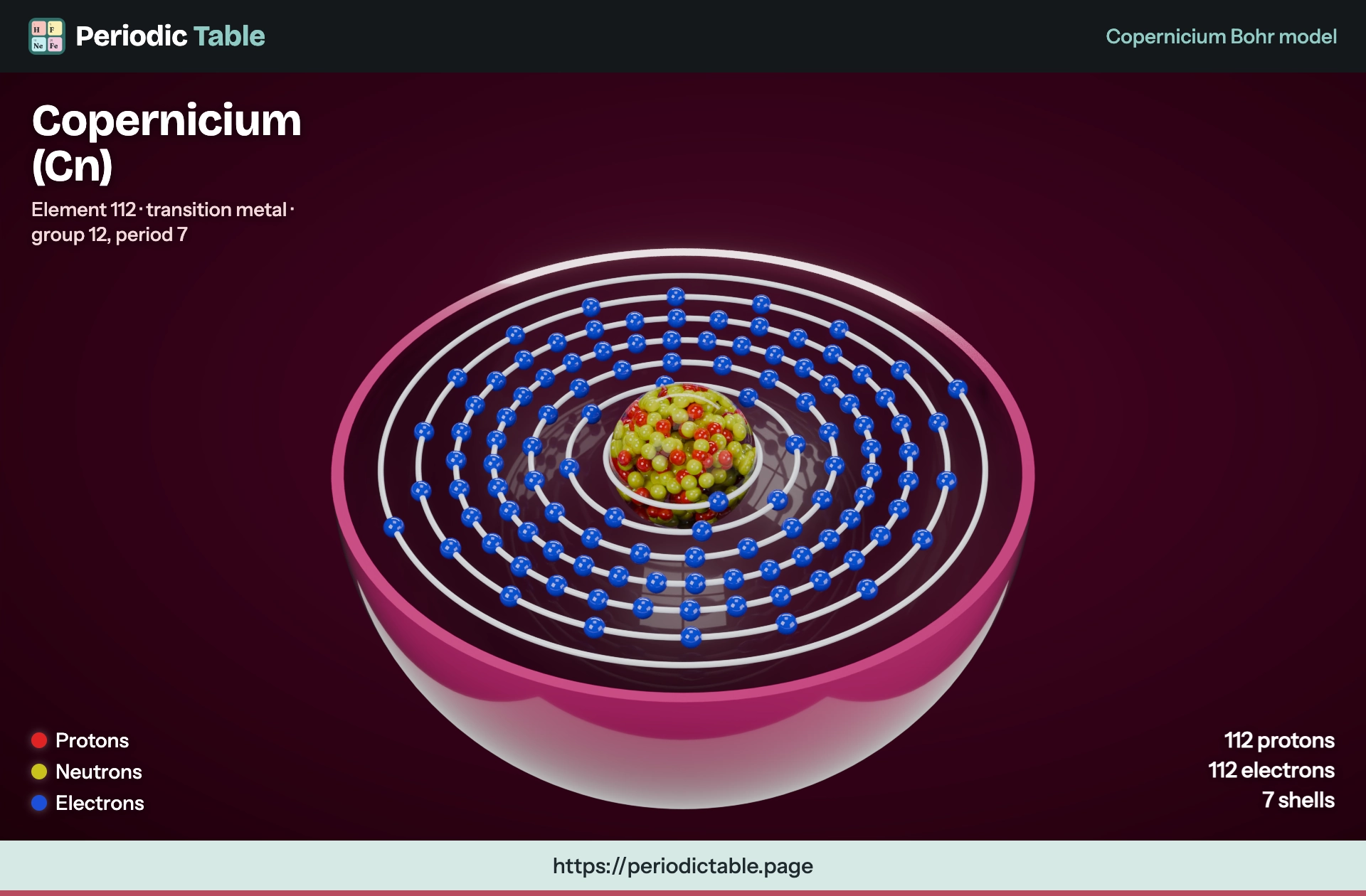
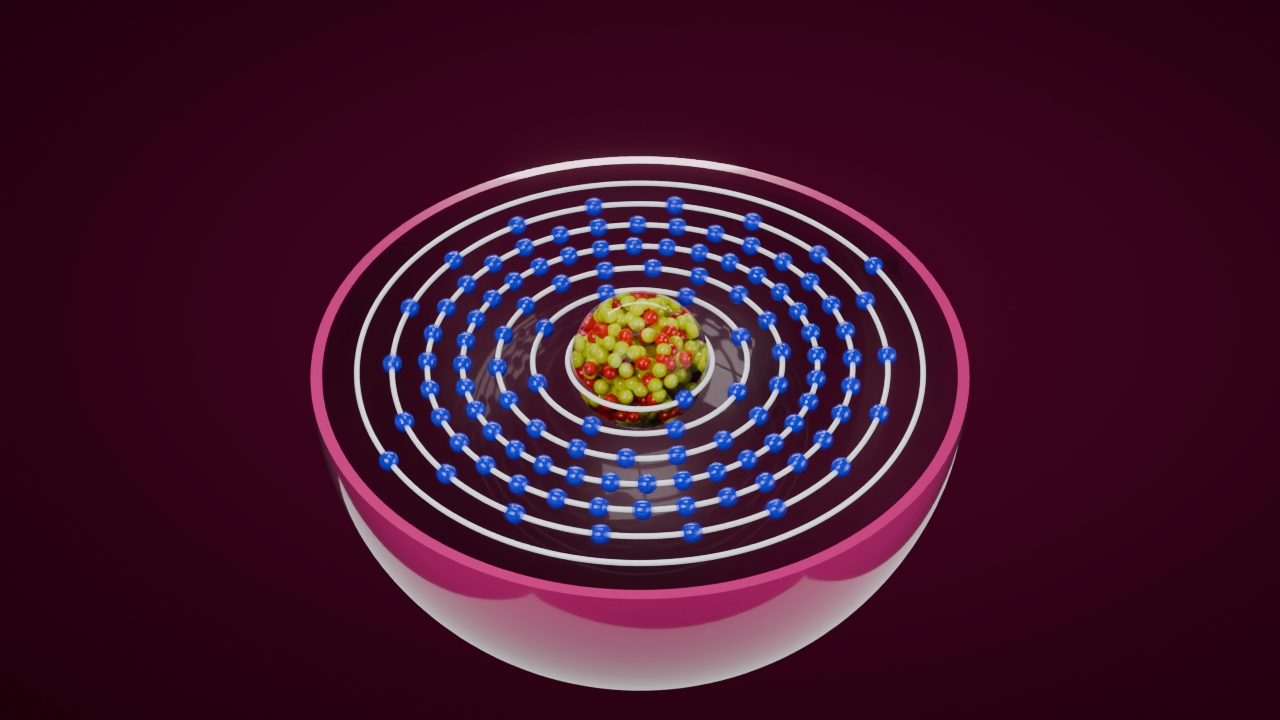
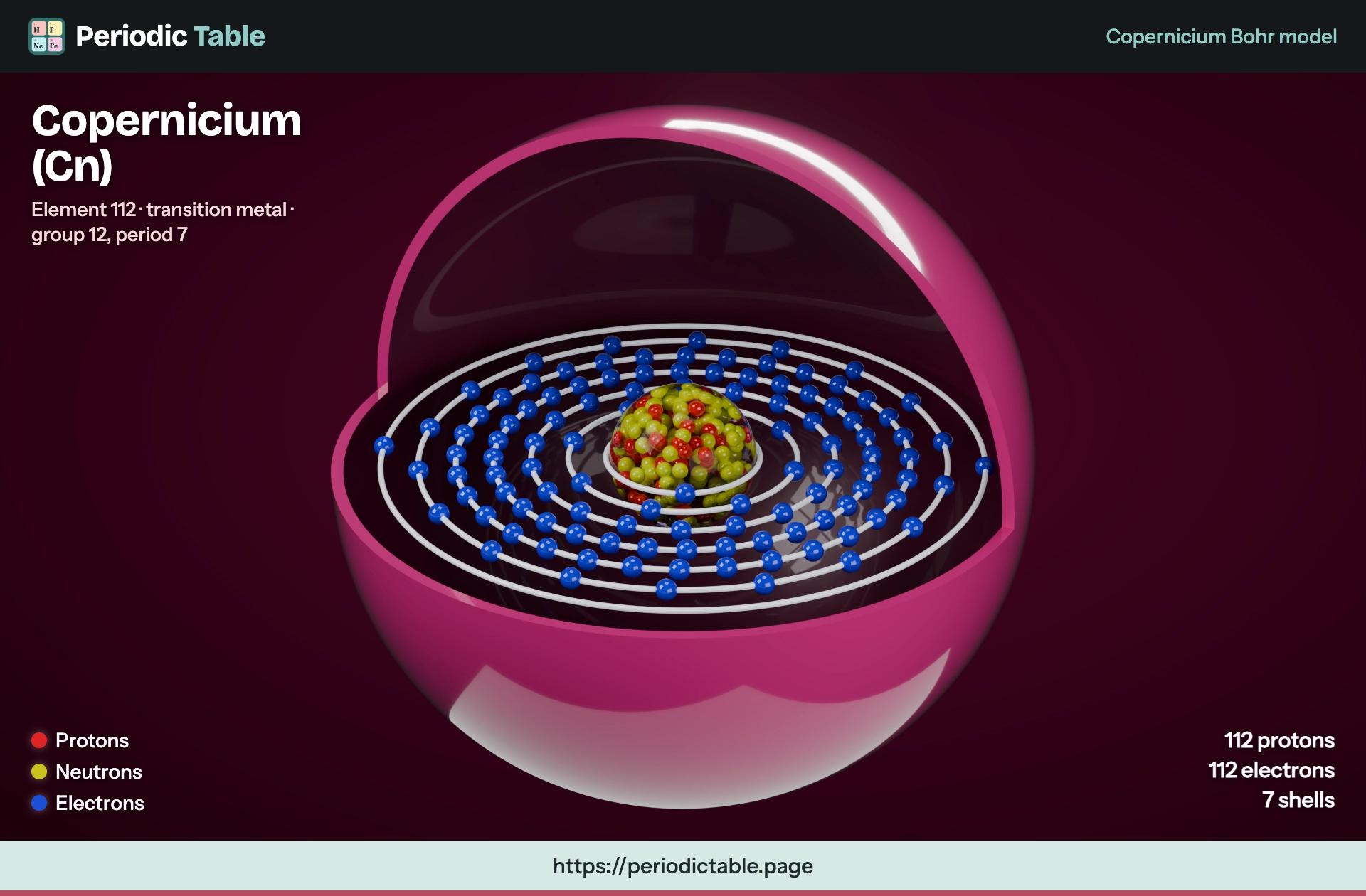
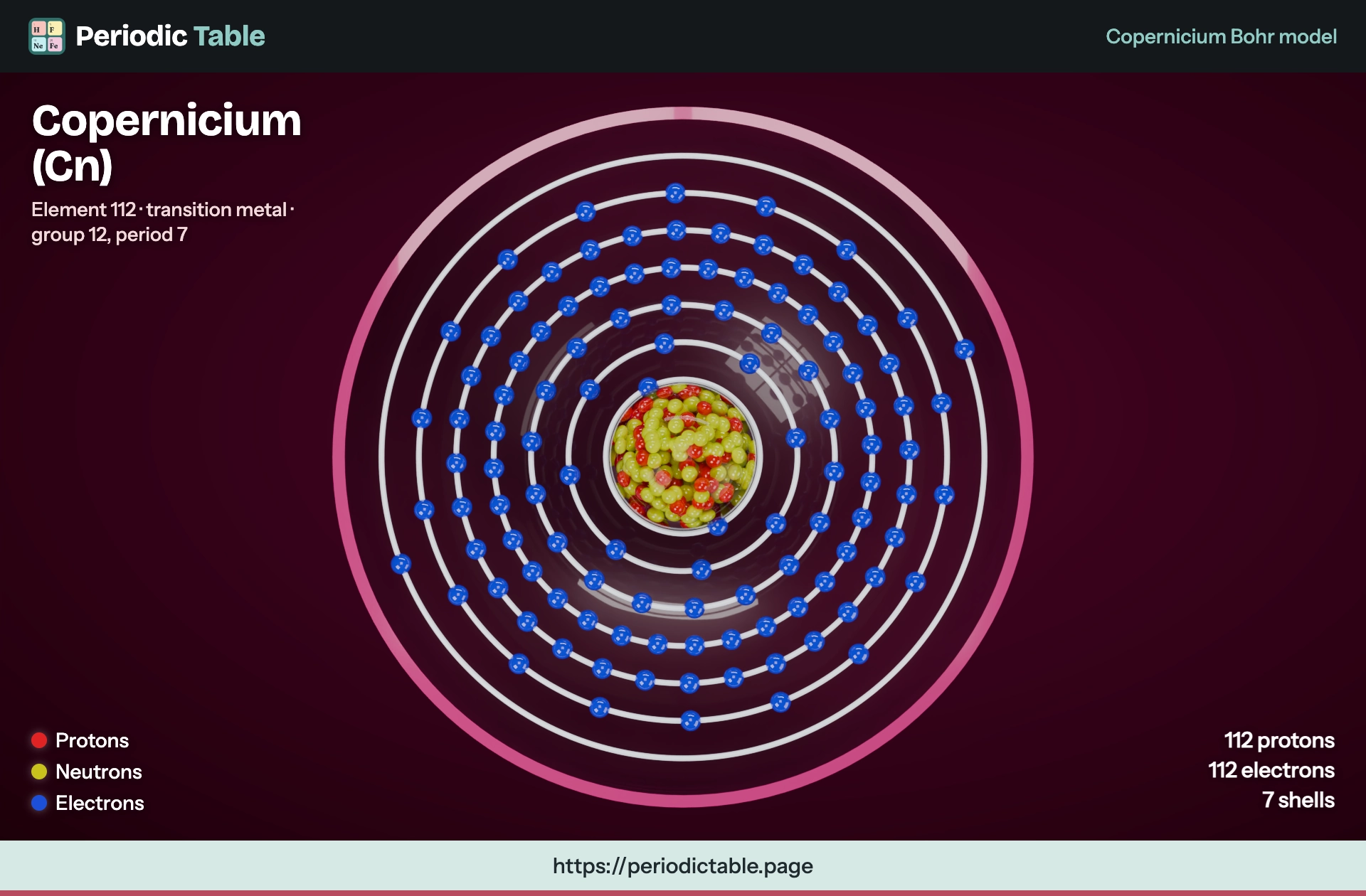
This is a Bohr model of copernicium (Cn), a simplified picture of a single copernicium atom. Its nucleus holds 112 protons, and a neutral copernicium atom has 112 electrons, arranged around it in 7 shells (2 in shell K, 8 in shell L, 18 in shell M, 32 in shell N, 32 in shell O, 18 in shell P and 2 in shell Q).
Copernicium periodic table electron configuration
- Shorthand
- *[Rn] 5f14 6d10 7s2
- Full
- 1s2 2s2 2p6 3s2 3p6 4s2 3d10 4p6 5s2 4d10 5p6 6s2 4f14 5d10 6p6 7s2 5f14 6d10
- Electrons per shell
- 2, 8, 18, 32, 32, 18, 2
Copernicium element properties and atomic data
- Atomic number
- 112
- Atomic mass
- [285] u
- Phase at STP
- Unknown
- Melting point
- 9.85°C (283 K)
- Boiling point
- 66.85°C (340 K)
- Density
- 14 g/cm³
- Electronegativity (Pauling)
- Unknown
- Period
- 7
- Group
- 12
- Block
- d-block
- Appearance
- Unknown
- Discovery date
- 1996
- Discovered by
- Gesellschaft für Schwerionenforschung
- Named by
- —
Copernicium (Cn) at a glance: element 112 key facts
Because only a few atoms have ever existed at once, most entries in a copernicium fact sheet are calculated rather than measured. The table below separates what scientists know for certain about element 112 from the values that come from theory. Treat the "predicted" figures as best estimates: they come from relativistic quantum calculations, and different research groups publish slightly different numbers. If your concern is radiation from decay and its health and environment effects, the radium on the periodic table is the focus.
| Property | Value for copernicium | Status |
|---|---|---|
| Symbol | Cn | Official (IUPAC, 2010) |
| Atomic number | 112 | Defining value |
| Mass number of longest-lived isotope | [285] | Measured |
| Group / period / block | Group 12 / period 7 / d-block | By position |
| Electron configuration | [Rn] 5f14 6d10 7s2 | Predicted |
| Melting point | 283 ± 11 K (about 10 °C) | Predicted |
| Boiling point | 340 ± 10 K (about 67 °C) | Predicted |
| Density | 14.0 g/cm3 | Predicted |
| Covalent radius | 122 pm | Predicted |
| Electronegativity / electron affinity | Unknown | Not measured |
| CAS number | 54084-26-3 | Registry value |
| Discovered | 9 February 1996, by Sigurd Hofmann's team | Confirmed 2009 |
Two numbers are easy to confuse here. The atomic mass shown in brackets, [285], is not an average weight like the one printed for iron or copper: an element with no stable isotopes has no natural mix to average, so the bracket simply reports the mass number of the longest-lived copernicium isotope known so far.
Where copernicium sits on the periodic table
On the periodic table, element 112 lands directly below mercury, which places it in the same column as zinc and cadmium. Some reference works file it with the transition metals; others list it as an uncategorised superheavy, because its real behaviour has not been settled by experiment. Boiling point, absolute zero and superfluidity are explained in the liquid helium, with notes on helium-4 and helium-3.
Group 12 and the transactinide element series
Copernicium is the heaviest known member of group 12 and the last of the 6d series, so it counts as a transactinide element: anything past lawrencium (103). Before it was discovered, chemists used Mendeleev's convention and called the empty slot eka-mercury, meaning "one place below mercury." Its neighbours in period 7 are roentgenium (111) on the left and nihonium (113) on the right, and all three are made only in accelerators.
- Group 12 members: atomic numbers 30, 48, 80 and 112
- Period 7: the row that runs from francium to oganesson, now complete
- Block: the 6d shell fills as you move across toward copernicium
Electron configuration and the d-block
The predicted ground state ends in a full 6d10 subshell and a full 7s2 pair. That closed-shell configuration is the same pattern found one row up, and it is why copernicium was expected to be reluctant to react. The twist, covered in the chemistry section below, is that at 112 protons the inner shells move so fast that the usual order of which electrons leave first can flip.
Discovery of copernicium in Darmstadt
Copernicium came out of a long hunt for new elements at the GSI Helmholtz Centre for Heavy Ion Research in Darmstadt, Germany, the same laboratory that had already produced bohrium, hassium and meitnerium. The scientists there were testing how far the periodic table could be pushed.
The 1996 heavy ion accelerator experiment
On 9 February 1996, a team led by Sigurd Hofmann and including Victor Ninov fired a beam of zinc-70 ions at a target of lead-208 in the GSI heavy ion accelerator. After about two weeks of bombardment, the detectors recorded one atom of copernicium-277. Lead brings 82 protons and zinc brings 30, so the fused nucleus carries 112; one of the neutrons boils off to cool it down:
$$^{208}_{82}\text{Pb} + ^{70}_{30}\text{Zn} \rightarrow ^{278}_{112}\text{Cn}^{*} \rightarrow ^{277}_{112}\text{Cn} + ^{1}_{0}\text{n}$$
A second atom was reported at the time, but it was later withdrawn after an inquiry found that part of the data had been fabricated. The GSI group repeated the run in 2000 and made one more atom of the same isotope.
Confirmation by RIKEN and the joint working party
A discovery claim only stands once outside physicists agree. The IUPAC/IUPAP Joint Working Party reviewed the GSI claim in 2001 and 2003 and found the evidence too thin, largely because of conflicting decay data for an isotope of rutherfordium further down the chain.
Japan's RIKEN laboratory then repeated the same reaction in 2004 and 2013 and matched the GSI decay data. In May 2009 the working party formally credited the GSI team.
How ununbium became copernicium
For years element 112 had only a placeholder. Under IUPAC's 1979 systematic rules it was ununbium (symbol Uub), Latin-Greek shorthand for "one-one-two." In practice, most researchers in the field ignored that name and wrote "element 112," E112, or just "(112)."
Once the discovery was accepted, IUPAC invited the GSI team to propose a permanent name. In July 2009 they suggested copernicium, symbol Cp, to honour Nicolaus Copernicus, whose sun-centred model of the planets changed how people saw the universe. Two objections came up during the six-month comment period:
- Cp had once stood for cassiopeium, an old name for lutetium that IUPAC still allowed until 1949.
- Chemists already use Cp everywhere as shorthand for the cyclopentadienyl ligand, C5H5.
The team switched to Cn, and IUPAC made the name and symbol official on 19 February 2010, the 537th anniversary of the astronomer's birth. Copernicium is one of the few elements named after a scientist whose work had nothing to do with chemistry.
How superheavy copernicium nuclei are made
Making a superheavy element such as copernicium means forcing two smaller nuclei to merge in a nuclear fusion reaction. The heavier nuclei sit in a thin target; a beam of lighter nuclei is accelerated to roughly a tenth of the speed of light and aimed at it. Both nuclei are positively charged, so they repel each other, and only a direct, fast collision gets them close enough for the strong force to take over.
Even then, most encounters fail. Two nuclei that touch usually stick together for about 10-20 seconds and then fly apart.
When they do merge, the result is an excited compound nucleus that must shed energy by ejecting neutrons; if it does not, it splits apart. The chance of success for a given pair is called its cross section, and for element 112 it is tiny, which is why each run of this nuclear reaction yields atoms by the handful, not by the gram.
Cold fusion and hot fusion routes
Researchers use two strategies. Cold fusion joins a medium-heavy beam with a lead or bismuth target, so the compound nucleus is only lightly excited and loses just one neutron; that is how GSI made copernicium-277.
Hot fusion fires calcium-48 at an actinide target such as uranium-238, producing a hotter nucleus that drops three or four neutrons but lands on heavier, longer-lived isotopes. Heavier copernicium isotopes have also turned up only as decay products of flerovium (114) and livermorium (116).
Decay and detection of Cn atoms
After the target, the reaction products, including any new nuclei, travel into a separator that uses magnetic and electric fields to strip away the leftover beam. The rare new nucleus continues to a silicon detector, which logs where it landed, its energy and its arrival time.
The trip takes about a microsecond, so any atom that decays faster than that is never seen. Copernicium-277 survives for under a millisecond on average, which is a thousand times longer than the flight, so it arrives intact.
Researchers identify the new nucleus by what happens next. Each decay is logged at the same spot on the detector, and that decay chain eventually reaches a daughter nucleus whose decay signature is already known.
For the first copernicium atom, the chain stepped down through element 110, then hassium and seaborgium, before reaching a rutherfordium nucleus whose decay was already catalogued. Working backwards from those known daughters is what proved the original was copernicium.
Alpha decay and spontaneous fission
Copernicium nuclei break down in two main ways. In alpha decay, the nucleus throws out an alpha particle (two protons and two neutrons) and becomes darmstadtium, element 110. In spontaneous fission, it splits into two medium-sized fragments, which erases the trail because the fragments vary from atom to atom.
A minor branch of electron capture may also exist for one isotope. Chains that end in a string of alpha particles are the easiest to trace, which is why alpha emitters dominate the discovery record.
Copernicium isotopes and half-lives
All copernicium isotopes are highly radioactive; none is stable and none occurs in nature. Eight have been reported, with mass numbers 277 and 280 to 286, plus one unconfirmed excited state of copernicium-285. Their half-lives range from under a millisecond to about half a minute.
| Isotope | Half-life | Decay mode | First reported |
|---|---|---|---|
| Cn-277 | 0.79 ms | Alpha | 1996 |
| Cn-281 | 0.18 s | Alpha | 2010 |
| Cn-282 | 0.83 ms | Fission | 2004 |
| Cn-283 | 3.81 s | Alpha, fission | 2004 |
| Cn-284 | 121 ms | Alpha, fission | 2004 |
| Cn-285 | 30 s | Alpha | 2004 |
| Cn-286 | 8.45 s | Fission | 2016 |
The pattern is that heavier isotopes live longer, and isotopes with an odd neutron count outlast their even neighbours because fission is harder for them. A half-life of 30 seconds sounds short, but it is long enough for a fast chemistry experiment. You can see how quickly a sample disappears with the standard decay law:
$$N(t) = N_0 \times \left(\frac{1}{2}\right)^{t / t_{1/2}}$$
Suppose a run captures 40 atoms of the 30-second isotope. After 75 seconds, \(40 \times (1/2)^{2.5} \approx 7.1\) atoms are expected to remain, and after 3 minutes the expected count falls to \(40 \times (1/2)^{6} = 0.625\), meaning the sample is very likely gone.
The most stable isotope: copernicium-285
Copernicium-285 is the most stable isotope confirmed so far, with a half-life of about 30 seconds. It decays by alpha emission to darmstadtium-281.
It was never made directly; it appears when flerovium-289 sheds an alpha particle. Cn-283, with a half-life near 4 seconds, matters for a different reason: it was the isotope that helped confirm the discoveries of flerovium and livermorium.
Island of stability and heavier isotopes of copernicium
Nuclear theory predicts an island of stability around 114 to 126 protons and about 184 neutrons, where closed nuclear shells resist fission. The heavier isotopes Cn-291 and Cn-293 sit close to that region and are predicted to last decades or longer.
If so, they may have formed in the stellar r-process and could, in principle, show up in cosmic rays, though at abundances around a trillionth that of lead. Neither has been made, because no current beam and target pair can add that many neutrons.
Predicted properties of copernicium
Almost everything about bulk copernicium comes from computer models, because no visible amount has ever existed. The values below are the current consensus estimates, and some of them have changed noticeably as the calculations improved.
Physical properties: liquid, solid or gas?
The most recent calculations place the melting point near 283 K and the boiling point near 340 K, so copernicium is expected to be a liquid at room temperature, much like mercury. Older sources describe it as a solid at 20 °C or even as a gas at standard temperature and pressure; those figures came from earlier models and from the observation that single atoms are very volatile. Its predicted density of about 14.0 g/cm3 is close to mercury's 13.5, and the predicted crystal structure for any solid form is hexagonal close-packed.
Atomic data: ionization energies and atomic radius
The predicted first ionization energy of copernicium is 1155 kJ/mol, almost the same as the noble gas xenon at 1170.4 kJ/mol, which tells you how tightly it holds its outer electrons. The second and third estimated ionization energies are 2170 and 3160 kJ/mol. Its calculated atomic radius is about 147 pm, smaller than you might expect for so heavy an atom, because relativity pulls the 7s shell inward.
Semiconductor, metal or insulator?
Predictions still disagree on what solid copernicium would conduct like. Some models give a weakly bound metal, others a semiconductor with a small band gap, and a few an insulator whose atoms barely interact, closer to a frozen noble gas. Until enough atoms exist for a bulk measurement, the honest answer is that it is unknown.
Copernicium chemistry and oxidation states
For a superheavy, copernicium has a surprisingly rich record of experimental chemistry, since its relatively long-lived isotopes give chemists a few seconds to work with. Theory predicts oxidation states of 0, +2 and possibly +4.
That last value would set it apart from its lighter group-mates: zinc and cadmium never reach a +4 oxidation state, and mercury shows it in only one disputed compound. A reduction potential of about +2.1 V is predicted for the Cn2+/Cn couple, which marks it as very hard to oxidise.
Relativistic effects on the 6d and 7s electrons
At 112 protons, the inner electrons move at a large fraction of light speed, and these relativistic effects pull the 7s orbital in and push the 6d orbitals out. The upshot is that copernicium may give up its 6d electrons before its 7s electrons, the reverse of its lighter group-mates. The Cn2+ ion is therefore expected to have the configuration [Rn]5f146d87s2, and those exposed 6d orbitals are what could allow the +4 state.
Is copernicium a noble metal?
The tightly held 7s pair makes copernicium a very noble metal, and its metallic bonds are expected to be weak. Some early studies went further and suggested it might behave like one of the noble gases, sitting closer to radon than to mercury.
Later high-accuracy calculations pulled back from that, finding that its single-bond chemistry still looks mercury-like. It is still expected to form metal-metal bonds with copper, palladium, platinum, silver and gold, only about 15 to 20 kJ/mol weaker than mercury's.
Gas phase chemistry experiments with Cn
Because copernicium is so volatile, the only practical way to study it is one atom at a time as it travels through a stream of carrier helium and argon. In 2006 and 2007, a team working at Dubna with Swiss and German groups produced Cn-283 by hot fusion and swept the atoms through a long channel lined with detectors. One side of the channel was coated with gold and the channel was cooled from room temperature down to about -180 °C along its length.
Each atom stuck to the coating at a particular temperature, and where it stopped reveals how strongly it binds:
- Copernicium adsorbed on gold at much lower temperatures than mercury does, so that bond is weaker.
- It still stuck to the surface rather than passing straight through, as radon would.
- Its measured adsorption enthalpy fits a volatile metal that keeps the group 12 pattern, not an inert gas.
Later experiments estimated a boiling point and confirmed the trend, making copernicium the first superheavy whose group placement was checked by chemistry, not just by its spot in the periodic table.
Copernicium uses, applications and health effects
Copernicium has no practical applications outside science. Only around 75 atoms have been made by all the world's accelerators combined, and each one lasts seconds, so there is nothing to use. Its real value is for research purposes:
- Testing how relativity reshapes chemistry at the bottom of the periodic table
- Checking nuclear shell models and the path toward the island of stability
- Serving as a known link in the decay chains used to confirm new elements
As for health effects, copernicium would be dangerous in principle because of its radioactivity, but its short life and tiny output mean no one has ever been exposed to a measurable amount. There are no specific toxicology studies, and there are unlikely to be any while its uses remain limited to nuclear physics and basic chemistry research.