


Helium element (He): helium periodic table facts
Helium periodic table facts: helium (He) is element 2, a noble gas in group 18, period 1. Look up at a drifting party balloon and you are looking at helium, the element helium that is a colorless, odorless, non-toxic and almost perfectly inert noble gas. Named after Helios, the Greek god of the sun, this lighter-than-air gas sits at the crossroads of chemistry and physics: it has the lowest boiling point of any element, it refuses to freeze without extra pressure, and the world quietly depends on it to cool hospital scanners and protect welds. To learn how Seaborg, McMillan, Kennedy and Wahl made the first sample at Berkeley in 1940, see element 94, plutonium for the full history of its discovery.
Rotate the 3D Bohr model of helium
Drag to orbit, scroll to zoom.
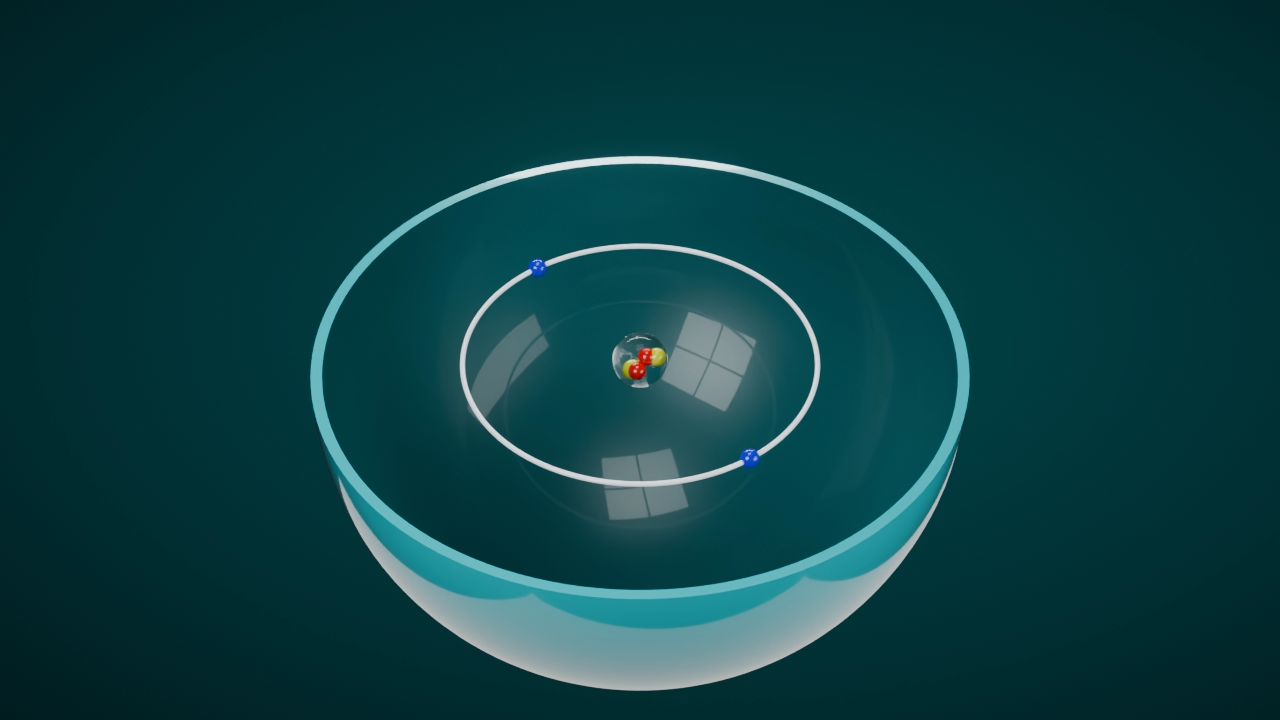
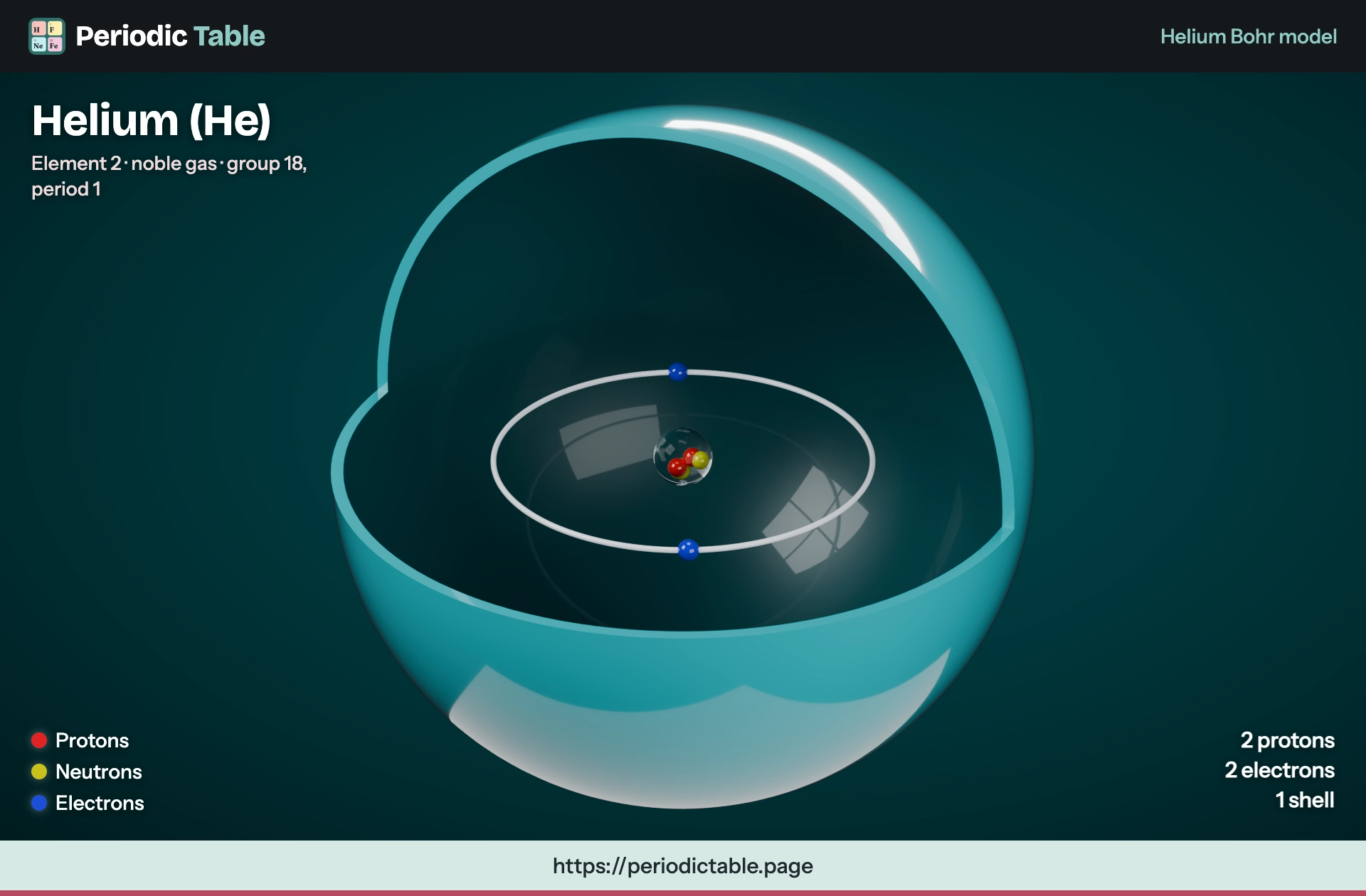
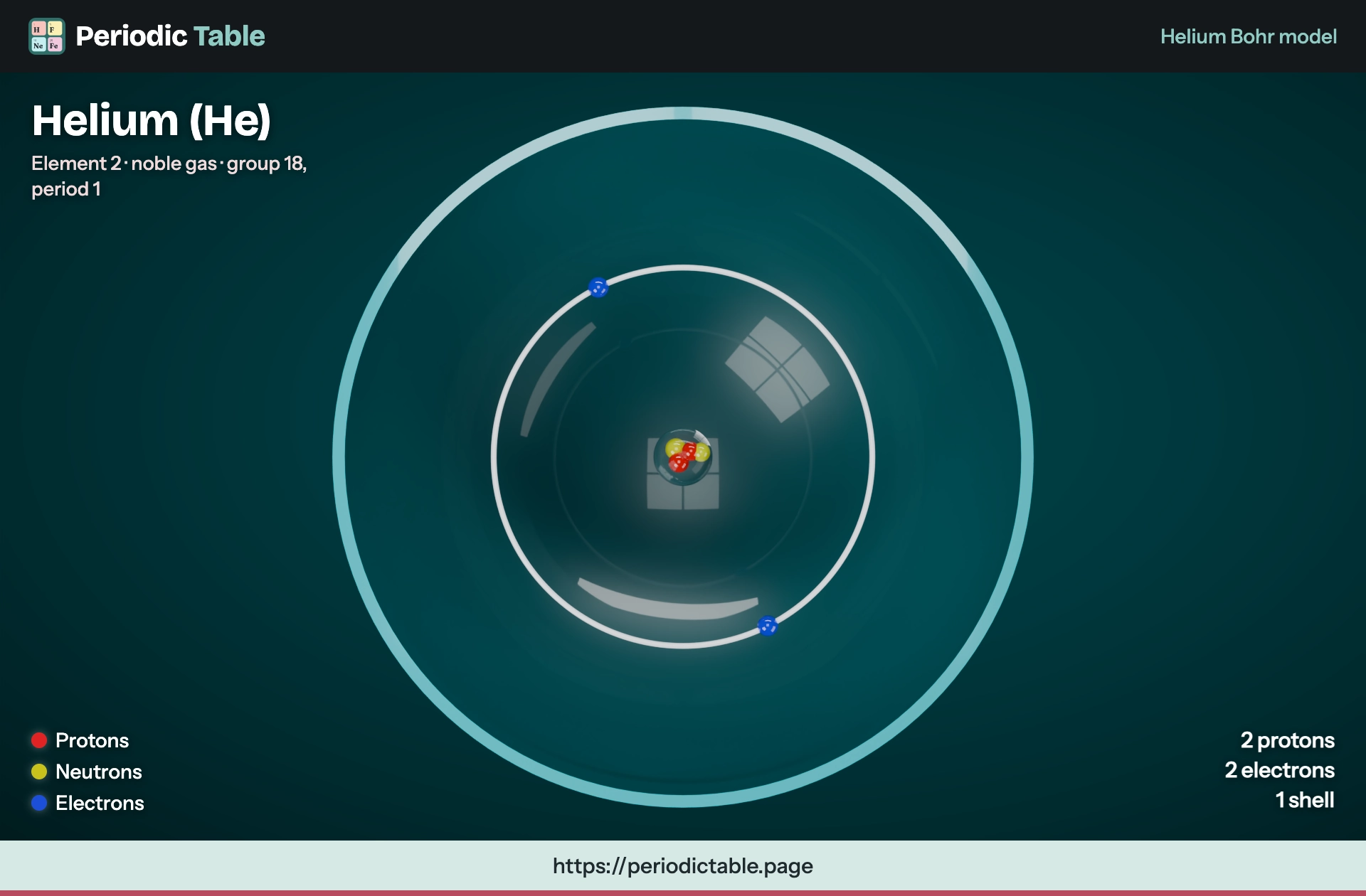
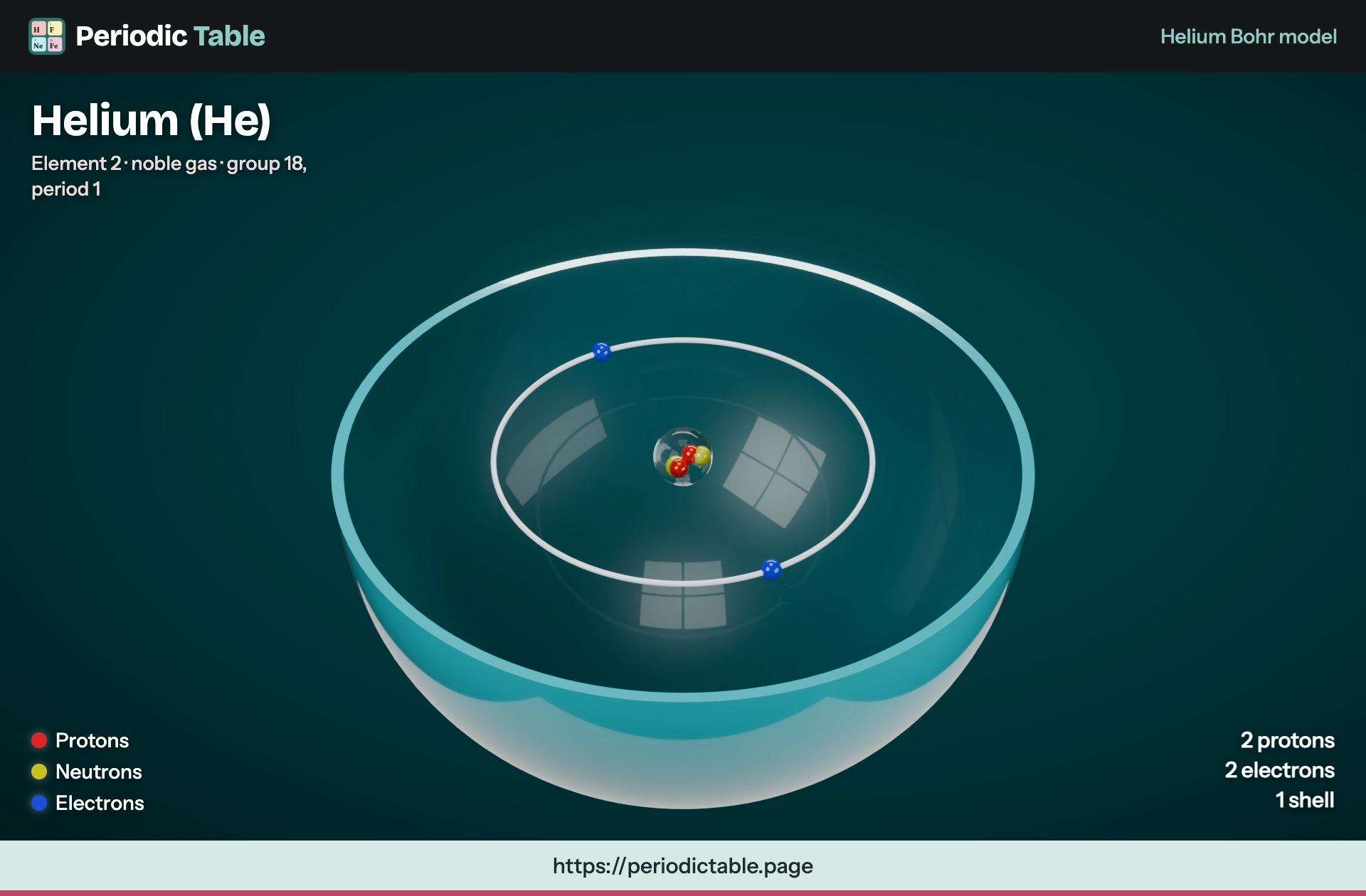
This is a Bohr model of helium (He), a simplified picture of a single helium atom. Its nucleus holds 2 protons, and a neutral helium atom has 2 electrons, arranged around it in 1 shell (2 in shell K).
Helium periodic table electron configuration
- Shorthand
- 1s2
- Full
- 1s2
- Electrons per shell
- 2
Helium element properties and atomic data
- Atomic number
- 2
- Atomic mass
- 4.0026 u
- Phase at STP
- Gas
- Melting point
- -272.2°C (0.95 K)
- Boiling point
- -268.93°C (4.222 K)
- Density
- 0.0001786 g/cm³
- Electronegativity (Pauling)
- Unknown
- Period
- 1
- Group
- 18
- Block
- s-block
- Appearance
- Colorless gas, exhibiting a red-orange glow when placed in a high-voltage electric field
- Discovery date
- 1868
- Discovered by
- Pierre Janssen
- Named by
- —
Helium element facts at a glance
The helium element carries the symbol He and is element 2, which makes it the second-lightest chemical element after hydrogen. Each atom is monatomic (helium atoms travel alone rather than pairing into molecules), and the gas is colorless, odorless and tasteless. Here are the reference values you will reach for most often. For synthesis details, the copernicium atom page includes its zinc-70 and lead-208 route and its relativistic, almost gas-like behaviour.
| Property | Value for helium (He) |
|---|---|
| Atomic number | 2 (atomic number 2, group 18, period 1, s-block) |
| Relative atomic mass | 4.0026 |
| Electron configuration | 1s2 |
| State at 20 °C | Gas |
| Boiling point | 4.22 K (−268.93 °C, −452.07 °F) |
| Melting point | None at 1 atm; freezes only above about 25 atm |
| Density at 0 °C, 1 atm | 0.1786 g/L (air is about 1.29 g/L) |
| First ionisation energy | 2372.3 kJ/mol, the highest of any element |
| Electronegativity (Pauling scale) | Not defined |
| Atomic radius (van der Waals) | 140 pm |
| Covalent radius | About 28 pm |
| Crystal structure (solid) | Hexagonal close-packed |
| Stable isotopes | Helium-4 (about 99.9999%) and helium-3 |
| CAS number | 7440-59-7 |
Two numbers on that list are worth remembering. The 4.22 kelvin figure is only a few degrees above the coldest possible temperature, and the undefined electronegativity tells you helium has no measurable pull on other atoms' electrons because it never shares any.
Atomic number, atomic mass and electron configuration
The atomic number of 2 means every helium nucleus holds two protons. The common form adds two neutrons, giving an atomic mass close to 4, which is why the relative atomic mass is listed as 4.0026 rather than a round 4 (the binding energy holding the nucleus together carries away a little mass).
Two electrons circle that nucleus, and the electron configuration 1s2 fills the first shell completely. A full first shell with nothing left to give or receive is the root of almost every property in this article.
Where he sits in the periodic table: group 18 and the noble gases
On the periodic table, He occupies the top-right corner, heading group 18, the column of the noble gases. Its neighbours down the column are: Students comparing density, boiling point and crystal structure can turn to element 81, thallium for the numbers.
- Neon (Ne) – the next noble gas, famous for red signs
- Argon (Ar) – the most plentiful noble gas in air
- Krypton (Kr) and xenon (Xe) – heavier, rarer and slightly more willing to react
- Radon (Rn) – the radioactive member at the bottom
Strictly, helium belongs to the s-block because its two electrons sit in an s orbital, just like the alkaline earth metals. It is placed with the noble gases anyway because its chemistry matches theirs, not beryllium's.
That column did not exist when Mendeleev first published his table; once helium and argon had been found in the 1890s, an extra group had to be added to hold them. Helium is also one of only two elements, along with hydrogen, in the first row of the periodic table.
Why the helium atom is so stable
Through the lens of quantum mechanics, the helium atom is the simplest atom after hydrogen, yet it already cannot be solved exactly, because three bodies (a nucleus and two electrons) pull on one another at once. Numerical methods show each electron partly shields the nucleus from the other, so each one feels an effective charge of about 1.69 rather than the full 2.
The nucleus has its own version of the same neatness. Its two protons and two neutrons are fermions that pair up with opposite spins, filling the lowest nuclear shell in the same way the two electrons fill the lowest electron shell. The result is a binding energy per particle far higher than any nearby nucleus has.
Adding one more proton or neutron costs energy rather than releasing it, which is why no stable atoms with mass number 5 exist. Paired helium-4 atoms behave as bosons overall, and the atom rests in its ground state unless a large jolt of energy lifts an electron into an excited state.
Chemically inert, with a few strange compounds
Because nothing can be gained by sharing or swapping electrons, helium is chemically inert: it is the second least reactive element after neon and is treated as an inert gas in every ordinary setting. Unreactive does not mean impossible, though. Chemists have coaxed it into a handful of unusual compounds:
- Helium hydride ion (HeH+), the first molecular bond formed in the young universe and the strongest known acid
- Excimers, short-lived excited molecules made in electrical discharges
- Helium trapped inside carbon cages called fullerenes, held in place without bonds
- Na2He, a compound of sodium and helium that is stable only above about 113 GPa of pressure
None of these exist in nature on Earth, so for practical purposes you can treat helium as a gas that will never burn, corrode or poison anything it touches.
Physical properties of helium gas
Helium gas has the highest thermal conductivity, specific heat and speed of sound of any gas except hydrogen. Sound moves through it at about 972 m/s, roughly 2.8 times faster than through room-temperature air.
Its tiny atoms slip through solids about three times faster than air does, which is exactly why it works as a leak tracer. It also has a refractive index closer to 1 than any other gas, so it bends light less than anything else you could put in a container.
Heat it enough and helium becomes plasma, the state it takes inside stars, where its electrons are stripped away and the gas conducts electricity well. Helium plasma streaming from the sun in the solar wind interacts with Earth's magnetic field and helps light up the aurora. In a discharge tube, glowing helium gives off a spectrum of sharp coloured lines, the same fingerprint astronomers first saw in sunlight.
Boiling point, melting point and density
The boiling point of helium-4 is 4.22 K (−268.93 °C), the lowest of any substance. Helium has no ordinary melting point at all, because at 1 atmosphere it stays liquid all the way down. Its density at 0 °C and 1 atm is 0.1786 g/L, about one-seventh of air's 1.29 g/L, which is what makes it lighter than air.
You can turn that gap into real lift. The lifting force of any gas is its volume times the difference between the mass of a cubic metre of air and a cubic metre of the gas:
$$L = V \times (\rho_{air} - \rho_{He})$$
Take a round party balloon 28 cm across. Its radius is 0.14 m, so its volume is \(\frac{4}{3}\pi(0.14)^3 \approx 0.0115\) m3, or about 11.5 L. At 20 °C, air weighs 1.204 kg/m3 and helium 0.166 kg/m3, so each cubic metre of helium lifts about 1.04 kg.
Multiply that by 0.0115 m3 and the balloon gets about 11.9 g of gross lift, before you subtract the latex and ribbon. That is why a bunch of more than 200 of these balloons would be needed to raise a 2.5 kg object. Compared with oxygen and nitrogen, the two gases that make up most of the air, helium is 8 and 7 times lighter respectively.
Liquid helium, superfluidity and absolute zero
Liquid helium forms when you cool the gas below 4.22 K at normal pressure. Unlike every other liquid, it then stays liquid all the way to absolute zero.
The reason is zero point energy: quantum mechanics says even the coldest helium atoms keep a minimum jiggle, and for such light, weakly attracted atoms that motion is enough to stop them locking into a solid. This is also where superfluidity, one of the strangest behaviours in physics, shows up.
The two liquid phases
Liquid helium-4 has two distinct phases separated by the lambda point at 2.17 K. Above it you have an ordinary liquid; below it, a superfluid.
Helium I: an ordinary cryogenic liquid
Helium I exists between 4.22 K and 2.17 K. It boils like other cryogenic liquids, but it is so thin and so close to the refractive index of its vapour that the surface is hard to see. Its viscosity is very low, and its density of roughly 0.125 g/mL is only about a quarter of what classical physics predicts, a sign that quantum effects already matter at this temperature.
Helium II: a quantum superfluid
Below the lambda point, helium II becomes a superfluid. Pyotr Kapitsa reported in 1938 that it flows through narrow channels with almost no viscosity, behaviour now linked to Bose–Einstein condensation. Helium II does several things no ordinary liquid can:
- It climbs the walls of its container as a thin Rollin film about 30 nm thick and escapes over the rim.
- It shoots upward in the fountain effect when one side of a porous plug is gently heated.
- It carries heat as a wave called second sound, moving at about 20 m/s, instead of by slow diffusion.
- It stops bubbling as it evaporates, because it conducts heat hundreds of times better than copper.
A practical way to picture it: helium II is part ordinary fluid and part superfluid, and the superfluid share grows as the temperature falls.
Solid helium needs pressure
Solid helium exists only when you add pressure. Near 1 K it takes about 25 atm to freeze the liquid, and at room temperature it would take over 100,000 atm.
The solid is so compressible that squeezing it can cut its volume by more than 30%, and its refractive index is so close to the liquid's that it is hard to tell where one ends and the other begins. Solid helium-4 usually forms a hexagonal close-packed crystal.
Helium isotopes: helium-4, helium-3 and short-lived forms
All helium isotopes have two protons; they differ in neutron count. Only two of the eight known isotopes are stable.
| Isotope | Neutrons | Natural share on Earth | Half-life | Where it comes from |
|---|---|---|---|---|
| Helium-3 | 1 | About 0.0001% | Stable | Left over from Earth's formation, beta decay of tritium, solar wind |
| Helium-4 | 2 | About 99.9999% | Stable | Big Bang, stars, alpha decay of uranium and thorium |
| Helium-6 | 4 | None | About 0.8 s | Made in nuclear reactions, decays by beta decay |
| Helium-8 | 6 | None | About 0.12 s | Made in nuclear reactions |
Helium-4 dominates because its nucleus is the same tightly bound unit as an alpha particle. Helium-3 is rare on Earth, about one atom per million helium-4 atoms in air, but the moon's surface holds more of it because lunar regolith has soaked up the solar wind for billions of years, which is why it is sometimes floated as a future fusion fuel.
Because helium-3 atoms are fermions and helium-4 atoms are bosons, cold mixtures of the two separate like oil and water. Dilution refrigerators exploit that split to reach a few thousandths of a kelvin, and a helium-3 refrigerator alone can reach about 0.3 K.
How the element helium was discovered
Helium is the only element found in space before anyone found it on Earth, and two astronomers, Jules Janssen and Norman Lockyer, share the credit for spotting it.
A yellow spectral line during the 1868 solar eclipse
During the solar eclipse of 18 August 1868, Janssen pointed a spectroscope at the sun's chromosphere, the glowing layer just above its surface, and recorded a bright spectral line at 587.49 nm. Every element splits light into its own pattern of lines, so a line that matched nothing known in the spectrum pointed to something new. Two months later Lockyer saw the same yellow line in the solar spectrum from England.
It sat close to sodium's famous pair of lines but did not match them, so Lockyer proposed a new element and named it after Helios. Astronomy had found an element that chemistry could not yet hold in a jar. The same light was later picked out in the sun's corona, and in 1881 Luigi Palmieri spotted the line in volcanic material from Mount Vesuvius.
William Ramsay finds helium on Earth
In March 1895 the Scottish chemist William Ramsay treated cleveite, a uranium-bearing variety of the mineral uraninite, with acid while hunting for argon. The gas that came off showed Lockyer's yellow line.
In the same year Per Teodor Cleve and Abraham Langlet in Sweden isolated enough from cleveite to measure its atomic weight. The milestones that followed came fast:
- 1907 – Ernest Rutherford and Thomas Royds show that alpha particles are helium nuclei.
- 1908 – Heike Kamerlingh Onnes liquefies helium for the first time, below 5 K.
- 1926 – Willem Keesom freezes it, but only by adding pressure.
- 1938 – Superfluidity is discovered in liquid helium-4.
Where helium comes from: big bang, stars and radioactive decay
Helium is the second most abundant element in the universe, making up about 24% of ordinary matter by mass; only hydrogen is more common. Almost all of it was made in the first few minutes after the Big Bang, in a process called Big Bang nucleosynthesis, when free protons and neutrons combined.
The extreme stability of helium-4 swallowed almost every free neutron, which is why the cosmic mix today is still roughly three parts hydrogen to one part helium. Jupiter and the sun carry a similar ratio.
Stars keep adding more. In the cores of stars, nuclear fusion turns hydrogen into helium, and in older, hotter stars helium itself fuses into carbon through the triple-alpha process:
$$3\,{}^{4}_{2}\text{He} \longrightarrow {}^{12}_{6}\text{C} + \text{energy}$$
Alpha decay inside Earth's crust
Earth's helium has a completely different origin. Almost every helium atom you can buy was born underground by alpha decay, a type of radioactive decay in which uranium or thorium spits out an alpha particle. That particle is a bare helium nucleus; once it grabs two electrons, it is a helium atom:
$$ {}^{238}_{92}\text{U} \longrightarrow {}^{234}_{90}\text{Th} + {}^{4}_{2}\text{He}$$
Uranium decays so slowly that this production is tiny compared with what industry uses. In geology terms, Earth's crust holds only trace amounts of helium, measured in parts per million, and most of it leaks away; it only becomes worth extracting where impermeable rock caps a gas field and traps it for millions of years. In the air you breathe, helium sits at about 5.2 ppm.
Helium production from natural gas
Commercial helium production relies almost entirely on natural gas. In 1903 a well in Dexter, Kansas, released a gas that would not burn; analysis at the University of Kansas found mostly nitrogen and methane, plus 1.84% helium.
Some gas fields hold up to 7% helium by volume, and the Hugoton field across Kansas, Oklahoma and Texas became one of the richest sources. Today the main producers are the United States, Qatar, Algeria and Russia.
Extraction separates the helium from everything else in the gas:
- Cryogenic separation (fractional distillation) – the natural gas is cooled until methane and nitrogen liquefy, leaving crude helium as a gas.
- Pressure swing adsorption – porous materials soak up the other gases under pressure, purifying the helium to 99.995% or better.
- Liquefaction – the purified helium is cooled to liquid helium for shipping in insulated containers.
From the helium act to privatization
Because the US had a near monopoly, Congress set up the National Helium Reserve near Amarillo, Texas, in 1925, and the Helium Act of 1925 blocked exports. German Zeppelins were left with flammable hydrogen, a choice remembered in the Hindenburg disaster of 1937.
The government later stored more than a billion cubic metres in the Cliffside field, but the Helium Privatization Act of 1996 ordered most of the stockpile sold off. The Bureau of Land Management still manages federal helium reserves and leases today.
What helium is used for
Helium's uses line up neatly with its properties: extreme cold, lightness and refusal to react. Across industry, research, space exploration and national defense, the biggest buyers are:
| Use | Property it depends on |
|---|---|
| MRI and NMR magnets, particle physics | Coldest liquid of any element (4.2 K) |
| Arc welding, semiconductor and fibre manufacturing | Inert, high thermal conductivity |
| Leak detection | Small atoms, very low background in air |
| Balloons, airships and blimps | Low density, non-flammable |
| Diving and medical breathing gases | Inert, low density, low solubility in blood |
Cryogenics, MRI scanners and superconducting magnets
Cryogenics is helium's largest single use. Liquid helium chills metal coils until they turn into superconductors, wires with zero electrical resistance that can carry huge currents.
Those superconducting magnets sit inside the MRI scanners used in medical imaging and inside the NMR instruments chemists use (nuclear magnetic resonance is the same physics on a lab bench). The electromagnets that steer beams in particle accelerators, including CERN's Large Hadron Collider, are cooled the same way, and so are the magnets of Japan's experimental maglev trains, the high-speed successors to the Shinkansen.
Lifting gas for balloons, blimps and airships
As a lifting gas, helium gives slightly less lift than hydrogen but is non-flammable, which made it the only sensible choice for airships after the 1930s. It still fills weather balloons, research balloons, surveillance blimps and the helium balloons sold for parties. Party balloons use a small but visible slice of world supply, which has made them a target of conservation campaigns.
Arc welding, leak detection and electronics
In gas tungsten arc welding, helium acts as a shielding gas that keeps oxygen away from hot metal and puts more heat into the weld than argon. For leak detection, technicians fill a sealed system with helium and sniff the outside with a mass spectrometer; because air holds so little helium, even a tiny leak stands out. Semiconductor and silicon wafers manufacturing uses it as a purge gas and coolant, rocket programmes use it for pressurizing fuel tanks (it stays a gas even beside cryogenic rocket fuel), and helium-neon lasers once read the barcodes at every checkout.
Breathing mixtures for divers and patients
Deep divers swap some nitrogen for helium in breathing mixtures such as heliox (helium and oxygen) and trimix (helium, oxygen and nitrogen). Helium avoids nitrogen narcosis, the drunk-like effect of nitrogen under pressure, and dissolves less in tissue, lowering the risk of the bends. In hospitals, heliox flows more easily through narrowed airways, which can help patients with severe breathing problems.
Is breathing helium safe? effects on your voice
A breath from a balloon makes your voice sound high and squeaky, the familiar Donald Duck effect. Your vocal folds actually vibrate at the same rate; what changes is the timbre.
Sound travels about 2.8 times faster in helium than in air, which shifts the resonances of your throat and mouth upward, so higher overtones dominate. The pitch you produce is unchanged, which is why the effect sounds odd rather than simply higher.
The safety problem is not toxicity, since helium is non-toxic, but what it displaces. Every breath of pure helium is a breath with no oxygen, and inhaling it straight from a pressurised cylinder can cause asphyxiation, loss of consciousness or burst lung tissue within seconds.
Helium supply risk: a non-renewable resource
The helium supply on Earth is effectively finite. The Royal Society of Chemistry rates its supply risk at 6.5 out of 10, and production is concentrated in a few countries. Making new helium by radioactive decay takes millions of years, so the gas in today's wells is a non-renewable resource built up over geological time.
Supply has swung between shortage and glut several times: prices doubled between 2002 and 2007, plant outages and the 2017 Qatar blockade cut deliveries, and sales from the US stockpile ended. Large users now invest in recycling systems that recapture boil-off gas from MRI scanners and labs, and conservation groups push to keep helium for uses that have no substitute.
Why helium escapes into space
Released helium does not build up in the atmosphere the way other gases do. Its atoms are so light and move so fast that some reach escape speed in the upper atmosphere, beat Earth's gravity and are lost to space for good. A helium balloon that floats away is, in the end, sending its contents off the planet.