


Thallium element (Tl): thallium periodic table facts
Thallium periodic table facts: thallium (Tl) is element 81, a post-transition metal in group 13, period 6. If you have ever wondered why one soft grey element earned the nickname "the poisoner's poison," thallium is the place to start. To learn how Seaborg, McMillan, Kennedy and Wahl made the first sample at Berkeley in 1940, see plutonium oxidation states for the full history of its discovery.
It is a chemical element with the symbol Tl and atomic number 81, a heavy post-transition metal that sits between mercury and lead in the periodic table. Below you will find thallium's key data, how it reacts, where it comes from, what it is used for and why it is handled with such care.
Rotate the 3D Bohr model of thallium
Drag to orbit, scroll to zoom.
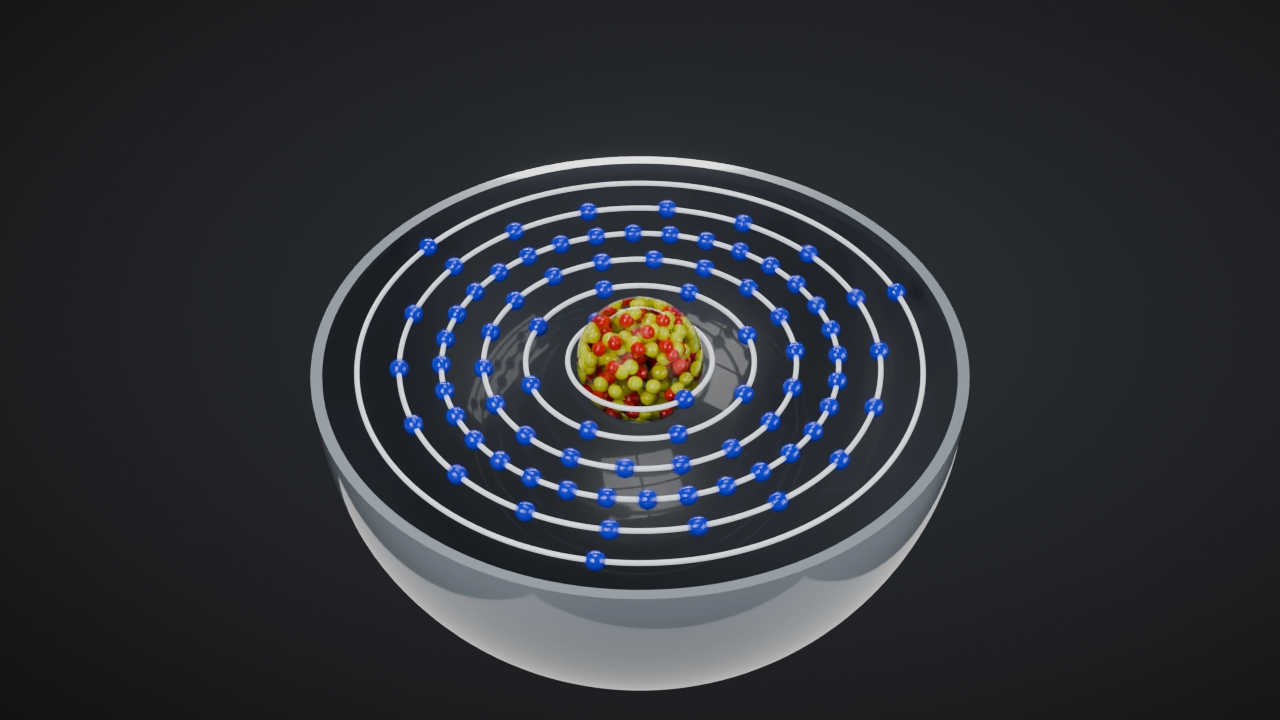
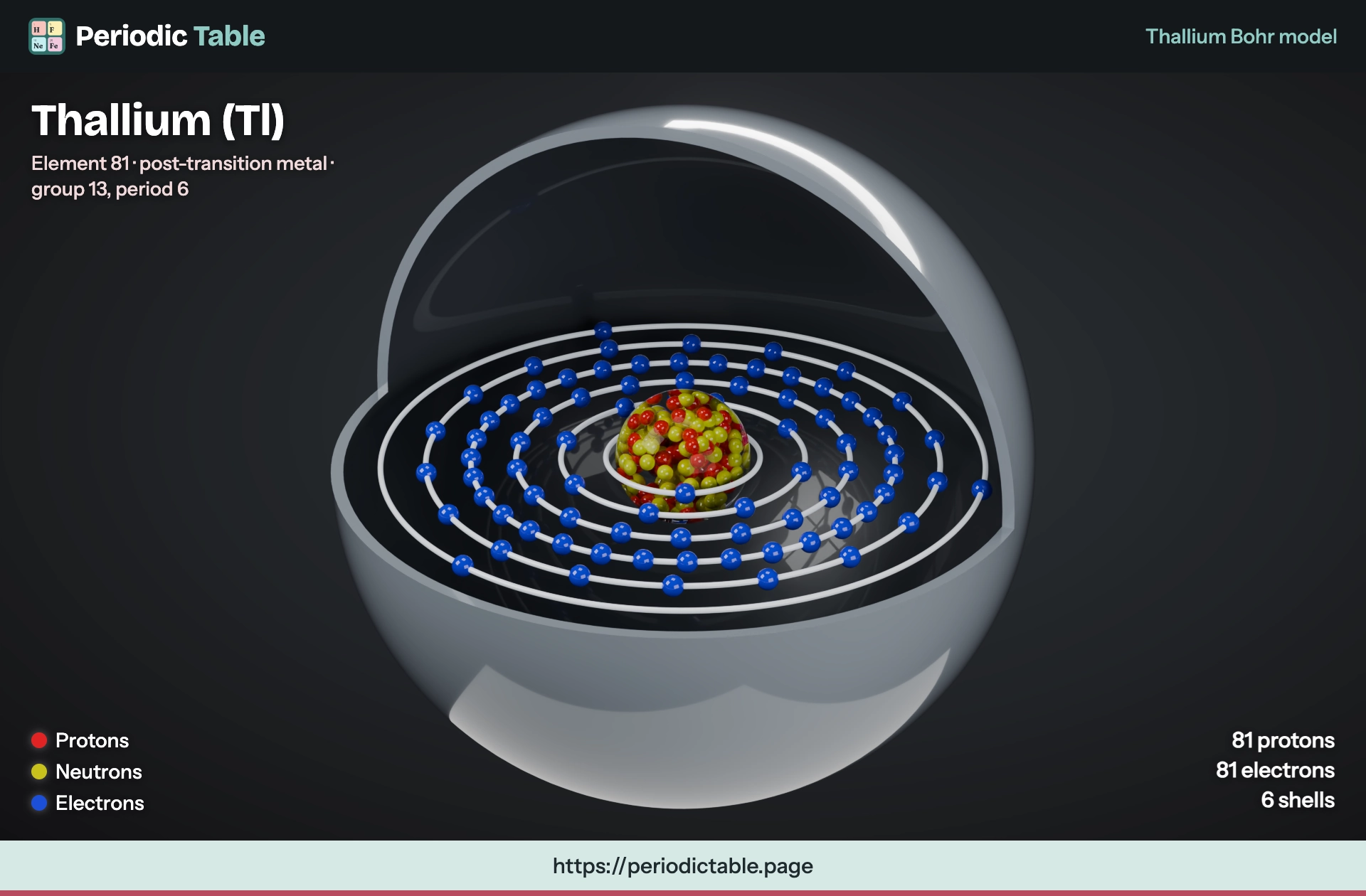
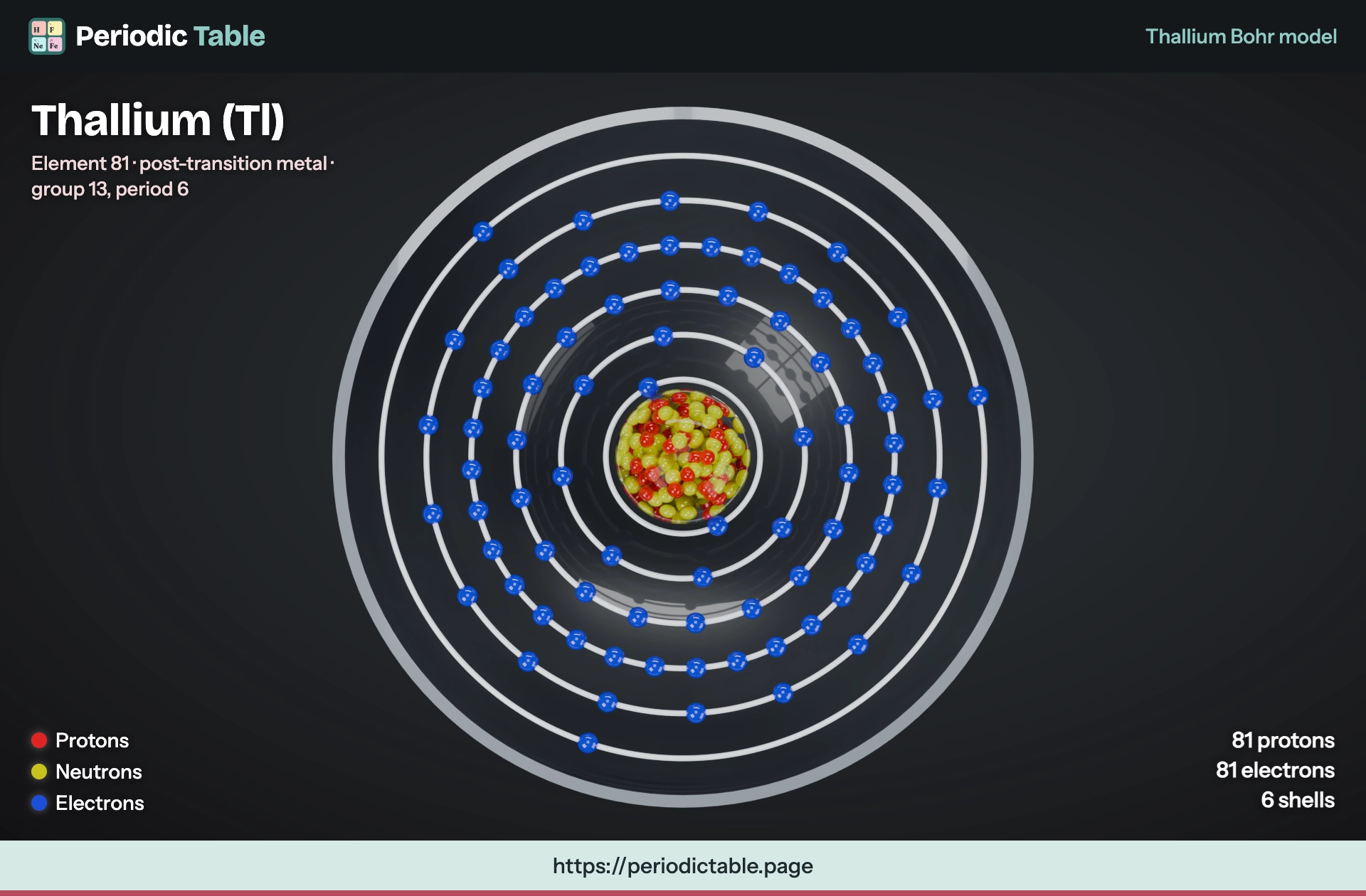
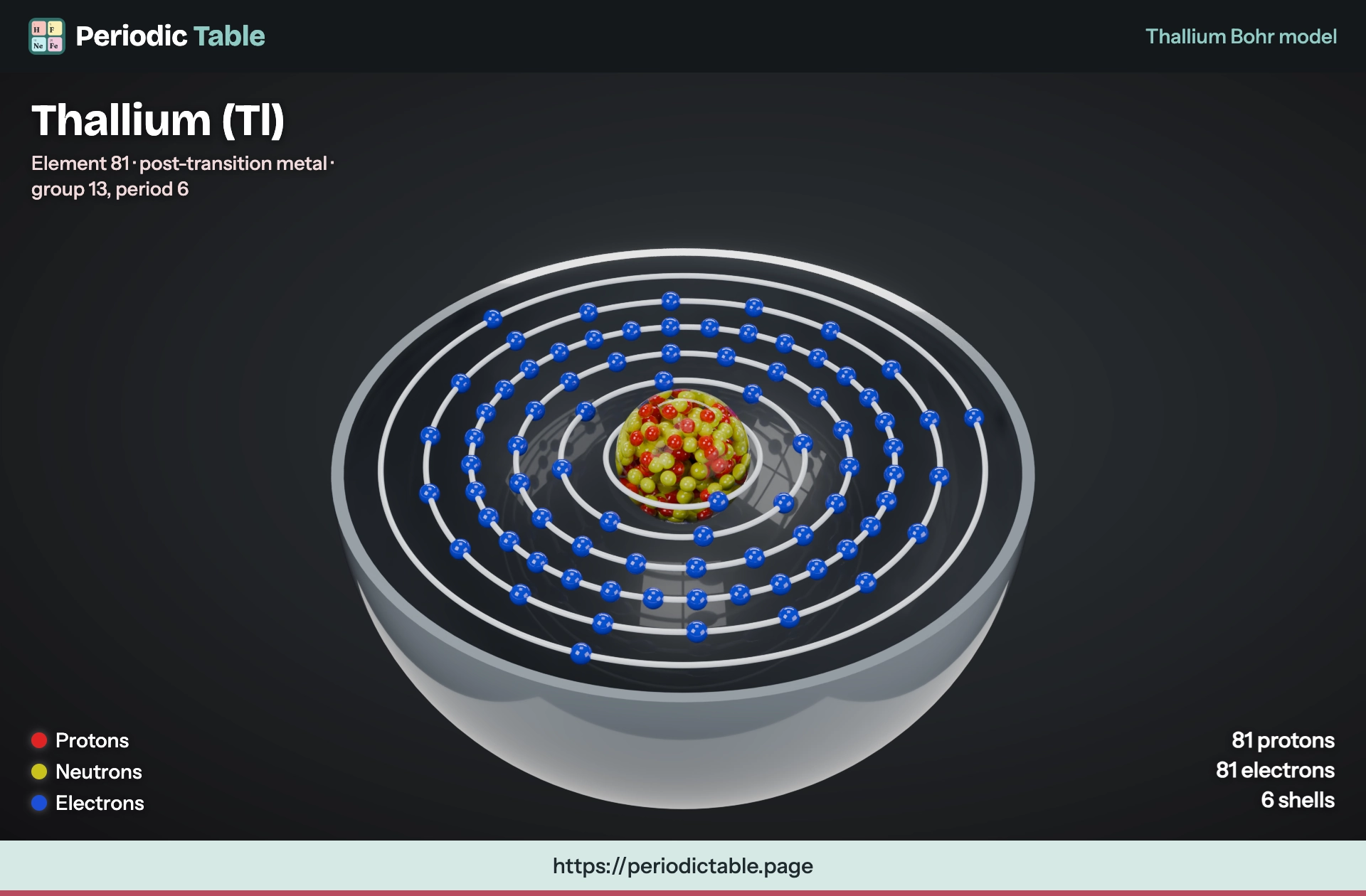
This is a Bohr model of thallium (Tl), a simplified picture of a single thallium atom. Its nucleus holds 81 protons, and a neutral thallium atom has 81 electrons, arranged around it in 6 shells (2 in shell K, 8 in shell L, 18 in shell M, 32 in shell N, 18 in shell O and 3 in shell P).
Thallium periodic table electron configuration
- Shorthand
- [Xe] 4f14 5d10 6s2 6p1
- Full
- 1s2 2s2 2p6 3s2 3p6 4s2 3d10 4p6 5s2 4d10 5p6 6s2 4f14 5d10 6p1
- Electrons per shell
- 2, 8, 18, 32, 18, 3
Thallium element properties and atomic data
- Atomic number
- 81
- Atomic mass
- 204.38 u
- Phase at STP
- Solid
- Melting point
- 303.85°C (577 K)
- Boiling point
- 1472.85°C (1746 K)
- Density
- 11.85 g/cm³
- Electronegativity (Pauling)
- 1.62
- Period
- 6
- Group
- 13
- Block
- p-block
- Appearance
- Silvery white
- Discovery date
- 1861
- Discovered by
- William Crookes
- Named by
- —
Thallium facts: atomic number, atomic weight and density
The quickest way to get to know element 81 is through its core numbers. Its atomic number is 81, so every atom carries 81 protons and, when neutral, 81 electrons. Janssen and Lockyer saw its yellow line in the sun, a story told in the liquid helium before Ramsay found it on Earth.
Its standard atomic weight is 204.38, and at room temperature it is a dense, silvery-white solid. With a density of about 11.85 g/cm³, a block of it weighs roughly the same as an equal block of lead.
| Property | Value |
|---|---|
| Symbol | Tl |
| Atomic number | 81 |
| Relative atomic mass | 204.38 |
| Classification | Post-transition metals |
| Appearance | Silvery-white, dulls to blue-grey in air |
| Density at 20 °C | 11.85 g/cm³ |
| State at 20 °C | Solid |
| CAS number | 7440-28-0 |
The CAS number is the identifier you will see on safety data sheets and supplier catalogues, so it is worth knowing when you look up the element in a database.
Thallium in the periodic table: group 13, period 6 and the p-block
Thallium sits in group 13, period 6 and the p-block. Being in period 6 means its electrons fill six shells, arranged 2, 8, 18, 32, 18, 3. Named for the discoverer of X-rays, the roentgenium element is a synthetic group 11 metal made a few atoms at a time.
To its left is mercury, to its right is lead, and directly above it is indium. That neighbourhood explains a lot: in looks and weight it resembles lead, while in parts of its chemistry it behaves like the elements above it in the group.
How thallium compares with the rest of the boron group
Thallium is the heaviest stable member of the boron group. Boron is a metalloid, while aluminium (spelled aluminum in the US), gallium and indium are light, reactive metals. Element 81 stands apart because its +1 chemistry looks more like the alkali metals than like its lighter neighbours.
| Element | Atomic number | Melting point (°C) | Density (g/cm³) |
|---|---|---|---|
| Boron | 5 | 2076 | 2.34 |
| Aluminium | 13 | 660 | 2.70 |
| Gallium | 31 | 30 | 5.91 |
| Indium | 49 | 157 | 7.31 |
| Thallium (Tl) | 81 | 304 | 11.85 |
Notice that the last column climbs steadily down the group, while melting points dip at gallium and then rise again.
Physical properties of thallium metal
Freshly cut thallium metal has a bright, bluish-white lustre. It is soft enough to be cut with a knife at room temperature, and it is both malleable and sectile, so it can be pressed or sliced without crumbling.
In air it quickly tarnishes to a dull bluish-gray film of oxide, which is why samples are stored under oil or in sealed ampoules. In contact with water it slowly forms thallium hydroxide, and steam speeds that up.
Melting point, boiling point and crystal structure
The melting point is 304 °C (577 K) and the boiling point is 1473 °C (1746 K), which is low for such a heavy element. Its crystal structure at room temperature is hexagonal close-packed, and it is diamagnetic, so it is weakly repelled by a magnet.
Its Mohs hardness is only about 1.2, softer than a fingernail. Mixed with mercury at about 8.5% thallium, it forms an alloy whose freezing point is near −60 °C, some 20 °C below that of pure mercury.
Electron configuration and chemistry of thallium
The electron configuration is [Xe] 4f14 5d10 6s2 6p1. The three outermost electrons, 6s2 6p1, are its valence electrons. On paper this predicts a +3 ion like the lighter group members, but heavy-atom effects change the picture and give the chemistry of thallium its unusual split personality.
Oxidation states and the inert pair effect
The common oxidation states are +1 and +3. Because of the inert pair effect, the 6s pair is held tightly and resists taking part in bonding, so losing only the single 6p electron is often easier.
That makes the +1 oxidation state the more stable one, while the +3 oxidation state behaves as an oxidising agent. The standard reduction potentials show the gap:
$$\mathrm{Tl^{3+} + 3e^- \rightleftharpoons Tl} \qquad E^\circ = +0.73\ \mathrm{V}$$
$$\mathrm{Tl^{+} + e^- \rightleftharpoons Tl} \qquad E^\circ = -0.336\ \mathrm{V}$$
The Tl⁺ ion is close in size to the potassium ion, and that likeness is the root of both its medical use and its danger. Living cells take it up as if it were potassium ions.
Electronegativity and ionization energies
On the Pauling scale its electronegativity is about 1.62 (some tables list 1.8). The first three ionization energies are 589.4, 1971 and 2878 kJ/mol. The empirical atomic radius is 170 pm, the covalent radius about 145 pm and the Van der Waals radius 196 pm.
Thallium compounds and how they behave
Most thallium compounds fall into two families, one for each main oxidation state. You can usually tell which one you are dealing with from the formula: Tl2O, TlCl and Tl2SO4 are +1, while Tl2O3 and TlCl3 are +3.
Thallium(I) salts
Thallium(I) forms salts with almost every common anion, and in many ways they resemble alkali metal or silver salts. Thallium(I) oxide, Tl2O, is basic. The halides TlCl, TlBr and TlI are photosensitive and dissolve poorly in water, much like silver halides.
Thallium bromide and thallium iodide crystals are used in infrared optics. By contrast, the sulfate, nitrate and acetate are very soluble, which is exactly what makes them dangerous.
Thallium(III) compounds
Thallium(III) compounds resemble those of aluminium but are less stable and act as strong oxidisers. Thallium(III) oxide, Tl2O3, is a black solid that breaks down above about 800 °C into the +1 oxide and oxygen. The trichloride and tribromide lose halogen just above room temperature, and organic chemists use the trinitrate and triacetate as reagents.
Organothallium chemistry and rare states
Compounds with direct carbon bonds, such as trimethylthallium, tend to be heat-sensitive liquids. Very unusual states, including +2 in a bulky silyl compound, have been made in the lab, but you will not meet them outside research papers.
Isotopes of thallium
Scientists have identified 41 isotopes, with mass numbers from 176 to 216. Natural thallium is made of just two of them: 203Tl (about 29.5%) and 205Tl (about 70.5%).
A few short-lived radioisotopes also appear in nature, but only as brief steps in the decay chains of uranium and thorium. You can recover the standard atomic weight from the two stable masses and their abundances:
$$\bar{A} = (0.2952 \times 202.972) + (0.7048 \times 204.974) \approx 204.38$$
Stable isotopes and the longest half-life
Only the two stable isotopes above last indefinitely. The longest-lived radioisotope is 204Tl, with a half-life of 3.78 years, followed by 202Tl at 12.31 days and 201Tl at about 73 hours.
201Tl decays by electron capture to mercury-201. Other isotopes are made by neutron activation of stable Tl in a reactor or by bombarding targets in a cyclotron.
That 73-hour figure is short. Using \(N/N_0 = (1/2)^{t/73}\), about 79.6% of a 201Tl dose remains after 24 hours, and only about 20.3% after a full week.
Thallium's discovery by flame spectroscopy
Thallium was found in 1861 thanks to a then-new technique. After Robert Bunsen and Gustav Kirchhoff improved flame spectroscopy, the method of reading the colours a substance gives off in a Bunsen burner flame, chemists began scanning minerals and industrial residues for unknown lines. William Crookes was examining selenium-rich residue from a sulfuric acid plant when he saw a bright green line that matched no known element.
In France, Claude-Auguste Lamy saw the same line in residues from his friend's acid works and, with far more raw material, produced the first ingot in 1862. Both men won medals at the International Exhibition in London that year, and their dispute over priority faded after Crookes was elected to the Royal Society in 1863.
The green spectral line behind the name
Crookes named the element after that green spectral line. The name comes from the Greek thallos, meaning a green shoot or green twig, the colour of fresh spring growth.
Where natural thallium comes from: a by-product of smelting
Thallium is never found free in nature. It makes up only about 0.7 parts per million of Earth's crust, mostly hidden in potassium-bearing clays, soils and granites. A handful of rare minerals contain it as a main ingredient, including crookesite, lorandite and hutchinsonite.
The Allchar deposit in North Macedonia was the one place it was ever mined for its own sake. Manganese nodules on the ocean floor also hold trace amounts.
In practice almost all of it is a by-product of other industries. Trace amounts sit in the sulfide ores of copper, zinc and lead, and in iron pyrite. When those ores are roasted or go through smelting, the element ends up in the flue dust and slag.
Producers dissolve it in acid, separate it by selective precipitation and then use electrolysis to recover metallic thallium. World output is small, on the order of 10 tonnes a year, because demand is low and so many uses are now restricted.
- Main sources: flue dust from copper, zinc and lead smelters
- Secondary sources: residue from sulfuric acid made from pyrite
- Rare Tl-rich minerals: crookesite, lorandite, hutchinsonite
What thallium is used for today
Because it is so toxic, modern uses are narrow and specialised. Most of the supply goes to the electronics industry, with the rest split between medical imaging, specialty glass and research. Each of these depends on one of the properties described above.
Infrared detectors and electronics
The electrical conductivity of thallium sulfide changes when infrared light hits it, which made it useful in early photocells and photoresistors. Thallium selenide has been used in bolometers, and traces of thallium improve selenium rectifiers and other semiconductors. In radiation detection, sodium iodide crystals are doped with a little thallium so they flash brightly when gamma radiation passes through, a process called scintillation.
Optics and low-melting glass
KRS-5, a mixed bromide-iodide crystal of the element, transmits far into the infrared, so it is used for lenses and windows in thermal imaging and spectrometers. Adding thallium's +1 oxide to glass gives a high index of refraction, and thallium-bearing glasses made with sulfur or selenium and arsenic melt at only 125 to 150 °C, yet stay durable at room temperature.
High-temperature superconductors
In 1988 researchers found a thallium-barium-calcium-copper oxide superconductor. Cuprate materials in this family become superconducting above 120 K, well above the temperature of liquid nitrogen. They are still studied for magnets, power lines and energy storage.
Thallium-201 in nuclear medicine and the stress test
In nuclear medicine, thallium-201 is injected as a dilute chloride solution. Because heart muscle cells pull in Tl⁺ through the same ion pumps they use for potassium, healthy tissue with good blood flow takes up the tracer while starved areas stay "cold" on the scan. Its gamma rays and x-rays give clear images.
A cardiac stress test compares scans at rest and under exercise to spot coronary artery disease. Technetium-99m has replaced it in many clinics, but the thallium scan is still in use.
Other industrial uses
- Mercury-Tl alloys in low-temperature thermometers and switches
- Thallium iodide in metal-halide lamps, which shifts their light toward green
- Clerici solution, a very dense liquid once used to sort minerals by density
- Small additions to gold plating baths and seawater battery anodes
Thallium toxicity and health risks
Thallium toxicity is the reason the element is so well known outside chemistry. Its soluble salts are highly toxic, it has no known role in any living thing, and because Tl⁺ mimics potassium it spreads into almost every tissue, harming the nervous system, liver, kidneys and heart. Even small amounts can be fatal, which is why health agencies treat it as a serious hazard.
Thallium sulfate as rat poison
For decades thallium sulfate was sold as a rat poison, ant killer and insecticide, and other salts were used to treat ringworm. Because these salts are odorless and nearly tasteless, they were also used in murders, earning the names "poisoner's poison" and "inheritance powder." The United States banned household rodenticide use in 1972, and many other countries followed.
Symptoms and treatment of thallium poisoning
The signs of thallium poisoning often appear slowly over days, which delays diagnosis. Classic signs include:
- Severe nerve pain and numbness in the hands and feet
- Stomach pain, vomiting or constipation
- Hair loss starting about two to three weeks after exposure
- Dark bands at the hair roots and white lines on the nails
The main antidote is Prussian blue, taken by mouth, which binds Tl in the gut so it leaves the body in stool instead of being reabsorbed. Hemodialysis can clear it from the blood, and potassium is given later to draw it out of tissues.
Exposure limits and environmental sources
OSHA sets the permissible exposure limit for soluble compounds in the workplace at 0.1 mg/m³ over an eight-hour day, and NIOSH recommends the same figure. At 15 mg/m³ the air is considered immediately dangerous to life.
The CDC notes that it is not classed as a carcinogen. In the environment, the EPA lists coal-fired power plants, cement works and ore processing as the main human sources, and caps drinking water at 2 parts per billion.