


Roentgenium element (Rg): roentgenium periodic table facts
Roentgenium periodic table facts: roentgenium (Rg) is element 111, a transition metal in group 11, period 7. You will never hold a piece of roentgenium. For space exploration, NASA probes and electricity from radioisotope generators, the weapons-grade plutonium page offers a summary.
This synthetic chemical element, symbol Rg with atomic number 111, is extremely radioactive and has only ever existed for moments inside a particle physics laboratory. Its longest-lived candidate, the unconfirmed roentgenium-286, lasts about ten minutes, and everything you read about its colour, hardness or chemistry is a prediction that scientists have built from theory rather than from a sample on a bench.
Rotate the 3D Bohr model of roentgenium
Drag to orbit, scroll to zoom.
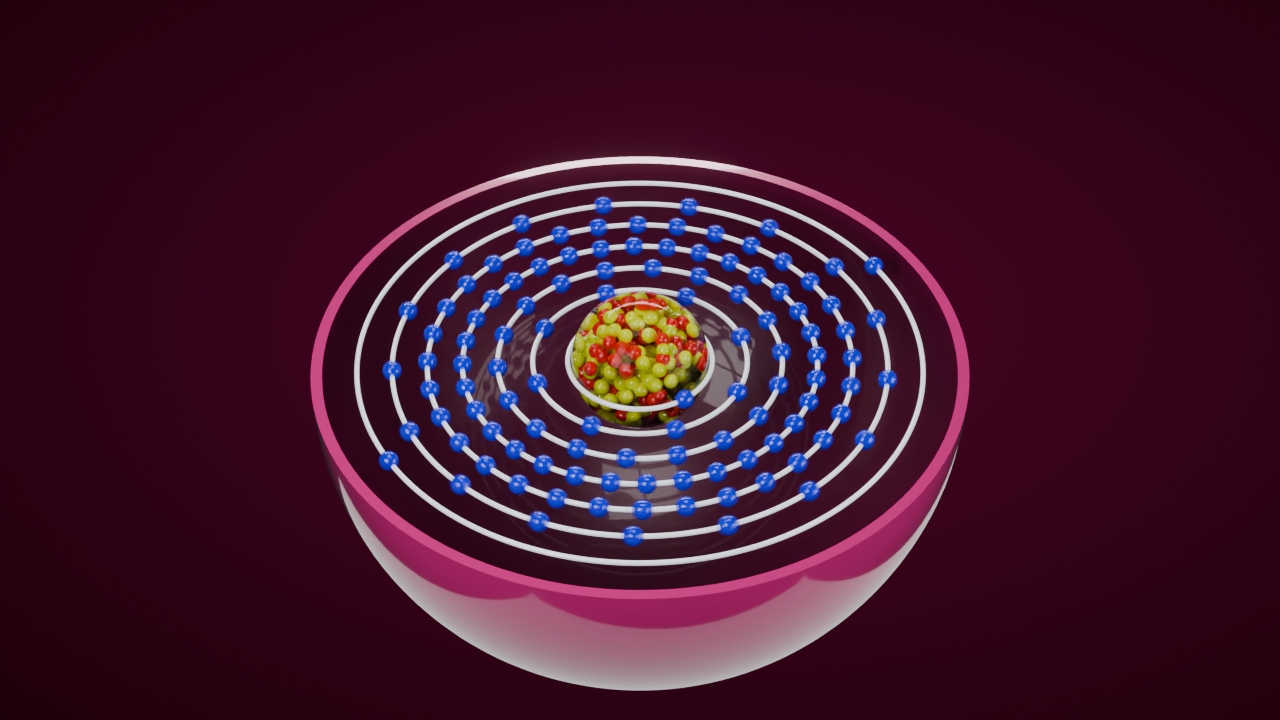
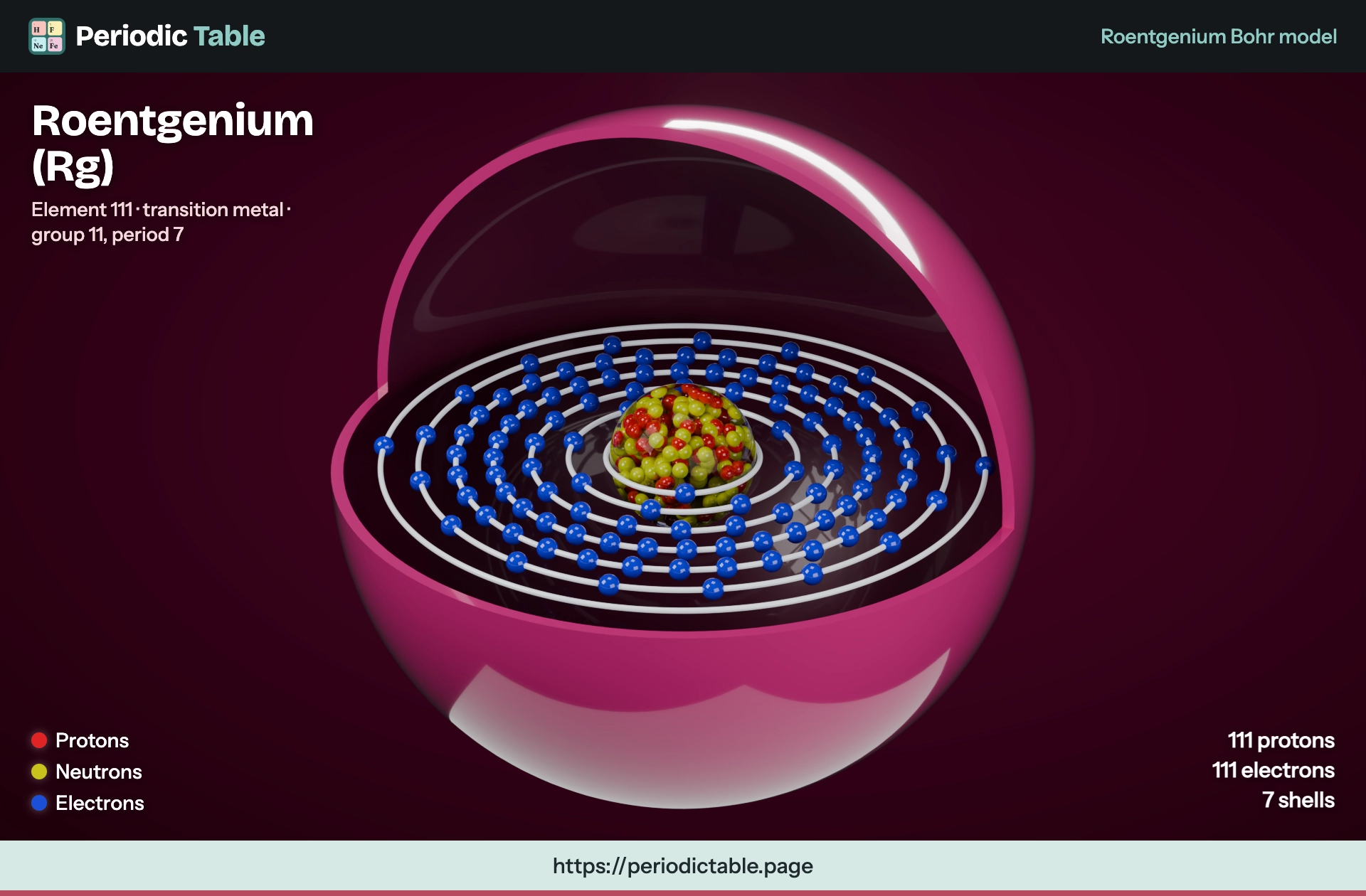
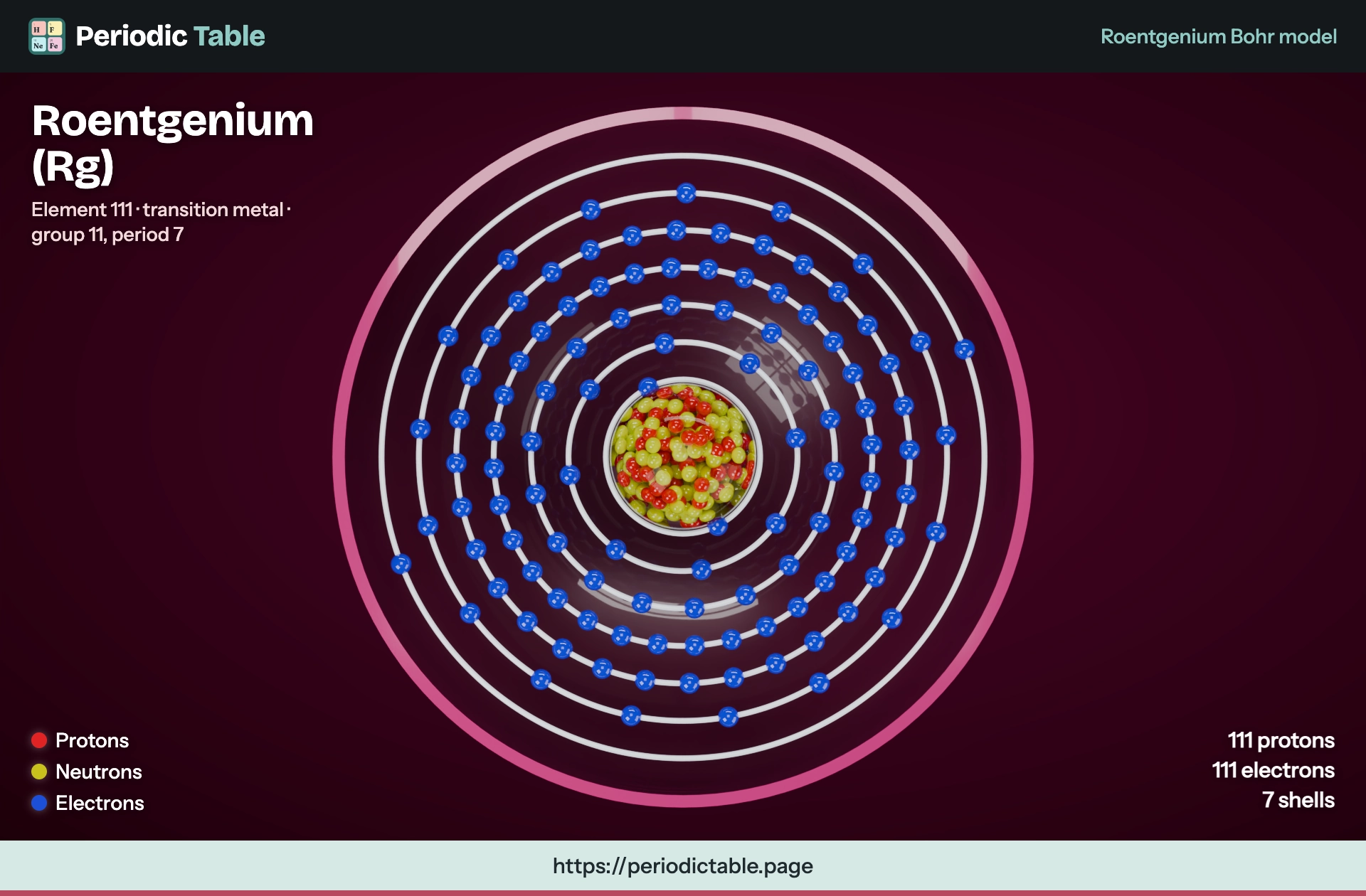
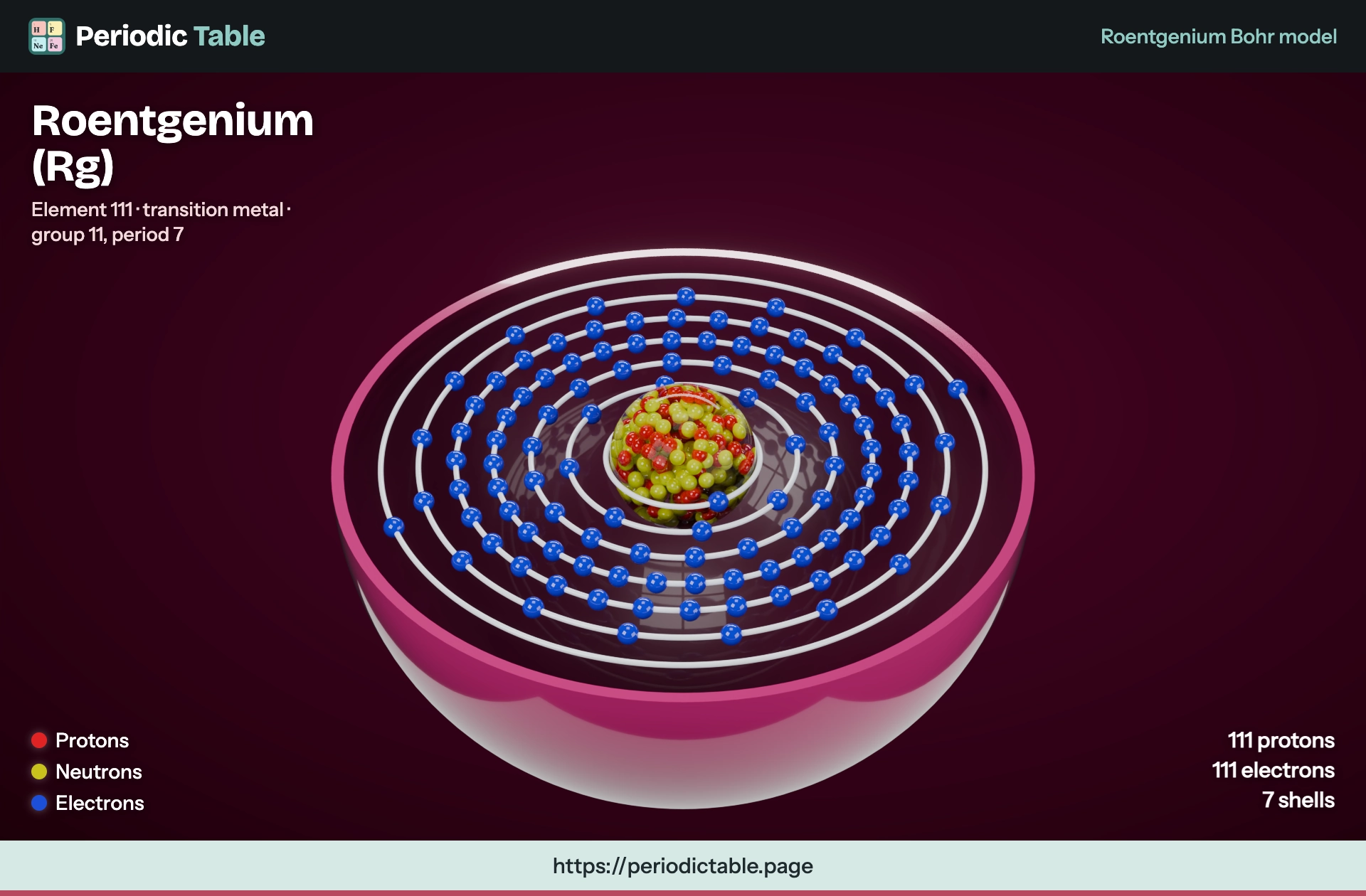
This is a Bohr model of roentgenium (Rg), a simplified picture of a single roentgenium atom. Its nucleus holds 111 protons, and a neutral roentgenium atom has 111 electrons, arranged around it in 7 shells (2 in shell K, 8 in shell L, 18 in shell M, 32 in shell N, 32 in shell O, 17 in shell P and 2 in shell Q).
Roentgenium periodic table electron configuration
- Shorthand
- *[Rn] 5f14 6d10 7s1
- Full
- 1s2 2s2 2p6 3s2 3p6 4s2 3d10 4p6 5s2 4d10 5p6 6s2 4f14 5d10 6p6 7s2 5f14 6d9
- Electrons per shell
- 2, 8, 18, 32, 32, 17, 2
Roentgenium element properties and atomic data
- Atomic number
- 111
- Atomic mass
- [282] u
- Phase at STP
- Unknown
- Melting point
- Unknown
- Boiling point
- Unknown
- Density
- 28.7 g/cm³
- Electronegativity (Pauling)
- Unknown
- Period
- 7
- Group
- 11
- Block
- d-block
- Appearance
- Unknown
- Discovery date
- 1994
- Discovered by
- Gesellschaft für Schwerionenforschung
- Named by
- —
Roentgenium element facts at a glance
The table below collects the core data for the roentgenium element. Values marked "predicted" come from relativistic modelling, not measurement, because no weighable amount has ever been made. Students comparing density, boiling point and crystal structure can turn to uses of thallium for the numbers.
| Property | Value |
|---|---|
| Symbol | Rg |
| Atomic number | 111 |
| Relative atomic mass | [282] (longest-lived confirmed isotope) |
| Position | Group 11, period 7, d-block |
| Electron configuration | [Rn] 5f14 6d9 7s2 (predicted) |
| State at room temperature | Solid (predicted) |
| Density | 22–24 g/cm³ (predicted) |
| Melting point / boiling point | Unknown |
| CAS number | 54386-24-2 |
| First observed | December 8, 1994 |
| Name accepted | November 1, 2004, after Wilhelm Conrad Roentgen |
Element 111 in group 11, period 7 and the D-block
On the periodic table, roentgenium sits directly under copper, silver and gold, which makes it the heaviest member of the coinage column. It is a transactinide element: every element past lawrencium (103) belongs to this heavy row, and all of them are classed as superheavy elements that can only be made one nucleus at a time. Across medicine, nutrition, electronics and construction, industry draws on the alkaline earth metal family in many different ways.
Within its row, It is the ninth member of the 6d series of transition metals, sitting between darmstadtium and copernicium. That placement suggests a transition metal that behaves as the heavier homologue of Au, and theory largely agrees: its ionization potentials and radii track those of its lighter homologues.
The catch is that, at this size, electrons move fast enough for relativity to bend the usual trends, so the newest superheavy element in the column is expected to differ from its neighbours in several measurable ways. Nothing measured yet confirms that it really belongs where it is drawn.
The discovery of Rg
The discovery of roentgenium (Rg) spans three laboratories and almost three decades, and it ends with a German team at GSI in Darmstadt, Germany, receiving the credit.
Early failed searches
In 1969, researchers at Lawrence Berkeley National Laboratory looked for traces of elements 110 to 114 in natural minerals and found none. In the mid-1980s, the Joint Institute for Nuclear Research in Dubna, then in the Soviet Union, tried the same fusion reaction that would later succeed, but the JINR team saw no events of the new element.
The Darmstadt experiment and its confirmation
A team led by Sigurd Hofmann at the Gesellschaft für Schwerionenforschung, now the GSI Helmholtz Centre for Heavy Ion Research, recorded three nuclei of the new element on December 8, 1994. The IUPAC/IUPAP Joint Working Party judged the evidence too thin in 2001, so the group repeated the run in 2002 and caught three more decay events. The working party accepted the claim in 2003, and the German physicists were invited to propose a permanent name, which was adopted in 2004.
Naming unununium: from eka-gold to Rg
Before it had a real name, the element went through several placeholders. Under Mendeleev's old nomenclature for undiscovered elements, the slot below Au would have been eka-gold — the prefix is Sanskrit for "one", meaning one place further down the column.
In 1979 IUPAC introduced a systematic element name built from the digits of the atomic number: un-un-un for 1-1-1, giving unununium with the symbol Uuu. It was meant purely as a placeholder, and specialists mostly ignored it, writing "element 111", E111 or simply (111) instead.
Once the discovery was confirmed, the naming rights went to the team, who chose to honour Wilhelm Conrad Röntgen, the German physicist who found X-rays in 1895. The English spelling follows the transliteration "Roentgen", which is also the name of an old unit of X-ray exposure. If you ever see Wilhelm Röntgen and "Roentgen" in the same text, they are the same person.
How Rg nuclei are made
There is no natural source of roentgenium atoms, so production relies on nuclear fusion: a nuclear reaction that merges two lighter nuclei into one heavier nucleus, then hopes it survives long enough to be detected.
Fusing bismuth-209 with nickel-64
In a heavy ion accelerator, a thin foil of bismuth-209 is bombarded with a beam of nickel-64 ions. The target supplies 83 protons and the projectile 28, which adds up to 111:
$$^{209}_{83}\text{Bi} + ^{64}_{28}\text{Ni} \rightarrow ^{272}_{111}\text{Rg} + ^{1}_{0}n$$
The beam has to be tuned carefully. Too little energy and electrostatic repulsion between the two positive nuclei pushes them apart before the short-range strong interaction can bind them.
Too much, and the merged compound nucleus is so excited that it splits instead of cooling down by releasing a neutron. The chance of a hit, expressed as a cross section, is tiny, so days of bombarding the target yield only a handful of events — the first product being roentgenium-272.
Decay and detection of superheavy elements
Fresh superheavy elements leave the foil mixed with unreacted beam particles. A separator applies electric and magnetic fields to steer the slower fusion products away and implant them in a silicon detector, which records where and when each nucleus lands. Seconds or milliseconds later, the same spot registers alpha particles as the new nucleus decays.
Each alpha line has a characteristic decay energy, so physicists can follow the decay products down to known nuclides such as meitnerium and bohrium, and work backwards to prove what was created. That chain of evidence, not a visible sample, is what nuclear physics accepts as proof of a new element.
Roentgenium isotopes and half-lives
Nine isotopes have been reported, with mass numbers 272, 274, 278–283 and 286. None is stable and none occurs in nature.
Most of the heavier ones were not made directly but turned up as daughters of nihonium, moscovium and tennessine. Two of them, 272 and 274, may also have metastable excited states.
| Mass number | Approx. lifetime (t½) | Main decay |
|---|---|---|
| 272 | 4.2 ms | α |
| 274 | 20 ms | α |
| 278 | 4.6 ms | α |
| 279 | 90 ms | α, SF |
| 280 | 3.9 s | α, electron capture |
| 281 | 11 s | SF, α |
| 282 | 130 s | α |
| 283 (unconfirmed) | 5.1 min | SF |
| 286 (unconfirmed) | 10.7 min | α |
The most stable isotope
The trend is clear: heavier isotopes last longer, because extra neutrons help offset the repulsion between 111 protons. Roentgenium-282 is the most stable isotope confirmed so far, with a half-life quoted at roughly 100 to 130 s depending on the data set.
The gap between 274 and 278 exists because those masses are too light for hot fusion and too heavy for cold fusion; the realistic route is to produce them from above, as decay daughters. More neutrons generally mean more stability, which is why the unconfirmed 283 and 286 isotopes look so promising.
Decay mode and decay chain
Every known isotope decays by alpha decay or spontaneous fission, and the 280 isotope may also have an electron-capture branch. The decay mode matters for identification.
An alpha particle leaves a predictable daughter, so a decay chain can be traced step by step; spontaneous fission shatters the nucleus into varied fragments that hide its origin. The older liquid drop model predicted that nuclei this heavy would fission almost instantly, while the nuclear shell model points to an island of stability near 300 nucleons, and the relatively long lifetimes of the heaviest isotopes fit that second picture.
Rg half-life: a worked example
Lifetimes in seconds are hard to picture, so here is an illustration of our own. Radioactive decay is random, and the chance that a single nucleus is still intact after time \(t\) follows the standard decay law:
$$P(t) = \left(\tfrac{1}{2}\right)^{t / t_{1/2}}$$
Take one freshly made roentgenium isotope nucleus of each of three kinds — 280 (t½ = 3.9 s), 282 (t½ = 130 s) and 286 (t½ = 642 s, the reported 10.7 min) — and ask how likely it is to survive four waiting times. Plugging the numbers into the formula gives:
| Waiting time | 280 isotope | 282 isotope | 286 isotope |
|---|---|---|---|
| 10 s | 16.9% | 94.8% | 98.9% |
| 60 s | under 0.01% | 72.6% | 93.7% |
| 300 s | effectively 0% | 20.2% | 72.3% |
| 600 s | effectively 0% | 4.1% | 52.3% |
The mean lifetime is the half-life divided by ln 2, so the 282 nucleus survives about 188 s on average and the 286 nucleus about 926 s. These calculations show why the heavier isotopes matter so much to chemists: a ten-second transfer from detector to chemistry apparatus loses most 280 nuclei but barely touches the 282 and 286 ones.
Predicted properties of Rg
Apart from its nuclear data, every value below for roentgenium metal comes from predictions rather than measurement. These predicted properties are best read as informed estimates, not settled facts.
Physical properties and crystal structure
Among the physical properties, the element is expected to be a solid at room temperature, probably silvery and metallic in appearance. Unlike its lighter group partners, which pack in a face-centred cubic lattice, its crystal structure is predicted to be body-centered cubic, because its electron charge distribution differs from theirs. At 22–24 g/cm³ it would rival osmium (22.61 g/cm³), the densest element measured so far.
Atomic radius, ionization energies and electron affinity
The predicted atomic radius is about 114 pm, with a covalent radius near 121 pm. Its ionization energies are unusually high: the first ionization energy, about 1020 kJ/mol, almost matches the noble gas radon (1037 kJ/mol), and the second, about 2070 kJ/mol, is close to silver's.
The electron affinity is estimated at around 1.6 eV, well below the 2.3 eV of Au. Behind these numbers are relativistic shifts in the electron shells: the 7s orbitals contract and the 6d ones expand.
Chemical properties of Rg
The expected chemical properties come almost entirely from theoretical relativistic quantum chemistry. In this column, relativistic effects on the outer s-shell are expected to peak at this element, which is why the chemistry of roentgenium has drawn more theoretical interest than that of its two lighter neighbours.
Oxidation states of Rg
The element is predicted to be a noble metal, with a standard electrode potential of about 1.9 V for the Rg³⁺/Rg couple, higher than the 1.5 V of Au³⁺/Au. Its likely oxidation states are +3 (the most stable), +5, and a weaker +1. Because spin–orbit interactions let more 6d electrons take part in bonding, the +5 state should be steadier than gold(V), which exists only in gold pentafluoride.
A −1 state is possible for Au, but its weaker pull on an extra electron means roentgenides may not be stable at all. High valence fluorides such as RgF₆⁻ are expected to be more stable than RgF₄⁻.
Predicted Rg compounds
Among the likely roentgenium compounds, following its group, it should form a dicyanide complex, Rg(CN)₂⁻, just as Au does in cyanide extraction of ore. Calculations on RgH suggest relativity doubles the strength of its hydrogen bonding.
Its +1 ion is predicted to be the softest metal ion of all, and in water it should form the aqua ion [Rg(H₂O)₂]⁺, as well as complexes with ammonia, phosphine and hydrogen sulfide. Practical chemistry has not tested any of these compounds.
Why experimental chemistry of Rg lags behind
No experimental chemistry has been done on roentgenium so far. A chemical study on a transactinide generally needs at least four nuclei in hand, an isotope that lives at least a second, and a production rate of roughly one atom per week. The 282 isotope comfortably passes the lifetime test, but making it is slow, and each experiment would have to run for weeks or months to give statistically meaningful results.
Automated gas-phase and solution chemistry setups would need continuous separation and detection to cope with yields that shrink for heavier elements. So far, the heavier copernicium through livermorium have received more attention, and its lighter neighbours remain equally unexplored. The 280 and 281 isotopes, reachable as granddaughters of moscovium, are the most likely candidates for future experiments.
Occurrence, uses and applications of Rg
Its occurrence in nature is zero: anything formed in a stellar event would have decayed almost at once. With only a small number of nuclei ever recorded, there is no practical application for the element, and any talk of industrial uses is speculation.
The real applications lie in basic scientific research:
- Testing models of nuclear structure and the predicted island of stability in nuclear physics.
- Checking how relativistic effects reshape periodic trends at the bottom of its column.
- Driving improvements in ion beams, separators and detectors that serve wider science.
In short, the element is a tool for asking questions, not a material, and its value lies in what each rare decay event teaches about the limits of the periodic table.
Key facts to remember about Rg
- Only a few atoms of roentgenium have ever been synthesized, all at large accelerator facilities.
- It is the heaviest of the coinage elements and is predicted to be one of the densest metals.
- The longest-lived confirmed isotope is the 282 isotope; unconfirmed 286 may last far longer.
- Its first ionization energy is close to that of a noble gas, an unusual result of relativity.
- Like other superheavy elements, it is identified by the chain of decays it leaves rather than by seeing it.
- It is one of six superheavy elements first made at GSI by cold fusion.
- Its discovery was first claimed on the strength of just three nuclei.