


Rutherfordium element (Rf): rutherfordium periodic table facts
Rutherfordium periodic table facts: rutherfordium (Rf) is element 104, a transition metal in group 4, period 7. You will never hold a piece of rutherfordium: this synthetic element does not occur in nature and exists only for moments in a handful of laboratories. For crystal habits and mechanical behavior, see bismuth (Bi) for rhombohedral structure, brittleness and why it expands on solidification.
It is the chemical element with symbol Rf and atomic number 104, named after the New Zealand-born physicist Ernest Rutherford, and its longest-lived known isotope survives for only about 48 minutes before it decays. Here is what researchers have measured, what they can only predict, and why such a fleeting element still matters.
Rotate the 3D Bohr model of rutherfordium
Drag to orbit, scroll to zoom.
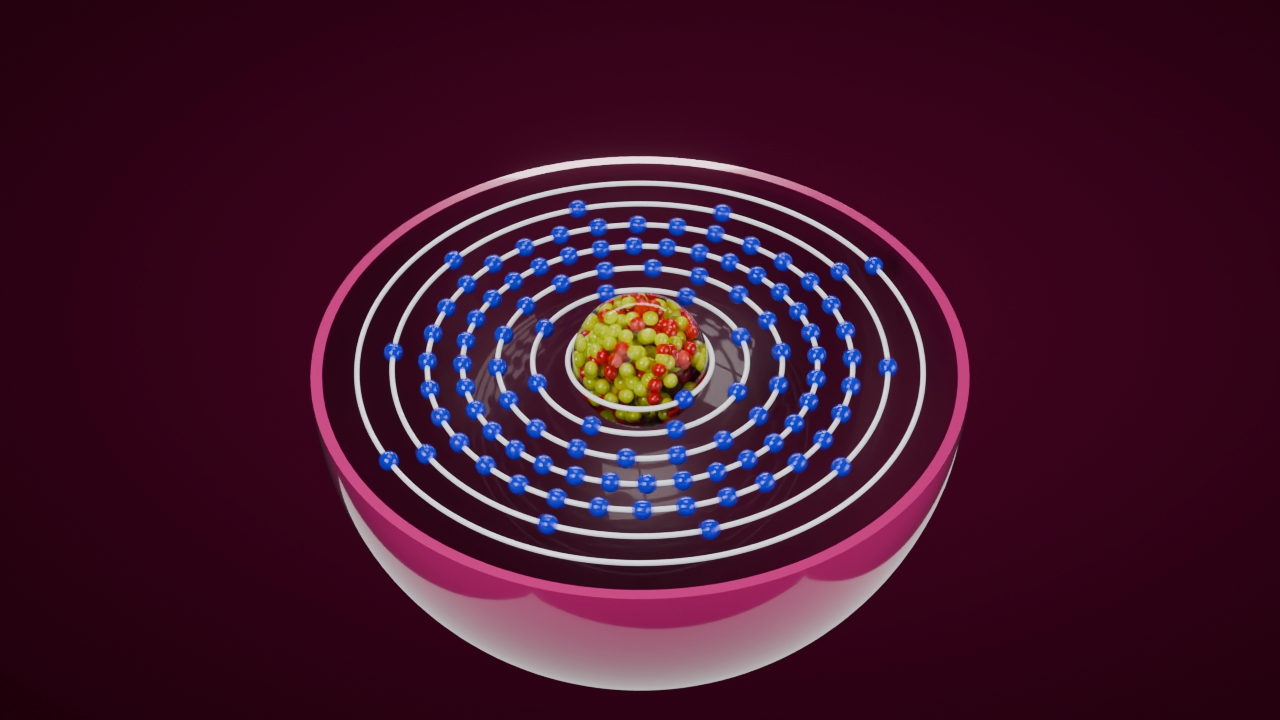
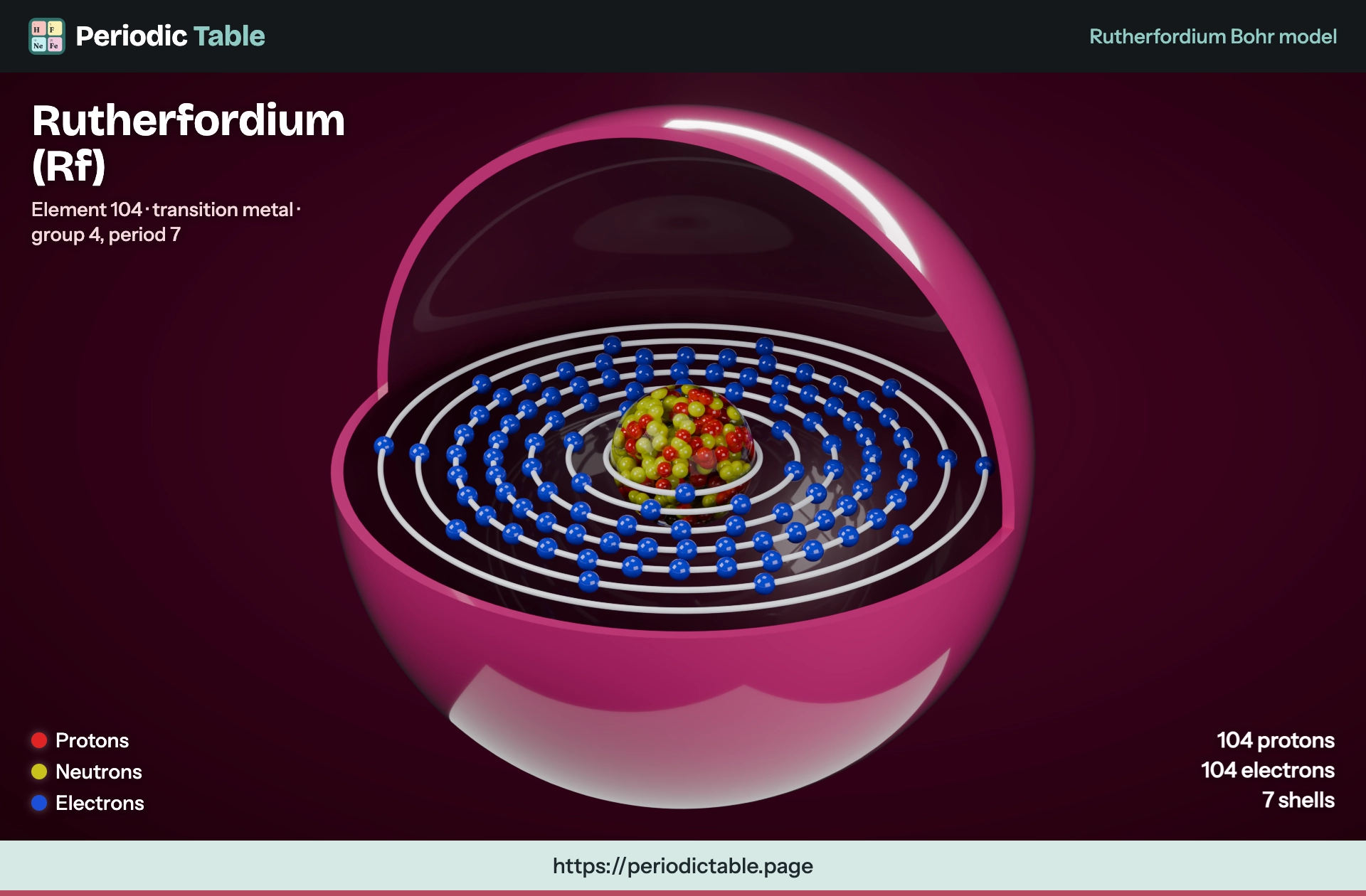
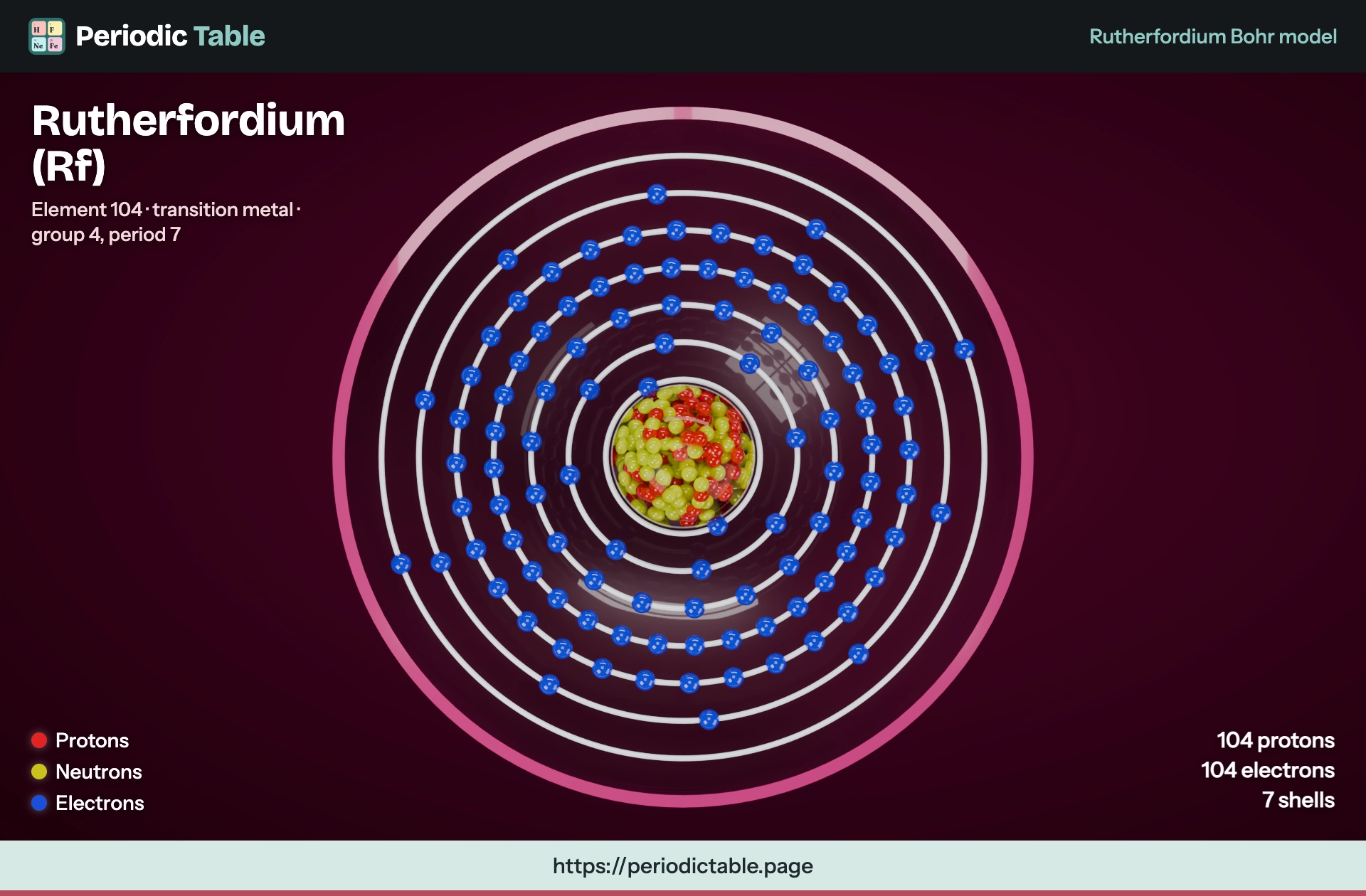
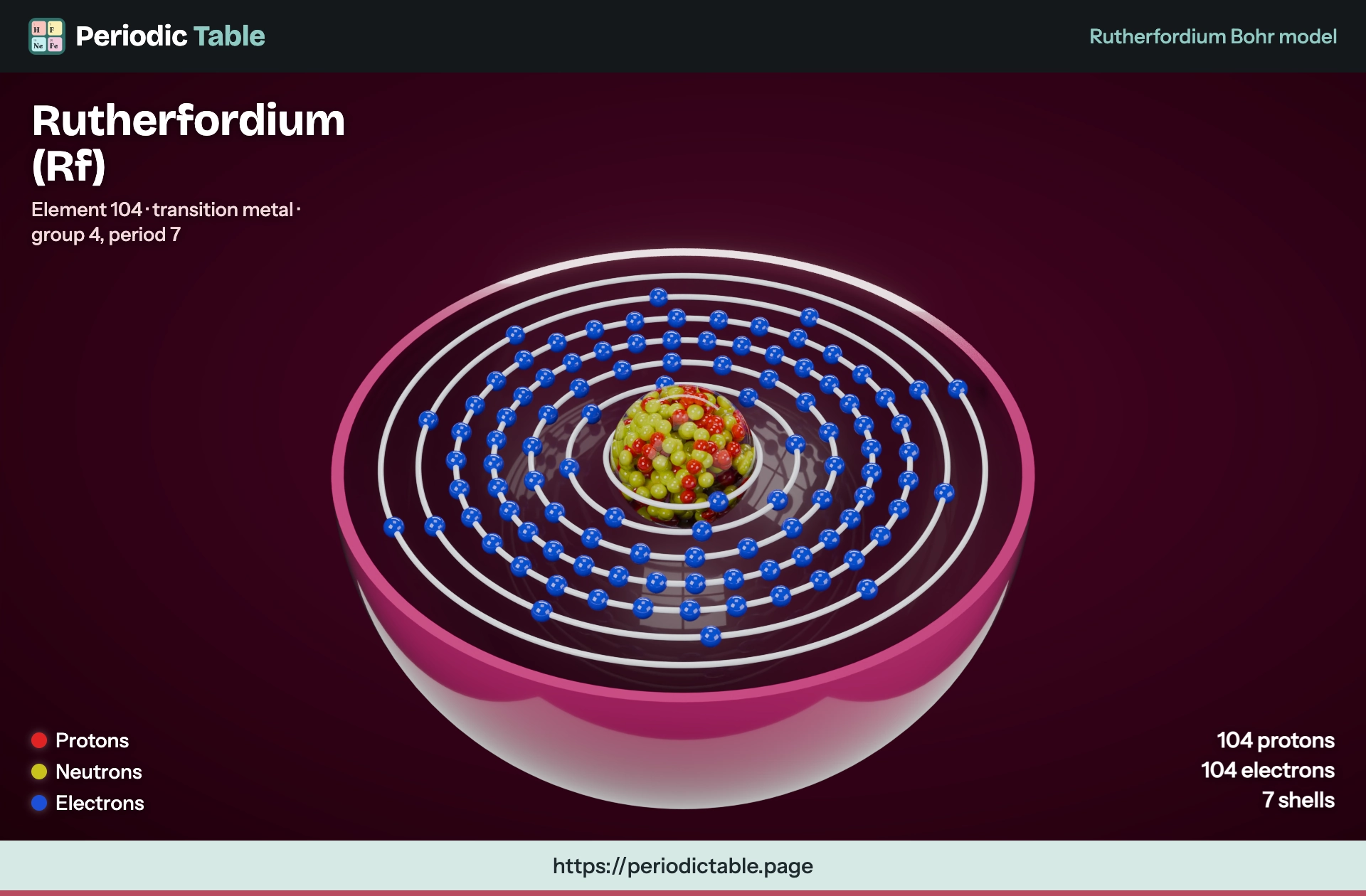
This is a Bohr model of rutherfordium (Rf), a simplified picture of a single rutherfordium atom. Its nucleus holds 104 protons, and a neutral rutherfordium atom has 104 electrons, arranged around it in 7 shells (2 in shell K, 8 in shell L, 18 in shell M, 32 in shell N, 32 in shell O, 10 in shell P and 2 in shell Q).
Rutherfordium periodic table electron configuration
- Shorthand
- [Rn] 5f14 6d2 7s2
- Full
- 1s2 2s2 2p6 3s2 3p6 4s2 3d10 4p6 5s2 4d10 5p6 6s2 4f14 5d10 6p6 7s2 5f14 6d2
- Electrons per shell
- 2, 8, 18, 32, 32, 10, 2
Rutherfordium element properties and atomic data
- Atomic number
- 104
- Atomic mass
- [267] u
- Phase at STP
- Unknown
- Melting point
- 2126.85°C (2400 K)
- Boiling point
- 5526.85°C (5800 K)
- Density
- 23.2 g/cm³
- Electronegativity (Pauling)
- Unknown
- Period
- 7
- Group
- 4
- Block
- d-block
- Appearance
- Unknown
- Discovery date
- 1964
- Discovered by
- Joint Institute for Nuclear Research
- Named by
- —
Rutherfordium (Rf) key facts and atomic mass data
Only a small number of atoms have ever been made, so most of the numbers below are predictions rather than measurements. The atomic mass shown in square brackets is the mass number of the most stable isotope, which is how the periodic table lists any element with no stable form. Treat every value marked "predicted" as a calculation, not something weighed on a balance. After mining of platinum ore, the palladium element entry follows the finished alloy and its oxidation chemistry.
| Property | Value |
|---|---|
| Symbol / atomic number | Rf / 104 |
| Atomic mass | [267] |
| Group, period, block | Group 4, period 7, d-block |
| Phase at room temperature | Solid (predicted) |
| Melting point | About 2400 K, roughly 2,100 °C (predicted) |
| Boiling point | About 5800 K, roughly 5,500 °C (predicted) |
| Density | About 17 g/cm3 (predicted) |
| Atomic radius | About 150 pm (estimated) |
| Covalent radius | About 157 pm (estimated) |
| First of the ionization energies | 580 kJ/mol |
| Electron configuration | [Rn] 5f14 6d2 7s2 |
| Main oxidation state | +4 |
| CAS number | 53850-36-5 |
| First reported | 1964, Dubna |
Electronegativity, electron affinity and the elastic moduli remain unknown, because nobody has gathered enough rutherfordium metal to test them.
Element 104 in group 4, period 7 and the d-block
Rutherfordium sits directly below hafnium in group 4, on the seventh row of the table (period 7), in the d-block. That position makes it a transition metal and the first transactinide, the first element after the actinides end with lawrencium (element 103). For anyone sorting stable isotopes, half-life data and Ir-192 can be found by using iridium facts as a reference.
To its right is dubnium (element 105). Chemists expect a silvery metal much like its lighter group-mates, and the few chemistry tests performed so far agree with that placement rather than with the actinide series.
Electron configuration and oxidation state
The ground-state electron configuration is [Rn] 5f14 6d2 7s2, which is often written in plain text as 5f14 6d2 7s2. The four outer electrons (two in the 6d orbitals and two in the 7s) mirror the d2s2 pattern of titanium, zirconium and hafnium.
That pattern is why the usual oxidation state is +4, with a less stable +3 state also predicted. One twist comes from relativity: because the 7s orbital is pulled inward and stabilized, the Rf+ and Rf2+ ions are expected to lose 6d electrons first, the reverse of what happens in hafnium.
Rutherfordium discovery: Dubna and Berkeley
The discovery story begins in 1964 at the Joint Institute for Nuclear Research (JINR) in Dubna, then in the Soviet Union. A team led by Georgy Flerov fired neon-22 ions at a plutonium-242 target and reported a spontaneous fission activity with a 0.3-second half-life.
Later work showed no isotope of element 104 has that half-life, so the original assignment was wrong. Between 1966 and 1969 the Dubna group repeated the work using thermochromatography, converting the products to chlorides and finding a volatile chloride that behaved like a group 4 element.
In 1969, Albert Ghiorso's team at Lawrence Berkeley Laboratory in California made rutherfordium conclusively, the first undisputed discovery of element 104. They bombarded californium-249 with carbon-12 and also tried curium-248 with oxygen-18, then tracked the alpha decay of the new nucleus to a known nobelium daughter:
$$^{249}_{98}\text{Cf} + {}^{12}_{6}\text{C} \;\rightarrow\; {}^{257}_{104}\text{Rf} + 4\,{}^{1}_{0}n$$
In 1970 the Berkeley group confirmed the chemistry with an ion-exchange separation, and an independent American team verified the result in 1973. A German team at Darmstadt later produced it again by firing titanium-50 at lead-208, so three laboratories in three countries have now made it. That history of rival claims is why the scientists involved fought over the name for decades.
The naming controversy behind kurchatovium and unnilquadium
The Soviet team at JINR proposed kurchatovium (Ku), after Igor Kurchatov, head of the Soviet atomic bomb project, and that name appeared in Eastern Bloc textbooks for years. The Americans proposed rutherfordium in honour of Rutherford, often called the father of nuclear physics.
This naming controversy became part of the wider "Transfermium Wars". Key steps in how it ended:
- IUPAC used the placeholder name unnilquadium (Unq), Latin-based for the digits 1-0-4.
- In 1992 the IUPAC/IUPAP Transfermium Working Group ruled that both laboratories deserved shared credit for the discovery.
- In 1994 IUPAC suggested calling element 104 dubnium and moving the Rf name to element 106, which Berkeley rejected.
- In 1997 the final names were fixed: element 104 kept the Berkeley proposal, element 106 became seaborgium, and dubnium went to element 105.
How Rf atoms are made in a particle accelerator
Every atom of Rf comes from a particle accelerator, not a mine or a reactor. In nuclear fusion experiments, a beam of lighter nuclei, accelerated to around a tenth of the speed of light, strikes a thin target of heavier atoms.
The positively charged nuclei repel each other through electrostatic repulsion, and only the strong interaction can bind them, so the beam has to bring the two close enough before they bounce apart. The chance that a collision ends in fusion is the reaction's cross section, and for superheavy products it is tiny.
When two nuclei do merge, they form a hot compound nucleus in an excited state. It either splits apart at once or sheds energy by emitting a neutron or a gamma ray, leaving a cooler atomic nucleus of element 104.
Each successful nuclear reaction yields a single atom, which is why a laboratory may run a beam for days to collect a few events. A nucleus counts as a new element only if it survives at least 10−14 seconds, long enough to gather its electrons.
Decay and detection of superheavy elements
Researchers studying superheavy elements never see the atoms directly. A separator pulls each new nucleus out of the beam and lodges it in a silicon detector, which records where it landed, its energy and its arrival time. The nucleus then decays in one of two ways:
- Alpha decay ejects alpha particles (two protons and two neutrons), producing a known daughter. Following the decay chain down to familiar decay products identifies the parent, which is how the first undisputed samples of this element were traced to a known nobelium daughter.
- Spontaneous fission splits the nucleus into two unpredictable fragments, which tells you far less about what decayed.
As the number of nucleons rises, electrostatic repulsion between protons grows faster than the binding force, so spontaneous fission becomes more likely in heavy elements. Shell effects in nuclear physics push back against this, which is why some heavier isotopes live longer than expected. For this element, it explains why most of its isotopes end in fission, while a few of the heaviest, including the longest-lived one at the top of its mass range, survive far longer.
Rutherfordium isotopes and half-lives
There are no stable or naturally occurring rutherfordium isotopes. About seventeen radioisotopes have been reported, with mass numbers from 252 to 270 (264 and 269 are missing).
All are radioactive, and most decay by spontaneous fission, especially those with even neutron numbers. The half-life generally grows with mass: the lightest isotope, 252Rf, lasts less than a microsecond, while rutherfordium-267 lasts about 48 minutes.
| Isotope | Approximate half-life | Main decay mode | How it is made |
|---|---|---|---|
| 252Rf | Under 1 microsecond | Spontaneous fission | Direct fusion |
| 257Rf | A few seconds | Alpha decay | Direct fusion (Berkeley, 1969) |
| 261mRf | About 1.1 minutes | Alpha decay | Direct fusion; used for chemistry |
| 263Rf | About 10 minutes | Spontaneous fission | Decay of heavier elements |
| 267Rf | About 48 minutes | Spontaneous fission | Decay chain of flerovium and livermorium |
Rutherfordium isotopes with an odd neutron count tend to outlive their even-even neighbours, because the unpaired neutron hinders fission. The heavy isotopes 266Rf and 268Rf have been reported as electron capture daughters of dubnium, but remain unconfirmed.
To see what these half-lives mean in practice, use the decay law, where \(N_0\) is the starting number of atoms and \(t_{1/2}\) the half-life:
$$N(t) = N_0 \times \left(\frac{1}{2}\right)^{t / t_{1/2}}$$
For 267Rf, after 120 minutes you have \(0.5^{120/48} = 0.5^{2.5} \approx 0.177\), so about 17.7% of the sample remains. For 261mRf, just 3 minutes leaves about 15.1%, and it takes only about 7.3 minutes to lose 99% of it. That gap is why chemists hope the longer-lived isotopes, nearer the predicted island of stability, will allow slower experiments in future.
Predicted properties of the first transactinide
As the first transactinide, rutherfordium has been made only a few atoms at a time, so almost all its bulk predicted properties come from theory. Calculations of its ionization potentials, radii and orbital energies line up with hafnium and differ sharply from lead, which is why theorists expect it to behave as a normal group 4 metal.
Physical properties and crystal structure
The expected physical properties are those of a dense, refractory solid: a density near 17 grams per cubic centimetre, a melting point around 2,400 K and an atomic radius of about 150 pm. Its crystal structure is predicted to be hexagonal close-packed, like hafnium, with a c/a ratio of about 1.61. Under very high pressure (calculated as roughly 50 to 72 GPa) it should switch to a body-centered cubic lattice, skipping the intermediate phase that hafnium passes through.
Chemical properties and relativistic effects
Early predictions of its chemical properties warned that relativistic effects, caused by inner electrons moving at a large fraction of light speed, might drop the 7p orbitals below the 6d and make the element act like lead. More precise ab initio calculations found the ground state is 6d27s2, with a 7p-containing state only 0.3 to 0.5 eV above it. Experiments then confirmed the element as the heavier homolog of hafnium, earning it the old label eka-hafnium, and it lines up with titanium and zirconium as well.
Rutherfordium compounds and experimental chemistry
Known rutherfordium compounds number only a handful, each identified from a few atoms. Theory predicts a very stable refractory oxide, RfO2, and volatile tetrahalides (RfX4) that hydrolyse in water to oxyhalides.
The chemistry experiments below test those predictions one atom at a time, and they are the reason its chemistry is better understood than that of any heavier element. A stable oxide has been predicted but never made in a measurable amount.
Gas phase tests on rutherfordium chloride
In the gas phase, atoms of 261mRf are swept from the target by an aerosol, chlorinated and passed along a temperature-graded column. The tetrachloride RfCl4 forms a volatile chloride with a tetrahedral shape, condensing at around 220 °C. It is more volatile than its hafnium counterpart, because its bonds are more covalent, and far more volatile than actinide chlorides.
A bromide and the oxychloride RfOCl2 have also been seen. These experiments confirmed group 4 behaviour.
Aqueous phase chemistry in acid solutions
In the aqueous phase, a Japanese team at JAERI extracted 261mRf from hydrochloric acid alongside zirconium, hafnium and thorium. The element formed the hexachloro complexes [RfCl6]2−, just as zirconium and hafnium do.
In hydrofluoric acid it bound fewer fluoride ions than its lighter relatives, and it showed a weaker pull toward sulfate. Both results fit its larger ionic radius of 76 pm, against 71 pm for zirconium and 72 pm for hafnium.
Uses of Rf in superheavy element research
There are no commercial uses for rutherfordium: too few atoms exist, and they decay too quickly to collect. Its value lies in research, where it serves three main roles:
- Testing the periodic table at its edge. Because Rf follows hafnium so closely, it shows how far relativistic effects can bend periodic trends before they break.
- Nuclear research on fission barriers and shell effects, using its many isotopes as reference points for radioactivity in heavy nuclei, a central question in heavy-element physics.
- Nuclear chemistry methods. Fast, single-atom separation techniques first proved on Rf are now used on dubnium, seaborgium and heavier elements.
Rf compared with hafnium, zirconium and titanium
Laying the four group 4 elements side by side shows both the family resemblance and where element 104 departs from it. The last row is predicted, while the others are measured values.
| Element | Atomic number | Density (g/cm3) | Melting point (K) | First ionization energy (kJ/mol) |
|---|---|---|---|---|
| Titanium (Ti) | 22 | 4.51 | 1941 | 659 |
| Zirconium (Zr) | 40 | 6.52 | 2128 | 640 |
| Hafnium (Hf) | 72 | 13.31 | 2506 | 659 |
| Rutherfordium (Rf) | 104 | About 17 | About 2400 | About 580 |
Density keeps climbing down the group, but the predicted melting point dips slightly below hafnium's and the first ionization energy falls well below the other three. Both shifts are signs of the relativistic changes to the 7s and 6d electrons, and they are the reason chemists still treat rutherfordium as a test of the periodic law.