


Palladium element (Pd): palladium periodic table facts
Palladium periodic table facts: palladium (Pd) is element 46, a transition metal in group 10, period 5. If you have ever wondered what keeps a car's tailpipe gases clean or why some wedding bands look like platinum but cost less, the answer is often palladium. Low toxicity and lead replacement in alloys are discussed in the bismuth atomic number, including supply risk.
This rare silvery-white metal is the chemical element with the symbol Pd, and it belongs to the six platinum group metals alongside platinum, rhodium, ruthenium, iridium and osmium. Here you get its key data, how it behaves, where it comes from and why it trades as a precious metal.
Rotate the 3D Bohr model of palladium
Drag to orbit, scroll to zoom.
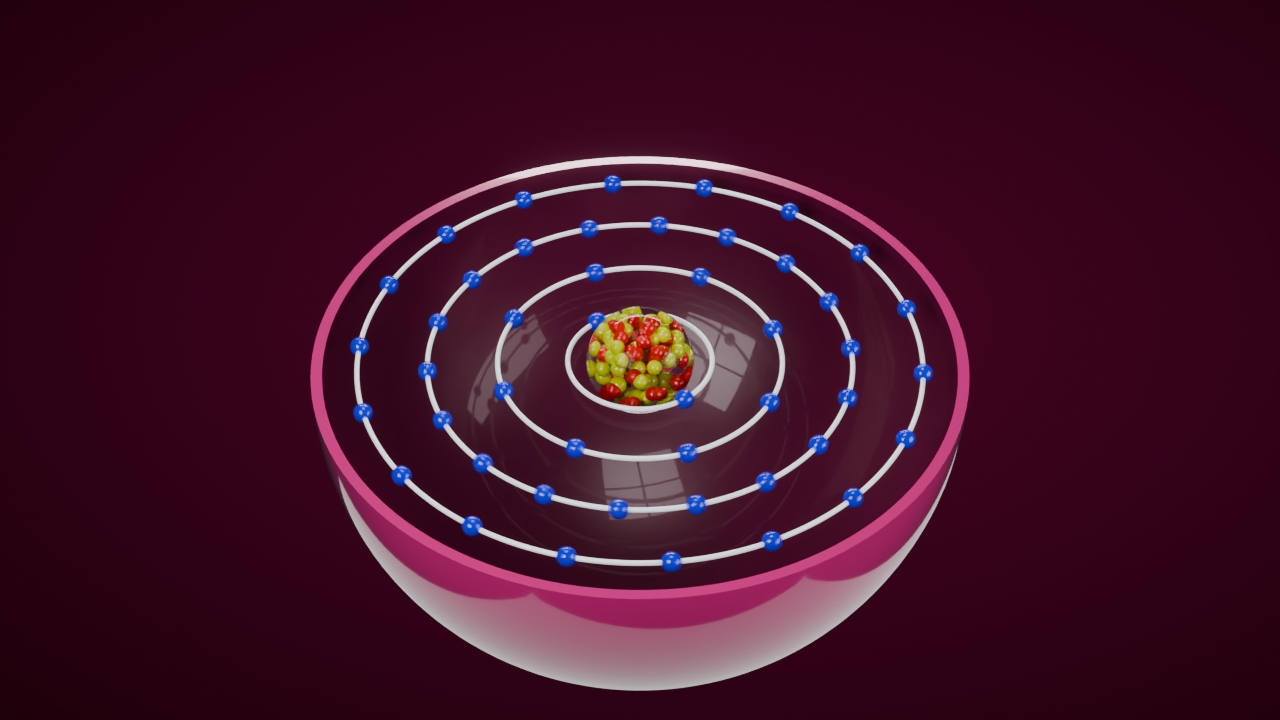
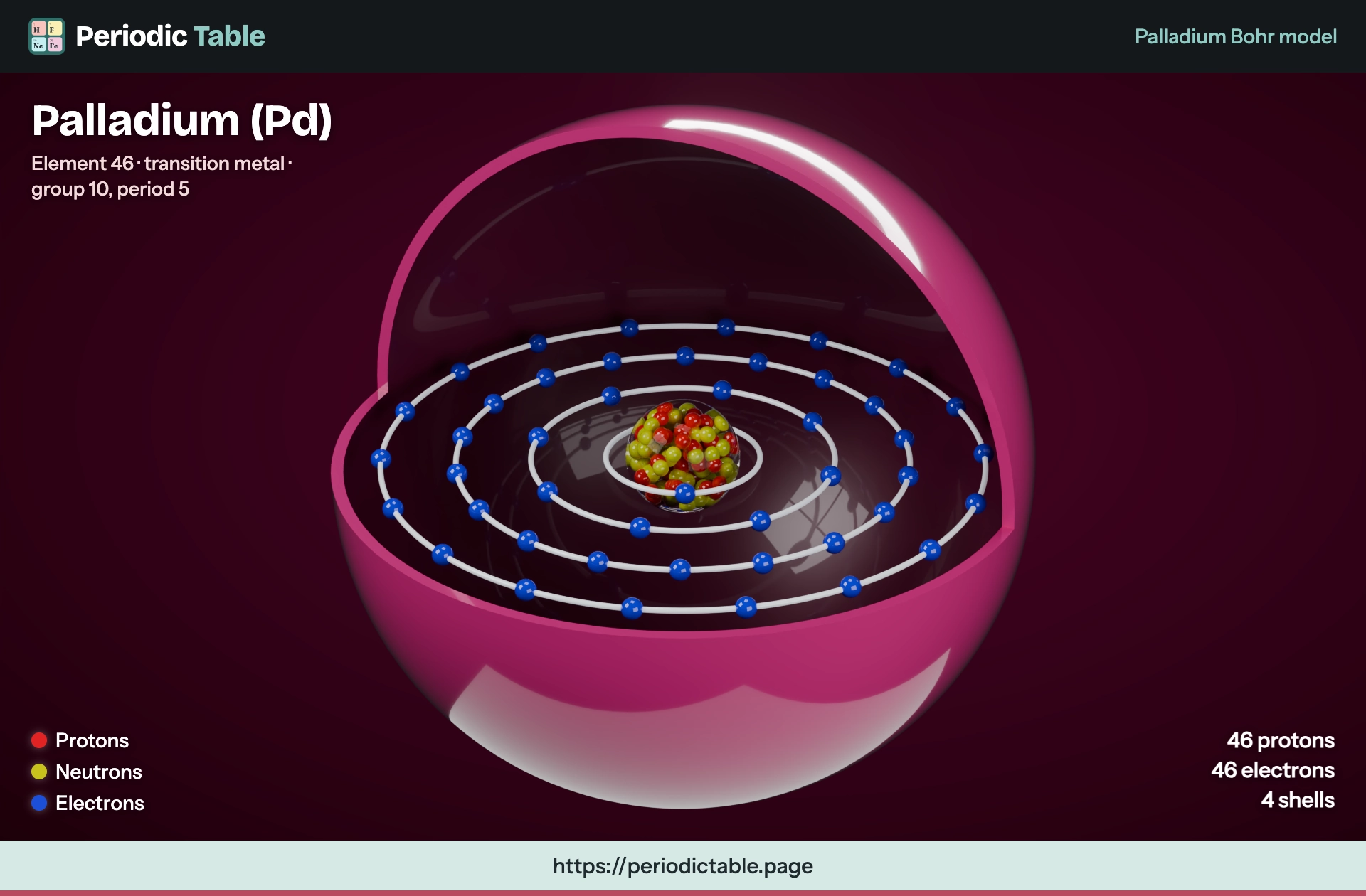
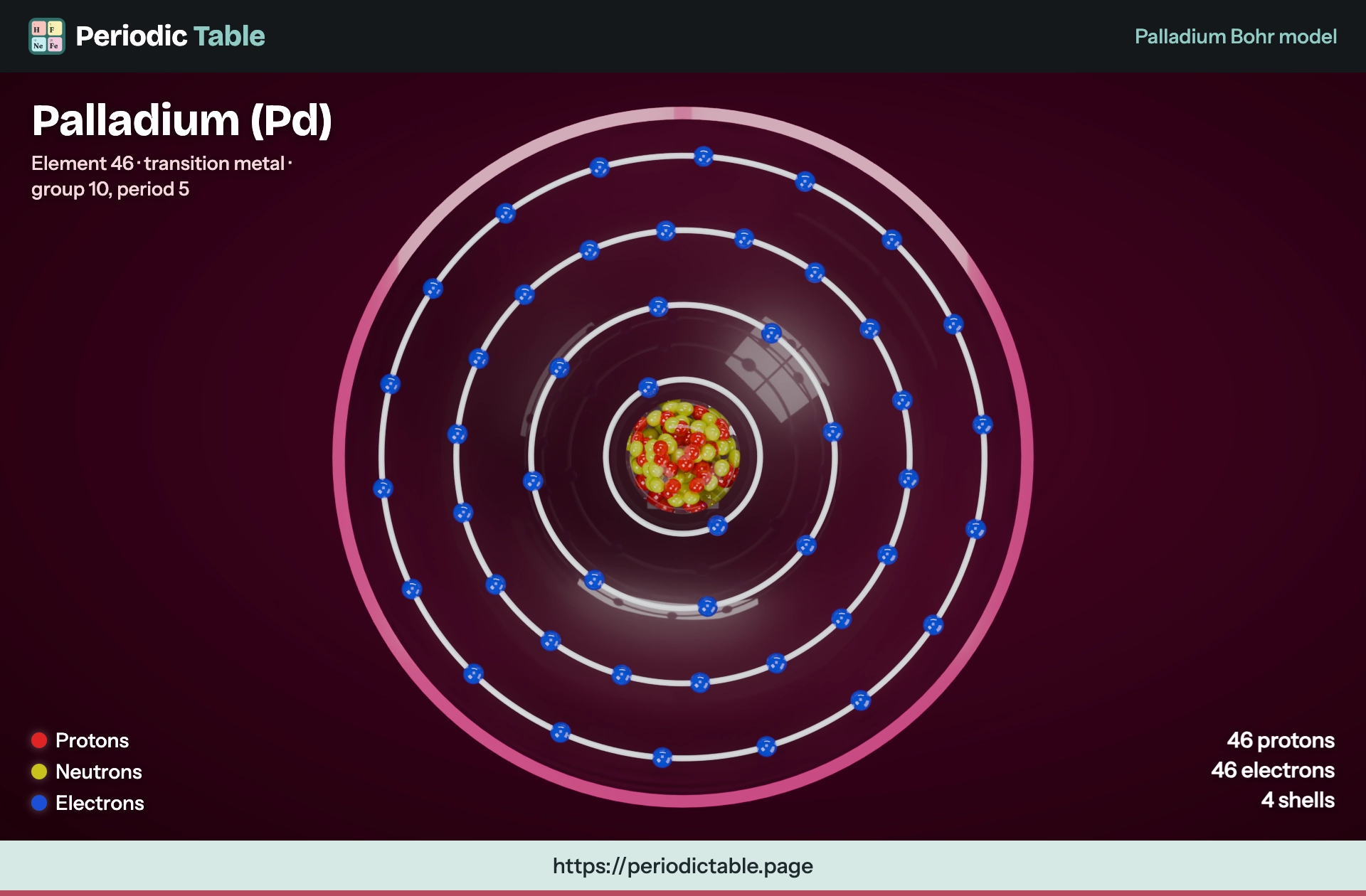
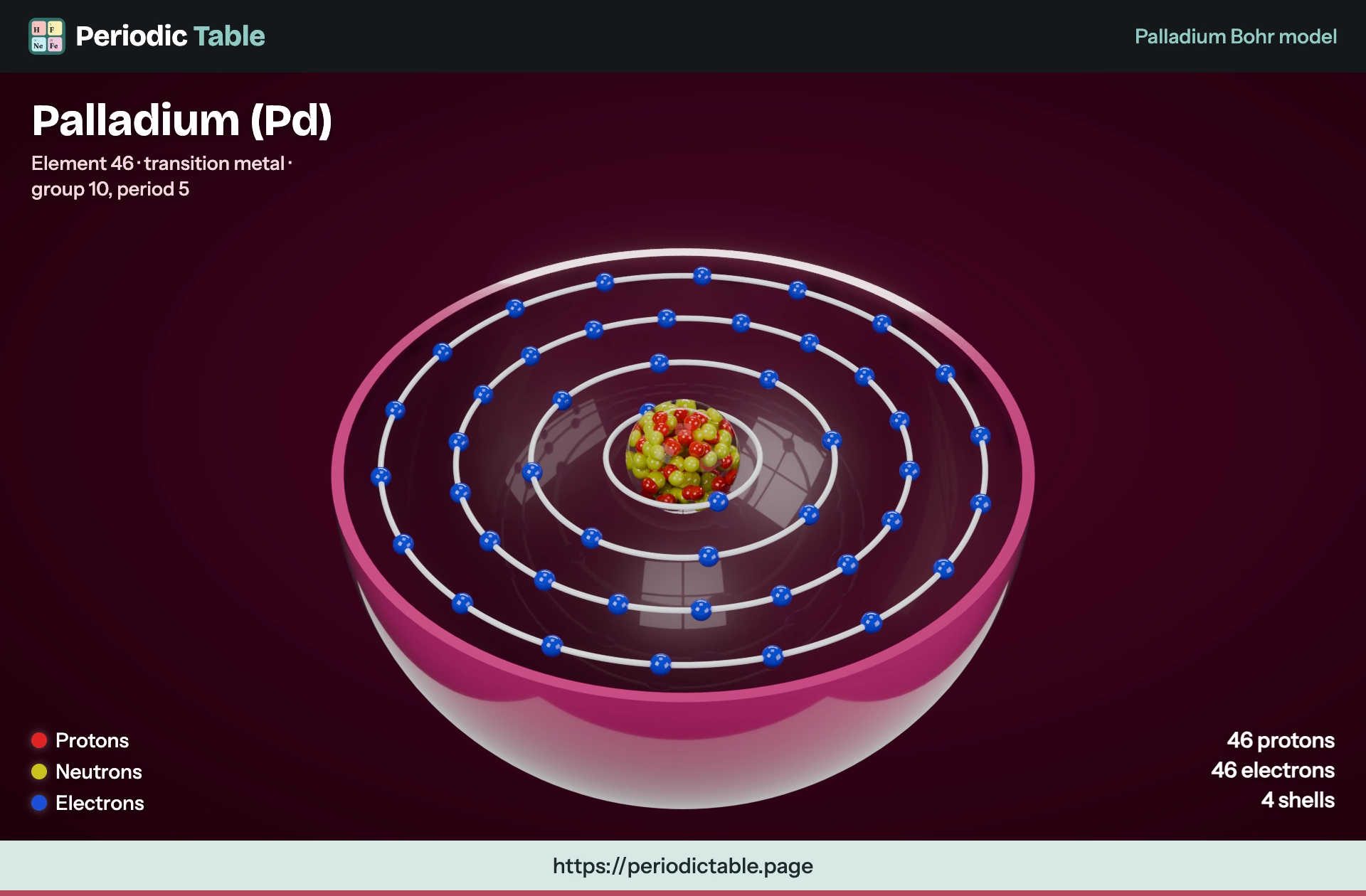
This is a Bohr model of palladium (Pd), a simplified picture of a single palladium atom. Its nucleus holds 46 protons, and a neutral palladium atom has 46 electrons, arranged around it in 4 shells (2 in shell K, 8 in shell L, 18 in shell M and 18 in shell N).
Palladium periodic table electron configuration
- Shorthand
- [Kr] 4d10
- Full
- 1s2 2s2 2p6 3s2 3p6 4s2 3d10 4p6 4d10
- Electrons per shell
- 2, 8, 18, 18
Palladium element properties and atomic data
- Atomic number
- 46
- Atomic mass
- 106.421 u
- Phase at STP
- Solid
- Melting point
- 1554.9°C (1828.05 K)
- Boiling point
- 2962.85°C (3236 K)
- Density
- 12.023 g/cm³
- Electronegativity (Pauling)
- 2.2
- Period
- 5
- Group
- 10
- Block
- d-block
- Appearance
- Silvery white
- Discovery date
- 1803
- Discovered by
- William Hyde Wollaston
- Named by
- —
Palladium at a glance: atomic number, density and key facts
Palladium is element 46 on the periodic table. Chemists class it as a noble metal because it resists attack from air and moisture, and as a transition element because its chemistry is driven by its d shell. The fact box below collects the values you will look up most often. Boiling point, density and oxidation states of quicksilver are summarised in the mercury toxicity, with its atomic weight.
| Property | Value |
|---|---|
| Symbol | Pd |
| Atomic number | 46 |
| Standard atomic weight | 106.42 |
| Group / period / block | Group 10, period 5, d-block |
| Electron configuration | [Kr] 4d10 |
| State at 20 °C | Solid |
| Density (20 °C) | 12.007 g/cm3 |
| Melting point | 1554.9 °C (1828.05 K) |
| Boiling point | 2963 °C (3236 K) |
| CAS number | 7440-05-3 |
To picture those numbers, take a one-troy-ounce bar (31.1035 g). At 12.007 g/cm3 it fills only about 2.59 cm3, roughly the size of a sugar cube and a half, while a full kilogram occupies about 83.3 cm3.
Where palladium sits: group 10, period 5, d-block
In its column, palladium sits below nickel and above platinum. What makes it unusual is its electron configuration.
The Madelung filling order predicts two electrons in the 5s orbital, but palladium moves them into the 4d set, leaving a completely filled 4d10 shell and an empty 5s. That makes it the heaviest element with only one incomplete outer shell, and it explains why palladium is so reluctant to react until a reaction pulls on those filled d orbitals.
Physical properties of palladium
Freshly polished palladium metal looks very much like platinum, with a bright, slightly warm grey-white lustre. Among its five platinum-group relatives it is the least dense and has the lowest melting point, which makes it easier to cast and work. Annealed metal is soft and ductile enough to beat into thin leaf, yet it gains a great deal of strength and hardness once cold-worked, a useful trait for springs and contacts. Scientists will find in the rutherfordium periodic table how heavy elements are built by nuclear reaction and studied in experiments.
| Physical property | Value |
|---|---|
| Crystal structure | Face-centered cubic (a = 389.02 pm) |
| Mohs hardness | 4.75 |
| Thermal conductivity | 71.8 W/(m·K) |
| Electrical resistivity (20 °C) | 105.4 nΩ·m |
| Specific heat capacity | 244 J/(kg·K) |
| Magnetic ordering | Paramagnetic |
The face-centered cubic lattice gives it many slip planes, which is why it deforms without cracking. Bulk palladium is paramagnetic rather than magnetic, and it conducts heat and electricity well, though less well than copper. One curiosity: thin films damaged by alpha-particle bombardment at very low temperature show superconductivity at about 3.2 K, something undamaged palladium never does.
Chemical properties and reactivity of Pd
Chemically, palladium is the most reactive of the platinum group, but palladium is still calm by everyday standards. It does not react with oxygen at room temperature, so it will not tarnish in air, and its resistance to corrosion is a big part of its value in connectors and dental work. Heat palladium to around 800 °C and a thin film of palladium oxide (PdO) forms on the surface, which decomposes again at higher temperatures.
- Dissolves readily in aqua regia at room temperature.
- Dissolves slowly in concentrated nitric acid and hot, concentrated sulfuric acid.
- Attacked by hydrochloric acid only when finely powdered.
- Reacts with chlorine on heating to give the dichloride.
Its electronegativity is 2.20 on the Pauling scale, and its first three ionization energies are 804.4, 1870 and 3177 kJ/mol, figures that sit close to those of platinum and help explain why the two metals share so much chemistry.
Palladium hydride and hydrogen purification
The most striking chemical trait of palladium is how much hydrogen it can hold. At room temperature it can take up around 900 times its own volume of the gas, which slips between the atoms of the lattice to form palladium hydride.
Warm palladium and the gas comes back out. Because no other gas passes through the lattice the same way, thin palladium membranes are used for hydrogen purification, delivering ultra-pure gas for semiconductor fabs and laboratories.
Palladium compounds and oxidation states
Most palladium compounds sit in the 0 or +2 oxidation states, with +4 less common and +1 and +3 known only in special cases. The workhorse compound is palladium(II) chloride, PdCl2, made by heating the metal in chlorine.
It is the usual starting point for making catalysts such as palladium on carbon, and dissolving it in nitric acid with acetic acid gives palladium(II) acetate, another common reagent. Zero-valent complexes like Pd(PPh3)4 round out the set of everyday laboratory forms.
Coupling reactions and catalysis in organic chemistry
Palladium catalysis changed how chemists join carbon atoms together. In coupling reactions such as the Heck, Suzuki, Negishi, Stille and Sonogashira reactions, a palladium centre swings between the 0 and +2 states while it stitches two molecular fragments into one. The 2010 Nobel Prize in Chemistry went to Richard Heck, Ei-ichi Negishi and Akira Suzuki for this work, and these reactions now underpin the synthesis of many pharmaceuticals, agrochemicals and fine chemicals.
Palladium also drives hydrogenation. The Lindlar catalyst, palladium on calcium carbonate deliberately poisoned with lead, stops the reduction of a triple bond at the double-bond stage, a selectivity that is hard to get any other way in organic chemistry.
Palladium's stable isotopes and radioactive forms
Natural palladium is a mix of six stable isotopes, plus vanishing traces of one long-lived unstable form. Pd-106 is the most common isotope, with Pd-108 a close second.
| Isotope | Atomic mass | Natural abundance |
|---|---|---|
| Pd-102 | 101.906 | 1.02% |
| Pd-104 | 103.904 | 11.14% |
| Pd-105 | 104.905 | 22.33% |
| Pd-106 | 105.903 | 27.33% |
| Pd-108 | 107.904 | 26.46% |
| Pd-110 | 109.905 | 11.72% |
Of the radioactive forms, Pd-107 has the longest half-life, about 6.5 million years. It is a fission product of uranium-235, so spent nuclear fuel contains recoverable palladium, though that slight radioactivity has kept anyone from extracting it.
Pd-103, with a half-life of 16.99 days, is sealed into tiny seeds used to treat prostate cancer. Lighter isotopes decay mainly by electron capture into rhodium, while heavier ones undergo beta decay into silver.
Discovery of palladium: Wollaston's new silver
English chemist William Hyde Wollaston isolated palladium in 1802 while refining South American platinum ore. He dissolved the residue in aqua regia, worked through a series of precipitations and finally heated palladium cyanide to release pure palladium. The same research also gave him a second new element.
Instead of publishing, Wollaston kept his purification method secret, since it protected his platinum business. In April 1803 an anonymous handbill appeared in a shop window on Gerrard Street in Soho, offering samples of "palladium, or new silver" for sale. Many chemists suspected a hoax.
Richard Chenevix argued palladium was an alloy of platinum and mercury and even received the Copley Medal for his work. Wollaston quietly offered a reward of twenty guineas to anyone who could make the "mixture" artificially, and nobody claimed it. In 1805 he finally explained his discovery to the Royal Society.
He named the element after the asteroid Pallas, found only months earlier, which in turn honours Pallas Athena, the Greek goddess of wisdom.
Where palladium is found: ores, mining and palladium supply
Palladium ore deposits are rare, and nearly all mined palladium comes as a by-product of nickel and copper production or from platinum-rich layers in ancient igneous rock. The global palladium supply rests on a handful of sites:
- Russia: the Norilsk–Talnakh deposits in Siberia, worked by Norilsk Nickel, the world's largest single producer.
- South Africa: the Merensky Reef and other layers of the Bushveld Igneous Complex.
- Canada: the Sudbury Basin and the Lac des Îles mine in Ontario.
- The United States: the Stillwater Complex in Montana.
- Zimbabwe: the Great Dyke.
World mining output was about 210,000 kilograms in 2022, with Russia supplying roughly 40% of it. That concentration means geopolitics moves the market: sanctions, export disputes and power cuts at South African mines all show up quickly in supply forecasts.
Recycling and refining Pd from scrap
Early extraction relied on slow, multi-step chemical separations. Modern refiners use acid leaching and solvent extraction, and recycling has become a major second source. Spent autocatalysts, electronic scrap and old dental work are collected, smelted and refined, and the Royal Society of Chemistry estimates that more than 30% of palladium is now recovered this way.
Uses of palladium in industry
The main uses of palladium draw on three traits: catalytic power, corrosion resistance and its white colour. More than half of annual demand goes into one product, but palladium turns up in dozens of others.
Catalytic converters and vehicle exhaust
Catalytic converters are by far the largest market. A typical car needs only a few grams, yet the automotive sector still consumes most of the world's output.
In a three-way converter, palladium works alongside platinum and rhodium to turn toxic carbon monoxide and unburned hydrocarbons into carbon dioxide and water vapor, and to break down nitrogen oxides. Tighter emissions rules on petrol exhaust have kept demand high for two decades.
Electronics and electrical contacts
In electronics, palladium and palladium-silver pastes form the electrodes in multilayer ceramic capacitors, tiny parts found by the hundred in every phone and laptop. It also plates connectors and electrical contacts that must not corrode, and it is used in aircraft spark plugs.
Dentistry and medical devices
Dentistry has used palladium for decades. Dental alloys for crowns and bridges rely on its strength, biocompatibility and white colour. In medicine it appears in surgical instruments, in the electrodes of blood sugar test strips and in the Pd-103 seeds mentioned above.
Jewellery, white gold and watchmaking
Palladium is a popular jewellery choice in its own right, and since 2010 UK palladium jewellery has had to carry its own hallmark. Its biggest role in jewelry, though, is as the whitening agent in white gold: a palladium-gold alloy gives a white colour without nickel, which many people react to. Its light weight also suits watchmaking and even some concert flutes.
Palladium as a precious metal investment
With a small, concentrated supply and steady industrial demand, palladium attracts serious investment interest. As a commodity it has its own ISO currency code, XPD, one of only four metals with such a code alongside gold, silver and platinum.
The palladium price is quoted per ounce, meaning the troy ounce of 31.1035 g, and it is famously volatile. It overtook gold in 2019, more than tripled between 2018 and 2021, then fell back sharply as car makers switched some loadings to platinum.
Bullion bars, coins and ETFs
You can hold palladium physically as bullion bars or palladium coins such as the Canadian Maple Leaf and the American Eagle, or gain exposure through physically backed ETFs and exchange-traded futures. Palladium held in an approved vault avoids delivery and some tax costs, while funds and futures trade like shares but add management fees or contract risk.
Is palladium metal toxic? health and handling
Solid palladium is considered low in toxicity: the body absorbs very little of it, and jewellery made from it is generally well tolerated. Some people with a nickel allergy do react to it, though, and soluble salts such as the chloride are harmful if swallowed in quantity.
The real handling hazard is finely divided catalyst. Dry palladium on carbon that has been exposed to hydrogen can ignite solvent vapours, so labs keep it wet and under an inert gas.
Pd in clean energy: fuel cells and the cold fusion claim
Palladium membranes and catalysts are being developed for hydrogen fuel cells that power buses and cars. Its gas-absorbing talent also produced the strangest episode in its history: on 23 March 1989, Martin Fleischmann and Stanley Pons announced cold fusion, claiming that electrolysing heavy water with a palladium cathode released excess energy from nuclear fusion. Laboratories around the world tried and failed to reproduce the result, and the claim is now regarded as an error, but it remains the most famous experiment ever run on palladium.