Mercury element (Hg): mercury periodic table facts
Mercury periodic table facts: mercury (Hg) is element 80, a transition metal in group 12, period 6. Tip a drop of mercury onto a glass plate and it races around as a bright bead instead of spreading out, which is why people called it quicksilver long before chemists gave it the symbol Hg. For physical data on a heavy pnictogen, melting point, density and thermal conductivity are laid out in the bismuth element reference for students.
Mercury is a heavy, shiny, silvery-white metal and a chemical element with atomic number 80, and it is the only metal that stays liquid at room temperature. That same metal is also toxic, so knowing how it behaves explains both why it was so useful and why it is now so tightly controlled.
Rotate the 3D Bohr model of mercury
Drag to orbit, scroll to zoom.
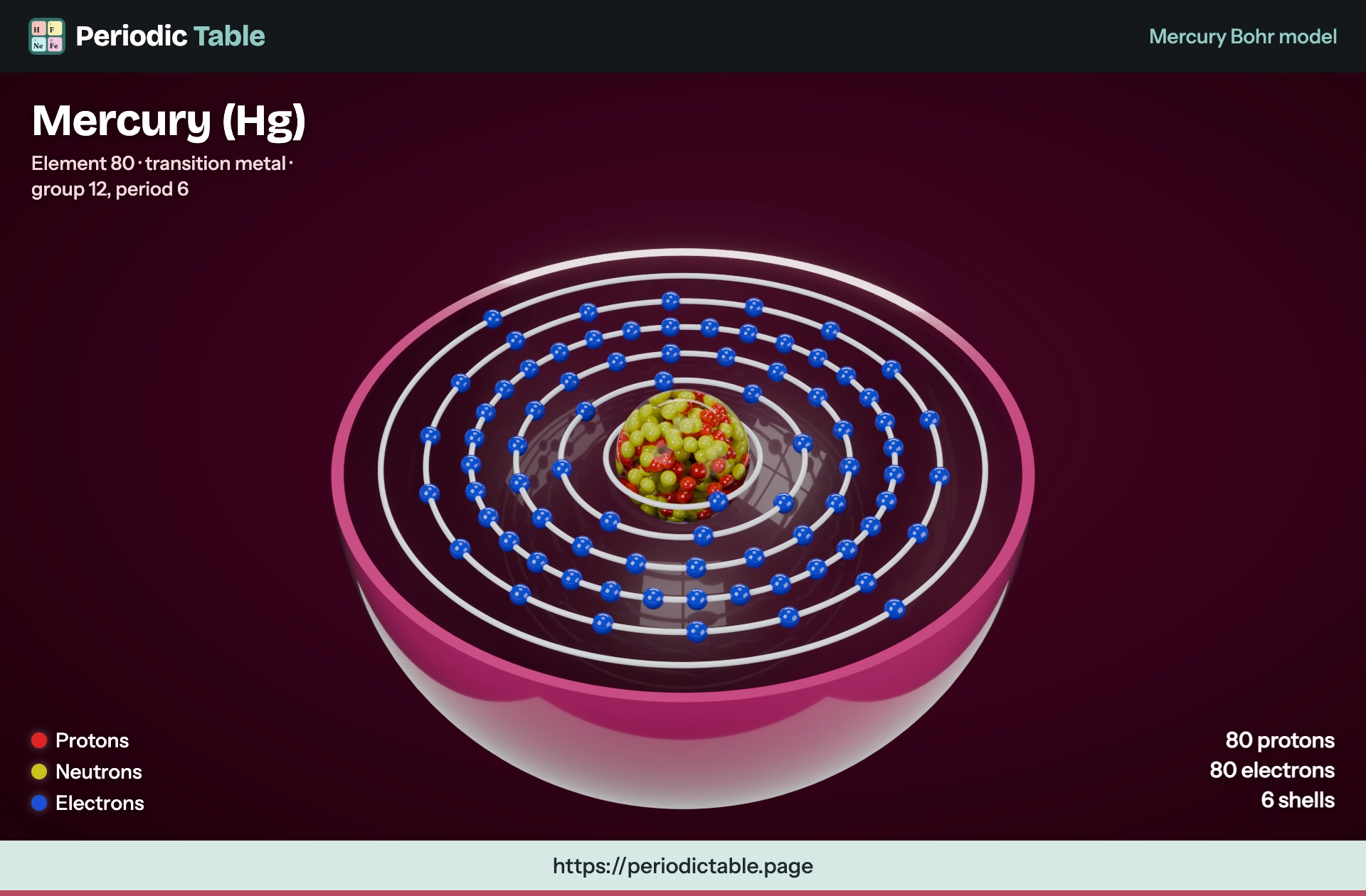
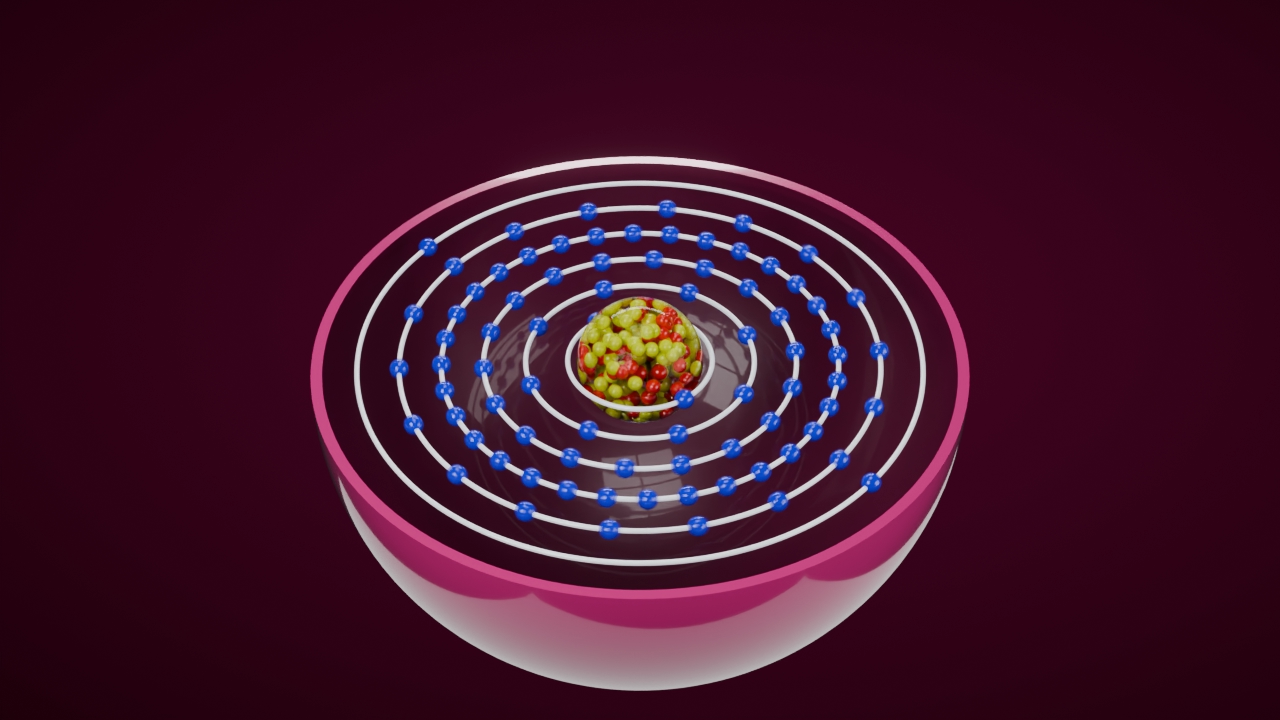
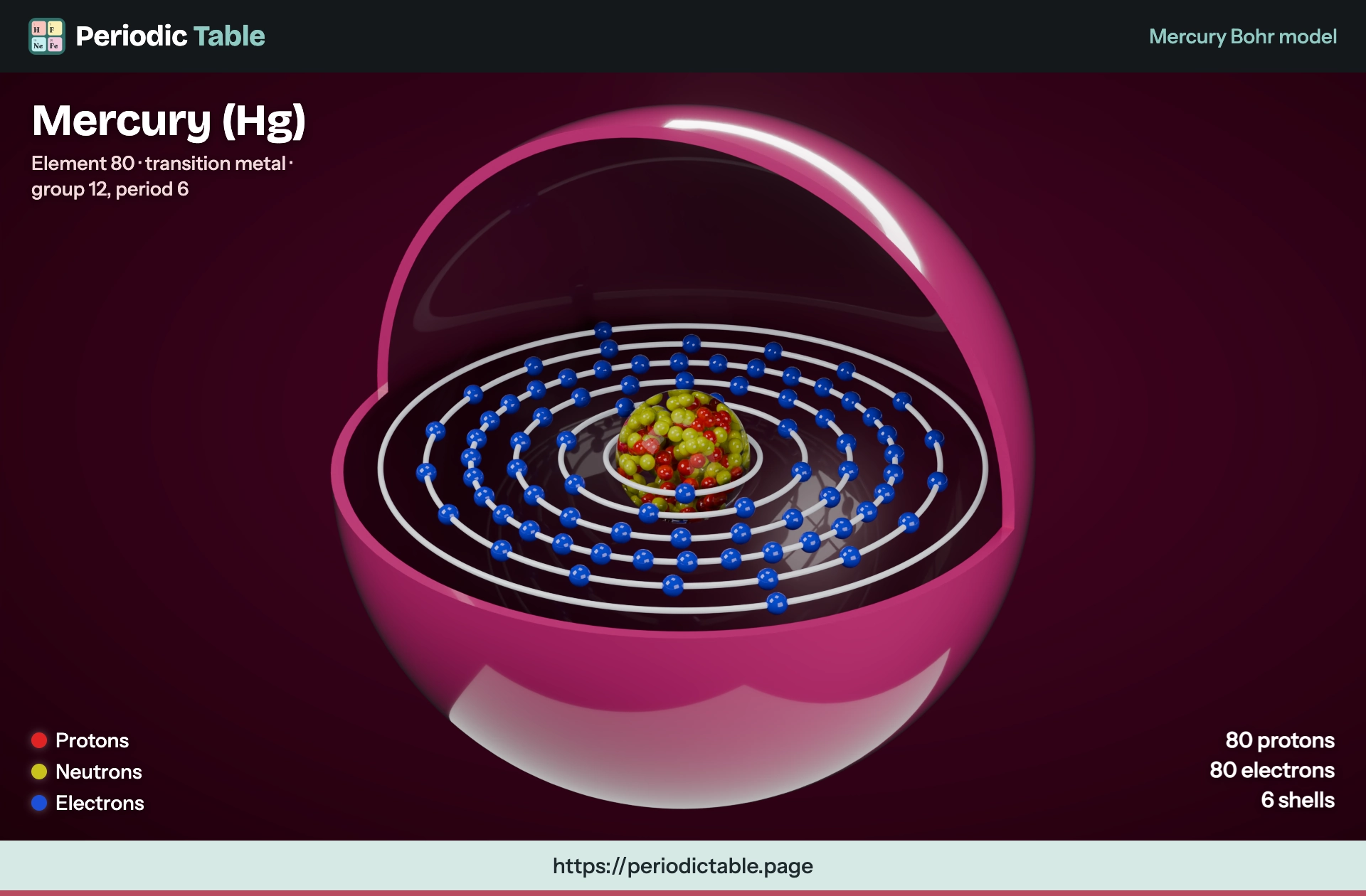
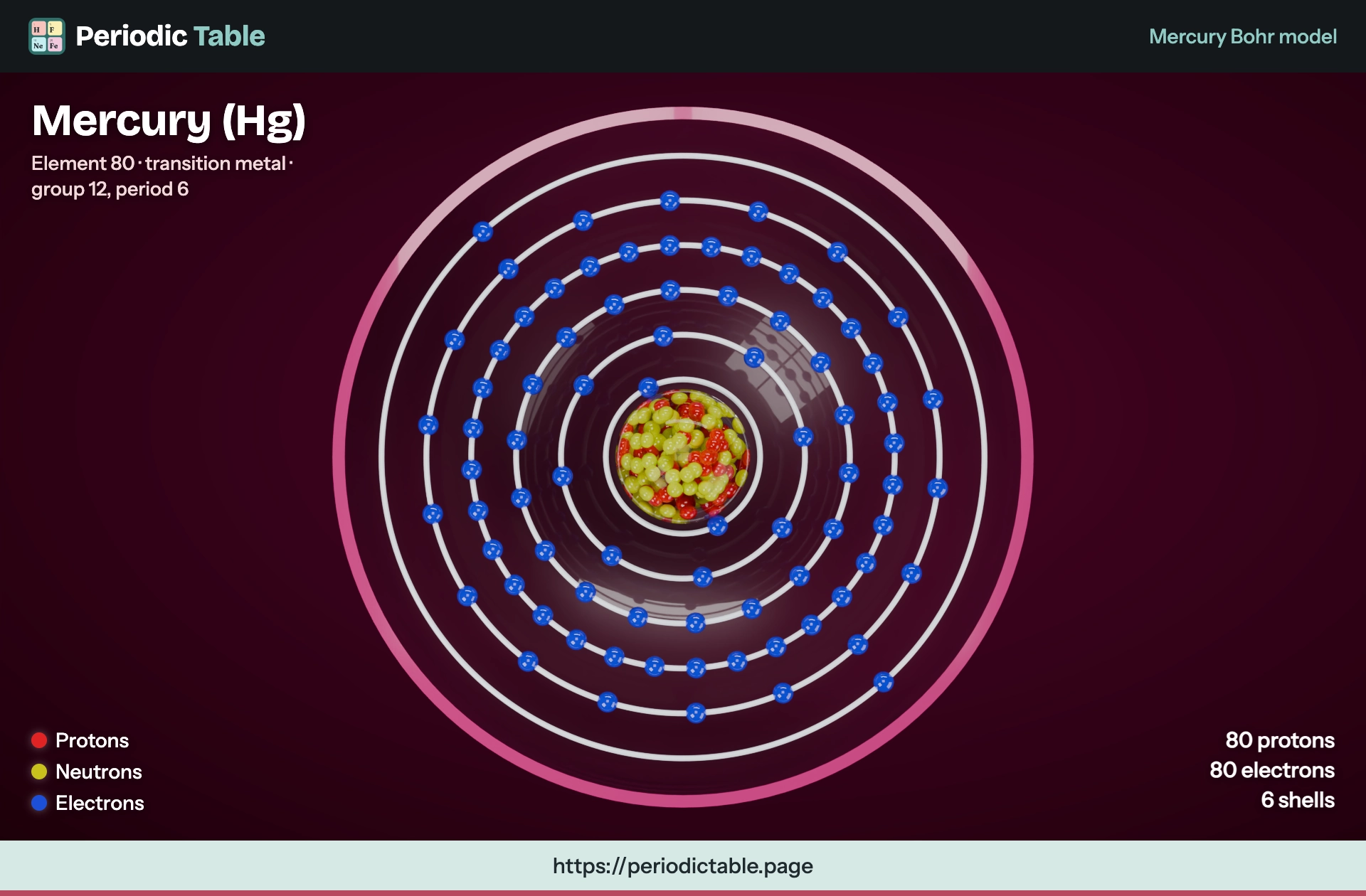
This is a Bohr model of mercury (Hg), a simplified picture of a single mercury atom. Its nucleus holds 80 protons, and a neutral mercury atom has 80 electrons, arranged around it in 6 shells (2 in shell K, 8 in shell L, 18 in shell M, 32 in shell N, 18 in shell O and 2 in shell P).
Mercury periodic table electron configuration
- Shorthand
- [Xe] 4f14 5d10 6s2
- Full
- 1s2 2s2 2p6 3s2 3p6 4s2 3d10 4p6 5s2 4d10 5p6 6s2 4f14 5d10
- Electrons per shell
- 2, 8, 18, 32, 18, 2
Mercury element properties and atomic data
- Atomic number
- 80
- Atomic mass
- 200.5923 u
- Phase at STP
- Liquid
- Melting point
- -38.83°C (234.321 K)
- Boiling point
- 356.73°C (629.88 K)
- Density
- 13.534 g/cm³
- Electronegativity (Pauling)
- 2
- Period
- 6
- Group
- 12
- Block
- d-block
- Appearance
- Silvery
- Discovery date
- Ancient
- Discovered by
- Unknown
- Named by
- —
Mercury element facts at a glance
Mercury (element 80) sits in the sixth row of the periodic table, between gold and thallium. The table below gathers the core data you need for homework, lab work or a quick comparison with neighbouring metals. Values are for pure mercury at standard conditions unless noted. Students of heavy elements will get from element 105 a view of applications limited to basic science.
| Property | Value for mercury |
|---|---|
| Symbol | Hg (from hydrargyrum, "water-silver") |
| Atomic number | 80 |
| Standard atomic weight | 200.59 |
| Group, period, block | Group 12, period 6, d-block |
| Electron configuration | [Xe] 4f14 5d10 6s2 |
| Electrons per shell | 2, 8, 18, 32, 18, 2 |
| State at 20 °C | Liquid metal |
| Melting point | −38.83 °C (234.32 K) |
| Boiling point | 356.73 °C (629.88 K) |
| Triple point | 234.3156 K at 1.65 × 10⁻⁷ kPa |
| Density (liquid, 20 °C) | 13.546 g/cm³ |
| Electronegativity (Pauling) | 2.00 |
| Common oxidation states | +1, +2 |
| Crystal structure (solid) | Rhombohedral |
| Magnetic ordering | Diamagnetic |
| CAS number | 7439-97-6 |
The atomic weight of 200.59 is an average across seven stable isotopes, so no single mercury atom actually weighs exactly that much. The high density, low melting point and modest electronegativity are the three numbers that explain most of what follows on this page.
Where Hg sits in the periodic table
Mercury closes off group 12 beneath zinc and cadmium, and it is the last stable member of that column (copernicium, below it, is synthetic). Like its two lighter relatives, mercury has a completely filled d subshell, which is why some chemists argue group 12 metals are not true transition metals at all: their electrons in the 5d shell almost never take part in bonding.
In practice Hg behaves like a soft, post-transition-style metal that loses its two 6s electrons and stops there. Its row neighbour, gold, has one fewer proton, yet the two look and behave very differently, a contrast explained in the next section.
Physical properties of liquid mercury
Most of what makes mercury memorable is physical rather than chemical. Its physical properties combine an unusually weak metallic bond with a very heavy nucleus, and that pairing produces a dense liquid metal with a narrow liquid range. When catalytic converters or hydrogen purification matter to you, the palladium on the periodic table guide describes both main uses.
Why mercury metal stays liquid
At standard temperature and pressure only two elements are liquid: bromine, a halogen that stays liquid from −7.2 °C to 58.8 °C, and mercury. Gallium and caesium melt only a few degrees above a warm room, but they start out solid. Mercury metal freezes at −38.83 °C, far below any other stable metal.
The reason is the way its outer electrons are held. Eighty protons pull the 6s electrons inward so fast that they move at a sizeable fraction of the speed of light, and that relativistic effect shrinks and stabilises the 6s orbital. The lanthanide contraction adds to it, because the poorly shielding 4f electrons fill just before mercury.
Both effects hold the two 6s electrons tightly, so they are reluctant to join the shared "sea" of electrons that ties metal atoms together. The result is weak metallic bonding, a low melting point and a boiling point of just 356.73 °C, which gives mercury the narrowest liquid range of any metal, about 396 °C.
Caesium, by comparison, stays liquid from 28.5 °C to 671 °C, and lead from 327.5 °C to 1,749 °C. Gold, with only one 6s electron, bonds strongly and melts at 1,064 °C.

Density, surface tension and thermal expansion
At 13.546 g/cm³, liquid mercury is about 13.5 times as dense as water. A steel ball bearing or a lead fishing weight floats on it, and only a handful of metals such as gold, platinum and tungsten sink. A one-litre bottle of mercury weighs about 13.5 kg.
Mercury's surface tension is roughly six times that of water, so a spilled drop pulls itself into a bead rather than wetting glass. The liquid also has a steady coefficient of thermal expansion over a wide temperature range, which is the property that made it the standard fluid for thermometers. Compared with copper or silver, mercury is a poor conductor of heat, but it is a fair conductor of electricity, good enough to complete a circuit in a tilt switch.
Mercury's low vapor pressure is the property people most often underestimate. It is small in absolute terms (about 0.17 Pa at 20 °C), yet still high enough that air above an open dish of metal can hold well over the occupational exposure limit. That is why an uncovered spill matters even when you cannot see or smell anything.
Solid mercury and superconductivity
Below −38.83 °C solid mercury forms a rhombohedral crystal that is soft enough to cut with a knife. It shrinks by about 3.6% on freezing, the opposite of water. Under high pressure it passes through several more solid forms.
Mercury also holds a place in physics history as the first known superconductor. In 1911 Heike Kamerlingh Onnes cooled a mercury wire with liquid helium and watched its electrical resistance drop to zero at about 4.2 K. That discovery opened the field that later gave us MRI magnets.
Chemical properties of the mercury element
The mercury element is less reactive than most metals but more reactive than gold. Mercury chemistry is dominated by the +1 and +2 states and by a strong attraction to sulfur, which shapes both its ores and its toxicity.
Oxidation states and reactivity
Mercury does not react with air at room temperature, and it ignores dilute hydrochloric acid. It is more reactive than the noble metals gold and platinum, though, and it dissolves in oxidising acids: nitric acid, hot concentrated sulfuric acid and aqua regia all attack it. Heated in air near its boiling point, it slowly forms red mercury(II) oxide.
Its two common oxidation states behave differently:
- Mercury(I), or mercurous, compounds contain a paired Hg–Hg unit, so mercury is one of the few metals that bonds to itself in its ions.
- Mercury(II), or mercuric, compounds are more common, more soluble and usually more toxic.
- Mercury(II) ions bind tightly to sulfur, which is why they latch onto the sulfur-bearing proteins in your cells.
Its first ionization energy, 1,007 kJ/mol, is the highest of any metal, another sign of how tightly those 6s electrons are held. Removing a third electron would mean breaking into the full 5d shell, which is why mercury chemistry almost never goes beyond +2.
Isotopes of mercury
Natural mercury is a mix of seven stable isotopes. Hg-202 is the most common, and Hg-196 is the rarest at just 0.15%. Their natural abundances are:
- Hg-196: 0.15%
- Hg-198: 9.97%
- Hg-199: 16.87%
- Hg-200: 23.10%
- Hg-201: 13.18%
- Hg-202: 29.86%
- Hg-204: 6.87%
Of the radioactive isotopes, Hg-194 lasts longest, with a half-life of about 440 years. Hg-203 (half-life about 47 days) is used as a tracer in research. Small differences in isotope ratios also let scientists trace mercury pollution back to a particular coal field or mine.

Mercury compounds and amalgams
Mercury compounds range from a harmless-looking red pigment to some of the most dangerous chemicals ever made in a lab. The split that matters most is between inorganic compounds and organomercury compounds, which carry a carbon–mercury bond.
Inorganic mercury salts
Inorganic mercury forms when the metal combines with chlorine, sulfur or oxygen, and it is the form most common in the environment, locked up in rocks, soil and sediments. These mercury salts have been used for centuries, and several still have a niche today:
| Compound | Formula | Traditional or current use |
|---|---|---|
| Mercuric chloride (corrosive sublimate) | HgCl2 | Disinfectant, wood preservative, laboratory reagent; highly toxic |
| Mercurous chloride (calomel) | Hg2Cl2 | Reference electrodes; formerly a laxative and teething powder |
| Mercuric sulfide (vermilion) | HgS | Red pigment, the same compound as the ore cinnabar |
| Mercuric oxide | HgO | Older batteries; Priestley heated it to isolate oxygen in 1774 |
| Mercury fulminate | Hg(CNO)2 | Detonator in early percussion caps |
| Mercuric sulfate | HgSO4 | Catalyst in organic synthesis |
Calomel is far less toxic than mercuric chloride because it dissolves so poorly, a clear example of how solubility, not just mercury content, decides how harmful a compound is. Vermilion was ground from cinnabar as a red pigment in Roman wall paintings and Chinese lacquer.
Methylmercury and other organic mercury
Organic mercury compounds attach mercury directly to carbon. Methylmercury is the one that matters most for public health: microbes in sediments make it from inorganic mercury, and it moves easily through cell membranes, including the barrier that protects the brain.
Dimethylmercury is even more dangerous; a few drops can be lethal through a laboratory glove. Ethylmercury is the breakdown product of thimerosal, a preservative once common in multi-dose vaccines, which the body clears much faster than methylmercury.
Amalgam: how mercury dissolves gold and silver
Mercury dissolves many metals to form an amalgam, a solid or pasty alloy. Gold, silver, tin and zinc amalgamate readily, while iron does not, which is why mercury has long been stored in iron flasks.
Dental amalgam is about half mercury by weight, mixed with silver, tin and copper. Miners use the same reaction to collect fine gold particles from crushed ore and then burn the mercury off, a practice that releases large amounts of mercury vapor.
Where quicksilver comes from: cinnabar and mining
Quicksilver is rare in Earth's crust, at roughly 0.08 parts per million, but it gathers in concentrated deposits near volcanic and hot-spring activity. Its main ore is cinnabar, mercury(II) sulfide, a heavy brick-red mineral. Native droplets of the metal sometimes sit inside cinnabar, but almost all mercury comes from roasting the ore.
Production is simple chemistry. Crushed cinnabar is heated in a current of air to around 600 °C; the sulfur leaves as sulfur dioxide and the mercury boils off as mercury vapor, which is then cooled and condensed back into liquid metal. This smelting step is also where workers historically received their heaviest doses.
The richest mine in history was Almadén in Spain, worked for roughly two thousand years and responsible for about a third of all mercury ever produced. It stopped mining in the early 2000s and is now a UNESCO World Heritage site. Today China produces most new mercury, with smaller output from Mexico, Tajikistan and Kyrgyzstan, while a growing share of supply comes from recycling and from waste streams such as natural-gas cleaning.
Uses of mercury in industry and science
Elemental mercury earned a place in industry because no other material is a dense, conductive liquid at room temperature. Most of those uses are being phased out, but you will still meet many of them in older equipment.
Thermometers, barometers and manometers
Mercury thermometers rely on the liquid's even expansion: a thin column rises by a predictable amount for each degree. Because mercury is so dense, a column only 760 mm tall balances the weight of the whole atmosphere at sea level, so barometers and manometers can stay compact.
That is where the pressure unit mmHg comes from, and why blood pressure is still quoted in it even though most sphygmomanometers have switched to aneroid or digital sensors. Glass mercury thermometers are now banned or discouraged in many countries in favour of digital and alcohol-filled versions.
Fluorescent lamps and mercury switches
Inside a fluorescent tube, an electric current excites mercury atoms, which emit ultraviolet light; a phosphor coating on the glass turns that into visible light. Compact fluorescent light bulbs typically contain only a few milligrams of mercury each, but billions of fluorescent lamps add up, and LEDs are now replacing them.
Mercury switches use a sealed blob of the liquid that rolls to make or break a circuit when tilted, and they were common in older thermostats and car-boot lights. Mercury also appeared in some button cells and alkaline batteries until regulations removed it.
Chlorine and caustic soda production
The chlor-alkali industry once relied on the mercury cell. Brine flows over a liquid mercury cathode, and electrolysis splits it into chlorine gas and a sodium amalgam; reacting that amalgam with water gives very pure sodium hydroxide, also called caustic soda. Leaks from these plants were a major pollution source, and the process has been replaced almost everywhere by membrane cells.
Quicksilver in medicine and dental fillings
Medicine used mercury for centuries. Calomel was a standard purgative, mercury ointments were the main treatment for syphilis from the 1500s until antibiotics, and mercurochrome was a household antiseptic.
The main survivor is dental fillings made from amalgam, which are durable and cheap but are being phased down. Mercury salts still turn up illegally in some skin lightening creams, which is one of the more common sources of inorganic poisoning today.
Toxicity of mercury and its health effects
How harmful mercury is depends on its form and on how it enters your body. Swallowing a little liquid mercury usually does less damage than most people expect, while breathing its vapour or eating methylmercury in food can cause lasting health problems. Exposure is measured over time, so both a large single dose and years of small doses matter.
How exposure to metallic mercury happens
Metallic mercury is poorly absorbed through the gut, but about 80% of inhaled mercury vapor passes into your blood. The vapour is invisible and odorless, so a broken thermometer in a warm, closed room can create a toxic vapor without any warning sign. Occupational exposure is highest in mining, smelting, small-scale gold processing, dental practices and the manufacture of lamps and instruments.
For most people the biggest source is diet. Large predatory fish and shellfish, such as swordfish, shark and king mackerel, carry the highest levels of methylmercury, while salmon, sardines and shrimp carry much less. Health agencies advise pregnant women and young children to choose low-mercury fish rather than avoiding fish altogether.
Symptoms of mercury poisoning
Mercury poisoning mainly targets the nervous system. Chronic exposure to vapour causes tremors, irritability, shyness, memory loss and sore gums, a cluster once called erethism. Inorganic mercury salts damage the kidneys and the gut.
Methylmercury attacks the brain, narrowing vision, numbing hands and lips and impairing balance and speech, and it crosses the placenta, so a developing baby can be harmed at doses that leave the mother without symptoms. Mercury also disturbs the immune system and can trigger allergic skin reactions.
Treatment starts with ending the exposure. For inorganic and elemental poisoning, doctors use chelation with drugs such as DMSA or DMPS, which bind mercury so the body can excrete it. Chelation helps far less once methylmercury has reached the brain.
Cleaning up a mercury spill
For a small spill of elemental mercury, such as one broken thermometer, open the windows, keep people and pets away and turn off heating or fans that blow air through the room. Gather beads with stiff paper and pick up fine droplets with sticky tape, then seal everything in a glass jar.
Never use a vacuum cleaner or broom, which spread the vapour, and contact your local waste authority for disposal. Larger spills need professional cleanup.
Environmental effects of mercury pollution
Mercury does not break down, it only changes form, so pollution released anywhere builds up in the environment over decades. The environmental effects come from three steps: release into the air, deposition onto land and water, and conversion to methylmercury.
Mercury emissions from coal and gold mining
Natural sources such as volcanoes and weathering rocks release some mercury into the environment, but human activity has raised the amount in the atmosphere several times over since 1850. The two largest sources of emissions worldwide are small-scale gold mining, where mercury amalgam is heated over open fires, and burning coal.
In the United States, coal-fired power plants were long the largest source until emission limits took effect in the 2010s. Cement kilns, metal smelting and waste incineration add more.
Elemental mercury vapor can stay aloft for months, which puts it into a global cycle: emissions from one continent fall on another. Rain and dry air deposition bring it down onto soil and lakes, and some of it evaporates again and moves on, so remote Arctic lakes now carry mercury from industrial regions thousands of kilometres away.
Biomagnification in the aquatic food chain
Once mercury reaches lake or ocean water, bacteria in low-oxygen sediments convert part of it to methylmercury. Plankton absorb it, small fish eat the plankton, and larger fish eat the small ones. Because methylmercury is stored in muscle rather than excreted, its concentration rises at each step of the food chain, a process called biomagnification.
Top predators can carry a million times the concentration found in the surrounding water. Fish-eating birds and mammals, such as loons, otters and eagles, show reduced breeding and abnormal behaviour as a result, and people who depend on the same food chains face the highest dietary doses.
History of quicksilver: alchemy, hatters and disasters
Few elements have a longer or darker history than mercury. Mercury has been found in Egyptian tombs dated to around 1500 BCE, and cinnabar was used as a pigment for thousands of years before that.
The name hydrargyrum and the planet mercury
The symbol Hg comes from the Latin hydrargyrum, built from the Greek words for water and silver, so the name means "water-silver" or liquid silver. The English name links the metal to the planet Mercury, named after the fast-moving Roman god, because medieval alchemists paired each known metal with a planet; reference works still file it as mercury (element) to keep the two apart.
Alchemy treated mercury as one of the principles behind all metals, and generations of alchemists tried to turn it into gold. Chinese alchemists went further and drank mercury preparations as elixirs of long life, with fatal results.
Mad hatters, Minamata and other mercury disasters
Hat makers in the 1700s and 1800s brushed mercuric nitrate onto animal fur to help it felt, and breathed mercury fumes all day. The tremors and personality changes that followed fed the phrase "mad as a hatter", and in Danbury, Connecticut the symptoms were known as the "Danbury shakes". The US Public Health Service ended the practice in 1941.
The worst modern disaster began in Minamata, Japan, where a chemical plant discharged mercury waste into the bay. Bacteria converted it to methylmercury, fish concentrated it, and from 1956 thousands of residents were diagnosed with what became known as Minamata disease.
In Iraq in 1971–72, seed grain treated with a methylmercury fungicide was baked into bread, and about 6,500 people were hospitalised. In 1997 the Dartmouth chemist Karen Wetterhahn died months after a few drops of dimethylmercury touched her glove, a case that changed laboratory safety rules worldwide.

Mercury regulations and the Minamata convention
These disasters led to tight regulations. The Minamata Convention on Mercury, a global treaty adopted in 2013 and in force since 2017, bans new mercury mines, phases out mercury in batteries, switches, most lamps, thermometers and cosmetics, phases down dental amalgam and requires countries to cut emissions from coal plants and gold mining. The European Union has banned mercury exports since 2011 and banned mercury cells for chlor-alkali plants from the end of 2017.
In the United States, the Mercury Export Ban Act and the EPA's power-plant standards limit trade and emissions. Together these rules aim to keep mercury out of the environment at every stage, from mine to landfill. If you find old mercury devices at home, take them to a household hazardous-waste collection point rather than throwing them away.