


Dubnium element (Db): dubnium periodic table facts
Dubnium periodic table facts: dubnium (Db) is element 105, a transition metal in group 5, period 7. You will never hold a sample of dubnium, and neither has anyone else: the element dubnium has only ever existed a few atoms at a time, made one collision at a time inside particle accelerators. Low toxicity and lead replacement in alloys are discussed in the bismuth on the periodic table, including supply risk.
Its longest-lived form, dubnium-268, lasts about 16 hours before it decays, so everything known about this chemical element comes from fleeting single-atom measurements and careful theory. Below you get the key facts, the Cold War fight over its discovery between JINR and Berkeley, its isotopes, and what chemists have actually learned about how it behaves.
Rotate the 3D Bohr model of dubnium
Drag to orbit, scroll to zoom.
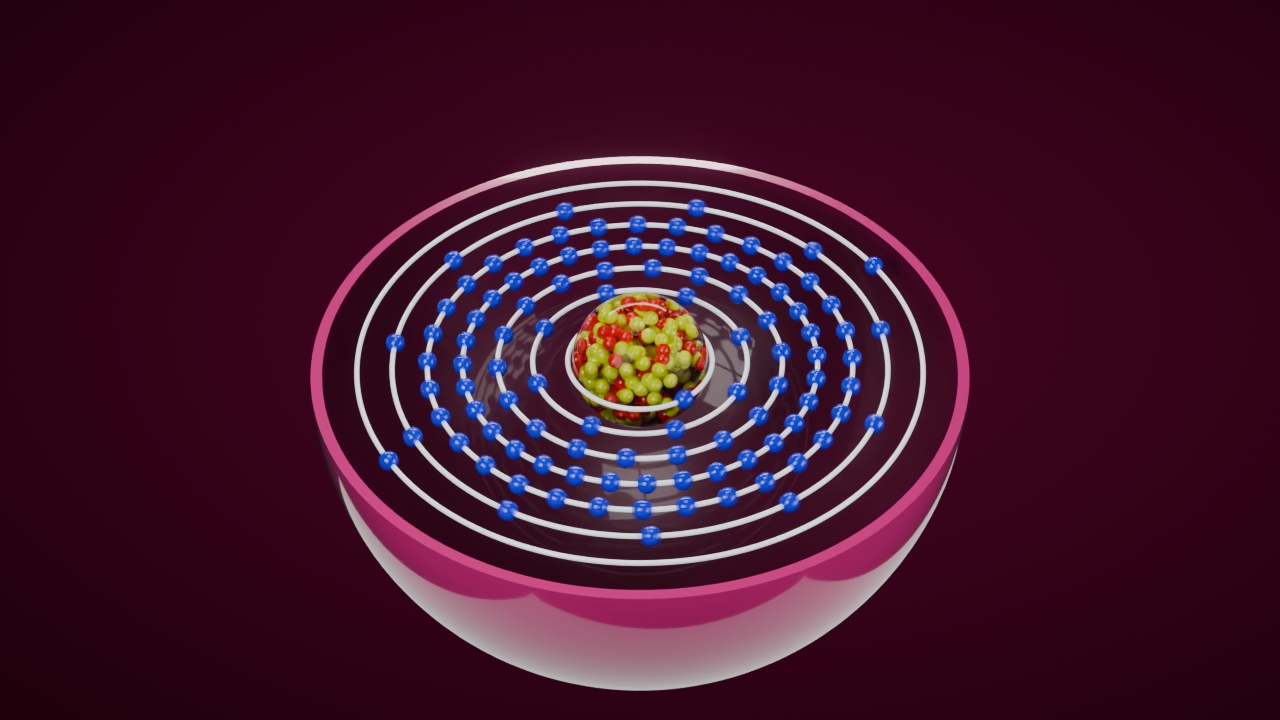
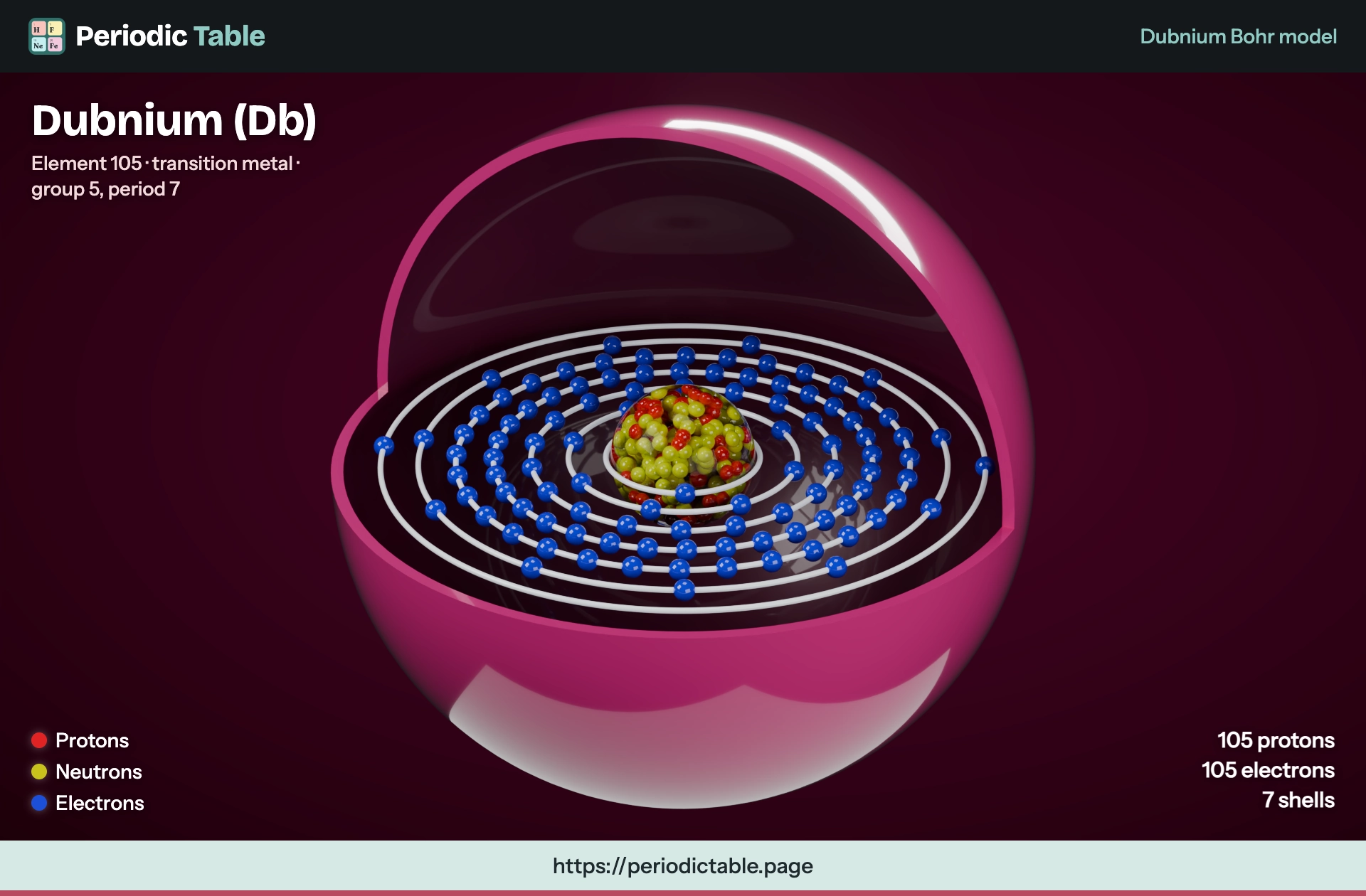
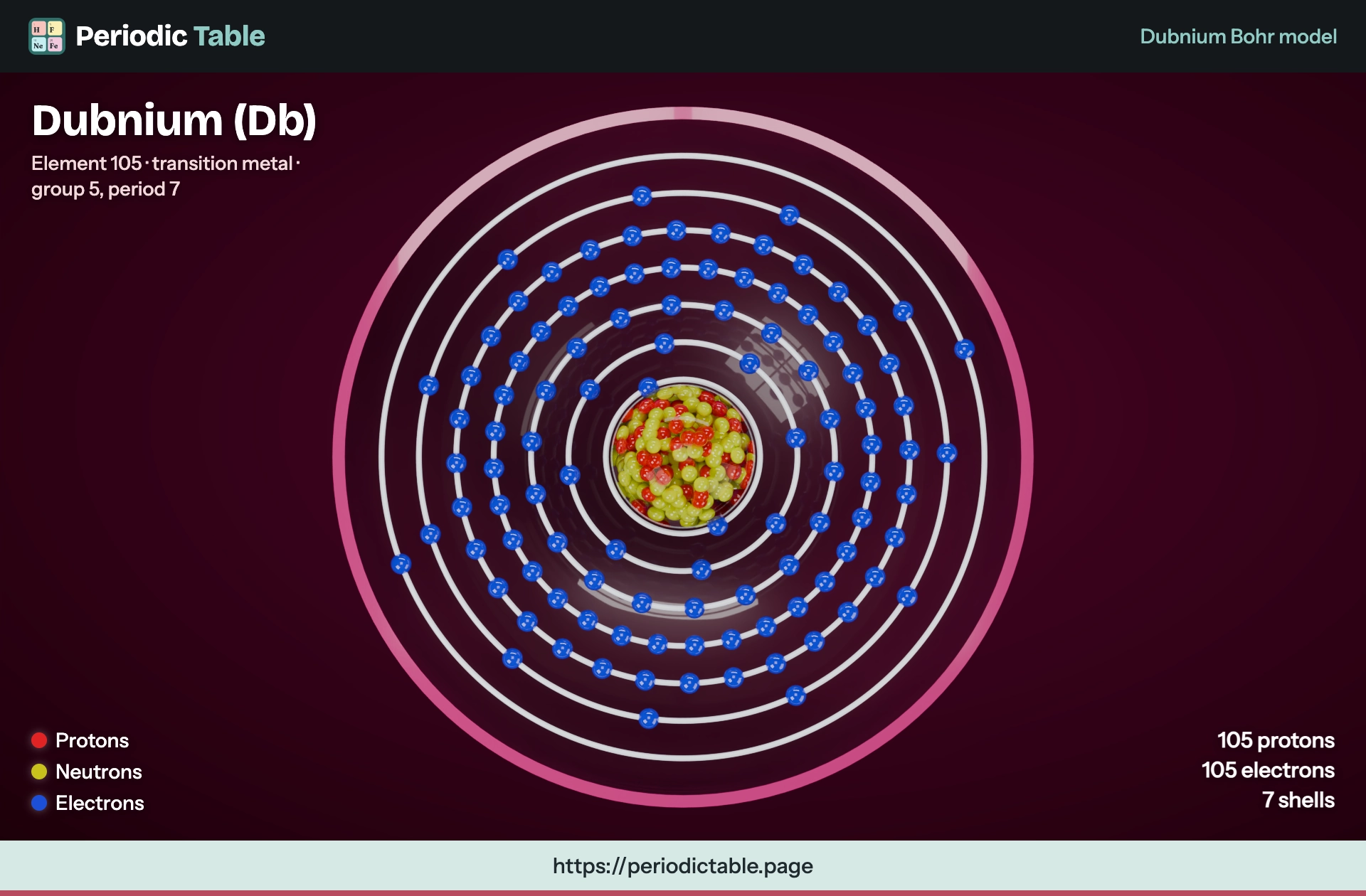
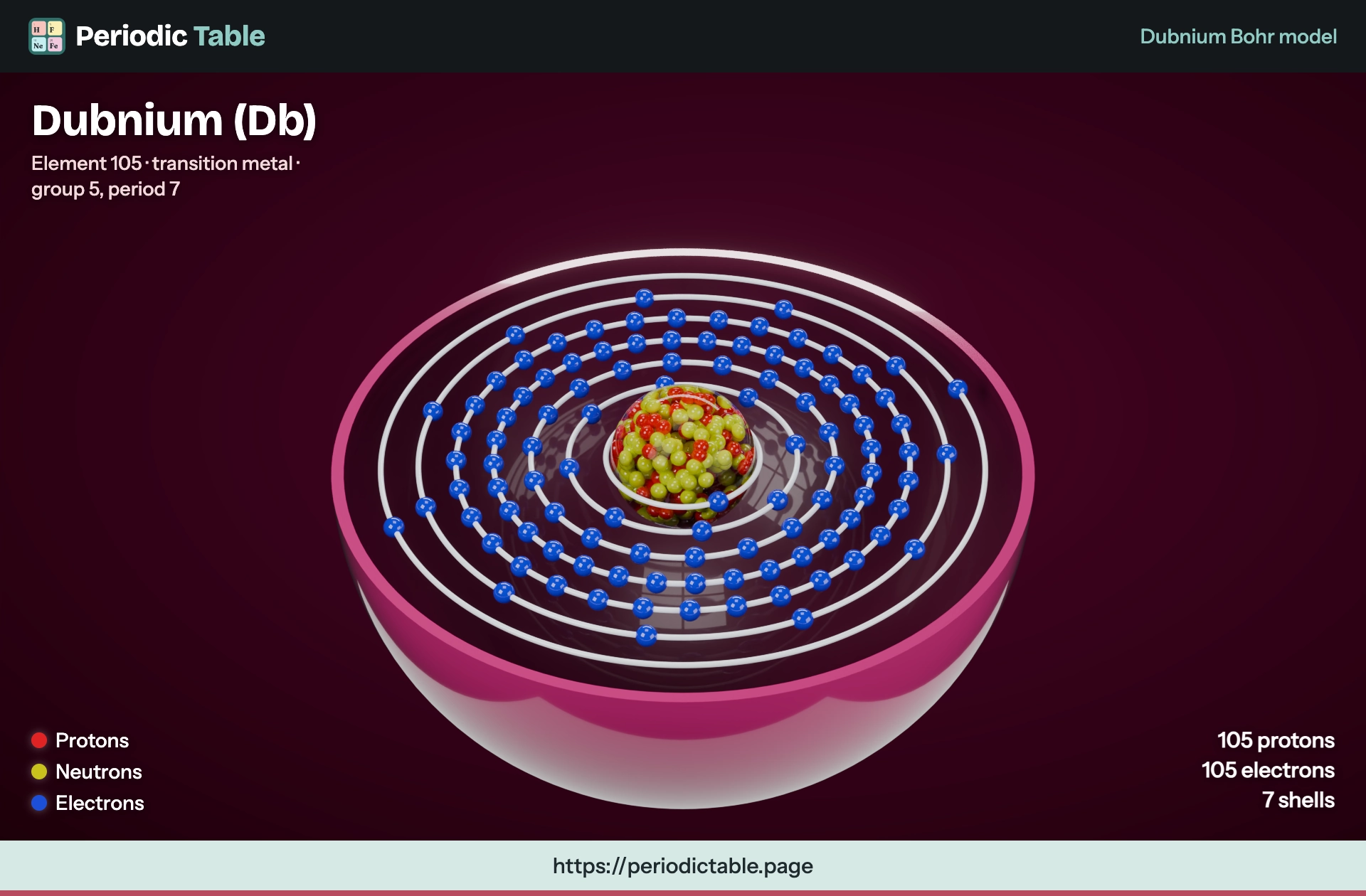
This is a Bohr model of dubnium (Db), a simplified picture of a single dubnium atom. Its nucleus holds 105 protons, and a neutral dubnium atom has 105 electrons, arranged around it in 7 shells (2 in shell K, 8 in shell L, 18 in shell M, 32 in shell N, 32 in shell O, 11 in shell P and 2 in shell Q).
Dubnium periodic table electron configuration
- Shorthand
- *[Rn] 5f14 6d3 7s2
- Full
- 1s2 2s2 2p6 3s2 3p6 4s2 3d10 4p6 5s2 4d10 5p6 6s2 4f14 5d10 6p6 7s2 5f14 6d3
- Electrons per shell
- 2, 8, 18, 32, 32, 11, 2
Dubnium element properties and atomic data
- Atomic number
- 105
- Atomic mass
- [268] u
- Phase at STP
- Unknown
- Melting point
- Unknown
- Boiling point
- Unknown
- Density
- 29.3 g/cm³
- Electronegativity (Pauling)
- Unknown
- Period
- 7
- Group
- 5
- Block
- d-block
- Appearance
- Unknown
- Discovery date
- 1968
- Discovered by
- Joint Institute for Nuclear Research
- Named by
- —
Dubnium (Db) key facts at a glance
Dubnium carries the symbol Db and sits at atomic number 105 in the periodic table. Most of its physical data are predictions, because no one has ever made enough of it to weigh, melt or look at. The table below separates what has been measured from what is still estimated. Tracing the name from alum to Humphry Davy and Hans Christian Ørsted is the job of the aluminium atom history section in full.
| Property | Value |
|---|---|
| Symbol | Db |
| Atomic number | 105 |
| Atomic mass (longest-lived isotope) | [268] |
| Group / period / block | 5 / 7 / d |
| Electron configuration | [Rn] 5f¹⁴ 6d³ 7s² (predicted) |
| Oxidation states | +5 dominant; +3 and +4 predicted to be less stable |
| State at room temperature | Solid (predicted) |
| Density | 21.6 g per cubic centimetre (predicted) |
| Covalent radius | 149 pm (estimated) |
| Melting point | Unknown |
| Boiling point | Unknown |
| CAS number | 53850-35-4 |
| Natural occurrence | None, synthetic only |
The bracketed atomic mass is a convention: when an element has no stable isotope, tables quote the mass number of its longest-lived form instead of a weighted average.
Where element 105 sits: group 5, period 7 and the d-block
It lands in group 5, directly below vanadium, niobium and tantalum, on the seventh row of the table. That makes it a period 7, d-block element and the second member of the 6d transition series, after rutherfordium (104) and before seaborgium (106).
Chemists also call it a transactinide, the name for all elements beyond the actinides. Its position is not just bookkeeping: it is the reason scientists expected it to behave like a heavier copy of the metal above it, and testing that expectation drove almost every experiment run on it.
A synthetic superheavy element
Dubnium is a synthetic, highly radioactive metal. It does not occur in nature, and never will in any amount you could detect: uranium is the heaviest element found in significant quantities on Earth, and all heavier elements have to be built in a laboratory. Only a few atoms of it have ever been produced, so its appearance, hardness and colour have never been observed. To see how this toxic metal causes pollution in rivers and air, read the explanation in the mercury melting point on this site.
It belongs to the superheavy elements, the heavy elements so packed with protons that their nuclei barely hold together. That instability is the defining fact about it.
Every property in the table above comes either from watching a single nucleus decay or from extending trends seen in its lighter relatives. Its radioactivity also explains why there are no commercial forms, compounds or samples to buy.
Discovery of dubnium in Dubna and Berkeley
The discovery was claimed twice, by rival teams on opposite sides of the Cold War. By the late 1960s, American scientists had synthesized every element up to mendelevium (101), and from element 102 onward the Soviet Union and the United States raced for new elements and the credit for each discovery. Element 105 became one of the most contested, reported from Russia and California within about two years of each other.
- April 1968: the Soviet group reports its first alpha activity.
- April 1970: the American group identifies mass-260 nuclei through their lawrencium daughter.
- June 1970: the Soviet group confirms its result with a purer setup.
- 1993: the Transfermium Working Group splits the credit.
- 1997: the official name is adopted.
The 1968 JINR claim
In April 1968, physicists at the Joint Institute for Nuclear Research (JINR) in Dubna, led by Georgy Flerov, bombarded an americium-243 target with neon-22 ions. They reported alpha particles with energies of 9.4 and 9.7 MeV and assigned them to isotopes of mass 260 and 261 of the new element. In 1970, the Soviet team followed up with fission data and an early chemical test, showing that the chloride of the new element behaved like niobium pentachloride rather than hafnium tetrachloride, which is what a group 5 member should do.
The 1970 lawrence Berkeley laboratory experiment
In April 1970, an American team led by Albert Ghiorso fired nitrogen-15 ions at californium-249 and recorded a 9.1 MeV alpha activity. The decay products matched lawrencium-256, which pointed to dubnium-260 as the parent.
Because the product could be identified, the American result was hard to dispute, but it did not reproduce the Soviet alpha energies. JINR then refined its own experiment with a purer target, and by June 1970 both groups had credible evidence for the new element.
How element 105 got its name
Each team proposed its own name. JINR suggested nielsbohrium (Ns), after Niels Bohr, one of the founders of atomic theory.
Berkeley proposed hahnium (Ha), after Otto Hahn, the chemist credited with discovering nuclear fission. Both names were used in papers for years without approval, which is why older textbooks list it under different symbols depending on where they were printed.
The naming controversy and the transfermium wars
The naming controversy was one front of the wider Transfermium Wars, the decades-long dispute over credit for elements 102 to 109. A 1975 meeting in the Soviet Union between Ghiorso, Glenn Seaborg, Flerov and Yuri Oganessian failed to settle it.
In 1985, the International Union of Pure and Applied Chemistry (IUPAC) and the International Union of Pure and Applied Physics (IUPAP) formed the Transfermium Working Group to review the evidence. Its 1993 report judged the April 1970 American experiment the first fully convincing one, followed closely by the Soviet team's June 1970 work, and ruled that credit for the discovery should be shared.
Interim names and the 1997 decision
Before a final name was chosen, the element passed through several temporary and proposed ones. IUPAC's systematic placeholder, unnilpentium, simply spells out the digits 1-0-5 in Latin and Greek roots.
A 1994 recommendation offered joliotium, honouring Frédéric Joliot-Curie, but American scientists objected because it reshuffled their own proposals. In 1997 the union settled on dubnium, after the town that hosts the Soviet-era institute, while the American work was recognised through the names of elements 104 and 106 and earlier names such as berkelium.
| Name | Symbol | Proposed by | Honours | Outcome |
|---|---|---|---|---|
| Hahnium | Ha | American team, 1970 | Otto Hahn | Dropped in 1997 |
| Nielsbohrium | Ns | Soviet team, early 1970s | Niels Bohr | Dropped |
| Unnilpentium | Unp | Systematic rule, 1979 | Digits of 105 | Placeholder only |
| Joliotium | Jl | 1994 recommendation | Frédéric Joliot-Curie | Withdrawn |
| Dubnium | Db | 1997 final ruling | Dubna, home of JINR | Official name |
A rejected name can never be reused for another element, so the American proposal is gone for good, while Lise Meitner, Hahn's collaborator, was later honoured with meitnerium (109).
How superheavy elements like Db are made by nuclear fusion
Every nucleus of element 105 ever made came from nuclear fusion of two lighter nuclei. A foil of a heavy actinide is bombarded with a beam of lighter nuclei, and on very rare occasions one of them merges with a nucleus in the foil. The odds of that happening are expressed as a cross section, and at this mass it is tiny.
The obstacle is electrostatic repulsion: both nuclei are positively charged, so they push each other apart. The strong interaction can bind them, but only at extremely short distances, which is why the beam has to be accelerated to around a tenth of the speed of light. Even when two nuclei touch, they usually separate again after about 10−20 seconds.
When they do fuse, the result is an excited compound nucleus that sheds energy by emitting neutrons or a gamma ray. The synthesis succeeds only if that nucleus survives long enough to count as a new element.
Heavy ion beams and production reactions
The heavy ion reactions behind every synthesis of this element pair an actinide foil with a light ion such as nitrogen or oxygen. Two classic routes are shown below as balanced nuclear reactions:
$$^{249}_{98}\mathrm{Cf} + {}^{15}_{7}\mathrm{N} \rightarrow {}^{260}_{105}\mathrm{Db} + 4\,{}^{1}_{0}n$$
$$^{249}_{97}\mathrm{Bk} + {}^{16}_{8}\mathrm{O} \rightarrow {}^{261}_{105}\mathrm{Db} + 4\,{}^{1}_{0}n$$
In each case the atomic numbers add up to 105, and the number of neutrons boiled off sets which isotope you get. Production rates are measured in nuclei per day or per week, not in grams.
Alpha decay, spontaneous fission and detection
After fusion, a separator pulls the new nucleus out of the beam and drives it into a detector that records where and when it lands. Its later decay is then logged with its own position, energy and time. Superheavy nuclei decay mainly by alpha decay or spontaneous fission (SF), because the repulsion between so many protons grows faster than the binding that holds them together.
An alpha emission leaves a recognisable product nucleus, which decays in turn, and so on. Matching that decay chain to known nuclides is how scientists prove which element they made from single atoms.
The 1970 Berkeley identification of Db rested on exactly this: the mass-260 nucleus emitted an alpha particle and left a known element 103 nucleus behind. Fission is harder to use, because it splits the nucleus into fragments that carry no signature of the parent, which is why early experiments argued so much over fission data.
Dubnium isotopes and their half-life values
About 12 isotopes of element 105 have known mass numbers, and none is stable. The table lists the best-characterised isotopes of dubnium and how long each one lasts.
| Mass number | Half-life | Main decay modes |
|---|---|---|
| 262 | 34 s | α 67%, SF 33% |
| 263 | 27 s | SF 56%, α 41%, electron capture 3% |
| 266 | 11 min | SF, electron capture |
| 267 | 1.4 h | SF |
| 268 | 16 h | α 51%, SF 49% |
| 270 | 1 h | α 87%, SF 13% |
For a superheavy nucleus, half-lives of minutes to hours are long. They are what made the chemistry experiments below possible at all, since each nucleus has to last long enough to be carried into a chemistry setup and tested.
Dubnium-268, the most stable isotope
The most stable isotope known is the mass-268 nucleus. Early measurements put its half-life anywhere from about one to two days, because each run produced so few nuclei; work at JINR's Superheavy Element Factory, running since 2019, narrowed it to about 16 hours by 2022.
The irony is that the longest-lived forms are the hardest to make. They need more neutrons than any available pairing of beam and foil can supply, so the mass-268 and mass-270 nuclei have been seen only as decay products of moscovium and tennessine, created with calcium-48 beams.
Predicted properties of dubnium
The periodic law says element 105 should resemble tantalum, and broadly it does. Its predicted behaviour, however, also includes deviations that come from physics specific to very heavy atoms, which is why theorists treat it as a test case for how far periodic trends hold.
Relativistic effects on the 6d and 7s electrons
In an atom this heavy, the innermost electrons move at a large fraction of the speed of light. That pulls the outer s orbital inward by roughly a quarter and lowers its energy, which leaves the outer d electrons less shielded from the nucleus and pushes them into larger orbitals. As a result, its 7s electrons are slightly harder to remove than its 6d electrons, the reverse of its lighter relatives.
A further spin–orbit splitting divides the d subshell into two energy groups. The atom still keeps five valence electrons, but the +3 state ends up rarer than it is for the lighter members of the group.
Electron configuration and ionization energies
Dubnium's ground state is written [Rn] 5f¹⁴ 6d³ 7s², the same pattern as tantalum one row up. The first ionization energy is about 665 kJ/mol, with the second and third estimated at about 1,547 and 2,378 kJ/mol. Its ionisation potential in the +5 state should be a little lower than that of its lighter homologue, and its ionic radius slightly larger, two details that shape how it forms compounds in solution.
Predicted density, covalent radius and appearance
A solid sample of this transactinide should pack into a body-centered cubic lattice, like the other members of its group. Its predicted density of 21.6 g/cm3 would make it one of the densest metals, roughly twice as heavy as lead.
Its bonding radius is estimated at 149 pm. If enough of it could ever be gathered, it would probably look silvery white or metallic grey, but that remains a guess.
Dubnium chemistry: what single-atom experiments show
Studying its chemistry means working with nuclei that appear one at a time and decay within seconds to hours. Radiochemistry groups developed fast, automated methods that repeat the same separation thousands of times and then read the pattern statistically. The question behind every run is simple: does element 105 really behave like the metals above it?
The +5 oxidation state and glass sorption
In 1988, an American team fumed the element with concentrated nitric acid and checked whether it stuck to cover slips. Group 5 elements sorb onto glass from aqueous solution; group 4 elements such as zirconium and hafnium do not.
Dubnium stuck, confirming its place in the group and supporting a dominant +5 state. Work in 1992 backed this up: Db(V) passed through cation-exchange columns with α-hydroxyisobutyrate like its lighter homologues, while lower states did not.
Halides, volatility and gas chromatography
Halide work tests how easily a compound evaporates. JINR's thermochromatographic runs in 1974 and 1976 found dubnium bromide less volatile than its niobium counterpart.
Calculations on dubnium pentachloride show it should be more covalent than the tantalum compound, with a lower effective charge on the metal. Later isothermal gas chromatography in 1992 and 1996 suggested that traces of oxygen formed oxyhalides that evaporate less readily than the plain chloride, so the measured volatility depended on how dry the system was.
Solvent extraction and complexes
Separation from mixed nitric acid and hydrofluoric acid into an organic solvent gave the biggest surprise: Db did not follow tantalum, as an eka-tantalum should, and behaved more like niobium. Thousands of runs between 1988 and 1993 using hydrochloric acid confirmed it also tracked protactinium, a pseudohomolog. The likely reason is that it forms highly charged complexes that stay in the water phase, something you could not predict just by extending the trend down the group.
Db compared with the other group 5 transition metals
The chemistry of dubnium only makes sense next to its neighbours. Its three lighter relatives are well-studied transition metals, so they set the baseline that every experiment on it is measured against.
| Element | Symbol | Atomic number | Period | Valence electrons | Density (g per cubic cm) | Melting point (°C) |
|---|---|---|---|---|---|---|
| Vanadium | V | 23 | 4 | 3d³ 4s² | 6.11 | 1,910 |
| Niobium | Nb | 41 | 5 | 4d⁴ 5s¹ | 8.57 | 2,477 |
| Tantalum | Ta | 73 | 6 | 4f¹⁴ 5d³ 6s² | 16.65 | 3,017 |
| Dubnium | Db | 105 | 7 | 5f¹⁴ 6d³ 7s² (predicted) | 21.6 (predicted) | Not measured |
Down the group, density climbs steadily and the newest member is expected to continue the trend. In solution, though, it often sides with niobium over its heavier neighbour, the clearest sign that relativistic physics bends the pattern.
Uses and applications of dubnium
Dubnium has no practical uses outside scientific research. With production counted in individual nuclei and a lifetime of hours at best, it cannot be put into alloys, catalysts or devices, and it never reaches the market.
Its value is what it teaches: each run checks theoretical models of nuclear stability and of how electrons behave in very heavy elements. Research applications are limited to accelerator labs able to run one-at-a-time chemistry, such as JINR and national laboratories in the United States, Germany and Japan.
Why Db matters to nuclear physics and nuclear chemistry
For nuclear physics, dubnium is a data point on the road toward the predicted island of stability, where certain superheavy nuclei may live much longer. Its decay chains link it to elements as heavy as tennessine, so measuring its half-lives helps confirm the discovery of newer elements. For nuclear chemistry, it is a test of whether the periodic table still predicts behaviour when relativistic effects take over.
The answer so far: mostly yes, but not completely. A handful of nuclei have shown that position in the table is a strong guide, not a guarantee.