


Aluminium element (Al): aluminium periodic table facts
Aluminium periodic table facts: aluminium (Al) is element 13, a post-transition metal in group 13, period 3. Pick up a soda can, a laptop shell or a kitchen pan and there is a good chance you are holding aluminium, the chemical element with symbol Al and atomic number 13. Spelled aluminum in North America, it is a soft, lightweight metal whose low density and self-healing oxide skin explain almost every place you find it, from aircraft to power lines. Students interested in electronics and industry will find history of bismuth lists electrical resistivity and sources of supply.
Rotate the 3D Bohr model of aluminium
Drag to orbit, scroll to zoom.
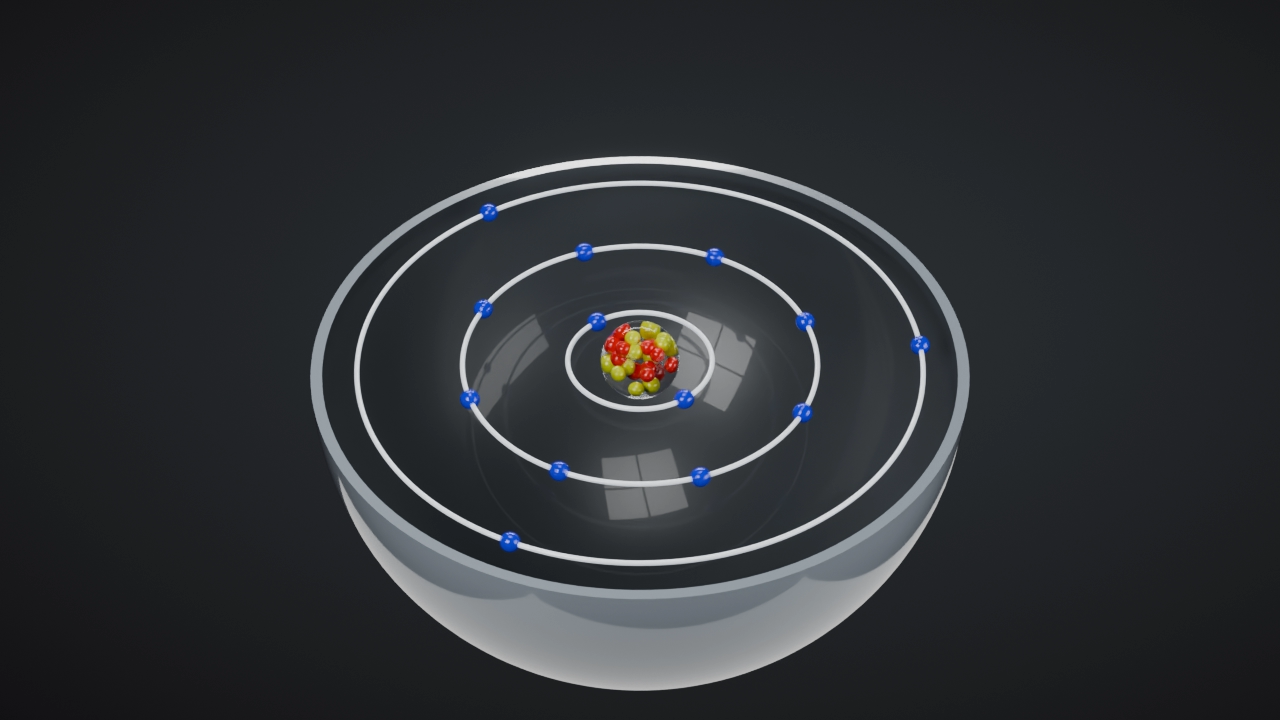
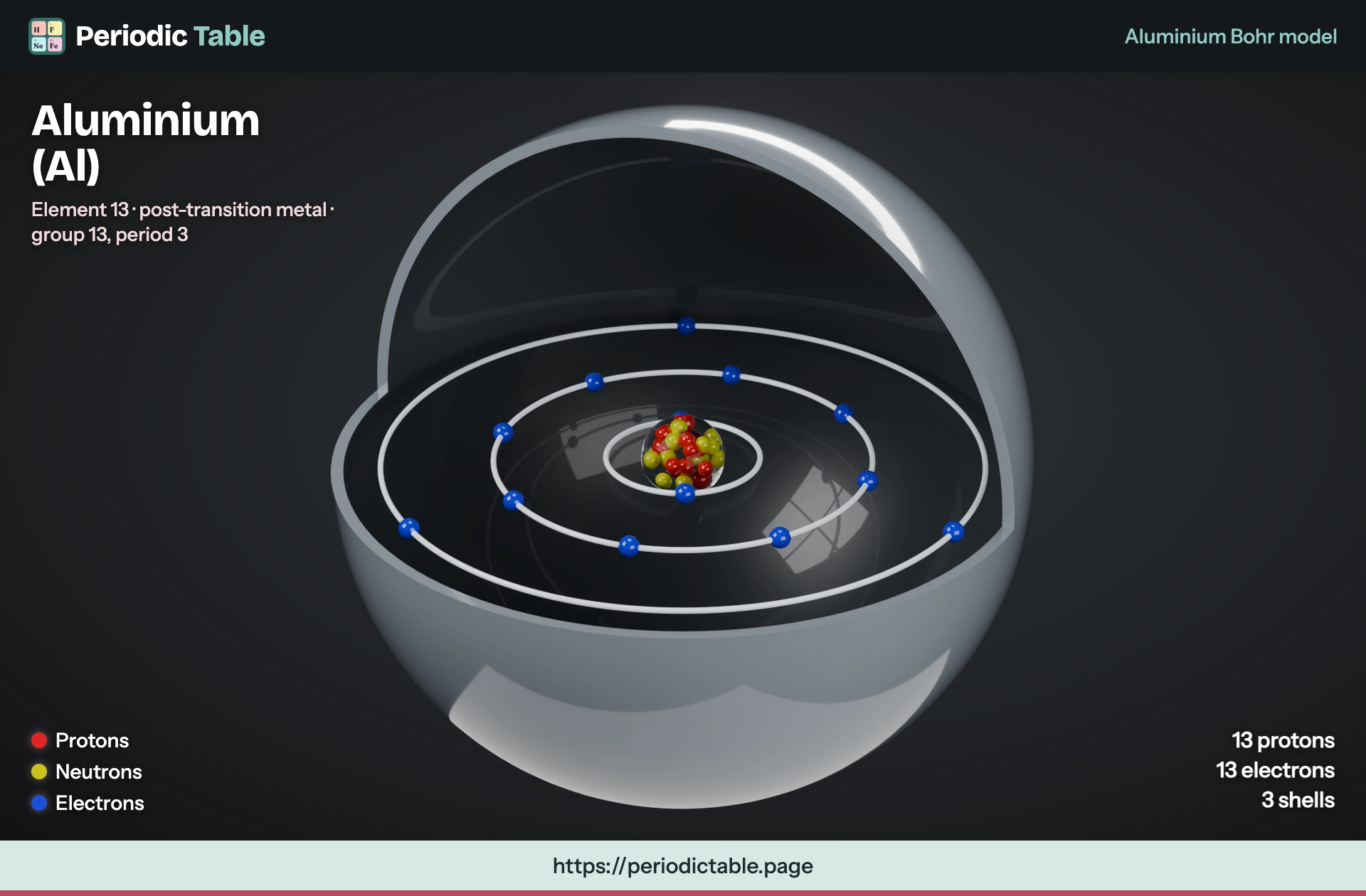
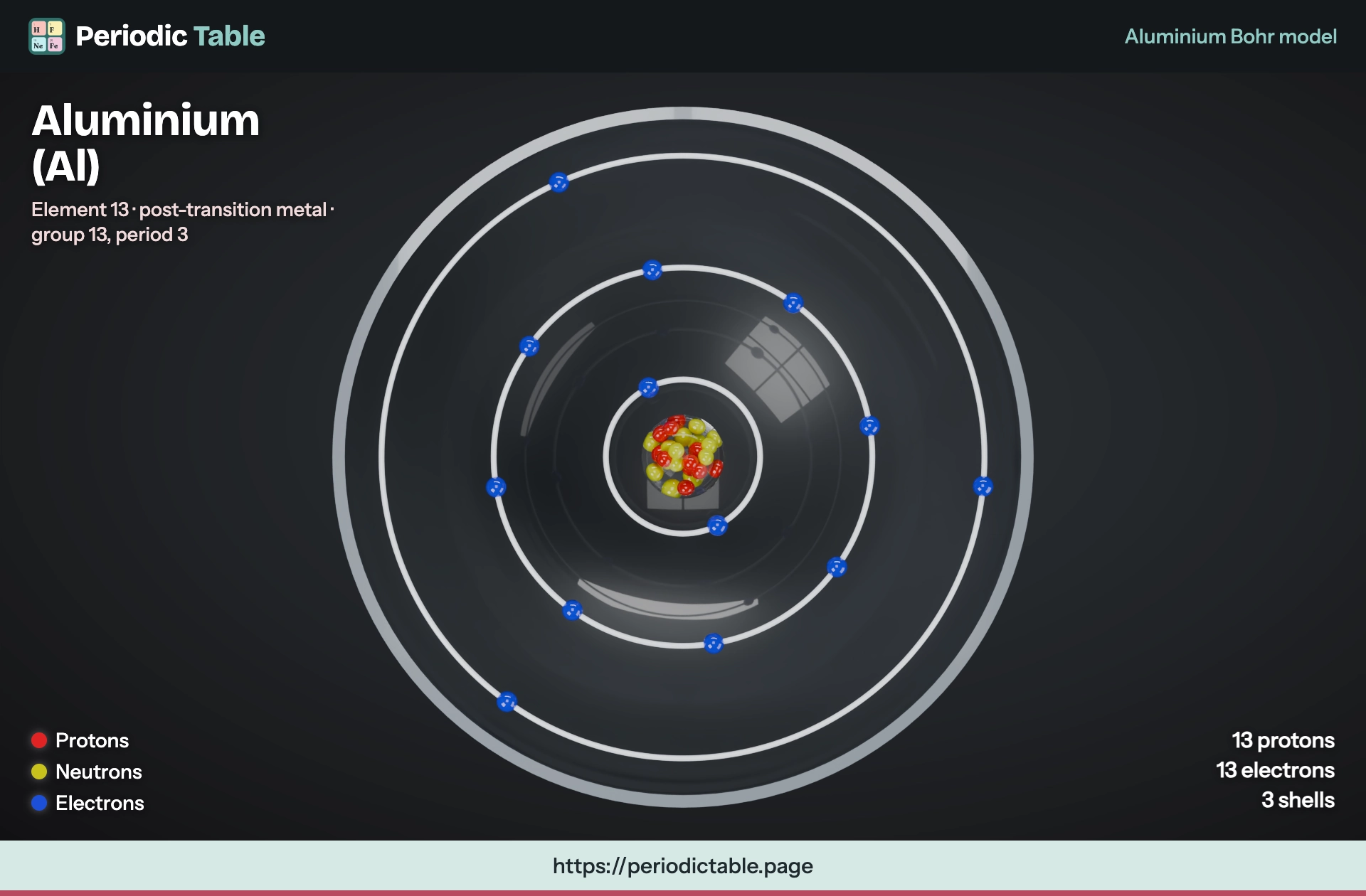
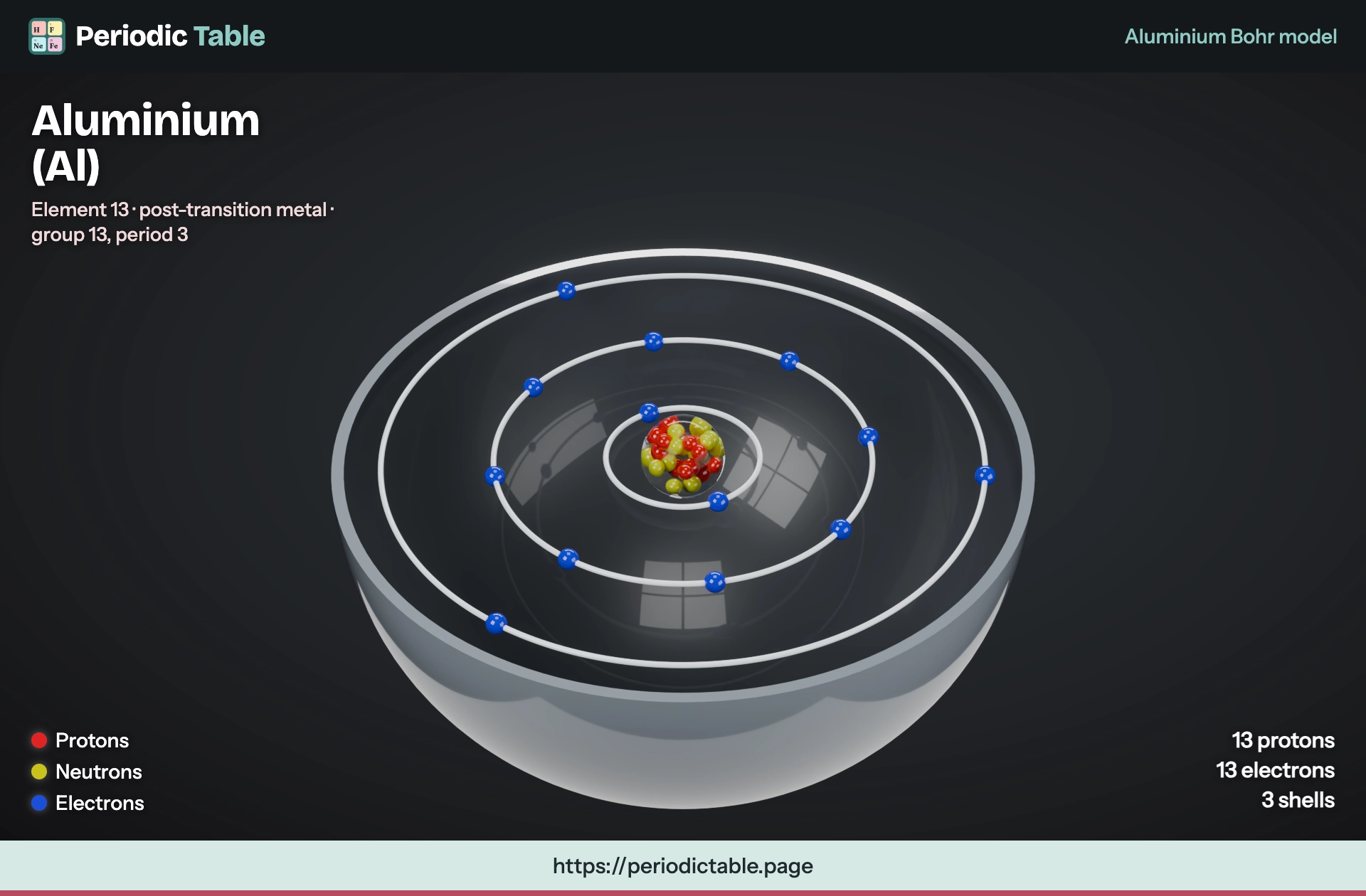
This is a Bohr model of aluminium (Al), a simplified picture of a single aluminium atom. Its nucleus holds 13 protons, and a neutral aluminium atom has 13 electrons, arranged around it in 3 shells (2 in shell K, 8 in shell L and 3 in shell M).
Aluminium periodic table electron configuration
- Shorthand
- [Ne] 3s2 3p1
- Full
- 1s2 2s2 2p6 3s2 3p1
- Electrons per shell
- 2, 8, 3
Aluminium element properties and atomic data
- Atomic number
- 13
- Atomic mass
- 26.9815 u
- Phase at STP
- Solid
- Melting point
- 660.32°C (933.47 K)
- Boiling point
- 2469.85°C (2743 K)
- Density
- 2.7 g/cm³
- Electronegativity (Pauling)
- 1.61
- Period
- 3
- Group
- 13
- Block
- p-block
- Appearance
- Silvery gray metallic
- Discovery date
- 1825
- Discovered by
- Unknown
- Named by
- Humphry Davy
Aluminium element facts: atomic number 13 at a glance
Before getting into how aluminium behaves, it helps to have the core numbers in one place. The values below are the standard reference figures you will see quoted on any element data sheet, rounded to sensible precision. Pure aluminium is a silvery white solid at room temperature, and it sits in the third row of the periodic table with 13 protons in its nucleus. When sorting out wolframite and scheelite ores, look up tungsten compounds for density and tensile strength values.
| Property | Aluminium value |
|---|---|
| Symbol | Al |
| Atomic number | 13 |
| Standard atomic weight | 26.982 |
| Group / period / block | Group 13 (boron group), period 3, p-block |
| Electron configuration | [Ne] 3s2 3p1 |
| Melting point | 660.32 °C (933.47 K) |
| Boiling point | 2,470 °C (2,743 K) |
| Density at 20 °C | 2.70 g/cm3 |
| Common oxidation state | +3 |
| Stable isotope | Al-27 (100% natural abundance) |
| CAS number | 7429-90-5 |
The atomic number tells you the element's identity: every Al atom has 13 protons and, when neutral, 13 electrons. Because only one isotope exists in nature, the atomic weight of 26.982 is fixed more precisely than for most elements, which is why chemists can quote it to so many decimal places. The CAS number 7429-90-5 is the registry identifier you will find on safety data sheets for aluminium powder and metal.
Aluminium on the periodic table: group 13 and the boron group
On the periodic table, aluminium sits directly below boron in group 13, also called the boron group, with gallium, indium, thallium and nihonium beneath it. It occupies period 3 and the p-block, because its outermost electron sits in a 3p orbital. Soviet Union and United States research programmes are compared in the dubnium atomic mass, with a note on laboratory experiments.
Chemists usually class Al as a post-transition metal: it is a true metallic element that conducts electricity and forms a metallic lattice, yet its compounds lean toward covalent bonding more than those of the alkali or alkaline earth metals. Boron above it is a metalloid, while gallium below it melts in your hand, so aluminium marks the point in the group where full metallic behaviour begins. That middle position runs through all of its chemistry, and it is why aluminium chemistry often looks like a cross between magnesium and boron chemistry: it gives up three electrons readily, but the small, highly charged Al3+ ion pulls on neighbouring atoms hard enough to make many aluminium bonds partly covalent.
Physical properties of aluminium metal
The physical properties of aluminium metal explain why engineers reach for it so often. It is ductile enough to draw into wire and malleable enough to roll into foil thinner than a human hair. It is nonmagnetic in the everyday sense (technically paramagnetic), and its polished surface has high reflectivity across ultraviolet, visible and infrared light, which is why telescope mirrors and space blankets use it.
On a North American spec sheet the same metal is listed as aluminum, and the numbers are identical. When the surface is anodized, a thicker oxide film is grown electrochemically, adding hardness and taking dyes for coloured finishes. Atoms pack in a face-centered cubic crystal structure, the same arrangement as copper and gold, and below 1.2 K the metal shows superconductivity.
Density and strength: one-third that of steel
Aluminium's density of 2.70 g/cm3 is roughly one-third that of steel. To see what that means, take a solid cube 10 cm on each side (1,000 cm3): in aluminium it weighs 2.70 kg, while the same cube in a typical carbon steel at 7.85 g/cm3 weighs 7.85 kg, so the steel block is about 2.9 times heavier.
The trade-off is strength. Pure metal is soft, with a yield strength of only about 7 to 11 MPa, while heat-treated alloys reach 200 to 600 MPa.
Its Young's modulus is about 70 GPa, its shear modulus about 26 GPa and its bulk modulus about 76 GPa, and it scores just 2.75 on the Mohs hardness scale. In other words, it bends about three times more than steel under the same load, so designers use thicker sections or alloying to make up the difference.
Thermal and electrical conductivity
Aluminium is an excellent conductor. Its thermal conductivity of about 237 W/(m·K) lets pans heat evenly and heat sinks shed warmth from chips quickly, and its specific heat capacity of about 897 J/(kg·K) is high for a metal.
Its electrical conductivity is about 61% of copper by volume, but because it is so light, an aluminium cable carrying the same current weighs roughly half as much as a copper one. That is the reason overhead transmission lines are aluminium rather than copper.
Inside the aluminium atom
A neutral aluminium atom is fairly large for its mass. Its empirical atomic radius is about 143 pm, its covalent radius about 121 pm and its Van der Waals radius about 184 pm. Strip away three electrons and the Al3+ ion shrinks to roughly 54 pm, one of the smallest common metal ions.
Electron configuration, electronegativity and ionization energies
The electron configuration of Al is 1s2 2s2 2p6 3s2 3p1, written in short form as [Ne] 3s2 3p1: three valence electrons outside a neon core. Its electronegativity is 1.61 on the Pauling scale, between magnesium (1.31) and silicon (1.90).
The ionization energies show why aluminium almost always loses exactly three electrons:
- 1st: 577.5 kJ/mol (removes the 3p electron)
- 2nd: 1,816.7 kJ/mol
- 3rd: 2,744.8 kJ/mol
- 4th: 11,577 kJ/mol (breaks into the neon core)
The fourth value is more than four times the third. Added together, the first three come to 5,139 kJ/mol, still less than half of the fourth alone, so an Al4+ ion never forms in ordinary chemistry.
Isotopes of aluminium: Al-27 and Al-26
Aluminium has a single stable isotope, Al-27, which makes up essentially all natural aluminium. Every other one of its isotopes is radioactive. The longest-lived is Al-26, with a half-life of about 717,000 years; it decays to magnesium-26 by positron emission.
Cosmic rays still make tiny amounts of Al-26 in the atmosphere and in surface rock, and the Al-26 to beryllium-10 ratio is used in radiometric dating of sediment burial and erosion over hundreds of thousands to millions of years. The single stable nucleus also makes Al-27 useful in NMR spectroscopy.
Chemical properties of aluminium: the oxide layer
On paper aluminium is a reactive metal, and its chemistry says it should corrode fast, yet a can lasts for years without rusting. The answer is the oxide layer. The moment fresh metal meets air, it reacts with oxygen to form a film of Al2O3 only about 5 nm thick.
That film is hard, transparent and tightly bonded, and it stops further corrosion, a process called passivation. Scratch it and a new film forms within seconds.
Remove that protection and the reactivity shows. Fine aluminium powder burns fiercely, and in the thermite reaction it strips oxygen from iron oxide so violently that molten iron is produced:
$$2\,\text{Al} + \text{Fe}_2\text{O}_3 \rightarrow \text{Al}_2\text{O}_3 + 2\,\text{Fe}$$
Aluminium is also amphoteric. It dissolves in hydrochloric acid, releasing hydrogen, and in hot sodium hydroxide to form aluminate ions:
$$2\,\text{Al} + 2\,\text{NaOH} + 6\,\text{H}_2\text{O} \rightarrow 2\,\text{Na}[\text{Al}(\text{OH})_4] + 3\,\text{H}_2$$
In water, the hydrated Al3+ ion undergoes hydrolysis, which makes aluminium salt solutions mildly acidic. Chlorides, mercury and contact with copper in salty water all break down the oxide film, which is why marine fittings need careful alloy choice.
Oxidation state and reactivity
Almost every Al compound has aluminium in the +3 oxidation state; lower states such as +1 exist only in gases or exotic molecules. The practical result is excellent corrosion resistance in neutral conditions (roughly pH 4 to 9) and poor resistance in strong acids, strong alkalis and salt spray, where the oxide film dissolves faster than it can rebuild.
Key aluminium compounds
Because Al3+ is small and highly charged, aluminium compounds tend to be colourless, high-melting and often useful as Lewis acids. The ones you are most likely to meet:
- Aluminium hydroxide, Al(OH)3: a mild antacid, a flame retardant filler, and the intermediate in refining.
- Aluminium sulfate: the workhorse of water treatment, where it clumps suspended particles so they settle out; also used in papermaking.
- Aluminium chloride: the anhydrous form, also called aluminium trichloride, is a catalyst for Friedel–Crafts reactions in industrial chemistry; hydrated chlorides go into antiperspirants.
- Aluminium nitride, AlN: a ceramic that conducts heat well but not electricity, used in electronics.
- Lithium aluminium hydride, LiAlH4: one of the strongest reducing agents in organic chemistry.
- Aluminium salts as adjuvants in some vaccines, where they strengthen the immune response.
Aluminium oxide: alumina, corundum and gemstones
Aluminium oxide, Al2O3, usually called alumina, is the most important compound of all, since nearly all alumina made goes on to become metal. Its crystalline mineral form, corundum, rates 9 on the Mohs scale, second only to diamond among common minerals, so it is a standard abrasive in sandpaper and grinding wheels. Trace chromium turns corundum into red ruby; traces of iron and titanium give blue sapphire.
Where aluminium is found: bauxite and the Earth's crust
Aluminium is the most abundant metal in the Earth's crust, about 8.2% by mass, and the third most abundant element after oxygen and silicon. Yet you will almost never find it as native metal, because it binds so tightly to oxygen. Instead it sits locked inside feldspars, clays, micas and hundreds of other minerals in common rocks.
Only one ore is worth processing commercially: bauxite, a reddish rock formed when tropical rain weathers aluminium-rich bedrock for millions of years, leaching away silica and leaving aluminium hydroxides behind. Most bauxite mining takes place in Australia and Guinea, which also hold the largest reserves.
History of aluminium: from alum to mass production
The history of aluminium starts with alum, a double sulfate salt used since ancient times as a dye fixative and to clear water. By the 1700s chemists suspected that alum held an unknown metal, but nobody could free it from oxygen.
Danish physicist Hans Christian Ørsted produced the first impure aluminium in 1825 by reducing aluminium chloride with a potassium amalgam. In 1827 Friedrich Wöhler made purer aluminium powder, and by 1845 he had produced small beads of metal.
For decades the result, whether called aluminium or aluminum, was so costly that it was treated as a precious metal, priced above gold. Even in 1884, the 2.8 kg aluminium pyramid capping the Washington Monument was a showpiece.
Everything changed in 1886, when Charles Martin Hall in the United States and Paul Héroult in France independently invented the electrolytic process that still bears their names. In 1888, Carl Joseph Bayer patented a method to purify bauxite into alumina. With both steps in place, the price collapsed, and within a century aluminium had become the most produced non-ferrous metal in the world.
Aluminium or aluminum? the spelling of element 13's name
Both words name the same element. The root is the Latin alumen, meaning alum. Humphry Davy first proposed "alumium" in 1808, then used "aluminum" in 1812, and other chemists pushed for "aluminium" to match the -ium ending of sodium, potassium and magnesium.
The spelling split along the Atlantic. Britain and most of Europe adopted aluminium, while aluminum gained ground in the United States through the 19th century.
In 1925 the American Chemical Society made aluminum its official spelling. IUPAC standardized on aluminium in 1990 and accepted aluminum as a variant in 1993.
Charles Martin Hall himself helped tip American usage: his patents said aluminium, but his company's early handbills used aluminum, a name that echoed platinum. By about 1900, aluminum was twice as common as aluminium in American print.
| Where you read it | Usual spelling |
|---|---|
| United States and Canada | aluminum |
| UK, Ireland, Australia, New Zealand, India, South Africa | aluminium |
| IUPAC chemistry nomenclature | aluminium (aluminum accepted) |
| American Chemical Society journals | aluminum |
| Most other European languages (French, German, Dutch) | aluminium or a close variant |
The pronunciations differ too: "al-yoo-MIN-ee-um" versus "a-LOO-min-um". If you write for a US audience, aluminum foil, aluminum cans and aluminum siding are the expected forms; in British English the same products take the -ium ending. Whichever spelling you use, the symbol stays Al.
Aluminium production: from bauxite to metal
Modern aluminium production is a two-stage chain: refine bauxite into alumina, then split alumina into metal with electricity. Roughly 4 to 5 tonnes of bauxite yield about 2 tonnes of alumina, which yields about 1 tonne of metal. The second step is so power-hungry that a smelter is usually built where cheap electricity is plentiful, such as near hydropower dams.
China now makes well over half of the world's primary metal, while Brazil is a major bauxite and alumina producer. Power is the largest single energy cost in the industry.
Bayer process: refining bauxite into alumina
In the Bayer process, crushed bauxite is digested in hot, concentrated sodium hydroxide under pressure. The aluminium minerals dissolve as sodium aluminate, while iron oxides and other impurities stay solid and are filtered off as "red mud". Cooling the solution and seeding it with crystals precipitates pure aluminium hydroxide, which is then heated to above 1,000 °C to drive off water:
$$2\,\text{Al}(\text{OH})_3 \rightarrow \text{Al}_2\text{O}_3 + 3\,\text{H}_2\text{O}$$
Hall–Héroult process: electrolysis of alumina
The Hall–Héroult process dissolves alumina in molten cryolite (Na3AlF6) at about 950 °C, far below alumina's own 2,072 °C melting point. A large direct current drives electrolysis: Al3+ ions gain electrons at the carbon cathode and collect as liquid metal at the bottom of the cell, while oxygen reacts with the carbon anodes to form CO2:
$$2\,\text{Al}_2\text{O}_3 + 3\,\text{C} \rightarrow 4\,\text{Al} + 3\,\text{CO}_2$$
The product is over 99% pure and is cast into ingots and billets, the starting stock for every aluminum sheet, extrusion and casting downstream.
Recycling aluminium cans and scrap
Recycling melts scrap instead of breaking oxide bonds, so it needs only about 5% of the energy used to make new metal from ore. Aluminium can be remelted repeatedly without losing its properties, and used beverage cans (aluminum cans in US usage) are the classic example: a returned can can be back on a shelf as a new can within weeks. A large share of all aluminium ever produced is still in use today.
Aluminium alloys and the alloy series
Pure metal is too soft for most structural jobs, so nearly everything you buy is one of the aluminium alloys, blended with small amounts of copper, magnesium, silicon, manganese or zinc. In North America the registered designations are published by the Aluminum Association, which is why a US data sheet reads "6061 aluminum" where a British one says 6061 aluminium. Wrought alloys are classified by a four-digit number whose first digit names the alloy series and its main additive:
| Series | Main addition | What it is known for |
|---|---|---|
| 1xxx | None (99%+ Al) | Best corrosion resistance and conductivity, low strength, excellent workability |
| 2xxx | Copper | High strength, heat treatable, weaker against corrosion |
| 3xxx | Manganese | Moderate strength, good formability |
| 4xxx | Silicon | Low melting range, used for welding wire and brazing |
| 5xxx | Magnesium | Good weldability, strong marine corrosion resistance |
| 6xxx | Magnesium + silicon | Versatile, the most common extrusion alloys, good machinability |
| 7xxx | Zinc | Highest strength, heat treatable |
The 2xxx, 6xxx and 7xxx families are heat treatable, meaning they can be solution-treated and aged to raise strength. The 1xxx, 3xxx and 5xxx families gain strength only by cold work. The 6xxx series dominates extrusion, where hot billets are pushed through a die to make window frames and profiles.
Choosing an aluminum alloy for the job
Picking an aluminum alloy is a short engineering checklist, and it matters more than the base metal, since two aluminum parts can differ in strength by a factor of five depending on series and temper. Ask how much strength you need, whether the part will be welded or machined, how much forming it must survive, and whether it will see salt water. A boat hull favours 5xxx, a bike frame or aircraft spar 7xxx or 2xxx, and an architectural profile 6xxx.
Uses and applications of aluminium
The uses of aluminium follow directly from its light weight, corrosion resistance and conductivity. The main applications are:
- Transportation: aircraft fuselages and wings in aerospace, automotive body panels, wheels and engine blocks, plus rail cars, ships and bicycles.
- Construction: window frames, curtain walls, roofing, siding and gutters.
- Packaging: drink cans, food trays and aluminium foil.
- Electrical: overhead power lines, busbars, motor windings and transformers.
- Household: cookware, utensils, furniture and the cases of phones and laptops.
Most of these applications rely on alloys rather than pure metal. Foil works so well in packaging because even a thin sheet blocks light, oxygen and moisture completely.
Across all these sectors, aluminium is the second most used metal after iron, and it is among the most important materials in modern manufacturing. In the US, the auto industry's shift to aluminum truck bodies in the 2010s showed how weight savings can justify a pricier material: a lighter body means better fuel economy without a smaller vehicle.
How aluminium compares with other lightweight metals
Among structural metals, aluminium hits a balance of weight, cost and corrosion resistance that the alternatives cannot match all at once. As a non-ferrous metal, it contains no iron and will not rust the way steel does.
| Metal | Density (g/cm3) | Where it beats aluminium | Where it loses |
|---|---|---|---|
| Aluminium | 2.70 | Baseline | Baseline |
| Magnesium | 1.74 | Lighter | Corrodes faster, burns more easily |
| Beryllium | 1.85 | Much stiffer | Toxic dust, very expensive |
| Titanium | 4.51 | Stronger, survives higher heat | Heavier and far costlier to make |
| Lithium | 0.53 | Lightest metal | Too reactive to use alone; added to some aerospace alloys |
For most structural applications, that table explains the outcome: magnesium and lithium are lighter but harder to protect, titanium and beryllium are stronger but costlier, so aluminum (as US engineers write it) remains the default lightweight choice among engineering materials. Being non-ferrous also makes it the natural choice wherever magnetic interference matters.
Aluminium toxicity, health and the environment
Aluminium has no known role in human biology, and its toxicity at everyday exposure levels is low. Food is the main source you take in, and healthy kidneys excrete most of what is absorbed.
The health risks are concentrated in specific groups: people with kidney failure, especially on long-term dialysis, can accumulate aluminium in bone and brain, and workers who inhale fine powder or welding fumes face lung damage. Decades of research into a link with Alzheimer's disease have not found good evidence that aluminium causes it.
The bigger environment problem comes from soil and water chemistry, and specifically acidity. In neutral soil and water, aluminium stays locked in insoluble minerals. In acidic soils, soluble Al3+ is released and stunts root growth, making it a leading limit on crop yields worldwide.
In acidified lakes and streams, dissolved aluminium settles on the gills of fish and disrupts their salt balance. Bauxite mining and red mud disposal add local impacts, which is one more reason recycling matters.