


Tungsten element (W): tungsten periodic table facts
Tungsten periodic table facts: tungsten (W) is element 74, a transition metal in group 6, period 6. If you have ever wondered which metal survives heat that would melt almost anything else, the answer is tungsten, the chemical element with symbol W and atomic number 74. For physical data on a heavy pnictogen, melting point, density and thermal conductivity are laid out in the bismuth density reference for students.
Its English name comes from the Swedish for "heavy stone," while much of Europe still calls it wolfram. Below you will find its key numbers, how it behaves physically and chemically, where it is mined, and why industry relies on it.
Rotate the 3D Bohr model of tungsten
Drag to orbit, scroll to zoom.
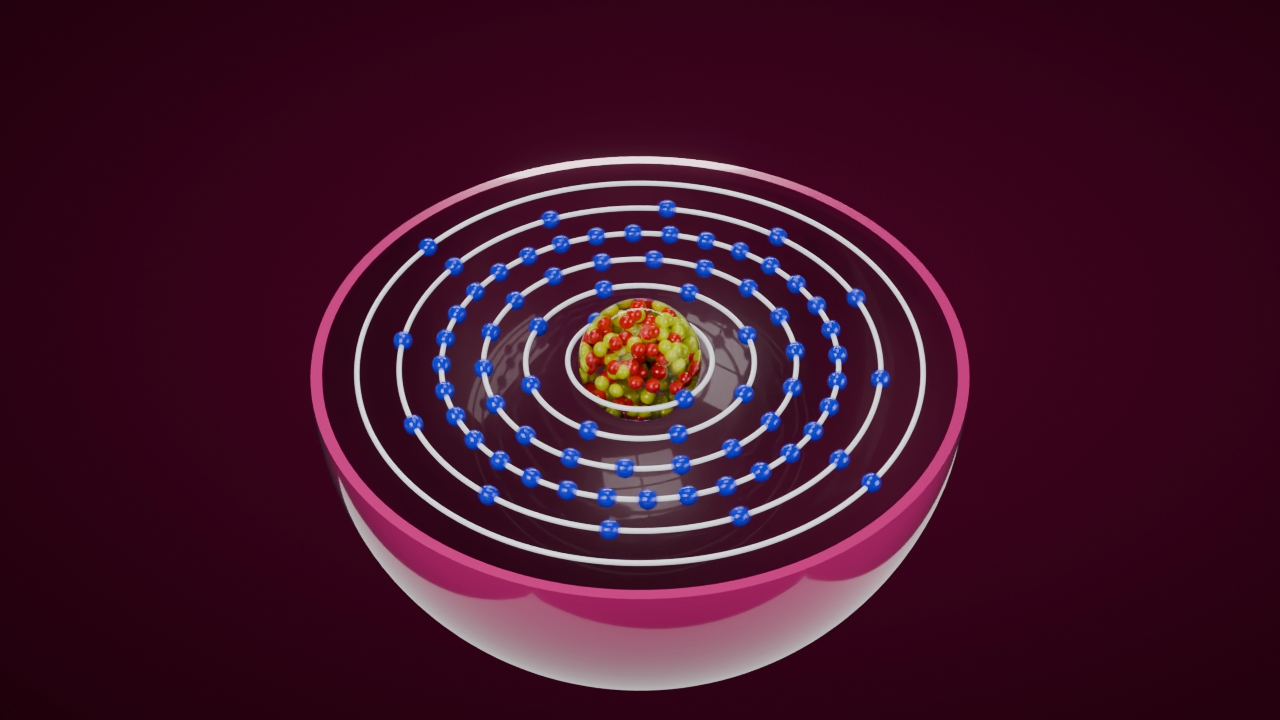
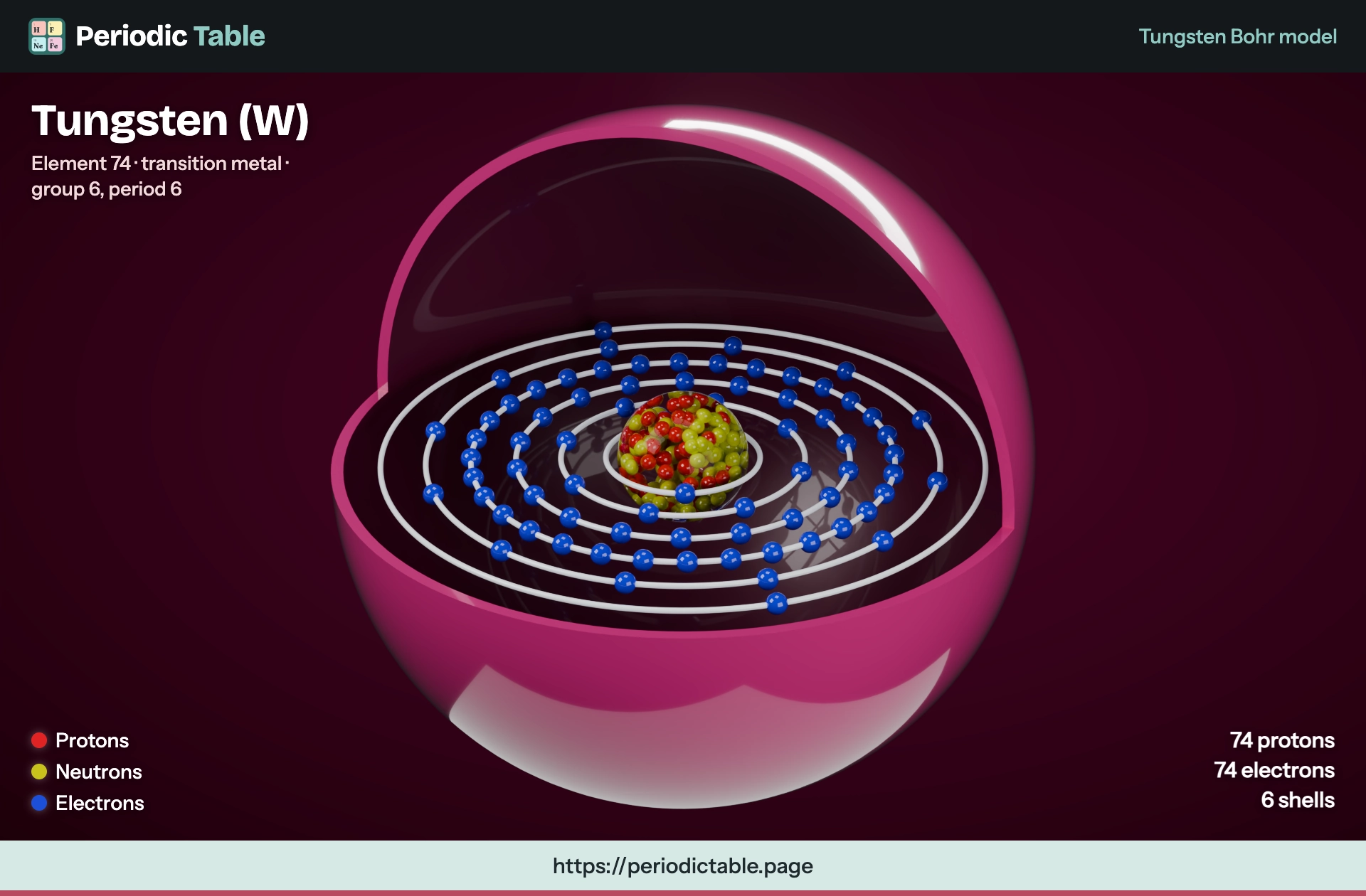
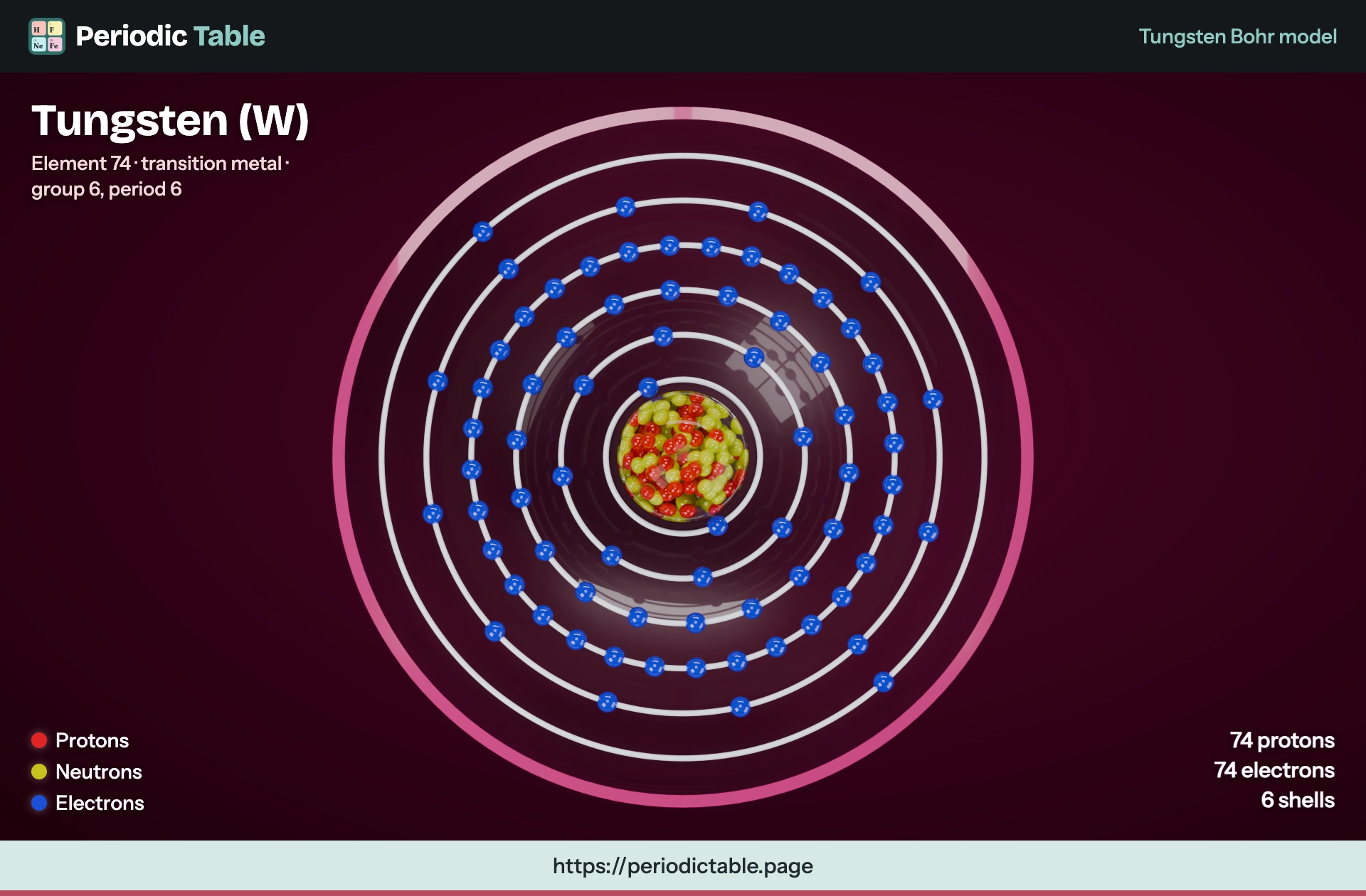
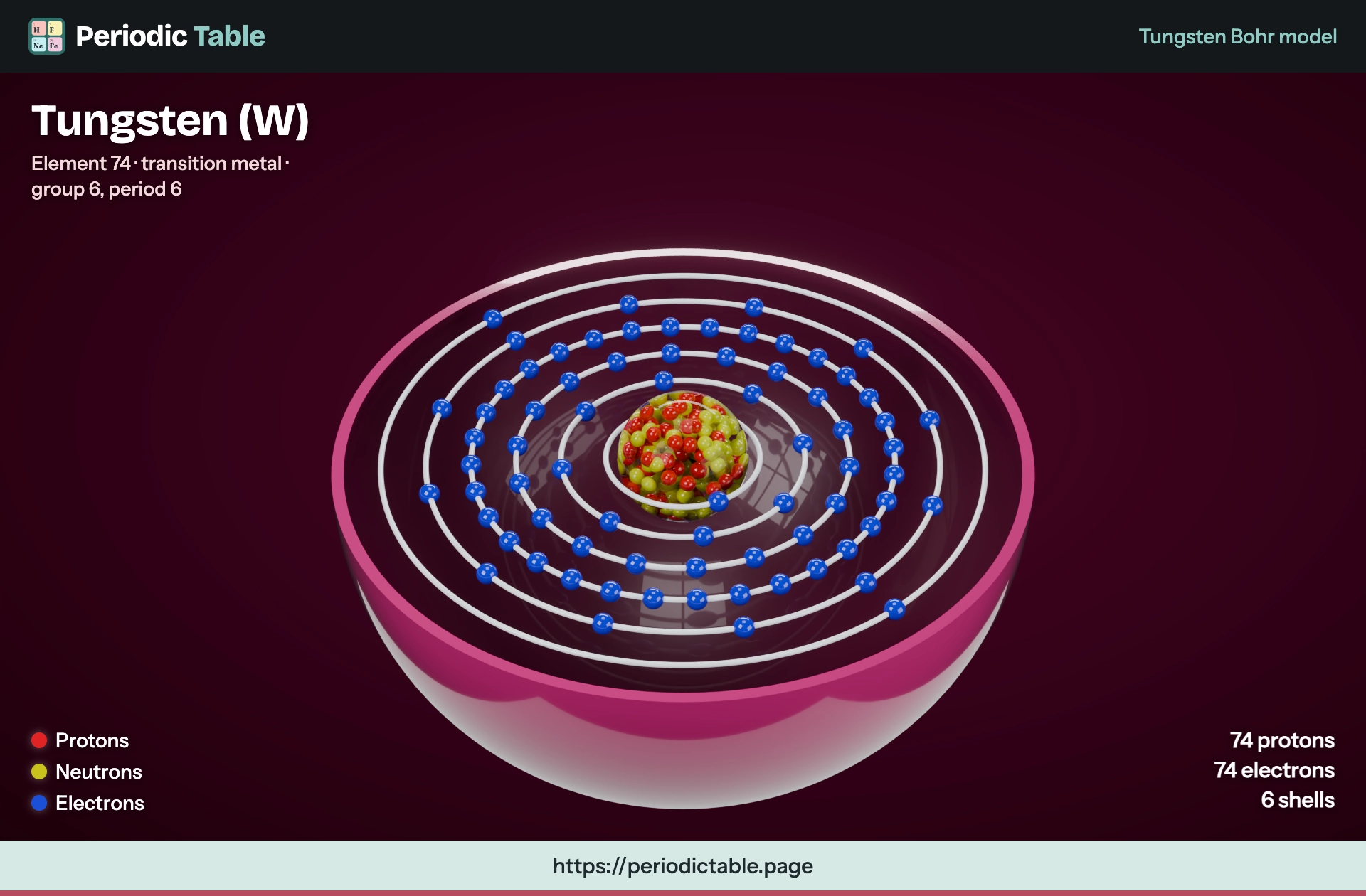
This is a Bohr model of tungsten (W), a simplified picture of a single tungsten atom. Its nucleus holds 74 protons, and a neutral tungsten atom has 74 electrons, arranged around it in 6 shells (2 in shell K, 8 in shell L, 18 in shell M, 32 in shell N, 12 in shell O and 2 in shell P).
Tungsten periodic table electron configuration
- Shorthand
- [Xe] 4f14 5d4 6s2
- Full
- 1s2 2s2 2p6 3s2 3p6 4s2 3d10 4p6 5s2 4d10 5p6 6s2 4f14 5d4
- Electrons per shell
- 2, 8, 18, 32, 12, 2
Tungsten element properties and atomic data
- Atomic number
- 74
- Atomic mass
- 183.841 u
- Phase at STP
- Solid
- Melting point
- 3421.85°C (3695 K)
- Boiling point
- 5929.85°C (6203 K)
- Density
- 19.25 g/cm³
- Electronegativity (Pauling)
- 2.36
- Period
- 6
- Group
- 6
- Block
- d-block
- Appearance
- Grayish white, lustrous
- Discovery date
- 1783
- Discovered by
- Carl Wilhelm Scheele
- Named by
- —
Tungsten at a glance: element 74 key data
The table below collects the reference values you are most likely to need for element 74. Measured values differ slightly between data sources (purity and test conditions matter), so the figures here are the commonly cited ones rounded to sensible precision. Abundance, extraction and uses of the reactive nonmetals are compared for the universe and for mass in the crust.
| Property | Value |
|---|---|
| Symbol | W |
| Atomic number | 74 |
| Standard atomic weight | 183.84 |
| Group, period, block | Group 6, period 6, d-block |
| Appearance | Grayish white, lustrous |
| State at 20 °C | Solid |
| Melting point | 3,422 °C (6,192 °F; 3,695 K) |
| Boiling point | 5,930 °C (10,706 °F; 6,203 K) |
| Mass per cm³ at 20 °C | about 19.25 g |
| CAS number | 7440-33-7 |
Two of these entries explain most of what tungsten is used for: no other element in the table above melts at a higher heat among the metals, and few are as heavy for their size. Keep both in mind as you read the uses further down.
Where W sits on the periodic table
On the periodic table, tungsten sits in group 6 and period 6, which places it in the d-block as a member of the third transition series. Directly above it are chromium and molybdenum, and below it is the synthetic element seaborgium. Its horizontal neighbours are tantalum (element 73) and rhenium (element 75), with hafnium one step further left.
That position matters. Tungsten behaves as a typical transition metal, with partly filled d orbitals that let its atoms bond strongly to each other and to many other elements. Its chemistry is very close to that of its lighter group partner, so the two often appear together in minerals and in industrial catalysts.
Physical properties of tungsten metal
Freshly cut or polished tungsten metal is hard and steel-grey to silvery white. Its physical properties read like a list of records, which is why engineers reach for it when other materials fail at high temperatures. To compare thermal conductivity, electrical conductivity and tensile strength with steel, see the post-transition metal aluminium for figures and comparisons.
Melting point, boiling point and density
Tungsten has the highest melting point of all metals at 3,422 °C. Only carbon resists more heat, and it sublimes rather than melting at normal pressure. It also boils at an extreme 5,930 °C or so, roughly as hot as the surface of the Sun.
Its density of about 19.25 g/cm³ puts it in the same league as gold and uranium. To make that concrete, you can work out the size of a 1 kg cube yourself: 1,000 g ÷ 19.25 g/cm³ gives about 51.9 cm³, so each edge is only about 3.73 cm long.
| Comparison | g/cm³ | Tungsten is heavier by |
|---|---|---|
| Aluminium | 2.70 | about 7.1× |
| Iron alloy (typical) | 7.85 | about 2.5× |
| Lead | 11.34 | about 1.7× |
| Gold | 19.32 | slightly lighter (about 0.4% less) |
Crystal structure, tensile strength and thermal expansion
The stable alpha form of tungsten has a body-centered cubic crystal structure. A metastable beta form (A15 structure) can appear in thin films, and it conducts electricity less well. Strong 5d bonding between neighbouring atoms gives tungsten very high tensile strength when hot and the lowest thermal expansion of any pure metal.
A quick comparison shows why that low expansion is useful: heat a 100 mm rod by 100 K and tungsten grows by roughly 0.045 mm, while an ordinary mild-steel rod grows by about 0.12 mm.
| Thermal and mechanical property | Typical value |
|---|---|
| Linear expansion coefficient | about 4.5 × 10⁻⁶ /K at 20 °C |
| Thermal conductivity | about 173 W/(m·K) |
| Electrical resistivity | about 52.8 nΩ·m at 20 °C |
| Specific heat capacity | about 132 J/(kg·K) |
| Young's modulus | about 411 GPa |
| Shear modulus | about 161 GPa |
| Bulk modulus | about 310 GPa |
| Vapor pressure | reaches 1 Pa only near 3,480 K |
The very low vapor pressure means hot tungsten loses little material by evaporation, and the good thermal conductivity and modest electrical resistivity help it carry heat and current at the same time.
Brittle or ductile? how pure tungsten behaves
Ordinary polycrystalline tungsten is brittle at room conditions, which makes it hard to machine. Pure tungsten grown as a single crystal is far more ductile and can even be cut with a hacksaw. Impurities at grain boundaries are what make commercial bars crack.
- Its hardness exceeds that of many tool alloys.
- Once heated past its transition point (several hundred degrees Celsius) it can be forged, drawn into wire, rolled and extruded.
- Most parts are shaped from powder rather than cast, because no ordinary crucible can hold it molten.
Atomic structure of tungsten: electron configuration and electronegativity
A neutral tungsten atom has 74 protons and 74 electrons arranged in shells of 2, 8, 18, 32, 12 and 2. Written in shorthand, the electron configuration is [Xe] 4f14 5d4 6s2, so the six outer electrons (four 5d plus two 6s) are the ones that take part in bonding. That count of six explains why +6 is tungsten's most common oxidation state.
- Electronegativity
- 2.36 on the Pauling scale in most modern tables (some older sources list about 1.7).
- Ionization energies
- About 770 kJ/mol for the first electron and about 1,700 kJ/mol for the second.
- Atomic radius
- About 139 pm (empirical).
- Electron affinity
- About 79 kJ/mol.
Relativistic effects in such a heavy atom contract the 6s orbital, which strengthens metal-metal bonding. That is part of the reason the chemistry of tungsten differs from that of chromium even though they share a group.
Chemical properties of tungsten
The chemical properties of tungsten are best summed up as "inert until hot." In everyday conditions it resists corrosion, does not react with water or air, and is attacked only slowly by most acids and bases. Things change once it glows red.
Oxidation states and reactivity
Tungsten shows oxidation states from −2 to +6, with +6 and +4 the most common. When heated in oxygen it forms yellow tungsten trioxide, WO3, and finely divided powder can even ignite on its own. Key reactions include:
- Fluorine attacks it even when cold, forming the colourless gas tungsten hexafluoride, WF6.
- Chlorine and bromine react at around 250 °C.
- Oxidation in air becomes rapid above roughly 500 °C, so hot parts need a vacuum or an inert gas.
Important tungsten compounds
Most tungsten compounds start from the +6 state. The trioxide dissolves in alkaline solutions to give the tungstate ion, WO42−, which links up into large polyoxometalate clusters as the solution is acidified.
- Ammonium paratungstate: the main intermediate from which almost every other tungsten product is made.
- Tungsten carbides (WC and W2C): formed by heating the powder with carbon; among the hardest compounds known.
- Tungsten disulfide (WS2): a dry lubricant that works at high temperature.
- Calcium and magnesium tungstates: phosphors and scintillator crystals.
- Chlorides from WCl4 to WCl6, which show the full range of tungsten chemistry.
Tungsten isotopes and radioactive decay
Natural tungsten contains four stable isotopes plus W-180, which has been observed to undergo alpha decay to hafnium-176 with a half-life of about 1.8 × 10¹⁸ years, far longer than the age of the universe.
| Isotope | Natural abundance | Status |
|---|---|---|
| W-180 | 0.12% | Alpha decay, extremely slow |
| W-182 | 26.5% | Stable |
| W-183 | 14.3% | Stable |
| W-184 | 30.6% | Stable (most abundant) |
| W-186 | 28.4% | Stable |
More than 30 artificial radioisotopes are known. The longest-lived is W-181, with a half-life of about 121 days, followed by W-185 and W-188; W-188 feeds generators that supply a short-lived isotope for nuclear medicine. Tungsten parts also hold up well near reactors, since the stable nuclei barely change under neutron exposure.
History of tungsten: from heavy stone to wolfram
People used tungsten long before anyone knew it was an element. More than 350 years ago, makers of Chinese porcelain used a tungsten-bearing glaze to give pieces a warm peach colour.
Discovery by Scheele and the Elhuyar brothers
In 1781 Carl Wilhelm Scheele showed that a new acid, tungstic acid, could be made from the mineral then called tungsten. He and Torbern Bergman suggested a new metal could be obtained by reducing it. Two years later, in 1783, the Spanish brothers Juan José and Fausto Elhuyar made the same acid from a different mineral and reduced it with charcoal, becoming the first to isolate the metal.
Tungsten later gained a stranger distinction: it is the only element to have been the subject of patent litigation. A US court in 1928 rejected General Electric's attempt to patent workable tungsten as such, ruling that an element found in nature cannot be patented.
Why the symbol is W: tungsten vs wolfram
The two names come from two minerals. "Tungsten" is Swedish for a stone of great weight, the old name for scheelite.
The other name comes from wolframite, whose German name traces back to "wolf's foam": medieval tin smelters noticed the mineral ate into their tin yield the way a wolf devours sheep. The Elhuyars themselves asked for the name wolfram (or volfram), and the symbol W comes from it.
The International Union of Pure and Applied Chemistry (IUPAC) briefly adopted the German-style name in 1949, then restored tungsten a year later after objections from English-speaking chemists. Today English and French use tungsten, while German, Swedish, Spanish and many other languages still use the W-derived name.
Where tungsten comes from: wolframite, scheelite and mining
Tungsten is never found uncombined in nature. Its two main minerals are wolframite, (Fe,Mn)WO4, a mix of iron and manganese salts, and scheelite, CaWO4, the calcium salt. Smaller sources include hübnerite, ferberite and stolzite.
Average crustal abundance is only about 1 part per million, and even rich deposits usually hold under 1.5% tungsten oxide, so mining must move a lot of rock. The ore is concentrated by gravity, flotation and, for weakly magnetic wolframite, magnetic separation.
Tungsten production and reserves by country
Global mine output is now around 80,000 tonnes of contained metal a year, and roughly a third of supply comes from recycled scrap. China dominates, producing over 80% of mined tungsten and holding the largest reserves. Other notable producers and reserve holders are:
- Vietnam and Russia, both important miners and reserve holders.
- Bolivia, long a significant South American source.
- Portugal (Panasqueira) and Austria, Europe's main producing deposits.
- Australia, Canada and South Korea, which hold large deposits that open and close with prices.
Supply risk and conflict mineral concerns
Because one country supplies most of the world's tungsten and substitutes are limited, the Royal Society of Chemistry rates its supply risk among the highest of any element. It is also classed as a conflict mineral under US and EU rules, since some supply has been linked to armed groups in the Democratic Republic of the Congo. For any industry that depends on it, sourcing and recycling are strategic questions, not just cost ones.
How elemental tungsten is extracted and processed
Turning rock into elemental tungsten takes several chemical steps, because it cannot be smelted like iron and heating the oxide with coal gives carbide instead.
- Crush, grind and concentrate the rock.
- Digest the concentrate in alkali to make a sodium salt solution, then purify it.
- Add ammonia to crystallize ammonium paratungstate (APT).
- Roast APT to the yellow trioxide.
- Reduce the oxide to powder with hydrogen in a hot furnace.
The hydrogen reduction in the last step can be written as:
$$\mathrm{WO_3 + 3H_2 \rightarrow W + 3H_2O}$$
The powder is then pressed and consolidated by sintering, the core of tungsten powder metallurgy, before being forged, swaged or drawn into wire. Thin films for microchips are made a different way, by reducing tungsten hexafluoride gas with hydrogen.
How tungsten carbide and tungsten alloys are used
About 60% of all tungsten ends up as tungsten carbide, bonded with cobalt into "cemented carbide" for cutting tools, drill bits, saw tips and rock picks used in metalworking, oil drilling and construction. Its wear resistance also makes it popular for scratch-resistant jewelry. Most of the rest goes into alloys and steels:
- High-speed steel can contain up to 18% tungsten, keeping a cutting edge even when red hot.
- Superalloys such as Stellite resist wear and heat in valves, blades and coatings.
- Heavy alloys with iron, copper or nickel combine density with machinability.
- Early permanent magnets were made from quenched tungsten-bearing steels, until newer magnet alloys replaced them.
Lighting, electronics and welding
Tungsten's best-known job is glowing: light bulb filaments run near 2,500 °C without melting, and potassium-doped wire keeps the filaments from sagging. The same heat tolerance suits heating elements, vacuum-furnace parts and x-ray tubes, where tungsten serves as the target.
In electronics, tungsten fills the tiny vertical connections in integrated circuits, provides field-emission tips for electron microscopes and adds mass to the spinning weights in phone vibration motors. Because it expands at about the same rate as borosilicate glass, it makes reliable glass-to-metal seals. Welders know it from gas tungsten arc welding (TIG), where a non-consumable tungsten electrode holds a stable arc.
Military and aerospace applications
Dense heavy alloys form kinetic energy penetrators, the long rods fired by tank guns, as a non-radioactive alternative to depleted uranium. The metal also appears in armour-piercing ammunition cores and in dense inert explosives.
Germany's wartime shortage even gave its name to the "Wolfram Crisis." In aerospace, its heat resistance is used in rocket nozzles, re-entry parts and coatings for turbine blades.
Weights, ballast and gold substitution
Wherever a lot of mass has to fit in a small space, tungsten wins. It is used for aircraft counterweights, helicopter rotor weights, yacht keel and race-car ballast (including in Formula One), professional darts, and lead-free fishing sinkers. Its near match with the precious metal has a darker side: counterfeiters have drilled out gold bars and filled them with tungsten rods, or gold-plated solid tungsten bars, which pass a simple weight-and-size check.
Chemical uses and fusion reactors
The trioxide strengthens catalysts that cut nitrogen oxides in power-plant exhaust, and calcium-salt phosphors once lit fluorescent lighting and X-ray screens. Its low tritium retention and resistance to erosion make it the leading armour for the hottest surfaces inside fusion reactors, including the ITER divertor. Dense tungsten-polymer composites also provide non-toxic radiation shielding for hospital radiopharmacies.
Tungsten among the refractory metals
Engineers group tungsten with the four metals in the table below as the refractory metals: metals that melt above roughly 2,000 °C and keep their strength when hot. Tungsten tops the group for heat tolerance, but it is also the hardest to fabricate and oxidizes in hot air, so designers often trade it for a lighter refractory when weight or cost matters more than peak temperature.
| Refractory metal | Melting point (°C) | Density (g/cm³) |
|---|---|---|
| Tungsten | 3,422 | 19.25 |
| Rhenium | 3,186 | 21.0 |
| Tantalum | 3,017 | 16.7 |
| Molybdenum | 2,623 | 10.2 |
| Niobium | 2,477 | 8.57 |
Biological role and health effects of tungsten
Tungsten is the heaviest element with a known biological role. Some bacteria and archaea, especially heat-loving microbes from hydrothermal vents, use it in place of its group partner in enzymes that convert carboxylic acids to aldehydes. Plants and animals have no known need for it.
For people, metallic tungsten has low acute toxicity, but soluble tungstate compounds can interfere with molybdenum and copper metabolism and are mildly toxic at high doses. Most exposure risk is occupational: inhaling fine dust from grinding cemented carbide (where the binder is the main concern) can cause lung disease, so dust control and extraction matter in any workshop that machines it.