


Hydrogen element (H): hydrogen periodic table facts
Hydrogen periodic table facts: hydrogen (H) is element 1, a reactive nonmetal in group 1, period 1. Pick any star in the night sky and you are mostly looking at hydrogen, the first and lightest element on the periodic table. Mendeleev's law of periodicity gave shape to the periodic system, now laid out in 18 columns.
A single proton orbited by one electron makes it the simplest atom there is, yet this tiny chemical element is also the most abundant element in the universe. Below you will find what hydrogen is, how it behaves, where it comes from and why industry and energy planners care so much about it.
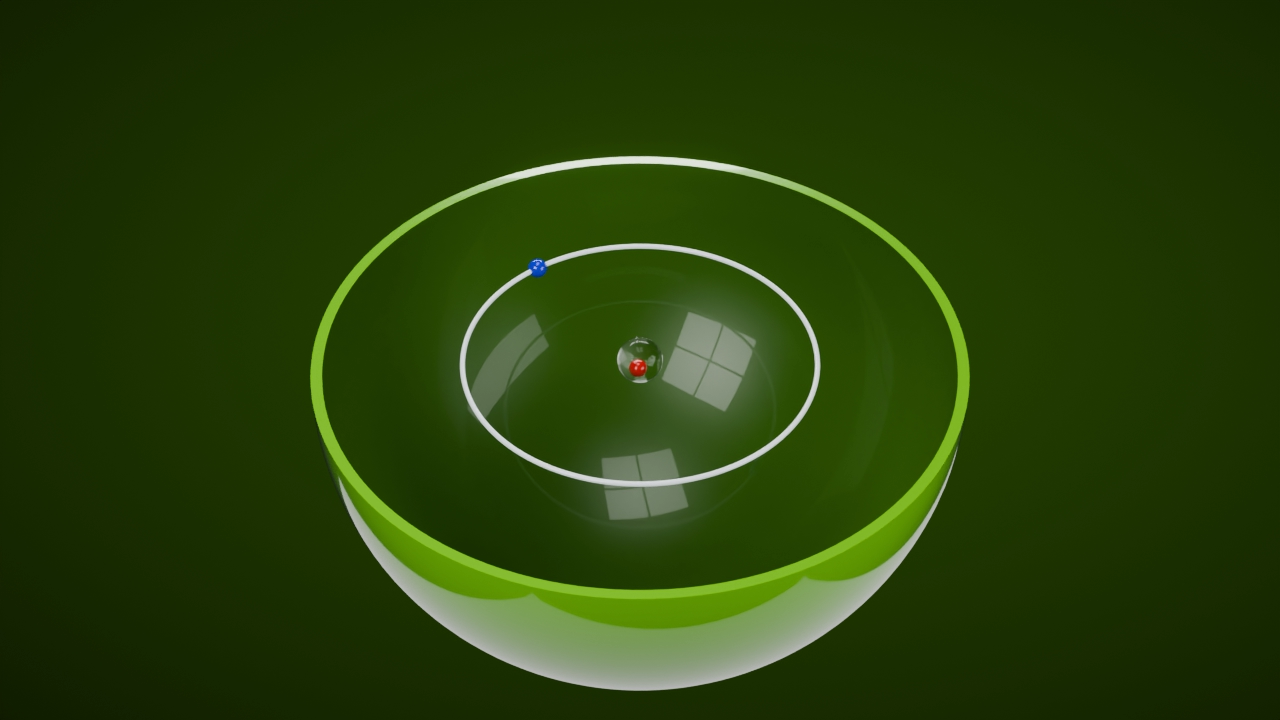
Rotate the 3D Bohr model of hydrogen
Drag to orbit, scroll to zoom.
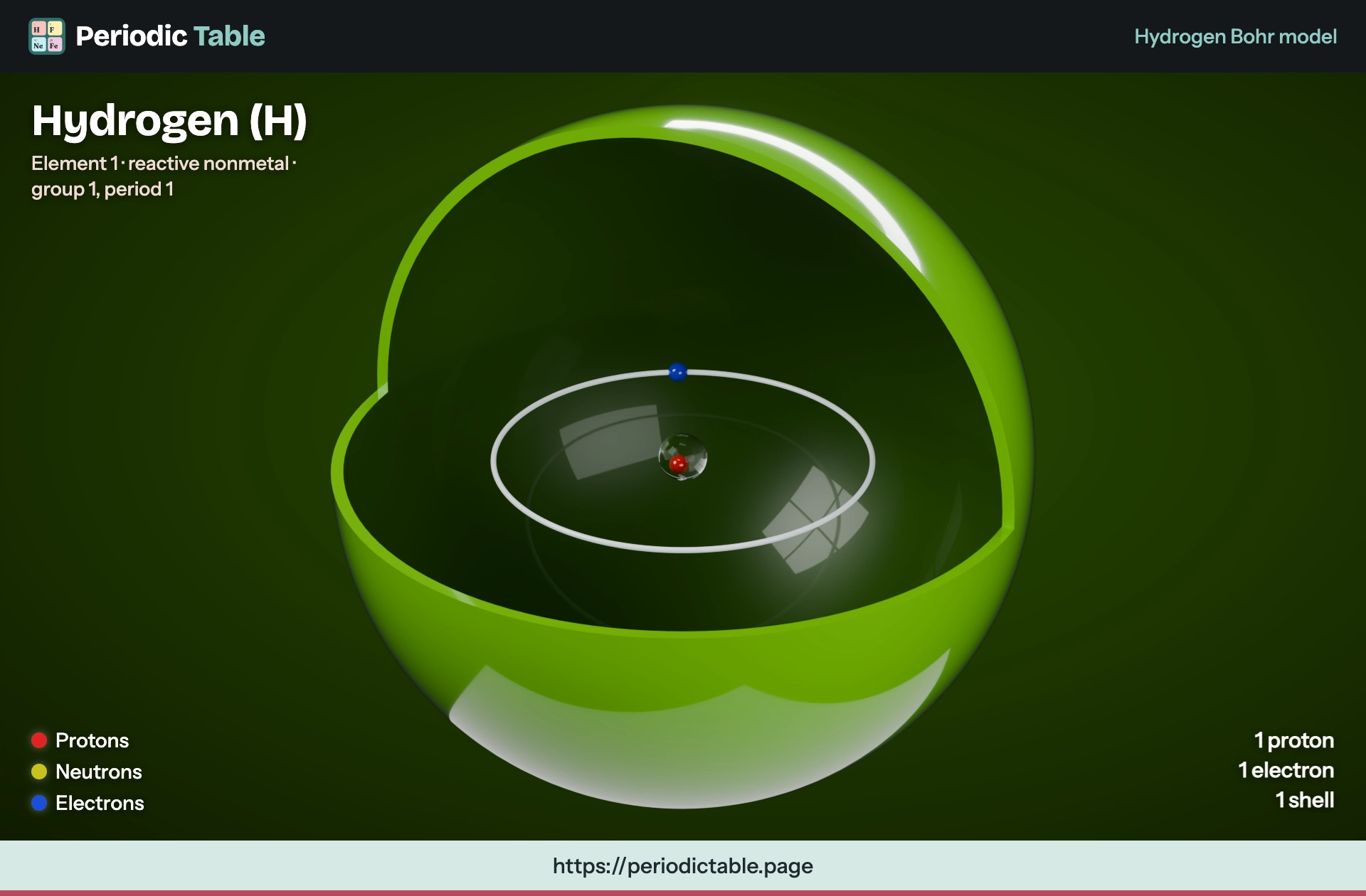
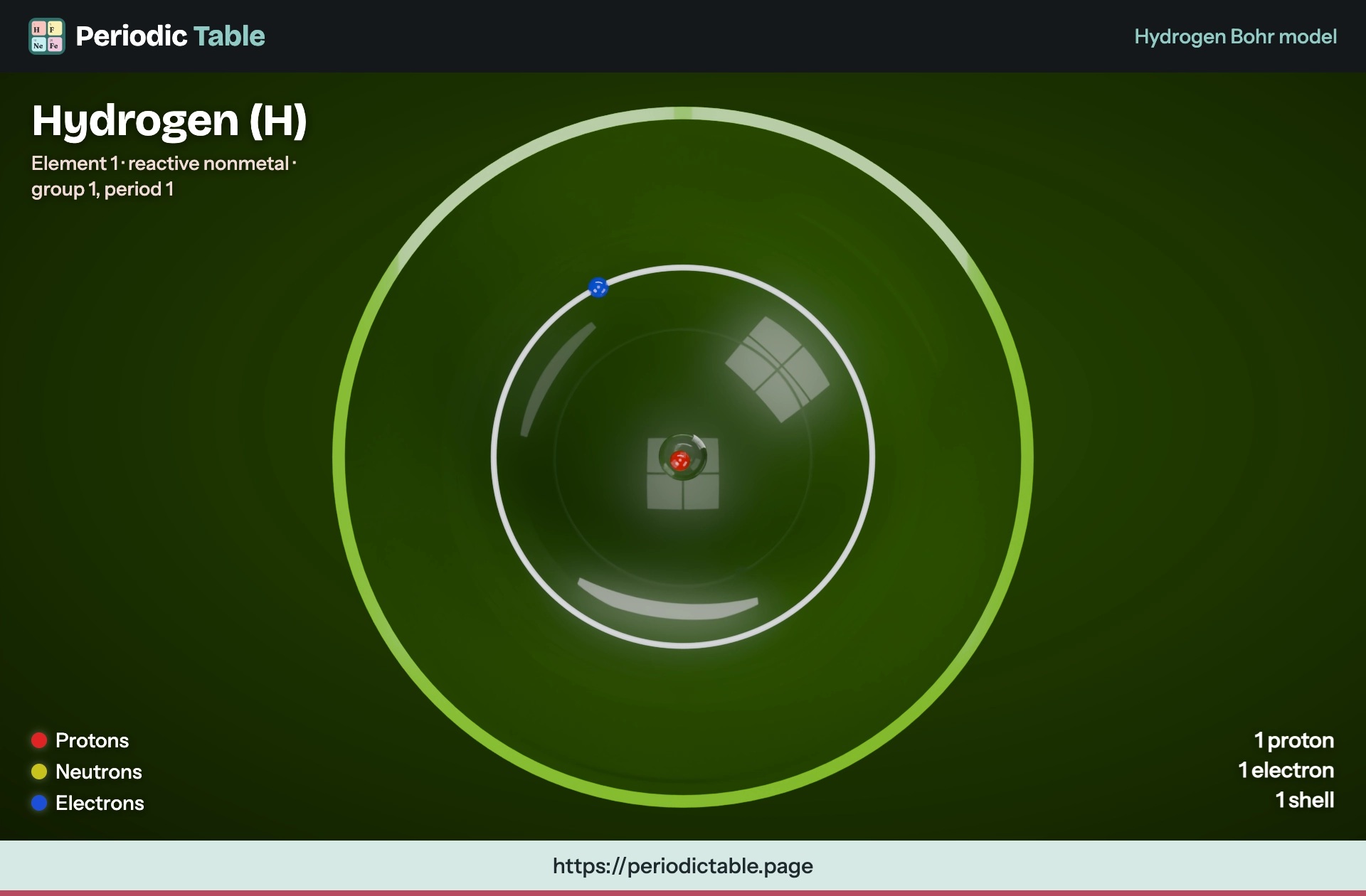
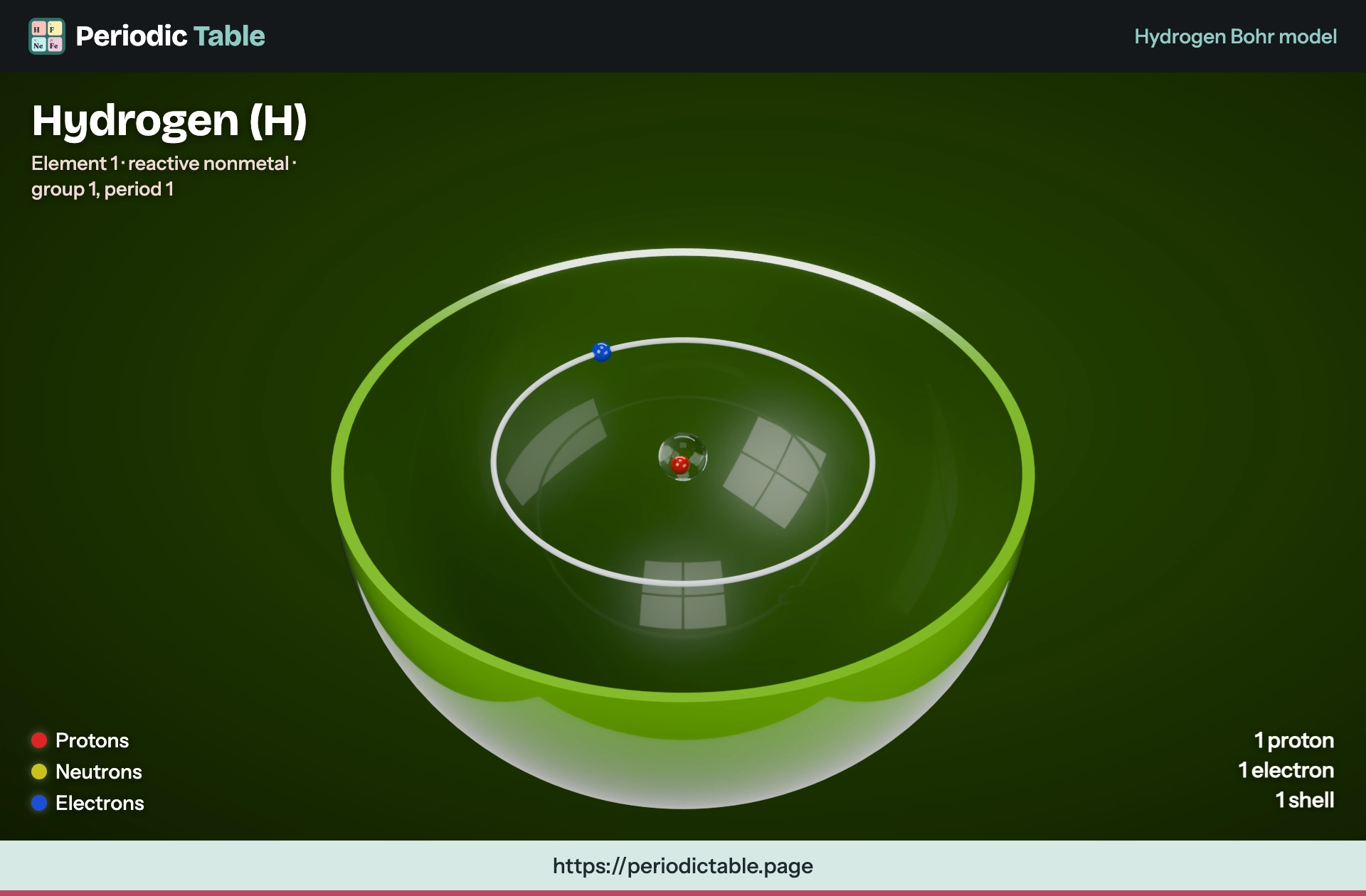
This is a Bohr model of hydrogen (H), a simplified picture of a single hydrogen atom. Its nucleus holds 1 proton, and a neutral hydrogen atom has 1 electron, arranged around it in 1 shell (1 in shell K).
Hydrogen periodic table electron configuration
- Shorthand
- 1s1
- Full
- 1s1
- Electrons per shell
- 1
Hydrogen element properties and atomic data
- Atomic number
- 1
- Atomic mass
- 1.008 u
- Phase at STP
- Gas
- Melting point
- -259.16°C (13.99 K)
- Boiling point
- -252.88°C (20.271 K)
- Density
- 0.00008988 g/cm³
- Electronegativity (Pauling)
- 2.2
- Period
- 1
- Group
- 1
- Block
- s-block
- Appearance
- Colorless gas
- Discovery date
- 1766
- Discovered by
- Henry Cavendish
- Named by
- Antoine Lavoisier
Hydrogen element facts at a glance
As element 1, it carries the chemical symbol H and sits at the top-left corner of the periodic table, in group 1, period 1 and the s-block. It shares that column with the alkali metals, but the resemblance stops at its lone outer shell: under standard conditions it is a colorless, odorless, tasteless and non-toxic substance, and in its bonding it acts much more like the nonmetals to its right. That split personality is one reason chemistry textbooks often draw it floating above the main table rather than locking it into one family. When comparing isotopes, readers can use properties of chlorine for chlorine-35, chlorine-37 and the trace of chlorine-36 found in nature.
| Property | Value |
|---|---|
| Atomic number | 1 |
| Symbol | H |
| Standard atomic weight | 1.008 |
| Group / period / block | 1 / 1 / s |
| Electron configuration | 1s1 |
| Common valences | +1, −1 |
| State at 20 °C | Gas |
| Discovered by | Henry Cavendish, 1766 |
Atomic mass and electron configuration
The atomic number of 1 means every nucleus of the element holds exactly one positive charge. Its atomic weight is quoted as 1.008, an average that reflects the small natural share of heavier forms, while the atomic mass of the commonest form is 1.0078 u.
IUPAC publishes the standard value as a narrow interval because the isotope mix shifts slightly between seawater, rock and air samples. The ground-state configuration is simply 1s1: one half-filled shell that hydrogen can share, lose or top up.
Physical properties of hydrogen gas
Pure hydrogen gas is made of diatomic units, and its physical properties follow from how light and weakly attracted those units are. At atmospheric pressure it is roughly 14 times lighter than air, it diffuses faster than any other substance, and it conducts heat about seven times better than air does. Those three traits shape almost everything engineers do with hydrogen gas, from cooling generators to designing leak-tight valves.
Boiling point, melting point and density
Very weak attraction between neighbouring units gives the element some of the lowest phase-change temperatures of any substance:
| Physical property | Value |
|---|---|
| Melting | 13.99 K (−259.16 °C) |
| Boiling | 20.27 K (−252.88 °C) |
| Mass per litre at 0 °C, 1 atm | 0.0899 g |
| Specific heat capacity | 14.30 kJ per kg per K |
| Thermal conductivity | 0.18 W per m per K |
Because it boils only about 20 degrees above absolute zero, keeping it liquid demands serious insulation, and it freezes just six degrees lower.
Liquid, slush and metallic hydrogen phases
Liquid hydrogen exists only below the critical point of about 33 K, and at normal pressure it must be chilled to roughly 20 K before it stays liquid. Cool it further and it freezes into solid hydrogen; at the triple point (13.8 K) solid and liquid coexist as slush hydrogen, a denser cryogenic propellant.
Squeeze it past roughly 400 gigapascals and theory predicts metallic hydrogen, an electrical conductor thought to fill the deep interior of Jupiter and every other gas giant, with some physicists even suggesting superconductivity. Heat it enough to strip its charge carriers away and you get a plasma, the state it takes inside stars.
Inside the hydrogen atom
A neutral hydrogen atom is one proton bound to one negative charge, and no other neutral atom lets you solve the Schrödinger equation exactly. That is why atomic hydrogen became the test bench for quantum mechanics, and why it still anchors so much of modern physics. The Bohr model already captures its energy levels well: To learn how brevium got its final name and who isolated the first weighable sample, see element protactinium for the account.
$$E_n = -\frac{13.6\ \text{eV}}{n^{2}}$$
Here \(n\) is the principal quantum number and \(n = 1\) is the ground state, 13.6 electronvolts below the free state. When the bound charge in a hot atom drops from \(n = 4\) to \(n = 2\), the energy gap is \(13.6 \times (\tfrac{1}{4} - \tfrac{1}{16}) = 2.55\) eV, which comes out as blue-green light at about 486 nm.
A drop from \(n = 2\) to \(n = 1\) releases 10.2 eV, deep in the ultraviolet at 121.6 nm. Those visible jumps form the Balmer series, the spectral lines that let astronomers read a star's hydrogen content from across the galaxy, and a tiny spin flip between the proton and its partner produces the famous 21-centimeter radio line that maps cold clouds in space.
Electronegativity, ionisation energies and covalent radius
- Electronegativity: 2.20 on the Pauling scale, close to carbon, so most bonds it forms are only mildly polar.
- Ionisation energies: 1312 kJ/mol for the first and only one, far higher than any alkali metal.
- Covalent radius: about 32 pm; the non-bonded atomic radius is roughly 110 pm.
- Electron affinity: about 73 kJ per mole, which is why the anion H− can exist at all.
Isotopes of hydrogen: protium, deuterium and tritium
Hydrogen is the only element whose isotopes carry their own names. Protium has no neutrons and makes up more than 99.98% of natural samples.
Deuterium adds one neutron and is stable; Harold Urey isolated it in 1931, and it is now used as a non-radioactive tracer and in the solvents for NMR spectroscopy. Tritium carries two neutrons and is radioactive, undergoing beta decay to helium-3 with a half-life of about 12.3 years, which is why it glows in self-powered exit signs and once lit the luminous paint on watch dials.
| Hydrogen isotope | Particles | Mass (u) | Natural abundance | Stability |
|---|---|---|---|---|
| ¹H | 1 p | 1.008 | ~99.99% | Stable |
| Deuterium (²H, D) | 1 p + 1 n | 2.014 | ~0.0115% | Stable |
| Tritium (³H, T) | 1 p + 2 n | 3.016 | Trace | Decays, 12.3 years |
Heavy water and exotic hydrogen analogs
Water built with deuterium instead of ordinary hydrogen is heavy water, about 11% denser than the everyday liquid and valued as a neutron moderator and coolant in certain nuclear reactors. Physicists also make stranger relatives: antihydrogen, an antiproton paired with a positron, and muonium, an antimuon holding a single bound charge. Comparing them with ordinary atoms is one of the sharpest ways to test whether matter and antimatter obey the same rules.
Molecular hydrogen and its spin isomers
On Earth, the free element almost never appears as lone atoms. Two of them share their charge in a strong bond to form molecular hydrogen, \(\mathrm{H_2}\), which IUPAC formally names dihydrogen and which chemists often just write as H2.
Each hydrogen molecule is held by an H–H bond worth about 436 kJ per mole, one of the strongest single bonds between two identical atoms, so these diatomic molecules are surprisingly sluggish at room temperature despite their explosive reputation. Like most nonmetals, it then builds covalent bonds with partners such as oxygen, giving the endless families of compounds in living things.
The two nuclei also give the hydrogen molecule a quirk called spin isomers. In ortho-hydrogen the nuclear spins point the same way; in para-hydrogen they oppose.
At room temperature the mix settles at about 75% ortho and 25% parahydrogen, but cooling drives it toward the para form. That conversion releases heat, so liquefaction plants pass the stream over an iron oxide catalyst to finish the switch before it goes into tanks, or the liquid slowly boils itself away.
Chemical properties of hydrogen
With a single bonding slot to fill, hydrogen reacts with almost every element, yet at ordinary temperatures it usually needs a push. It is a strong reducing agent: heated with metal oxides it strips them back to the bare metal.
With chlorine in sunlight, it reacts through a free-radical chain reaction to form HCl, and finely divided platinum or nickel lets it add across the double bonds of alkenes without heating. These reactions stall at first because the H–H bond is so strong, then race once heat, light or a metal surface splits it apart, a quirk that shapes most of hydrogen chemistry.
Combustion, flames and explosive mixtures
The most famous reaction is combustion:
$$2\,\mathrm{H_2(g)} + \mathrm{O_2(g)} \rightarrow 2\,\mathrm{H_2O(l)} \qquad \Delta H = -286\ \text{kJ per mole of } \mathrm{H_2}$$
The gas is highly flammable: explosive mixtures form with air anywhere from about 4% to 74% by volume, and the autoignition temperature is around 500 °C. The pale flame emits mostly ultraviolet light, so a hydrogen fire can be an almost invisible flame in daylight. The only product is water vapor, which is the whole appeal of burning it as a clean fuel.
Bond enthalpies of hydrogen compounds
Bond strength explains why some of its compounds are rock-steady and others react readily:
| Bond | Found in | Bond enthalpy (kJ/mol) |
|---|---|---|
| H–F | Hydrogen fluoride | 565 |
| H–O | Water | 463 |
| H–H | Dihydrogen | 436 |
| C–H | Methane | 415 |
| H–N | Ammonia | 391 |
| H–I | Hydrogen iodide | 299 |
Bonds to small, electronegative partners such as fluorine and oxygen are among the strongest, while the bond to large iodine is weak enough to break easily.
Hydrogen oxidation states and hydrides
The element shows two common oxidation states. At +1 it bonds to more electronegative partners, as in acids and the hydrocarbons and other organic compounds built on a carbon skeleton. At −1 it gains a negative charge and becomes a hydride.
Saline hydrides such as sodium hydride form when the gas meets the hot alkaline earth metals or the alkali metals; covalent ones include the boranes; and lithium aluminium hydride is a workhorse reducing reagent in the organic chemistry lab. Many transition metals simply soak it into their lattice, forming metal hydrides. Most fuels you know, from propane to diesel, are hydrocarbons, so the element sits inside the energy system long before anyone isolates it.
Hydrogen bonding in water and DNA
When it is attached to oxygen, nitrogen or fluorine, it can reach across to a lone pair on a neighbouring molecule. This hydrogen bonding is weaker than a full covalent bond but strong enough to matter enormously: it is the reason water stays liquid on Earth rather than boiling away far below 0 °C. It also zips the two strands of DNA together and steers protein folding, so without it there would be no chemistry of life as we know it.
Hydrogen ions, acids and pH
Remove the atom's only negative charge and what remains is a bare nucleus, the hydron (H+), effectively a lone proton. In the Brønsted–Lowry picture, acids donate this ion and bases accept it. A bare proton never floats free in solution, though; it attaches to a solvent molecule to form hydronium, \(\mathrm{H_3O^+}\), and larger clusters around it.
The pH scale is simply the negative logarithm of that hydronium concentration, so each step down the scale means ten times more hydrogen ions per litre. Few species are counted as carefully in everyday chemistry and biology.
History of hydrogen discovery
Robert Boyle collected a flammable vapour from iron filings dropped in dilute acid in 1671 without realising it was new. In 1766 Henry Cavendish showed that metals such as zinc in acid released a distinct substance he called inflammable air, and he later found it burned to produce water.
He tied the gas to the phlogiston theory, the reigning chemistry of burning, but in 1783 Antoine Lavoisier repeated the experiment, recognised a new element and named it hydrogen, Greek for water-former. James Dewar first liquefied the gas in 1898 using his newly invented vacuum flask, and froze it a year later.
- 1671: Boyle produces the gas from metal and acid.
- 1766: Cavendish identifies inflammable air as a distinct substance.
- 1783: Lavoisier names the element; Jacques Charles flies the first hydrogen balloon.
- 1898: Dewar liquefies the gas.
- 1931: Urey discovers deuterium, a discovery that soon reshaped nuclear physics.
Hydrogen-filled airships and the Hindenburg
Its lightness made it the natural lifting gas. Balloons rose over Paris in 1783, and rigid Zeppelin airships carried paying passengers across Europe and the Atlantic in the early twentieth century.
The Hindenburg fire at Lakehurst, New Jersey, in 1937 ended commercial airship travel almost overnight. It still lifts most weather balloons, where low cost beats the safety margin of the pricier noble alternative.
Where elemental hydrogen occurs
About 75% of the ordinary matter in the universe by mass, and over 90% of all atoms, is hydrogen. Protons formed in the first second after the Big Bang, and neutral hydrogen atoms appeared about 370,000 years later. Stars, including the sun, shine by fusion of these nuclei, and the thin material between them, the interstellar medium, is mostly the same raw ingredient, which makes hydrogen central to astrophysics.
On Earth, elemental hydrogen is scarce: the molecules are so light they escape to space, so Earth's atmosphere holds only about 0.5 parts per million. Almost all terrestrial hydrogen is locked in water, minerals and living tissue, about 1,400 ppm of the crust by weight, and it makes up roughly 10% of the human body by mass.
A glass of water is a neat example: 2 × 1.008 ÷ 18.015 means about 11.2% of what you drink is hydrogen by weight. Geologists have also found natural hydrogen seeping from rock, and companies are now drilling for underground hydrogen in Mali, France and Australia.
Hydrogen production methods
Because the free element is rare, almost all of it has to be manufactured. Large-scale hydrogen production today still depends overwhelmingly on fossil fuels, with low-emission routes supplying only around 1% of world output, so for any industrial buyer the method matters as much as the volume.
Steam reforming of natural gas
Steam reforming reacts methane from natural gas with steam at 700–1,100 °C over a nickel catalyst:
$$\mathrm{CH_4} + \mathrm{H_2O} \rightarrow \mathrm{CO} + 3\,\mathrm{H_2}$$
The carbon monoxide in that synthesis gas, or syngas, then goes through the water gas shift reaction to release more hydrogen and turn the CO into carbon dioxide, between about 7 and 9 tonnes of it for every tonne of hydrogen made. Partial oxidation of heavier oils and coal gasification follow a similar logic.
Electrolysis and green hydrogen
Electrolysis splits water with an electric current, releasing hydrogen at the cathode. When the power comes from wind or solar, the product is called green hydrogen.
Today's electrolyzers cost more per kilogram than reformers, but cheap renewable electricity is narrowing the gap. Methane pyrolysis offers a middle path: it cracks the feed into hydrogen and solid soot instead of CO2.
Biohydrogen, serpentinization and lab methods
Some algae and bacteria make biohydrogen with enzymes called hydrogenases, and other microbes consume it, a loop known as the hydrogen cycle. Deep underground, serpentinization of mafic rock by groundwater generates hydrogen naturally. In a school lab the simplest method is still zinc dropped into hydrochloric acid.
Hydrogen storage and embrittlement
Storage is the hardest practical problem. Per kilogram, hydrogen holds a lot of energy, but per litre it holds very little, so it is either compressed to 350–700 bar, chilled to a liquid, or bound into a carrier.
Carriers range from palladium, which absorbs many times its own volume of it, to ammonia borane, which packs about 19.6% by weight but is hard to recharge. Metals bring their own risk: dissolved hydrogen makes steel brittle, so hydrogen embrittlement cracks in pipelines and tanks are a central design constraint.
Industrial uses of hydrogen
Most of the roughly 100 million tonnes of hydrogen made each year is consumed close to where it is produced. Its biggest single customer is modern agriculture, by way of fertilizer.
Ammonia, the Haber process and hydrogenation
The Haber process combines hydrogen with atmospheric nitrogen to make ammonia:
$$\mathrm{N_2} + 3\,\mathrm{H_2} \rightarrow 2\,\mathrm{NH_3}$$
Most of that output becomes fertilizer, and those fertilizers help feed roughly half the world's population. Hydrogenation adds hydrogen across double bonds, a staple of industrial chemistry: it hardens vegetable oils into margarine, and with carbon oxides it yields methanol, a building block for plastics and fuels.
Petroleum refining and steelmaking
Refineries use it to upgrade crude petroleum. Hydrocracking breaks heavy oil into lighter products, and hydrodesulfurization pulls sulfur out of diesel and jet fuel. In steelmaking, hydrogen can replace coke as the agent that reduces ore to metal, leaving steam instead of CO2, which makes it a leading route to decarbonization of heavy industry.
Semiconductors, welding and other niche uses
- Semiconductor fabrication: hydrogen caps dangling bonds in amorphous silicon.
- Welding: atomic-hydrogen torches reach very high temperatures.
- Coolant: large power-station generators circulate it for its thermal conductivity.
- Food additive E949: used as a packaging gas.
- Leak detection: a 5% hydrogen blend finds tiny leaks safely.
Hydrogen fuel as an energy carrier
Energy analysts describe hydrogen as an energy carrier rather than a primary energy source: making it takes more energy than you get back, but it moves and stores energy in a usable form. Its energy content by weight is roughly three times that of gasoline, yet its energy density per litre, even as a liquid, is about a quarter. In numbers, using the higher heating value of 141.9 MJ per kg, a 3 kg tank of hydrogen releases about 426 MJ, or roughly 118 kWh.
Because converting hydrogen leaves only water at the point of use, it features in nearly every clean energy and climate plan as a way to cut emissions and greenhouse gas output where wires cannot reach, and as seasonal storage for surplus renewable energy. Whether the transition leans on hydrogen depends on how cheaply low-carbon supply can scale.
Fuel cells and hydrogen cars
These cells combine hydrogen with oxygen electrochemically to make electricity, heat and water, with no flame. A single fuel cell stack powers the electric motor in hydrogen cars, which refill in minutes, though refueling stations remain rare.
It can also burn in a modified internal combustion engine. For heavy transportation such as ships, trucks and buses, regional hydrogen hubs aim to cluster production and demand.
Liquid hydrogen as rocket fuel
Paired with liquid oxygen, it delivers the highest exhaust velocity of any common chemical propellant. NASA flew it in the upper stages of the Saturn V and in the Space Shuttle main engines, and spacecraft from NASA and other agencies have long run fuel cells for onboard power. Further ahead, hydrogen's heavy isotopes are the planned feedstock for nuclear fusion reactors.
Hydrogen safety and handling precautions
Good practice starts with the gas's unusual behaviour. Leaks rise and disperse quickly outdoors, but indoors it pools under ceilings, and it ignites with very little energy. Use rated fittings, ventilate enclosed spaces, install flame and leak detectors because the flame is hard to see, and remember that in a sealed room it can displace breathable air and cause asphyxiation.