Protactinium element (Pa): protactinium periodic table facts
Protactinium periodic table facts: protactinium (Pa) is element 91, an actinide in period 7 of the f-block. If you are looking up protactinium, you have found one of the scarcest natural substances on Earth: a heavy, dense actinide with atomic number 91, wedged between elements 90 and 92 in the actinide series. Supplies are so rare that labs count samples in milligrams, yet it still earns a place in nuclear fuel design and in reading the ocean's past. When studying clean fuels, electrolysis, steam reforming and an energy carrier role for the lightest element are explained in the elemental hydrogen guide for curious readers.
Rotate the 3D Bohr model of protactinium
Drag to orbit, scroll to zoom.
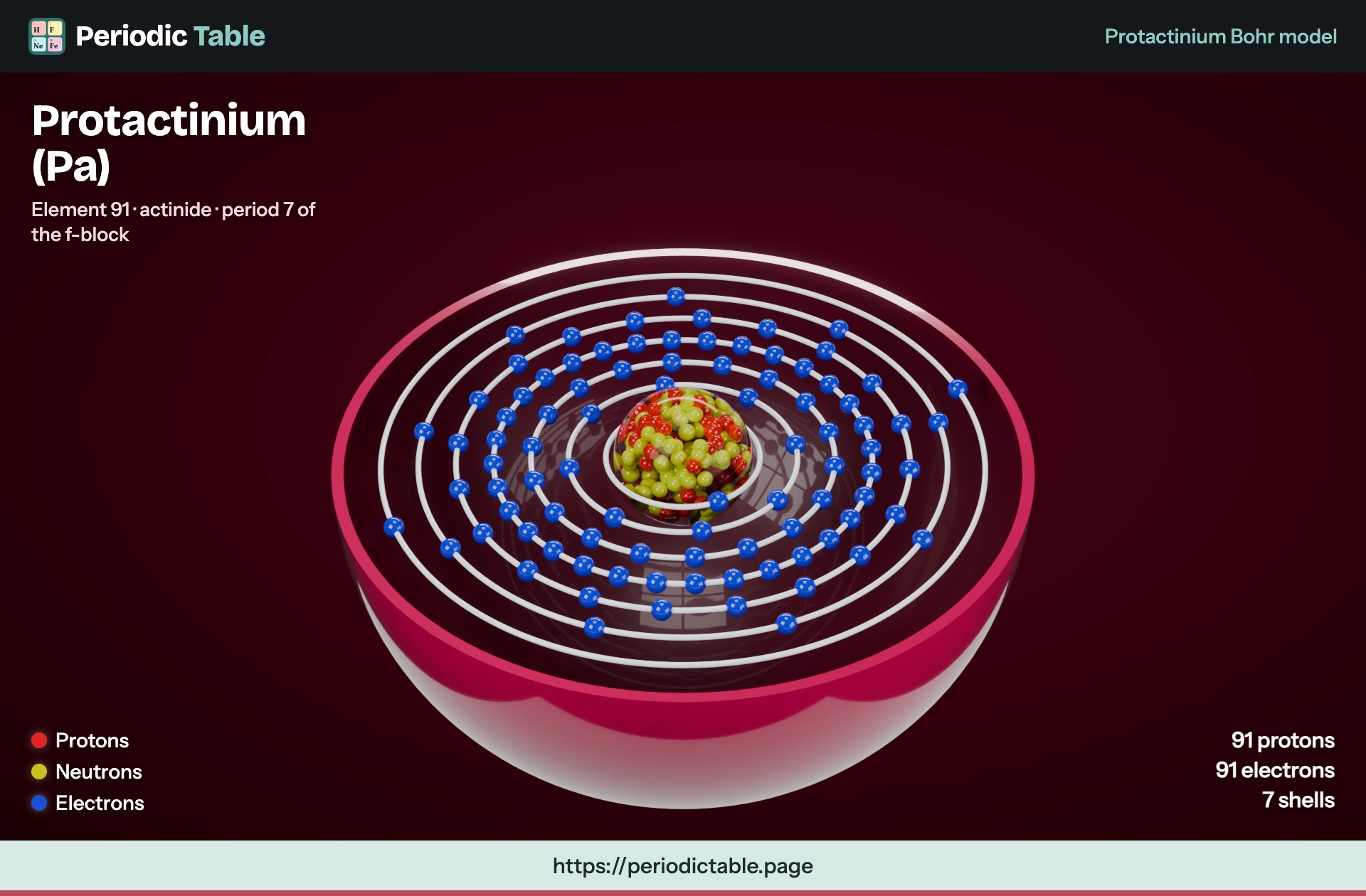
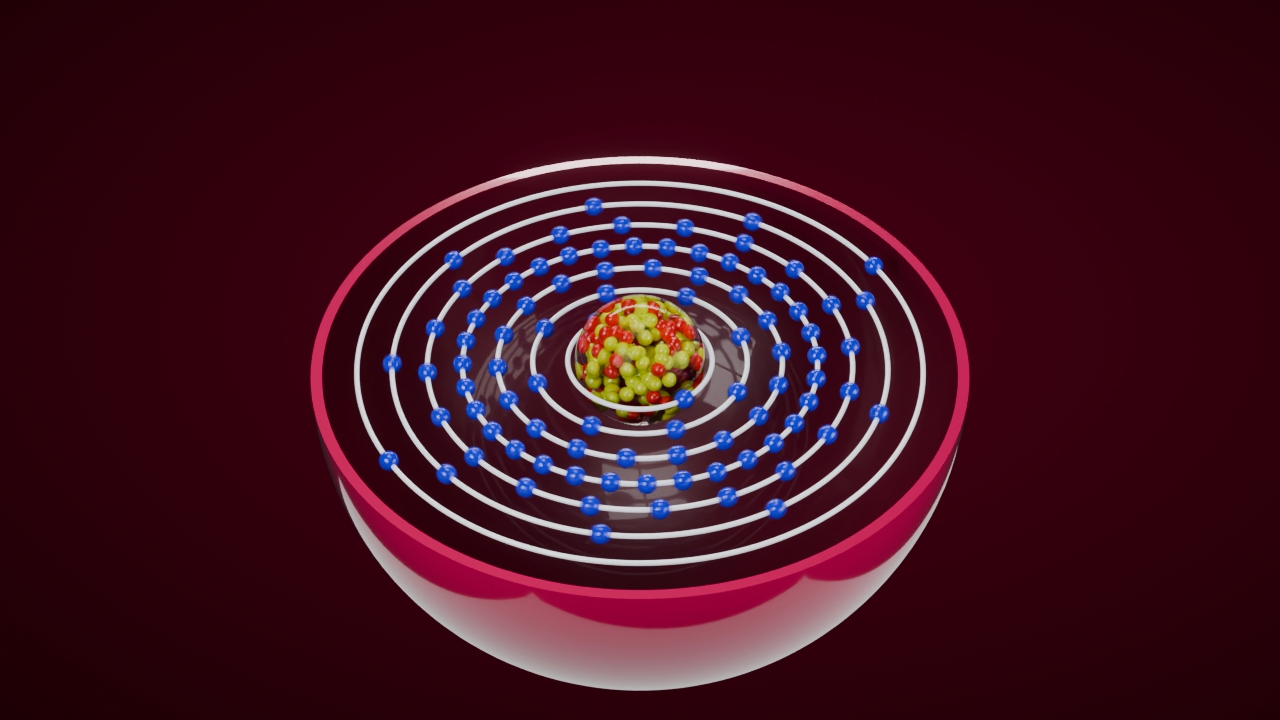
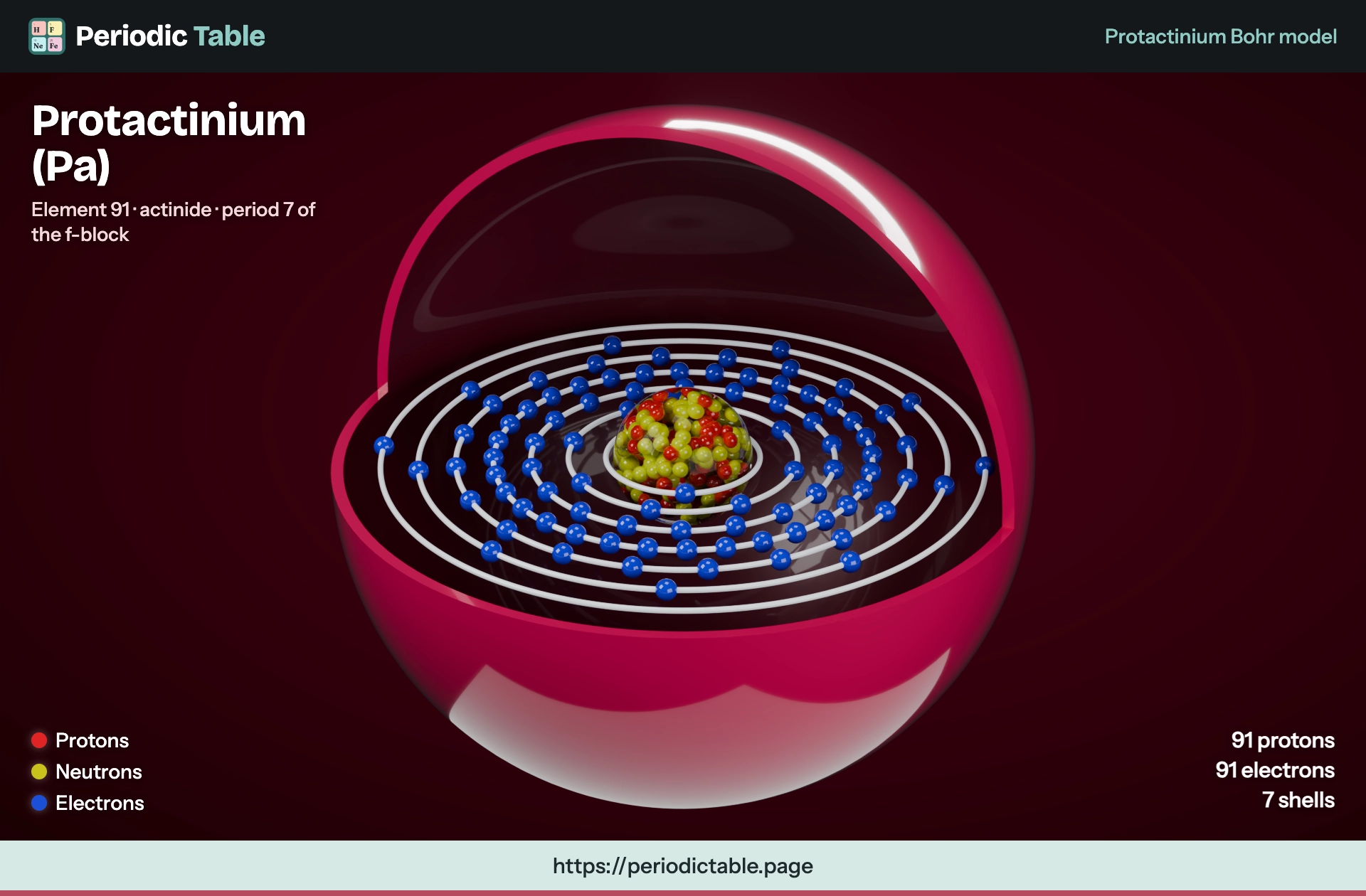
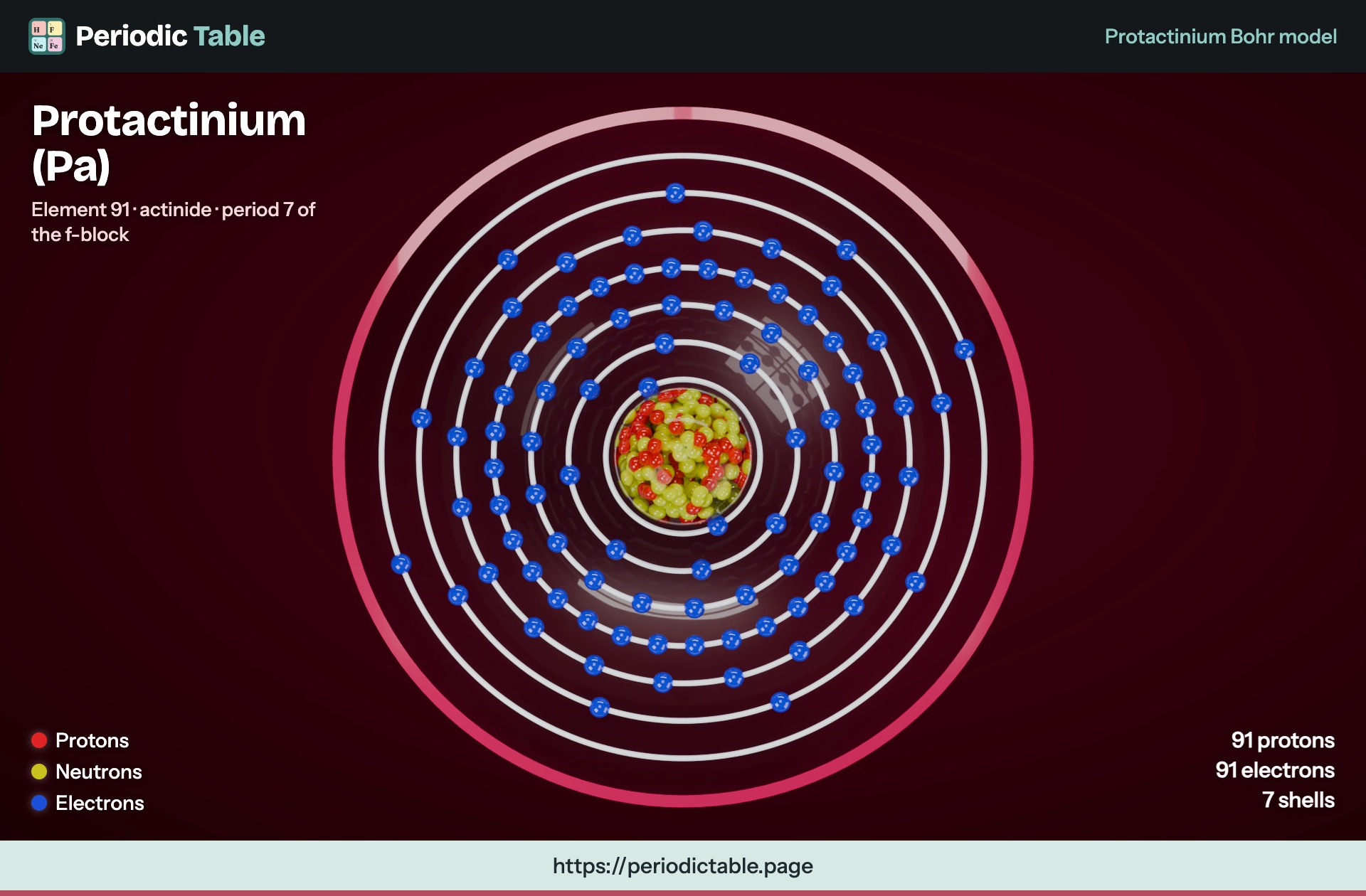
This is a Bohr model of protactinium (Pa), a simplified picture of a single protactinium atom. Its nucleus holds 91 protons, and a neutral protactinium atom has 91 electrons, arranged around it in 7 shells (2 in shell K, 8 in shell L, 18 in shell M, 32 in shell N, 20 in shell O, 9 in shell P and 2 in shell Q).
Protactinium periodic table electron configuration
- Shorthand
- [Rn] 5f2 6d1 7s2
- Full
- 1s2 2s2 2p6 3s2 3p6 4s2 3d10 4p6 5s2 4d10 5p6 6s2 4f14 5d10 6p6 7s2 5f2 6d1
- Electrons per shell
- 2, 8, 18, 32, 20, 9, 2
Protactinium element properties and atomic data
- Atomic number
- 91
- Atomic mass
- 231.0359 u
- Phase at STP
- Solid
- Melting point
- 1567.85°C (1841 K)
- Boiling point
- 4026.85°C (4300 K)
- Density
- 15.37 g/cm³
- Electronegativity (Pauling)
- 1.5
- Period
- 7
- Group
- —
- Block
- f-block
- Appearance
- Bright, silvery metallic luster
- Discovery date
- 1913
- Discovered by
- William Crookes
- Named by
- Otto Hahn
Protactinium key facts and physical data
In pure form it is a bright, malleable, silvery-gray metal that crystallises in a body-centred tetragonal lattice at room temperature and becomes superconducting below about 1.4 K. The core numbers you will need most often are below.
| Property | Value |
|---|---|
| Symbol | Pa |
| Z (proton count) | 91 |
| Standard atomic weight | 231.04 |
| Block and period | f-block, period 7 |
| Density | 15.37 g/cm3 |
| Melting point | about 1,570 °C (1,841 K) |
| Boiling point | about 4,000 °C |
| Electron configuration | [Rn] 5f2 6d1 7s2 |
| Electronegativity (Pauling) | 1.5 |
| Ionization energy (1st) | about 568 kJ/mol |
| Common oxidation states | +5, +4 |
Chemical properties of element 91 and its compounds
A freshly cut surface dulls quickly: it reacts with oxygen, water vapor and inorganic acids, while alkalis leave it largely alone. Its chemistry yields oxides, hydroxides, halides (fluorides, chlorides, bromides and iodides), hydrides, nitrides and sulfides, and because its oxides are basic it also forms sulfates, phosphates and nitrates. One quirk catches newcomers out: its dissolved compounds hydrolyse so readily that they drop colloidal particles and cling to glassware. The biological role of these essential elements and their minerals is part of the story told in the group IA guide for every reader.
The +5 oxidation state and its oxide
The +5 oxidation state is the stable one, and it explains why the highest oxide, a pentoxide, behaves so much like those of tantalum and niobium. The lower states behave more like its actinide neighbours:
- +5
- Most stable; the white pentoxide, pentahalides and fluoro complexes.
- +4
- Forms under reducing conditions; tetrahalides and a dioxide.
- +3 and +2
- Reported only in a handful of special compounds.
Protactinium-231 and the other isotopes
Every known nuclide of this actinide is unstable: 29 have measured lifetimes, with mass numbers from 211 to 239. Nearly all natural material is the mass-231 form, an alpha emitter born in the chain that starts at uranium-235 and one that turns into actinium-227 as it ages.
Half-life comparison across the main nuclides
Lifetimes run from fractions of a second to tens of millennia, so each isotope suits a different job. The last column shows how much of a fresh sample remains after a fixed wait, computed from each lifetime:
| Mass number | Half-life | Main source | Left after the wait |
|---|---|---|---|
| 231 | 32,760 years | U-235 chain | 80.9% after 10,000 years |
| 233 | 26.97 days | Capture in Th-232 breeders | 21.4% after 60 days |
| 234 | 6.70 hours | U-238 chain | 28.9% after 12 hours |
| 230 | 17.4 days | Accelerator production | Not used here |
Protactinium-234 and radioactive decay from U-238
The second natural nuclide belongs to the uranium-238 chain. Its excited state, with a lifetime of only about 1.2 minutes, was the earliest form of number 91 anyone identified. Both states emit beta particles and become U-234, so they never build up beyond trace equilibrium amounts in ore.
Uranium-X to brevium: the discovery history
In 1900 William Crookes separated an intensely active fraction from a salt of element 92 and gave it the placeholder name in this heading. Pinning down what hid inside took two decades and several teams.
A gap in Mendeleev's periodic table
In 1871 Dmitri Mendeleev forecast a missing entry between numbers 90 and 92, with an atomic weight near 235 and a highest oxide of the X2O5 type, like tantalum's. The oxide prediction held up. The weight did not quite: number 91 turned out lighter than number 90, one of only four "pair reversals" that ordering by proton count, rather than mass, later resolved.
From brevium to a name meaning first
In 1913 Kasimir Fajans and Oswald Göhring caught the 1.2-minute nuclide and called it brevium, for its brevity. In 1917 and 1918, Lise Meitner and Otto Hahn in Berlin, and independently Frederick Soddy and John Cranston in Glasgow, isolated the long-lived mass-231 form. Since naming customs favour the longest-lived nuclide, brevium was dropped.
Meitner and Hahn chose a name built on the Greek protos, because the new substance is the parent of actinium, which it becomes by shedding an alpha particle. IUPAC settled the modern spelling in 1949 and credited Hahn and Meitner.
Protactinium-233 in the thorium fuel cycle
This nuclide matters most to breeder designers. In a breeder fuelled with thorium-232, fertile material becomes fuel in three steps:
- Th-232 gains one mass unit by capture and becomes Th-233.
- Th-233 undergoes beta decay within about 22 minutes, producing the intermediate this section is named after.
- That intermediate emits a further beta particle, half of it converting every 27 days, into uranium-233, a fissile fuel.
Those 27 days cause the headache. While the intermediate sits in the core's neutron flux, it can absorb another particle and become the mass-234 nuclide instead of fuel, wasting breeding gain. Molten-salt concepts therefore propose pulling it out of the core, letting it convert outside, and returning the product.
That same separation is a nonproliferation concern, because the isolated material ages into almost pure U-233. Separately, the mass-231 form has been studied as a burnable neutron poison in Th-232 fuelled boiling-water designs.
Where atomic number 91 is found and how it is extracted
It ranks among the rarest elements in nature: Earth's crust averages roughly 1.4 parts per trillion, almost all of it the mass-231 form sitting in pitchblende and other U-bearing minerals at a few tenths of a gram per tonne of U. For decades the main stock was one batch: about 125 grams that Britain's Atomic Energy Authority recovered from some 60 tonnes of processing residue in 1961.
Separation from processed ore
Recovery takes several stages: solvent extraction with organic solvents to pull it from leach liquors, ion exchange resins to concentrate it, and a final radiochemical step to strip out chemically similar niobium and tantalum. Its habit of hydrolysing and sticking to vessel walls slows every stage, which is why research labs keep stock solutions strongly acidic or fluoride-bearing.
Uses of protactinium in science
There are no commercial uses: scarcity, toxicity and cost rule them out. Inside the lab, though, it does real work:
- Radiometric dating of marine sediments: dissolved U in seawater produces the mass-231 nuclide and thorium-230 at a fixed ratio of about 0.093, but the two settle out at different speeds, so the ratio buried in the seabed records past ocean circulation.
- Reactor physics, modelling capture and breeding in Th-232 systems.
- Nuclear safeguards studies on how proliferation-resistant Th-232 breeders really are.
- Heavy-element bonding, since its 5f electrons sit right where transition-series behaviour gives way to actinide behaviour.
Pa radiation hazards and safe handling
Protactinium is a highly toxic, intensely radioactive metal. Radioactivity is the main danger: the mass-231 form emits alpha particles, harmless outside the body but damaging once inhaled or swallowed, so handling precautions are comparable to those for plutonium.
Work takes place in sealed glove boxes with radiation shielding, gloves, lab coats and personal dosimeters. It has no known biological role and no part in metabolism, so any intake is purely a hazard.