


Praseodymium element (Pr): praseodymium periodic table facts
Praseodymium periodic table facts: praseodymium (Pr) is element 59, a lanthanide in period 6 of the f-block. If you hold a freshly cut piece of praseodymium metal, you are looking at a soft, silvery, malleable rare earth metal that starts to grow a green oxide crust within days. To see how electron capture in potassium-40 builds the radiogenic isotope, check the noble gas argon for details and examples.
Praseodymium (symbol Pr) is the chemical element with atomic number 59, and the quick answer to why it matters is simple: it helps the strongest commercial magnet grades work harder, tints glasses and glazes yellow-green, and protects the eyes of anyone who stares into a hot flame for a living. Here is everything you need to know about its properties, chemistry, discovery and uses.
Rotate the 3D Bohr model of praseodymium
Drag to orbit, scroll to zoom.
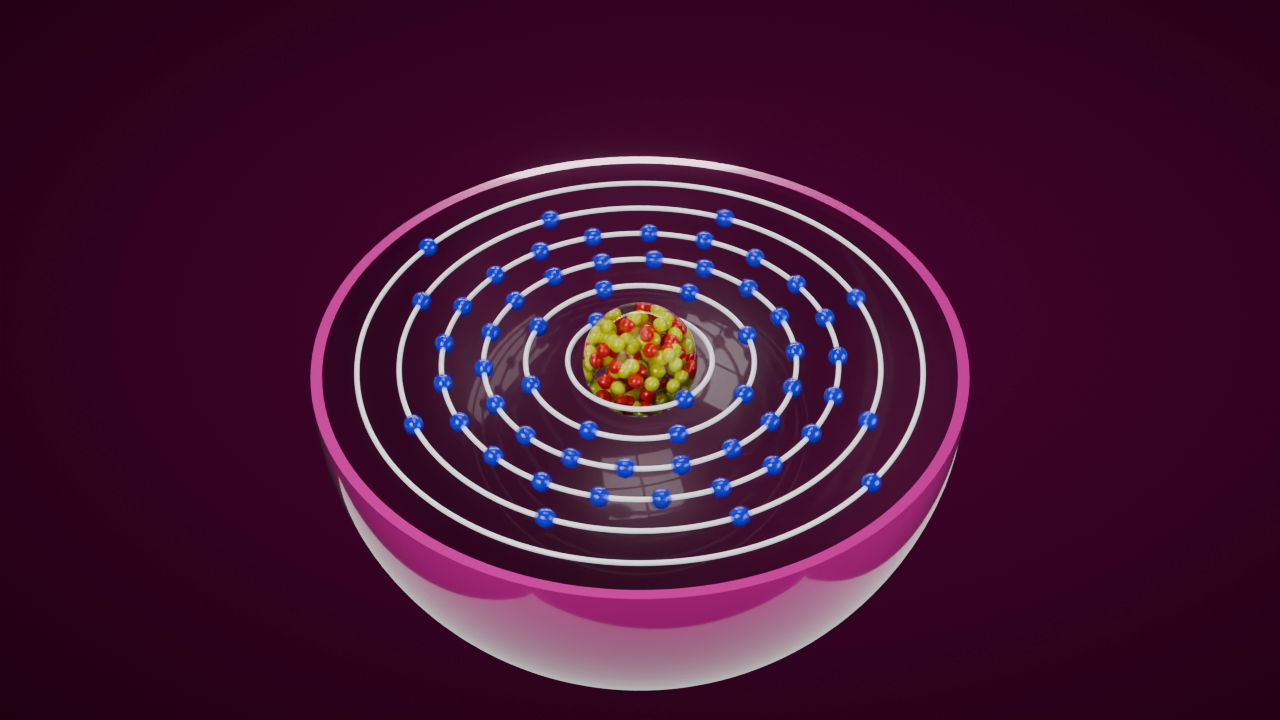
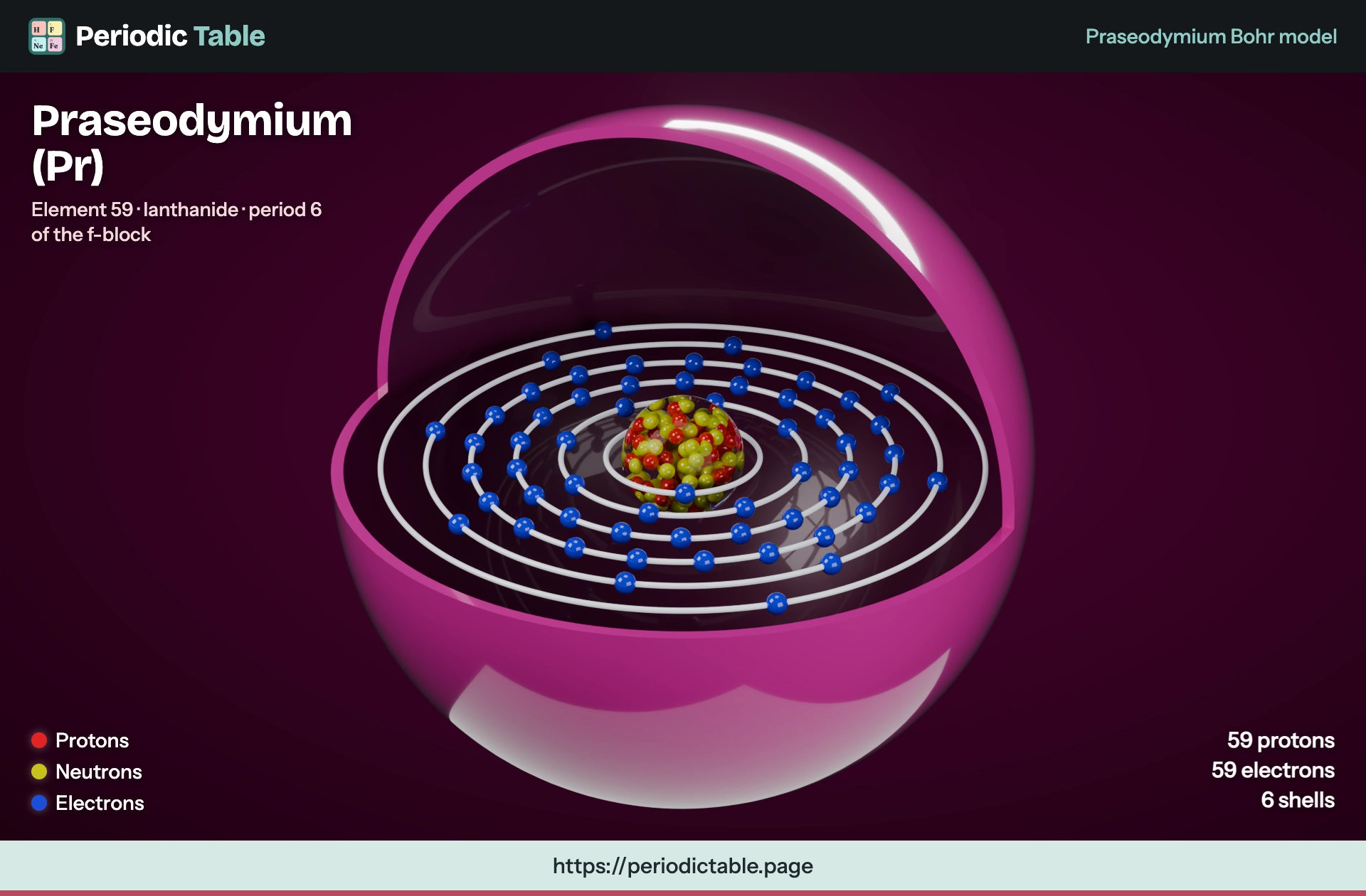
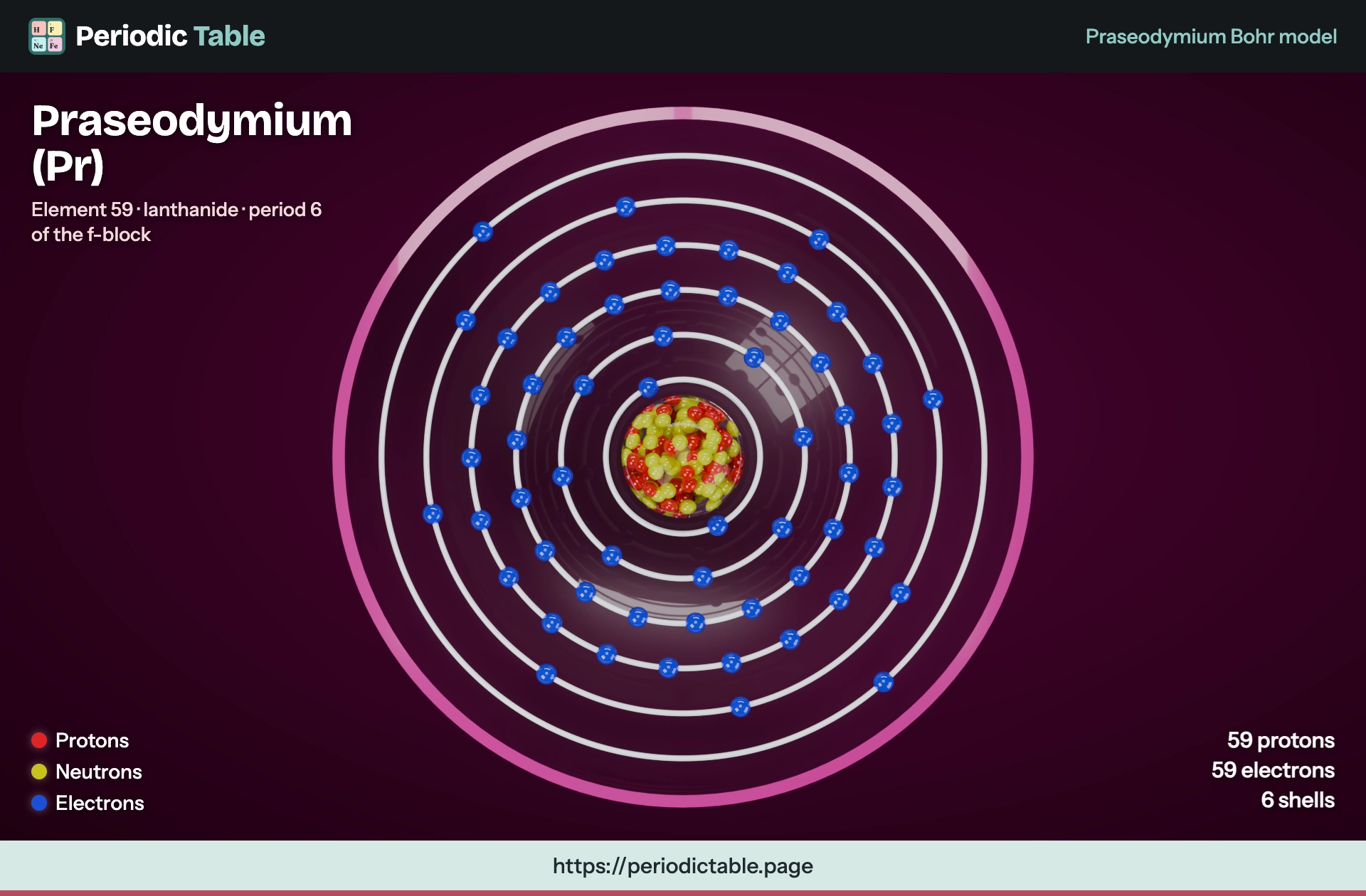
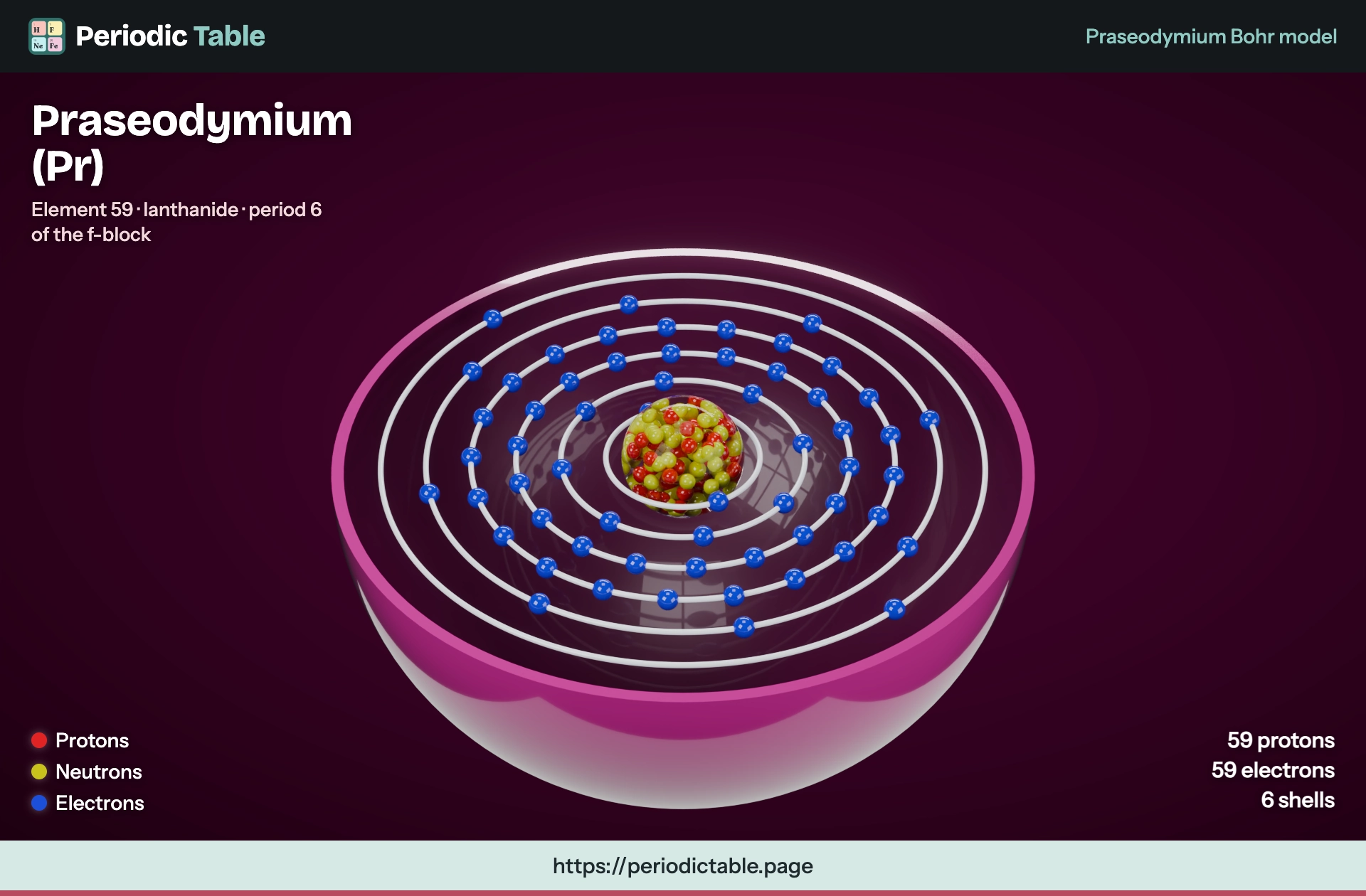
This is a Bohr model of praseodymium (Pr), a simplified picture of a single praseodymium atom. Its nucleus holds 59 protons, and a neutral praseodymium atom has 59 electrons, arranged around it in 6 shells (2 in shell K, 8 in shell L, 18 in shell M, 21 in shell N, 8 in shell O and 2 in shell P).
Praseodymium periodic table electron configuration
- Shorthand
- [Xe] 4f3 6s2
- Full
- 1s2 2s2 2p6 3s2 3p6 4s2 3d10 4p6 5s2 4d10 5p6 6s2 4f3
- Electrons per shell
- 2, 8, 18, 21, 8, 2
Praseodymium element properties and atomic data
- Atomic number
- 59
- Atomic mass
- 140.9077 u
- Phase at STP
- Solid
- Melting point
- 934.85°C (1208 K)
- Boiling point
- 3129.85°C (3403 K)
- Density
- 6.77 g/cm³
- Electronegativity (Pauling)
- 1.13
- Period
- 6
- Group
- —
- Block
- f-block
- Appearance
- Grayish white
- Discovery date
- 1885
- Discovered by
- Carl Auer von Welsbach
- Named by
- —
Praseodymium element facts at a glance
The praseodymium element sits in period 6 of the periodic table, inside the f-block, as the third member of the lanthanide series. Cerium is its neighbour on the left and neodymium on the right. The table below collects the reference values you are most likely to need. If you wonder how Hennig Brand found a glowing substance, the phosphorus element page tells it while he sought the philosopher's stone.
| Property | Value |
|---|---|
| Symbol | Pr |
| Atomic number 59 | 59 protons in every nucleus |
| Standard atomic weight | 140.90766 |
| Group / block | Lanthanides, f-block |
| Electron configuration | [Xe] 4f3 6s2 |
| Melting point | 931 °C (1,204 K) |
| Boiling point | 3,130 °C (3,403 K); some tables list 3,520 °C |
| Density at 20 °C | 6.77 g/cm3 |
| Electronegativity (Pauling scale) | 1.13 |
| First three ionization energies | 527, 1,020 and 2,086 kJ/mol |
| Atomic radius (empirical) | 182 pm |
| Covalent radius | 203 pm |
| State at 20 °C | Solid |
| CAS number | 7440-10-0 |
Two quick figures you can work out from those values: one gram of the element holds about 4.27 × 10²¹ atoms (Avogadro's number divided by 140.908), and a one-kilogram ingot fills roughly 148 cm3, a little less than a standard can of soda.
Physical properties of praseodymium metal
The physical properties of this element are typical of the early lanthanides. It is ductile enough to draw into wire and about as hard as silver, with a Young's modulus of 37.3 GPa and a specific heat capacity of 193 J/(kg·K). Students of radiation and physics will find lawrencium element facts useful for laboratory research on superheavy elements.
Of its 59 electrons, only three normally act as valence electrons: the remaining 4f electrons sit close to the nucleus, shielded by the filled xenon core, and rarely take part in bonding. That shielding explains why the lanthanides look so alike, and why their sharp, narrow spectral lines make them useful in light-based devices.
Allotropic forms and crystal structure
Praseodymium has two allotropic forms. At room temperature it adopts a double hexagonal close-packed (dhcp) structure, the alpha phase. Heat it to 795 °C and the atoms rearrange into a body-centered cubic beta phase, which stays stable until it melts at 931 °C.
Magnetic properties
Its magnetic properties are quieter than you might expect from a magnet ingredient. Pr is paramagnetic at every temperature above 1 K, while several other lanthanides switch to ferromagnetic or antiferromagnetic order when cooled. Its value in magnet making comes from how it behaves inside a crystal lattice with iron and boron, not from the pure element.
Chemical properties and praseodymium ions
The chemical properties of element 59 are dominated by how reactive it is. It tarnishes slowly in air, shedding a flaky green oxide much like rust, so a centimetre-sized sample can corrode right through in about a year.
Laboratories store it under mineral oil or sealed in plastic. It reacts slowly with cold water and quickly with hot, forming praseodymium(III) hydroxide and hydrogen gas, and it combines with all the stable halogens to give trihalides such as PrF3 and PrCl3.
Drop a sample into dilute sulfuric acid and it dissolves to form praseodymium ions, Pr3+, which give the aqueous solution a pale chartreuse or yellowish-green colour. Each ion is wrapped in a shell of nine H2O molecules.
Oxidation state from +3 to +5
The +3 oxidation state is the only one stable in solution. The +4 oxidation state shows up in solids such as praseodymium dioxide, PrO2, and in fluorides, but the Pr4+ ion oxidises water almost instantly.
Uniquely among the lanthanides, Pr can also reach the +5 oxidation state: first in gas-phase oxide species trapped in frozen noble gas in 2016, then in a bulk crystalline compound reported in 2025. Older references that say Pr(V) does not exist are now out of date.
Praseodymium compounds and oxides
Burning it at about 150 °C gives the dark, mixed-valence praseodymium oxide Pr6O11, the form most suppliers sell. Hydrogen reduces it to Pr2O3.
Other common praseodymium compounds include praseodymium fluoride (PrF3), used in arc-lamp cores, and praseodymium chloride (PrCl3), a feedstock for reduction to the pure element. Its organometallic chemistry mirrors that of lanthanum and cerium, because none of these elements can back-bond to ligands.
Isotopes of Pr
Natural praseodymium is a single nuclide: every atom is 141Pr, which carries 82 neutrons (141 minus 59), a "magic number" that makes the nucleus especially stable. Because there are no other natural isotopes to average over, its atomic weight is known to five decimal places. Around 38 radioisotopes have been made in the lab.
The longest-lived is 143Pr, with a half-life of 13.57 days; nearly all the others decay in under a minute. Both 141Pr and 143Pr also form during the fission of uranium in reactors.
History of the element praseodymium
The history of the element praseodymium is a story of a substance that turned out to be two. In 1803 chemists isolated ceria from cerite, a heavy mineral from the Bastnäs mine in Sweden.
Between 1839 and 1843 Carl Gustaf Mosander showed that this earth hid other oxides, which he named lanthana and didymium (from the Greek for "twin", because it sat beside lanthanum). For four decades chemists treated didymium as an element.
The breakthrough came from spectroscopy, the technique pioneered by Robert Bunsen and Gustav Kirchhoff. Bunsen's student Carl Auer von Welsbach ran hundreds of fractional crystallizations on didymium salts and, in 1885, split it into two elements with distinct spectral lines: a lilac one he called neodidymium ("new twin") and a green one he called praseodidymium ("green twin").
The names were later shortened to neodymium and praseodymium, the latter after the Greek prasios, leek green, the colour of its salts. Samarium had already been pulled out of the same mixture in 1879 (europium followed in 1901), and scientists did not have fast separation methods until the ion-exchange work of the 1940s.
Occurrence of the rare-Earth metal in Earth's crust
Despite the name, this rare-earth metal is not rare. Its occurrence in Earth's crust is about 9 parts per million, close to that of boron, making it the sixth most abundant rare earth.
What it never does is dominate: in commercial minerals it always trails cerium and lanthanum, and usually neodymium. Most of it comes from two ores, monazite (a phosphate) and bastnäsite (a fluorocarbonate), where it typically makes up only around 4 to 5 percent of the rare-earth content.
Extraction and production of pure praseodymium
Getting pure praseodymium means separating it from neighbours that are almost chemically identical. Crushed ore is roasted with hot concentrated acid, impurities such as thorium are precipitated, and the mixed rare earths are taken into solution.
Global production is now driven by demand for NdPr, a neodymium-praseodymium mix sold for magnet making, and China refines the large majority of it. Older routes such as fractional crystallization with ammonium nitrates still work but are far too slow for tonnage.
Ion exchange and solvent extraction
Commercial refiners rely on liquid-liquid separation with solvents such as tributyl phosphate, where hundreds of mixer-settler stages exploit tiny differences in how each rare earth partitions between phases. Ion exchange chromatography, which pushes a complexing agent through resin columns so the elements leave in separate bands, is slower and is used mainly for very high purity and laboratory work.
Calcium reduction and electrolysis
To turn the separated compound into metal, producers use calcium reduction, heating praseodymium fluoride or chloride with calcium so the calcium takes the halogen and leaves praseodymium behind. The alternative is molten-salt electrolysis, in which direct current deposits Pr at the cathode of a cell filled with molten fluoride or chloride salts. This route suits continuous output for alloy makers.
Supply risk for the rare earth element
Because it is mined only as a by-product of mixed rare-earth ores, this rare earth element carries a high supply risk. The Royal Society of Chemistry's element risk index scores it 9.5 out of 10, with a recycling rate below 10 percent and output concentrated in China, followed by Russia and Malaysia.
Demand is tied to motors for electric vehicles and to direct-drive wind turbines, so renewable energy policy shapes its price. In practice, if you are buying magnet material for your industry, praseodymium availability is usually the line item to watch.
Praseodymium uses and applications
Most praseodymium uses exploit one of three things: its effect on magnetic materials, its sharp light absorption, or its oxide chemistry. Because the lanthanides are so similar, it can also stand in for its neighbours in mixed products such as mischmetal lighter flints. The main applications are below, and each one shows up in everyday technology.
Rare earth magnets
Your phone speakers, laptop fans and hybrid car motors probably contain sintered magnet blocks built on the Nd2Fe14B lattice. In these permanent magnets, Pr replaces part of the neodymium, typically about a quarter of the rare-earth content, which keeps strength high at lower cost. Small additions of dysprosium then help the magnet survive heat.
Alloys and the magnetocaloric effect
As an alloying agent, Pr strengthens magnesium for parts in aircraft engines. A praseodymium-nickel compound, PrNi5, shows such a strong magnetocaloric effect that researchers used it to cool samples to within a thousandth of a degree of absolute zero.
Colored glass, ceramics and carbon arc lights
Praseodymium gives glazes and window-grade glasses a clean yellow color. The ceramic stain Praseodymium Yellow, Pr dissolved in a zircon lattice, is still standard for ceramics and enamels, and a dash in cubic zirconia turns cheap gems green. Mixed with neodymium it forms didymium glass, which absorbs the glaring orange sodium line, so welders and every glass blower can see the work through their goggles.
Some praseodymium glass also blocks infrared heat. Its fluoride once formed the core of carbon arc lights used for studio lighting and projectors in the motion picture industry.
Catalysts, lasers and optics
Praseodymium oxide mixed with ceria makes a good oxidation catalyst, and newer Pr-doped single-atom catalysts are being studied for turning carbon dioxide into fuels. In optics, Pr3+ dopants appear in lasers, fiber optical amplifiers and red, green and blue phosphors, because the shielded inner levels emit light efficiently.
How praseodymium compares with other lanthanide metals
This element behaves so much like its neighbours that it stayed hidden inside Mosander's mixture for 46 years. The table puts the light lanthanides side by side so you can see how small the differences are.
| Element | Atomic number | Melting point (°C) | Density (g/cm3) | Best-known modern use |
|---|---|---|---|---|
| Lanthanum (La) | 57 | 920 | 6.15 | Camera lenses, hydrogen storage |
| Cerium (Ce) | 58 | 795 | 6.77 | Polishing powder, catalytic converters |
| Praseodymium (Pr) | 59 | 931 | 6.77 | NdFeB magnet blends, yellow glazes |
| Neodymium (Nd) | 60 | 1,024 | 7.01 | The main magnet ingredient |
| Samarium (Sm) | 62 | 1,072 | 7.52 | SmCo magnet grades |
| Dysprosium (Dy) | 66 | 1,407 | 8.55 | Heat resistance in NdFeB grades |
Notice that cerium breaks the trend by melting lower than element 57; past it, melting points generally rise along the row. The steady gain in mass per cubic centimetre comes from the lanthanide contraction: each added proton pulls the electron shells slightly tighter, so each one shrinks as it gets heavier. For praseodymium, that near-identical size to cerium and neodymium is why it stayed hidden for decades and why separating it still takes hundreds of solvent stages.
Biological role and praseodymium safety
Pr has no known biological role in people, plants or animals. The one exception is a group of methanotrophic bacteria living in hot volcanic mud, which use light lanthanides, Pr among them, in an enzyme that processes methanol.
The element is not especially toxic, though injected rare-earth salts can harm the liver in animals. The practical hazards are fire and dust: the fine powder can ignite on contact with air, so you should handle it under inert gas and treat it as a flammable solid.