


Lawrencium element (Lr): lawrencium periodic table facts
Lawrencium periodic table facts: lawrencium (Lr) is element 103, an actinide in period 7 of the f-block. Element 103 is the last stop on the actinide row and one of the hardest atoms on the periodic table to study at all. For liquid air, air separation and the welding shield made from it, open the argon element for a closer look.
Lawrencium (Lr) is a synthetic chemical element and radioactive metal that exists only a few atoms at a time, made by bombarding heavy targets inside a particle accelerator and named after Ernest Lawrence. Below you'll find its key numbers, where it sits on the table, how lawrencium was discovered, and what has actually been measured versus what is still predicted.
Rotate the 3D Bohr model of lawrencium
Drag to orbit, scroll to zoom.
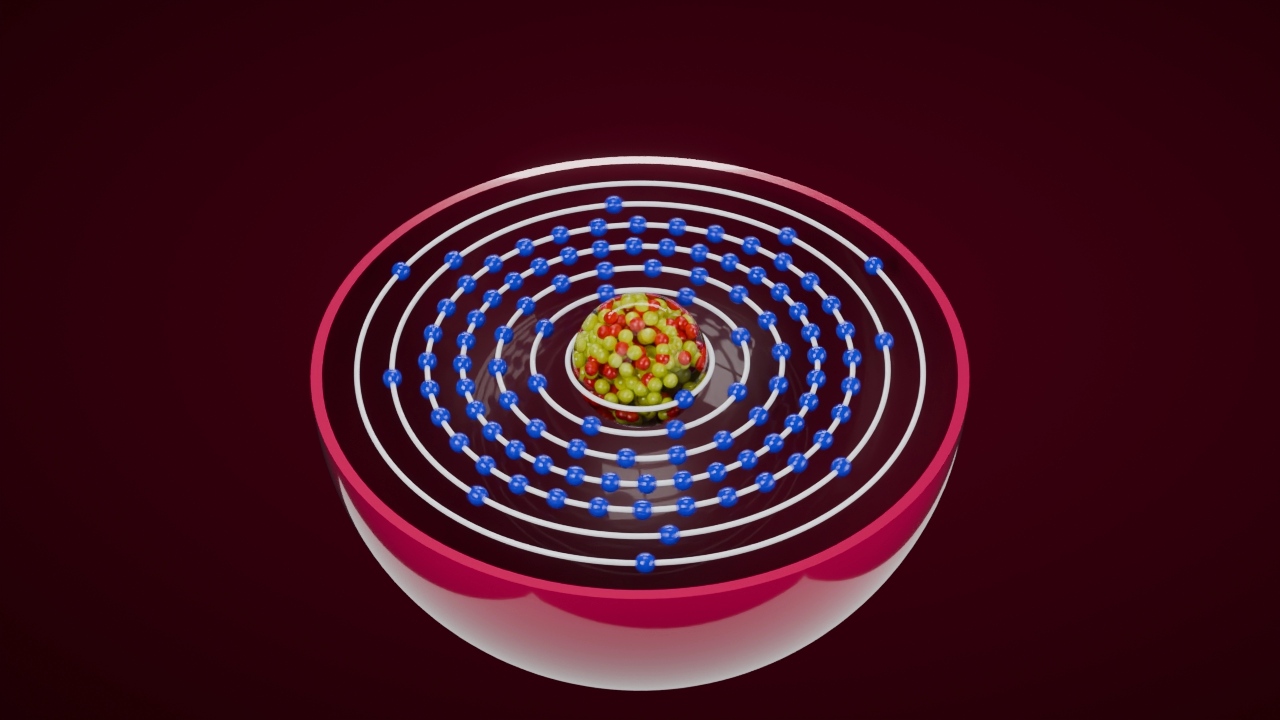
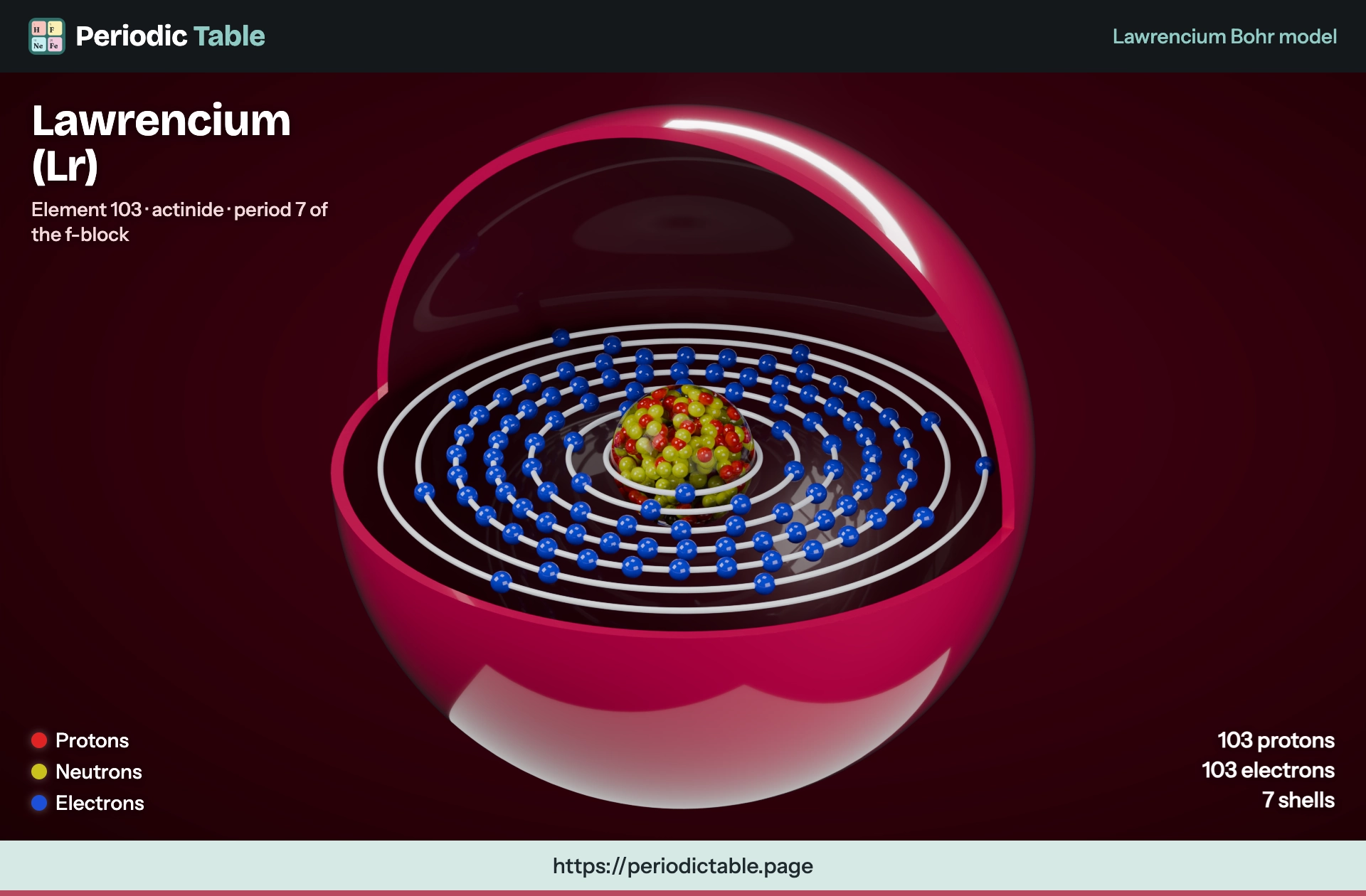
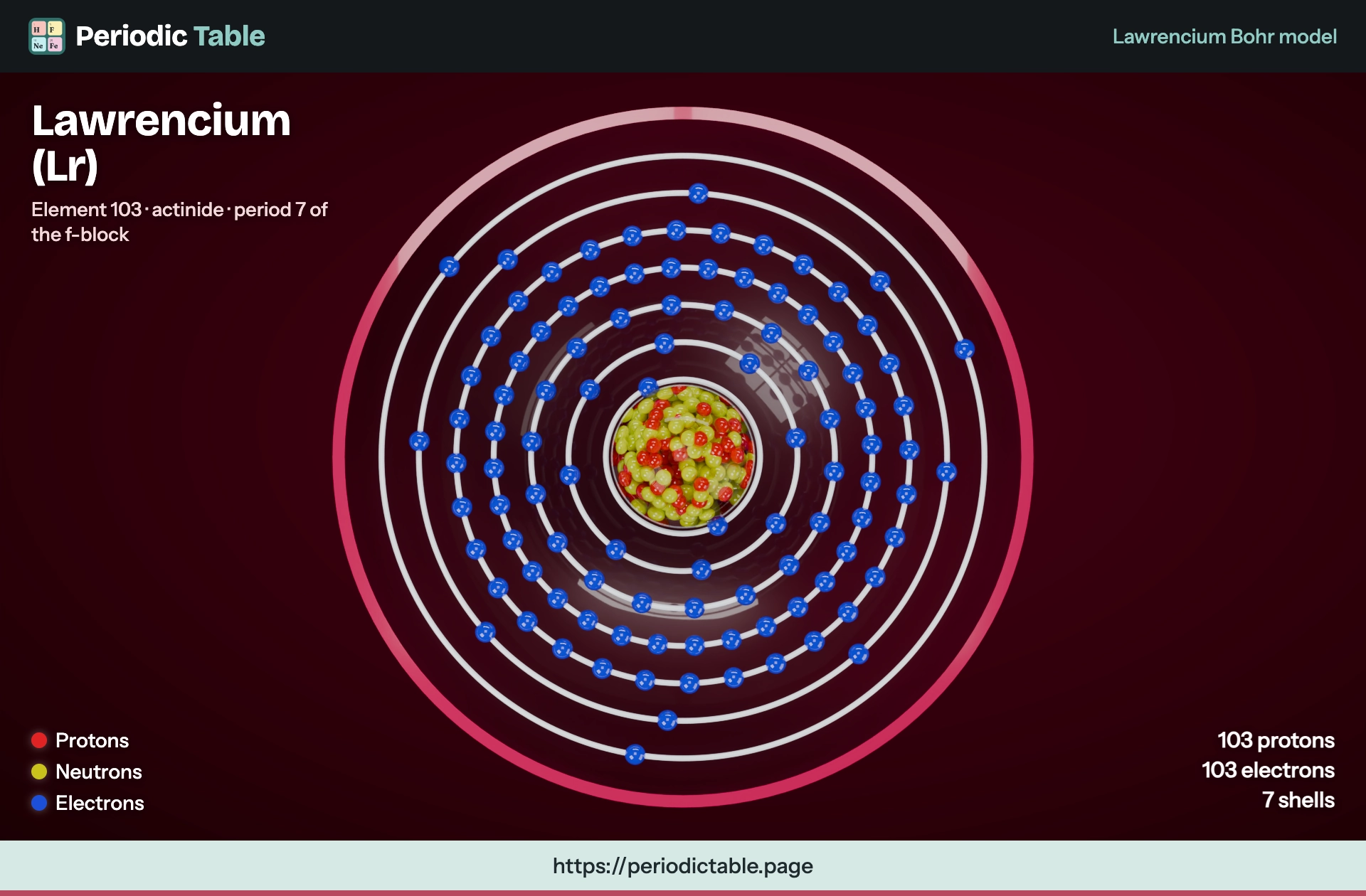
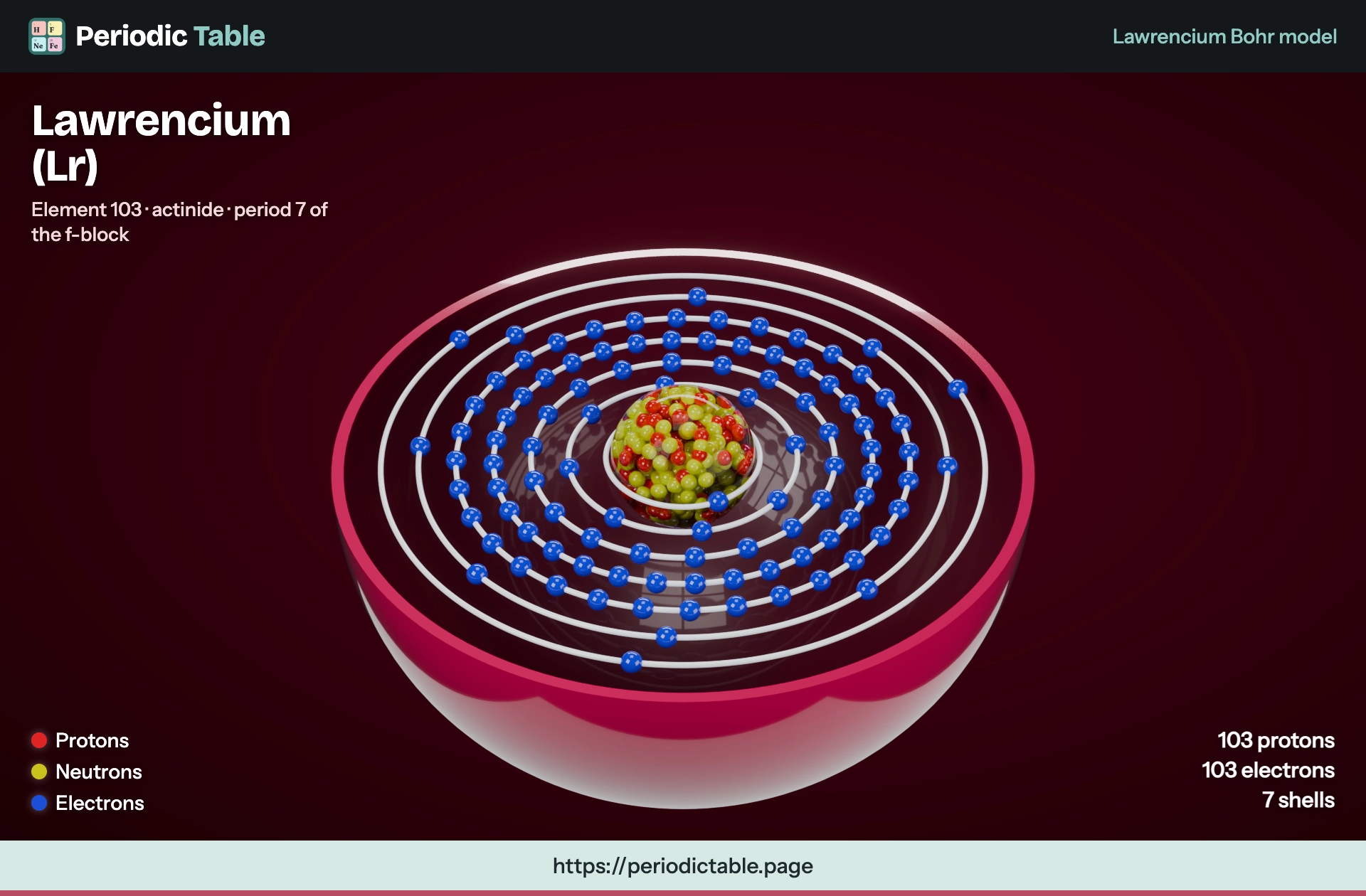
This is a Bohr model of lawrencium (Lr), a simplified picture of a single lawrencium atom. Its nucleus holds 103 protons, and a neutral lawrencium atom has 103 electrons, arranged around it in 7 shells (2 in shell K, 8 in shell L, 18 in shell M, 32 in shell N, 32 in shell O, 8 in shell P and 3 in shell Q).
Lawrencium periodic table electron configuration
- Shorthand
- [Rn] 5f14 7s2 7p1
- Full
- 1s2 2s2 2p6 3s2 3p6 4s2 3d10 4p6 5s2 4d10 5p6 6s2 4f14 5d10 6p6 7s2 5f14 7p1
- Electrons per shell
- 2, 8, 18, 32, 32, 8, 3
Lawrencium element properties and atomic data
- Atomic number
- 103
- Atomic mass
- [266] u
- Phase at STP
- Solid
- Melting point
- 1626.85°C (1900 K)
- Boiling point
- Unknown
- Density
- Unknown
- Electronegativity (Pauling)
- 1.3
- Period
- 7
- Group
- —
- Block
- d-block
- Appearance
- Unknown
- Discovery date
- 1961
- Discovered by
- Lawrence Berkeley National Laboratory
- Named by
- —
Key facts about Lr and its atomic number
Every value below comes either from experiments on single atoms or from theory. Entries marked with an asterisk are predicted rather than measured, because nobody has ever gathered enough of the element to weigh it, melt it or look at it. Scientists in a laboratory handle it under mineral oil, a note found in the praseodymium atomic mass, as the metal reacts with air, water and acid.
| Property | Value |
|---|---|
| Symbol | Lr (formerly Lw) |
| Atomic number | 103 |
| Group, period, block | Group 3, period 7, d-block (some tables show it in the f-block) |
| Electron configuration | [Rn] 5f14 7s2 7p1 |
| State at room temperature | Solid* |
| Melting point | About 1,900 K (1,627 °C)* |
| Density | About 14.4 g/cm³* |
| Common oxidation state | +3 |
| Electronegativity (Pauling scale) | 1.3* |
| First ionization energy | 4.96 eV (about 479 kJ/mol), measured |
| Covalent radius | 161 pm* |
| CAS number | 22537-19-5 |
| Discovered | 1961 at Berkeley; credit shared with Dubna in 1992 |
Only the ionization figure and the behaviour of the +3 ion come from direct experiments on the atom; the bulk figures are calculations. Read together, they still tell a coherent story: a dense, high-melting element that forms a +3 ion, with an outer arrangement unlike anything above it in its column.
Lawrencium on the periodic table
Look at a standard 18-column periodic table and you'll find it at the far right of the second floating row, directly after nobelium. That row holds the actinides, and together with the lanthanide row above it, it forms the f-block: the inner transition metals usually pulled out below the main grid to keep the chart narrow. In a 32-column layout, where those rows sit inline, lawrencium lines up under lutetium and right next to rutherfordium, the first element of the 6d series. To learn how a lanthanide came to power hard disk drives and solid-state lasers, open the neodymium periodic table for uses and background.
Group 3 and period 7 placement
The element has seven occupied shells, so its row is not in doubt. Its column is.
Older charts place lanthanum and actinium under scandium and yttrium. Many newer ones place lutetium and Lr there instead, because the outer shells of that pair continue the pattern of the two elements above them more cleanly, and because the long-form table reads in strict atomic order only when they do.
Transition metals or actinides
The argument matters because it changes how you describe the element. Read it as an actinide and it is the final member of the 5f series. Read it as a group-three element and it becomes the first of the period-seven transition elements, a heavier cousin of lutetium.
IUPAC has not settled the question, so you'll meet both versions in textbooks. Either way the chemistry is the same: a trivalent ion that behaves like the lighter elements in its column.
Discovery of lawrencium
No laboratory found this element in nature, because none of it survives there. It was assembled atom by atom near the end of the post-war race to fill the actinide row, when American and Soviet groups competed for every new slot. As the eleventh transuranium element and the third transfermium, it went through a decade of rival claims before anyone was fully confident it had been made.
The Berkeley claim and the Lr symbol
On February 14, 1961, Albert Ghiorso, Torbjørn Sikkeland, Almon Larsh and Robert Latimer at Lawrence Berkeley National Laboratory fired boron nuclei from the Heavy Ion Linear Accelerator into a target of mixed californium isotopes weighing only a few milligrams. They recorded an alpha emitter lasting a few seconds and assigned it to element 103. The team proposed honouring Ernest Lawrence, inventor of the cyclotron, with the symbol Lw.
The naming commission accepted the name but changed the symbol to Lr. The mass they first reported later turned out to be wrong by one unit, though that did not undo the claim itself.
Dubna counterclaims and shared credit
Georgy Flerov's group at the Joint Institute for Nuclear Research in the Soviet Union challenged the Berkeley assignment and, in 1965, reported its own isotope, made by striking americium-243 with oxygen-18. Both labs kept refining their data until a 1971 series of Berkeley experiments on masses 255 to 260 settled the decay properties and confirmed most earlier results from each side.
In 1992 the IUPAC/IUPAP Transfermium Working Group divided the credit between the two teams. The name lawrencium had been in print for three decades by then, so it stayed, and it was formally ratified in 1997.
How element 103 is made in a particle accelerator
Every sample ever studied came from a collision. A beam of light ions, anything up to neon, is accelerated to around a tenth of the speed of light and aimed at a thin target of a heavier actinide, from americium up to einsteinium. When a beam nucleus fuses with a target nucleus, the merged system is hot, so it boils off a few particles and, occasionally, settles into a new isotope.
Two nuclear reactions do most of the work today. Californium-249 struck with boron-11 gives Lr-256 after four neutrons escape. Berkelium-249 struck with oxygen-18 gives Lr-260, an alpha particle and three more neutrons:
$$^{249}_{97}\text{Bk} + {}^{18}_{8}\text{O} \rightarrow {}^{260}_{103}\text{Lr} + {}^{4}_{2}\alpha + 3\,{}^{1}_{0}n$$Yields are so small that experiments handle one atom at a time. The two heaviest isotopes cannot be made this way at all: the mass-264 and mass-266 nuclides appear only as a decay product of dubnium, which itself comes from the even heavier moscovium and tennessine.
Decay and detection of each lawrencium atom
Once formed, the new nucleus recoils out of the target with the beam and passes through a separator that removes unreacted beam particles. It then stops in a silicon detector, which logs where it landed, when it arrived and how much energy it carried. When it decays, the detector logs the same three things again.
Lr isotopes decay mainly by alpha decay, spontaneous fission and electron capture. An alpha chain is the gold standard of proof: each daughter is a known nucleus with a known energy signature, so the chain points straight back to its parent. Fission splits the nucleus into two unpredictable fragments, which is why fission-only events were never enough on their own to prove a discovery.
Physical properties of lawrencium
Nobody has ever seen metallic lawrencium in bulk, so every physical figure comes from calculation and from trends among its neighbours. Those trends agree with each other: it should be a silvery, dense heavy metal, solid at room temperature, with a density near 14.4 g/cm³ and a melting point close to 1,900 K, just under the value of its lighter column-mate.
Its crystal structure is predicted to be hexagonal close-packed, matching the elements above it. The estimated enthalpy of sublimation, about 352 kJ/mol, is the most telling clue about the bulk element: it implies three electrons shared in the metallic bond, which makes it trivalent in the bulk, unlike fermium, mendelevium and nobelium before it. It should also oxidise readily in air, steam and acids, so even a visible speck would not stay bright for long.
Chemistry of lawrencium and its chemical properties
Glenn T. Seaborg, who devised the actinide concept in the 1940s, predicted that element 103 would close the series and behave like its lanthanide counterpart in solution. Experiments run decades later bore that out. What makes it interesting is the gap between its odd outer configuration and its ordinary behaviour: relativistic effects pull its outer s and p orbitals inward, yet in water it still acts like a plain trivalent ion.
The +3 oxidation state in water
Lr exists as the Lr3+ ion in aqueous solution, and every attempt to reduce it to +2 or +1 has failed, just as it does for lutetium. A 1970 study on roughly 1,500 atoms showed it extracting with the other +3 ions rather than with +2 or +4 ones. Later work using ammonium α-hydroxyisobutyrate as the eluant placed it near erbium in the elution sequence and gave an ionic radius of about 88 pm, larger than simple extrapolation along the series suggested.
Compounds studied so far
The first chemistry ever done on the element, in 1969, reacted it with chlorine and produced a volatile product that was most likely the trichloride, LrCl3, with a volatility close to the chlorides of curium, fermium and nobelium. Beyond that, the fluoride LrF3 and the hydroxide Lr(OH)3 are expected to be insoluble in water, but neither has been isolated. Small molecules such as a bent dihydride have been modelled on computers only.
Atomic structure and electron configuration of lawrencium
A neutral atom has 103 protons, but only three of its outer particles take part in bonding. The 5f shell is full and sits in the core, leaving three valence electrons to do the chemistry.
Following the pattern of the element above it, the first prediction for the ground state was 6d17s2. Relativistic calculations from 1971 onward pointed instead to an s2p ending, with the last electron in a p orbital: the s and p1/2 orbitals sit so close to a 103-proton nucleus that their occupants move fast enough for relativity to stabilise them.
Newer work confirms the p-electron version, with the 6d arrangement only a low-lying excited state. That makes it an anomaly in the same way chromium and copper are: its configuration breaks the textbook filling order, but its chemistry still follows its column.
The 2015 first ionization energy measurement
In 2015 a Japanese-led team ionised atoms of lawrencium-256 on a hot surface and measured the energy needed to remove the outermost electron: 4.96 eV, matching the relativistic calculation almost exactly. That is the lowest value among all the lanthanides and actinides.
Because values normally climb from left to right across the 5f row, a figure this low fits the start of the d-block trend instead, which is the strongest experimental argument for placing the element in group three beneath scandium and yttrium. A 2021 experiment then put a lower limit of 13.3 eV on removing the second electron.
Lawrencium isotopes and half-life data
Fourteen isotopes are known, with mass numbers 251 to 262 plus 264 and 266, and every one is radioactive. The table lists the longest-lived of them alongside the shortest.
| Mass number | Half-life | Main decay modes |
|---|---|---|
| 266 | About 11 hours | SF |
| 264 | About 4.8 hours | SF |
| 262 | 3.6 hours | EC, SF |
| 261 | About 44 minutes | SF |
| 260 | 2.7 minutes | α, EC |
| 256 | About 27 seconds | α, EC |
| 251 | 24.4 milliseconds | α |
Key: SF is spontaneous fission, EC is electron capture and α is alpha emission. Lifetimes rise fairly smoothly from mass 251 to mass 266, with a dip between 257 and 259. The mass-266 nuclide is among the longest-lived superheavy nuclides known, but it was only spotted in 2014 as a decay product at the end of the tennessine chain.
Which isotopes chemists actually use
Half-life alone doesn't pick the workhorse. Lawrencium-256, lasting about 27 seconds, carried the first solvent-extraction experiments.
Lawrencium-260, lasting 2.7 minutes, is the usual choice now because the berkelium route makes it in larger numbers. Each has a short half-life, too brief for full chemical purification, so lawrencium atoms in these runs are identified by their alpha energy, 8.24 MeV in the lighter case, rather than isolated.
Why Lr is the last actinide in the actinide series
The actinide series runs from actinium (89) to element 103, fifteen elements in which the 5f subshell fills one step at a time. This is where that subshell is complete, which makes it the last actinide by definition and the counterpart of element 71 at the end of the 4f row. Like the rest of the series it is radioactive, and beyond plutonium nearly every member is made rather than mined.
Fermium and mendelevium are expected to be divalent as bulk solids, and nobelium favours +2 even in water, because a full or nearly full 5f shell holds on tightly. Lr breaks that slide and returns firmly to +3, one more reason some chemists treat it as the first period-seven transition element rather than the closing member of the row.
Lawrencium and the hunt for superheavy elements
Lawrencium sits on the doorstep of the superheavy region, and making it taught chemists and physicists how to build heavier atoms. Fusing two nuclei means beating the electrostatic repulsion between their protons without hitting so hard that the merged nucleus falls apart.
Most near-misses separate again after about 10−20 seconds. A new element only counts as discovered if its nucleus survives at least 10−14 seconds, roughly the time needed to gather an electron cloud.
The same separator-and-detector methods first refined on element-103 work now find atoms of moscovium and tennessine, whose decay chains end, in turn, at the heaviest lawrencium nuclides. For nuclear chemistry, it is also the place where relativistic effects first visibly change an atom's ground state, a warning that periodic trends can bend in the elements beyond it.
Lawrencium compared with lutetium
Lr sits directly below element 71 in most modern tables, and the pairing is the quickest way to understand it. The table sets the two side by side.
| Property | Lu (Z = 71) | Lr (Z = 103) |
|---|---|---|
| Orbital of the last electron | 5d | 7p |
| Usual ion | +3 | +3 |
| Energy to remove first electron | 5.43 eV | 4.96 eV |
| Melting temperature | 1,925 K | About 1,900 K (est.) |
| Crystal structure | Hexagonal | Hexagonal (est.) |
| Stable isotope | 175Lu | None |
The match is close but not exact. Lr gives up its first electron more easily, because that electron sits in a weakly bound p orbital rather than in a d one.
Its +3 ion also comes out slightly larger than the trend along the series predicts. In bulk, both should be hexagonal metals with almost the same melting temperature, which is why so many chemists now treat the two as a matched pair at the foot of group three.
Uses of lawrencium in nuclear physics
Outside the lab, Lr has no uses at all. It can't be made in more than a few atoms at a time, and its longest-lived isotope is gone within days, so its only role is in research.
Inside nuclear physics and atomic physics it is a test case, and in chemistry it shows how far relativity can push an element away from simple periodic trends. Every isotope of the element gives off radiation, so the work happens in facilities licensed for radioactivity.
- Whether element-103 chemistry closes the 5f series: yes, it returns to a stable +3 ion.
- Whether relativity changes a ground state: yes, the outer electron sits in a p orbital, not 6d.
- Whether the +3 ion follows its column: its elution position and size say it does, almost.
- How heavy nuclei decay: lawrencium alpha chains and fission data feed models of the hoped-for island of stability.