


Neodymium element (Nd): neodymium periodic table facts
Neodymium periodic table facts: neodymium (Nd) is element 60, a lanthanide in period 6 of the f-block. If you have ever stuck a tiny magnet to a fridge and struggled to pull it off, you have already met neodymium. For dating rocks by potassium-argon dating, radioactive decay and argon-40, the argon on the periodic table covers the method.
This neodymium element (symbol Nd) is a soft, silvery rare-earth metal from the lanthanide row of the periodic table, and its real claim to fame is that it makes the strongest permanent magnets sold today. Below you will find its key data, how this chemical element behaves, where it is mined and why so much modern hardware depends on it.
Rotate the 3D Bohr model of neodymium
Drag to orbit, scroll to zoom.
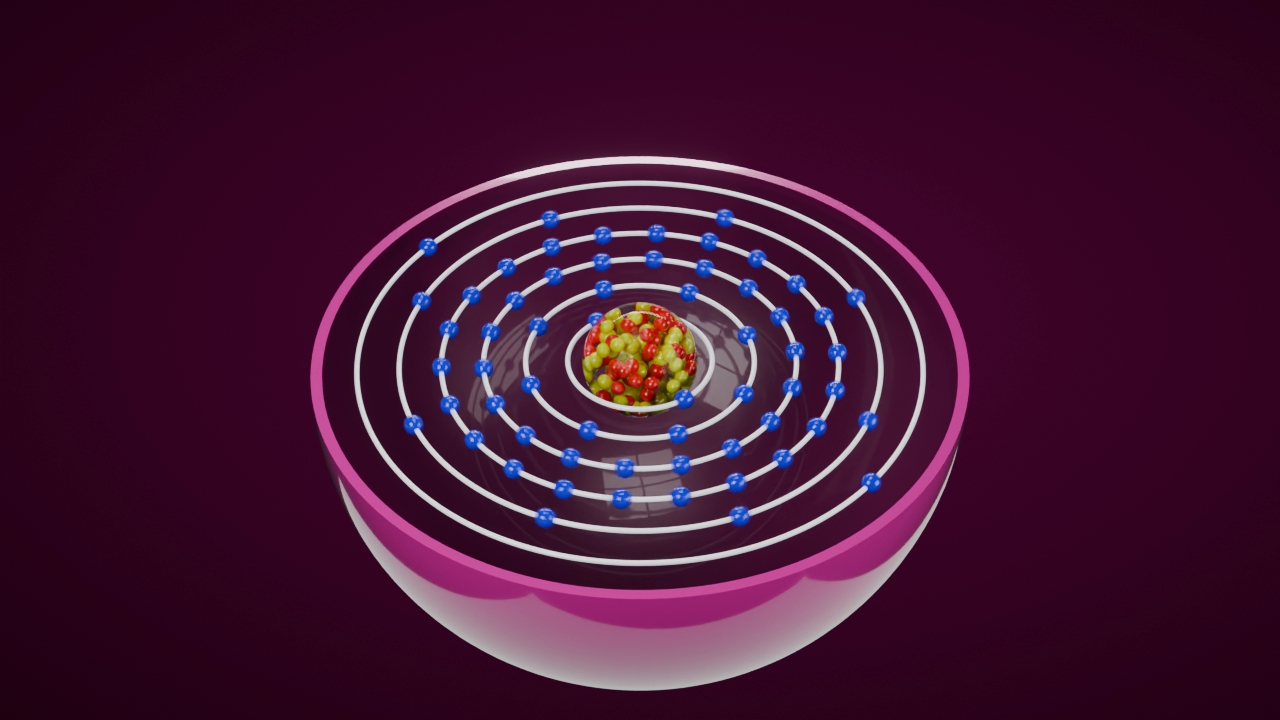
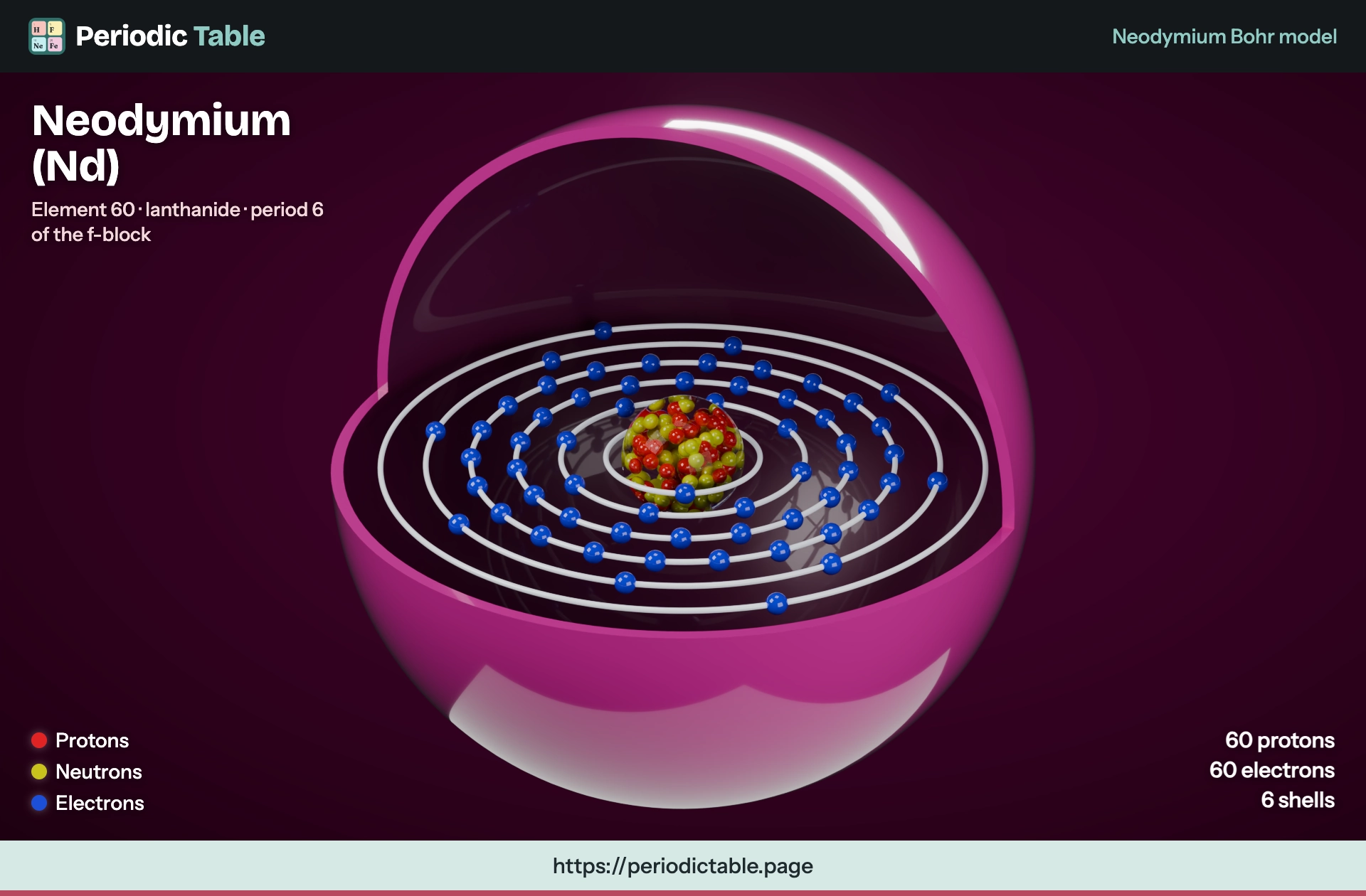
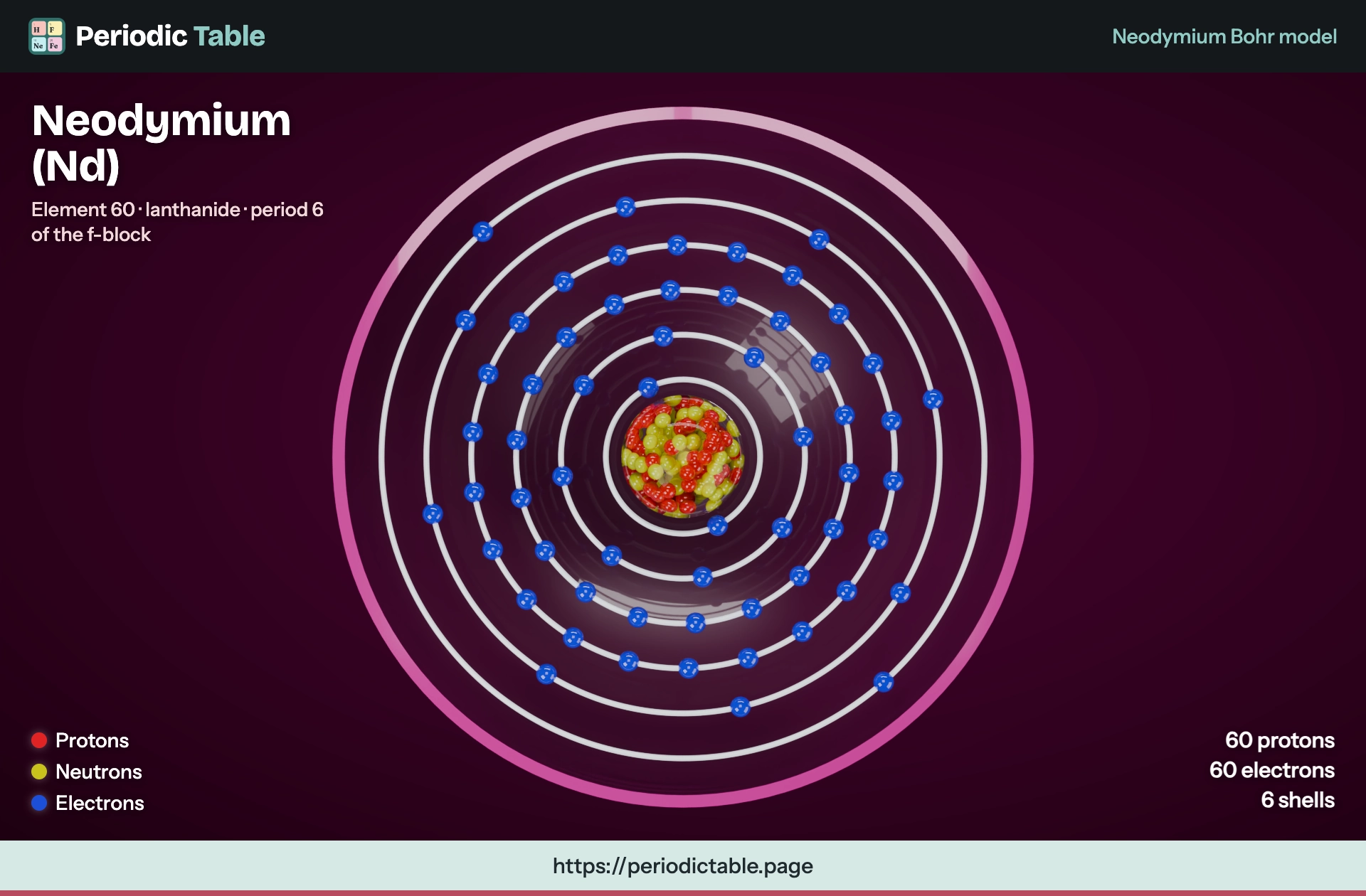
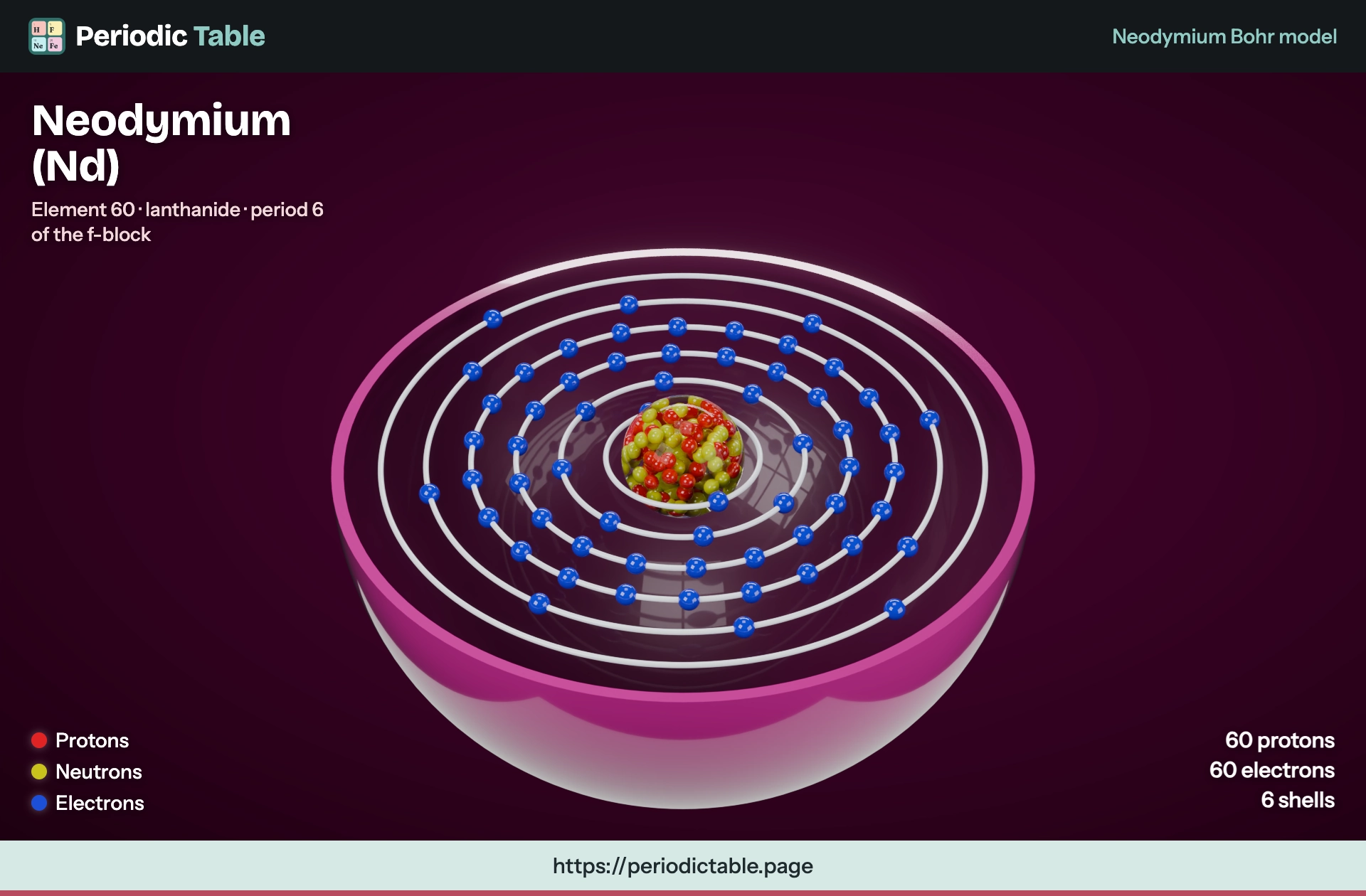
This is a Bohr model of neodymium (Nd), a simplified picture of a single neodymium atom. Its nucleus holds 60 protons, and a neutral neodymium atom has 60 electrons, arranged around it in 6 shells (2 in shell K, 8 in shell L, 18 in shell M, 22 in shell N, 8 in shell O and 2 in shell P).
Neodymium periodic table electron configuration
- Shorthand
- [Xe] 4f4 6s2
- Full
- 1s2 2s2 2p6 3s2 3p6 4s2 3d10 4p6 5s2 4d10 5p6 6s2 4f4
- Electrons per shell
- 2, 8, 18, 22, 8, 2
Neodymium element properties and atomic data
- Atomic number
- 60
- Atomic mass
- 144.2423 u
- Phase at STP
- Solid
- Melting point
- 1023.85°C (1297 K)
- Boiling point
- 3073.85°C (3347 K)
- Density
- 7.01 g/cm³
- Electronegativity (Pauling)
- 1.14
- Period
- 6
- Group
- —
- Block
- f-block
- Appearance
- Silvery white
- Discovery date
- 1885
- Discovered by
- Carl Auer von Welsbach
- Named by
- —
Neodymium element key facts and electron configuration
Neodymium sits at atomic number 60, in period 6 and the f-block, between praseodymium (59) and promethium (61) in the lanthanide series. Each atom carries 60 protons in its nucleus and, in the neutral state, 60 electrons arranged around a xenon core. The numbers below are published reference constants, so you can use them for homework, lab notes or a quick sanity check. Students of radiation and physics will find lawrencium isotopes useful for laboratory research on superheavy elements.
| Property | Value for Nd |
|---|---|
| Symbol / atomic number | Nd / 60 |
| Standard atomic weight | 144.242 |
| Group / block | Lanthanides (no group number) / f-block |
| Electron configuration | [Xe] 4f4 6s2 |
| Electronegativity (Pauling) | 1.14 |
| First, second, third ionization energies | 533, 1,040, 2,130 kJ/mol |
| Atomic radius (empirical) | 181 pm |
| Covalent radius | 201 pm |
| Melting point | about 1,021 °C (1,870 °F) |
| Boiling point | 3,074 °C (5,565 °F) |
| Density at 20 °C | 7.01 g/cm3 |
| CAS number | 7440-00-8 |
Two details are worth reading carefully. First, the atomic mass of 144.242 is an average weighted by the seven natural isotopes, so no single Nd atom actually weighs that. Second, the configuration ends in four 4f electrons; that shielded inner shell explains the element's sharp optical absorption, its magnetism and why the first ionization energy (533 kJ/mol) is modest compared with transition metals.
Properties of neodymium
The properties of neodymium follow a familiar rare-earth pattern: a reactive, soft solid that settles almost always into the +3 state. A short overview of properties of oganesson covers its alpha decay, its half-life and its IUPAC naming in 2016.
Physical properties, melting point and density
Freshly cut, the neodymium metal is silvery-white with a bright luster; some suppliers describe it as silvery-yellow once a thin film forms. It is ductile (it can be drawn into wire) and malleable (it can be hammered into sheet), and neodymium is soft enough to cut with care. Published values for the melting temperature range from 1,016 °C to 1,024 °C depending on sample purity, so treat any single figure as approximate; the boiling point sits much higher, at 3,074 °C.
At room temperature the atoms pack in a double hexagonal close-packed (dhcp) lattice with an ABAC stacking sequence. Heat neodymium past roughly 863 °C and it switches to a body-centered cubic form, the β-phase. Squeeze it instead and it walks through face-centered cubic and finally monoclinic structures above about 75 GPa.
Magnetically, the pure element is paramagnetic at room temperature and only turns antiferromagnetic below about 19.9 K. That surprises many readers: neodymium on its own is not strongly magnetic at all.
The strength only appears once it is alloyed, as covered under applications. Other useful physical properties:
- Specific heat capacity: about 190 J/(kg·K)
- Young's modulus: 41.4 GPa
- Shear modulus: 16.3 GPa
- Bulk modulus: 31.8 GPa
- Thermal conductivity: 16.5 W/(m·K)
Chemical properties and the +3 oxidation state
The defining feature among its chemical properties is reactivity. Neodymium tarnishes in air within hours, and unlike aluminium it gains no protection from that film: the oxide spalls off and exposes fresh surface, so the sample keeps corroding. Because it oxidizes so readily, laboratories keep it under mineral oil, sealed in plastic, or in an inert atmosphere such as argon.
In water neodymium reacts slowly when cold and briskly when hot, releasing hydrogen gas:
$$2\,\text{Nd} + 6\,\text{H}_2\text{O} \rightarrow 2\,\text{Nd(OH)}_3 + 3\,\text{H}_2$$
It also dissolves in dilute sulfuric acid to give the hydrated Nd3+ ion, which binds about nine water molecules. Its most common oxidation state is +3: losing both 6s and one 4f electron leaves a tightly bound [Xe]4f3 core, which is why trivalent compounds dominate its chemistry. The +2 and +4 states exist but are rare and unstable in solution.
Neodymium compounds and their shifting colors
Most neodymium compounds contain the +3 ion, and many of them share an odd trait: their color depends on the light you view them under. A salt that looks lavender in daylight can look blue under a fluorescent tube and pinkish under an incandescent bulb, because the 4f absorption bands remove narrow slices of each light source's spectrum.
| Compound | Formula | Notable trait |
|---|---|---|
| Neodymium(III) oxide | Nd2O3 | Pale blue-grey powder; feedstock for metal and glass colorant |
| Neodymium chloride | NdCl3 | Mauve, water-soluble, absorbs moisture |
| Neodymium fluoride | NdF3 | Violet; used as the electrolyte base for metal production |
| Neodymium hydroxide | Nd(OH)3 | Barely soluble in water, dissolves in acid |
| Neodymium iodide | NdI3 | Green, one of the four trihalides |
The neodymium oxide, also called neodymia, exists in hexagonal and cubic forms and slowly picks up moisture and carbon dioxide from air. Chemists usually make it by heating the oxalate. All four trihalides form directly when the metal meets a halogen, and the bromide shares that violet tone.
Beyond those, Nd forms borides (NdB4, NdB6), sulfides and tellurides with a rock-salt structure, a nitride studied as a magnetic semiconductor, and organometallic complexes with carbon rings. In solution chemistry, the color shift is a handy identity check: a purple-to-blue change under different lamps is a strong hint that Nd3+ is present.
Neodymium isotopes and radioactive decay
Natural neodymium is a blend of seven isotopes. Five show no measurable decay, and two are technically radioactive but decay so slowly that they have survived since before Earth formed.
| Isotope | Natural abundance | Behaviour |
|---|---|---|
| Neodymium-142 | 27.2% | Most abundant, stable |
| Neodymium-143 | 12.2% | Stable |
| Neodymium-144 | 23.8% | Alpha decay to cerium-140, half-life about 2.29 × 10¹⁵ years |
| Neodymium-145 | 8.3% | Stable |
| Neodymium-146 | 17.2% | Stable |
| Neodymium-148 | 5.8% | Stable |
| Neodymium-150 | 5.6% | Double beta decay to Sm-150, roughly 9.3 × 10¹⁸ years |
To put those numbers in perspective, the universe is about 1.4 × 10¹⁰ years old, so a sample of neodymium-144 has lost a vanishingly small fraction of its atoms since the Big Bang. Neodymium-150 matters to physicists because its high decay energy (about 3.37 MeV) makes it a candidate in searches for neutrinoless double beta decay. Among the synthetic neodymium isotopes, the longest-lived is Nd-147 at about 11 days; the other radioisotopes have half-lives of days, minutes or less.
Several Nd isotopes also form during nuclear fission, and measuring Nd-148 in spent nuclear fuel is a standard way to work out burnup, the share of the fuel that has actually fissioned.
Samarium–neodymium dating and ocean circulation
Because Sm-147 slowly turns into Nd-143, the ratio of the two lets geologists date rocks and meteorites. In samarium–neodymium dating, several minerals from one rock are plotted on an isochron, and the slope of the line gives the age. Oceanographers use the same isotope ratios in a different way: water masses carry distinct Nd signatures, so isotope records in seafloor sediments help reconstruct past ocean circulation.
Discovery of neodymium: Carl Auer von Welsbach splits didymium
The story starts with a mineral called cerite. In 1841 the Swedish chemist Carl Gustaf Mosander pulled two supposed new elements out of it: lanthanum and a second substance he named didymium, from the Greek word for "twin," because it seemed inseparable from lanthanum. Didymium was accepted as an element for decades and even appeared in Mendeleev's 1869 periodic table.
Doubts grew once Robert Bunsen and Gustav Kirchhoff invented the spectroscope in 1859. Spectroscopy showed that every element glows with its own pattern of lines, and samples of didymium from different minerals did not quite agree. Bunsen handed the puzzle to his student Carl Auer von Welsbach.
Working in Vienna in 1885, Auer von Welsbach ran hundreds of rounds of fractional crystallization on double ammonium nitrate salts, exploiting tiny differences in solubility. He ended up with two fractions: a green one he called praseodymium ("green twin") and a larger, lilac one he called neodidymium, the new twin.
The name was soon shortened to neodymium. What Carl Mosander had taken for one element was really two neighbours on the lanthanide row.
Separation stayed slow and painful for another half century. The breakthrough came in the 1940s, when Frank Spedding and his team at Iowa State showed that ion exchange columns could split neodymium from praseodymium cleanly. Reasonably pure Nd metal had only been isolated in 1925, so it was Spedding's work, and the solvent methods that followed, that finally made kilogram quantities cheap enough for industry to use, turning rare-earth chemistry from a curiosity into a supply chain.
Where neodymium comes from: minerals, mining and production
Neodymium is not actually rare; what is rare is finding it concentrated enough to mine. Its path from rock to ingot runs through several chemical steps.
Monazite, Bastnäsite and rare-Earth elements in the crust
Neodymium makes up about 41 mg per kg of Earth's crust, roughly twice as much as lead and about half as much as copper. Only yttrium, lanthanum and cerium are more plentiful among the rare earths. It always travels with its neighbours, because Nd3+ is almost the same size as their ions, so the elements swap freely inside the same crystals.
The two main commercial minerals are monazite, a rare-earth phosphate, and bastnäsite, a fluorocarbonate (often written bastnasite in trade reports). Big deposits form in carbonatites, such as Mountain Pass in California and Bayan Obo in Inner Mongolia, while monazite also piles up in placer deposits of river and beach sand. Thorium in the phosphate adds a waste stream that the fluorocarbonate largely avoids.
Separating and refining the rare-Earth metal
Mined ore is crushed, ground and concentrated by flotation, gravity and magnetic separation. The concentrate is then baked with concentrated acid and leached so the rare-earth elements dissolve.
- Solvent extraction: the solution is mixed again and again with an organic liquid in banks of mixer-settlers, and each rare earth partitions slightly differently, so it takes many stages to isolate Nd or a mixed Nd-Pr fraction for magnets.
- Precipitation: neodymium comes out of solution as an oxalate, which is heated to give the oxide.
- Metal making: the oxide is dissolved in molten fluoride salts and reduced by electrolysis, or the anhydrous fluoride is reduced with calcium.
$$2\,\text{NdF}_3 + 3\,\text{Ca} \rightarrow 2\,\text{Nd} + 3\,\text{CaF}_2$$
Each step consumes acid, energy and carbon anodes, which is why refining, not digging, is the real bottleneck for neodymium.
Neodymium supply, reserves and electric vehicles
Supply is concentrated in very few hands. The International Energy Agency reported that in 2024 China accounted for about 60% of mined output and 91% of refined output of the four rare earths used in magnets (neodymium, praseodymium, dysprosium and terbium). Other producers include Russia, Malaysia, the USA, Australia, Brazil and India, and world reserves of neodymium are estimated at around 8 million tonnes.
Demand is climbing with renewable energy and transport: magnets for wind generators and traction motors drove a doubling of demand since 2015, with roughly another third expected by 2030. That is why many governments list neodymium as a critical material for the energy transition. For you as a buyer or engineer, the practical takeaway is price volatility: a policy change in one country can move the cost of every motor you specify.
Recycling old magnets
Fewer than 10% of rare earth elements are currently recovered. A block of NdFeB is about 31-32% rare earths by mass, so scrapped motors and hard drives are a rich source of neodymium, but pulling small units out of electronic waste, then stripping their coatings and glue, is labour-intensive. One route dissolves the alloy and re-separates the elements; a shorter one uses hydrogen to crumble old blocks into powder that can be pressed straight into new ones.
Applications of neodymium
The applications of neodymium cluster around one property: the way its 4f shell interacts with magnetic fields and light. Roughly 70% of the supply ends up in magnets, and most of the rest goes into glass, lasers and the chemical uses that quietly support modern technology.
Permanent magnets for electric motors and wind turbines
Discovered in 1984, the neodymium–iron–boron alloy NdFeB (main phase Nd2Fe14B) is the strongest widely available material for permanent magnets. Iron supplies a large magnetization, while neodymium and the alloy's tetragonal crystal lock that magnetization along one axis. The result is a high energy product: a small, light neodymium magnet holds the field of a far larger ferrite block.
They come in two main forms. Sintered magnets are pressed and heated from aligned powder and give the highest strength; bonded magnets hold the powder in a polymer, so they can be moulded into complex shapes at some cost in strength. Two weaknesses shape every design:
- Heat: coercivity, the resistance to demagnetization, falls as temperature rises, so motor magnets often swap some Nd for dysprosium or terbium.
- Corrosion: the alloy rusts and the pressed form is brittle, so it is almost always nickel-plated or polymer-coated.
How does neodymium compare with the other common magnet materials? Typical published ranges:
| Material | Max energy product | Typical working limit | Trade-off |
|---|---|---|---|
| Neodymium alloy | up to about 52 MGOe | 80 °C standard, 200 °C+ for heavy-rare-earth grades | Strongest, but corrodes and weakens with heat |
| SmCo | up to about 32 MGOe | 250-350 °C | Holds up at high heat, costly and brittle |
| Alnico | about 5-10 MGOe | 500 °C+ | Heat-proof, easily demagnetized |
| Ferrite (ceramic) | about 3-4.5 MGOe | about 250 °C | Cheapest, bulky for the same pull |
The practical reading: pick the neodymium alloy when size and weight matter most, and step to SmCo only when the part runs hot.
Their compact strength made neodymium magnets standard in:
- Electric motors in electric and hybrid vehicles, robots and industrial drives
- Wind turbines, especially direct-drive generators with no gearbox
- Hard disk drives, where voice-coil magnets position the read heads in computer hard drives
- Loudspeakers, headphones, microphones and the tiny speakers in mobile phones
- Vibration motors and camera autofocus units in cell phones
- Low-field MRI prototypes and guitar pickups
A practical note if you buy them for hobby use: two large magnets can snap together hard enough to pinch skin or shatter, so keep them apart and away from children.
Neodymium glass, goggles and optical filters
Adding neodymium oxide to molten glass gives a lavender, blue or reddish-purple tint that shifts with the light source, a trick decorative glassmakers have used since the 1920s. Small doses also cancel the green cast that iron impurities leave in crystal glass.
The more important optical use is absorption. Didymium glass, a mix of neodymium and praseodymium, blocks the intense sodium emission near 589 nm. That is exactly the yellow glare that blinds glassblowers and some welders working at a flame, so their goggles use it to make hot glass visible again.
Similar filters cut light pollution for amateur astronomers, sharpen color contrast in photomicrography and calibrate spectrophotometers. Nd salts also color ceramics, glazes and enamels, and Nd-doped glass appears in fiber optics (fibre optics in British usage).
Nd:YAG and other solid-state lasers
In solid-state lasers, Nd3+ ions are the light-amplifying centres inside a transparent host. The best known is Nd:YAG, where Nd replaces some yttrium in yttrium aluminum garnet (spelled yttrium aluminium garnet outside the US).
Pumped by a lamp or diode, it emits infrared light at 1064 nm through a four-level transition that is easy to keep running. Other hosts include YLF, YVO4 and glass.
These neodymium lasers show up across industry and medicine:
- Welding, cutting, marking and engraving metal parts
- Ophthalmology, such as clearing clouded lens capsules after cataract surgery
- Laser surgery, including the removal of some skin cancers
- Green laser pointers, where a crystal doubles the 1064 nm output to 532 nm
At the largest scale, neodymium-doped phosphate glass slabs amplify the 192 beams of the National Ignition Facility, the US machine built for inertial confinement fusion research. Glass wins there because it can be cast in far bigger pieces than a YAG crystal.
Catalysts, alloys and electronics
- Catalysts: Nd-based catalyst systems make high-cis polybutadiene, a synthetic rubber prized in tyres for its abrasion resistance.
- Alloys: misch metal (written mischmetal in older sources) contains about 15-18% neodymium and is used in lighter flints; small additions also go into steel.
- Cryocoolers: Nd spheres serve as a regenerator that stores heat near 4 K, thanks to their high heat capacity at low temperature.
- Electronics: Nd compounds appear in some phosphors for lamps and displays, and the acetate is being tested as a safer electron-microscope stain.
Neodymium in the environment and human health
Most exposure comes from mining, refining and discarded gadgets rather than natural sources. Neodymium can build up in soil and water near processing sites, and studies report aquatic toxicity in the form of damage to cell membranes in some organisms. Its general toxicity to people is considered low to moderate.
Health effects of dust, salts and strong magnets
The main health effects come from handling. Neodymium dust and salts cause eye and skin irritation, inhaling fumes can harm the lungs, and fine metal powder can ignite in air. For most people, though, the bigger everyday risk is mechanical: swallowed magnet sets can pull together through the gut wall, which is why many countries restrict small, powerful magnets in toys.
A surprising biological role
Neodymium has no known role in the human body, but some bacteria use it. The volcanic microbe Methylacidiphilum fumariolicum needs a lanthanide as the metal cofactor in its methanol dehydrogenase enzyme, and Nd works well in that slot. It was one of the first signs that rare earths, long thought biologically inert, can be essential to life.