


Oganesson element (Og): oganesson periodic table facts
Oganesson periodic table facts: oganesson (Og) is element 118, a noble gas in group 18, period 7. Follow the periodic table to its very last box and you land on oganesson (symbol Og), element 118 and the chemical element with the highest atomic number anyone has ever made. To read about argonium, clathrates and the first compound, argon fluorohydride, look up element 18 first for the basics.
Scientists at the Joint Institute for Nuclear Research first produced it in 2002, and only a handful of atoms have existed since, each gone in less than a thousandth of a second. What makes it worth your time is the twist in its research story: it sits in the noble-gas column, yet theory says it behaves like neither a typical noble element nor a gas.
Rotate the 3D Bohr model of oganesson
Drag to orbit, scroll to zoom.
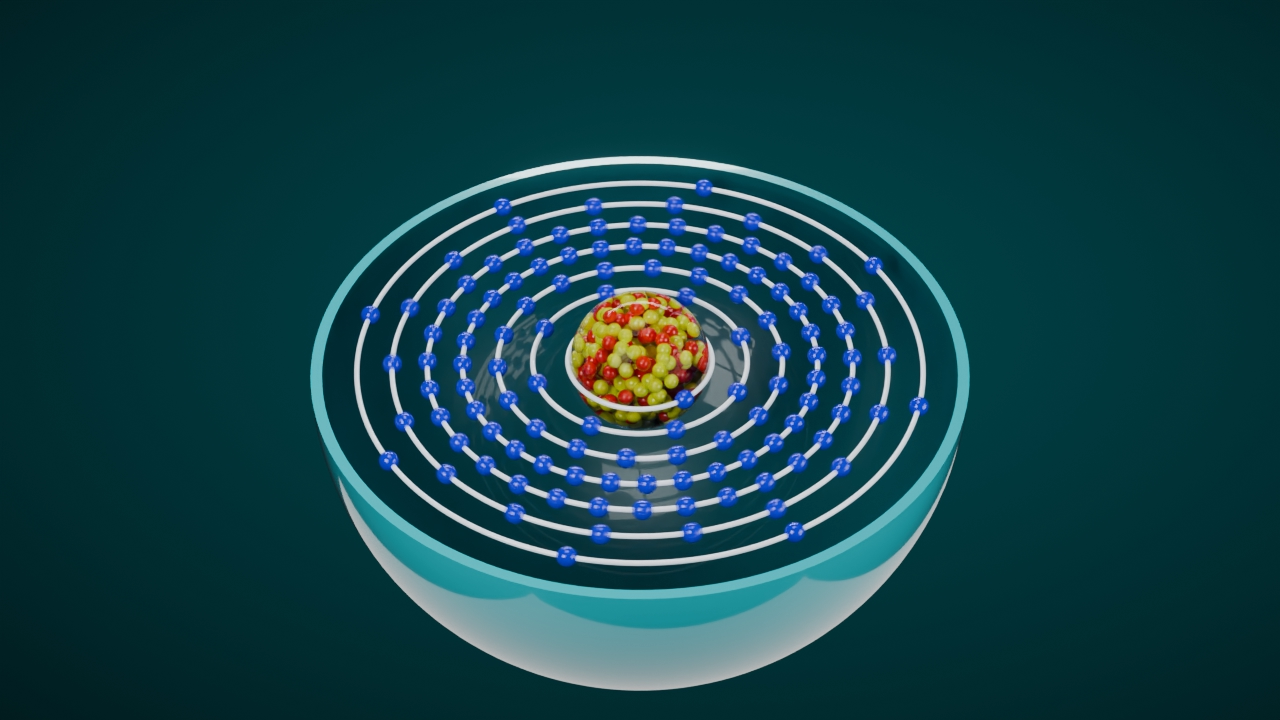
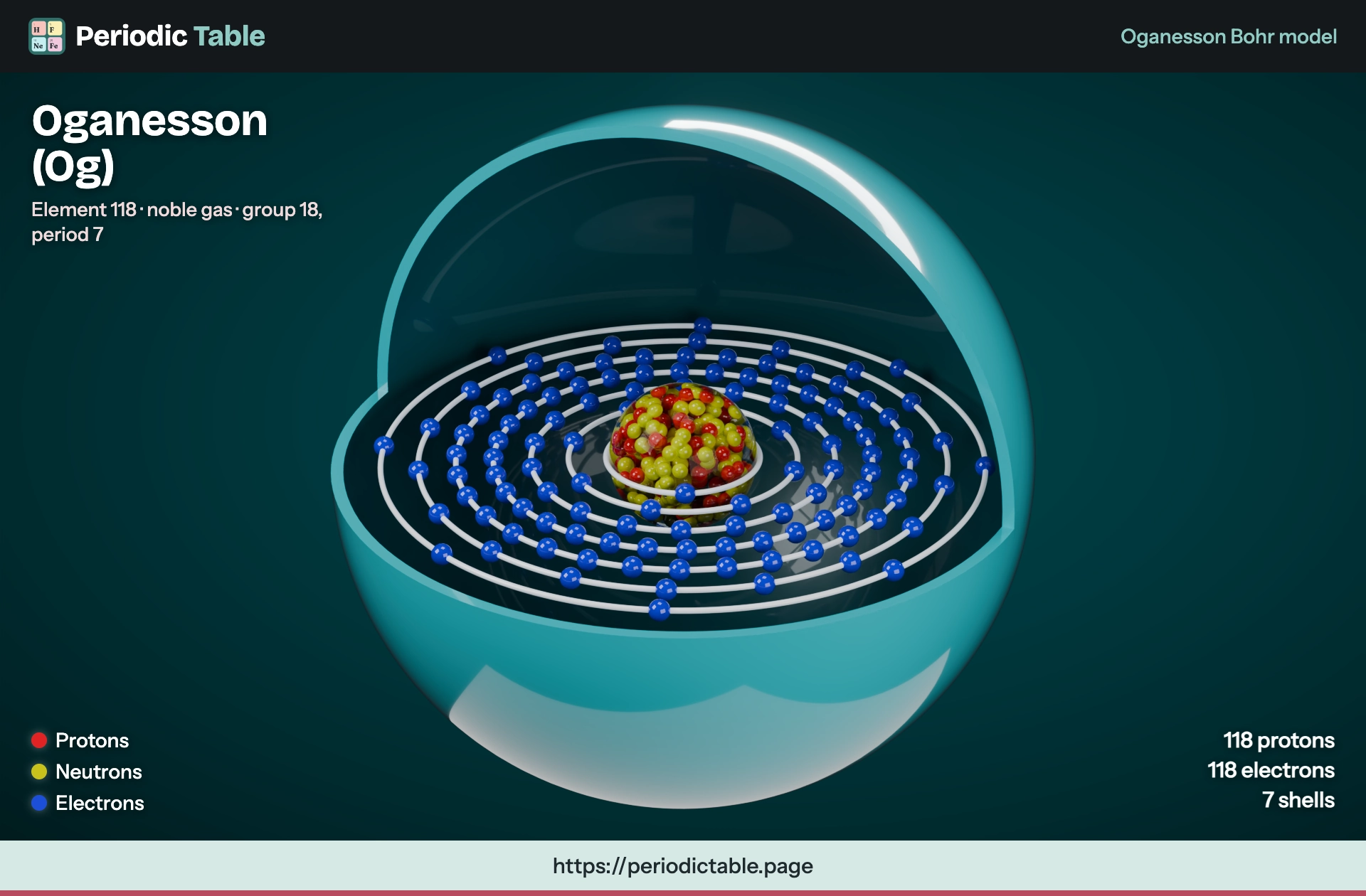
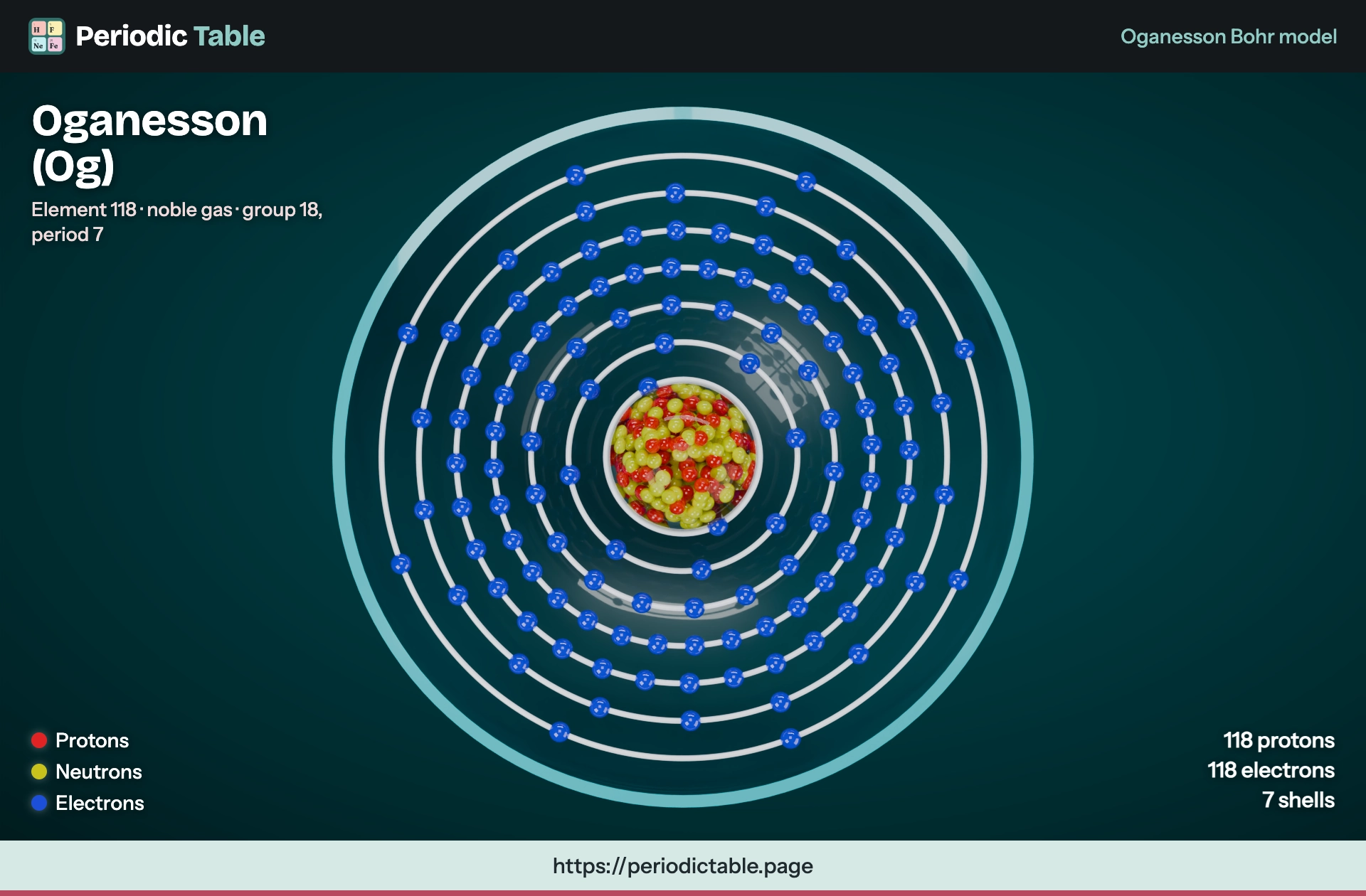
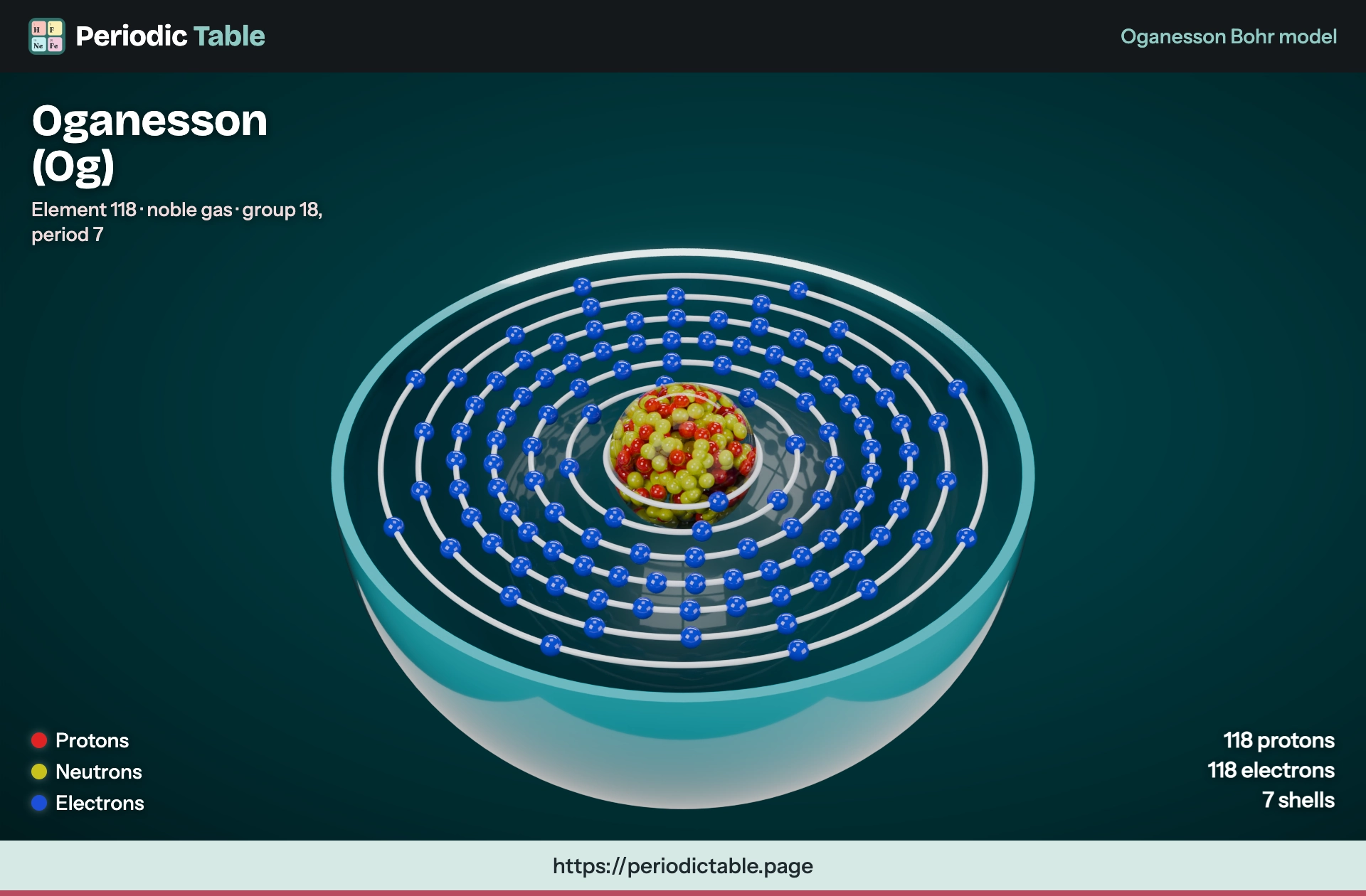
This is a Bohr model of oganesson (Og), a simplified picture of a single oganesson atom. Its nucleus holds 118 protons, and a neutral oganesson atom has 118 electrons, arranged around it in 7 shells (2 in shell K, 8 in shell L, 18 in shell M, 32 in shell N, 32 in shell O, 18 in shell P and 8 in shell Q).
Oganesson periodic table electron configuration
- Shorthand
- *[Rn] 5f14 6d10 7s2 7p6
- Full
- 1s2 2s2 2p6 3s2 3p6 4s2 3d10 4p6 5s2 4d10 5p6 6s2 4f14 5d10 6p6 7s2 5f14 6d10 7p6
- Electrons per shell
- 2, 8, 18, 32, 32, 18, 8
Oganesson element properties and atomic data
- Atomic number
- 118
- Atomic mass
- [294] u
- Phase at STP
- Unknown
- Melting point
- Unknown
- Boiling point
- 76.85°C (350 K)
- Density
- 4.95 g/cm³
- Electronegativity (Pauling)
- Unknown
- Period
- 7
- Group
- 18
- Block
- p-block
- Appearance
- Unknown
- Discovery date
- 2002
- Discovered by
- Joint Institute for Nuclear Research
- Named by
- —
Oganesson element facts: atomic number and atomic mass
The values below are the reference figures you will find for this synthetic element in most data sources. Anything marked predicted or calculated comes from theory, because no one has ever held enough of the substance to measure a bulk property directly. For the NdFeB alloy, its oxidation state and its role inside electric vehicles, look up neodymium isotopes in this guide.
| Property | Value |
|---|---|
| Symbol | Og |
| Atomic number (Z) | 118 |
| Atomic mass | [294], the mass number of the only confirmed isotope |
| Group, period, block | 18, 7, p |
| Electron configuration | [Rn] 5f14 6d10 7s2 7p6 (predicted) |
| Shell occupancy | 2, 8, 18, 32, 32, 18, 8 |
| Protons / neutrons / electrons in Og-294 | 118 / 176 / 118 |
| First ionization energy | about 860 kJ/mol (calculated) |
| Electron affinity | about 0.080 eV (calculated) |
| Covalent radius | 157 pm (predicted) |
| Atomic radius | 152 pm (predicted) |
| CAS number | 54144-19-3 |
| First produced | 2002, reported in 2006 |
Notice the square brackets around 294. When a substance has no stable isotope, a standard atomic weight can't be defined, so the mass number of its best-known form stands in.
For element 118 that single form is all chemists have to work with, and every figure in the table traces back to one short-lived nucleus and the models built around it. Most other heavy elements at least have a few isotopes to compare; this one has exactly one.
Where Og sits on the table: group 18, period 7 and the p-block
Element 118 closes out period 7 and sits at the foot of the noble gas group, directly below radon. Its spot on the periodic table follows the same rule every entry obeys: position is set by electron count, not by measured behavior. With 118 electrons, the last subshell to fill is 7p, which puts it in the p-block next to elements 113 through 117 and completes the seventh row. Rutherford, Priestley and Scheele all get credit in the nitrogen on the periodic table, which covers noxious air and Lavoisier's azote.
Reading down the column, the periodic trend is easy to see. The noble gases get heavier, larger, easier to ionize and more willing to bond as you descend.
Helium and neon refuse to form stable compounds at all, while the heavier members build a growing list of them. Oganesson, as the heaviest element in the column, is expected to push that trend much further than a simple extrapolation would suggest, and that is where it gets interesting.
Electron configuration and the valence shell
On paper, oganesson's arrangement looks textbook: a filled 7s2 7p6 outer layer, giving it eight valence electrons, a closed valence shell and the same octet that keeps radon inert. That octet is why it was assigned to group 18 decades before anyone made it. The catch is that a full shell only guarantees quiet chemistry when the outer orbitals are held tightly, and in an atom this heavy they are not.
Close to a nucleus carrying 118 protons, the inner orbitals contract and the outer ones swell and split, so the octet that looks closed on paper behaves like a loose, easily disturbed cloud. That shift is the thread running through nearly every prediction further down this page.
History and discovery of oganesson
The road to this transactinide element runs more than a century, from a Danish chemist's guess to a joint Russian-American laboratory effort. It also passes through one of the best-known misconduct cases in nuclear science, which is part of the reason the eventual discovery was checked so carefully before anyone signed off on it.
Early predictions of a seventh noble gas
In 1895, a year after argon was identified, Hans Peter Jørgen Julius Thomsen argued that a whole family of unreactive gases should exist and that its seventh member would weigh about 292, strikingly close to the 294 measured for the one confirmed nucleus today. Niels Bohr tied that member to atomic number 118 in 1922 and sketched the same 2-8-18-32-32-18-8 shell pattern still used now.
Under Mendeleev's naming scheme it became eka-radon, and earlier eka-emanation, since emanation was once the name for element 86. In 1975 Kenneth Pitzer then suggested that relativistic effects would make it a gas or a volatile liquid that did not behave like its lighter neighbors.
The Berkeley claim and its retraction
In 1999 a team at Berkeley announced in Physical Review Letters that it had made elements 116 and 118 by firing krypton-86 at a lead-208 target, a route encouraged by calculations hinting that the cross section would be unusually favorable. No other group could reproduce the result, and neither could the original one.
A retraction followed in 2001, and in 2002 an investigation concluded that the key decay events had been fabricated by physicist Victor Ninov. Later work confirmed the opposite of the original hope: fusion probability with lead targets drops steeply as the product gets heavier.
Discovery at the joint institute for nuclear research
The real breakthrough came in Dubna, Russia, in 2002, from a collaboration of Russian and American scientists, led by Yuri Oganessian, that included staff from Lawrence Livermore National Laboratory in California. They aimed a beam of calcium ions at a californium target for months, and a 2005 run raised the beam energy from 245 to 251 MeV to confirm the first signal. In October 2006 the team reported in Physical Review C that it had detected three, possibly four, atoms of oganesson through this reaction:
$$^{249}_{98}\mathrm{Cf} + {}^{48}_{20}\mathrm{Ca} \rightarrow {}^{294}_{118}\mathrm{Og} + 3\,{}^{1}_{0}\mathrm{n}$$
Each event was identified by its decay chain: the new nucleus shed an alpha particle to become livermorium-290, which decayed in turn to flerovium-286. The odds that the signals were random noise were estimated at less than one in 100,000, but the chain ended in fission without reaching a previously known nucleus, which kept the claim from being accepted straight away.
IUPAC confirmation and recognition
In 2011 an IUPAC review judged the Dubna data internally consistent but not yet anchored to known nuclei. That anchor came from later experiments in 2009 and 2010 that independently confirmed the properties of flerovium-286, plus another matching chain seen by the same Russian group in 2012 during a run that was actually aimed at tennessine. In December 2015 the Joint Working Party of IUPAC and IUPAP credited the discovery to the Dubna–Livermore collaboration, closing a search that had started with Thomsen's guess 120 years earlier.
From ununoctium to oganesson: honoring Yuri Oganessian
Before it had a real name, the element went by the IUPAC placeholder name assigned in 1979, built from Latin and Greek roots for one-one-eight, with the three-letter symbol Uuo. Most specialists ignored it and simply wrote E118 or element 118.
The Berkeley group, before its claim collapsed, had planned to call it ghiorsium after Albert Ghiorso. The Russian team, based at the Flerov Laboratory of Nuclear Reactions, later floated names honoring Georgy Flyorov and the Moscow region, and those ideas ended up attached to elements 114 and 115 instead.
In March 2016 the discoverers agreed to name element 118 after Oganessian, whose group had driven the synthesis of elements 107 through 118 over several decades. Gases in this column traditionally take an -on ending, like the gas directly above it, and a 2016 IUPAC recommendation restored that convention, which is why the final name ends in -on rather than -ium.
The name became official on 28 November 2016, and the naming ceremony for moscovium, tennessine and oganesson was held in Moscow on 2 March 2017. Oganessian is one of only two people to have an entry on the table named after them while still alive, which makes this one of very few elements with a living namesake.
How oganesson atoms are made: synthesis of superheavy elements
There is no natural source of Og on Earth, in meteorites or in the Sun, so every atom ever studied came out of an accelerator. The method is nuclear fusion of two unequal nuclei: a target of a heavy actinide is bombarded with a beam of lighter ions moving at around a tenth of the speed of light. In practice, the synthesis of oganesson has always relied on calcium-48 striking californium-249, with neutron-rich calcium chosen because its neutron surplus carries over into the product.
Getting two nuclei to merge is the hard part of this accelerator physics. Both carry positive charge, so electrostatic repulsion pushes them apart until they come close enough for the strong interaction to take over. Most collisions end with the pair separating again within about 10-20 seconds.
When a fusion reaction does succeed, it forms an excited compound nucleus that has to shed energy by boiling off neutrons, three of them for Og-294, rather than splitting apart. A separator then sorts the new nucleus from the beam and drives it into a silicon detector, which records where and when it lands and logs each decay that follows.
The yield is tiny. The 2002 and 2005 experiments ran for months and needed roughly 2.5 × 10¹⁹ calcium projectiles to produce a single recorded event, a cross section well below one picobarn. That scarcity is why superheavy elements are studied atom by atom, and why nuclear reactions at this scale are as much about detector timing as about chemistry.
Oganesson isotopes and the island of stability
Only one of the isotopes of oganesson has been confirmed since its discovery: oganesson-294, with 118 protons and 176 neutrons. It is highly radioactive, and like all elements above lead it has no stable isotope. Its radioactivity, not its chemistry, is what limits everything known about it, since each atom is lost to decay before it can be handled.
Theory still offers some hope. The nuclear shell model predicts extra binding at magic numbers, with closed shells expected near 114 protons and 184 neutrons, creating an island of stability where lifetimes could stretch far longer. Og-294 sits just past the edge of that region, which helps explain why it survives longer than older liquid-drop estimates allowed.
A quantum-tunneling model suggests heavier isotopes such as Og-295, Og-296 and especially Og-297 could live somewhat longer, and those are the targets for anyone hoping to make enough material for a real experiment. They are also a central test of nuclear stability theory at the limit of the chart.
Half-life, alpha decay and spontaneous fission
Like most superheavy elements, this one ends its life in one of two ways. In alpha decay the nucleus throws off an alpha particle and steps down by two elements; in spontaneous fission it splits into two large fragments. Oganesson-294 follows the first route, and each decay step releases a characteristic energy that lets physicists recognize it:
$$^{294}_{118}\mathrm{Og} \rightarrow {}^{290}_{116}\mathrm{Lv} + {}^{4}_{2}\mathrm{He}$$
Its measured half-life is about 0.7 milliseconds. The unstable daughter nucleus, livermorium-290, lasts only around 14 ms before it emits another alpha particle, and the chain ends in spontaneous fission at the element 114 stage or, after one more step, at copernicium.
Because so few decays have been seen, the uncertainty is wide: the 2006 paper gave 0.89 ms with error bars running from roughly 0.6 to 2 ms. For chemists the exact figure matters less than its order of magnitude. Any technique that needs the oganesson nucleus to sit still for more than about a millisecond, which rules out essentially all wet chemistry, simply can't be used.
Physical properties of oganesson at room temperature
No bulk sample of Og will ever exist, so every physical number for it is predicted from computation. Even so, the models have moved a long way.
Early estimates expected a dense gas, while modern theoretical calculations agree that element 118 would most likely be a solid under everyday conditions, with an unusually low melting temperature for something so heavy. The lighter elements in its column are all gases, so this is the first place the column's character breaks.
Melting point, boiling point and density
A 2020 study using Monte Carlo sampling and relativistic molecular dynamics produced the figures below. With relativity switched off, the same model melts the substance near 220 K, which shows how much of its character comes from fast-moving inner shells.
| Property | Model value |
|---|---|
| Melting point | 325 ± 15 K (about 52 °C) |
| Boiling point | 450 ± 10 K (about 177 °C) |
| Density | 7.2 g/cm³ as a crystal near 319 K; 6.6 g/cm³ as a liquid |
Those values describe a soft, low-melting crystal at room temperature, a phase much closer to a metal than to the colorless gas formed by the lighter members.
Relativistic effects and smeared electron shells
The physics behind this comes down to spin–orbit splitting. In an atom this heavy, the 7p subshell divides into two very different energy levels, and the outer cloud becomes loosely held and easy to distort. Its polarizability is predicted to be almost twice radon's, and its first ionization energy, near 860 kJ/mol, is lower than that of gold or platinum.
In 2018, Peter Schwerdtfeger's team at Massey University and nuclear theorists at Michigan State University computed its electronic and nuclear structure side by side. They found that the shell structure defining every other noble gas nearly disappears: the electrons spread into something close to a uniform Fermi gas, the neutron distribution inside the nucleus smears out as well, and only the proton distribution keeps some of its ordering.
Spin–orbit effects may also make bulk oganesson a semiconductor with a band gap near 1.5 eV, while every lighter member of the column is an insulator. That narrow gap, a step from insulator toward metallic behavior, is a clear sign that position on the table no longer predicts behavior at the bottom.
Chemical properties and oxidation states of oganesson
Nobody has made a single Og compound, because building a molecule requires the atom to survive far longer than 0.7 ms. What exists are calculations, and they point the same way: the oganesson properties that matter for bonding make it the most reactive member of its column, the reverse of what its position would suggest. Unlike most elements in the column, it is also expected to bind an extra electron and release energy doing so, a positive electron attachment that the lighter gases lack.
Its likely oxidation states are +2 and +4, with 0 in the free atom. A +6 state is predicted to be unstable, the opposite of xenon, which forms a well-known hexafluoride. Its chemical properties also lean toward ionic rather than shared bonds, which sets it apart from the lighter gases even more.
Predicted oganesson fluorides and other compounds
The best-studied hypothetical compounds are OgF2 and OgF4. Calculations give OgF4 a tetrahedral shape instead of the square-planar geometry of XeF4, because two inner electron pairs stay out of bonding. Its bonds would be mostly ionic rather than covalent, so these fluorides would be salt-like and non-volatile rather than small gas-phase molecules.
Its diatomic molecule would have a dissociation energy of about 6 kJ/mol, roughly four times that of its lighter neighbor's equivalent, with a shorter bond than expected. It is also expected to be electropositive enough to bond with chlorine. Each of these results is a test of chemical bonding theory, not a lab observation.
How element oganesson compares with the lighter noble gases
Set beside the rest of its column, this element is where every trend bends. The table lists each member's boiling temperature and its state at 20 °C, using published reference values for the six lighter gases and model values for the last row.
| Element | Z | Period | Boils at (K) | State at 20 °C |
|---|---|---|---|---|
| Helium | 2 | 1 | 4.2 | Gas |
| Neon | 10 | 2 | 27.1 | Gas |
| Argon | 18 | 3 | 87.3 | Gas |
| Krypton | 36 | 4 | 119.9 | Gas |
| Xenon | 54 | 5 | 165.1 | Gas |
| Radon | 86 | 6 | 211.5 | Gas |
| Oganesson | 118 | 7 | about 450 (predicted) | Solid (predicted) |
Read the rows from top to bottom and two patterns stand out. Each step down adds a shell and raises the boiling temperature by roughly 20 to 60 kelvin, as heavier, more polarizable members pull on each other more strongly.
Then the last row breaks the pattern by more than 200 K. That jump is the cleanest single illustration of how relativity rewrites chemistry for the heaviest elements, and why you can't predict the bottom of the periodic table by pattern alone.
Oganesson uses in scientific research
Oganesson has no practical or commercial use, and none is plausible: a few atoms lasting under a millisecond can't be bought, stored or shipped. Its value lies entirely in what it tests.
For nuclear physics, each new event checks models of how far the chart of nuclides extends and where the island of long-lived nuclei might sit. For atomic physics and nuclear chemistry, it is the extreme test case for relativistic quantum methods, the same methods used to explain the color of gold and the liquidity of mercury among lighter heavy elements.
Researchers still want heavier isotopes for one reason: a version that lasted even a few seconds would allow the first single-atom chemistry experiment on this transactinide, and would finally show whether a superheavy element at the bottom of the column reacts the way the calculations say. Until then, it remains a benchmark for physics and chemistry at the outer edge of the periodic table.