


Nitrogen element (N): nitrogen periodic table facts
Nitrogen periodic table facts: nitrogen (N) is element 7, a reactive nonmetal in group 15, period 2. Take a breath and roughly four out of every five molecules you pull in are nitrogen, the chemical element with symbol N and atomic number 7. To read about argonium, clathrates and the first compound, argon fluorohydride, look up element 18, argon first for the basics.
It is a colorless, odorless and tasteless inert gas that makes up about 78% of Earth's atmosphere, so the air we breathe is mostly this one gas, yet the same element sits inside every protein your body builds. This guide walks you through its properties, isotopes, compounds and history, and shows why such a quiet gas matters so much to life, farming and industry.
Rotate the 3D Bohr model of nitrogen
Drag to orbit, scroll to zoom.
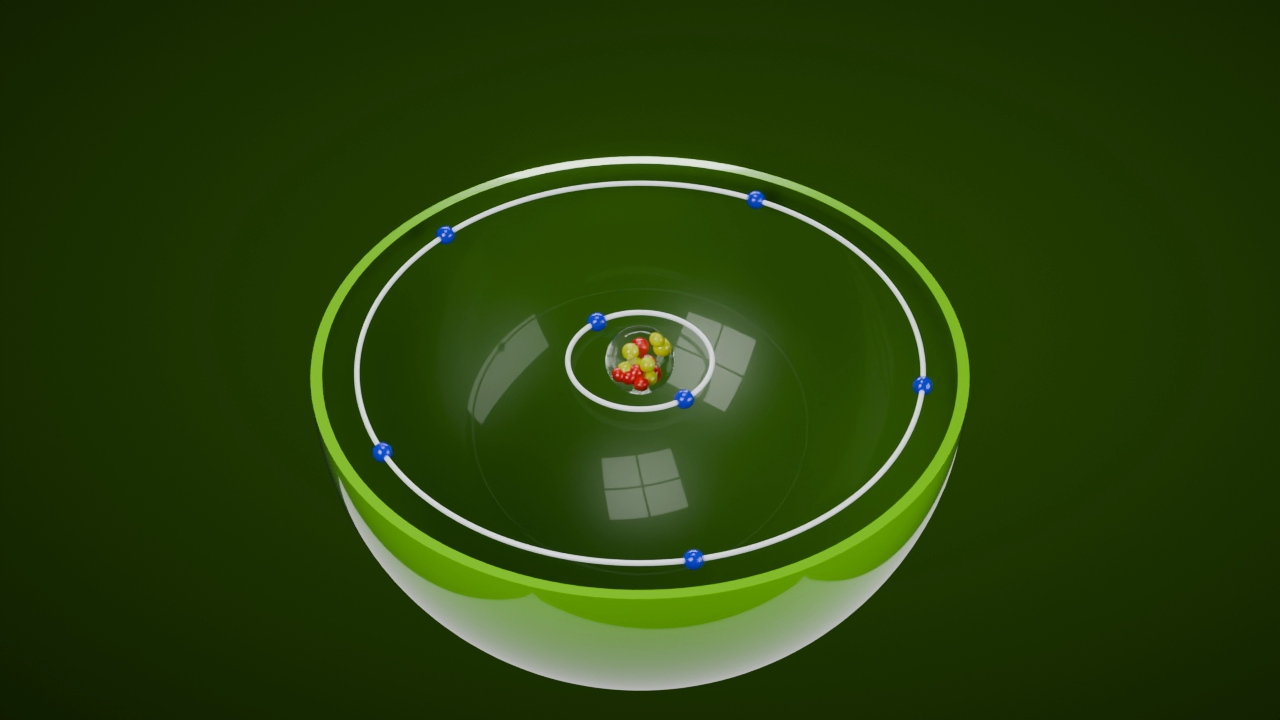
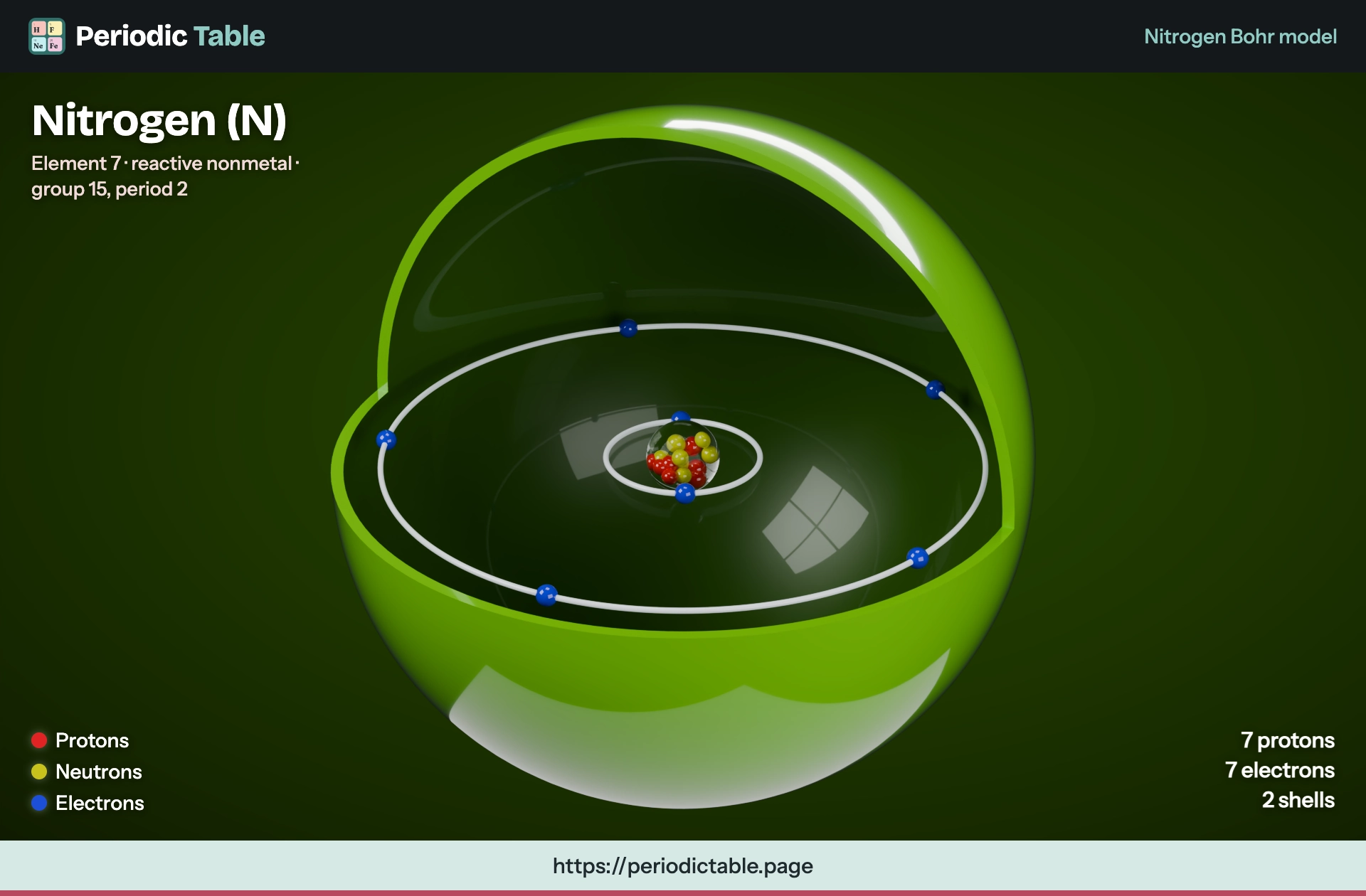
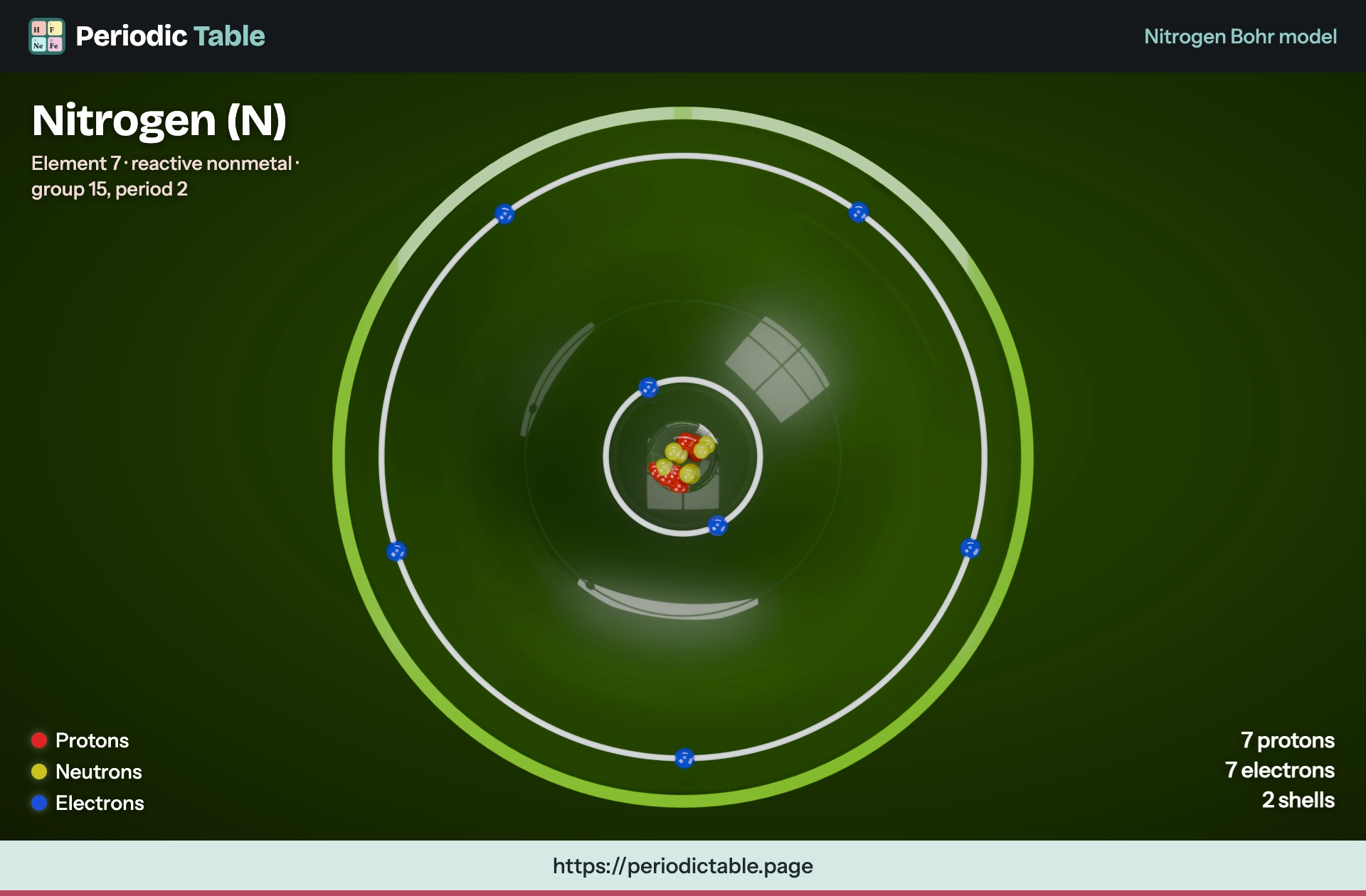
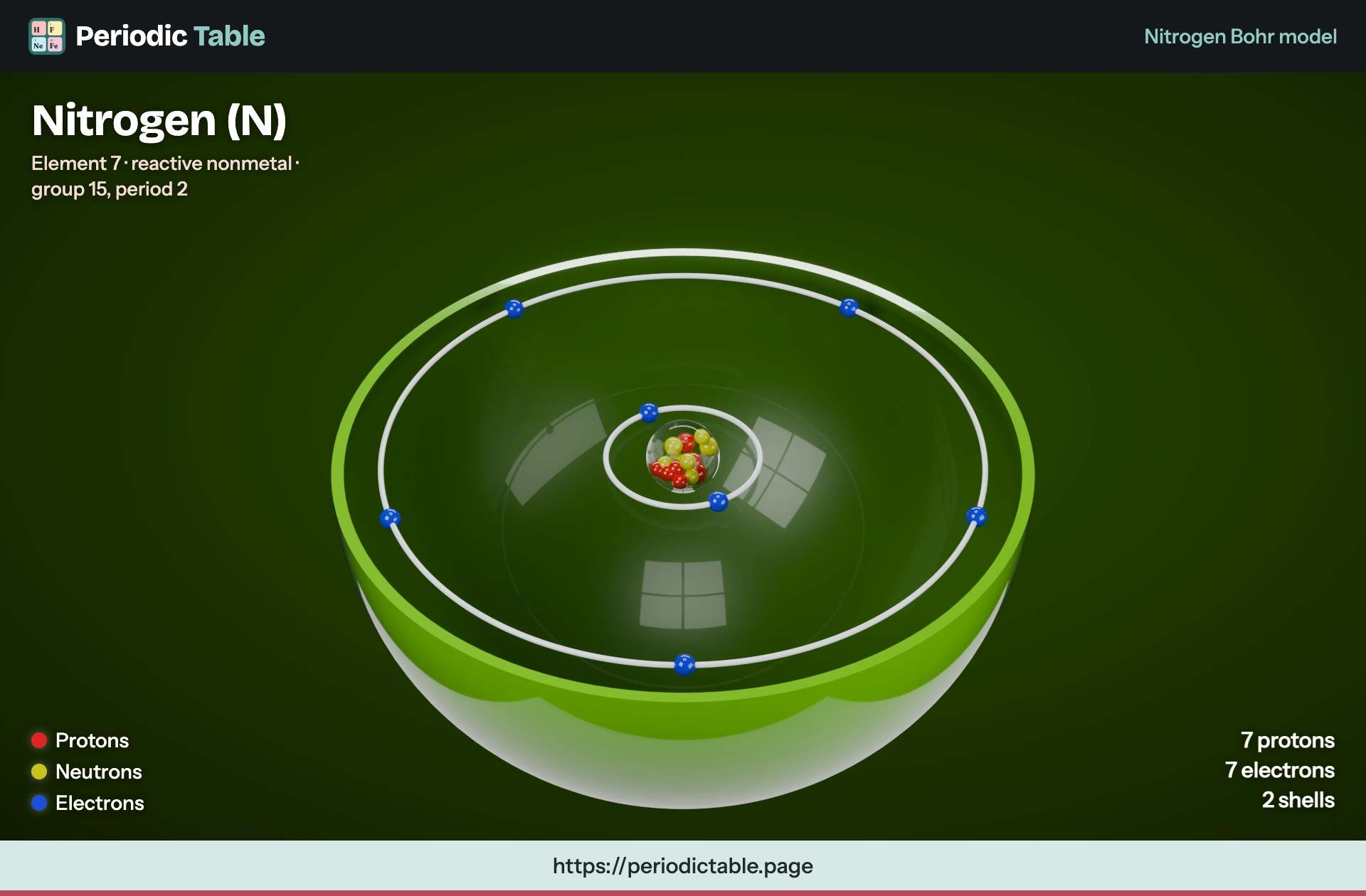
This is a Bohr model of nitrogen (N), a simplified picture of a single nitrogen atom. Its nucleus holds 7 protons, and a neutral nitrogen atom has 7 electrons, arranged around it in 2 shells (2 in shell K and 5 in shell L).
Nitrogen periodic table electron configuration
- Shorthand
- [He] 2s2 2p3
- Full
- 1s2 2s2 2p3
- Electrons per shell
- 2, 5
Nitrogen element properties and atomic data
- Atomic number
- 7
- Atomic mass
- 14.007 u
- Phase at STP
- Gas
- Melting point
- -210°C (63.15 K)
- Boiling point
- -195.79°C (77.355 K)
- Density
- 0.001251 g/cm³
- Electronegativity (Pauling)
- 3.04
- Period
- 2
- Group
- 15
- Block
- p-block
- Appearance
- Colorless gas, liquid or solid
- Discovery date
- 1772
- Discovered by
- Daniel Rutherford
- Named by
- Jean-Antoine Chaptal
Nitrogen facts at a glance
Before you dig into the chemistry, it helps to have the standard values in one place. The figures below are the accepted reference constants for the element, measured at STP (standard temperature and pressure) where a state or density is given. Nitrogen is a nonmetal, and at room temperature it exists as a gas made of two-atom molecules. Chemistry and physics meet in the oganesson electron affinity, a nucleus whose decay and stability were measured in milliseconds.
Nitrogen atomic and chemical data
| Property | Value |
|---|---|
| Symbol and atomic number | N, 7 |
| Standard atomic weight | 14.007 |
| Group, period, block | Group 15, period 2, p-block |
| Electron configuration | [He] 2s2 2p3 |
| Electronegativity (Pauling scale) | 3.04 |
| Covalent radius / Van der Waals radius | 71 pm / 155 pm |
| Common oxidation states | −3, +3, +5 |
| CAS number (N2) | 7727-37-9 |
| Discovery | Daniel Rutherford, 1772 |
Nitrogen physical properties
| Property | Value |
|---|---|
| State at 20 °C | Gas (colorless) |
| Melting point | 63.23 K (−209.92 °C) |
| Boiling point | 77.355 K (−195.795 °C) |
| Density of the gas at STP | 1.2506 g/L |
| Solid crystal structure | Hexagonal (beta phase); cubic below 35.4 K |
Atomic number, atomic mass and electron configuration
The atomic number of 7 tells you every nitrogen nucleus holds seven protons, matched by seven electrons in a neutral atom. Two electrons fill the inner 1s shell and five sit in the outer shell, giving the electron configuration 1s2 2s2 2p3. Those five valence electrons include three unpaired p-electrons, one in each 2p orbital, which is exactly why nitrogen likes to form three bonds.
The atomic mass you see quoted, about 14.007, is a weighted average of the element's two stable isotopes rather than the mass of any single atom. You can check it yourself from the isotope masses and their natural shares:
$$A_r(\text{N}) = (0.99636 \times 14.00307) + (0.00364 \times 15.00011) \approx 14.0067$$
That result rounds to the 14.007 atomic weight printed on the periodic table, so the bulk of the value comes from the lighter isotope.
Melting point, boiling point and density
Nitrogen has an unusually low melting point (63 K) and boiling point (77 K) for an element in its group, because its molecules are held together only by weak van der Waals forces. Temperatures this low are easier to read in kelvin, and they explain why the element is a gas in every natural setting on Earth.
The density of the gas is close to that of air. You can estimate it from the molar mass of the two-atom molecule (28.014 g/mol) divided by the molar volume of an ideal gas at 0 °C and 1 atm:
$$\rho = \frac{28.014\ \text{g/mol}}{22.414\ \text{L/mol}} \approx 1.250\ \text{g/L}$$
That lands within a fraction of a percent of the measured 1.2506 g/L, which is why nitrogen is slightly lighter than air and mixes freely with it instead of pooling the way heavier gases do.
Where element nitrogen sits on the periodic table
Element nitrogen heads its column of the periodic table, and its position explains much of its chemistry. It is the lightest pnictogen, a name taken from the Greek word for "to choke", and it sits between carbon on its left and oxygen on its right. For electronics designers and medical device engineers, the tantalum melting point summarises why this refractory metal is so inert.
Group 15, period 2 and the P-block
Nitrogen belongs to group 15, sharing the column with phosphorus, arsenic, antimony and bismuth. It sits in period 2, the first row with p-orbitals, which places it in the p-block. Even so, it behaves very differently from its heavier relatives:
- Nitrogen is a gas, while phosphorus, arsenic, antimony and bismuth are solids at room temperature.
- Nitrogen readily forms multiple bonds, including the triple bond in its own molecule; the heavier members prefer single bonds.
- Its small 2p shell rules out the expanded bonding that phosphorus uses, so nitrogen rarely forms more than four bonds.
Electronegativity and covalent radius next to carbon and oxygen
On the Pauling scale nitrogen's electronegativity is 3.04, one of the highest of any element. Only chlorine (3.16), oxygen (3.44) and fluorine (3.98) pull harder on shared electrons. That strong pull lets nitrogen form hydrogen bonds, which is why ammonia, like water, has a much higher boiling point than its small size suggests.
Its single-bond covalent radius of 71 pm is smaller than carbon's (76 pm) and larger than oxygen's (66 pm), following the normal trend of atoms shrinking across a period. The Van der Waals radius, 155 pm, describes how close two separate molecules can get before they repel.
- Compared with carbon
- Nitrogen does not form long chains with itself, but it forms many compounds with carbon, including the backbone of proteins and nucleic bases.
- Compared with oxygen
- Both are small and electronegative, both form hydrogen bonds, and both make strong double or triple bonds.
The nitrogen atom and its triple bond
A single nitrogen atom is highly reactive, but two of them pair up almost immediately into a diatomic molecule. In that molecule the atoms share three pairs of electrons, forming one of the strongest bonds in chemistry. The triple bond is only 109.76 pm long and needs about 945 kJ/mol to break, second only to carbon monoxide among diatomic molecules.
This bond is the key to understanding the element. Because it is so hard to break, the molecule shows very low reactivity and stays unreactive at room temperature, reacting directly only with lithium and a few metal complexes.
The same strength works the other way, too: when nitrogen compounds break down and re-form the triple bond, they release a large burst of energy. That single fact explains both why living things struggle to use atmospheric nitrogen and why many nitrogen-rich substances are explosive.
Oxidation states from minus three to plus five
Nitrogen can take every oxidation states value from −3 to +5, which gives it an unusually wide range of compounds. The most common are:
- −3 in ammonia (NH3) and metal nitrides.
- +3 in nitrous acid and nitrites.
- +5 in nitric acid and nitrates.
The in-between states appear in compounds such as hydrazine (−2), nitric oxide (+2) and nitrogen dioxide (+4).
Isotopes of nitrogen and where they show up
Natural nitrogen is a mix of two stable isotopes: nitrogen-14 makes up about 99.6% and nitrogen-15 about 0.4%. Both are made inside stars through the CNO cycle, a fusion chain that uses carbon, nitrogen and oxygen as catalysts to turn hydrogen into helium. The ratio between the two stays almost constant in air but shifts slightly in rocks and living things, so scientists use it to trace where nitrogen in a sample came from.
Nitrogen-15 is useful in the lab because its nuclear spin of one-half gives sharp signals in NMR spectroscopy, letting chemists map the structure of nitrogen-containing molecules.
Stable isotopes versus radioisotopes with a short half-life
Beyond the two stable isotopes, about a dozen radioactive forms have been made artificially. All are short-lived:
- Nitrogen-13 has a half-life of about 10 minutes, long enough to be used as a tracer in positron emission tomography scans, but it must be made in a cyclotron at the hospital.
- Nitrogen-16 lasts about 7 seconds and forms in the cooling water of nuclear reactors, where its gamma rays help operators detect leaks.
- The remaining radioisotopes decay in under eight seconds.
Allotropes of dinitrogen and other forms
Almost all elemental nitrogen exists as dinitrogen, the two-atom molecule, so its main allotropes are really different ways of packing those molecules as a liquid or solid. Atomic nitrogen, sometimes called active nitrogen, can be made by passing an electric discharge through the gas; it glows peach-yellow and reacts with most elements to form nitrides. Chemists have also chased higher forms such as the six-atom hexanitrogen, reported in 2025, as possible high-energy materials.
Liquid nitrogen as a cryogenic fluid
Cooled below 77 K, nitrogen condenses into liquid nitrogen, a clear fluid that looks like water but has about 80.8% of its density (0.808 g/mL at its boiling point). It is the most widely used cryogenic liquid because it is cheap and chemically inert. As a cryogen it boils away fast: by our own calculation, one litre of liquid expands into roughly 690 litres of gas at 20 °C and normal pressure, which is why it must never be sealed in a closed container.
Solid nitrogen on Pluto and triton
Below 63 K, solid nitrogen forms a white, snow-like ice. You won't find it naturally on Earth, but it covers large areas of Pluto, including the bright plains of Sputnik Planitia, and the surface of Neptune's moon Triton. Even that cold, it is soft enough to flow slowly in glaciers, and it can turn straight to gas or settle back as nitrogen frost as the seasons change.
Nitrogen compounds: ammonia, nitric acid and nitrates
Because the element combines with almost everything except helium and neon, nitrogen compounds come in huge variety. Three carry most of the commercial weight:
- Ammonia (NH3) is the most important compound commercially. It is a fertilizer, a cleaning agent and the starting point for most industrial nitrogen chemistry.
- Nitric acid (HNO3) is made from ammonia and feeds the production of dyes, plastics and other compounds.
- Nitrates, such as potassium nitrate and sodium nitrate, are salts of nitric acid used as fertilizers, food preservatives and oxidizers.
Ammonia and water share some behaviour: both can gain or lose a hydrogen ion, and liquid ammonia even dissolves some metals. Hydrazine (N2H4), a close cousin, is a powerful reducing agent used as rocket fuel.
Nitrides and azides
Binary compounds of nitrogen with metals and other elements are called nitrides. Some, like lithium nitride, are salt-like; others, like silicon nitride and boron nitride, are hard ceramics, and gallium nitride is a semiconductor used in blue LEDs.
Azides contain a chain of three nitrogen atoms. Sodium azide is the compound that breaks down in a split second to inflate car air bags with nitrogen gas, while heavy-metal azides detonate when struck.
Nitrous oxide, nitric oxide and nitrogen dioxide
Nitrogen forms a whole family of oxides, and three matter most in daily life:
| Oxide | Formula | Where you meet it |
|---|---|---|
| Nitrous oxide | N2O | Anaesthetic "laughing gas", whipped-cream propellant and a long-lived greenhouse gas |
| Nitric oxide | NO | Signalling molecule that relaxes blood vessels; forms in engines and lightning |
| Nitrogen dioxide | NO2 | Brown gas in smog and a major cause of air pollution |
Organic molecules built around nitrogen
In biology and organic chemistry, the element is everywhere. It is part of all amino acids, so every one of your proteins contains it, and it forms the rings of the bases in nucleic acids, the DNA and RNA that store genetic information.
The energy carrier adenosine triphosphate contains it too. Your body is about 3% nitrogen by mass, making it the fourth most common element in you after oxygen, carbon and hydrogen.
The element also turns up across medicine and nature: in caffeine and morphine, in antibiotics, and in toxic cyanides. All organisms depend on it, which is why its supply limits plant growth so often.
Discovery of nitrogen: from noxious air to azote
Nitrogen compounds were known long before the element itself. Ancient writers described ammonium chloride, medieval alchemists made nitric acid, and their aqua regia, a mix of nitric and hydrochloric acids, could dissolve gold. Saltpetre was the key ingredient of gunpowder for centuries.
The discovery of nitrogen is credited to Scottish physician Daniel Rutherford in 1772. He removed oxygen and carbon dioxide from a sample of air and found that what remained put out candles and killed mice, calling it noxious air.
Around the same time Carl Wilhelm Scheele, Henry Cavendish and Joseph Priestley studied the same gas; Priestley and Cavendish called it burnt air or phlogisticated air, and it was also lumped in with "mephitic air", a name for any air that suffocates. Cavendish worked out that air is roughly four parts nitrogen to one part oxygen but never published.
Antoine Lavoisier then named the gas azote, Greek for "no life", because it is an asphyxiant. That name survives in French and in English words such as azide and azo dyes.
How the name Nitrogène was chosen
In 1790 French chemist Jean-Antoine Chaptal proposed nitrogène, meaning "nitre-forming", after it was shown that the gas is part of nitric acid and of nitre (potassium nitrate, also spelled saltpeter). English adopted the word as "nitrogen" in 1794.
Nitrogen gas in the atmosphere, stars and the human body
Nitrogen is the seventh most abundant element in the universe and in the Milky Way, forged in stars and spread by them when they die. On Earth, nitrogen gas is the largest part of the atmosphere at about 78% by volume.
Because its compounds are volatile and dissolve easily, it is surprisingly scarce in the solid planet: it makes up only about 19 parts per million of Earth's crust. In the human body it ranks fourth by mass.
Nitrogen fixation and the nitrogen cycle
Plants need nitrogen but cannot break the triple bond in air. Nitrogen fixation is the process that converts it into usable forms such as ammonia and nitrates. Three routes do this:
- Bacteria in soil and in the root nodules of legumes fix nitrogen using the enzyme nitrogenase.
- Lightning supplies enough energy to join nitrogen and oxygen into nitric oxide, which rain carries to the ground.
- Factories do it on a vast scale through the Haber-Bosch process.
The nitrogen cycle describes the full loop: fixed nitrogen passes from soil to plants to animals, returns to the soil as waste and decay, and is finally released back to the air by bacteria that turn nitrates into gas.
Reactive nitrogen and the environment
The nitrogen in the air (dinitrogen) is harmless. Problems come from reactive nitrogen, the fixed forms such as nitrate, ammonia and the nitrogen oxides.
When fertilizer runoff carries too much nitrate into rivers and lakes, it feeds algae blooms that use up oxygen, a process called eutrophication. Nitrous oxide adds to warming, and nitrogen dioxide adds to smog, so cutting excess reactive nitrogen is a major goal for the environment.
How molecular nitrogen is produced
Since air is the raw material, producers simply separate it. The classic method is fractional distillation: air is cooled until it liquefies, then warmed slowly so each component boils off at its own temperature, with nitrogen leaving first at 77 K.
For smaller amounts of molecular nitrogen, pressure swing adsorption passes compressed air through a material that traps oxygen and lets nitrogen through. Roughly two-thirds of the output is used as a protective gas, and much of the rest is sold as liquid.
What N2 is used for in farming, industry and medicine
Pure N2 is valued mainly because it does not react. It replaces air wherever oxygen would cause damage:
- Food packaging: bags of crisps and salad are flushed with nitrogen to slow spoilage.
- Metalwork: it shields welding and the heat treatment of steel and stainless steel from oxidation.
- Electronics: it protects electronic components during manufacturing.
- Preservation: some light bulbs use it to protect the filament, and museums flush display cases with nitrogen to slow decay. (The Declaration of Independence, often said to sit in nitrogen, is actually sealed in argon.)
- Pressurising: it pushes beer from kegs and powers paintball guns.
As a liquid it is used to flash freeze food, keep loads cold in transport, and store blood, eggs and sperm in medicine. Doctors also use it to freeze off warts. Freezing food this fast keeps ice crystals small, so texture survives thawing better.
The Haber-Bosch process and synthetic fertilizers
The most important use of the element is in food production. In the early 1900s Fritz Haber and Carl Bosch found a way to combine nitrogen and hydrogen over an iron catalyst at high temperature and pressure:
$$\text{N}_2 + 3\,\text{H}_2 \rightleftharpoons 2\,\text{NH}_3$$
The ammonia it produces is turned into fertilizers, and today about half of the world's food depends on synthetic fertilizers made this way. Working from standard atomic masses, ammonia is 82.2% nitrogen by mass, urea 46.6% and ammonium nitrate 35.0%, which is why farmers compare products by that percentage. Modern agriculture would look very different without it.
Explosives, propellants and rocket fuel
The energy locked in nitrogen compounds makes them ideal explosives. TNT, nitroglycerin (the active part of dynamite) and gunpowder all release large volumes of gas when they burn.
The Ostwald process, developed in 1902, turned ammonia into nitric acid on an industrial scale, and that supply fed the production of explosives in both World Wars. The same chemistry powers propellants and rocket fuel, including hydrazine for spacecraft thrusters, and shaped modern warfare.
Nitrogen safety: why an inert gas can suffocate
Nitrogen is not toxic, but it can still kill. Because you can't see, smell or taste it, a room filling with the gas gives no warning: it simply pushes out oxygen.
Breathing air with too little oxygen causes confusion and collapse within moments, and people can suffocate before they notice anything is wrong. Liquid nitrogen adds two more risks: severe frostbite on contact, and pressure build-up that can burst sealed containers.
The same effect has been used in capital punishment. In 2024 the US state of Alabama carried out the first execution by nitrogen gas, a method that critics argue may be cruel.
Oxygen deficiency monitors and safe handling
Wherever nitrogen is stored or used in bulk, oxygen deficiency monitors sound an alarm if oxygen in the air falls below a safe level, usually around 19.5%. Good ventilation, never entering tanks or pits without testing the air, and wearing insulated gloves and face shields when pouring liquid nitrogen keep the risks low.